


Abstract
Background: Metabolic disorders are known to alter the mechanical properties of tendons. We sought to evaluate the prevalence of asymptomatic Achilles tendon enthesopathic changes in patients with type 2 diabetes mellitus (T2DM) without peripheral neuropathy. Methods: We recruited 43 patients with T2DM and 40 controls. Neuropathy was excluded with the Michigan Neuropathy Scoring Instrument. Bilateral ultrasonography of the Achilles tendon enthesis was performed. Results: Patients with T2DM had a higher prevalence of hypoechogenicity (26.7% versus 2.5%; P = .0001), entheseal thickening (24.4% versus 8.7%; P = .007), and enthesophytes (74.4% versus 57.5%; P = .02). No differences were found in the number of patients with erosions (1.2% versus 0%; P > .99), cortical irregularities (11.6% versus 3.7%; P = .09), bursitis (5.8% versus 3.7%; P = .72), or tears (2.3% versus 1.2%; P > .99). The mean ± SD sum of abnormalities was higher in patients with T2DM (1.5 ± 1.1 versus 0.7 ± 0.6; P < .0001), as was the percentage of bilateral involvement (72.1% versus 45.0%; P = .01). Mean ± SD thickness did not differ between patients and controls (4.4 ± 1.1 mm versus 4.2 ± 0.8 mm; P = .07). Conclusions: According to our data, there is an elevated prevalence of asymptomatic Achilles tendon enthesopathic changes in patients with T2DM independent of peripheral neuropathy.
Type 2 diabetes mellitus (T2DM) is an epidemic disease affecting approximately 9% of the adult population in Europe,[1] and it represents the seventh cause of death in the world.[2] In addition, T2DM is a major cause of disability[3] because of the high prevalence of microangiopathic and macroangiopathic complications.[4]
Besides the classical complications, T2DM has been associated with a variety of rheumatic conditions, including Dupuytren's contracture, flexor tenosynovitis, adhesive capsulitis, diffuse idiopathic skeletal hyperostosis, neuropathic osteoarthropathy, crystal-induced arthritis, rheumatoid arthritis, and osteoarthritis[5,6]; however, it is often difficult to ascertain whether the risk is associated mostly with the disease itself or with associated conditions (ie, obesity or alcohol consumption).
In the functioning of the foot, the Achilles tendon (AT), plantar fascia, and metatarsophalangeal joints represent a complex biomechanical unit[7] and contribute actively to the plantar pressure on the forefoot,[8] a key mechanism in the development of diabetic foot ulcers.
Metabolic disorders are known to alter the mechanical properties of tendons.[9] In the context of T2DM, however, AT and plantar fascia, in particular, are sites of major interest because of their potential role in diabetic foot biomechanics.[10] Both of these structures[11] contribute to the increased forefoot pressures in patients with T2DM, thus increasing the risk of diabetic ulcerations.[12] For this reason, AT lengthening has been successfully proposed for the management of recurrent diabetic ulcers.[13] In addition, patients with T2DM have a greater risk of AT rupture requiring hospitalization,[14] and animal models suggest that tendon repair after injury is compromised in those with T2DM.[15]
Clinical studies suggest that ultrasonographic abnormalities are frequently detected in ATs from patients with T2DM.[16] According to previously published studies, one of the main etiologic factors for diabetic tendinopathy is peripheral neuropathy.[17] Nevertheless, although the enthesis is a critical zone where the highest forces are applied owing to the sudden transition from soft tissue to bone,[18] no study specifically evaluated the effect of T2DM on this portion of the tendon.
Therefore, the aim of this study was to evaluate the prevalence of asymptomatic sonographically detected AT enthesopathic changes in patients with T2DM without peripheral neuropathy.
Materials and Methods
Patients
All consecutive patients with T2DM who presented between June 1, 2015, and December 31, 2015, were evaluated. Of 74 consecutive patients screened, 31 were excluded because they refused study entry or presented one or more of the exclusion criteria. All of the included patients were recruited at the Diabetes Outpatient Clinic, University of Catanzaro “Magna Graecia,” Catanzaro, Italy.
The exclusion criteria were predefined as follows: 1) past diagnosis of diabetic peripheral neuropathy; 2) history of foot or ankle fracture or other injury; 3) history of AT, heel, or other foot pain; 4) history of foot ulcers; and 5) a Michigan Neuropathy Screening Instrument (MNSI) score of at least 7 on the questionnaire portion or at least 2.5 on the physical assessment portion.[19,20]
Written informed consent was obtained from all of the study participants. For comparison, we enrolled 40 asymptomatic individuals without diabetes who were age and sex matched according to frequency distribution.
This study was approved by the local institutional research ethics committee of Comitato Etico Azienda Ospedaliera “Mater Domini,” Catanzaro, Italy and was performed in accordance with the ethical standards proposed by the latest revision of the Declaration of Helsinki (World Medical Association General Assembly, Fortaleza, Brazil, October 2013).
MNSI Evaluation and Scoring
The MNSI is a scoring instrument aimed at evaluating the risk of diabetic neuropathy. It is composed of a self-administered questionnaire and a physical assessment of the foot by a physician, including a foot inspection, vibration sensation, muscle stretch reflex, and monofilament testing.
During the MNSI inspection, deformities, dry skin, callosities, infections, and fissures were evaluated. Each abnormality received a score of 1. Both feet were also inspected for ulcers, and each ulcer received a score of 1. The ankle reflexes were also evaluated. If the reflex was absent, the patient was asked to perform the Jendrassik maneuver; if present, the reflex was scored as 0.5. If the reflex was absent with the Jendrassik maneuver, the reflex was scored as 1. Vibration sensation was tested at the great toe using a 128-Hz tuning fork. Vibration was scored as present if the examiner sensed the vibration on his or her finger for less than 10 sec longer than the patient felt it in the great toe, decreased if it was sensed for 10 sec or longer (scored as 0.5), or absent (scored as 1). The total possible score was 8.
Clinical Assessment and Anthropometric Measurements
All of the patients underwent a careful medical history, including year of T2DM diagnosis, other comorbidities, and current/past pharmacologic treatments. Height and weight were measured, with patients wearing light clothing and no shoes, to the nearest 0.1 cm and 0.1 kg, respectively. Body mass index (BMI) was calculated as the weight in kilograms divided by the square of the height in meters.
Laboratory Evaluation
After overnight fasting, blood samples were obtained for laboratory evaluation. Plasma glucose levels were measured with an automated chemistry analyzer (Cobas 6000/Cobas e411; Roche Diagnostics, Indianapolis, Indiana). Hemoglobin A1c (HbA1c) levels were measured by high-performance liquid chromatography (ADAMS A1c, HA-8180; Arkray Inc, Kyoto, Japan). For analysis purposes, the three most recent fasting glucose and HbA1c values obtained during the previous 12 months were used to calculate means.
Ultrasonographic Evaluation
The ultrasonographic assessment of patients was performed at the Rheumatology Research Unit, University of Catanzaro “Magna Graecia.” Before scanning, the patient was asked to lie down in the prone position, leaving the foot hanging off the examination table.
Bilateral sonographic examination of the entheseal portion of the AT was performed by a physician experienced in musculoskeletal sonography (F.U.), blinded to the category of the patient, using a MyLab 70XVG machine (Esaote, Genoa, Italy) equipped with a 6- to 18-MHz linear probe. The following settings were used: grey-scale frequency, 10 to 18 MHz; Doppler frequency, 6.7 to 7.5 MHz; power Doppler pulse repetition frequency, 750 Hz; and low wall filters. Power Doppler gain was adjusted just below the level that caused the appearance of noise artifacts. The focus was positioned at the level of the region of interest, and the color box was enlarged to the upper part of the image. Longitudinal and transverse scans were performed, with the probe parallel and perpendicular, respectively, to the direction of tendon fibers.
Achilles tendon thickness was measured in longitudinal and transverse scans at the level where the tendon fibers meet the calcaneal tuberosity. The mean of both measures was used for the analysis.
Elementary sonographic findings were recorded as absent-present. Hypoechogenicity was defined as loss of the typical fibrillar pattern with the appearance of hypoechoic areas; entheseal thickening, tendon swelling at the level of its bony insertion; calcification, the presence of hyperechoic spots or linear formations; enthesophyte, a step-up bony prominence at the bone junction; bony erosion, discontinuity of the bony surface visible in two perpendicular planes; cortical irregularity, a change in the cortical profile not including definite enthesophytes or bony erosion; bursitis, an abnormal hypoechoic–anechoic intrabursal expansion; and tendon tear, an interruption of the tendon fibers with or without hypoechoic material filling the defect. The presence of intratendinous Doppler signal or entheseal Doppler was also recorded.
Statistical Analysis
Data are expressed as mean ± SD or as number (percentage) as appropriate. The Student t test was used to compare means for continuous variables. The Fisher exact test was used to compare prevalences between dichotomous variables. The Pearson product moment correlation coefficient was used to evaluate correlations between continuous or categorical variables. A P < .05 was considered statistically significant. All of the tests were two-tailed.
Interobserver agreement was estimated by using Cohen κ statistics. A κ value less than 0.20 was considered poor agreement; 0.21 to 0.40, fair agreement; 0.41 to 0.60, moderate agreement; 0.61 to 0.80, good agreement; and 0.81 to 1, excellent agreement.[21] A statistical software program (SPSS Statistics for Windows, Version 17.0; SPSS Inc, Chicago, Illinois) was used for all of the analyses.
Results
Interobserver agreement was evaluated by Cohen κ statistics. Accordingly, a set of 40 randomly selected scans from study patients was evaluated by a second sonographer (C.B.) and κ values were calculated for each independent abnormality. Interobserver agreement was excellent for the detection of enthesophytes (κ = 0.87) and bursitis (κ = 1) and good for hypoechogenicity (κ = 0.66), cortical irregularities (κ = 0.78), entheseal thickening (κ = 0.73), calcifications (κ = 0.66), and tears (κ = 0.65). Agreement for erosions and power Doppler was not calculated because no such abnormalities were detected.
The clinical characteristics of the study population are detailed in Table 1. Patients with T2DM and controls did not significantly differ in percentage of men (58.1% versus 52.5%; P = .66), mean ± SD age (60.8 ± 9.4 years versus 58.4 ± 7.0 years; P = .07), mean ± SD BMI (29.2 ± 4.8 versus 28.6 ± 3.7; P = .52), percentage of obese individuals (23.2% versus 17.5%; P = .60), and percentage of patients with high blood pressure (55.8% versus 37.5%; P = .13).
Table 1.
Clinical Characteristics of the Study Population
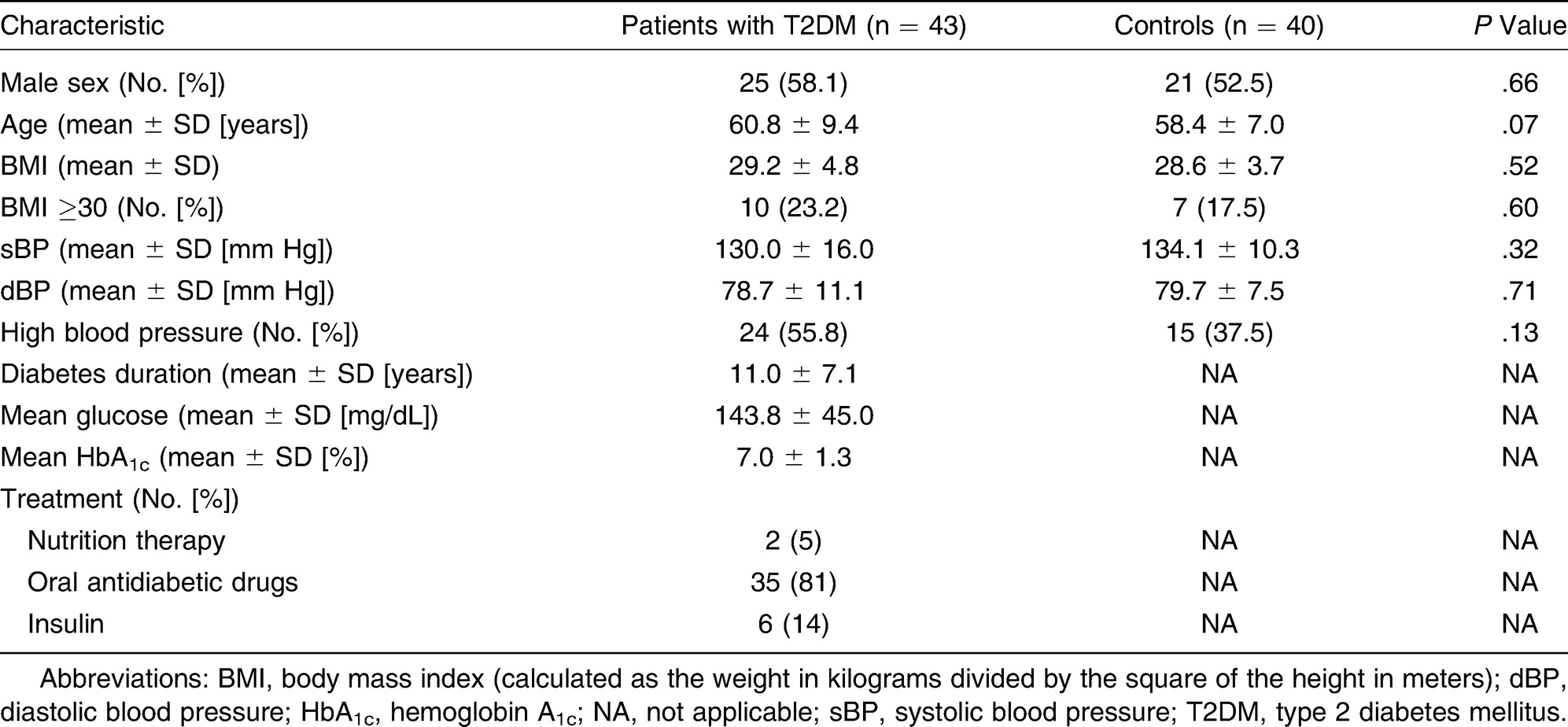
Patients with T2DM had a mean ± SD disease duration of 11.0 ± 7.1 years, a mean ± SD glucose level of 143.8 ± 45.0 mg/dL, and a mean ± SD HbA1c level of 7.0% ± 1.3%. Of 43 patients, two (5%) were treated with nutritional therapy alone, 35 (81%) were treated with oral antidiabetic drugs, and six (14%) were treated with insulin.
Comparative sonographic characteristics of the AT enthesis are reported in Table 2. The ATs of patients with T2DM had a significantly higher prevalence of hypoechogenicity (26.7% versus 2.5%; P = .0001), entheseal thickening (24.4% versus 8.8%; P = .007), and enthesophytes (74.4% versus 57.5%; P = .02). No significant differences were found in the number of tendons with erosions (1.2% versus 0%; P > .99), cortical irregularities (11.6% versus 3.8%; P = .09), bursitis (5.8% versus 3.8%; P = .72), or tears (2.3% versus 1.3%; P > .99). Entheseal power Doppler signal was not detected in any patient. The mean ± SD overall sum of individual abnormalities was significantly higher in the ATs of patients with T2DM (1.5 ± 1.1 versus 0.7 ± 0.6; P < .0001). The percentage of bilateral involvement was significantly higher in patients with T2DM (72.1% versus 45.0%; P = .01). A trend toward increased mean ± SD AT thickness in patients with T2DM was observed, but it did not reach significance (4.4 ± 1.1 mm versus 4.2 ± 0.8 mm; P = .07).
Table 2.
Prevalence of Enthesopathic Changes in Achilles Tendons from Patients and Controls
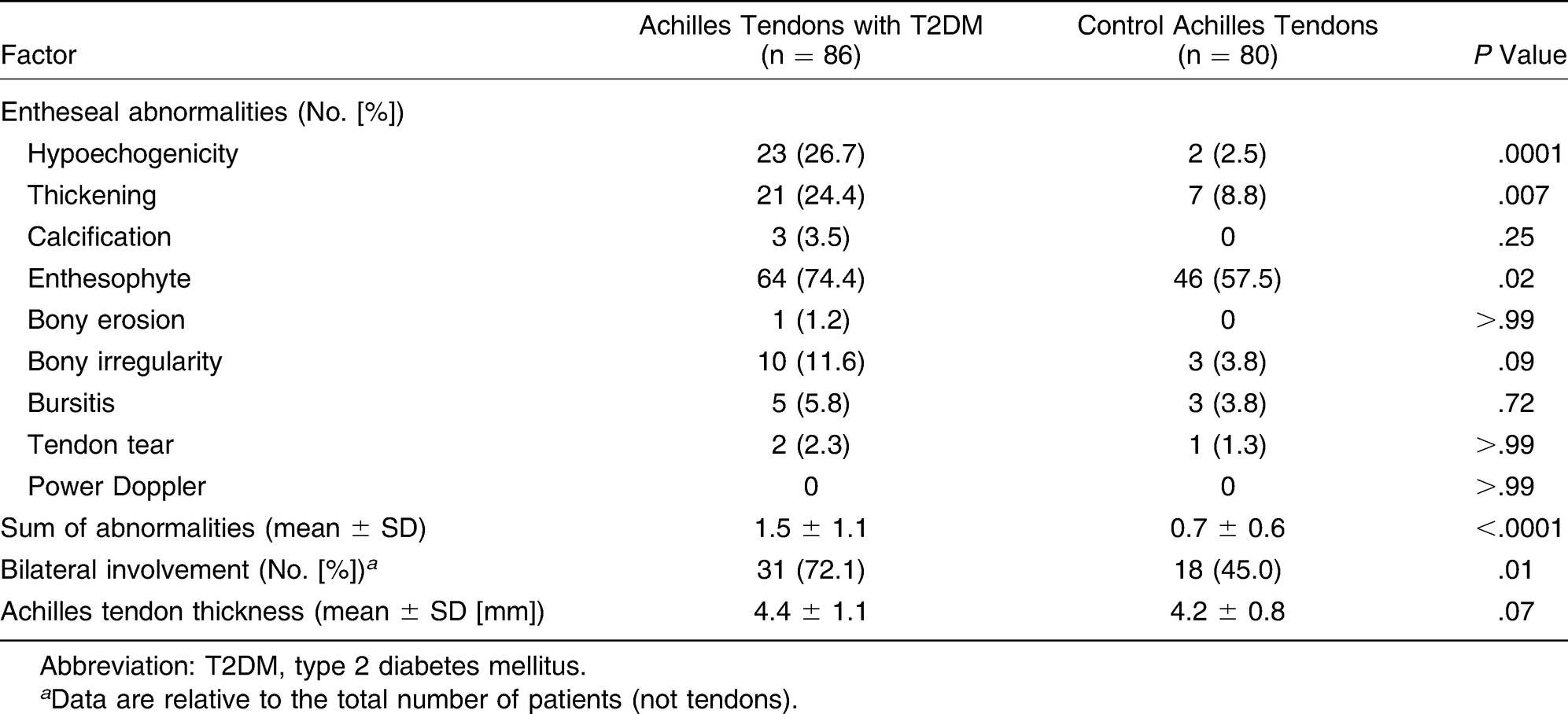
In univariate analysis, AT thickness correlated significantly with fasting glucose level (R = 0.24; P = .004) and mean glucose level (R = 0.29; P = .01) but not with age, diabetes duration, BMI, HbA1c level, or mean HbA1c level. Also, the overall number of AT abnormalities correlated significantly with glucose level (R = 0.26; P = .03) and mean glucose level (R = 0.28; P = .02) but not with age, diabetes duration, BMI, HbA1c level, or mean HbA1c.
Discussion
We demonstrated a significantly higher prevalence of sonographically detected AT enthesopathic changes in patients with T2DM without peripheral neuropathy. In particular, patients with T2DM had a higher prevalence of entheseal hypoechogenicity, entheseal thickening, and enthesophytes. In addition, the cumulative number of abnormalities and the percentage of bilateral enthesopathy were significantly higher in patients compared with controls.
Achilles tendon enthesopathy is a common finding in adults, reported to be present in up to 16% of the general population[22,23] on plain radiographs of the foot, especially in older people and females. However, the presence of Achilles spurs (enthesophytes) does not necessarily implicate heel pain and could frequently represent an incidental finding reflecting abnormal forces applied to the ankle-foot complex.[24] This finding, however, becomes of relevant interest in the setting of T2DM, where, independent of the presence of heel pain, abnormal forces can lead to overpressure on the forefoot and, therefore, favor the development of diabetic foot ulcers.[25] On the other hand, obesity and diabetes have been identified as risk factors for posterior heel pain.[26]
The risk of several rheumatic conditions is increased in patients with diabetes.[5] Tendons and ligaments, in particular, have been demonstrated to be a major target of diabetes-associated musculoskeletal damage, for example, in diffuse idiopathic skeletal hyperostosis.[27] However, the wide diffusion of high-definition ultrasonography has greatly improved the definition of peripheral tendon conditions. For example, rotator cuff disease has been associated with diabetes.[28,29]
An elevated prevalence of sonographically detected structural abnormalities (eg, disorganized tendon fibers, calcification, and thickening[30]) in the ATs of patients with T2DM has been demonstrated in recent years.[16] Also, in patients with a recent diagnosis of diabetes, a significant increase in AT thickness has been demonstrated.[31] The same group reported a higher prevalence of asymptomatic sonographic abnormalities in ATs of individuals with T2DM[32] or in patients with metabolic syndrome.[33] None of these studies, however, focused on the entheseal portion of the tendon or adopted the severe descriptive method used in the present study.
In the present study population, the most frequent sonographic abnormality was enthesophytes. Enthesophyte formation is a complex mechanism largely unknown, but a pivotal role of vascularity and abnormal forces is widely suspected.[34] Other factors, such as genetic background and hormonal influences, could contribute in such a category of patients, as demonstrated by the strict association of enthesophytes and osteophytes in those defined as bone formers.[35]
According to previously published studies, one of the main etiologic factors of diabetic tendinopathy is peripheral neuropathy.[17] Peripheral neuropathy contributes to AT pathology through the alteration of foot biomechanics, thus increasing the mechanical stress exerted on tendon fibers. The present study has the advantage of having reduced this bias because it excluded a priori patients with suspected peripheral neuropathy through a well-validated screening tool (the MNSI). However, despite a good correlation between the MNSI and electrophysiologic tests, the existence of neuropathy could not be excluded with certainty, at least in a small percentage of patients.
Other potential mechanisms have been evoked in the setting of T2DM-associated tendinopathy. Experimental DM induces structural, inflammatory, and vascular changes in the AT similar to those seen in other chronic tendinopathies.[36,37] Consequently, T2DM alters tendon mechanical properties and the dynamic response to load in mice and rats[38,39] and impairs tendon repair.[15] From the histologic point of view, DM-induced changes in tendon structure include degeneration of tendinocytes, vascular proliferation, chondrocyte-like tendon cells, and ruptures at insertion areas.[40] In rabbits, the glycation-induced collagen cross-linking is directly associated with the increased matrix stiffness and other mechanical attributes of the tendon.[41] In addition, a high glucose concentration up-regulates the expression of matrix metallopeptidases 9 and 13 in tendon cells[42] and produces a reduction in proteoglycan levels related to decreased synthesis or sulfation of glycosaminoglycans.[43] In support of this hypothesis, in the present study, the number of abnormalities detected in the AT enthesis and the thickness of the entheseal portion of the tendon were significantly correlated with actual fasting glucose and mean fasting glucose levels during the past year.
Another possible mechanism of AT disease in diabetes is microvascular damage. The blood supply of the AT arises mainly from the anterior paratenon. The proximal part of the tendon is supplied by a branch of the posterior tibial artery, and the distal part of the tendon is vascularized by the rete arteriosum calcaneare, supplied by the fibular and posterior tibial arteries. However, a relative avascular area is present close to the insertion of the tendon to the calcaneus. Consequently, the enthesis is naturally poorly vascularized.[44] Abnormal vascularization, as in the case of T2DM microangiopathy, has been demonstrated to have a causal role in AT pathology.[44,45]
Conclusions
These data, although limited by the small number of patients, suggest that asymptomatic changes in the AT enthesis are present in most patients with T2DM, independent of peripheral neuropathy. Furthermore, prospective studies are needed to better ascertain the role of tissue glycation and microvascular disease in the development of these abnormalities and to evaluate the predictivity of AT enthesopathy in the development of foot ulcers.
Financial Disclosure:
None reported.
Conflict of Interest:
None reported.
References
- Shaw JE, Sicree RA, Zimmet PZ: Global estimates of the prevalence of diabetes for 2010 and 2030. Diabetes Res Clin Pract87: 4, 2010.
- Gu K, Cowie CC, Harris MI: Mortality in adults with and without diabetes in a national cohort of the U.S. population, 1971-1993. Diabetes Care21: 1138, 1998.
- Gregg EW, Mangione CM, Cauley JA, et al: Diabetes and incidence of functional disability in older women. Diabetes Care25: 61, 2002.
- Volpato S, Maraldi C, Fellin R: Type 2 diabetes and risk for functional decline and disability in older persons. Curr Diabetes Rev6: 134, 2010.
- Al-Homood I: Rheumatic conditions in patients with diabetes mellitus. Clin Rheumatol32: 527, 2013.
- Ursini F, Russo E, D'Angelo S, et al: Prevalence of undiagnosed diabetes in rheumatoid arthritis: an OGTT study. Medicine (Baltimore)95: e2552, 2016.
- Hernandez-Diaz C, Saavedra MA, Navarro-Zarza JE, et al: Clinical anatomy of the ankle and foot. Reumatol Clin8(suppl 2): 46, 2012.
- Cheung JT, Zhang M, An KN: Effect of Achilles tendon loading on plantar fascia tension in the standing foot. Clin Biomech21: 194, 2006.
- Abate M, Schiavone C, Salini V, et al: Occurrence of tendon pathologies in metabolic disorders. Rheumatology52: 599, 2013.
- Cheing GL, Chau RM, Kwan RL, et al: Do the biomechanical properties of the ankle-foot complex influence postural control for people with Type 2 diabetes?Clin Biomech28: 88, 2013.
- D'Ambrogi E, Giurato L, D'Agostino MA, et al: Contribution of plantar fascia to the increased forefoot pressures in diabetic patients. Diabetes Care26: 1525, 2003.
- Frykberg RG, Lavery LA, Pham H, et al: Role of neuropathy and high foot pressures in diabetic foot ulceration. Diabetes Care21: 1714, 1998.
- Colen LB, Kim CJ, Grant WP, et al: Achilles tendon lengthening: friend or foe in the diabetic foot?Plast Reconstr Surg131: 37e, 2013.
- Zakaria MH, Davis WA, Davis TM: Incidence and predictors of hospitalization for tendon rupture in type 2 diabetes: the Fremantle diabetes study. Diabet Med31: 425, 2014.
- David MA, Jones KH, Inzana JA, et al: Tendon repair is compromised in a high fat diet-induced mouse model of obesity and type 2 diabetes. PLoS One9: e91234, 2014.
- Batista F, Nery C, Pinzur M, et al: Achilles tendinopathy in diabetes mellitus. Foot Ankle Int29: 498, 2008.
- Papanas N, Courcoutsakis N, Papatheodorou K, et al: Achilles tendon volume in type 2 diabetic patients with or without peripheral neuropathy: MRI study. Exp Clin Endocrinol Diabetes117: 645, 2009.
- Benjamin M, McGonagle D: The enthesis organ concept and its relevance to the spondyloarthropathies. Adv Exp Med Biol649: 57, 2009.
- Moghtaderi A, Bakhshipour A, Rashidi H: Validation of Michigan neuropathy screening instrument for diabetic peripheral neuropathy. Clin Neurol Neurosurg108: 477, 2006.
- Feldman EL, Stevens MJ, Thomas PK, et al: A practical two-step quantitative clinical and electrophysiological assessment for the diagnosis and staging of diabetic neuropathy. Diabetes Care17: 1281, 1994.
- Bland JM, Altman DG: Statistical methods for assessing agreement between two methods of clinical measurement. Lancet1: 307, 1986.
- Bassiouni M: Incidence of calcaneal spurs in osteo-arthrosis and rheumatoid arthritis, and in control patients. Ann Rheum Dis24: 490, 1965.
- Shama SS, Kominsky SJ, Lemont H: Prevalence of non-painful heel spur and its relation to postural foot position. JAPA73: 122, 1983.
- Moroney PJ, O'Neill BJ, Khan-Bhambro K, et al: The conundrum of calcaneal spurs: do they matter?Foot Ankle Spec7: 95, 2014.
- Giacomozzi C, D'Ambrogi E, Uccioli L, et al: Does the thickening of Achilles tendon and plantar fascia contribute to the alteration of diabetic foot loading?Clin Biomech20: 532, 2005.
- Chatterton BD, Muller S, Roddy E: Epidemiology of posterior heel pain in the general population: cross-sectional findings from the clinical assessment study of the foot. Arthritis Care Res (Hoboken)67: 996, 2015.
- Daragon A, Mejjad O, Czernichow P, et al: Vertebral hyperostosis and diabetes mellitus: a case-control study. Ann Rheum Dis54: 375, 1995.
- Kang JH, Tseng SH, Jaw FS, et al: Comparison of ultrasonographic findings of the rotator cuff between diabetic and nondiabetic patients with chronic shoulder pain: a retrospective study. Ultrasound Med Biol36: 1792, 2010.
- Lin TT, Lin CH, Chang CL, et al: The effect of diabetes, hyperlipidemia, and statins on the development of rotator cuff disease: a nationwide, 11-year, longitudinal, population-based follow-up study. Am J Sports Med43: 2126, 2015.
- Akturk M, Ozdemir A, Maral I, et al: Evaluation of Achilles tendon thickening in type 2 diabetes mellitus. Exp Clin Endocrinol Diabetes115: 92, 2007.
- Abate M, Schiavone C, Di Carlo L, et al: Achilles tendon and plantar fascia in recently diagnosed type II diabetes: role of body mass index. Clin Rheumatol31: 1109, 2012.
- Abate M, Salini V, Antinolfi P, et al: Ultrasound morphology of the Achilles in asymptomatic patients with and without diabetes. Foot Ankle Int35: 44, 2014.
- Abate M, Di Carlo L, Salini V, et al: Metabolic syndrome associated to non-inflammatory Achilles enthesopathy. Clin Rheumatol33: 1517, 2014.
- Benjamin M, Rufai A, Ralphs JR: The mechanism of formation of bony spurs (enthesophytes) in the achilles tendon. Arthritis Rheum43: 576, 2000.
- Rogers J, Shepstone L, Dieppe P: Bone formers: osteophyte and enthesophyte formation are positively associated. Ann Rheum Dis56: 85, 1997.
- de Oliveira RR, Martins CS, Rocha YR, et al: Experimental diabetes induces structural, inflammatory and vascular changes of Achilles tendons. PLoS One8: e74942, 2013.
- Boivin GP, Elenes EY, Schultze AK, et al: Biomechanical properties and histology of db/db diabetic mouse Achilles tendon. Muscles Ligaments Tendons J4: 280, 2014.
- Connizzo BK, Bhatt PR, Liechty KW, et al: Diabetes alters mechanical properties and collagen fiber re-alignment in multiple mouse tendons. Ann Biomed Eng42: 1880, 2014.
- de Oliveira RR, de Lira KD, Silveira PV, et al: Mechanical properties of achilles tendon in rats induced to experimental diabetes. Ann Biomed Eng39: 1528, 2011.
- Ji J, Wang Z, Shi D, et al: Pathologic changes of Achilles tendon in leptin-deficient mice. Rheumatol Int30: 489, 2010.
- Reddy GK: Cross-linking in collagen by nonenzymatic glycation increases the matrix stiffness in rabbit achilles tendon. Exp Diabesity Res5: 143, 2004.
- Tsai WC, Liang FC, Cheng JW, et al: High glucose concentration up-regulates the expression of matrix metalloproteinase-9 and -13 in tendon cells. BMC Musculoskelet Disord14: 255, 2013.
- Burner T, Gohr C, Mitton-Fitzgerald E, et al: Hyperglycemia reduces proteoglycan levels in tendons. Connect Tissue Res53: 535, 2012.
- Morel M, Boutry N, Demondion X, et al: Normal anatomy of the heel entheses: anatomical and ultrasonographic study of their blood supply. Surg Radiol Anat27: 176, 2005.
- Holmes GB, Lin J: Etiologic factors associated with symptomatic achilles tendinopathy. Foot Ankle Int27: 952, 2006.
© 2017 American Podiatric Medical Association