Next Article in Journal
Relation Between Nail Consistency and Incidence of Ingrown Toenails in Young Male Runners
Previous Article in Journal
Combined Treatment of Diabetic Foot Ulcer with Tarsal Tunnel Release and Perilesional Injections of Peripheral Blood Mononuclear Cells
 
 
Journal of the American Podiatric Medical Association is published by MDPI from Volume 116 Issue 1 (2026). Previous articles were published by another publisher in Open Access under a CC-BY (or CC-BY-NC-ND) licence, and they are hosted by MDPI on mdpi.com as a courtesy and upon agreement with American Podiatric Medical Association.
Article

Treatment Algorithm for Chronic Achilles Tendon Lesions. Review of the Literature and Proposal of a New Classification

by
Roberto Buda
,
Francesco Castagnini
*,
Gherardo Pagliazzi
and
Sandro Giannini
I Clinic, Rizzoli Orthopedic Institute, Via Pupilli 1, Bologna, 40136, Italy
*
Author to whom correspondence should be addressed.
J. Am. Podiatr. Med. Assoc. 2017, 107(2), 144-149; https://doi.org/10.7547/15-099
Published: 1 March 2017

Abstract

Chronic Achilles tendon lesions (CATLs) ensue from a neglected acute rupture or a degenerated tendon. Surgical treatment is usually required. The current English literature (PubMed) about CATLs was revised, and particular emphasis was given to articles depicting CATL classification. The available treatment algorithms are based on defect size. We propose the inclusion of other parameters, such as tendon degeneration, etiology, and time from injury to surgery. Partial lesions affecting less than (I stage) or more than (II stage) half of the tendon should be treated conservatively for healthy tendons, within 12 weeks of injury. In II stage complex cases, an end-to-end anastomosis is required. Complete lesions inferior to 2 cm should be addressed by an end-to-end anastomosis, with a tendon transfer in the case of tendon degeneration. Lesions measuring 2 to 5 cm require a turndown flap and a V-Y tendinous flap in the case of a good-quality tendon; degenerated tendons may require a tendon transfer. Lesions larger than 5 cm should be treated using two tendon transfers and V-Y tendinous flaps. A proper algorithm should be introduced to calibrate the surgical procedures. In addition to tendon defect size, tendon degeneration, etiology of the lesion, and time from injury to surgery are crucial factors that should be considered in the surgical planning.

Chronic Achilles tendon lesions (CATLs) represent a challenge for orthopedic and podiatric surgeons. If an acute Achilles rupture can easily be managed, chronic cases require more complex treatments, often followed by lower outcomes.[1,2] In fact, 6 weeks after the traumatic event, the treatment of Achilles lesions is unlikely to achieve as good results as in earlier interventions.[3] The etiology of CATLs encompasses neglected or undertreated acute ruptures (occurring in 25% of cases) or lesions involving degenerated tendons, mostly in middle-aged sportsmen.[1,2,4]
Symptoms of CATLs may be severe: a marked dysfunction may ensue, with compromised plantarflexion and an impaired gait pattern.[1,2,4] Moreover, no muscle tension is reported when the Achilles fibers shorten by up to 60% of their resting length.[5] Thus, restoring the function, strength, and length of the triceps surae complex is mandatory; surgical management of CATLs is universally recommended.[1,2,3,4,5,6,7] Conservative treatment should be limited to elder patients with comorbidities and a few cases of partial ruptures.[1,2,3,4,5,6,7]
Currently, only a few treatment algorithms for CATLs have been described in the literature, and most of them focus on defect size.[1,4,6,7,8,9] The aim of this work was to revise the current guidelines and to propose a new, comprehensive treatment algorithm for CATLs.

Materials and Methods

The electronic database PubMed was investigated for articles on CATLs in the English language. In addition to Achilles tendon, the following predetermined key words were used: chronic or neglected rupture or lesion, delayed or late reconstruction, classification, guidelines, and algorithm. The abstracts of the resultant articles were screened: particular emphasis was given to articles depicting CATL classification. Hard copies of pertinent articles were acquired. The reference lists of the previous articles were examined for articles relating to the previously mentioned topic.

Results

Twenty-nine articles were found. Articles not fulfilling the criteria depicted in the “Materials and Methods” section were excluded. Six articles were considered appropriate for this review.
Kuwada[8] described four stages of CATLs. The first stage consisted of partial lesions for which conservative management was advised. The second stage included defect gaps up to 3 cm, and an end-to-end anastomosis was the first treatment choice. Larger defects (3–6 cm after debridement: third stage) were addressed with tendon graft flap, possibly augmented with synthetic graft. Lesions larger than 6 cm (fourth stage) should be managed with gastrocnemius recession, free tendon or synthetic grafts.
The Myerson algorithm was based on four stages.[1] End-to-end anastomosis, possibly associated with posterior compartment fasciotomy, was advised in the first stage (gap of 1–2 cm); larger defects (2–5 cm) required a V-Y lengthening, occasionally augmented with a tendon transfer. Larger gaps (>5 cm) were treated with a tendon transfer, with V-Y lengthening.
Den Hartog[7] proposed the end-to-end repair for defects smaller than 2 cm, whereas gaps of 2 to 5 cm required a V-Y lengthening or a gastrocnemius recession along with flexor hallucis longus (FHL) transfer. Larger gaps were repaired using an FHL transfer and a turndown flap. Defects larger than 10 cm required an Achilles allograft.
Maffulli et al[6] did not specify any defect size for treatment strategies. He suggested an end-to-end repair whenever possible. Peroneus brevis transfer was the first choice. For larger defects, flexor digitorum longus (FDL) transfer was preferred, and in cases of tears larger than 6.5 cm, a gracilis and semitendinosus graft was advised.
Krahe and Berlet[9] described an algorithm for CATLs based on defect size. In the case of a healthy tendon, when apposition is possible, an end-to-end anastomosis was advised. Gastrocnemius soleus complex recession, possibly associated with turndown flap or augmentation techniques, was the suggested treatment for 3- to 5-cm gaps. Tears larger than 5 cm were treated with an FHL tendon transfer; unhealthy tendons, with even larger gaps before debridement, required bracing and then FHL tendon transfer.
Bevilacqua[4] recommended an end-to-end anastomosis for gaps smaller than 2 cm. Fascial advancement and FHL transfer were performed in the case of larger defects.

Discussion

All of the classifications were largely based on defect size.[1,4,6-9] Although no universal consensus exists regarding the best treatment strategy based on the defect's gap size, there are general guidelines to be drawn. The end-to-end anastomosis was suggested for small defects, whereas larger gaps required tendon transfer or augmentation techniques.[1,4,6,7,8,9] End-to-end repair was usually suggested whenever possible, usually for gaps up to 2 cm.[1,4,6,7,8,9] In large defects (2- to 5-cm gap), many tendons were advocated for transfer procedures, most of all using the FHL.[1,4,6,7,8,9] In very large defects, synthetic materials or allografts were generally suggested.[1,4,6,7,8,9]
A literature review supports claims that defect size is crucial in choosing the right treatments for CATLs.[1,4,6,7,8,9] Nevertheless, many other factors should be considered to tailor the algorithm for CATLs to the patient. More specifically, according to the literature, a magnetic resonance imaging (MRI) evaluation of the whole tendon, the time elapsed between trauma and surgical treatment, and the presence of predisposing factors are parameters that should be considered in the surgical plan.
Magnetic resonance imaging is a useful tool for diagnosis and surgical planning in CATLs because it can focus on the main lesion and the whole tendon status as well: very high specific and moderate sensitivity were reported.[6,10] The use of MRI may allow us to diagnose the CATL and, at the same time, concomitant insertional and noninsertional tendinopathy.[10,11]
Noninsertional Achilles tendinopathy is a continuum spectrum of conditions ranging from paratenonitis (first stage) to tendinosis (third stage).[12] In the case of tendinosis, particularly in young athletes and elderly patients, chronic degeneration may lead to further microtears or partial tears, compromising the tendon integrity even after the CATL repair.[9,13,14,15] According to Reddy et al[10] and Krahe and Berlet,[9] diffuse tendinosis (>50% or >33% of the tendon, respectively) is an indication for a tendon transfer, regardless of the defect size of the CATL.
Insertional tendinopathy may significantly affect the prognosis after a CATL repair, requiring an associated surgical procedure.[2,6,11,16] Magnetic resonance imaging is useful in the diagnosis of insertional tendinopathy: findings of more than 8 mm of insertional tendon thickening and more than 50% of intramural degeneration require a surgical approach.[17] In addition to CATL repair, surgical treatments include removal of degenerative tendon and associated calcification, excision of the retrocalcaneal bursa, and resection of the posterior calcaneal prominence.[9]
Predisposing factors may cause Achilles tendinopathy and tendinosis, causing a possible rupture.[18,19,20,21] Järvinen et al[18] hypothesized that intrinsic factors (eg, age, sex, malalignment, ischemia) combined with extrinsic factors (eg, drugs, concomitant disease, sport practice) may prompt insults to the Achilles tendon.[20] Predisposing factors, causing a possible noninsertional tendinopathy, may require a further preventive surgical measure, modifying the approach to CATLs.[18,19,20]
The time elapsed from injury to surgery seems to affect decision making regarding CATLs.[1,22,23] After the rupture, a partial regeneration of the tendon occurs, producing thick scar tissue: however, it was classically supposed that the fibers lack organization and biomechanical properties.[1] In a work by Porter et al,[22] excellent results with direct tendon repair with no debridement of the scar tissue were achieved in patients treated 4 to 12 weeks after injury: all of the patients returned to preinjury activity levels. Yasuda et al[23] confirmed the presence of viable vascularization and collagen fibers in scar tissue of tendons after CATLs in the case of the presence of a specific MRI peculiarity (a thickened fusiform-shaped tendon with diffuse intratendinous high signal). Thus, the authors proposed use of the scar tissue even after 12 weeks in the case of favorable MRI outcomes.[23] Thus, limited debridement before 12 weeks or in the case of healthy tendon could be advised.[22,23]
Chronic Achilles tendon lesions may be partial or complete tears. Only Kuwada[8] included partial ruptures in the classification of CATLs, proposing a conservative approach. On the contrary, Smigielski[24] highlighted the low self-healing capabilities of the partial lesions: the author advised a surgical approach, possibly using plantaris tendon augmentation. Denstad and Roaas[25] performed tendon debridement and end-to-end anastomosis without tendon transfer in 58 partial lesions (44 were athletes). Good outcomes were achieved, with a large rate of sport resumption.[25] Concerning partial lesions, surgical treatment is advisable because it can improve the vascularization of the tendon and its healing response.[8,24,25]

Proposal of a New Algorithm

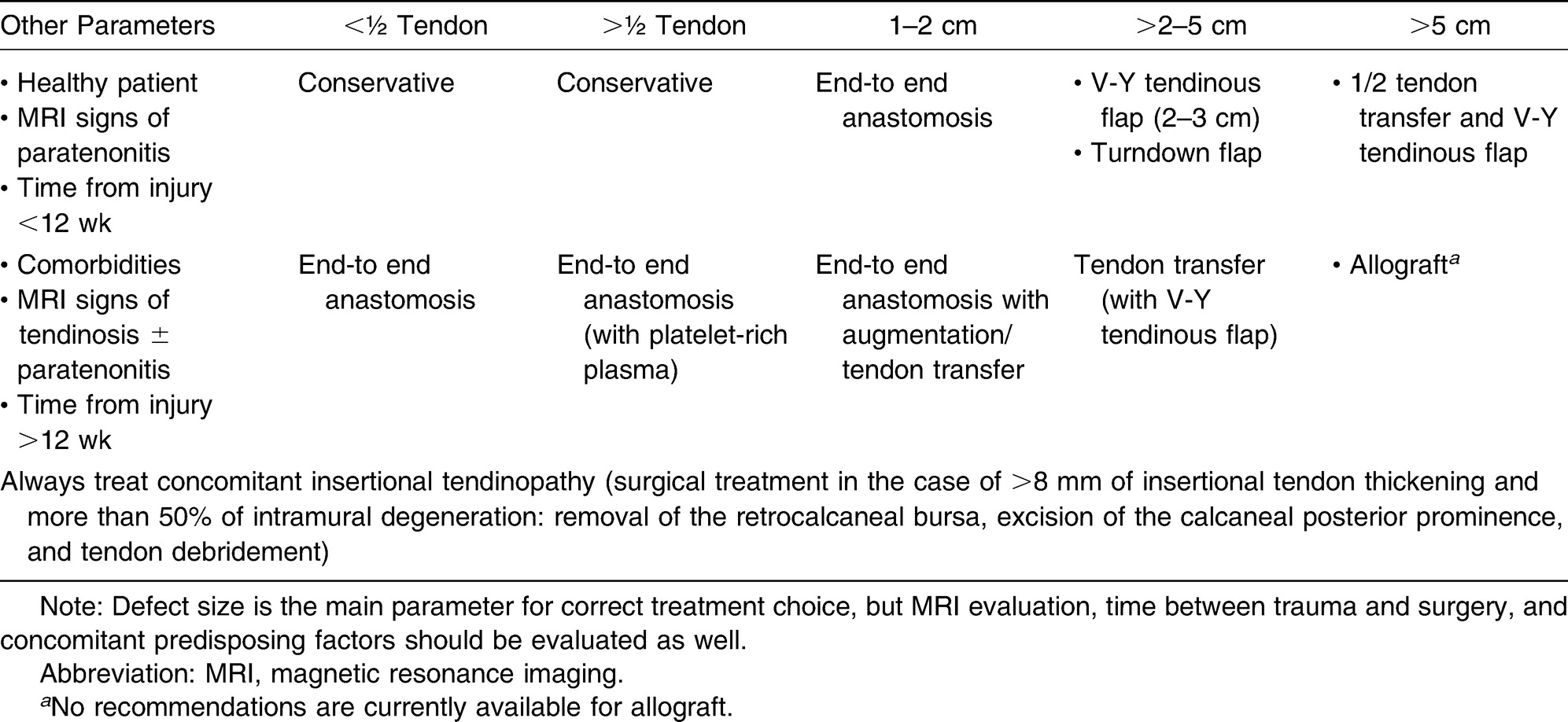
Considering the limits of the previous classifications and the other parameters related to CATLs, we propose a new algorithm that includes a comprehensive assessment of the defect size and the other parameters (comorbidities, MRI evaluation, time from injury to surgery). Based on defect size, CATLs are divided into partial lesions (less or more than half tendon involvement) and complete lesions (1- to 2-cm gaps; 2- to 5-cm defects; tears >5 cm). Other parameters modulate the treatment choice: comorbidities, MRI signs of tendinosis and insertional tendinopathy, and time from injury to surgery (Table 1).
Table 1. Treatment Algorithm for Chronic Achilles Tendon Lesions
Japma 107 00144 g001
Comorbidities include all of the medical conditions that could affect tendon quality, causing degeneration: drugs such as quinolones or corticosteroids, hyperparathyroidism, renal failure, metabolic diseases, and foot diseases.[18,19,20,21]
Magnetic resonance imaging is important for evaluating the degree of tendinopathy, assessing paratenonitis or tendinitis. Paratenonitis is a low-stage tendinopathy, with negligible risk of tendon degeneration and subsequent rupture.[9,10,11,12,13,14,15,16,17] Tendinitis is correlated with a higher risk of tendon rupture: treatment should take into account the low quality of the Achilles tendon, requiring timely surgery or an augmentation procedure.[9,10,11,12,13,14,15,16,17]
Time from injury to surgery seems to affect the scar tissue between the two stumps: when the surgery is performed within 12 weeks of the injury, a soft debridement could be advised to spare as much tissue as possible.[22,23]
Looking at our classification, partial lesions affecting less than (I stage) or more than (II stage) half of the tendon should be treated conservatively in the case of modest degeneration in a healthy patient within 12 weeks of injury. The conservative approach consists of rest, a purpose-made orthosis, nonsteroidal drugs, and physical exercise.[1,8,9,10] Four to 8 weeks of immobilization using a cast of a brace is usually advised[1,8]; eccentric exercises and flexor muscle strengthening are then prescribed.[9,10] The return to sports activity should be accompanied by the use of proper shoes and specific training modifications.[9,10] Surgical repair should be performed after 4 to 6 months of unsuccessful therapies.[8,9,10,26,27] In the case of partial lesions graded as I and II associated with comorbidities, signs of degeneration, and inveterate lesions for more than 12 weeks, an end-to-end anastomosis is required.[25] The surgical procedure requires an end-to-end suture with absorbable stitches, followed by loose adaptive sutures to connect the injured bundle to the remaining Achilles tendon; augmentation with plantaris tendon may be added.[24] A platelet-rich plasma application could be added to improve tendon quality in II stage.[28,29]
Complete lesions, inferior to 2 cm, should be addressed by end-to-end anastomosis in the case of modest degeneration in a healthy patient: Kessler-, Bunnell-, or Ma and Griffith–type closures may be adopted.[1,6,8,16] Krachow locking stitches in the proximal stump may be used to gently mobilize the tendon.[4] In the case of low-quality tissue, the tendon requires an end-to-end anastomosis with an augmentation or a tendon transfer.[6] Tendon transfer is aimed at providing collagen fibers, improving the local blood supply, and restoring plantarflexion strength.[30]
The plantaris tendon should be preferred as first-line reinforcement: this tendon is present in 90% of patients and can be safely used as a local tissue augmentation to improve the strength of the reconstruction.[31,32] However, Lynn[33] pointed out that plantaris tendon harvesting may be challenging in chronic lesions, mainly because of the inclusion of the tendon in the cicatricial mass. A few cases with only plantaris augmentation and absorbable sutures in CATLs were described by Schedl and Fasol,[34] with good results in almost all of the cases: thickening of the tendon and calf atrophy were common in the postoperative setting.
The peroneus brevis tendon is another viable means to augment the repair.[10,16,30] Two main drawbacks should be highlighted: possible weakened eversion and the need to violate a separate muscle compartment.[30] However, the peroneus longus, the principal tendon implicated in eversion, may compensate for the loss of the peroneus brevis.[30] Few articles described good results in CATLs using peroneus brevis transfer: the authors highlighted that neglected ruptures may face more postoperative complications and loss of ankle plantarflexion.[35,36] In the series published by Maffulli et al,[36] after peroneus brevis tendon transfer in CATLs, the Achilles tendon total rupture score improved from 58 points to 91 points at 4.6-year follow-up: 10 of 13 patients returned to sports activity at preinjury levels.
The FHL is an appreciated alternative: it is a long, durable tendon, with anatomical proximity and good vascular supply, acting as a plantar flexor, in phase with the gastrocnemius soleus complex.[7,16,37] The technique may be performed with one or two incisions, harvesting the tendon from the posterior or the midfoot, respectively.[30] The tendon is passed into a transosseous tunnel in the calcaneus, fixed with an interfering screw, and then sutured to the native tendon with nonabsorbable stitches.[30] Very good clinical results were achieved in most of the reported series (American Orthopaedic Foot and Ankle Society [AOFAS] score >90 points at 3-year follow-up), with good incorporation of the tendon (MRI evaluation).[7,10,16,30] Nevertheless, a loss of push-off strength during gait, claw hallux, and transfer metatarsalgia were reported as possible drawbacks.[30]
A turndown flap and, preferably, a V-Y tendinous flap could be suggested in cases of tendon gaps between 2 and 5 cm, in the absence of comorbidities or low-quality tendon.[38] Turndown flaps achieved overall good results, but many patients noted persistent symptoms (eg, weakness and stiffness), probably related to the lack of vascularization of the repair tendon tissue.[2,4,6,10,39] The V-Y tendinous flap was developed to allow a tendon-to-tendon apposition, overcoming some drawbacks related to turndown flaps: adhesions at the repair site and loss of push-off strength.[2] Repair of large defects (5–10 cm) was performed with good results and almost normal functionality (6 of 6 patients returned to preinjury activity levels in the series by Us et al40), although excessive tension is not recommended.[1]
In the case of degenerated tendons, or patients with comorbidities, a tendon transfer (also including a V-Y tendinous flap and a turndown flap in larger lesions) should be performed.[7] Elias et al[38] reported very good outcomes (AOFAS score of 94–100 at 2 years), even in the case of larger defects, with negligible consequence on plantarflexion.
Lesions larger than 5 cm should be treated using one or two tendon transfers and a V-Y tendinous flap, augmented with an allograft, regardless of the etiology, degeneration, and time from injury.[6,7,36,39] Although no evidence exists, allograft may be a salvage procedure in the case of availability: few cases in very large defects are reported, with overall good results.[41,42,43] Cienfuegos et al[41] reported the use of Achilles tendon allograft in a 12-cm defect: the allograft was secured to the calcaneus using two interference screws and was tunneled through the distal portion of the native tendon. Deese et al[42] reported good results in case of reconstruction of large defects due to massive debridement of the tendon. To date, no recommendation can be made about this option. Moreover the main drawbacks of this technique should be carefully weighed: infectious disease transmission, immunologic rejection, incorporation failure, and difficult retrieval of the proper graft.[41,42,43]
Insertional tendinopathy should be investigated in the case of CATLs. A proper, contemporary treatment is required to achieve satisfying results.[6,10,44,45] Usually, conservative treatments are the first-choice therapy.[6,10,44,45] If failure occurs, the most common surgical procedure involves removal of the retrocalcaneal bursa, excision of the posterior prominence, and debridement of the degenerated tendon (calcaneal ostectomy) usually performed with a lateral approach to the insertional zone.[6,10,44,45] Outcomes are usually positive, with marked improvement in pain and function, even in sportsmen.[44,45]
Many treatments are currently available for chronic Achilles tendon ruptures, reporting good results. Some treatment algorithms have been provided, based on the personal experience of foot and ankle specialists and a few case series. All the classifications are mainly focused on the tendon defect size. However, the current literature highlights the role of other parameters in decision making regarding CATL repair, such as tendon degeneration, etiology of the lesion, and time from injury to surgery. A combination of end-to-end repair with concomitant fascial flaps or tendon transfer or even allograft generally achieves good outcomes, but prospective randomized controlled studies are required to delineate the correct surgical indications for these procedures.
Beyond the many proposed treatments for CATLs, a lack of solutions is evident when large gaps are present. Tendon transfer may result in loss of function, and allografts face some considerable drawbacks. Future studies should focus on tissue engineering and biologic interventions such as growth factors and stem cells, which are expected to offer new solutions in augmentation procedures.[46]

Financial Disclosure

None reported.

Conflicts of Interest

None reported.

References

  1. Myerson MS: Achilles tendon ruptures. Instr Course Lect48: 219, 1999.
  2. Padanilam TG: Chronic Achilles tendon ruptures. Foot Ankle Clin North Am14: 711, 2009.
  3. Boyden EM, Kitaoka HB, Cahalan TD, et al: Late versus early repair of Achilles tendon rupture: clinical and biomechanical evaluation. Clin Orthop Relat Res317: 150, 1995.
  4. Bevilacqua NJ: Treatment of the neglected Achilles tendon rupture. Clin Podiatr Med Surg29: 291, 2012.
  5. Elftman H: Biomechanics of muscle with particular application to studies of gait. J Bone Joint Surg Am48: 363, 1966.
  6. Maffulli N, Ajis A, Longo UG, et al: Chronic rupture of tendo Achillis. Foot Ankle Clin North Am12: 583, 2007.
  7. Den Hartog BD: Surgical strategies: delayed diagnosis or neglected Achilles' tendon ruptures. Foot Ankle Int29: 456, 2008.
  8. Kuwada GT: Classification of tendo Achillis rupture with consideration of surgical repair techniques. J Foot Surg29: 361, 1990.
  9. Krahe MA, Berlet GC: Achilles tendon ruptures, re rupture with revision surgery, tendinosis, and insertional disease. Foot Ankle Clin14: 247, 2009.
  10. Reddy SS, Pedowitz DI, Parekh SG, et al: Surgical treatment for chronic disease and disorders of the Achilles tendon. J Am Acad Orthop Surg17: 3, 2009.
  11. Karjalainen PT, Soila K, Aronen HJ, et al: MR imaging of overuse injuries of the Achilles tendon. AJR Am J Roentgenol175: 251, 2000.
  12. Puddu G, Ippolito E, Postachini F: A classification of Achilles tendon disease. Am J Sports Med4: 145, 1976.
  13. Gibbon WW, Cooper JR, Radcliffe GS: Sonographic incidence of tendon microtears in athletes with chronic Achilles tendinosis. Br J Sports Med33: 129, 1999.
  14. Weinfeld SB: Achilles tendon disorders. Med Clin North Am98: 331, 2014.
  15. Christensen I: Rupture of the Achilles tendon: analysis of 57 cases. Acta Chir Scand106: 50, 1953.
  16. Maffulli N, Ajis A: Management of chronic ruptures of the Achilles tendon. J Bone Joint Surg Am90: 1348, 2008.
  17. Nicholson CW, Berlet GC, Lee TH: Prediction of the success of nonoperative treatment of insertional Achilles tendinosis based on MRI. Foot Ankle Int28: 472, 2007.
  18. Järvinen TA, Kannus P, Maffulli N, et al: Achilles tendon disorders: etiology and epidemiology. Foot Ankle Clin10: 255, 2005.
  19. Boivin GP, Elenes EY, Schultze AK, et al: Biomechanical properties and histology of db/db diabetic mouse Achilles tendon. Muscles Ligaments Tendons J4: 280, 2014.
  20. Abate M, Schiavone C, Salini V, et al: Occurrence of tendon pathologies in metabolic disorders. Rheumatology (Oxford)52: 599, 2013.
  21. Basic-Jukic N, Juric I, Racki S, et al: Spontaneous tendon ruptures in patients with end-stage renal disease. Kidney Blood Press Res32: 32, 2009.
  22. Porter DA, Mannarino FP, Snead D, et al: Primary repair without augmentation for early neglected Achilles tendon ruptures in the recreational athlete. Foot Ankle Int18: 557, 1997.
  23. Yasuda T, Kinoshita M, Okuda R: Reconstruction of chronic Achilles tendon rupture with the use of interposed tissue between the stumps. Am J Sports Med35: 582, 2007.
  24. Smigielski R: Management of partial tears of the gastro-soleus complex. Clin Sports Med27: 219, 2008.
  25. Denstad TF, Roaas A: Surgical treatment of partial Achilles tendon rupture. Am J Sports Med7: 15, 1979.
  26. Kader D, Saxena A, Movin T, et al: Achilles tendinopathy: some aspects of basic science and clinical management. Br J Sports Med36: 239, 2002.
  27. Saxena A, Cheung S: Surgery for chronic Achilles tendinopathy: review of 91 procedures over 10 years. JAPMA93: 283, 2003.
  28. Di Matteo B, Filardo G, Kon E, et al: Platelet-rich plasma: evidence for the treatment of patellar and Achilles tendinopathy: a systematic review. Musculoskelet Surg99: 1, 2015.
  29. Filardo G, Kon E, Di Matteo B, et al: Platelet-rich plasma injections for the treatment of refractory Achilles tendinopathy: results at 4 years. Blood Transfus12: 533, 2014.
  30. Lin JL: Tendon transfers for Achilles reconstruction. Foot Ankle Clin14: 729, 2009.
  31. Leslie HD, Edwards WH: Neglected ruptures of the Achilles tendon. Foot Ankle Clin10: 357, 2005.
  32. Gebauer M, Beil FT, Beckmann J, et al: Mechanical evaluation of different techniques for Achilles tendon repair. Arch Orthop Trauma Surg127: 795, 2007.
  33. Lynn TA: Repair of the torn Achilles tendon, using the plantaris tendon as a reinforcing membrane. J Bone Joint Surg Am48: 268, 1966.
  34. Schedl R, Fasol P: Achilles tendon repair with the plantaris tendon compared with repair using polyglycol threads. J Trauma19: 189, 1979.
  35. Pintore E, Barra V, Pintore R, et al: Peroneus brevis tendon transfer in neglected tears of the Achilles tendon. J Trauma50: 71, 2001.
  36. Maffulli N, Oliva F, Costa V, et al: The management of chronic rupture of the Achilles tendon: minimally invasive peroneus brevis tendon transfer. Bone Joint J97-B: 353, 2015.
  37. Wegrzyn J, Luciani JF, Philippot R, et al: Chronic Achilles tendon rupture reconstruction using a modified flexor hallucis longus transfer. Int Orthop34: 1187, 2010.
  38. Elias I, Besser M, Nazarian L, et al: Reconstruction for missed or neglected Achilles tendon rupture with V-Y lengthening and flexor hallucis longus transfer through one incision. Foot Ankle Int29: 1238, 2007.
  39. Maffulli N, Leadbetter WB: Free gracilis tendon graft in neglected tears of the Achilles tendon. Clin J Sport Med15: 56, 2005.
  40. Us AK, Bilgin SS, Aydin T, et al: Repair of neglected Achilles tendon ruptures: procedures and functional results. Arch Orthop Trauma Surg116: 408, 1997.
  41. Cienfuegos A, Holgado MI, Díaz del Río JM, et al: Chronic Achilles rupture reconstructed with Achilles tendon allograft: a case report. J Foot Ankle Surg52: 95, 2013.
  42. Deese JM, Gratto-Cox G, Clements FD, et al: Achilles allograft reconstruction for chronic achilles tendinopathy. J Surg Orthop Adv24: 75, 2015.
  43. Haraguchi N, Bluman EM, Myerson MS: Reconstruction of chronic Achilles tendon disorders with Achilles tendon allografts. Tech Foot Ankle Surg4: 154, 2005.
  44. Oshri Y, Palmanovich E, Brin YS, et al: Chronic insertional Achilles tendinopathy: surgical outcomes. Muscles Ligaments Tendons J2: 91, 2012.
  45. Chiara Vulpiani M, Guzzini M, Ferretti A: Operative treatment of chronic Achilles tendinopathy. Int Orthop27: 307, 2003.
  46. Freedman BR, Gordon JA, Soslowsky LJ: The Achilles tendon: fundamental properties and mechanisms governing healing. Muscles Ligaments Tendons J4: 245, 2014.