Foot and ankle injuries are the number one performance-inhibiting injury for soldiers.[
1] Wallace et al[
1] found that ankle and foot injuries are a major cause of active-duty Army soldiers' time lost from training and combat operations. Previous literature suggests that there is a relationship between foot structure and injury patterns. In a population of cadets from the United States Military Academy (West Point, New York), Levy et al[
2] established a significant relationship between pes planus and the number of injuries sustained in a 4-year period. An interesting deviation from the findings was that women, who tended to have smaller feet and a lesser degree of pes planus, sustained more injuries than men. Williams et al[
3] examined injury history in runners with pes cavus or pes planus and showed that arch structure is associated with different injury patterns in runners. Runners with pes cavus reported greater incidences of ankle, bony, and lateral injuries. Runners with pes planus reported greater incidences of knee, soft-tissue, and medial injuries.
The correlation between arch structure and injury may be related to the fact that foot structure influences foot function. Mootanah et al[
4] categorized foot type based on arch height (planus, rectus, and cavus), malleolar valgus index, arch height index (AHI), and arch flexibility and foot function based on center of pressure excursion index, peak plantar pressure, maximum force, and gait pattern parameters. The researchers observed a significant relationship between several measures of foot structure and foot function.
In addition to arch height, there is evidence to suggest that arch flexibility may be a meaningful descriptor of the relationship between foot structure and foot function. In their recent study of high-arched runners, Williams et al[
5] found varying levels of arch flexibility, which led to differing lower-extremity movement patterns and loading. There is substantial literature that uses methods of classification to describe individuals' arches as rectus, cavus, or planus. Yet, despite the potential implications for including arch flexibility as a measure of foot structure, there is not a similar categorization method to describe arch flexibility. Classification methods are useful for researchers to draw comparisons between groups. They can also be useful for clinicians who are making decisions regarding best practice treatment options. Therefore, the first purpose of this study was to propose a classification scheme for arch flexibility based on a large foot structure data set.
Although recent literature, such as the study by Willams et al,[
3] suggests that arch height does not necessarily predict arch flexibility, it is often assumed that high arches tend to be stiffer and low arches tend to be more flexible.[
6] A clearer understanding of the strength of the relationship between these two structural measures can support the development of appropriate clinical treatment of foot abnormalities. It may also better describe the spectrum of foot structure so as to strengthen the predictability of foot function by structure. Therefore, the second purpose of this study was to use the classification scheme proposed herein to assess the relationship of arch flexibility with arch height. Based on the assumption that high arches are stiffer and low arches are more flexible, a relationship between arch flexibility and arch height categories was expected.
Materials and Methods
Volunteers were drawn from a pool of 1,200 incoming military cadets, of whom 1,124 agreed to participate in this study. All of the procedures were reviewed and approved by the Keller Army Hospital institutional review board, and all of the participants gave informed consent before participation in the study. Erroneous data were eliminated from the data set before analysis, including individuals who had duplicate information, missing information (ie, weight, foot structure measurements), or negative values for the change in arch height from sitting to standing. The negative value would suggest that arch height in the standing position would be greater than arch height in the sitting position, which is not possible owing to the natural splaying of the foot with body weight loading.
After the removal of erroneous data, 1,056 individuals (882 men and 174 women) were included in the study (mean ± SD: age, 18.4 ± 1.4 years; height, 1.76 ± 0.80 m; and weight, 76.1 ± 12.7 kg).
Arch height index was measured using the arch height index measurement, the validity and reliability of which has been previously established by Butler et al.[
]
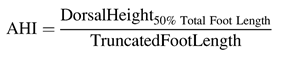
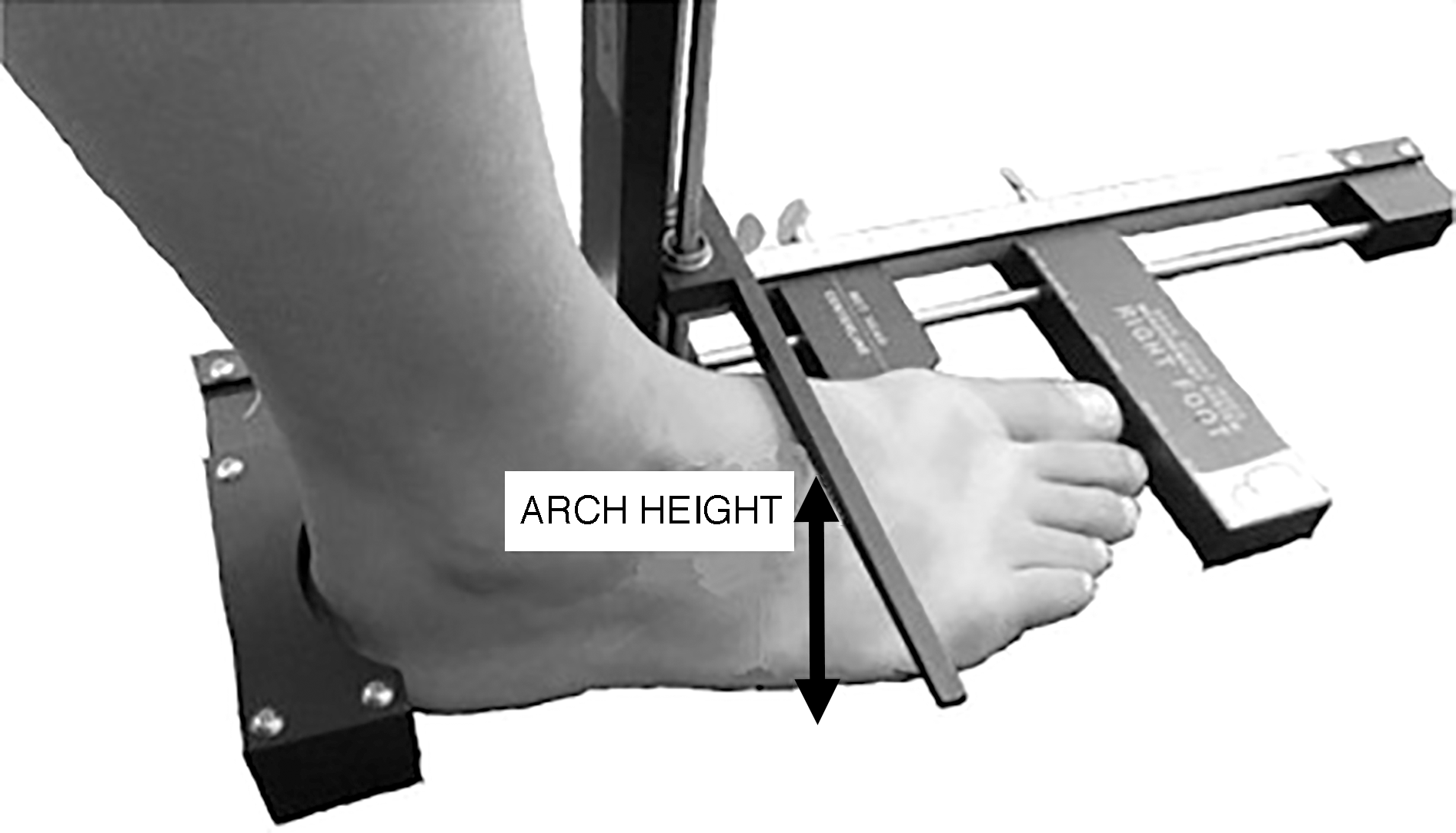
Figure 1 depicts the apparatus for the right foot; a mirrored apparatus was used to measure the left foot as well. Arch height index (AHI) was calculated according to the following formula
8:
where dorsal height is measured at 50% of the total foot length and truncated foot length is the distance from the posterior heel to the first metatarsal head, measured along the medial border of the foot.
Figure 1.
The arch height index measurement system was used to measure the arch height at half of the total foot length to calculate arch flexibility.
Figure 1.
The arch height index measurement system was used to measure the arch height at half of the total foot length to calculate arch flexibility.
Arch flexibility was defined as the change in arch height (distance from the dorsal surface to the ground) from sitting to standing due to the change in load borne by the arch during these activities. The change in load was based on an assumed change in body weight from sitting to standing. The standing condition assumes the weight on the foot to be 50% of the body weight on each foot, and the sitting condition assumes the weight on the foot to be 10% of the body weight.[
9] Therefore, there was an assumed 40% change in load from standing to sitting.
The final equation used to calculate arch flexibility[
4] was:
where AH is arch height from the floor to the dorsal surface of the foot at half the total foot length and BW is body weight.
Because data were collected from both the left and right sides, the AHI and arch height flexibility data were first compared between sides using a paired
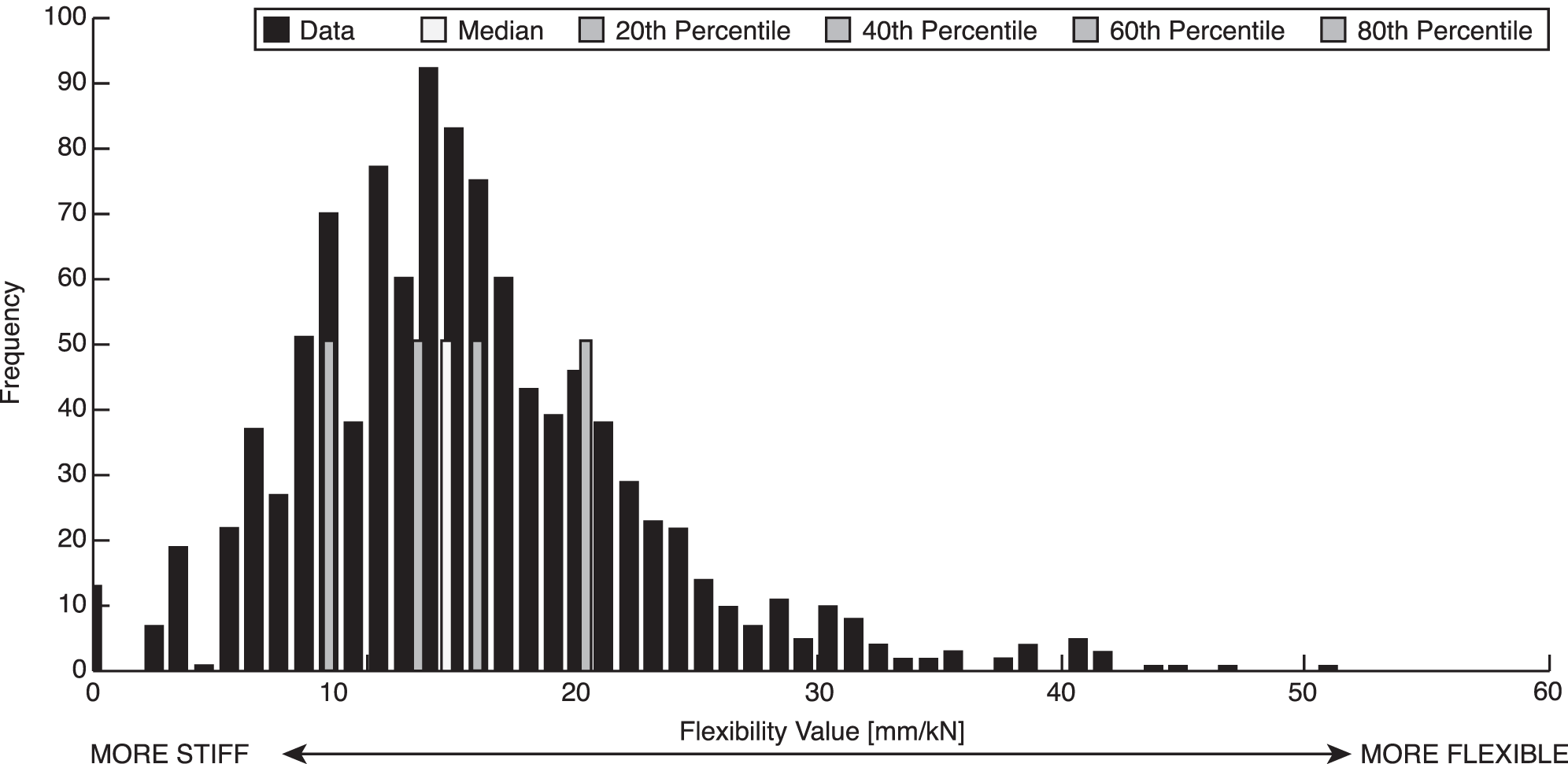
t test to determine whether the analysis from one side could be generalized to the other side. The data were then used to create a classification scheme for arch height flexibility. Visualization of the compiled AHI data showed that the mean ± SD would not represent the skewness of the data (
Fig. 2). Therefore, quintiles were used to classify five arch height flexibility categories: very stiff, stiff, neutral flexible, and very flexible.
Figure 2.
Distribution of left and right foot arch flexibility measurements was skewed toward stiffer feet. Therefore, quintiles, as opposed to mean ± SD, were used to classify arch flexibility types.
Figure 2.
Distribution of left and right foot arch flexibility measurements was skewed toward stiffer feet. Therefore, quintiles, as opposed to mean ± SD, were used to classify arch flexibility types.
The distribution of arch flexibility types was also compared among arch height categories. This was accomplished by identifying the number of individuals with each AHF type in each arch height category. The arch height flexibility type was based on the classification system proposed herein, and the arch height category was based on previous clinically based cutoff values for cavus, rectus, and planus proposed by Hillstrom et al.[
10] The distribution was compared using a χ
2 goodness of fit test.
Results
The arch height flexibility was not significantly different between the left and right feet (
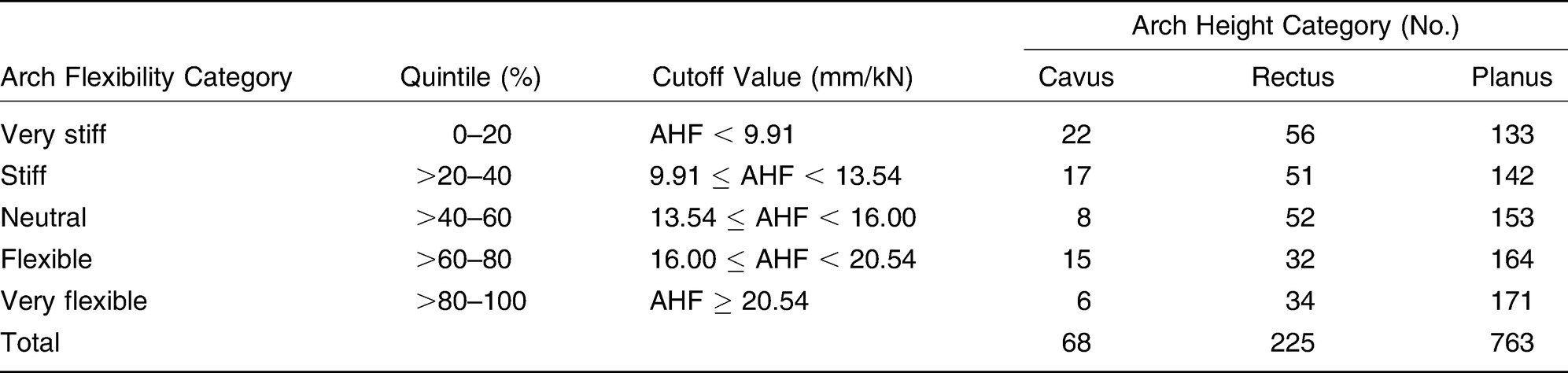
P = .21). Therefore, the right side was used to represent the participants' feet overall. The classification scheme based on quintiles is shown in
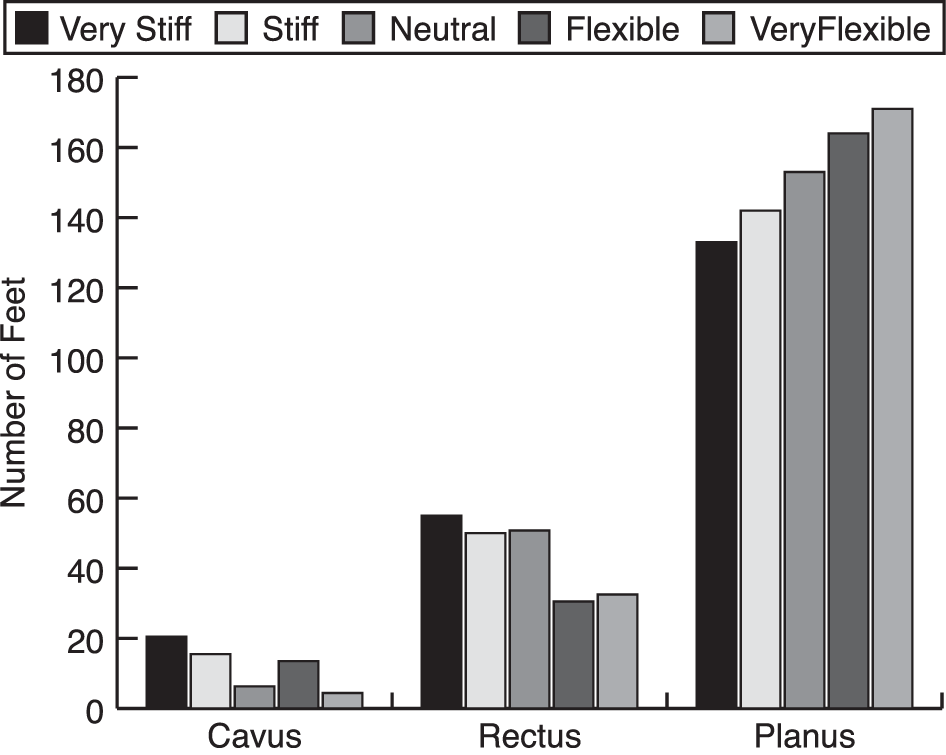
Table 1. The median arch height flexibility value was 14.75 mm/kN. Sixty-eight feet were classified as cavus, 225 as rectus, and 763 as planus. The goodness of fit test suggested that among arch height categories there was a significantly disproportionate number of feet that were classified in each of the arch height flexibility categories (
P < .01). As shown in
Figure 3, the largest proportion of cavus feet was very stiff and the smallest proportion was very flexible. This was also true of the feet in the rectus arch height category, although a large portion of rectus feet also demonstrated neutral arch flexibility. Conversely, the largest proportion of planus feet was very flexible and the smallest proportion was very stiff.
Table 1.
Proposed Cutoff Values for Arch Flexibility Categories and the Distribution of 1,056 Feet by Arch Flexibility (AHF) and Arch Height Categories
Table 1.
Proposed Cutoff Values for Arch Flexibility Categories and the Distribution of 1,056 Feet by Arch Flexibility (AHF) and Arch Height Categories
Figure 3.
Distribution of feet in the appropriate arch height and arch flexibility categories. The distribution of arch flexibility types was significantly different among arch height types (P < .01).
Figure 3.
Distribution of feet in the appropriate arch height and arch flexibility categories. The distribution of arch flexibility types was significantly different among arch height types (P < .01).
Note that the planus group demonstrated an obvious stepwise increase in the proportion of individuals in each category from very stiff to very flexible. However, the distribution of arch height flexibility categories in cavus and rectus feet is less defined.
Discussion
The purpose of this study was to expand our understanding of arch flexibility as a measure of foot structure. Although still measured statically, arch flexibility accounts for dynamic foot changes. Based on a large data set, we proposed a five-category classification scheme for arch flexibility. This information is useful for clinically defining an individual's foot structure, and it will assist in future studies that seek to develop categorical analyses between foot types. Categorical analyses have been performed for decades based on arch height[
11,
12]; however, new emphasis[
4,
5] of the importance of arch flexibility in describing foot structure supports the need for a similar classification scheme based on this measure.
It is important to note some limitations associated with this study. First, arch flexibility is calculated based on the assumption that the individuals were evenly loading their body weight on each of their feet as they were being measured. The participants were prompted to stand evenly on both feet, but this was not quantitatively monitored during data collection. In addition, the study was conducted on a population of healthy men and women aged 18 to 25 years. Therefore, the arch flexibility classification scheme described in this study was based on this demographic feature. Future studies should be performed to determine whether the classification scheme can be applied to children, older adults, or a pathologic population. It is likely that additional, or modified, classification schemes may be necessary. Finally, there were more than ten times as many planus as cavus feet and more than three times as many planus as rectus feet in the cohort. Future studies should include additional cavus and rectus feet in the cohort to determine whether there is a clearer distribution of arch flexibility types in those arch height categories.
Nevertheless, despite the skew toward planus feet enrolled in the study, the results supported the hypothesis: there was a significantly different distribution of arch flexibility types among arch height types. Specifically, planus feet were more likely to be very flexible and cavus and rectus feet were more likely to be stiffer. This relationship was most evident for the two extreme arch flexibility categories (very stiff and very flexible). For planus arches, there was a commensurate stepwise increase in the number of feet that fell into the stiff, neutral, and flexible categories. The clear distribution of these data may be due to the large number of individuals in this subcohort (n = 763). The distribution in the cavus and rectus categories, specifically in the intermediate categories (stiff, neutral, and flexible), was less obvious.
The results of the present research support the common belief that cavus feet tend to be very stiff and planus feet tend to be very flexible.[
6] This finding is useful where generalizations of foot structure are warranted. However, the results of this study also demonstrate that there was a distribution of arch flexibility types among the arch height types. For example, although 22 of the 68 cavus feet were very stiff, another 15 of the 68 cavus feet were flexible. In fact, this study demonstrates that at least two foot classification methods are useful to fully describe foot structure.
This study proposes a five-category arch flexibility classification system. The results suggest that a multidimensional description of foot structure requires classification of both arch height and arch flexibility. In addition to addressing the relationship between arch height and flexibility, the five-category classification of arch flexibility combined with the three-category classification of arch height proposes a two-dimensional matrix of 15 possible foot types that more completely describe foot structure. This provides the framework for a normative database that will be useful for future studies relating foot structure to injury and performance.