


Abstract
Background: We sought to determine a predictive model of data, differentiated by sex, from a radiographic study of the skeleton of the foot as an alternative to the classic study of the hand. Methods: The study included 2,476 digital radiographs from 816 participants aged 0 to 21 years. The radiographs were from the Radiology Diagnostic Services of the Public Health System of Extremadura (Spain) from 2007 to 2011. The method used for their analysis consisted of assigning a numerical code to each ossification center of each growing bone of the foot and subsequently subjecting the data to a multivariate, decision tree, statistical analysis. Results: The decision tree study identified the bones that have a common age-dependent pattern of growth (as determined by a comparison of means test with P < .01) among individuals of the same sex. The quality of the decision tree predictions was evaluated in terms of the r2 coefficient. These values were r2 = 0.897 for females and r2 = 0.890 for males, thus establishing the predictive goodness of the model of bone data to provide a specific estimate of the individual's age. Conclusions: The foot is a good predictor of an individual's age from birth to complete bone maturity.
How to estimate an individual's age is a topic of interest in various areas of medicine. One of the commonly used tools for this purpose is radiography. For example, a radiographic study can be used to aid in the identification of skeletal remains in forensic anthropology,[1] the prediction of height in clinical practice,[2] and the determination of age in legal medicine for use in the courts.[3]
Calculations of age through a study of bone maturation have traditionally been conducted with anatomical structures other than the foot.[3-5] Anatomical areas of the skeleton with primary relevance to the determination of age include the limbs and teeth.[6] The anatomical region of the carpus is currently the most extensively studied for the daily practice of age determination.[7] Other studies, however, provide guidelines for the possible use of other anatomical regions for this purpose: dentition, cervical spine, pelvis, and even the first rib.[8-11]
The pelvis, for example, contributes to the diagnosis with the assessment of the Risser sign or merger of the iliac crest, which involves establishing the age of the individual around 18 years by the natural process of epiphyseal union.[12] For this reason, the calcification of the pelvis has been used to assess age. The cervical spine is used in the maxillofacial clinical field to establish an age limit of 16 years, which is the limit of facial growth in orthodontics.[8,9] The accuracy of the analysis of the first rib and sternum breastplate is usually low, although they provide significant data on mature individuals.[11]
In humans, the similar phylogenetic development of the limbs suggests that the ontology of the lower limb may have much in common with that of the upper limb.[12] The foot has maturational parameters that are valid for their use in legal studies and in the estimation of age,[13] and the use of radiography of the hand to assess bone maturity in the first 2 years of life is subject to a series of limitations,[14] such as the method used[5,14] and subjective interpretation of the results by the examiners.[12] For these reasons, the foot may aid in completing the study of certain cases, such as agenesis, hypoplasia, or the absence of pieces of the individual's dentition.
We found certain shortcomings in the literature on the foot as a structure with which to predict age. Some studies are older,[15] others are based on a small sample.[16] The population of some is very different from the reference white population of Spain,[17,18] and some do not cover all of the foot bones.[19] We, thus, considered taking an up-to-date approach to examining the potential usefulness of foot radiography for the estimation of age.
Methods
Participants
The study included 2,476 digital radiographs from 816 individuals aged 0 to 21 years, which is an average of 3.03 radiographic images per individual. These radiographs were weightbearing lateral, weightbearing dorsoplantar, and oblique images of right and left feet. They were made by the Radiology Diagnostic Services of the Public Health System of Extremadura (Spain) between 2007 and 2011.
The sample was, thus, representative of the entire population of the region, not just of a specific subpopulation. For each individual, data were recorded corresponding to sex, age, and which foot was studied.
Individuals were excluded if they underwent radiography for growth studies or preoperatively or postoperatively for surgery; they had evidence of structural, functional, or traumatic alterations affecting bone morphology (idiopathic juvenile arthritis, fractures, enchondromatosis, osteochondrosis, clubfoot, etc); or their nonloading radiographs showed radiographic artifacts with dubious visibility or with technical defects resulting from incorrect positioning of the foot when taking the radiograph.
Protocol
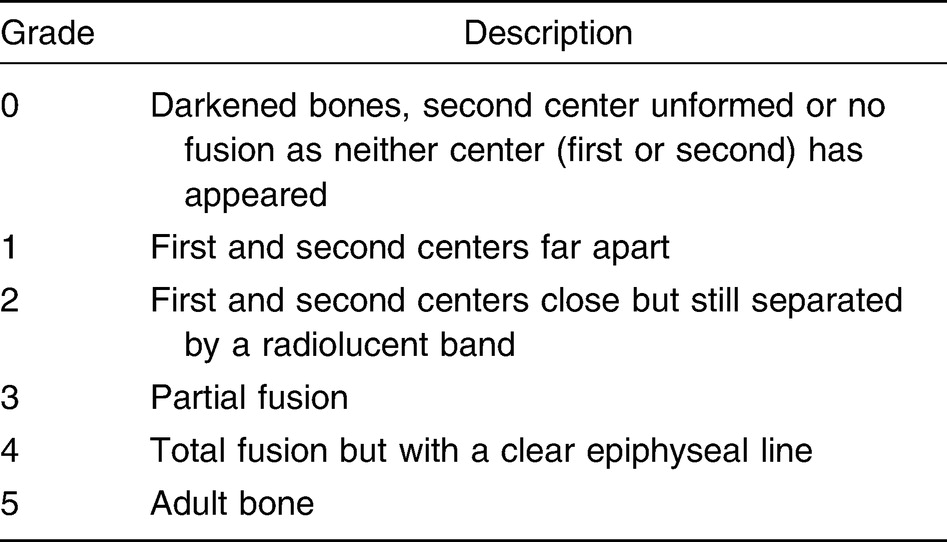
Image analysis was performed following the system validated by Whitaker et al[16] designed to estimate the age in months from the skeletal radiograph of the foot. This system significantly reduces interexaminer and intraexaminer bias in the gradation process. It consists of applying graded scales of stages of ossification of each of the growing foot bones. The system has three independent scales applicable to each foot bone, always given that the foot is in the process of maturation. One scale assesses the degree of maturation of the primary ossification center, another assesses the degree of maturation of the secondary ossification center, and the third assesses their degree of fusion. The first two scales have identical gradations but differ in their application according to the ossicle under study (Table 1). The third scale indicates the stage of fusion between the two ossification nuclei (primary and secondary) (Table 2). Each foot bone is, thus, assigned three numbers: grading of the primary center, grading of the secondary center, and the degree of fusion. This sequence of three numbers is logged in a spreadsheet, together with the individual's known chronological age and sex.
Table 1.
Gradation of Ossification in the Bones of the Growing Foot[16]
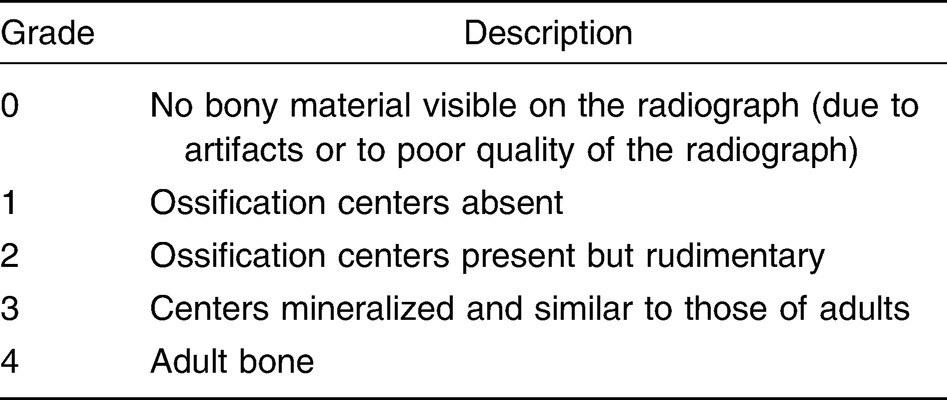
Table 2.
Gradation of the Fusion of the First and Second Ossification Nuclei of the Bones of the Foot[16]
The radiographs were visualized and analyzed by four qualified examiners (podiatric physicians and radiologists) at different intervals, with 20 projections per session. In addition, each group of films was viewed three times by the same examiner, with a 5-day separation between viewings.
Statistical Analysis
The data from the digital radiographs were first processed for their unification. They were then subjected to statistical analysis using a software program (IBM SPSS Statistics for Windows, Version 19.0; IBM Corp, Armonk, New York). The method used was a multivariate technique known as decision tree or segmentation analysis. Its aim is to find subsets (nodes) of the sample that possess their own distinct behavior with respect to a variable to be explained (age, in the present study). The variables that contributed the most information were selected iteratively, with the subdivisions being validated statistically by a comparison of means test for each sex (P < .01). A further criterion was that the nodes generated at least 20 cases.
The quality of the prediction yielded by these trees was evaluated in terms of the r2 coefficient—the standard measure used for the goodness of fit of a model—in this case quantifying the correlation between the actual ages and the ages predicted by the decision tree. The closer the coefficient is to unity, the more significant the fit of the model. This test was used in the present study to determine which variables (foot bones) behaved similarly, ie, had the same degree of ossification over the age of the individual, and, thus, are predictive of age differentiated by sex because ossification varies significantly between boys and girls.[13,20-22]
Results
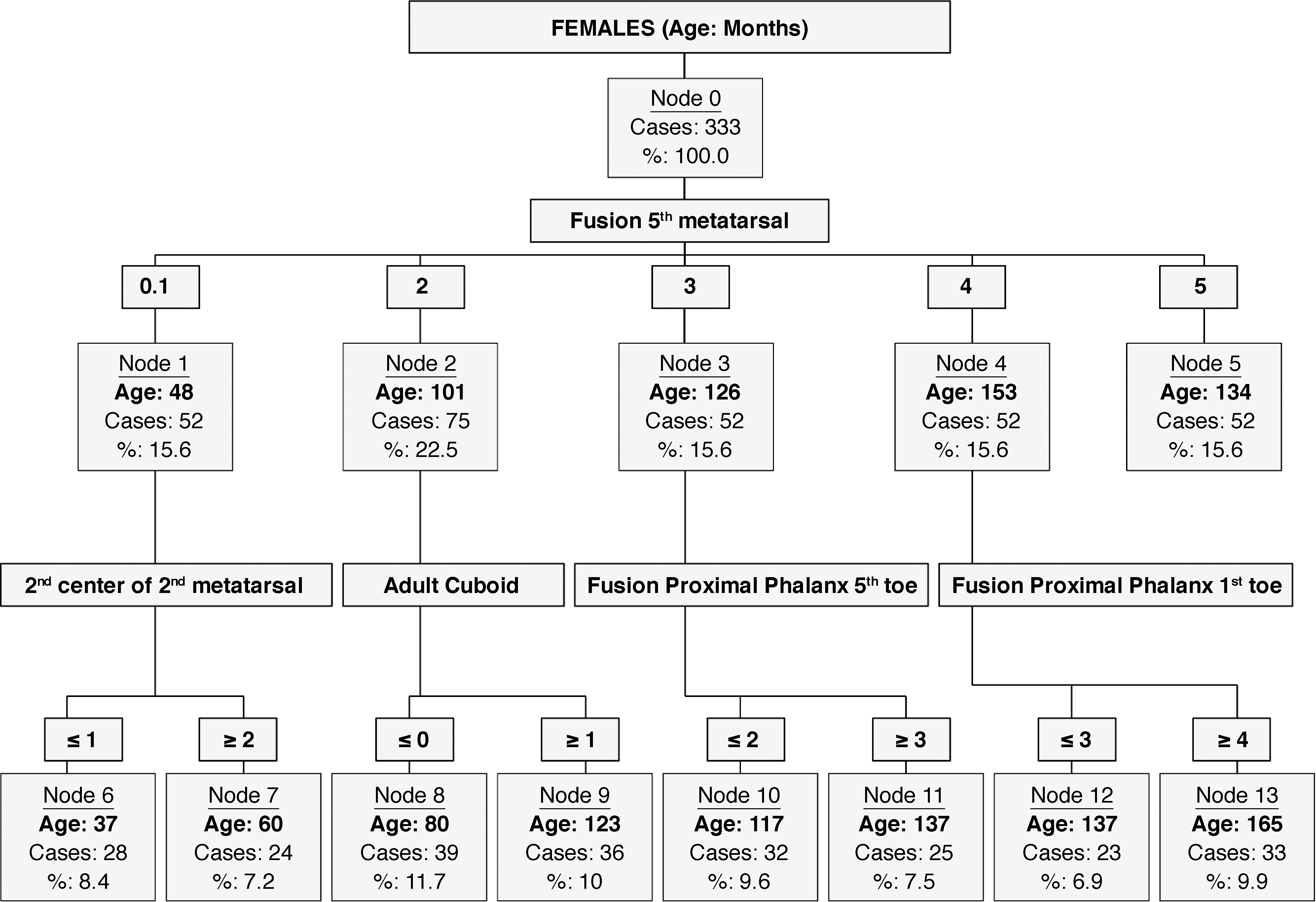
The tree reading starts in all cases at its root, and continues along the branches that determine the characteristics of ossification of the individual to evaluate. With respect to females (Fig. 1), the following bone growth features presented similar behavior in all of the girls' feet studied (P < .01): the fusion of the fifth metatarsal, the secondary ossification center of the fourth metatarsal, the cuboid at its maximum degree of maturation, the fusion of the proximal phalanx of the fifth toe, and the fusion of the proximal phalanx of the great toe. The decision tree model explained almost 90% of the variations with age (r2 = 0.897). The study variable whose maturation pattern differed least between individuals was the fusion of the proximal phalanx of the fifth toe. It, therefore, constituted the primary branch of the tree after its root. The subsequent ramifications correspond to variables that follow a regular maturational pattern significantly shared by most of the population, classified by degree of bone maturation. This allows one to specifically predict the age by considering only the variables involved in the branches of the decision tree. For example, if an individual who has undergone a bone study to determine the chronological age has the fifth metatarsal (node 0) partially fused (grades 3 to 4), the tree will branch to this gradation interval (node 4) (Fig. 1). One will then evaluate the stage of fusion of the proximal phalanx of the great toe. If this has a grade of 3 or less (node 12), the individual is determined to have a mean bone age compared with the general female population of 137 months (11 years 5 months). If, instead, the grade of the developmental stage of fusion of the proximal phalanx of the great toe is greater than 3 (node 13), the prognosis will be a mean age of 165 months (13 years 9 months) (Fig. 1).
Figure 1.
Decision tree for females. Age is given in months.
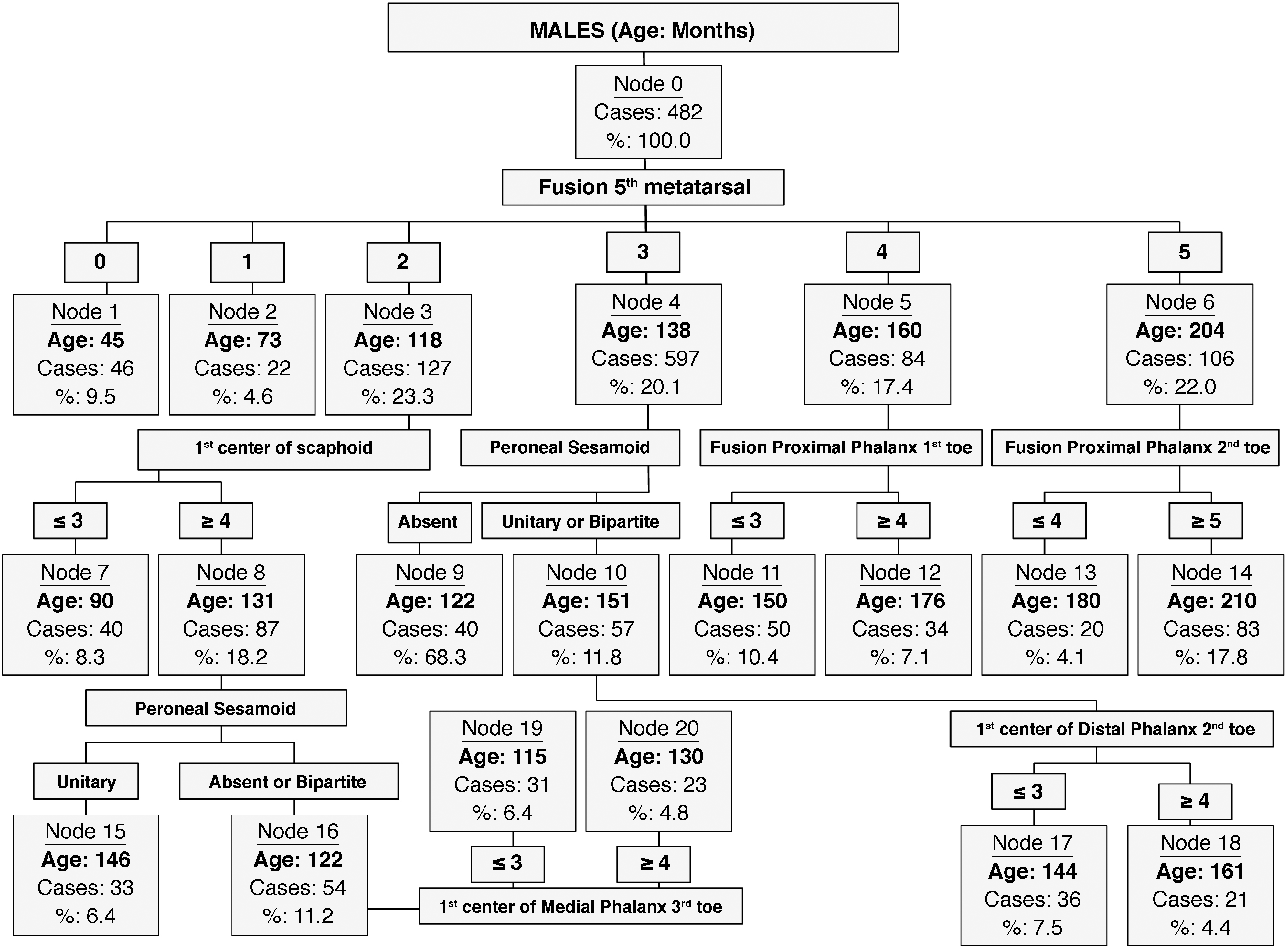
With respect to males, the following bone growth features presented similar behavior in all the boys' feet studied (P < .01): the fusion of the fifth metatarsal, the primary center of the scaphoid, the peroneal sesamoid, the primary ossification center of the middle phalanx of the third toe, the secondary ossification center of the distal phalanx of the second toe, the fusion of the proximal phalanx of the great toe, and the fusion of the proximal phalanx of the second toe. The decision tree model explained 89% of the variations with age (r2 = 0.890). The root of the tree is, thus, the fifth metatarsal, from which, depending on this bone's grade of fusion, there branch out different paths (Fig. 2).
Figure 2.
Decision tree for males. Age is given in months.
Discussion
In view of these results, we can propose to the scientific community the set of foot bones that best predict an individual's age, reflecting the homogeneity of maturation among individuals of the same sex.
For females, the determination of the bone data can be estimated with minimal bias from the following bones: the fusion of the fifth metatarsal, the secondary ossification center of the fourth metatarsal, the cuboid in its maximum degree of maturation, the fusion of the proximal phalanx of the fifth toe, and the fusion of the proximal phalanx of the great toe.
Similarly, the following bones best predict age for males: the fusion of the fifth metatarsal, the primary center of the scaphoid, the peroneal sesamoid, the primary ossification center of the middle phalanx of the third toe, the secondary ossification center of the distal phalanx of the second toe, the fusion of the proximal phalanx of the great toe, and the fusion of the proximal phalanx of the second toe.
Few authors have considered the foot to be useful for estimating age, and among them even fewer have considered the entire phase of maturation of the individual, instead, most commonly studying specific age ranges (eg, infants aged 0–2 years[2] or adolescents[19]). Neither has any published study taken all of the bones of the foot into account. Most often, certain anatomical regions have been studied in isolation, such as the ankle[13,23] or some of the tarsal and metatarsal bones.[16] In particular, published works have given no attention to bone maturation of the phalanges. With the intention of contributing to filling this gap in knowledge, the present study described the results of a comprehensive analysis of the bones of the toes throughout their phases of maturation. The perhaps surprising conclusion drawn was that together with the metatarsals, these are the bones of the foot that ossify most uniformly among individuals of the same sex; therefore, they are of interest as predictors of age.
Note that most authors emphasize the sex difference in bone maturation, especially with respect to epiphyseal fusion.[20,21] Indeed, the present results are consistent with the classic literature regarding the differentiation of bone maturation by sex in that it is advisable to have previous knowledge of the individual's sex to estimate the precise age by means of comparisons with the standards established for that sex.[13]
There are two principal limitations of the present study. Its results need to be applied with caution for different racial/ethnic groups because the present study was of a white population. Any use of the proposed standards should take this premise into account. The same goes for the age range studied. The present study was limited to the period of bone development of the foot. This often does not coincide with the period of growth of other anatomical structures that are also used for bone dating purposes.
In conclusion, the results show that the skeleton of the foot is a good predictor of an individual's chronological age from birth to complete bone maturity.
Financial Disclosure:
None reported.
Conflict of Interest:
None reported.
References
- Gisbert Calabuig JA: Medicina Legal y Toxicología, 6th Ed, Masson SA, Barcelona, 2004.
- Hernández M: Maduración Ósea y Predicción de Talla: Atlas y Métodos Numéricos, Díaz de Santos SA, Madrid, 1991.
- Todd TW: Atlas of Skeletal Maturation (Hand), Mosby, St. Louis, 1937.
- Tanner JH, Whitehouse RM: Standard Skeletal Maturity: Part I,International Children's Center, París,1959.
- Demirjian A, Goldstein LH, Tanner JH: A new system of dental age assessment. Hum Biol45: 211, 1973.
- Garamendi PM, Landa MI: Determinación de la edad mediante la radiología. Rev Esp Med Legal36: 3, 2010.
- Bañón R: El estudio de la edad ósea en el carpo y en otras regiones anatómicas aplicado a la estimación de minoría de edad. Jornadas sobre determinación de edad en menores indocumentados, Donostia,2004.
- Hassel B, Farman AG: Skeletal maturation evaluation using cervical vertebrae. Am J Orthod Dentofacial Orthop107: 58, 1995.
- Baccetti T, Franchi L, McNamara JAJr: An improved version of the cervical vertebral maturation (CVM) method for the assessment of mandibular growth. Angle Orthod72: 316, 2002.
- Landa MI: Parámetros de Maduración con la Edad en Ortopantomografías Digitales, Universidad de Granada, Granada, Spain, 2007.
- Garamendi PM, Landa MI, Botella MC, et al: Forensic age estimation on digital X-ray images: medial epiphyses of the clavicle and first rib ossification in relation to chronological age. J Forensic Sci56(suppl 1): S3, 2011.
- Scheuer L, Black SM: The Juvenile Skeleton,Elsevier Academic Press, San Diego, CA,2004.
- Robledo-Acinas MM: Determinación de la Edad Ósea en Adolescentes: Estudio Radiológico del Pie y Análisis de Imágen en el Grupo de 17 a 19 Años, Universidad Complutense de Madrid, Madrid, 2008.
- Tanner JH, Whitehouse RM, Healy MJ, et al: “A Revised System for Estimating Skeletal Maturity from Hand and Wrist Radiographs with Separate Standards for Carpains and Other Bones (TW2 System),”inStandards for Skeletal Age, International Children's Centre, Paris, 1972.
- Hernandez C, Sánchez E, Sobradillo B, et al: A new method for assessment of skeletal maturity in the first 2 years of life. Pediatr Radiol18: 484, 1988.
- Whitaker JM, Rousseau L, Williams T, et al: Scoring system for estimating age in the foot skeleton. Am J Phys Anthropol118: 385, 2002.
- Banejee K, Agarwal BBL: Estimation of age from epiphyseal union at the wrist and ankle joints in the capital city of India. Forensic Sci Int98: 31, 1998.
- Crowder C, Austin D: Age ranges of epiphyseal fusion in the distal tibia and fibula of contemporary males and females. J Forensic Sci50: 1001, 2005.
- Robledo-Acinas MM, Sánchez-Sánchez JA, Pumar-Martín M, et al: Determinación de edad ósea en adolescentes: estudio radiológico de pie y tobillo. Rev Escuela Med Legal Madrid7: 22, 2008.
- Krogman WM, Isçan MY: The Human Skeleton in Forensic Medicine, 2nd Ed, Charles C Thomas Publisher, Springfield, IL,1986.
- Reverte JM: Antropología Forense, 2nd Ed, Ministerio de Justicia, Secretaría General Técnica, Centro de Publicaciones, Madrid, 1991.
- Scheuer L, Black SM: Developmental Juvenile Osteology, Academic Press, San Diego, CA,2000.
- Hoerr NL, Pyle SL, Francis CC: Radiographic Atlas of Skeletal Development of the Foot and Ankle: A Standard of Reference,Charles C Thomas Publisher, Springfield, IL,1962.
© 2017 American Podiatric Medical Association