People have been walking and running without shoes for millions of years. [
1] Everyone, including athletes, ran either barefoot or in what would be considered a minimalist shoe by today's standards until the 1970s, when the modern running shoe came into existence. [
1] The modern running shoe is designed to provide cushioning, support, protection, and motion control; however, some shoe companies have produced a minimal or “barefoot” shoe. [
1] With the rise in popularity of minimalist shoes, numerous debates have ensued regarding proposed benefits and deleterious issues concerning them. Advocates, citing mostly anecdotal evidence, describe an increase in lower-extremity muscle strength with minimalist shoes that reduces injuries. [
2] Several studies have illustrated a statistically significant increase in anatomical cross-sectional area on magnetic resonance imaging of intrinsic muscles after a period of engaging in activities while minimally shod. [
3,
4] Quantifying these strength gains can be difficult, but the abductor hallucis muscle is most commonly measured owing to its large size and relative ease of access with diagnostic imaging devices, such as magnetic resonance imaging and ultrasound. [
5-
7]
The abductor hallucis muscle has been described as having a V-shaped configuration, with one branch extending to the calcaneal tuberosity and a second branch running distally to the hallux. [
8] The abductor hallucis muscle contributes to stabilization and supination of the midtarsal joint against the pronating force of ground reaction during propulsion. [
9,
10] Along with the abductor hallucis, other intrinsic and extrinsic muscles, ligaments, and osseous structures support the medial longitudinal arch. [
10,
11] If any of these structures become weak, abnormal pronation may occur, leading to a possible overuse injury. [
11] Improving the strength of the intrinsic muscles, demonstrated by Mulligan and Cook, [
12] reduces the amount of navicular drop, which could potentially control abnormal pronation and, thus, reduce these injuries. Although walking barefoot would engage these muscles, there are obvious risks, such as hazardous surfaces, extreme temperatures, and exposure to infectious agents. Individuals with loss of protective sensation are also more likely to become injured when unshod. [
13] Nigg [
14] described the barefoot shoe as a misnomer because only specific aspects of being barefoot can be taken and implemented into the shoe. Nigg notes that barefoot shoes can mimic the shape of the foot, the kinematics of barefoot running (such as the Nike Free concept [Nike Inc, Beaverton, Oregon]), or the feeling of barefoot walking or running. [
14] The construct of Vibram FiveFingers (VFF; Vibram USA Inc, Concord, Massachusetts) mimics pedal structure while providing protection against various external environmental agents, such as rocks and extreme temperatures, or foreign objects, such as glass.
Speculation concerning the benefits of minimalist shoes has demonstrated the need for research. This study investigated the effect of VFF Bikila shoes on the abductor hallucis muscle of the foot. We hypothesized that a gradual transition into minimalist shoes will increase the thickness of the abductor hallucis muscle.
Methods
Forty-eight healthy individuals (96 feet) were enrolled into the study and divided into four groups: 1) control group (traditional shod; n = 12), 2) restricted walking group (n = 12), 3) running group (n = 12), and 4) unlimited walking group (n = 12). Both feet from each of the participants were used in the study. A power analysis was performed to determine the appropriate sample size for this study. With a desired power of 0.8 and α = 0.05, the required sample size was calculated to be 40 individuals (80 feet). To allow for a 20% attrition rate, the sample size was increased to 48 participants (96 feet).
Participants were recruited from Kent State University College of Podiatric Medicine (KSUCPM). Individuals were excluded from the study if they had worn minimalist shoes or were active in barefoot running, had previous back or lower-extremity surgery, had injuries that could prevent completion of the study, had lower-extremity manifestations of local or systemic disease, had diabetes, were pregnant, or planned on becoming pregnant. Prior to initiating the study, the proposal was reviewed and approved by the KSUCPM Institutional Review Board. Each participant provided written consent before any research-related activities were performed.
The duration of the study was 24 weeks, with the participants assessed on day 0, week 12, and week 24. All of the participants, except those in the control group, wore VFF Bikila shoes. Participants in the control group wore any type of footwear, except barefoot or minimalist shoes, for the duration of the study. Individuals in the two walking groups (restricted walking and unlimited walking) were asked to walk at a normal daily pace while wearing the VFF shoes. Individuals in the running group had to be running 10 to 40 miles per week in traditional shoes before the start of the study.
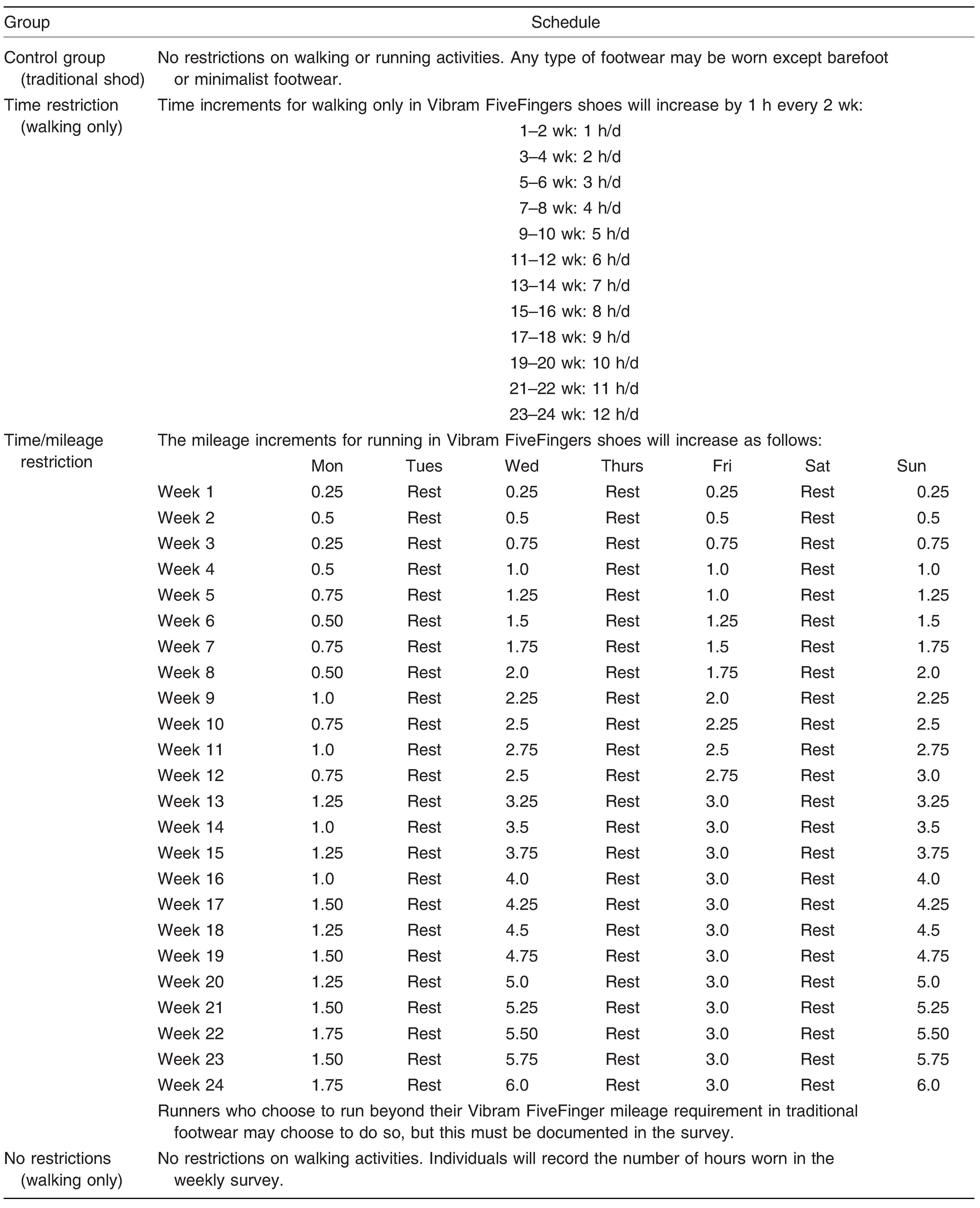
The schedule of walking and running activities for each group is summarized in
Table 1. Participants in the control group were not restricted in walking or running activities. Individuals in the restricted walking group were limited in the amount of time they could walk in the minimalist shoes, as described in the schedule. Those in the running group followed a running schedule that strictly adhered to the 10% rule for increasing mileage, which is outlined on the schedule in
Table 1. [
15-
17] To minimize injury while running in VFF Bikila shoes, the participants in this group were given an educational brochure on proper running form and were instructed to run in their traditional running shoes for any additional mileage beyond the running schedule. Those in the running group were allowed to run outdoors or on a treadmill. Finally, participants in the unlimited walking group had no restrictions on walking activities. All participants in the study were instructed to report any pain or injuries incurred during the study via weekly online surveys.
Table 1.
Schedule of Walking and Running Activities by Study Group
Table 1.
Schedule of Walking and Running Activities by Study Group
The thickness of the abductor hallucis muscle was assessed via ultrasound on day 0, week 12, and week 24. A single sonographer (S.A.S.) performed all of the ultrasound measurements in order to reduce variability that may potentially be introduced by multiple examiners. Furthermore, the sonographer was blinded to the group to which each participant was assigned. Bilateral measurement of the thickness of the abductor hallucis muscle was performed with the participant in a seated position by placing the ultrasonic transducer on the plantar surface of the foot perpendicular to the long axis of the foot at a reference point 1 cm proximal to the navicular tuberosity. [
5-
7] The ultrasound unit used for measuring the abductor hallucis muscle was the MyLabFive (Esaote; Indianapolis, Indiana). Measurements were performed by the examining physician using the
generic measurement setting on the MyLabFive unit adhering to the specific instructions as outlined in the unit's manual:
1. Always enlarge the format to maximize the structure/signal to be measured.
2. Use of full screen formats for M-Mode and Doppler Measurements.
The system cannot be used to measure images with ambiguous calibrations. An error message is shown on such images when the measurement is attempted.
The mean and standard deviation of the muscle thickness was determined for each group at each time period. For each group, the differences in thickness at the three different time points were statistically analyzed using a one-way repeated-measures (RM) analysis of variance (ANOVA). If the data did not pass the normality test, statistical analysis was performed using a Friedman RM ANOVA on Ranks. Furthermore, a two-way RM ANOVA with one repeated factor repetition (also known as a mixed ANOVA) was performed to determine if there was a significant interaction between time points and groups. SigmaStat version 3.5 software (Systat Software Inc, Point Richmond, California) was used to perform all statistical analyses and significance was defined as P < 0.05.
Results
Forty-eight individuals (96 feet) were initially enrolled in the study, however seven participants were lost to follow-up and were unavailable for data collection. Forty-one participants (25 men and 16 women aged 20 to 33 years) completed the study: nine (six men and three women) in the control group, 11 (five men and six women) in the restricted walking group, ten (six men and four women) in the running group, and 11 (eight men and three women) in the unlimited walking group.
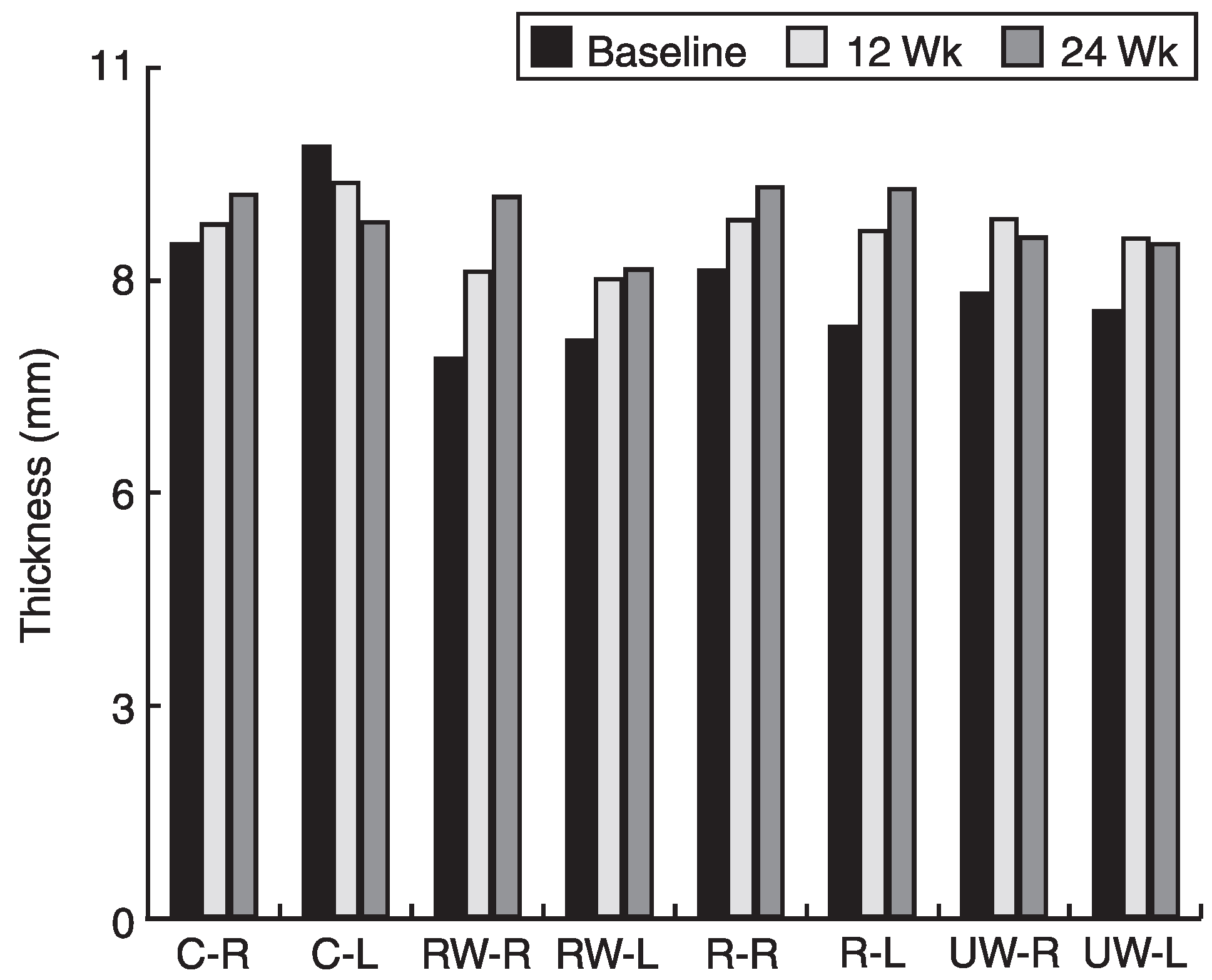
The results for the mean thickness of the abductor hallucis muscle for all four groups are shown in
Figure 1. For the control group, the mean thickness of the abductor hallucis muscle was 9.4 ± 2.3 mm at baseline, 9.3 ± 2.0 mm after 12 weeks, and 9.2 ± 2.1 mm after 24 weeks. The differences in mean muscle thickness at the three time points were not statistically significant (
P = 0.432).
Figure 1.
Mean thickness of the abductor hallucis muscles of each foot as measured with ultrasound. Measurements were taken at week 0 (baseline), week 12, and week 24. C-R, control right foot; C-L, control left foot; RW-R, restricted walking right foot; RW-L, restricted walking left foot; R-R, running right foot; R-L, running left foot; UW-R, unlimited walking right foot; UW-L, unlimited walking left foot.
Figure 1.
Mean thickness of the abductor hallucis muscles of each foot as measured with ultrasound. Measurements were taken at week 0 (baseline), week 12, and week 24. C-R, control right foot; C-L, control left foot; RW-R, restricted walking right foot; RW-L, restricted walking left foot; R-R, running right foot; R-L, running left foot; UW-R, unlimited walking right foot; UW-L, unlimited walking left foot.
With respect to the restricted walking group, the mean thickness of the abductor hallucis muscle was 7.4 ± 1.9 mm at baseline, 8.3 ± 1.8 mm after 12 weeks, and 8.9 ± 1.6 mm after 24 weeks. Analysis of the results indicated that there were statistically significant differences in the mean thickness of the abductor hallucis muscle among the three time points (P = 0.005). Pairwise multiple comparisons using the Holm-Sidak method found that there were no statistically significant differences in the mean thickness of the abductor hallucis muscle between baseline and 12 weeks and between 12 and 24 weeks. However, the mean muscle thickness at 24 weeks was significantly greater than that at baseline (P < 0.05).
Regarding the running group, the mean thickness of the abductor hallucis muscle was 8.0 ± 1.3 mm at baseline, 9.0 ± 1.6 mm after 12 weeks, and 9.5 ± 1.8 mm after 24 weeks. The differences in the mean muscle thickness among the three time points were statistically significant (P < 0.001). Pairwise multiple comparisons using the Holm-Sidak method found that there were no significant differences in the mean thickness of the abductor hallucis muscle between baseline and 12 weeks and between 12 and 24 weeks. However, the mean thickness of the muscle at 24 weeks was significantly greater than that at baseline (P < 0.05).
The results from the unlimited walking group found that the mean thickness of the abductor hallucis muscle was 8.0 ± 2.0 mm at baseline, 8.9 ± 1.3 mm after 12 weeks, and 8.8 ± 2.0 mm after 24 weeks. Statistical analysis revealed a significant difference in mean muscle thickness between the three time points (P = 0.036). Pairwise multiple comparisons using the Tukey post hoc test found no statistically significant differences in the mean thickness of the abductor hallucis muscle between baseline and 24 weeks and between 12 and 24 weeks. However, the mean muscle thickness at 12 weeks was significantly greater than that at baseline (P < 0.05).
The data for all groups and time points were analyzed for significant interactions between the two factors, The analysis indicated that there was no statistically significant difference in mean muscle thickness between groups when allowing for the effects of differences in time point (P = 0.139). However, there was a statistically significant difference (P < 0.001) in mean muscle thickness among the three time points after allowing for effects of differences in groups. A pairwise multiple comparison for time periods using the Holm-Sidak method found a significant difference in muscle thickness between baseline versus 12 weeks and baseline versus 24 weeks (P < 0.05), but no significant difference between 12 weeks versus 24 weeks. Finally there was no statistically significant interaction between groups and time periods (P = 0.122).
Examination of the completed weekly surveys found that no significant injuries (back, hip, knee, ankle, or foot pain) that could be identified as being a direct result of the minimalist shoes were recorded among the participants.
Discussion
The importance of transitioning to a minimalist shoe is supported by the evidence of injuries in runners who advance too quickly without taking the appropriate time to allow for adaptation. [
18] A review of the literature demonstrates that this factor has not been studied regarding minimalist shoes, although several authors have reported transition periods for barefoot running. [
19,
20] The study transitioned runners over a 6-month period using the 10% philosophy for increasing mileage. The 10% philosophy implies that there should be no more than a 10% increase in mileage per week while exposing the feet and lower extremities to the minimalist shoe. This same transition rule applies to runners who are increasing their mileage with any training program in any type of shoe. It is a means of gradual transition to reduce the occurrence of injuries.
The ultrasound measurements of the participants who walked with restrictions, walked with no restrictions, and ran after the transition protocol of 6 months in the minimalist shoes all demonstrated a significant increase in abductor hallucis muscle thickness. However, the differences in mean muscle thickness were not significant between any of the time periods for the control group. This finding was expected because the individuals in this group were instructed to wear any type of footwear (except minimalist footwear), with no restrictions on running or walking activities. In essence, there were no changes to the control subjects' daily routines. It should be noted that, with no significant interaction between group and time period, the observed differences in mean muscle thickness among the groups is not dependent upon the time period. One point that should be considered is that there are differences in shoe choices between men and women. Over time this should not have affected the results obtained in this study. However, it is a fact that some shoes are more supportive than others, which may have an effect on intrinsic muscle function.
Although the increase in muscle thickness over time was found to be statistically significant in the restricted walking, running, and unlimited walking groups, the actual maximum increase from baseline ranged from 0.9 to 1.5 mm. The clinical significance of this amount of increase with respect to strength gain of the muscle is not known. Correlation between increases in the cross-sectional area of the abductor hallucis muscle and strength gains is not well studied. The thickness of the abductor hallucis muscle in this study was only measured in one dimension and the cross-sectional area was not calculated. Future studies should be aimed at measuring the cross-sectional area of the abductor hallucis muscle to better determine the possibility of strength gains to this muscle.
This study recruited a moderate number of participants and implemented a slow transition protocol for the runners over 24 weeks. Similarly, Bruggemann et al [
3] transitioned runners to wearing Nike Free shoes during warm-up over 5 months and showed a significant increase in the anatomical cross-sectional area of intrinsic muscles. The increase in anatomical cross-sectional area of the abductor hallucis muscle in their study was approximately 5% as compared to the approximate 15% increase of the abductor hallucis muscle as measured in our study. [
3] This favorably shows changes in the feet of individuals wearing the VFF shoes.
Conversely, Ridge and colleagues [
21] reported no significant arch height increase in those who ran in VFF shoes for ten weeks; however, Ridge et al [
21] implied that they may have had significant findings with a longer study. Pes planus classically presents with a reduced medial longitudinal arch height. [
22,
23] A foot pronating throughout the entire stance phase may be associated with overuse injuries, such as patellofemoral pain syndrome, Achilles tendonitis, posterior tibial tendon dysfunction, plantar fasciitis, and hallux valgus. [
22-
27] Increasing the muscular support of the medial longitudinal arch by strengthening the extrinsic and intrinsic foot muscles may prevent abnormal pronation overuse injuries. [
4,
11,
22,
27] Contrary to previous practices of wearing supportive shoes and custom orthotic devices for these chronic injuries, [
28] there may be a benefit from functioning in minimalist shoes or even barefoot. Further research is needed to determine whether intrinsic muscle strengthening could be a component in preventing overuse injuries.
Concern exists as to whether running in VFF shoes can result in an increase in injuries. To date, few studies exist that examine running in VFF shoes and show no direct link to increased injury rates. Ridge et al [
21] examined the effects that VFF had on foot bone marrow edema. They concluded that increases in bone marrow edema are more common in individuals who were transitioning to the VFF; however, this could very well be the product of the physiologic phenomenon of osseous remodeling due to stress which is essential to the normal development and maintenance of bone. [
21] Their study demonstrated that two out of the 19 subjects developed stress fractures while running in VFF, according to the magnetic resonance image findings. They also failed to control foot strike patterns of the runners, which could have played a role in the increased stress leading to the fractures as demonstrated in recent literature. [
29-
31]
The individuals who transitioned to VFF shoes in this study reported no significant injuries over 48 weeks of running.
Limitations
One limitation of this study is that only the abductor hallucis muscle was evaluated with ultrasound in only one dimension so that the cross-sectional thickness of the muscle could not be determined. By having access to magnetic resonance imaging, a more comprehensive understanding of the effects of wearing VFF shoes on all of the intrinsic muscles could be obtained. According to previous studies, however, ultrasound imaging seems to be a reliable assessment for the abductor hallucis muscle. [
5-
7]
Another limitation to this study is that matched controls were not included. In retrospect, incorporating a control group that was provided a new pair of traditional running shoes and performed the same activities as each group wearing the VFF shoes would have improved the scientific reliability of the findings.
An additional limitation to this study is that the height of the navicular bone was not measured at various time periods. Performance of the navicular drop test would have been beneficial because it was found in other studies that this examination determines the height of the medial longitudinal arch. [
12,
25,
26,
27] A reduction in this height would indicate pes planus.
The time of day that the participants' abductor hallucis muscles were measured was not controlled, given the difficulty of getting the large number of subjects in to be assessed while using only one examiner to minimize observer variability. Future studies may consider performing these measurements at controlled times to account for any changes in the muscle mass resulting from an increase in blood flow that could occur during periods of exercise. Scientific literature does demonstrate an increase in muscle volume after moderate intensity activity but the duration is short lived. [
32] The participants in this study did not have the ultrasound measurements performed immediately after running, which makes the blood volume effect less likely to be a factor.
Another limitation of this study is that demographic data, such as existing activity levels and body mass index, were not recorded. Training surfaces and areas, one's pre-existing physical condition, and body mass all could play a role, albeit small, in identifying factors that could have led to an increase in the muscle size of the abductor hallucis.
Conclusions
Our study demonstrated that with proper transition, wearing the VFF Bikila shoe may increase abductor hallucis muscle thickness in runners, which may help prevent pathologic abnormalities resulting from intrinsic atrophy. By increasing abductor hallucis muscle thickness, with presumed associated strengthening of the abductor hallucis muscle, the medial longitudinal arch may be further supported. This medial longitudinal arch support may subsequently better control pronation and result in less pronatory foot injuries.
Financial Disclosure: The VFF Bikila shoes used in this study were donated by Vibram USA Inc. Vibram agreed to allow the results of this study to be published regardless of the results found.
Conflict of Interest: Dr. Campitelli was a member of the Vibram Medical Advisory Board (2010–2012). No financial support was received from Vibram for this study.