Hallux rigidus (HR) is a degenerative disorder characterized by a narrowed first metatarsophalangeal joint space, dorsal osteophytes, and reduced joint range of motion in the sagittal plane [
1]. Although cheilectomy is a favorable alternative in the early stages when conservative treatment fails [
2], wide-ranging surgical treatment options are available for the advanced stages, including metatarsal and phalangeal osteotomy procedures, resection arthroplasty, arthrodesis, and implant arthroplasty [
3,
4,
5]. The best treatment option for the disorder in the advanced stage remains controversial [
6,
7].
The cheilectomy procedure for HR involves dorsal incision; synovectomy; removal of intra-articular loose bodies and osteophytes localized in the metatarsal head and proximal phalanx; and medial, lateral, and plantar capsular release of the metatarsal head, followed by resection of the degenerated 30% dorsal portion [
8]. The method is considered advantageous in that it is a simple and less extensive procedure compared with other surgical options; it preserves the first metatarsophalangeal joint, hence allowing for further joint-sacrificing major surgical procedures; and it allows joint motion [
2,
9,
10,
11].
This study aimed to assess cheilectomy results in the surgical treatment of patients with grade III HR and to consider whether it is a preferable first-line treatment method to be used before joint-sacrificing surgical procedures available for the treatment of grade III HR.
Materials and Methods
Twenty-nine patients with moderate daily physical activity [
12]. (≥3 days of vigorous-intensity activity for ≥20 min/d or ≥5 days of moderate-intensity activity or walking for ≥30 min/d or ≥5 days of any combination of walking and moderate-intensity and vigorous-intensity activities achieving a minimum total physical activity level of ≥600 metabolic equivalent task minutes per week) underwent cheilectomy between January 1, 2009, and December 31, 2012. Of these, 21 patients (14 women and 7 men; mean age, 59.2 years; age range, 52–67 years) (22 feet) with regular follow-up and complete medical records were included in the study.
All of the patients had grade III HR according to the Coughlin-Shurnas grading system [
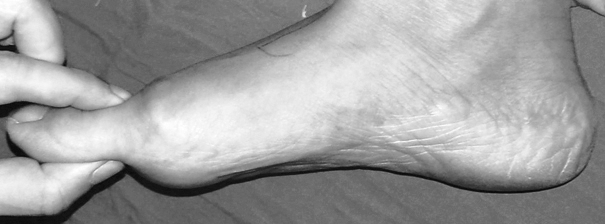
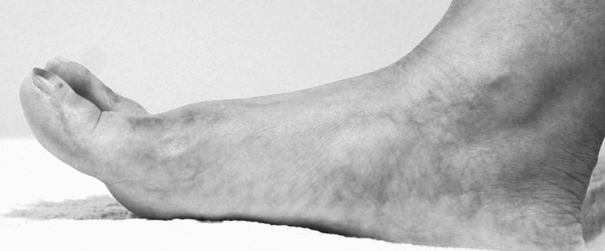
3]. Physical examination revealed that first metatarsophalangeal joint dorsiflexion movement was less than 10° (range, 0°–10°) in all of the patients, with pain in the first metatarsophalangeal joint being present throughout the arc of motion (
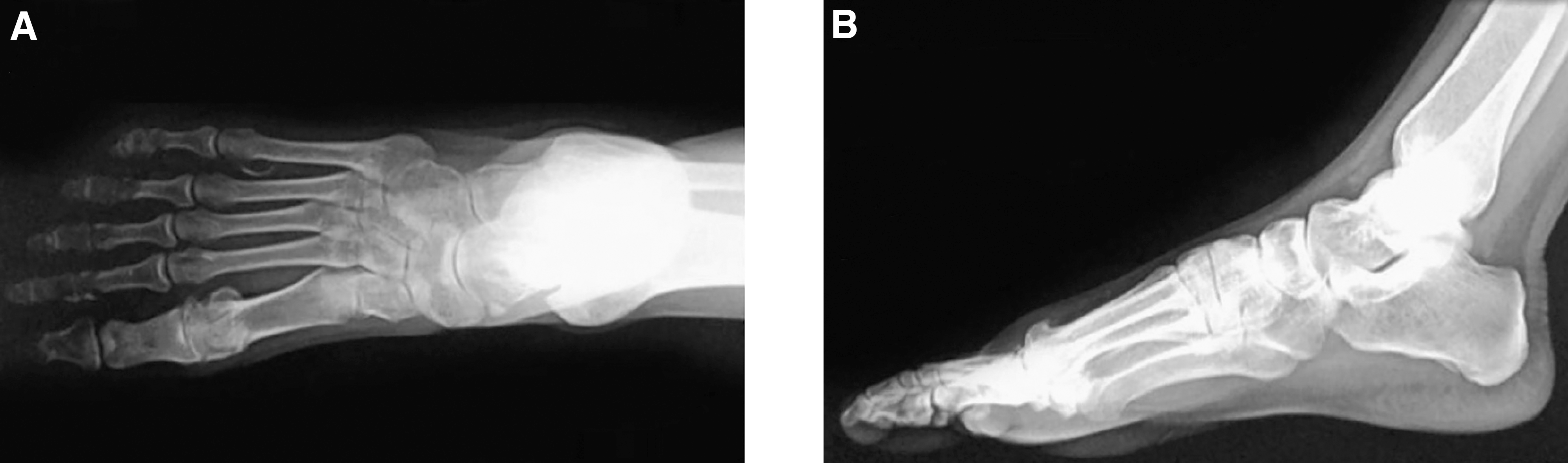
Figure 1). Radiographs demonstrated that all of the feet had dorsal, lateral, and medial osteophyte and periarticular cyst formation in the first metatarsophalangeal joint, with significant narrowing in the joint space on anteroposterior and lateral radiographs and more than 25% joint damage and sesamoid enlargement on the lateral radiograph (
Figure 2).
Figure 1.
Preoperative clinical view showing passive dorsiflexion of the first metatarsophalangeal joint.
Figure 1.
Preoperative clinical view showing passive dorsiflexion of the first metatarsophalangeal joint.
Figure 2.
Preoperative anteroposterior (A) and lateral (B) radiographs in the weightbearing position.
Figure 2.
Preoperative anteroposterior (A) and lateral (B) radiographs in the weightbearing position.
All of the patients in the study were known to have unsuccessfully resorted to nonsurgical treatments (nonsteroidal anti-inflammatory drug therapy, activity limitation, and use of shoe insoles) owing to complaints including forefoot pain while walking and inability to wear shoes.
The surgical method used was dorsal incision as described by DuVries [
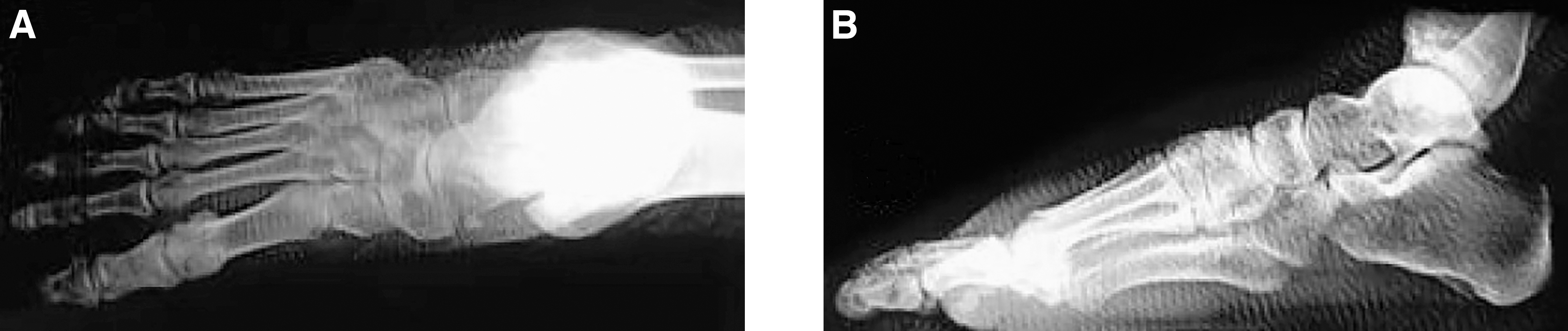
8]. All of the osteophyte formations and intra-articular loose bodies were removed. The capsule was released in the medial, lateral, and plantar aspects. The degenerated dorsal face of the metatarsal head, including approximately 30% of the joint, was removed by osteotomy (
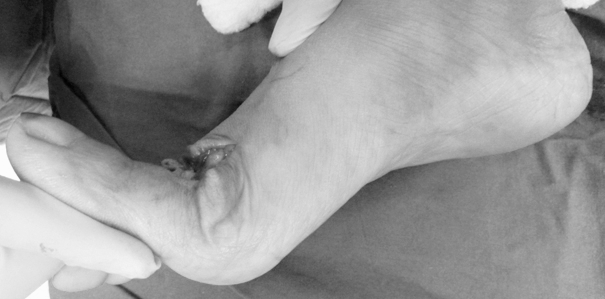
Figure 3). The metatarsophalangeal joint was brought to 70° passive dorsiflexion during the surgery (
Figure 4) [
13]. After making sure that there was no compression in the joint in dorsiflexion, the incision was irrigated and closed. A dressing was applied, and the foot was wrapped in an elastic bandage.
Figure 3.
A, Postoperative anteroposterior radiograph. B, Postoperative lateral radiograph revealing dorsal resection of 30% of the first metatarsophalangeal joint.
Figure 3.
A, Postoperative anteroposterior radiograph. B, Postoperative lateral radiograph revealing dorsal resection of 30% of the first metatarsophalangeal joint.
Figure 4.
Intraoperative postresection view of 70° passive dorsiflexion.
Figure 4.
Intraoperative postresection view of 70° passive dorsiflexion.
During the early period, wound care checks were conducted in the postoperative follow-up process. Brace or cast use was omitted because no stability issues were foreseen. To ensure complete healing in the soft tissue within the first 2 weeks, the patients were allowed to bear weight as tolerated with two crutches. The applied weight was increased after complete soft-tissue healing, with full weightbearing attained at the end of the sixth week. No special shoes were recommended for this period.
The patients were assessed in the preoperative and postoperative periods using the visual analog scale for pain and the American Orthopaedic Foot and Ankle Society metatarsophalangeal assessment forms [
14]. Furthermore, values for preoperative and postoperative active joint range of motion were compared. Postoperative evaluations with the visual analog scale, the American Orthopaedic Foot and Ankle Society metatarsophalangeal assessment forms, and joint range of motion were completed at the final follow-up visit. Patients were also assessed for the presence of transfer metatarsalgia, hypoesthesia, and infection in the final examination at the outpatient clinic. Mean follow-up was 24.8 months (range, 12–63 months). The results were assessed with the Wilcoxon statistical test. A
P < .05 was considered significant.
Results
The preoperative mean American Orthopaedic Foot and Ankle Society score of 53 (range, 29–67) improved to 78 (range, 57–92) postoperatively (Wilcoxon test
P = .001). The preoperative mean active joint range of motion, with a mean arc of motion of 13° (range, 5°–24°), was found to be 41° (range, 31°–56°) in the postoperative active joint range of motion evaluation (Wilcoxon test
P = .001) (
Figure 5). The preoperative mean visual analog scale score of 89 (range, 60–100) improved to 29 (range, 0–70) in the postoperative period (Wilcoxon test
P = .001).
Figure 5.
Postoperative clinical view taken at the month 26 examination showing active dorsiflexion of the first metatarsophalangeal joint.
Figure 5.
Postoperative clinical view taken at the month 26 examination showing active dorsiflexion of the first metatarsophalangeal joint.
None of the patients exhibited subluxation at the metatarsophalangeal joint or transfer metatarsalgia. Footwear complaints ended in all of the patients. Three patients exhibited minor hypoesthesia around the scar tissue at the surgery site. No superficial or deep soft-tissue infection findings were observed in any of the patients.
Discussion
Although cheilectomy is a surgical method commonly recommended and implemented for the treatment of early-stage HR [
2,
3,
4], there are several surgical treatment options for advanced-stage HR, such as cheilectomy, corrective phalangeal or metatarsal osteotomy, metatarsophalangeal arthrodesis, resection arthroplasty, and implant arthroplasty [
3,
4,
5,
15]. However, the optimum option for the treatment of grade III HR remains controversial [
6,
7,
9,
16].
There are several studies claiming that although cheilectomy is a simple, convenient, and reliable method that reduces pain complaints and improves functional scores in patients, it fails to prevent the progress of the disorder, it is not a permanent treatment method, and hence, it should be preferred only for the early stage of the disorder [
2,
3,
17,
18]. Although Coughlin and Shurnas [
3]. reported that five of nine patients with grade IV HR treated with cheilectomy were revised to arthrodesis in 6.9 years, poor cheilectomy results reported by Hattrup et al [
19]. for grade I and grade III HR were 15% and 37.5%, respectively. A recent systematic review article reports the revision requirement for patients treated with cheilectomy to be 9% for grade III HR and 56% for grade IV HR [
7]. In this study, statistically significant improvement was observed in patients' pain and functional scores, and no revisions were required. The relative shortness of the follow-up period and the low level of physical activity among the patients are believed to have a positive influence on the results.
Although cheilectomy is claimed to be a method with high patient satisfaction and few complications in the literature [
20], patient satisfaction attained in almost all of the cases in the early stage is reported to be reduced in grade III HR, with two of every three patients being satisfied with the results [
21]. On the other hand, there is a further view claiming that satisfaction in patients with HR treated by cheilectomy is not correlated with the stage of the disorder. In their case series, where 67 patients who underwent cheilectomy were followed up for 65 months with 78% general patient satisfaction, Feltham et al [
16] reported 91% patient satisfaction for patients older than 60 years and asserted that there is no statistically significant difference between the stage of the disorder and the satisfaction results of the patients. Despite the fact that the mean age in this study was 59.2 years, it is considered that the fair results attained regarding functionality are related to the moderate level of physical activity of the patients, and, therefore, cheilectomy is a preferable surgical option not only in young and physically active patients but also in older patients with relatively low physical activity.
The key advantages of cheilectomy for the treatment of grade III HR are that it is a relatively simple surgery technique that allows faster return to daily activities and that it does not inhibit further surgical methods when revision is required [
3,
4,
7,
13,
20,
21,
22,
23]. In a 189-patient study with mean follow-up of 3.2 years conducted for determining how long a cheilectomy can be expected to delay relatively radical surgical interventions, the success rate of cheilectomy is reported to be 98.5% [
15]. The study, with a failure rate of 1.5%, claims that there is no significant correlation between the rate of failure and the stage of the disorder and emphasizes that cheilectomy is a method that entails good results in every stage of the disorder when used before more extensive, joint-sacrificing surgical methods [
15]. Similarly, the literature also includes studies and meta-analysis data that recommend cheilectomy as the first option to be preferred in the surgical treatment of HR and claim that revision requirement after the procedure is not common [
7,
20]. In the final postoperative examination at the outpatient clinic, patients who had not benefited from conservative treatment in the preoperative period and who previously presented with forefoot pain and footwear complaints were found to be satisfied with the results of cheilectomy, with a significant reduction in pain and no footwear complaints.
The drawbacks of this study include that it is a retrospective study with no control group and a relatively short follow-up period. On the other hand, the results of the study are believed to have the potential to contribute to the literature because the cohort of patients is homogenous and there are a limited number of studies assessing the sole use of cheilectomy in the treatment of patients with grade III HR.
In light of the satisfactory functional results obtained in the patients in this study, cheilectomy is considered a simple and repeatable procedure to be considered as a first-line option for the surgical treatment of grade III HR, which allows for further joint-sacrificing surgical procedures when required. Prospective studies assessing more patients would shed more light on the efficiency level of cheilectomy in the treatment of grade III HR.