The views expressed herein are those of the authors and do not reflect the official policy of the Department of the Army, the Department of Defense, or the US Government.
Acinetobacter baumannii is a gram-negative, aerobic, nonmotile bacterial species found in soil, water, sewage, and, increasingly, health-care settings. [
1] This organism is one of the most troublesome pathogens in health-care settings due to its ability to gain or upregulate antibiotic drug–resistant determinants. [
2] Transmission is via contact with contaminated surfaces or person-to-person contact. Outbreaks have been associated with the use of respiratory and wound care equipment, humidifiers, and invasive devices such as urinary catheters. [
3]
Acinetobacter baumannii is usually found in hospital settings in critically ill patients, such as those in the intensive care unit, and can cause pneumonia, meningitis, bacteremia, urinary tract infections, and wound infections. [
3] Individuals with weakened immune systems, diabetes, open wounds, chronic lung disease, or a prolonged hospital stay are the most susceptible to infection by this organism. [
1] Healthy individuals are at low risk.
The prevalence of
A baumannii in hospital settings is suspected to be a result of resistance to antimicrobial drugs, desiccation, and disinfectants. Studies have suggested that
A baumannii infection is associated with increased mortality in patients with underlying health conditions but is not an independent factor for mortality.
Acinetobacter baumannii is the leading bacterial species associated with combat-related infections and is rarely found in podiatric medical infections in young, healthy patients not in a deployed setting. [
4]
As a result of the US involvement in Iraq and Afghanistan, numerous cases of drug-resistant organisms, particularly
A baumannii, have been reported in war casualty wounds. [
5] In a study of 35 combat soldiers with open tibial fractures,
A baumannii was identified as the most commonly isolated organism, detected in 32.5% of the cases. Follow-up wound cultures showed no presence of
A baumannii after initial treatment. Uncertainty still remains as to whether contamination occurred at the moment of injury, during initial care, or during transport to various facilities before arriving at a hospital in the United States. [
5]
Emerging multidrug-resistant
A baumannii present in military personnel with traumatic injuries has caused wound infections, osteomyelitis, respiratory infections, and bacteremia. To evaluate the source of infection, samples were taken from the skin of patients, from soil, and from multiple field hospital environments. Sampling kits, containing 25 swabs, were used to sample selected surfaces in and around treatment areas and the soil environment within 25 m of the field hospital. [
4] Copan Venturi swabs (Copan Diagnostics Inc, Murrieta, California) were passed over sample surfaces, labeled, and shipped at room temperature by express courier to Walter Reed Army Medical Center (Bethesda, Maryland) for processing. [
4] Of the 49 soil samples evaluated, 18 were collected during environmental sampling using the standard protocol and 31 were archived soil samples. [
4] The archived soil samples were collected between March 2003, and December 2004, from locations throughout Iraq and Kuwait during routine combat theater environmental assessment. [
4] The archived soil samples were stored in screw-top Teflon jars (Savillex, Eden Prairie, Minnesota) at 2°C to 6°C at the US Army Center for Health Promotion and Preventive Medicine (Aberdeen Proving Ground, Maryland). [
4] Of 160 patients,
A baumannii-calcoaceticus was detected on the skin of only one (0.6%). Of the 49 soil samples examined,
A baumannii-calcoaceticus complex organisms were found in one (2%);
A baumannii-calcoaceticus complex isolates were found in all seven treatment areas evaluated. Findings from this study suggest that
A baumannii-calcoaceticus complex infection is strongly associated with contamination of field hospitals and infection transmission in hospital settings. [
4]
The reason for presenting this case is that the presence of A baumannii in a traumatic wound of unknown pathogen acquisition in an unlikely carrier is not a typical presentation. The elusive nature of A baumannii and the minimal treatment protocol points to the relevance of describing the successful treatment method in this case.
Case Report
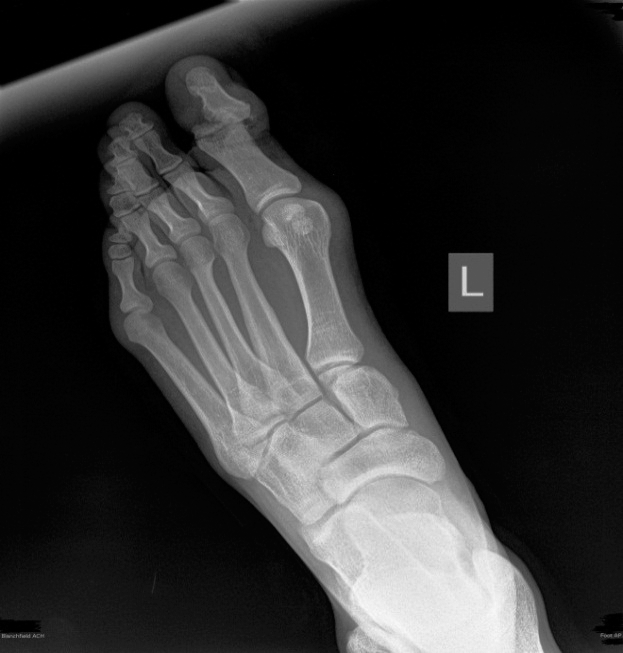
A 30-year-old US Army soldier was hooking a trailer to a vehicle when the trailer inadvertently dropped onto his left hallux. The trailer was removed immediately, revealing a deep transverse laceration that exposed bone on the dorsum of the left hallux. In the emergency department, radiographs revealed a medially displaced oblique fracture of the distal phalanx base, with joint depression of the left proximal phalanx (
Fig. 1). Clinically, the distal portion of the left hallux was attached by the plantar soft tissues only. The skin color was normal, and the neurovascular status was intact. The patient was administered 1 g of cefazolin and 10 mg of morphine intravenously, along with a local nerve block, and all of the visible debris was removed with normal saline irrigation. A basic metabolic panel and a complete blood cell count with an automated differential cell count were within normal limits.
Figure 1.
Initial anteroposterior foot radiograph.
Figure 1.
Initial anteroposterior foot radiograph.
Formal surgical irrigation and debridement was delayed 6 hours because the patient had eaten an hour before the injury. Intraoperatively, the patient received 2 g of intravenous cefazolin after culture samples were obtained and before irrigation. No tourniquet was used during the procedure. The toe was fixated with two crossed 0.045 Kirschner wires entering the distal aspect of the left toe and extending proximally. The extensor hallucis longus tendon and capsular tissue was repaired, and the skin was loosely reapproximated with nylon sutures. The patient was admitted to the hospital for continuation of intravenous cefazolin administration and pain management.
On postoperative day 1, the patient's pain was well controlled, and there were no clinical signs of infection. The patient was discharged in stable condition with the following medications: oxycodone and acetaminophen (Percocet; Endo Pharmaceuticals Inc, Malvern, Pennsylvania), 5 mg; docusate, 100 mg; and promethazine, 25 mg.
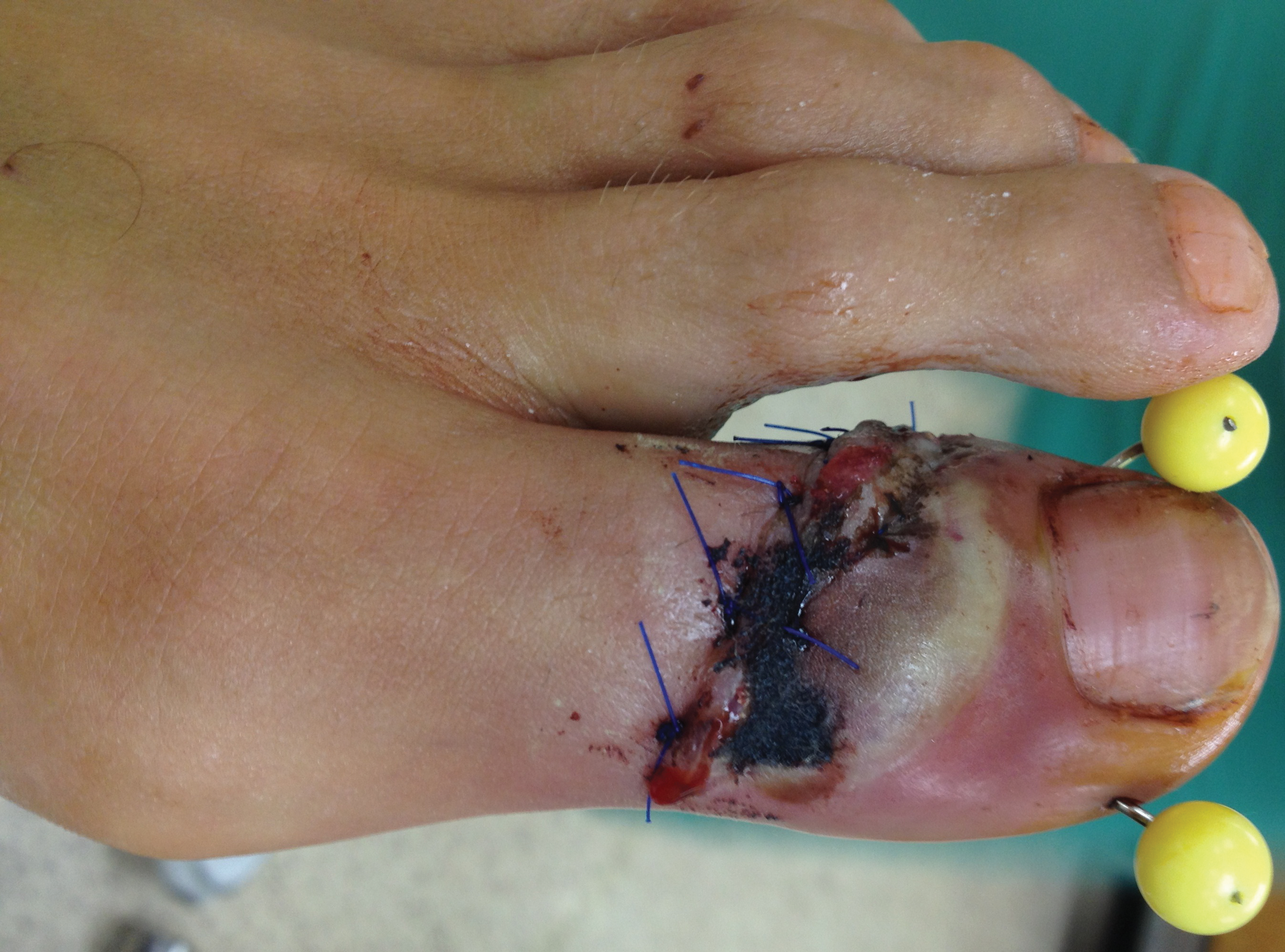
Six days after surgery the patient returned to the clinic for his first postoperative visit and noted increased pain. The left hallux was erythematous and tender to palpation, with cloudy drainage along the wound line (
Fig. 2). Intraoperative cultures were positive for
A baumannii. Inflammatory markers revealed an elevated erythrocyte sedimentation rate of 45 mm/h and C-reactive protein level of 22.2 mg/L. The patient was readmitted to the hospital for pain control and intravenous antibiotic drug therapy. After consultation with the clinical pharmacist, the patient was given oral ciprofloxacin, 750 mg twice daily, and rifampin, 300 mg once daily, due to more effective penetration of bone compared with intravenous delivery of these medications. The patient's symptoms improved, and he was discharged on the antibiotic drug regimen with instructions to apply an antibacterial-absorbent dressing to the wound three times daily.
Figure 2.
First postoperative visit.
Figure 2.
First postoperative visit.
Fourteen days after the injury, the local erythema was resolving and the wound had minimal drainage and was covered with eschar. The erythrocyte sedimentation rate and C-reactive protein level had also decreased to 32 mm/h and 12.6 mg/L, respectively. A formal infectious disease consult was obtained at this time due to the rarity of the bacteria, the geographic exposure of the patient during several previous deployments required for his job, and the open fracture sustained. A recommendation was made to have a peripherally inserted central catheter inserted to administer intravenous tigecycline and amikacin for an additional 4 weeks. These antibiotics caused gastrointestinal issues, and the patient was transitioned to 1 g of meropenem daily for completion of therapy.
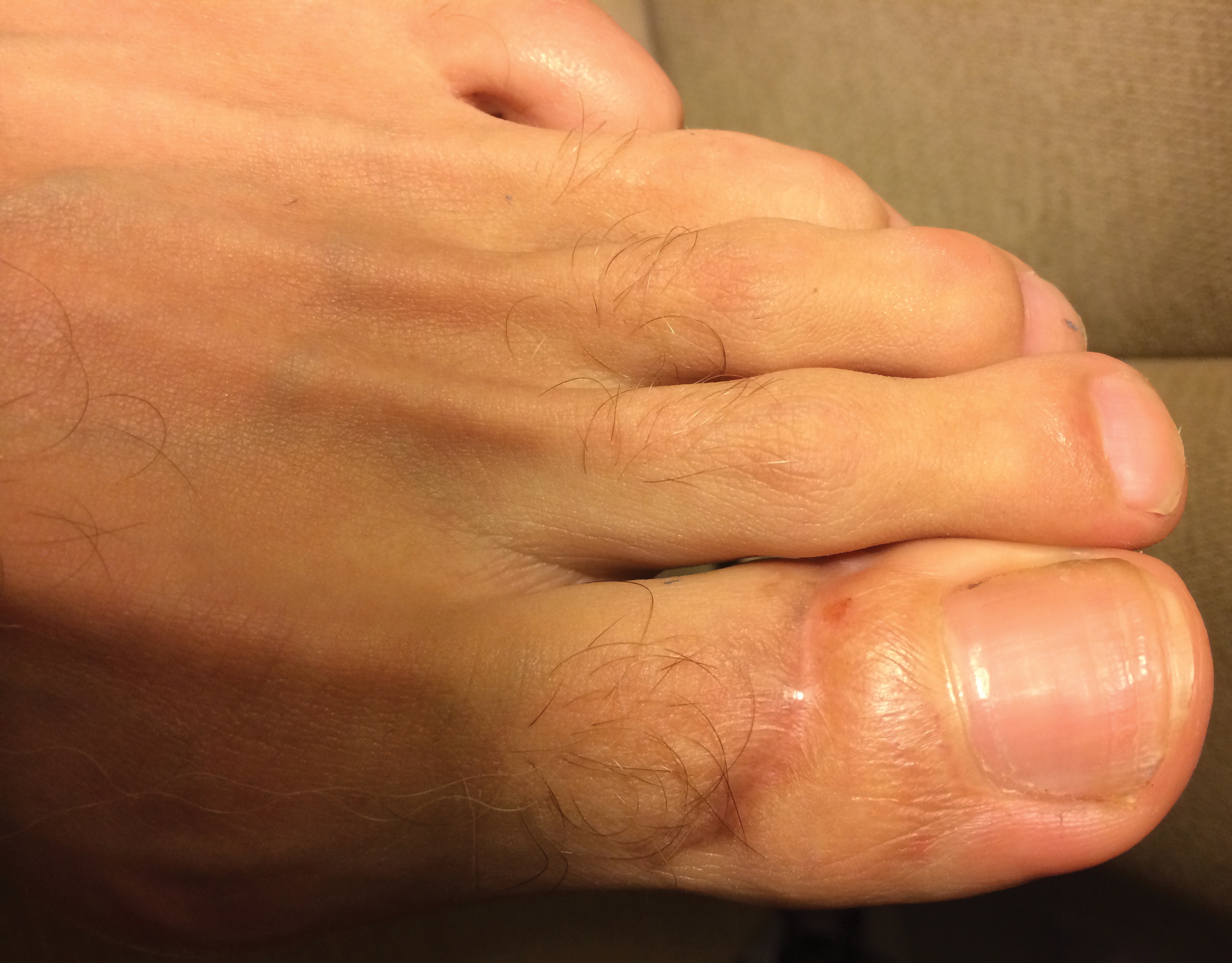
The Kirschner wires were removed at 6 weeks, and the patient advanced to weightbearing as tolerated in a CAM walker boot. The wound continued to be debrided weekly until a red, granular wound bed was seen. A hydrocolloid dressing was used for the final healing stages. Four months after injury, the range of motion of the hallux was normal, there was no pain with palpation, and full sensation was noted (
Fig. 3). The patient has maintained full-duty requirements with no issues 13 months after injury.
Figure 3.
Four months postoperatively.
Figure 3.
Four months postoperatively.
Conclusions
The elusive nature of
A baumannii and the minimal treatment protocol points to the relevance of describing the successful treatment method in this case. Treatment of
A baumannii is difficult due to its ability to resist multiple antibiotic drugs. [
2] Although the direct point of transmission is unclear, the enforcement of infection control procedures, such as standard precautions, hand hygiene, and environmental disinfection, should be a direct focus to minimize the risk of transmission of
A baumannii infection. In addition, the development of a strategic plan may be necessary to prevent the transmission of pathogens such as
A baumannii in military field hospitals. [
4,
5] Despite notable research advances in understanding
A baumannii, many uncertainties still remain. The ability of
A baumannii to disseminate is alarming and raises concern about global spreading. Future research, new therapeutics, and a focus on prevention are necessary to control the dissemination of
A baumannii. Due to the narrow range of treatments, new therapeutic options, additional clinical trials, and recognizing the importance of preventing
A baumannii infections are key to maintaining a healthy health-care facility.