This is a retrospective study to review the diagnostic results of laboratory testing with calcofluor white/potassium hydroxide (KOH), fungal culture (FC), and periodic acid–Schiff (PAS) in the process of confirming the presence of fungal elements in suspected onychomycotic toenail. The data reviewed were from July 1, 2002, to December 31, 2010. The study also looked at the cost of each diagnostic test in the institution where the study was conducted (Penn State Milton S. Hershey Medical Center, Hershey, PA). Moreover, we observed the relationship between sex variables.
Onychomycosis is a fungal infection seen in the nail that can be caused by dermatophytes, yeasts, or nondermatophyte molds. Toenails are more commonly affected than are fingernails, especially the big toe or second toe. [
1] It represents the most common nail disorder, with approximately 2% to 13% of the general population being affected, with an increase to 48% in individuals older than 70 years. [
2]
Dermatophytes are the most common causative organisms, composing approximately 90% of toenail infections and 50% of fingernail infections. Distal subungual onychomycosis is most often seen in clinical practice. This type of onychomycosis is characterized by invasion of the nail bed and the underside of the nail plate in a distal to proximal direction. The nail becomes thickened, with a change in shape, and the nail plate is elevated from the nail bed. However, other nail disorders, such as psoriasis, lichen planus, and traumatic onychodystrophies, may mimic the appearance of onychomycosis. [
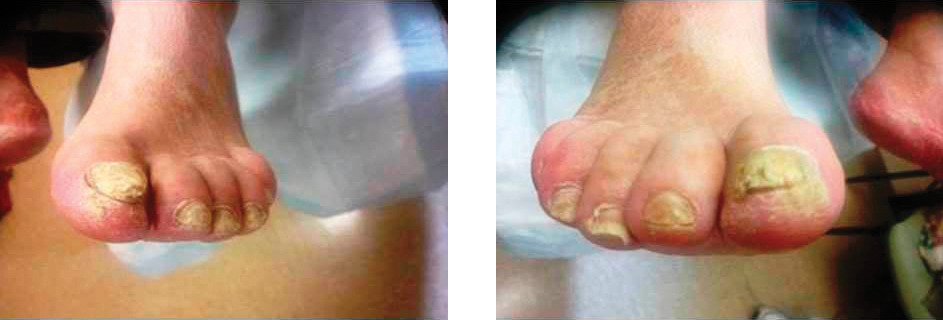
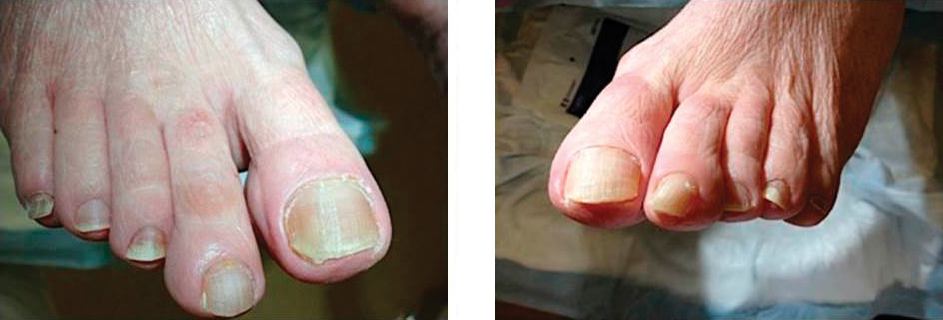
1] Examples of mild and severe disease are pictured in
Figures 1 and
2.
Figure 1.
Mild onychomycosis.
Figure 1.
Mild onychomycosis.
Figure 2.
Severe onychomycosis.
Figure 2.
Severe onychomycosis.
To diagnose onychomycosis, a clinician must use the patient's history, physical findings, and diagnostic test results. The gold standard in many cases is KOH microscopy and FC. In this study, we used FC as the gold standard because mycologic culture remains the indisputable best choice of mycologic diagnostics. Other laboratory tests also have been used to determine the presence of onychomycosis, such as PAS and polymerase chain reaction. Although all of these tests can be performed, it is best to use the test with the greatest percentage of reliability or with the most sensitivity and specificity. It has been unclear as to which test is the most reliable to detect a positive result.
In addition to diagnostic tests, there are other clinical signs that can be used to determine the probability that a patient has onychomycosis. Garcia-Doval et al [
3] evaluated a clinical diagnostic rule for onychomycosis using different findings seen in patients with proven onychomycosis. The results demonstrated that in patients with plantar desquamation or a history of interdigital tinea pedis, the diagnosis was more likely to be onychomycosis. This clinical sign can be used to either treat without testing or justify the use of one test to verify the diagnosis instead of performing multiple diagnostic tests that are less reliable.
Treatments were available for patients with onychomycosis; however, some insurance companies required authorization for antifungal medication and requested laboratory results to confirm infection. This study examined the use of calcofluor white/KOH microscopy, FC, and PAS staining to diagnose onychomycosis in patients with positive clinical findings. The objectives were to compare the reliability of KOH, PAS, and FC diagnostic results for confirmation of fungal disease of the toenails and to determine their sensitivity and specificity. This will help physicians evaluate which single test can be used to positively diagnose a patient with onychomycosis and which test is the most cost-effective.
Methods
Population
Patients were chosen by International Classification of Diseases, Ninth Revision codes from those seen in the office between July 1, 2002, and December 31, 2010. These patients had yellow, thickened, and dystrophic toenails that were clinically determined to be onychomycosis. One hundred eight patients (76 women and 32 men) aged 23 to 87 years were sampled. The institutional review board of Penn State Milton S. Hershey Medical Center approved this study on July 15, 2010.
Collection of the Samples
Toenail samples were collected by cleaning the nails first with alcohol and clipping the nail plates with a sterile nail cutter and removing fungal debris from under the nail plate. The nails were cut back as far as possible without excessive participant discomfort. The clippings and debris were placed in a sterile cup and sent to the laboratory for KOH microscopy, FC, and PAS staining.
KOH Microscopy
Each specimen was placed on a glass slide, and a drop of 10% KOH was placed on the slide. The slide was heated for 3 to 5 min to clear up the material. Then, one to five drops of 10% KOH was added, and the slide was examined under a microscope to determine the presence of fungal elements, such as hyphae and spores. The calcofluor white/KOH staining procedure was performed at Penn State Milton S. Hershey Medical Center, Hershey, Pennsylvania, before 2002 and during the data collection period.
The procedure is as follows: 1) Place the material to be examined onto a clean glass microscope slide. 2) Add a drop of 15% KOH and mix. 3) Add a drop of the calcofluor white solution and mix. 4) Place a cover glass over the material. 5) If necessary, allow the KOH preparation to sit at room temperature (25°C) until the material has been cleared. The slide may be warmed to speed the clearing process, especially for nails or skin. 6) Observe the preparation by ultraviolet/blue-violet microscopy. If dematiaceous fungi are suspected, the preparation should also be examined using brightfield microscopy.
Fungal Culture
Each specimen from the nail clippings was placed on a petri dish containing cornmeal agar with polysorbate. These media are the standard of practice isolation media in mycology laboratories. As selective media, they are specifically designed to support the growth of pathogenic fungi and suppress the growth of bacteria and saprophytic molds. Each specimen was incubated at 22°C to 26°C for 48 to 72 hours. Then the growth was examined under the microscope to identify the organism, if one was present. The culture sometimes took up to 3 to 4 weeks before sufficient growth was present for examination. Our laboratory accepts any amount of tissue or nail for culture. Our facility employs medical technologists and medical laboratory technicians who are trained and proficiency tested for performance in accordance with the College of American Pathologists. All records are maintained in the Department of Pathology and are available for audit.
PAS Staining
Each specimen was cut into 5-μm sections and then placed on a slide that was deparaffinized and hydrated in distilled water. Then the specimens were oxidized in periodic acid for 5 min, rinsed in distilled water, and stained in Schiff's reagent for 15 min. The slides were then washed with tap water for 10 min, counterstained in Gill's III hematoxylin for 4 min, and then rinsed three times with distilled water. The slides were placed in ammonia water for 1 min, rinsed again, and then dehydrated in xylene. After staining, the slides were examined under the microscope for fungal elements.
Collection of Data
The results of the KOH, FC, and PAS tests were collected using medical records. Each test result was recorded as either positive or negative for each individual. Statistical analysis using the kappa test was performed. Standard operating procedures were followed in the mycology laboratory. The standard operating procedures were reviewed annually by the microbiology supervisor and signed off by the microbiology medical director for consent and edits. Reviews of the standard operating procedures by laboratory personnel were documented.
Results
Summary Statistics
One hundred eight patients were sampled. A summary of the results from the three tests (PAS, FC, and KOH) of fungal disease of the samples is given in
Table 1. More than 50% of the time the three tests were in perfect agreement (29.6% all negative and 23.1% all positive). The overall result was considered positive if the results of any one of the three tests were positive. Additional summary results are provided in
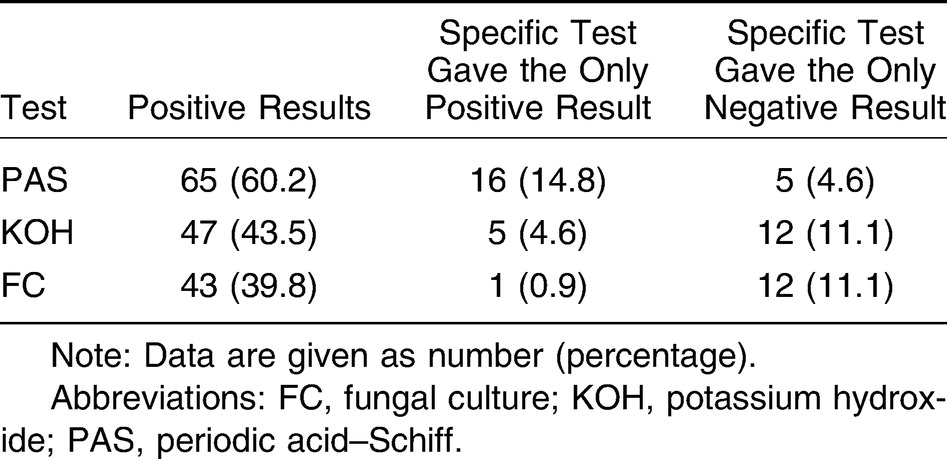
Table 2. As expected, PAS had a higher percentage of positive signals (60.2%) than the other two tests. The PAS test was more likely to be the only test to give positive results. Fungal culture and KOH tests were more likely to be the only tests to yield negative results.
Table 1.
Summary of the Results of All Three Tests
Table 1.
Summary of the Results of All Three Tests
Table 2.
Additional Summary Results from All Three Tests
Table 2.
Additional Summary Results from All Three Tests
Agreement Between the Tests, Measured Kappa Statistic
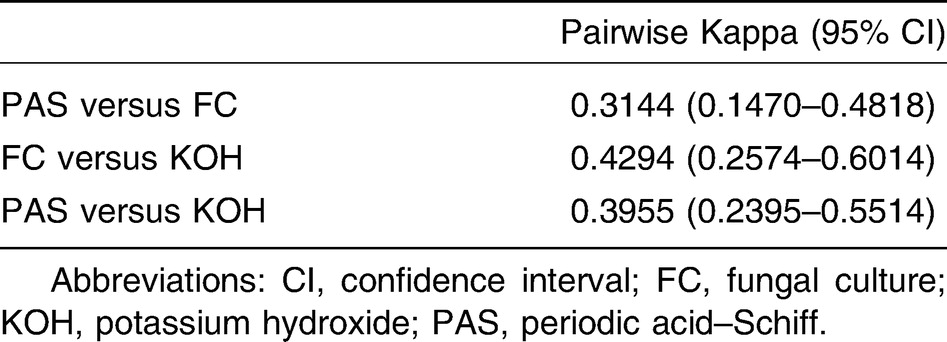
Agreement between the three tests (PAS, FC, and KOH) was evaluated by the Cohen kappa statistic. For each pair of tests, the kappa coefficient and its 95% confidence interval is listed in
Table 3. In general, the levels of agreement for these three pairs of tests were between fair and moderate. The agreement between FC and KOH is slightly higher than the agreement between PAS and FC and between PAS and KOH, but the difference is not statistically significant because their confidence intervals overlap with each other.
Table 3.
Kappa Statistics for the Agreement Between Tests
Table 3.
Kappa Statistics for the Agreement Between Tests
Sensitivity and Specificity Analysis
We evaluated the sensitivity and specificity of the three tests. Sensitivity is the probability that an individual with fungal disease has a positive test result; specificity is the probability that an individual without fungal disease has a negative test result. A formal sensitivity and specificity analysis requires the existence of a gold standard, which should be independent of the tests being evaluated. In this study, we used FC as the gold standard because mycologic culture is the indisputable best practice of mycologic diagnostics [
4] to evaluate the sensitivity and specificity of the KOH and PAS results.
The results using FC as the gold standard are listed in
Table 4. With FC used as the standard, PAS had higher sensitivity than KOH, but the difference was not statistically significant. The specificity of KOH was statistically significantly higher than that of PAS.
Table 4.
Sensitivities and Specificities for PAS and KOH Using FC as the Gold Standard
Table 4.
Sensitivities and Specificities for PAS and KOH Using FC as the Gold Standard
Observed Sex Demographic Variable
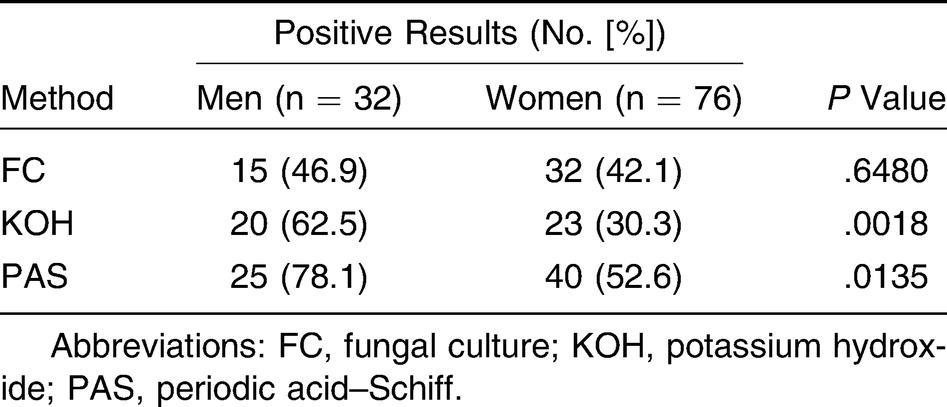
The PAS stain and KOH tests had a higher percentage of positive results for men than for women.
Table 5 summarizes this observation.
Table 5.
Patients with Positive Test Results by Sex
Table 5.
Patients with Positive Test Results by Sex
Cost Comparison
The PAS test is the most expensive of the three tests to perform. At our institution, in 2002 through 2010, PAS had a technical charge of
$125 and a professional charge of
$163, making the total cost to perform this test
$288. The KOH and FC together had a charge of
$110, which made the PAS more than twice as expensive. In the study by Lilly et al, [
2] a cost analysis was performed for multiple diagnostic tests, and PAS was the least cost-effective and KOH with chlorazol black (which was not evaluated herein) was the most cost-effective. These results took into account the Medicare reimbursement and cost in the private practice. The question is whether the ability to more accurately verify the diagnosis of onychomycosis is worth the extra cost of the PAS. If the provider's goal is to prove that the patient has a fungal infection, the best way is to perform the PAS test only because it provides more reliable and consistent results. The sooner the patient can be given a proven diagnosis, the sooner treatment can be started. Our Penn State Milton S. Hershey laboratories produced the results for PAS in 48 hours, whereas FC results ranged from 3 to 4 weeks. The PAS test affords a quicker result and perhaps a decrease in the start time for the treatment course, if additional correlating clinical symptoms are present.
These results will be helpful to dermatology, podiatric, orthopedic, and primary-care health providers. By using PAS, clinicians can treat patients after performing one test that is quicker than the previous standard test, which aids in treating patients in a timely manner. The PAS test had been shown to have greater sensitivity compared with other diagnostic tests in other studies and in this study. Although KOH and FC are less expensive, the rate of false-negatives for KOH can range from 5% to 15%, and FC can be contaminated, leading to false-positive results. [
5] The PAS test provides results in 24 to 48 hours and is relatively simple to perform.
The results of this study provide our health-care providers with one single test to order, which provides a confidence level for a positive result rather than multiple tests with lower confidence levels. The results of this study also may reduce the cost to the patients overall if only a single test rather than multiple tests are submitted for examination. The PAS test alone is more costly but is still inexpensive compared with PAS, KOH, and FC together.
Discussion
A sample was considered positive if any of the tests gave a positive result. Of all of the samples, more than 50% had test results that were either all positive or all negative. The PAS test had the highest percentage of positive results (60.2%) and was more likely to be the only positive test result. The KOH test result was positive for 43.5% of the samples, and the FC was positive for 39.8%.
Sensitivity was highest with PAS (0.79) when the gold standard was considered to be FC. The sensitivity of KOH was 0.64. With FC as the standard, the specificity was 0.54 for PAS and 0.79 for KOH. As anticipated, KOH had the greater specificity and PAS had the greater sensitivity based on 95% confidence intervals.
The observed sex demographic variable demonstrated that men had a higher percentage of positive results than women.
These results are in accordance with those of other studies. In the review by Lawry et al, [
6] PATHPAS had the highest frequency of positive results and the greatest sensitivity in a comparable population. Similarly, in the study by Weinberg et al, [
5] sensitivity was 92% for PAS, 80% for KOH, and only 59% for FC. The reason for the FC yielding lower results comes from the thought that fungal elements are more difficult to culture than to stain. Staining also can provide a different diagnosis for the nail dystrophy, such as psoriasis or lichen planus. [
6]
Some suggestions for future studies include determining the clinical outcomes of individuals who tested positive to ascertain whether a proven diagnosis had any significance in successful treatment. Comparing male and female patients, male patients seem to have positive results more frequently than female patients. This could be an area of future study also. It would be interesting to know whether men overlook the beginning signs and go without treatment longer or whether there is a metabolic reason that could contribute to the frequency.
Limitations
The sample size and population were limited; only patients at the Penn State Hershey Bone and Joint Institute were included. Treatment results for patients with positive test results were not included.
Conclusions
The three tests evaluated in this study are commonly used in everyday practice. Determining which has the most utility is helpful for professionals treating patients with onychomycosis. The PAS test was the most consistent of the three tests to yield a positive result. Therefore, it is a more reliable test for a positive result. This study shows that PAS has higher sensitivity than KOH when FC is used as the gold standard. Moreover, the study (data not shown) revealed that the agreement between PAS and the overall results was significantly higher than that for KOH and FC. Specificity was higher for KOH and FC. Because the patients in this experiment were clinically diagnosed as having onychomycosis, specificity was not as relevant as sensitivity. The PAS test would be the single most appropriate test to verify a positive result for onychomycosis in this population.