Methods
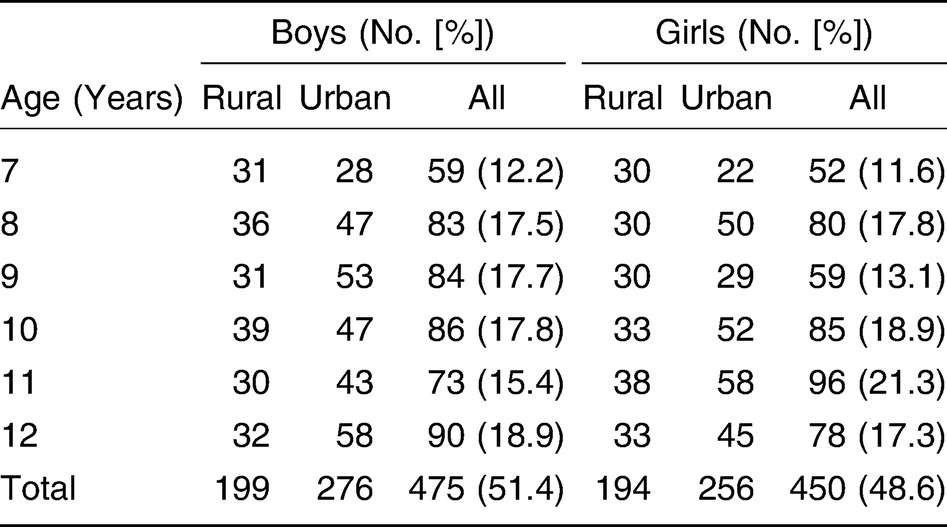
A podoscopic foot examination was performed on 925 children aged 7 to 12 years who were residents of Kraków, Poland (532 children [57.5%]), and suburban villages (393 children [42.5%]). The group consisted of 450 girls (48.6%; 256 urban and 194 rural) and 475 boys (51.4%; 276 urban and 199 rural). In this study, the selection of public schools and children was randomized. The authors who conducted the study (R.W. and A.B.) were trained to make the measurements. Headmasters and parents were informed about the aims and the time of the study and about the study methods. The study was conducted with the approval of the headmasters and parents. In addition, before the study, every child was asked to give consent for making measurements. This study was conducted in accordance with research ethics and the Declaration of Helsinki. The participants' caregivers signed a written consent form agreeing to the participation of their children in the study and to their data being processed for the purposes of the project. All of the measurements were repetitive.
Table 1 presents the number of children by age group.
Table 1.
Number of Study Children by Age Group
Table 1.
Number of Study Children by Age Group
Children with congenital structural disorders affecting the areas below the ankle joint and those with pathologic flatfoot caused by cerebral palsy, surgical treatment, genetic conditions, or neurologic or muscle abnormalities were not included in the study group.
A Martin-type anthropometer was applied to measure body height. Body mass was measured with electronic scales, and three skinfolds (abdominal, triceps, and subscapular) were measured with a caliper. In addition, fat mass and fat-free mass were measured using the Tanita analyzer (Tanita Corporation of America, Inc, Arlington Heights, Illinois). The Tanita analyzer is a simple and proper method for assessing the obesity level.[
17]
A podoscopic examination was performed to determine the MLA. Each time both feet were subjected to examination, they were scanned twice: the first scan was performed to calibrate the equipment, and the second one was a real measurement. On the basis of the picture obtained during the second scan, foot-arching parameters were calculated (FA). The researcher marked, by hand, points in the computer, and next the computer calculated the FA on the basis of those points. The footprint received during podoscopic examination really represents the MLA. Kanatli et al[
18] found a positive correlation between the FA and the radiographic measurement.
The FA is a widely used method for assessing the MLA.[
16,
19,
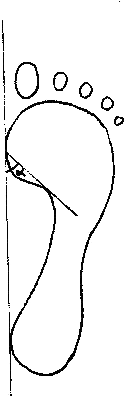
20] It is constructed by drawing a tangent to the medial edge of the foot (the prints) and a line connecting the deeper part of the footprint with the most medial point of the forefoot (
Fig. 1).
Figure 1.
Footprint angle.
Figure 1.
Footprint angle.
The FA cutoff values were calculated by means of the regression method and the percentile grids on the basis of 3,923 children from Kraków aged 3 to 15 years (2,028 girls and 1,895 boys) in terms of sex and age.[
21] On the basis of cutoff points, the definitions of MLA types are as follow: FA values below the lower range of normal are described as a flatfoot, and FA values above the higher range of normal are defined as a high-arched foot. Standard values for children aged 7 to 12 years are shown in
Table 2.
Table 2.
Standards Based on Linear Regression for Footprint Angle by Sex and Age[
21]
Table 2.
Standards Based on Linear Regression for Footprint Angle by Sex and Age[
21]
The Spearman rank correlation was used to evaluate the correlation of obesity level with the FA. It is the appropriate measure for conducting statistical analysis in this article. It illustrates the strength of the relationship if the distribution of variables deviates from the normal distribution and the relationships between variables are not linear. The normality of distributions of all analyzed variables have been examined and in most cases these distributions differ from normal. Application of the well-known Pearson correlation coefficient would, therefore, not be appropriate in this situation. It would have to be preceded by the transformation of variables and, consequently, complications in interpreting the results, which we wanted to avoid. The high and statistically significant value of the rank correlation coefficient indicates the existence of not only a linear functional relationship but also another shape when an examined relationship is not linear. However, determination of the functional form has not been the subject of research because we did not build statistical models. It can be the subject of future research.
Results
On the basis of the FA, the numbers of children with high-arched foot, normal foot, and flatfoot were determined. The FA normal values for a particular age and sex were applied.[
21] Left flatfoot was observed in 101 children (10.9%) and right flatfoot in 91 (9.8%). Flatfoot was more frequent in boys than in girls. In the group of 450 girls, flatfoot was more common in the left foot (8%; n = 36) than in the right one (6.9%; n = 31). In the group of 475 boys, flatfoot was also more frequent in the left foot (13.7%; n = 65) than in the right one (12.6%; n = 60).
High-arched foot was the most common deformity in the whole study group; 523 children (56.5%) had a high-arched left foot and 592 (64.0%) had a high-arched right foot. High-arched foot was more common in girls than in boys. However, it was the most frequent condition of the MLA in both groups. In the girls' group, high-arched foot occurred in 271 (60.2%) in the left foot and in 299 (66.4%) in the right foot. In the boys' group, high-arched foot was observed in 252 (53.0%) in the left foot and in 293 (61.7%) in the right foot.
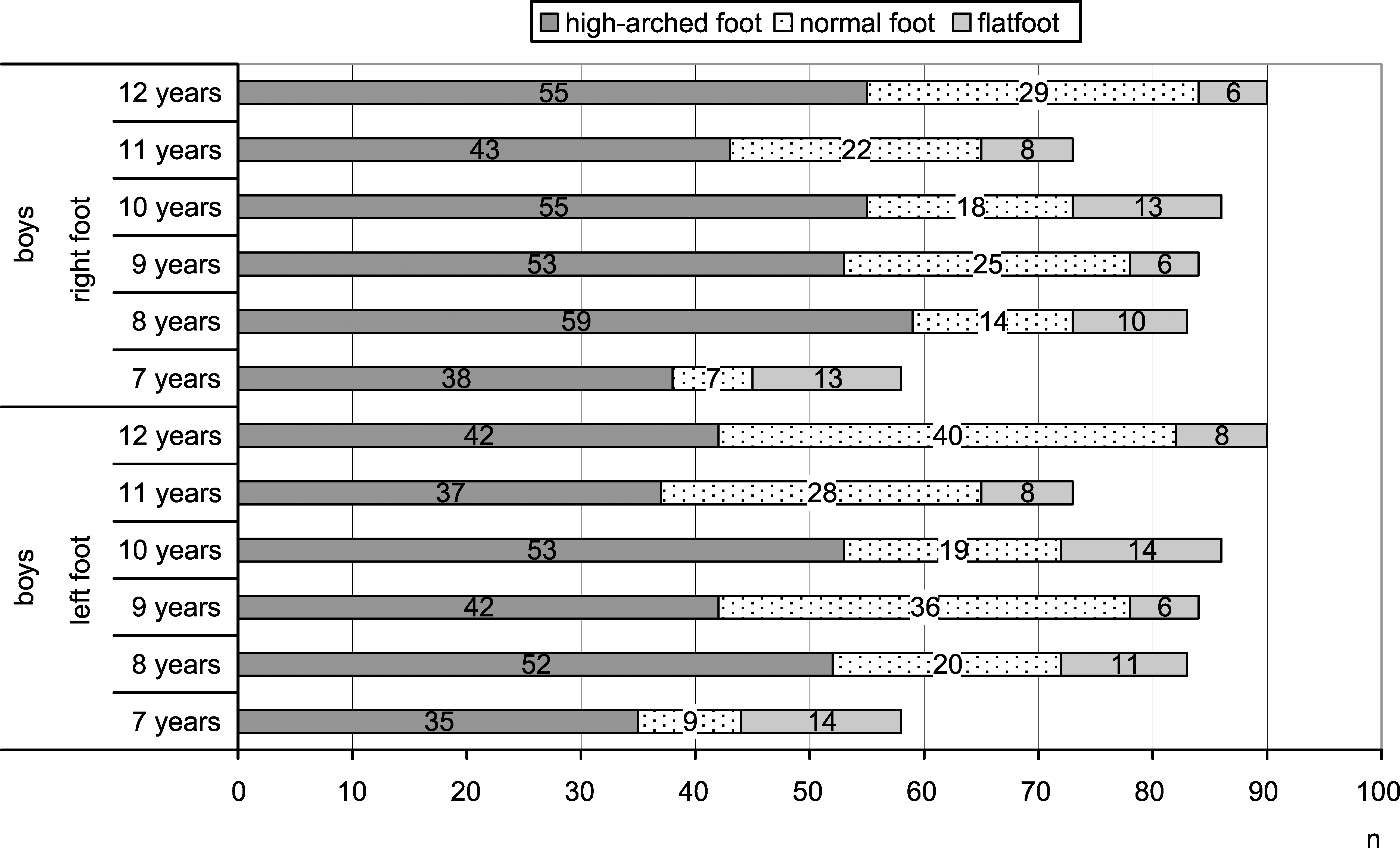
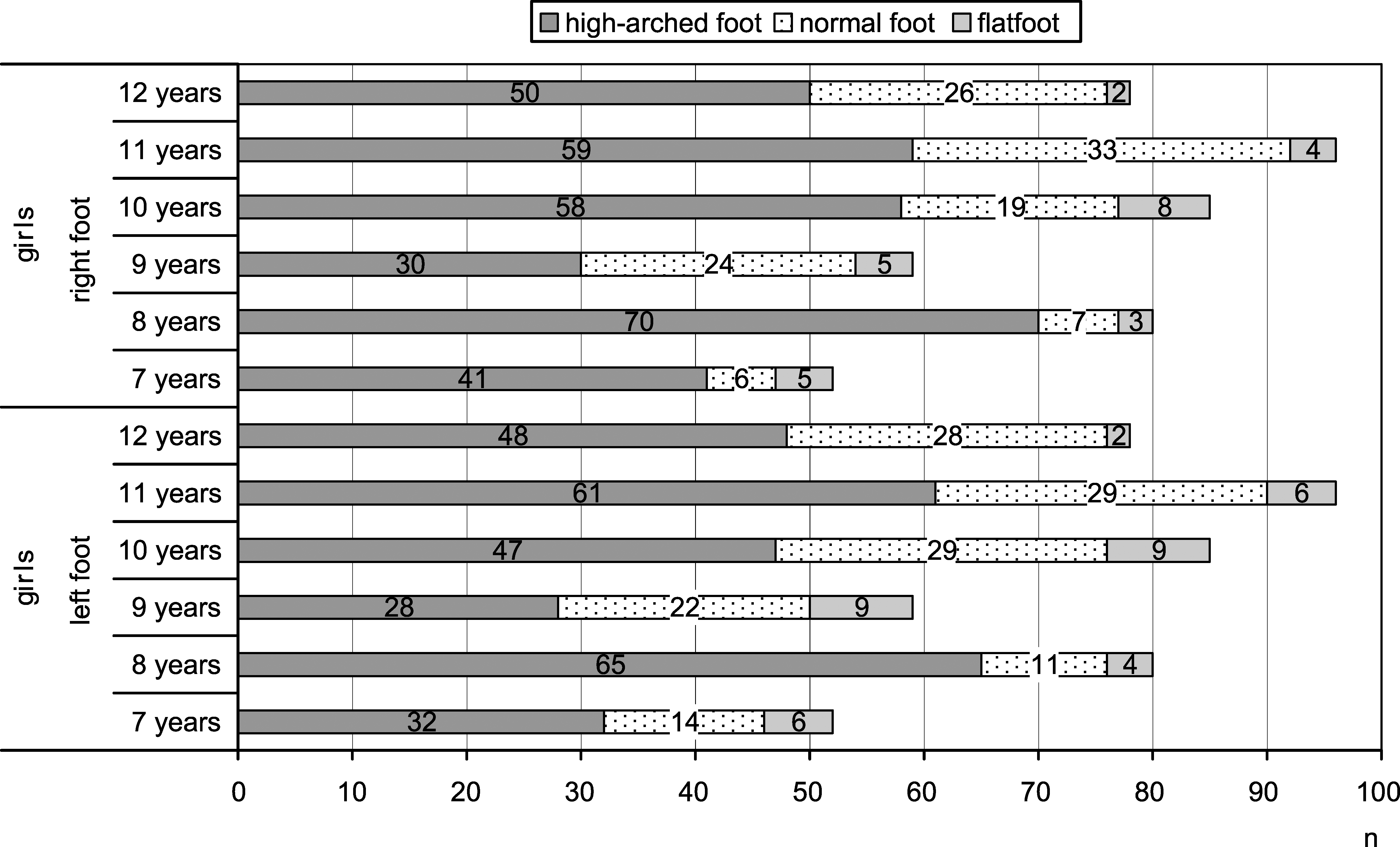
The rarest MLA abnormality was flatfoot in urban and rural children. Analyzing the differences between the arching of both feet, flatfoot was more predominant in the left foot. Numbers of the foot arch types regarding age, sex, and place of residence are presented in
Figures 2 and
3 and
Tables 3 and
4. High-arched foot was the most common disorder in all of the age groups except 9-year-old urban children. In this group, the most common foot type was the normal MLA in the left foot regardless of sex. In the group of 12-year-old urban boys, the numbers of high-arched and normal feet are almost the same in the left foot. In rural children at the same age, there is a clear decrease in the incidence of high-arched feet and similarly an increase in the number of normal MLAs.
Figure 2.
Number of each medial longitudinal arch type in boys according to age.
Figure 2.
Number of each medial longitudinal arch type in boys according to age.
Figure 3.
Number of each medial longitudinal arch type in girls according to age.
Figure 3.
Number of each medial longitudinal arch type in girls according to age.
Table 3.
Medial Longitudinal Arch Types in Rural Children
Table 3.
Medial Longitudinal Arch Types in Rural Children
Table 4.
Medial Longitudinal Arch Types in Urban Children
Table 4.
Medial Longitudinal Arch Types in Urban Children
The percentage of boys with flatfoot was significantly lower among those aged 11 to 12 years (~22%) than in those aged 7 to 10 years (~30%). A similar situation was observed in girls in the same age groups: the percentage of flatfoot decreased from approximately 19% to approximately 10%.
The BMI was used to determine the obesity level of the examined children. The results helped select three categories: obese, overweight, and normal weight. The occurrence of overweight and obesity in children was determined by means of the International Obesity Task Force cutoff values with respect to age.[
22] The results are shown with reference to age, sex, and place of residence (
Table 5).
Table 5.
Prevalence of Overweight (OW) and Obesity (OB) in Children Based on International Obesity Task Force Criteria According to Place of Residence and Age
Table 5.
Prevalence of Overweight (OW) and Obesity (OB) in Children Based on International Obesity Task Force Criteria According to Place of Residence and Age
Overweight was observed in 67 of 276 urban boys (24.3%), and obesity was diagnosed in 30 (10.9%). Of the 256 urban girls, 31 (12.1%) were overweight and 11 (4.3%) were obese. In the 199 rural boys, 56 (28.1%) were overweight and seven (3.5%) were obese. In the 194 rural girls, 32 (16.5%) were overweight and eight (4.1%) were obese. Regardless of sex and place of residence, overweight was determined in more children than was obesity. In urban girls, overweight was less common than in boys. In urban children overall, obesity occurred three times more often in boys than in girls. In the rural group, the number of obese children was the same in both sexes.
The occurrence of MLA types by adiposity group based on BMI was analyzed. High-arched foot was more common than flatfoot in all adiposity and sex groups. The largest difference between the incidence of high-arched foot and flatfoot was observed in children with normal obesity levels regardless of sex. Flatfoot was the rarest pathologic disorder regardless of sex and obesity level (
Table 6).
Table 6.
Medial Longitudinal Arch Types Depending on Sex and Adiposity Groups (According to BMI)
Table 6.
Medial Longitudinal Arch Types Depending on Sex and Adiposity Groups (According to BMI)
The number of children with a sum of three skinfold values greater than the 90th percentile was determined in the adiposity groups based on BMI. Ninetieth percentile values were based on data from studies conducted in children in Kraków.[
23] The MLA type was determined, and high-arched foot was more common than flatfoot in both sexes and in adiposity groups based on BMI (
Tables 7 and
8).
Table 7.
Medial Longitudinal Arch Types Depending on Adiposity Groups (BMI) According to the s3f in Boys
Table 7.
Medial Longitudinal Arch Types Depending on Adiposity Groups (BMI) According to the s3f in Boys
Table 8.
Medial Longitudinal Arch Types Depending on Adiposity Groups (BMI) According to the s3f in Girls
Table 8.
Medial Longitudinal Arch Types Depending on Adiposity Groups (BMI) According to the s3f in Girls
Table 9.
Correlation Coefficients of the FA with Obesity Level
Table 9.
Correlation Coefficients of the FA with Obesity Level
In addition, fat mass and fat-free mass were measured using the Tanita analyzer. Further analysis of the influence of obesity level on foot deformities in children was based on the measurement of body fat percentage as well as fat mass and fat-free mass.
The data connected with BMI and the sum of the three skinfolds were correlated with the FA. On the basis of the FA values, the type of MLA was determined. Because the distribution of the obesity level differed from the normal distribution, the Spearman rank correlation was used to evaluate the correlation of obesity level with the FA. In boys and girls, the correlation coefficients were significant (P < .001) in the case of BMI, the sum of three skinfolds, fat percentage, and fat mass. In the girls, the values of the correlation coefficients in the case of fat-free body mass were not statistically significant in either foot. In the boys, the rank correlations were significant: P < .1 (left foot) and P < .05 (right foot).
With respect to sex and place of residence, some differences were noted in the strength of the correlation of obesity level with the degree of the MLA. The weakest correlation was observed in the case of fat mass and fat percentage in rural girls (P < .05 in both feet). In the study group (rural boys and urban children), the significance level was P = .001. There was a very strong correlation between BMI and the FA (P < .001) in all of the examined groups except rural girls, where the significance level for the right foot was P < .05. The correlation of the MLA types with the sum of three skinfolds was slightly weaker than that with BMI, and it was P < .001 in rural boys (left foot) and rural girls (right foot). In the urban children, such a high significance level was observed only in the boys in the right foot. In the remaining urban children, the significance level was P < .05.
Different results were observed in the correlation of fat-free mass. In the rural girls and urban boys, those coefficients were not statistically significant and had negative values. The coefficient value was positive only in the right foot in the rural girls.
In the urban girls and rural boys, the correlation of fat-free body mass with the FA of the right foot reached significance (P < .001). In the same groups, the correlation established for the left foot was significant (P < .05).
Discussion
Many researchers claim that of the numerous types of faulty posture observed in schoolchildren, particular attention should be given to MLA disorders.[
16,
24-
27] There are three basic foot types: high-arched foot, normal foot, and flatfoot. Many publications concerned with foot arch in children and adolescents divide feet into flatfoot and the others. In such studies there are missing reports of the occurrence of high-arched feet. During the past few years, a decline in the incidence of flatfoot in children and adolescents has been observed. Garcia-Rodriguez et al[
3] ask whether flatfoot is a real problem. In a group of 1,181 children aged 4 to 13 years, they reported flatfoot in 2.7% of respondents. In the study by Stavlas et al[
4] conducted in a group of 5,866 children aged 6 to 17 years, the percentage of flatfoot was 9.1% for the right foot and 5.1% for the left in boys and 3.1% and 3.7%, respectively, in girls. Those results are similar to the present results, although slightly lower. In the Kraków studies, the percentage of flatfoot in boys was recorded at a rate of 12.6% in the right foot and 13.6% in the left foot. In girls, the percentage of flatfoot was 6.8% in the right foot and 8% in the left foot. The lower percentage of flatfoot may be associated with the fact that the study group was limited to children younger than those in the study by Stavlas et al.[
4] Meanwhile, many researchers indicate that the percentage of flatfoot decreases with age. This is confirmed by the present results.
One of the most frequently observed correlations presented in the available literature is the dependence between foot arch and the age of examined children. Most researchers[
3-
5,
28] state that the percentage of flatfoot (regardless of sex) decreases with age, and the present study confirms this regularity. In a study conducted by Chen et al[
27] in a group of 1,024 children aged 5 to 13 years, flatfoot was observed in 28%, and the authors also noted a decrease in the incidence of flatfoot with age. Also, studies in adults show that flatfoot is a small percentage of the observed foot abnormalities in those 18 years and older.[
29,
30]
In the present study, the problem of high-arched foot was researched. Analysis of the excessively elevated MLA has shown that this type of curve is most common in children regardless of their age and sex. In the boys, 61.7% of right feet and 53.0% of left feet were high arched. In the girls, the occurrence of left and right high-arched foot was 60.2% and 66.4%, respectively. Reports in the literature regarding the prevalence of excessively elevated MLAs in children note the following. In children and adolescents from the Mediterranean population,[
4] the percentage with high-arched foot in boys was 15.3% in the right foot and 16.7% in the left foot and in girls was 16.3% in the right foot and 17.9% in the left one. In studies conducted in India, in 2,300 children aged 4 to 13 years, high-arched foot occurred in 25.8% of respondents.[
31] In Lithuania, the high-arched foot was observed in 19.6% of urban children and in 26.3% of rural children.[
19] Also, studies in adults indicate that high-arched foot is more common than flatfoot.[
30,
32] Differences in the incidence of high-arched foot may depend on different methods of obtaining footprints and the use of different indicators to assess the MLA. This is a problem taken up by many researchers.[
3,
4] Dependency analysis of foot arching in relation to the sex of the respondents is performed in many articles concerning the MLA.[
3,
4,
27,
28,
33] In those studies, flatfoot occurs more frequently in boys in each age category, which, according to Mickle et al,[
34,
35] may result from a thicker plantar metatarsal fat pad in boys. The present study confirms this relationship. In each age group, flatfoot occurred more often in boys than in girls.
The impact of weight and, thus, fat on the foot arch is the next problem tackled in many studies. In Taiwanese children, the occurrence of flatfoot in children with overweight or obesity was significantly higher compared with that in children with normal weight.[
27] The percentage of flatfoot in obese children was 56%, in overweight children was 31%, and in children with normal weight was 27%. According to Villaroya et al,[
14] in 116 examined children, a strong dependence between excessive body mass and lowering of the MLA was observed. Similar results were obtained by Pfeiffer et al[
28]: the highest percentage of flatfoot was registered in obese children in every age group (3-, 4-, 5-, and 6-year-olds), although their percentages still decreased with age. Chang et al[
15] also reported that the flatfoot incidence is significantly higher in overweight and obese children compared with underweight children or with those whose weight was normal. Statistical analysis of the results of the study by Mickle et al[
34] confirms the existence of a statistically significant dependence between overweight and obesity and lowering of the MLA, as reported by Woźniacka et al.[
20] Also, in adults, a relationship between overweight and obesity and lowering of the MLA is observed.[
30,
36] The present study also confirms that in the examined children, such a dependence exists regardless of age and proves that the flatfoot incidence decreases with age.
The occurrence of MLA types depending on the obesity level assessed by BMI and the sum of three skinfolds showed that high-arched foot occurred more frequently than flatfoot. In children with normal BMI values, high-arched foot appeared several times more often than flatfoot regardless of sex. In obese children, high-arched foot appeared two times more often than flatfoot. The sum of three skinfolds assesses obesity level better than BMI. In the boys, sum of three skinfolds values greater than 90th percentile were observed in 20.8% (n = 99). For all of those boys, high-arched foot was the most common type of MLA and occurred in nearly half of the children in both feet. In almost all of the obese boys (36 of 37), the sum of three skinfolds exceeded the 90th percentile. Nevertheless, high-arched foot appeared in 13 boys in the left foot and in 14 boys in the right foot, and flatfoot appeared in eight and ten boys, respectively. In the girls, 11.8% (n = 53) exceeded the 90th percentile values for the sum of three skinfolds. Also, in nearly half of the girls, high-arched foot was observed, and flatfoot occurred in only seven girls.