Solitary fibrous tumors (SFTs) are rare mesenchymal, primary spindle cell neoplasms that were described as distinct pleural lesions by Klemperer and Rabin in 1931.[
1] They have been found in all anatomical locations. Most are found in the pleural cavity; however, approximately 10% originate in the head, neck, trunk, or extremities and are designated as extrapleural SFTs (ESFTs). Typically, SFTs are slow-growing tumors that most often occur in the fourth and fifth decades of life, with fairly equal distribution between males and females. Usually, SFTs behave in a benign manner, but a malignant course has also been reported. Studies have shown a 20% rate of malignancy associated with this neoplasm.[
2]
Histogenesis and biological behavior remains controversial and has resulted in a variety of terms used to describe this neoplasm, including localized fibrous mesothelioma, benign fibrous mesothelioma, localized fibrous tumor of serous membrane, submesothelial fibroma, subpleural fibroma, or solitary fibrous mesothelioma.[
3,
4]
Complete surgical excision of the lesion is the treatment of choice at the present time and is curative in most cases. Survival 8 years after surgical resection was nearly 100% in two studies.[
2,
5] Torres-Olivera et al,[
6] however, reported that approximately 10% to 30% of patients have recurrence or metastases. Other treatment modalities, including chemotherapy and radiotherapy, for SFTs have been suggested in the literature, with good results.
Case Report
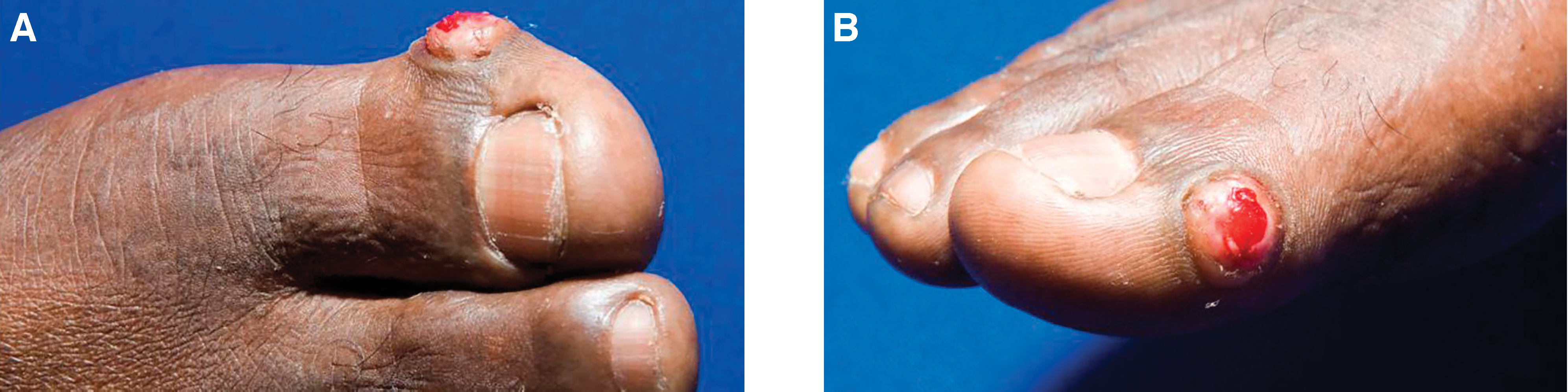
A 55-year-old male veteran, admitted for blind rehabilitation, was evaluated by nursing for a painful lesion of 10 years' duration at the medial aspect of the right hallux. The patient's medical history included legal blindness, cocaine abuse, hypertension, cerebrovascular accident with right hemiparesis, and right adrenal gland adenoma. The patient admitted to self-debridement with a pocket knife. On debridement of the lesion, pain and bleeding were noted by the nurse. The podiatric medical service was then consulted for evaluation and treatment. Initial physical examination of the medial right hallux revealed a 1.0 × 1.0 × 1.0-cm firm, mobile, pedunculated mass with a centrally bleeding ulceration measuring 0.6 cm in diameter. An annular area of skin was noted at the base of the nodule (
Fig. 1). No perilesional erythema or cellulitis was noted, and there was no pain on direct palpation of the lesion.
Figure 1.
Anteroposterior (A) and mediolateral (B) clinical views of the solitary fibrous tumor in the right hallux showing central ulceration and bleeding without perilesional changes.
Figure 1.
Anteroposterior (A) and mediolateral (B) clinical views of the solitary fibrous tumor in the right hallux showing central ulceration and bleeding without perilesional changes.
Based on the patient's clinical presentation, the differential diagnosis included granuloma, hemangioma, and foreign body. Radiographs were ordered by a primary-care physician before podiatric medical evaluation to rule out a possible foreign body; however, the patient never reported to the imaging department. Treatment options were discussed with the patient and primary-care physician and the decision was made to perform an excisional biopsy. Under local anesthesia with plain 1% lidocaine, the tumor was excised en toto, with 3-mm margins. The patient healed without complications and was free of recurrence 1 year after surgical excision.
Microscopic and Immunohistochemical Findings
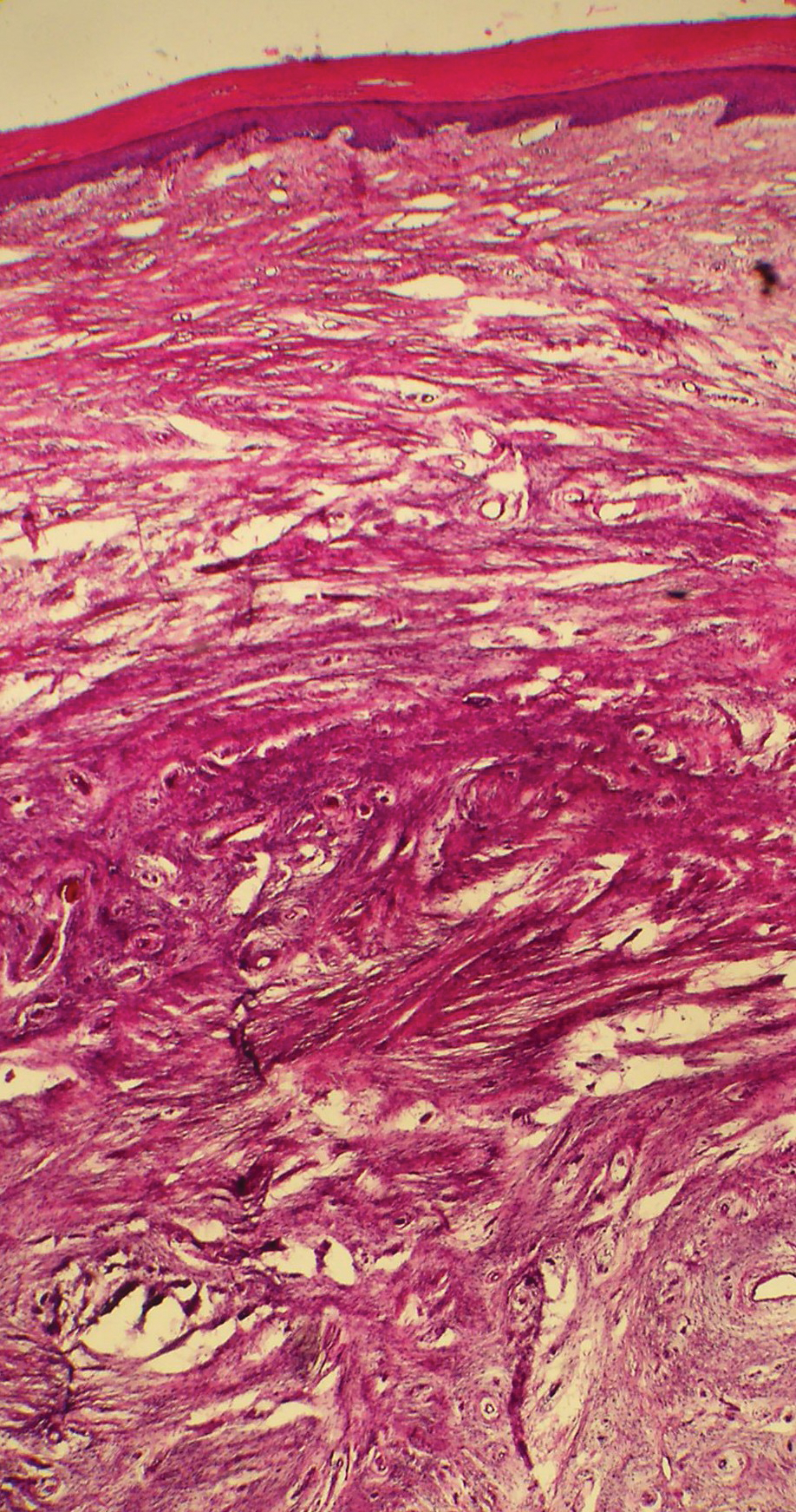
The tumor was well circumscribed and nonencapsulated, originating in the dermis and extending into the subcutaneous tissue and the overlaying epidermis. The hematoxylin and eosin preparation showed proliferation of spindled cells arranged haphazardly in a storiform or whorled pattern in a heavily collagenized stroma without mitotic activities (
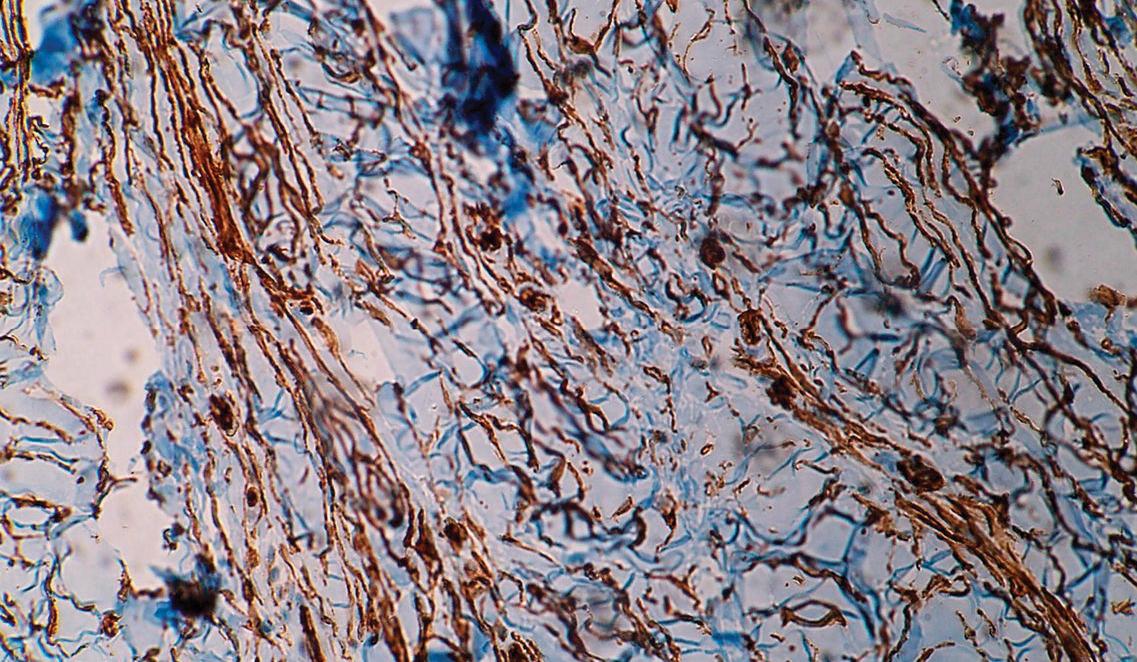
Fig. 2). Masson trichrome staining showed a positive reaction in dense keloidal collagen stroma. Immunochemical staining was positive for CD34 on the surface of the tumor cells (
Fig. 3). In immunohistochemical analysis, positive and negative controls were examined and reacted appropriately. There was negative immunoreactivity for S100 protein, desmin, and smooth muscle actin.
Figure 2.
Staining shows uniform spindle-shaped cells arranged haphazardly in a storiform or whorled pattern in heavily collagenized stroma. No mitotic activity is identified (H&E, x20).
Figure 2.
Staining shows uniform spindle-shaped cells arranged haphazardly in a storiform or whorled pattern in heavily collagenized stroma. No mitotic activity is identified (H&E, x20).
Figure 3.
Solitary fibrous tumor cells are positive for CD34 on immunochemical staining (H&E, x400).
Figure 3.
Solitary fibrous tumor cells are positive for CD34 on immunochemical staining (H&E, x400).
Discussion
On gross examination, an ESFT is a well-circumscribed or lobulated mass or nodule that is often pedunculated and that can be encapsulated or nonencapsulated. Histologically, ESFTs are generally characterized as being fibrous or cellular. Fibrous ESFTs are more common and have interchanging areas of hypercellularity and hypocellularity along with “medium-sized ramified vessels with characteristically thickened and hyalinized walls.”
3(p66) Cellular ESFTs appear more homogenized, have moderate to high cellularity, and tend to be larger. Although ESFTs are characterized as being either fibrous or cellular, their morphological appearance can span a broad spectrum. Types of morphology include storiform, diffuse sclerosis, hemangiopericytic, herringbone, and neural-type palisading.[
3] Although its morphological appearance can vary, ESFTs most frequently involve a patternless growth pattern.[
4,
5,
7,
8] These histologic features are specific to ESFTs and can provide a reliable diagnosis, despite the broad array of morphological characteristics.
Immunochemically, the hematopoietic progenitor cell antigen CD34 is positively expressed in 80% to 90% of patients with ESFTs; however, CD34 occasionally showed negative reactivity in the cellular form.[
3] Other challenging differential diagnoses with positive CD34 expression included dermatofibrosarcoma protuberans, spindle cell lipoma, vascular tumors, and benign and malignant fibrous histiocytoma.[
7] Also, SFTs expressed bcl-2 (30%) and smooth muscle actin (20%).[
3] Recent evidence suggested that bcl-2 protein can be expressed in ESFTs regardless of tumor site, growth pattern, degree of cellularity, or presence of mitotic activity. Thus, the expression of bcl-2 protein can be used together with CD34 to enhance the diagnosis of SFTs.[
4] S100 protein and desmin are usually negative in SFTs.
The clinical course of an ESFT has a 20% chance of malignancy. Metastasis is rare but can occur in lung, liver, or bone.[
3,
7] The ESFTs located in the mediastinum, retroperitoneum, peritoneum, and pelvis are generally larger, more cellular, and more aggressive than those occurring elsewhere. The metastatic rates are 25% for the cellular form and 5% for the fibrous form of SFT; disease-specific 5-year survival is greater than 85%, with an excellent prognosis.[
3]
In larger studies, SFTs that recurred or metastasized after surgical resection were greater than 10 cm at the time of resection.[
2] Gengler and Guillou[
3] pointed out that the quality of the initial excision and degrees of free margins are important indicators of clinical outcome in pleural and extrapleural SFTs. An ESFT has an increased risk of local recurrence that is small but statistically significant for the presence of compression and hypoglycemia symptoms.[
2,
3,
5]
Conclusions
Despite its recognition for being a benign tumor with a low rate of a metastatic course, an SFT is still unpredictable, and complete surgical excision remains the treatment of choice. The patient we present was followed-up for 1 year after surgical excision, and there was no recurrence.