Next Article in Journal
Atypical Localization of Enchondroma in the Calcaneus
Previous Article in Journal
Giant Cell Tumor of the Tendon Sheath Around the Foot and Ankle. A Report of Three Cases and a Literature Review
 
 
Journal of the American Podiatric Medical Association is published by MDPI from Volume 116 Issue 1 (2026). Previous articles were published by another publisher in Open Access under a CC-BY (or CC-BY-NC-ND) licence, and they are hosted by MDPI on mdpi.com as a courtesy and upon agreement with American Podiatric Medical Association.
Article

A Postaxial Polydactyly with a Partial Duplication of the Fifth Metatarsal Without a Supernumerary Digit. Is Excision of the Duplicated Metatarsal Necessary?

by
Gi Won Choi
1,
Jung Ro Yoon
2,
Youngbae B. Kim
2,
Jung Jin Yu
2,
Hyo Seong Seo
2 and
Taik Seon Kim
2
1
Department of Orthopaedic Surgery, Korea University College of Medicine, Ansan Hospital, Ansan, Republic of Korea
2
Department of Orthopaedic Surgery, Veterans Health Service Medical Center, 61, Jinhwangdoro-gil, Kangdong-gu, Seoul, 134-060, Republic of Korea
J. Am. Podiatr. Med. Assoc. 2015, 105(3), 255-259; https://doi.org/10.7547/0003-0538-105.3.255

Published: 1 May 2015

Abstract

Postaxial polydactyly of the foot is one of the most common congenital malformations. Only a few cases of postaxial polydactyly with a partial duplication of the fifth metatarsal without a supernumerary digit have been reported, and both metatarsal heads were united to form a common joint with the proximal phalanx in all of those cases. We present a rare case of postaxial polydactyly with a partial duplication of the fifth metatarsal characterized by dual metatarsal heads and an extra proximal phalanx bud, without a supernumerary digit.

Postaxial polydactyly of the foot is one of the most common congenital malformations[1,2] and is manifested in a variety forms, according to the morphological features of a metatarsal and digit.[3-6] Several polydactyly classification systems have been developed for various malformations.[7-9] Although these classification systems hypothetically cover all types of malformations, some postaxial polydactyly with variant malformation of polymetatarsia and digit are difficult to classify according to these systems.[3,4,6] Only a few cases of postaxial polydactyly with a partial duplication of the fifth metatarsal without a supernumerary digit have been reported, and both metatarsal heads were united to form a common joint with the proximal phalanx in all of those cases.[3,4,10] Herein, we present a rare case of postaxial polydactyly with a partial duplication of the fifth metatarsal characterized by dual metatarsal heads and an extra proximal phalanx bud, without a supernumerary digit.

Case Report

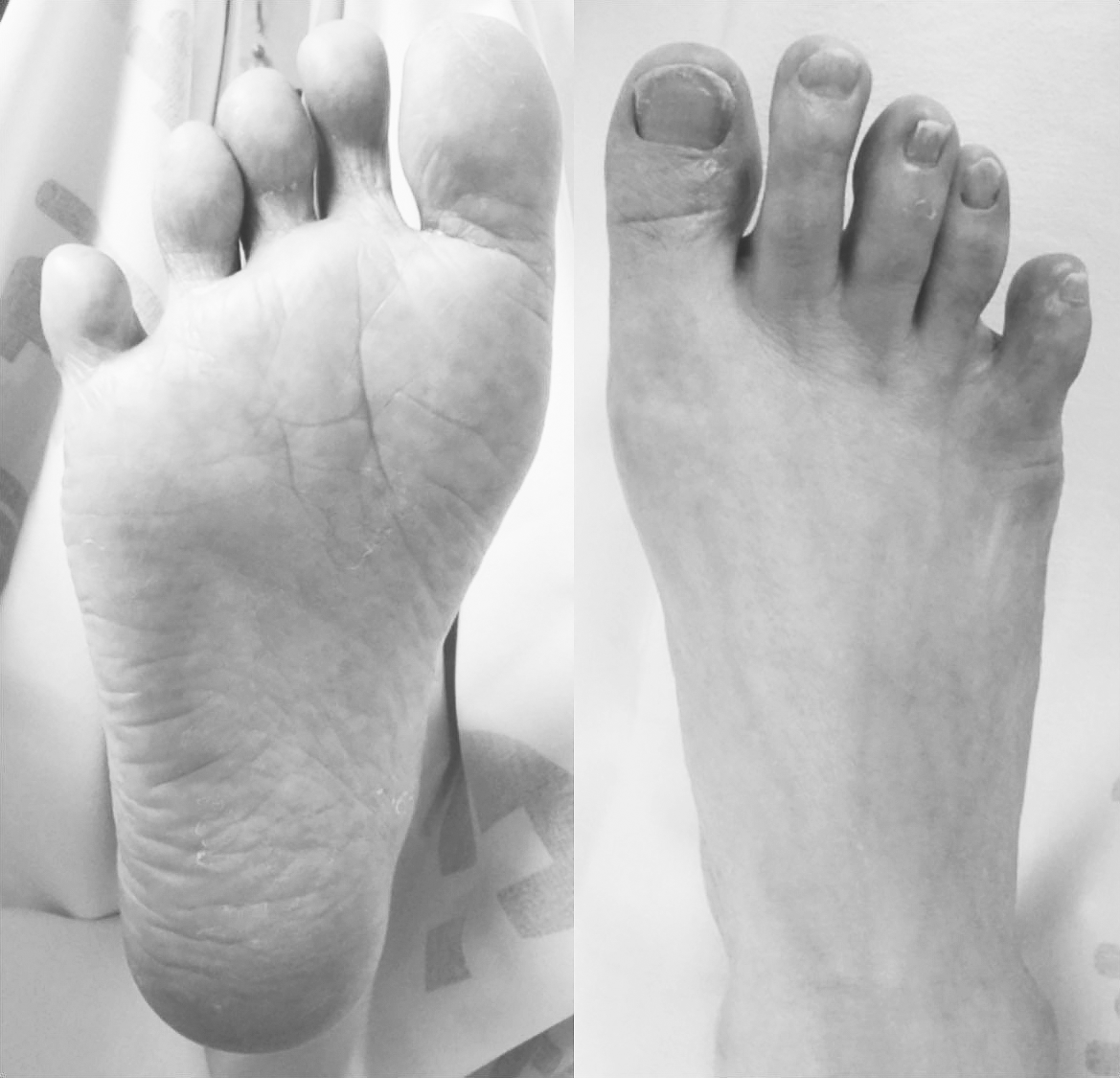
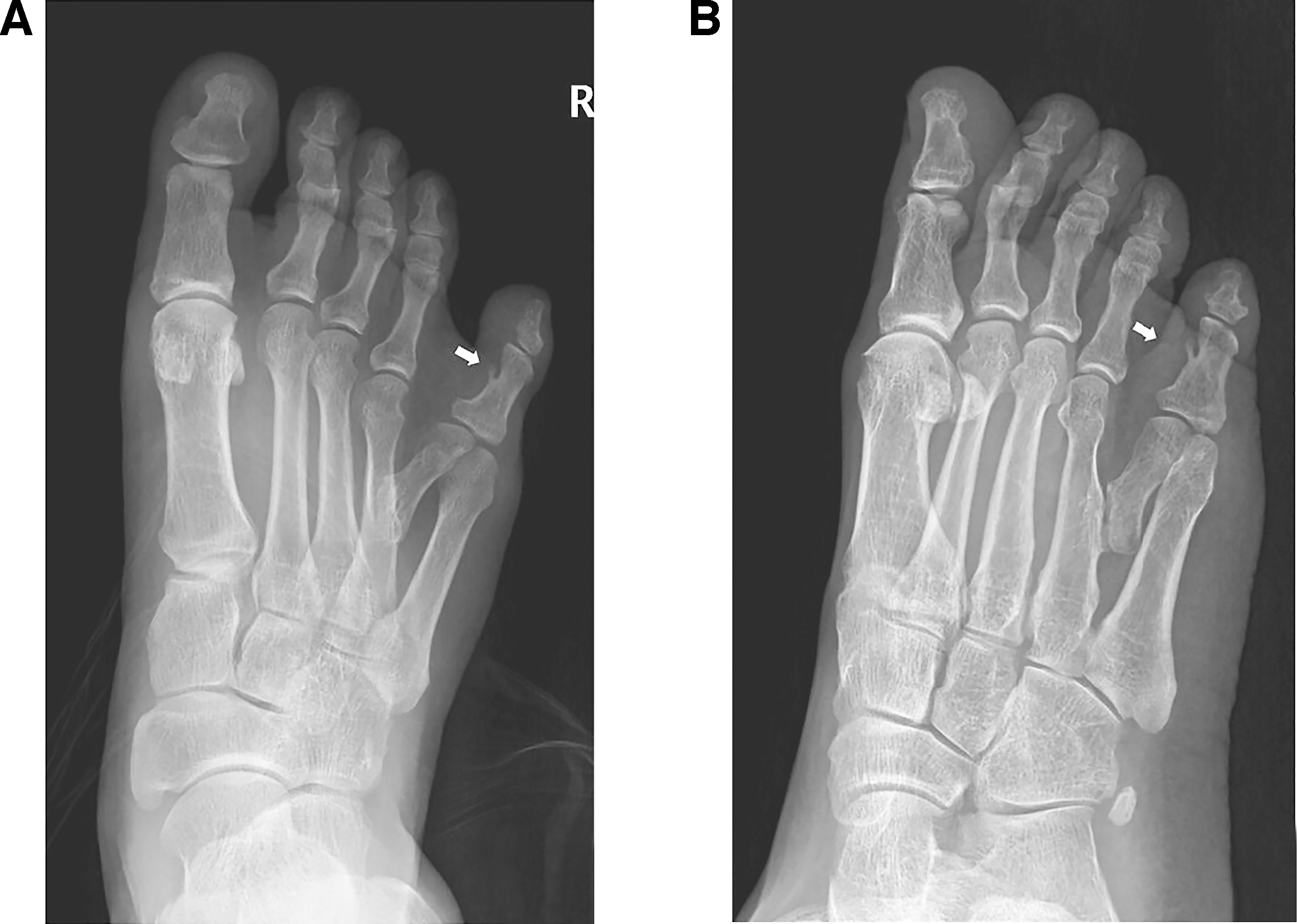
A 45-year-old man presented with concerns about pain in the dorsolateral area of the distal interphalangeal joint of the right fifth toe when he wears his normal footwear. On examination, although the fourth interdigital space seemed enlarged, no supernumerous digits were seen, and no other abnormalities were observed (Fig. 1). Tenderness was felt over the dorsolateral area of the interphalangeal joint of the fifth toe but not around the fifth metatarsophalangeal joint. Radiographs of the foot revealed a hypoplastic fifth metatarsal with its base adjoining the shaft of the fourth metatarsal and the wider fourth intermetatarsal space compared with that of the contralateral foot (Fig. 2). A proximal phalanx of the fifth toe was mainly articulated with a hypoplastic fifth metatarsal of the two metatarsal heads. An extra proximal phalanx bud was seen in the medial aspect of the shaft of the fifth proximal phalanx, and the proximal interphalangeal joint of the fifth toe was fused.
Figure 1. Clinical photograph of the patient's right foot showing enlargement of the fourth interdigital space.
Japma 105 00255 g001
Figure 2 . Dorsoplantar weightbearing (A) and oblique (B) radiographs of the right foot. Note a hypoplastic fifth metatarsal, an extra proximal phalanx bud (arrows) in the medial aspect of the shaft of the fifth proximal phalanx, and fusion of the proximal interphalangeal joint of the fifth phalanx.
Japma 105 00255 g002

Operative Technique

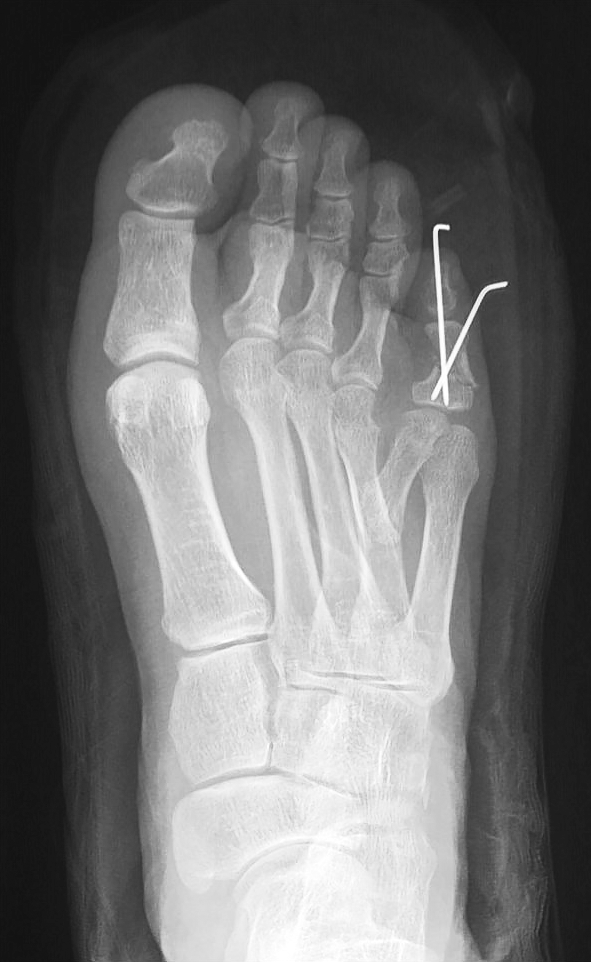
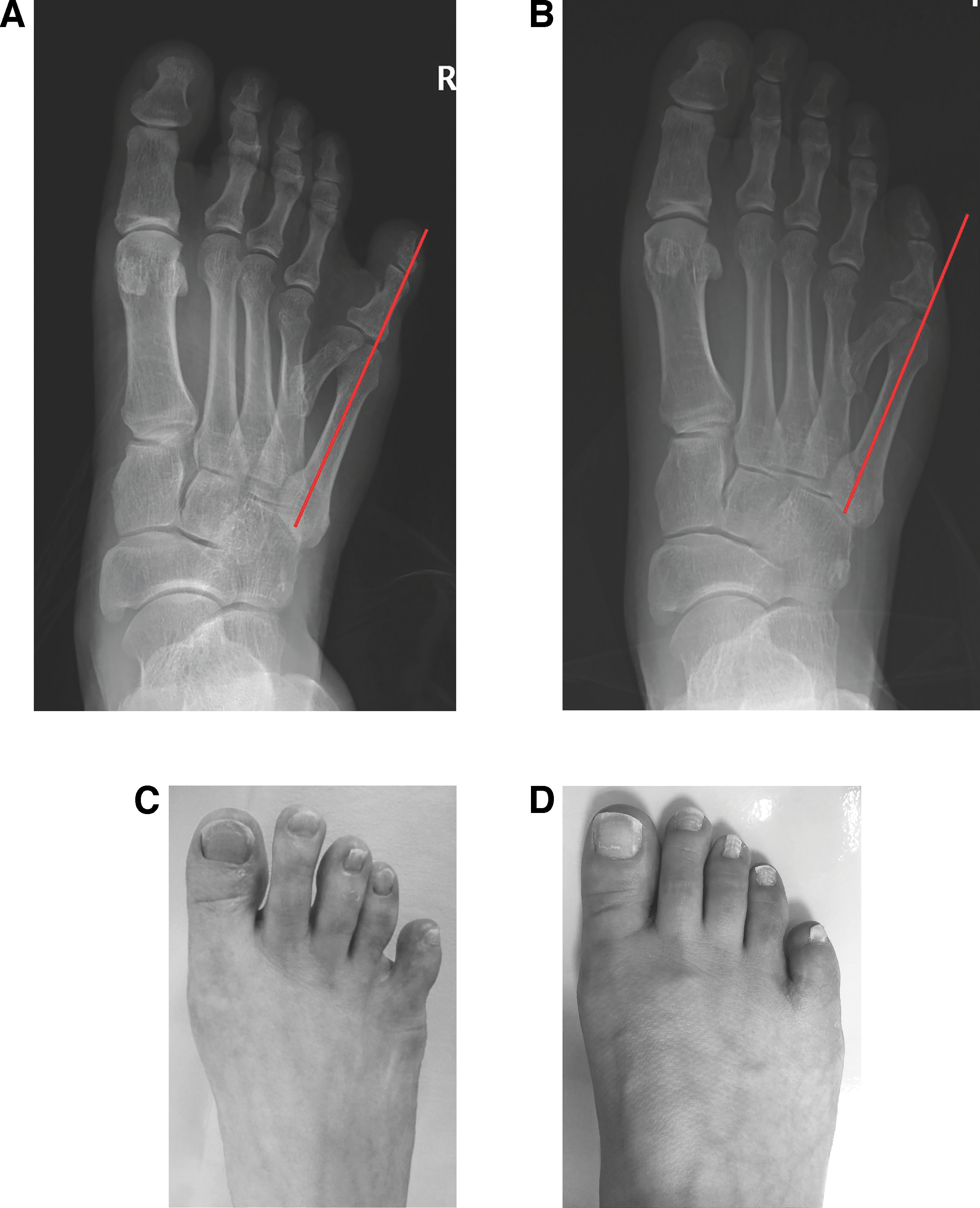
The patient noted difficulty in wearing his normal footwear owing to the pain in the dorsolateral area of the distal interphalangeal joint of the right fifth toe; he did not report any symptoms around the fifth metatarsophalangeal joint. Therefore, we decided to perform a medial closing wedge osteotomy of the fifth proximal phalanx to reduce the fourth interdigital space. A small longitudinal incision was made over the dorsomedial side of the fifth toe. A closing wedge osteotomy was performed on the medial aspect of the fifth proximal phalanx, and then the osteotomy was secured with two Kirschner wires (Fig. 3). Postoperatively, the patient wore an open, hard-soled shoe and was allowed to bear weight on his heel on the first postoperative day. The Kirschner wires were removed 5 weeks after surgery, and the postoperative shoe was discontinued at the same time. Seventeen months after surgery, the alignment of the fifth toe, which was deviated laterally before surgery, was corrected (Fig. 4). The patient was able to wear conventional footwear without pain around the fifth toe.
Figure 3 . Postoperative dorsoplantar nonweightbearing radiograph of the right foot.
Japma 105 00255 g003
Figure 4 . Dorsoplantar weightbearing radiographs of the right foot before surgery (A) and 17 months after surgery (B). Clinical photographs of the right foot before surgery (C) and 17 months after surgery (D). The alignment of the fifth toe was deviated laterally before surgery and was corrected 17 months after surgery.
Japma 105 00255 g004

Discussion

In the literature, we found four cases[3,4,6,10] of postaxial polydactyly with a partial duplication of the fifth metatarsal, and they could not be classified based on previous classification systems.[7-9] Thus, we directly categorized them into three types as follows. First, the fifth metatarsal was partially duplicated without a supernumerary digit, and both metatarsals were conjoined at their heads.[3,10] Second, the malformation was the same as that of the first type except with an extra hypoplastic proximal phalanx in the lateral side of the fifth proximal phalanx.[4] Third, the fifth metatarsal was partially duplicated, with dual metatarsal heads and a supernumerary digit, and an extra digit was fused at the base of the proximal phalanx.6 In the present patient, the fifth metatarsal was partially duplicated, with dual metatarsal heads, and there was no supernumerary digit; however, an extra proximal phalangeal bud existed in the medial aspect of the fifth proximal phalanx. Therefore, this malformation is different from the three types described previously herein. Postaxial polydactyly with a duplicated metatarsal is manifested with or without a supernumerary digit. Supernumerary digits have all the digital components distal to the splitting level because limb malformation occurs in a proximal to distal order in the early stages of development.[11-13] Ishii et al[5] reported two cases of complete polymetatarsia without a supernumerary digit and suggested that one possible explanation for the etiology of polymetatarsia without a supernumerary digit is contiguity fusion of the overinduced phalanges after the induction of excess digital rays. Hayashi et al[3] also reported a case of postaxial polydactyly with a duplicated metatarsal with normal phalanges and concluded that two embryologic failures seemed to have been involved in causing their anomaly: 1) duplication at the level of the metatarsals and 2) fusion (failure of separation) at the level of the phalanges. The present case and other case reports[4] also reported cases of postaxial polydactyly with a partial duplication of the fifth metatarsal without supernumerary digits. However, these cases differ from the three cases described previously herein with normal phalanges in that extra hypoplastic proximal phalanges existed on either side of the fifth proximal phalanx. Thus, the reason why these cases had no supernumerary digits seems to be because the extra digit is hypoplastic rather than the duplicated phalanges being fused to form a single digit. Therefore, hypoplasia or fusion of the extra phalanx seems to contribute to the development of a duplicated metatarsal without a supernumerary digit.
The treatment of polydactyly ranges from shoe modification to complex surgical procedures, and surgical treatment may be indicated for shoe problems, pain, or cosmetic reasons.[10] Of the aforementioned four patients with a partial duplication of the fifth metatarsal, two patients[3,10] with normal phalanges underwent excision of the duplicated metatarsal because of shoe problems and pain around the fifth metatarsophalangeal joint. Another patient[6] with a supernumerary digit noted difficulty in wearing normal footwear, but there were no cosmetic or functional problems due to an extra metatarsal. Thus, only the extra digit was excised, and a closing wedge osteotomy of the fifth toe was performed to obtain proper alignment. The remaining patient, with an extra hypoplastic proximal phalanx, reported no history of pain or inconvenience with the feet, and, therefore, surgical treatment was not performed.[4] Ishii et al[5] reported two cases of complete polymetatarsia without a supernumerary digit between the fourth and fifth metatarsals. They suggested that in metatarsal polydactyly, both the supernumerary digit and metatarsal bone should be removed, although there may be no cosmetic problems if the extra metatarsal is left intact. In the present case, the patient did not note any symptoms around the fifth metatarsophalangeal joint, and a hypoplastic fifth metatarsal was mainly articulated with a proximal phalanx of the fifth toe. Therefore, excision of the duplicated metatarsal was unnecessary. A medial closing wedge osteotomy of the fifth proximal phalanx was performed to allow for comfortable wear of normal footwear.

Conclusions

A postaxial polydactyly with a partial duplication of the fifth metatarsal is manifested in a variety of forms, and symptoms also vary from patient to patient. Therefore, preoperative planning should be individualized, depending on the patient's deformities and symptoms. If a partial duplication of the fifth metatarsal exists but there are no symptoms around the fifth metatarsophalangeal joint, as in the present patient, an excision of the duplicated metatarsal is unnecessary.
Financial Disclosure: None reported.
Conflict of Interest: None reported.

References

  1. ParkGH, JungST, ChungJY, et al: Toe component excision in postaxial polydactyly of the foot. Foot Ankle Int34: 563, 2013.
  2. YamadaN, TakayamaA, TakedaA, et al: An ideal surgical technique for postaxial polysyndactyly of the toes. J Plast Reconstr Aesthet Surg65: e357, 2012.
  3. HayashiM, TakagiT, MasadaY: Lateral ray polydactyly: a case of duplicated metatarsal with normal phalanges. Ann Plast Surg39: 97, 1997.
  4. BiereSS, LagardeSM, WustAF, et al: An unusual case of polydactyly. Orthopedics32:pii, 2009.
  5. IshiiT, KawabataH, KuratsuS, et al: Two cases of complete polymetatarsia without polydactyly. Br J Plast Surg58: 267, 2005.
  6. OraguiE, EliN, FolaranmiS, et al: An unusual case of fibular (postaxial) polydactyly: extrametatarsal head with fused duplication of the proximal phalanx. J Foot Ankle Surg51: 468, 2012.
  7. Venn-WatsonEA: Problems in polydactyly of the foot. Orthop Clin North Am7: 909, 1976.
  8. BlauthW, OlasonAT: Classification of polydactyly of the hands and feet. Arch Orthop Trauma Surg107: 334, 1988.
  9. WatanabeH, FujitaS, OkaI: Polydactyly of the foot: an analysis of 265 cases and a morphological classification. Plast Reconstr Surg89: 856, 1992.
  10. GaloisL, MainardD, DelagoutteJP: Polydactyly of the foot: literature review and case presentations. Acta Orthop Belg68: 376, 2002.
  11. O'RahillyR: Morphological patterns in limb deficiencies and duplications. Am J Anat89: 135, 1951.
  12. O'RahillyR, GardnerE: The timing and sequence of events in the development of the limbs in the human embryo. Anat Embryol (Berl)148: 1, 1975.
  13. YasudaM: Pathogenesis of preaxial polydactyly of the hand in human embryos. J Embryol Exp Morphol33: 745, 1975.