Next Article in Journal
The Development of a Charcot Foot after Significant Weight Loss in People with Diabetes. Three Cautionary Tales
Previous Article in Journal
Primary High-Grade Squamous Cell Carcinoma of the Foot. A Case Report
 
 
Journal of the American Podiatric Medical Association is published by MDPI from Volume 116 Issue 1 (2026). Previous articles were published by another publisher in Open Access under a CC-BY (or CC-BY-NC-ND) licence, and they are hosted by MDPI on mdpi.com as a courtesy and upon agreement with American Podiatric Medical Association.
Article

Simultaneous Bilateral Stress Fractures in a Homemaker. A Case Report and Literature Review

by
Sohail Yousaf
1,
Kapil Sugand
2,
Mushahid Raza
3 and
Palanisamy Ramesh
2
1
Department of Orthopedics, Frimley Park Hospital, Surrey GU16 7UJ, England
2
Department of Orthopedics, Kingston Hospital, Surrey, England
3
Department of Emergency Medicine, Frimley Park Hospital, Surrey, England
J. Am. Podiatr. Med. Assoc. 2014, 104(5), 518-521; https://doi.org/10.7547/0003-0538-104.5.518

Published: 1 September 2014

Abstract

Stress fractures commonly occur in athletes and military cadets due to repetitive stress on the bony cortex. Stress fractures of the tibia are commonly localized proximally and occur during aerobic weightbearing exercises. This is an unusual case of bilateral simultaneous distal tibial stress fracture in a young homemaker.

Stress fractures commonly occur in the physically active and have been described particularly in athletes and military cadets. [1,2] This is secondary to the repetitive stress on the bone, which results in weakening of the bony cortex. [3] Stress fractures are more common in the proximal tibia due to ground-reaction forces being distributed during aerobic weightbearing exercises such as running or marching. [1-5] However, stress fractures of the distal tibia are relatively uncommon [2,4-8] and are usually found in those who are physically active or regularly lift heavy objects, such as military personnel. [2,5,9,10]
This is a case report of bilateral distal tibial stress fractures in a young homemaker generally leading a sedentary lifestyle.

Case Report

A 31-year old Croatian homemaker presented to her general practitioner (GP) with a 2-day history of bilateral shin pain. Her last physical activity was reported to be jogging for approximately 10 minutes 2 weeks prior to her presentation. There were no previous episodes of repetitive injury to her legs. Her past medical history was unremarkable with a negative history of recreational drugs and smoking. She described herself as a social drinker and was living a sedentary lifestyle on a strict vegetarian diet. Her initial management was oral analgesics and she was advised to bear weight as able. The GP referred her to the orthopedic outpatient clinic at Frimley Park Hospital (Surrey, England) with the suspicion of “shin splints,” suggesting further investigations.
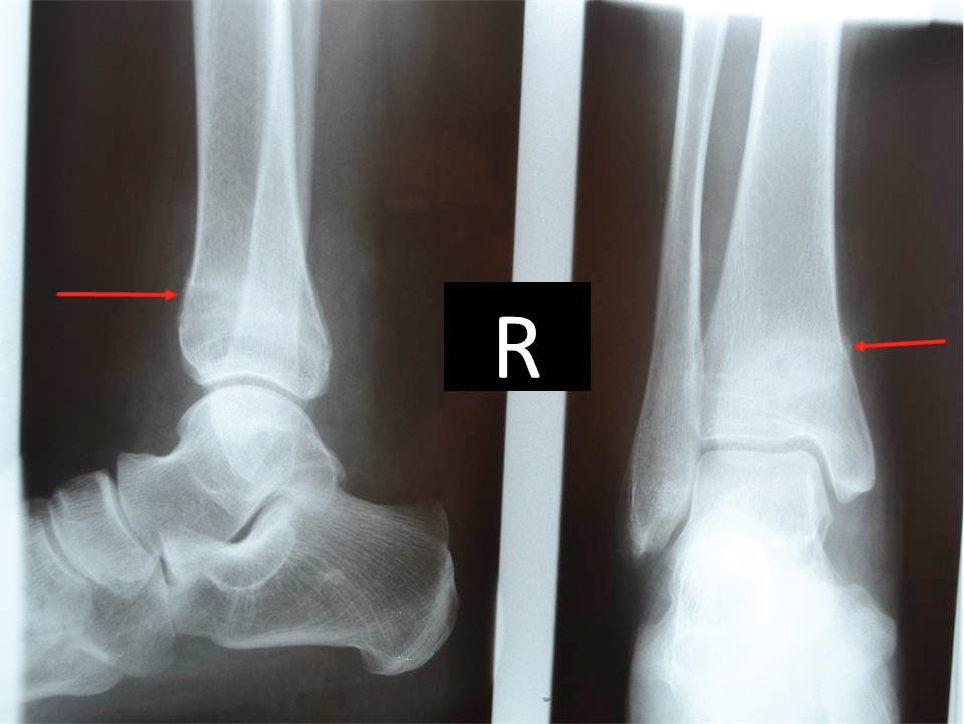
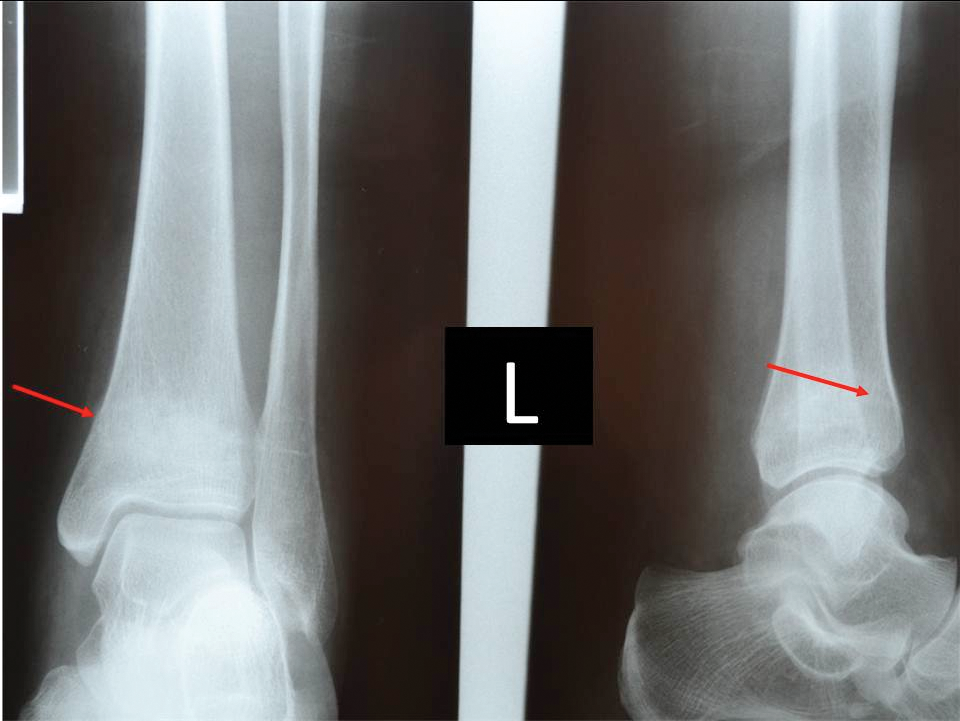
On clinical examination 3 weeks later, she demonstrated an antalgic gait and partial weightbearing with minimal edema on the anterior aspect of the distal third of the tibia bilaterally (localized pain measured 4–6 cm superior to the medial malleoli). She was also tender on the anterior aspect in the region of the third of the tibial diaphyses. Her anteroposterior and lateral radiographs on the day of her clinic visit elicited stress reactions in the distal one third of the tibia bilaterally, suggesting bilateral stress fractures. The patient was provided with bilateral air cast boots, and touch weightbearing was recommended. A bone scintigraphy was performed along with biochemical and hematological tests to investigate any obvious reason for stress fractures.
Her urea and electrolytes were found to be within normal range. Her adjusted calcium was 2.26 mmol/L and phosphate 1.17 mmol/L. She had a vitamin D level of 60 nmol/L (normal 75–200), falling under mild insufficiency.
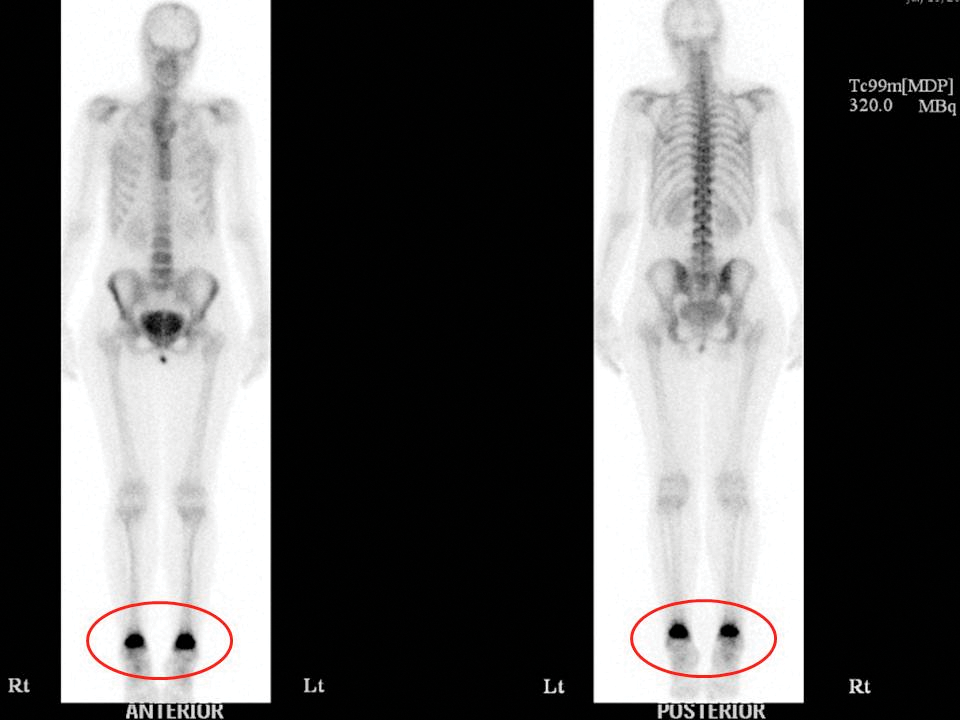
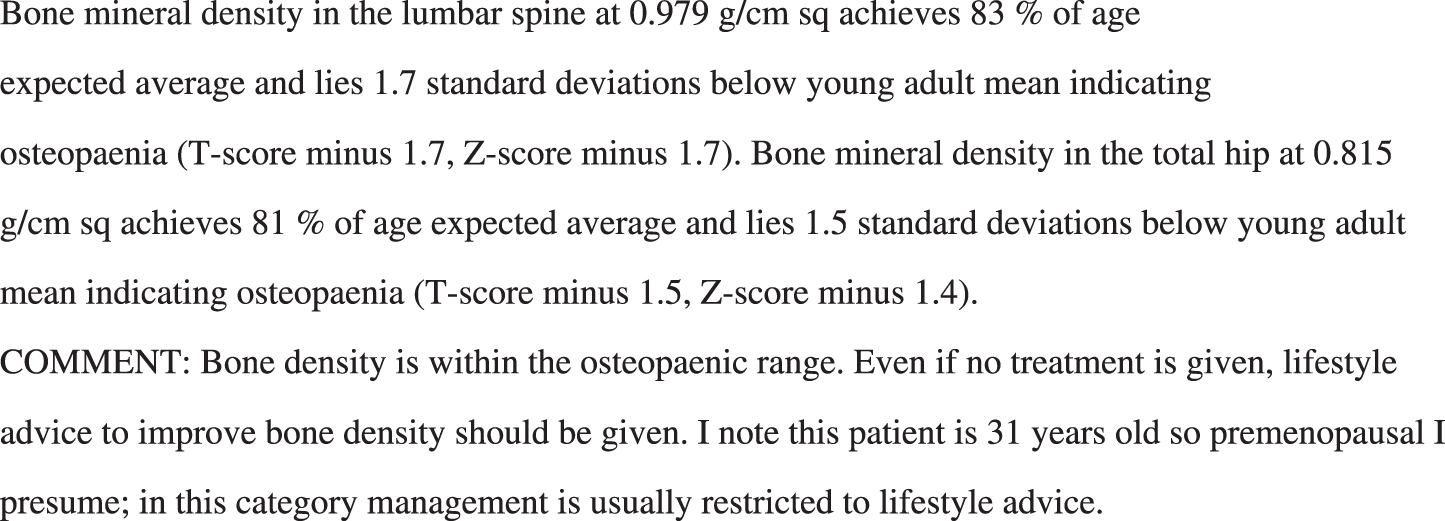
The anteroposterior and lateral radiographs (Figs. 1 and 2) showed distal tibial fractures 3 weeks after presenting to her GP. Two weeks after first presenting to the orthopedic outpatient clinic, the technetium-99m (Tc-99m) bone scan (Fig. 3) confirmed focal uptake in both tibial metaphyses. A dual energy X-ray absorptiometry (DEXA) scan (Fig. 4) elicited bone mineral density in her lumbar spine and hip within the osteopenic range with an average T-score of −1.6 and average Z60 score of 1.5.
Figure 1. Lateral (left) and anteroposterior (right) radiographs of the right leg showing a single incomplete and undisplaced oblique distal tibial stress fracture (red arrow) with overlying soft callous formation secondary to inflammation (hyperdense line).
Japma 104 00518 g001
Figure 2. Lateral (left) and anteroposterior (right) radiographs of left leg showing a single incomplete and undisplaced oblique distal tibial stress fracture (red arrow).
Japma 104 00518 g002
Figure 3. Anterior (left) and posterior (right) Technetium-99m scans showing intense symmetrical increased activity related to the distal metaphyseal region of distal tibiae bilaterally. This would be in keeping with healing fractures demonstrated on the recent plain radiographs. Otherwise, there is normal even distribution of isotope in the bony skeleton with no evidence of further fractures.
Japma 104 00518 g003
Figure 4. Bone densitometry dual energy X-ray absorptiometry (DEXA) report.
Japma 104 00518 g004
The usual recommendation for this type of stress fracture is immobilization in a nonweightbearing plaster cast; however, the patient was not prepared to use cast immobilization and opted to follow an alternative regime that included partial weightbearing until pain free with air cast boots. She discarded the air cast boots after 2 weeks and continued with her activities of daily living with less discomfort. A dietician introduced her to a varied diet with added treatment of active vitamin D3 (calcitriol) as her calcium was within the normal range.
Three months later, at the follow-up in the orthopedic outpatient clinic, she remained asymptomatic in terms of pain and was independently mobile. Repeat laboratory investigations showed normal vitamin D levels and her repeat radiographs demonstrated fracture healing. The patient was subsequently discharged from outpatient care and her GP was informed of the outcomes. Hence, no repeat Tc-99 or DEXA scans were warranted.

Discussion

Stress fractures commonly occur with repetitive mechanical loading over a long period. This equates to a higher number of fractures in the proximal tibia; however, the incidence of symptomatic bilateral distal tibial stress fractures has rarely been reported. [2,4-8] Singer and Maudsley [5] commented that stress fractures in the distal tibia occur at the site where the ratio of cancellous to cortical bone was greatest known as a “critical point.” They defined the critical point in the tibia as 1.5 to 2.5 inches superior to the apex of the medial malleolus.
Risk factors associated with stress fractures in the tibia include female gender [5,11]; repetitive activity such as running, marching, and heavy lifting [2,5,9,10,12,13]; and systemic diseases causing weakening of the bony cortex including inflammatory arthritides, [14-16] osteoporosis, [17] and defects in the mechanism of bone mineralization such as low serum levels of vitamin 25(OH)D. [11,12,18] Other predisposing factors include a short or narrow tibia with a low area moment of inertia and significant external rotation of the hip [8] as well as heavy smoking. [19]
The remarkable feature was that she sustained bilateral simultaneous fractures despite any significant history of repetitive trauma. Due to the poor bone cortical instability secondary to osteopenia, the mechanical loading exerted over a short period of time was a significant factor for her stress fractures. Her initial symptomatic presentation of bilateral shin tenderness at her GP should have warranted an early radiograph and biochemical investigations. Yet, it is notably uncommon for GPs in the UK to request radiography for such presentations and usually refer patients to orthopedic outpatient clinics, which was done in this case.
If patients are symptomatic with no plain radiological abnormality identified, they should be followed-up with an outpatient Tc-99m bone scan, which is highly sensitive in detecting fractures by typically showing poor uptake at fracture site. The Tc-99 scan in our patient revealed extensive uptake likely attributable to an underlying mechanism of poor bone mineral density or a response to bone remodeling (Fig. 3). [20,21]
With regards to bone mineralization, the importance of vitamin D in the prevention of rickets in children and osteomalacia in adults is well recognized. [22] Our patient’s unvaried vegetarian dietary preference and vitamin D insufficiency had overall been a major contributor to her stress fractures. Vitamin D deficiency may occur due to eating disorders or metabolic derangements. In recent studies, a correlation has been found between vitamin D insufficiency and the occurrence of stress fractures in athletes. [18,23,24] It has also been documented that additional supplementation of vitamin D reduces the incidence of stress fractures in physically active females. [25]
However as of yet, no large-scale studies have investigated a possible correlation between vitamin D insufficiency and stress fractures in those who live a definable sedentary lifestyle.

Financial Disclosure

None reported.

Conflict of Interest

None reported.

References

  1. MartinAD, McCullochRG:Bone dynamics: stress, strain and fracture. J Sports Sci5: 155, 1987.
  2. SciberrasN, TaylorC, TrimbleK:Bilateral distal tibial stress fractures in a military recruit. BMJ Case Rep May 30, 2012. Published online; doi:10.1136/bcr.01.2012.5563.
  3. FitzgeraldRH, KaufferH, MalkaniAL(eds): “Overuse Injuries Including Stress, Fractures, Exertional Compartment Syndrome,”inOrthopaedics, p 1557,Mosby Elsevier, UK, 2002.
  4. ZlatkinMB, BjorkengrenA, SartorisD, et al: Stress fractures of the distal tibia and calcaneus subsequent to acute fractures of the tibia and fibula. AJR Am J Roentgenol149: 329, 1987.
  5. SingerM, MaudsleyRH:Fatigue fractures of the lower tibia; a report of five cases. J Bone Joint Surg Br36-B: 647, 1954.
  6. BrudvigTJ, GudgerTD, ObermeyerL:Stress fractures in 295 trainees: a one-year study of the incidence as related to age, sex and race. Mil Med148: 666, 1983.
  7. RoebuckJD, FingerDR, IrvinTL:Evaluation of suspected stress fractures. Orthopedics24: 771, 2001.
  8. SpeedCA, FordhamJN, CunninghamJL:Simultaneous bilateral tibial stress fractures in a 15-year-old milkman-a case report. Br J Rheumatol35: 905, 1996.
  9. SobczykK, MoćkoK, SoneckiL, et al: Bilateral stress fracture of distal fibula and tibia: case report. Ortop Traumatol Rehabil10: 183, 2008.
  10. RuoholaJP, KiuruMJ, PihlajamäkiHK:Fatigue bone injuries causing anterior lower leg pain. Clin Orthop Relat Res444: 216, 2006.
  11. MattilaVM, NivaM, KiuruM, et al: Risk factors for bone stress injuries: a follow-up study of 102,515 person-years. Med Sci Sports Exerc39: 1061, 2007.
  12. ChatzipapasCN, DrososGI, KazakosKI, et al: Stress fractures in military men and bone quality related factors. Int J Sports Med29: 922, 2008.
  13. JensenA, DahlS:Stress fracture of the distal tibia and fibula through heavy lifting. Am J Ind Med47: 181, 2005.
  14. PeaseCT:Insufficiency fractures of the distal tibia. Br J Rheumatol33: 1056, 1994.
  15. MäenpääH, LehtoMU, BeltEA:Stress fractures of the ankle and forefoot in patients with inflammatory arthritides. Foot Ankle Int23: 833, 2002.
  16. ElkayamO, ParanD, FlusserGet al: Insufficiency fractures in rheumatic patients: misdiagnosis and underlying characteristics. Clin Exp Rheumatol18: 369, 2000.
  17. MiyakoshiN, SatoK, MuraiHet al: Insufficiency fractures of the distal tibiae. J Orthop Sci5: 71, 2000.
  18. Van DemarkRE3rd, AllardB, Van DemarkREJr: Nonunion of a distal tibial stress fracture associated with vitamin D deficiency: a case report. S D Med63: 87, 2010.
  19. MpofuS, MootsRJ, ThompsonRN:Bilateral distal fibular and tibial stress fractures associated with heavy smoking. Ann Rheum Dis62: 273, 2003.
  20. BlankS:Transverse tibial stress fractures: a special problem. Am J Sports Med15: 597, 1987.
  21. MulliganME, ShanleyDJ:Supramalleolar fatigue fractures of the tibia. Skeletal Radiol25: 325, 1996.
  22. Devas M: Stress Fractures, Churchill Livingstone, Edinburgh, 1975.
  23. Larson-MeyerDE, WillisKS:Vitamin D and athletes. Curr Sports Med Rep9: 220, 2010.
  24. Pérez-LópezFR:Vitamin D and its implications for musculoskeletal health in women: an update. Maturitas58: 117, 2007.
  25. LappeJ, CullenD, HaynatzkiG, et al: Calcium and vitamin D supplementation decreases incidence of stress fractures in female navy recruits. J Bone Miner Res23: 741, 2008.