Next Article in Journal
Doctors of Podiatric Medicine—On a Pathway to Becoming Fully Licensed Physicians and Surgeons?
Previous Article in Journal
Acute Rupture of the Tibialis Posterior Tendon without Fracture
 
 
Journal of the American Podiatric Medical Association is published by MDPI from Volume 116 Issue 1 (2026). Previous articles were published by another publisher in Open Access under a CC-BY (or CC-BY-NC-ND) licence, and they are hosted by MDPI on mdpi.com as a courtesy and upon agreement with American Podiatric Medical Association.
Article

Subungual Schwannoma with Clinical, Sonographic, and Histologic Correlation

by
Rosamary Soto
1,
Maria Jose Aldunce
2,
Ximena Wortsman
3 and
Ivo Sazunic
4
1
Department of Dermatology, Faculty of Medicine, University of Chile, Santiago, Chile
2
Department of Dermatology, Hospital Universitari Sagrat Cor, Barcelona, Spain
3
Departments of Radiology and Dermatology, Institute for Diagnostic Imaging and Research of the Skin and Soft Tissues, Clinica Servet, Faculty of Medicine, University of Chile, Santiago, Chile
4
Department of Pathology, Dermopathology Section, Histodiagnostico Malaga, Faculty of Medicine, University of Chile, Santiago, Chile
J. Am. Podiatr. Med. Assoc. 2014, 104(3), 302-304; https://doi.org/10.7547/0003-0538-104.3.302

Published: 1 May 2014

Abstract

We show an unusual presentation of a schwannoma that was located in the ungual bed of the left great toe. The clinical, color Doppler ultrasound imaging, and histologic findings are shown to illustrate the case. This type of neurogenic tumor and the ultrasound presurgical imaging support should be considered when dealing with subungual tumors of the foot.

Schwannoma is the most common benign neurogenic tumor and is formed by the proliferation of Schwann cells in the peripheral nerves. Less than 1% of schwannomas occur in the hand and wrist region. [1] Although schwannoma in the proximal nail fold has been described, few cases with a subungual localization have been reported, [2,3] and, to date, no cases with a correlation between the clinical and color Doppler ultrasound findings have been reported. Thus, Moon et al [2] described in gray-scale sonography a hypoechoic well-defined solid mass, but, to date, there are no reports of the blood flow patterns in this entity. Color Doppler ultrasonography is a noninvasive imaging modality that has been proven useful for studying the pathologic conditions that affect the nail unit and periungual tissues. [2]

Case Report

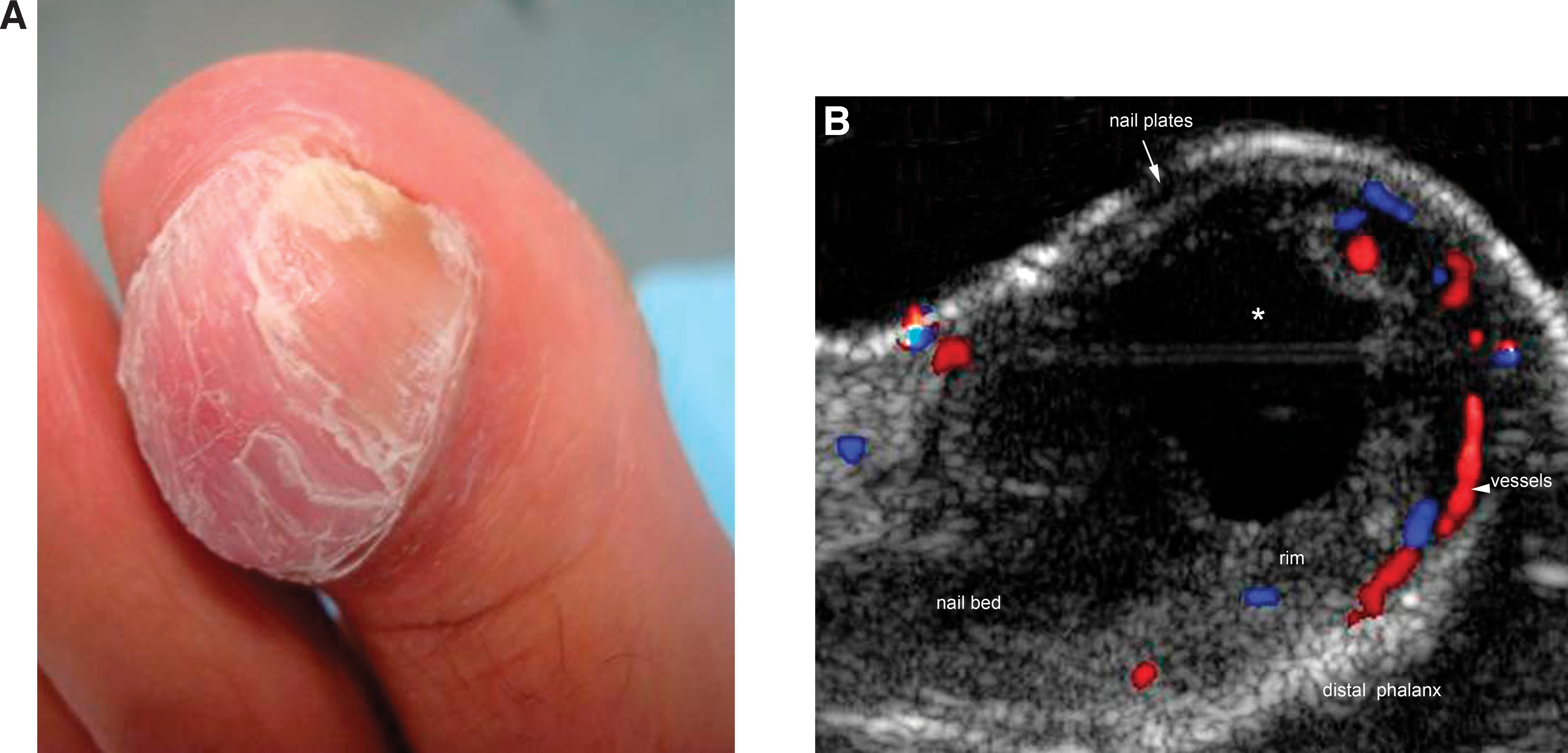
A 59-year-old female patient presented with a 1-year history of a slow-growing and painless mass in the ungual region of the left great toe, without previous trauma. A firm nodular swelling and dystrophy of the nail plate was detected on physical examination (Fig. 1).
Figure 1. Clinical and sonographic findings. A, Clinical picture of the lesion in the great toe of the left foot. B, Color Doppler ultrasonography (longitudinal view of the nail) demonstrates a subungual mass with a hypoechoic rim (solid) (gray) and an anechoic center (cystic) (black). Small vessels (colors) are detected in the periphery of the mass. The nail plate is displaced upward by the mass.
Japma 104 00302 g001
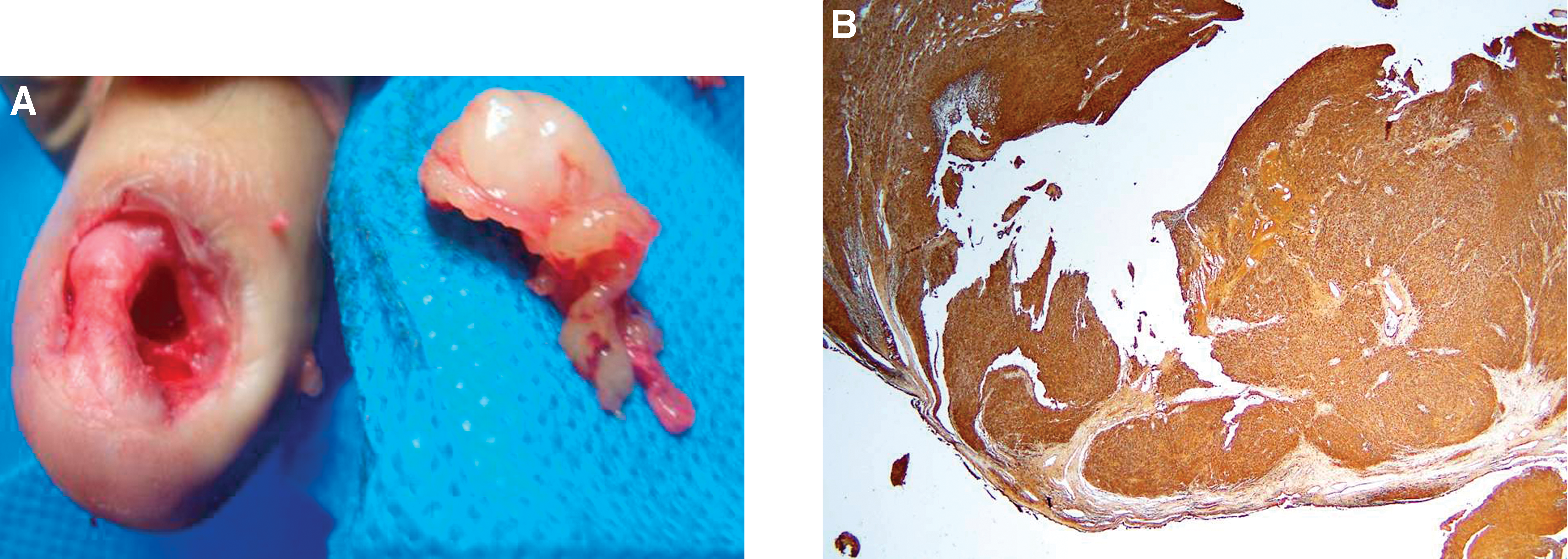
Ultrasonography showed a 6 × 12-mm subungual mass of mixed echogenicity with a hypoechoic rim (solid) and an anechoic center (cystic) that displaced the nail plate upward and produced scalloping of the bony margin of the distal phalanx. The mass involved the matrix region, and on color Doppler ultrasound there were slow flow arterial vessels in the periphery (Fig. 1). Surgical excision of the subungual mass was performed, and the histopathologic analysis reported a nodular formation with proliferation of spindle-shaped cells with neural differentiation (hematoxylin-eosin staining). The S-100 inmunohistochemical test result was positive (Fig. 2).
Figure 2. Surgery and immunohistochemical analysis. A, The tumor at surgery. B, Immunohistochemical analysis shows a positive stain for S-100 (×2).
Japma 104 00302 g002
At 1-year follow-up, the patient showed no signs of recurrence, and the nail morphology was restored to normal.

Discussion

Schwannoma is a benign tumor of neural tissue that shows a predilection for the head, the neck, and the flexor surfaces of the upper and lower extremities. This tumor is uncommon, and the dermal location is extremely rare. Only four cases of digital schwannoma have been reported in the literature, [4,5] and only two with subungual localization. [2,3]
This condition affects both sexes equally and commonly presents with a slow-growing, well-encapsulated, firm and painless mass, found most often on the volar surface (81%). [6] Color Doppler ultrasonography can be useful in the differential diagnosis by proving the existence and assessing the nature (solid, cystic, or mixed), exact localization, and extent of the subungual mass in all of the axes. This imaging technique has been used for studying tumors and pseudotumors of the nail, [7-10] including other neurogenic subungual tumors, such as perineuriomas. [11] The gray-scale sonographic pattern of the present case is different from the one previously described by Moon et al [2] and could represent another form of presentation of this rare tumor. The blood flow pattern of subungual schwannoma has not been previously reported in the literature. Confirmation of the diagnosis of subungual schwannoma is performed by histologic analysis (hematoxylin-eosin staining), and immunohistochemical analysis (S-100) may serve as an adjunct method.
In conclusion, we show a rare location and a new form of ultrasound presentation of a subungual schwannoma that includes the blood flow pattern, with the corresponding histologic correlation. This type of neurogenic tumor and the ultrasound presurgical imaging support should be considered when dealing with subungual tumors of the foot.

Financial Disclosure

None reported.

Conflict of Interest

None reported.

References

  1. RockwellGM, ThomaA, SalamaS:Schwannoma of the hand and wrist. Plast Reconstr Surg111: 1227, 2003.
  2. MoonSE, ChoYJ, KwonOS:Subungual schwannoma: a rare location. Dermatol Surg31: 592, 2005.
  3. HuntleyJS, DavieRM, HooperG:A subungual schwannoma. Plast Reconstr Surg117: 712, 2006.
  4. WolpaME, JohnsonJD:Schwannoma of the fifth digit. J Foot Surg28: 421, 1989.
  5. TisaVN, PauliCD:Neurilemmoma of a digit: a case report. JAPA70: 524, 1980.
  6. IshidaN, WatanabeD, YokooK, et al: Schwannoma of a digit. Eur J Dermatol16: 453, 2006.
  7. WortsmanX, JemecGBE:Ultrasound imaging of nails. Dermatol Clin24: 323, 2006.
  8. SotoR, WortsmanX, CorredoiraY:Onychomatricoma: clinical and sonographic findings. Arch Dermatol145: 1461, 2009.
  9. WortsmanX, WortsmanJ, SotoR, et al: Benign tumors and pseudotumors of the nail: a novel application of sonography. J Ultrasound Med29: 803, 2010.
  10. WortsmanX, JemecGBE:Role of high-variable frequency ultrasound in preoperative diagnosis of glomus tumors: a pilot study. Am J Clin Dermatol10: 23, 2009.
  11. WortsmanX, MerinoD, CatalanV, et al: Perineurioma of the nail on sonography. J Ultrasound Med29: 1379, 2010.