Next Article in Journal
Subungual Schwannoma with Clinical, Sonographic, and Histologic Correlation
Previous Article in Journal
Malignant Melanoma Presenting as a Nonhealing Heel Ulceration
 
 
Journal of the American Podiatric Medical Association is published by MDPI from Volume 116 Issue 1 (2026). Previous articles were published by another publisher in Open Access under a CC-BY (or CC-BY-NC-ND) licence, and they are hosted by MDPI on mdpi.com as a courtesy and upon agreement with American Podiatric Medical Association.
Article

Acute Rupture of the Tibialis Posterior Tendon without Fracture

by
Nicolò Martinelli
1,*,
Carlo Bonifacini
1,
Alberto Bianchi
1,
Laura Moneghini
2,
Gennaro Scotto
1 and
Elena Sartorelli
1
1
Istituto di Ricerca e Cura a Carattere (IRCCS) Galeazzi, Ankle and Foot Surgery, Milan, Italy
2
Department of Pathology, San Paolo Hospital, Milan, Italy
*
Author to whom correspondence should be addressed.
J. Am. Podiatr. Med. Assoc. 2014, 104(3), 298-301; https://doi.org/10.7547/0003-0538-104.3.298

Published: 1 May 2014

Abstract

The acute rupture of the tibialis posterior (TP) tendon, compared to an acute rupture of the Achilles tendon, is a quite uncommon disease to be diagnosed in the emergency department setting. In most cases symptoms related to a TP dysfunction, like weakness, pain along the course of the tendon, swelling in the region of the medial malleolus, and the partial or complete loss of the medial arch with a flatfoot deformity precede the complete rupture of the tendon. In this case report, we describe an acute rupture of the TP tendon following a pronation-external rotation injury of the ankle with no association of a medial malleolus fracture and with no history of a prior flatfoot deformity or symptoms.

Complete traumatic rupture of the tibialis posterior (TP) tendon is a rare condition, which can be easily missed in the emergency department setting with only 6 cases reported since 1995. [1] The pathogenic mechanism leading to the rupture of an apparently healthy tendon is generally a trauma in pronation and external rotation and, less frequently, a direct trauma to the ankle. Signs and symptoms of a TP insufficiency, like swelling and pain along the course of the tendon with or without a progressive loss of the medial arch, indicate in some cases a TP rupture. This scenario, described by a stage II TP tendon dysfunction according to Myerson's classification, is characterized by a correctable defect, with the foot retaining its flexibility and by an elongation of the tendon with anatomopathological signs of degeneration but without clinical and radiological signs of a rupture. [26] Sometimes the TP tendon rupture is a consequence of a fracture of the medial malleolus. [7] The sequela of a TP rupture is an acquired flatfoot of the adult. [8] In this report, we describe an acute rupture of the TP tendon following a pronation-external rotation injury of the ankle with no association of a medial malleolus fracture and with no history of a prior flatfoot deformity or symptoms.

Case Report

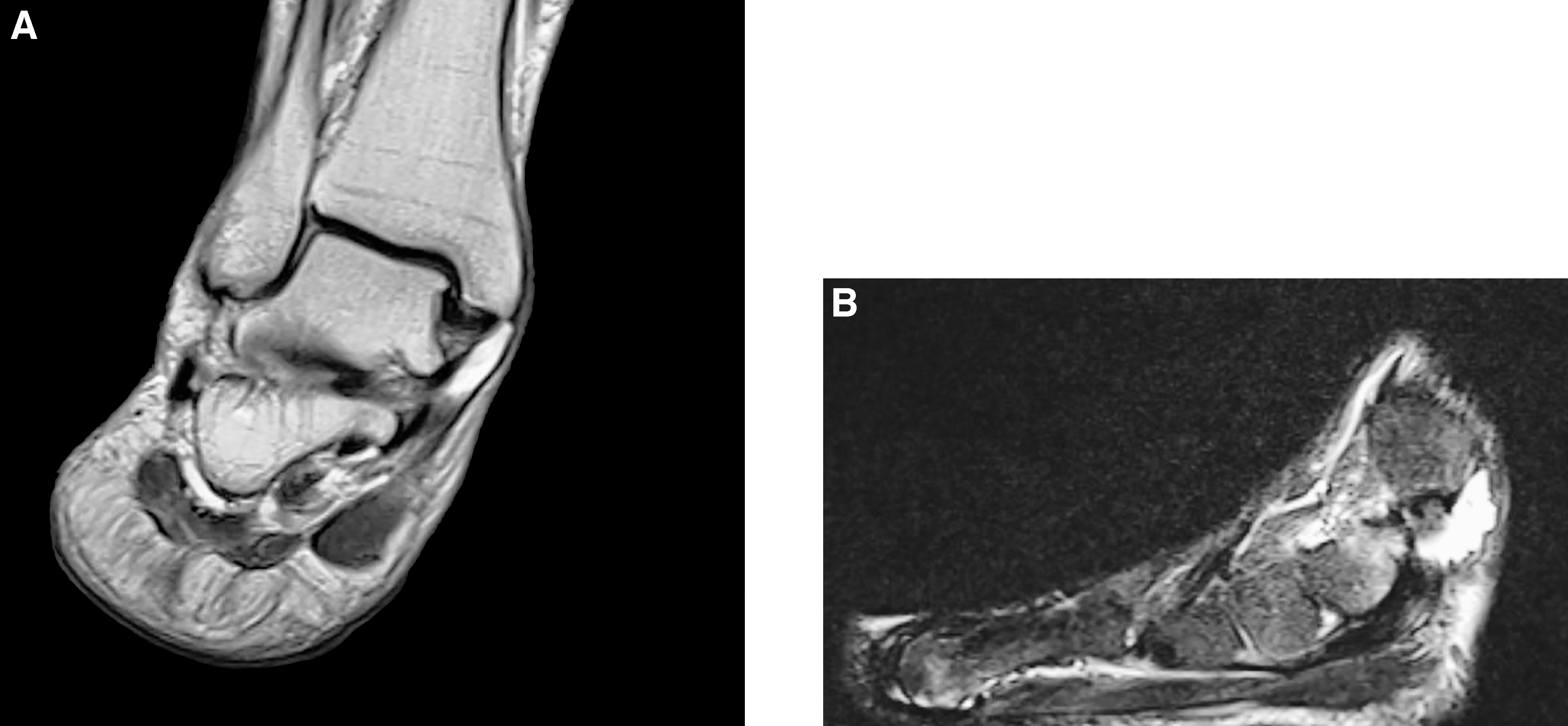
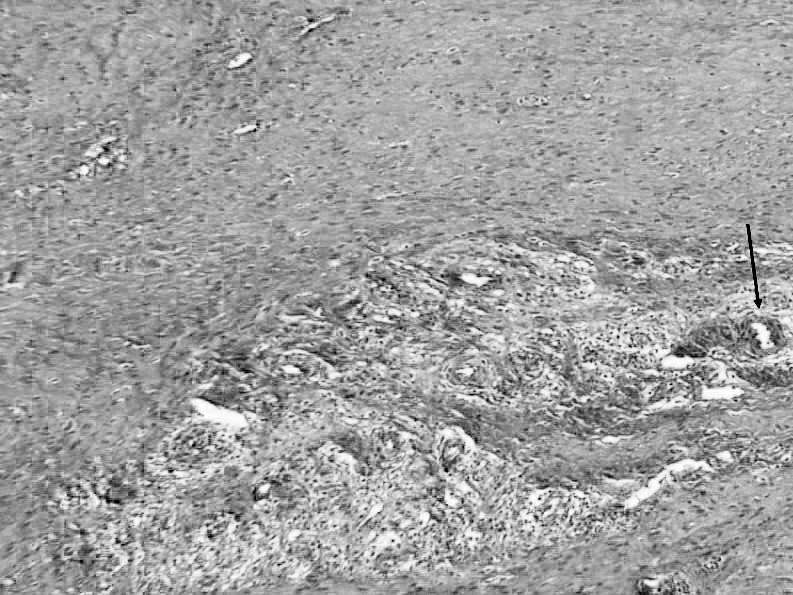
A 45-year-old female hairdresser without history of diabetes or rheumatic disorders, was referred to our orthopedic outpatient clinic with an episode of right ankle sprain with consequent persisting ankle pain. The trauma mechanism was a forced external rotation with a concomitant pronation of the foot due to impact with a heavy object during working activity. The patient was initially treated conservatively in a different hospital with a plaster leg cast after the radiographic exclusion of fractures and a diagnosis of “ankle sprain.” No signs of a flatfoot deformity were reported by the admitting doctor. One month after the trauma, the plaster cast was removed and the patient was allowed to fully bear weight. One week after the plaster cast was removed, she presented to the outpatient clinic of Ankle and Foot surgery of IRCCS Galeazzi (Milan, Italy). She was concerned about the changed appearance of the foot and was having difficulty wearing normal footwear. Her medical history was not relevant (body mass index, 24 kg/m2; nonsmoker) and the patient denied having any signs and symptoms of a flatfoot deformity in the right injured foot before the trauma. The left foot presented neither signs of TP tendon dysfunction nor signs of a flatfoot deformity. The clinical examination of the right foot revealed a flat, everted foot with an obvious valgus heel position. A deficit while inverting and the inability to raise the affected heel off the ground was evident. The first metatarsal rise test was positive. [9] From behind, the forefoot appeared grossly abducted, and pain was elicited along the course of the tendon. Magnetic resonance imaging of the right ankle revealed the presence of a complete tear affecting the TP tendon with surrounding edema (Fig. 1). A standard weightbearing radiograph of the foot revealed a flatfoot deformity. Verbal and written informed consent was obtained from the patient to use photographs, radiographs, and magnetic resonance images in this report, and approximately 2 weeks later surgical exploration and tendon repair were performed. Intraoperatively, a complete tear of the tibialis posterior tendon with thickened distal and proximal segments was noted. The gap between the two segments measured approximately 3 cm. Because of the highly degenerated tendon remaining, we decided to perform a medial calcaneal displacement osteotomy with flexor digitorum longus transfer. [8] A specimen was obtained from the distal segment of the tendon in order to evaluate the degree of histological degeneration. Areas of degeneration were present (Fig. 2). Postoperatively the foot was placed in a below-the-knee plaster cast and the patient remained nonweightbearing for 4 weeks. Thereafter, the patient underwent a 6-week course of physical therapy to improve muscle function, joint mobility, and confidence while walking. At follow-up visits, we observed correction of both the flatfoot and the hindfoot valgus. At 2 years of follow-up the patient was pain free, and she returned to her usual work as a hairdresser and her mild sport activities without limitations.
Figure 1. Magnetic resonance images showing a complete tear of the tibialis posterior tendon. A, frontal section of the ankle joint; B, sagittal section of the foot hindfoot.
Japma 104 00298 g001
Figure 2. Histologic appearance of tendinopathy tissue with a characteristic pattern of fibroblasts and vascular (arrow), atypical, granulation-like tissue. H&E stain, magnification not available.
Japma 104 00298 g002

Discussion

Rupture of the TP tendon can occur as a direct consequence of a medial malleolus fracture in an otherwise healthy individual. However, the rupture is far more commonly observed in patients with a prior history of TP tendon dysfunction in association with well-known risk factors like overweight, hypertension, advanced age, diabetes, rheumatoid arthritis [10] following a trauma in pronation, and external rotation. The isolated rupture of the tendon without a history of TP tendon insufficiency, with no clinical and radiological signs of a flatfoot deformity is uncommon, but should nevertheless be considered in the emergency department. The clinical evaluation in this setting should include an appropriate medical history taking (signs of TP tendon dysfunction) with plain radiographic examination.
Clinical evaluation alone may not be sufficient in diagnosing acute TP tendon rupture, and magnetic resonance imaging might be helpful in the immediate management of TP tendon rupture for early surgical repair. Surgical treatment may include primary repair or tendon transfer, calcaneal osteotomy, arthrodesis, or a combination of techniques depending on the stage of presentation, the presence of collapse of the medial longitudinal arch, or the development of degenerative joint disease. [11] However, direct end-to-end repair is often impossible due to the retraction of the proximal end, and in these patients flexorum digitorum longus transfer has shown good to excellent results as reported by Mann and Thompson. [8] We suggest that intraoperative sampling of the tendon is a useful technique in differentiating between chronic and traumatic acute ruptures. In fact the specimen collected in our patient showed only a few histopathologic changes. We suspect that our patient was affected by a mild tendinopathy at the time of trauma, which was not detectable by clinical or radiologic examination. The tendon, despite being grossly normal, was probably more prone to rupture. The pattern of degeneration found in our patient is similar to that of a chronic ruptured Achilles tendon. [12] Previous studies [1214] reported similar histopathologic features in stage II TP tendon dysfunction to those observed in painful Achilles tendinopathy. Although preexisting tendinosis has been observed in ruptured tendons, [14-16] most acute TP tendon ruptures have been observed with a fracture. Chronic ruptures are commonly observed in patients with a history of ankle sprain or injury and with flattening of the medial arch of the foot and inability to perform the heel-raise test. Acute TP tendon rupture should be suspected in patients with an ankle injury, accompanied by pain along the course of the tendon and weakness of foot inversion. [17]
In conclusion, rupture of the TP tendon, although a rare event, should be considered in the differential diagnosis when assessing ankle trauma in pronation and external rotation even with normal radiographs, without signs of a chronic TP tendon dysfunction and without a flatfoot deformity.

Financial Disclosure

None reported.

Conflict of Interest

None reported.

References

  1. ZwippH, DahlenC, AmlangM, et al: Verletzungen der sehne des M. tibialis posterior. Orthopäde29: 251, 2000.
  2. MyersonMS, BadekasA, SchonLC:Treatment of stage II posterior tibial tendon deficiency with flexor digitorum longus tendon transfer and calcaneal osteotomy. Foot Ankle Int25: 445, 2004.
  3. Kohls-GatzoulisJ, AngelJC, SinghD, et al: Tibialis posterior dysfunction: a common and treatable cause of adult acquired flatfoot. BMJ329: 1328, 2004.
  4. JohnsonKA, StromDE:Tibialis posterior tendon dysfunction. Clin Orthop Relat Res239: 196, 1989.
  5. FunkDA, CassJR, JohnsonKA:Acquired adult flat foot secondary to posterior tibial tendon pathology. J Bone Joint Surg Am68: 95, 1986.
  6. GluckGS, HeckmanDS, ParekhSG:Tendon disorders of the foot and ankle, part 3: the posterior tibialis tendon. Am J Sports Med38: 2133, 2010.
  7. WestMA, SanganiC, TohE:Tibialis posterior tendon rupture associated with a closed medial malleolar fracture: a case report and review of the literature. J Foot Ankle Surg49: 565, 2010.
  8. MannRA, ThompsonFM:Rupture of the posterior tibial tendon causing flat foot. Surgical treatment. J Bone Joint Surg67: 556, 1985.
  9. HintermannB, GächterA:The first metatarsal rise sign: a simple, sensitive sign of tibialis posterior tendon dysfunction. Foot Ankle Int17: 236, 1996.
  10. HolmesGB, MannRA:Possible epidemiological factors associated with rupture of the posterior tibial tendon. Foot Ankle13: 70, 1992.
  11. MendicinoSS:Posterior tibial tendon dysfunction. Diagnosis, evaluation and treatment. Clin Podiatr Med Surg17: 33, 2000.
  12. TallonC, MaffulliN, EwenSW:Ruptured Achilles tendons are significantly more degenerated than tendinopathic tendons. Med Sci Sports Exerc33: 1983, 2001.
  13. JonesGC, CorpsAN, PenningtonCJ, et al: Expression profiling of metalloproteinases and tissue inhibitors of metalloproteinases in normal and degenerate human achilles tendon. Arthritis Rheum54: 832, 2006.
  14. KannusP, JózsaL:Histopathological changes preceding spontaneous rupture of a tendon. A controlled study of 891 patients. J Bone Joint Surg Am73: 1507, 1991.
  15. CorpsAN, RobinsonAH, HarrallRL, et al: Changes in matrix protein biochemistry and the expression of mRNA encoding matrix proteins and metalloproteinases in posterior tibialis tendinopathy. Ann Rheum Dis71: 746, 2012.
  16. HarnerO, LindholmA:Subcutaneous rupture of the Achilles tendon; a study of 92 cases. Acta Chir Scand Suppl116: 1, 1959.
  17. FosterAP, ThompsonNW, CroneMD, et al: Rupture of the tibialis posterior tendon: an important differential in the assessment of ankle injuries. Emerg Med J22: 915, 2005.