Primary lymphomas of bone (PLB) comprise approximately 2% to 5% of extra-nodal lymphomas and 3% to 5% of all malignant lymphomas.
1 The age distribution for PLBs occur between the second and fifth decades of life with a 3:2 male to female predilection.
2 Bao also reported a high preponderance in males younger than 20 years of age.
3 Non-Hodgkin's lymphoma is usually a disorder of lymph nodes, but rarely, can be present in extra-nodal sites (ie, gastrointestinal, osseous, cutaneous, hepatic, orbital/ocular, or oral). Usually, bone involvement entails a secondary process as metastases from nodal sites; however, primary bone lymphomas can arise in any bone and account for 3% to 7% of all malignant bone tumors.
1 Long bones are the most common sites of presentation, particularly the femur, followed by the pelvis, spine, scapula, maxilla, and mandible.
1,2 Generally, patients are asymptomatic and healthy overall, with few patients reporting skeletal pain.
The predominating clinical feature is localized tenderness with varying degrees of pain in an otherwise healthy patient. Occasionally, the affected area may present with an overlying soft-tissue mass. Skeletal pain appears inflammatory in nature and is relieved by nonsteroidal anti-inflammatory drugs or steroids.
6 Other characteristics include anemia, leukocytosis, elevated erythrocyte sedimentation rate, and alkaline phosphatase.
1,3,4 This particular presentation often leads to a misdiagnosis of an inflammatory disorder relating to further delay in accurate diagnosis and treatment. Radiographic features can vary from a solitary osseous lesion with sclerosis to an aggressive lytic lesion with permeative destruction. Periosteal layering, cortical disruption, pathologic fractures, and soft-tissue involvement are often associated in aggressive lesions.
5-7 Further imaging studies are indicated for diagnosis to determine the extent of bone and soft-tissue involvement. Magnetic resonance imaging has a relatively high sensitivity in displaying bone marrow abnormalities and soft-tissue extension of pathologic process;
7 however, it lacks specificity and requires bone biopsy for final diagnosis. Computed tomography (CT) scans can also be a useful tool to help evaluate the extent of the lesion and if there are any pathologic fractures. Inclusion criteria for primary bone lymphoma consist of three components (Coley's criteria): (1) a primary focal lesion in a single bone, (2) positive histological diagnosis, and (3) no distant soft-tissue or lymph node involvement.
2,7,8 Multiple bone involvement is not considered exclusion criteria; however, the other two criteria must be met. Shoji and Miller further stated that the “metastases [must] be regional on presentation, or the onset of symptoms from the primary tumor precedes the appearance of metastasis by at least six months.”
1 Clinical history should also rule out lymphadenopathy and abnormal findings of the chest, abdomen, and neck CT scan.
7 Differential diagnoses should include osteomyelitis, avascular necrosis of bone, metabolic (ie, hyperparathyroidism) and inflammatory conditions, and other neoplasms (ie, osteosarcoma, Ewing's sarcoma) particularly round cell tumors of the musculoskeletal system.
1,6 Case Report
A 60-year-old female presented with a 12-month history of painful hallux abducto valgus and tailor's bunion deformities. Her past medical history included hepatitis C, depression, and hypothyroidism. The hepatitis originated from a blood transfusion many years prior. Prior surgical history included colonoscopy, breast lumpectomy, and liver biopsies. The patient's family history was negative and she was neither a smoker nor a drinker. Medications upon presentation were citalopram and levothyroxine. The hepatitis had been treated in the past, but at the time of initial presentation treatment regimens had ceased. The patient was routinely monitored by her hepatologist, as well as her primary care physician. The patient had no food or drug allergies.
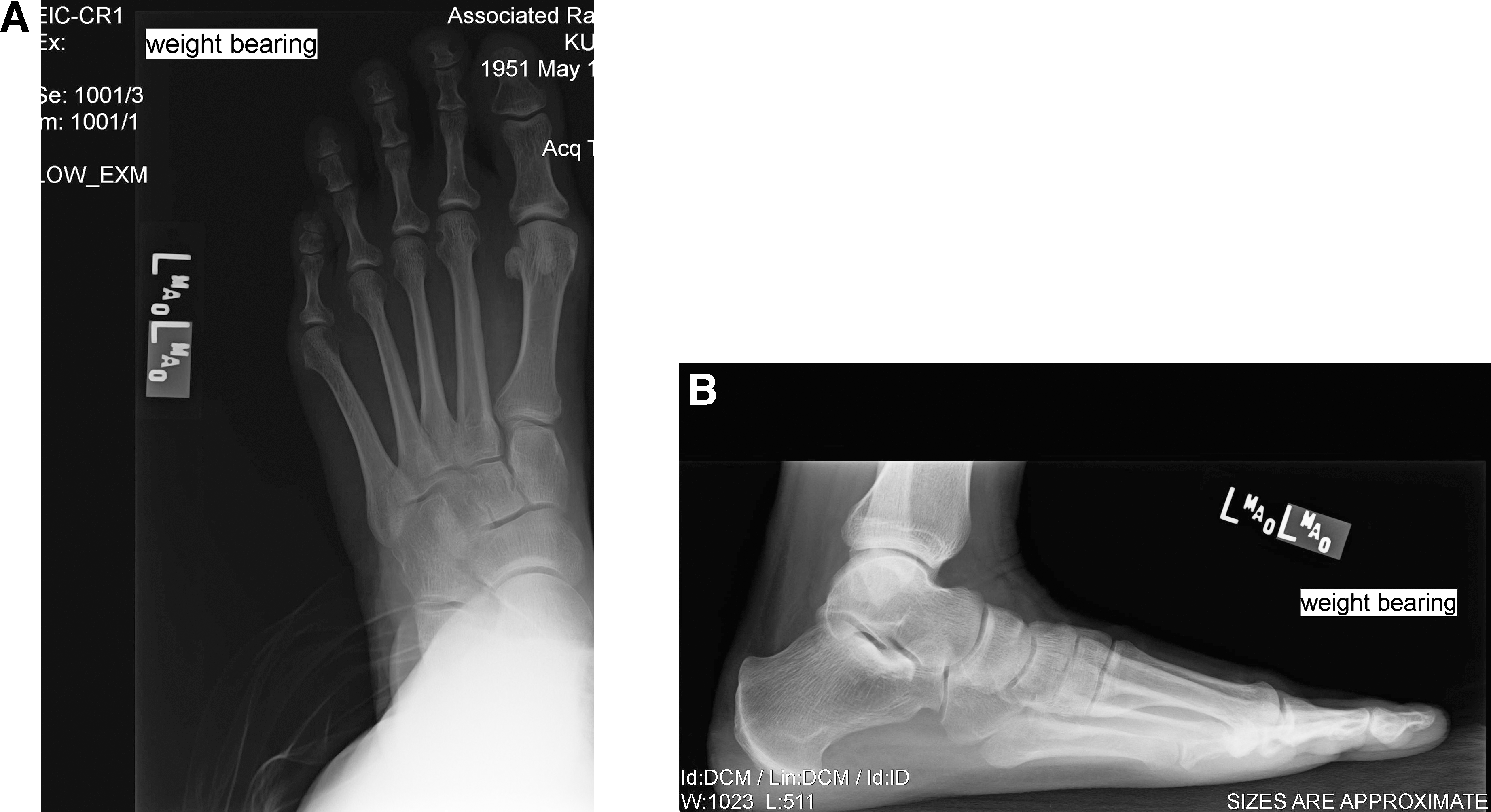
She presented to the office for a surgical consultation regarding the previously mentioned pedal deformities. Preoperative laboratory studies included a complete blood count, complete metabolic panel, prothrombin time, partial thromboplastin time and international normalized ratio, serum calcium, chest X-ray, electrocardiogram, and urine analysis. All results were within normal limits, and the patient was medically cleared by both of the noted physicians. Radiographic studies (
Fig. 1) revealed increased first and fifth intermetatarsal angles, and prominent first and fifth metatarsal heads. No further imaging studies were warranted. Pedal examination correlated with radiographic findings. No crepitus was present at either of the metatarsophalangeal joints. Semiflexible and reducible contractures of the lesser digits were also demonstrated but were not painful.
Figure 1.
Left foot radiographs. (A) Dorsoplantar view shows mild dorsomedial and dorsolateral prominences on the first and fifth metatarsals, respectively. Mild erosive changes are noted on the medial aspect of fifth metatarsal. (B) Lateral view shows no cortical erosions or periosteal changes.
Figure 1.
Left foot radiographs. (A) Dorsoplantar view shows mild dorsomedial and dorsolateral prominences on the first and fifth metatarsals, respectively. Mild erosive changes are noted on the medial aspect of fifth metatarsal. (B) Lateral view shows no cortical erosions or periosteal changes.
First and fifth metatarsal osteotomies were performed and fixated with a Kirschner wire and metallic screws, respectively. Postoperative radiographs demonstrated appropriate reduction in the deformities. All resected bone and soft tissues were sent for pathologic analysis, as per routine of the surgeon.
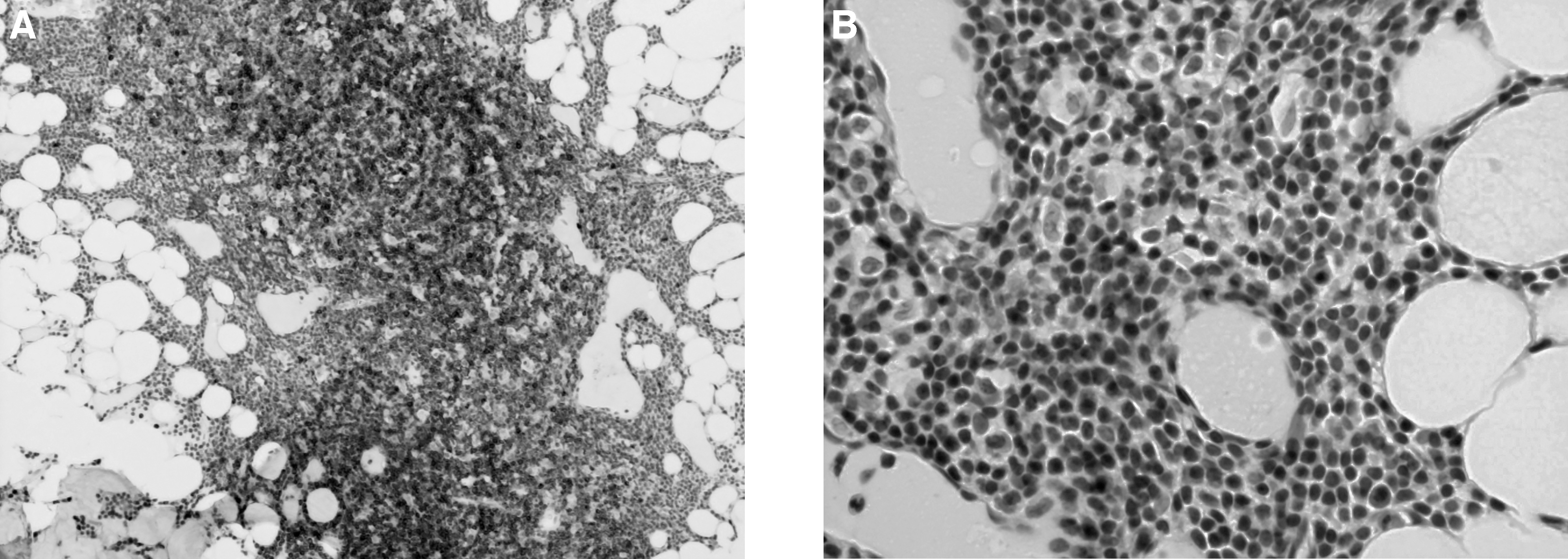
On initial histological inspection, routine immunostains of the bone marrow revealed clusters of monomorphic lymphoid cells, which were positive for CD20 and BCL-2, markers for B cell lymphomas. Due to the rare positivity of these markers, the specimen was sent for secondary analysis and further investigation. An H&E stain was performed as well as a CD20 stain. On secondary analysis the specimen revealed, “numerous lymphoid aggregates composed of small to medium-sized cells with round to slightly cleaved nuclear contours, mature chromatin, and no nuclei” (
Fig. 2A). The nuclei of cancerous cells are often genetically destabilized and can vary greatly in size. Between these aggregates, the marrow was hypocellular, which is another key abnormality. Markers for lymphoma, CD20 and BCL-2, were positive again, confirming the initial hypothesis (
Fig. 2B). Other positive markers included: CD3, CD43, and CD5. Lymphoma markers: CD10, CD23, CD21, BCL-1, and BCL-6, were negative on secondary testing. T-cells and MUM-1 rare plasma cells were positive, and aided in confirming diagnosis. Kappa and lambda showed high background. The final pathologic report diagnosed the bone specimen as “low-grade B-cell lymphoma.” The analysis of the soft tissue was unremarkable.
Figure 2.
Photomicrograph of left foot bone specimen. (A) H&E staining of lymphoid aggregates in low-grade B-cell lymphoma of bone. The lymphoid cells appear small to medium in size, with round to slightly cleaved nuclear contours, mature chromatin, and no nuclei. (B) Immunostaining of primary B-cell lymphoma of bone with CD20 and BCL-2. CD20 is a pan B-cell antigen from immature to mature B-cells. BCL-2 is an anti-apoptosis protein that detects subsets of B-cell lymphomas.
Figure 2.
Photomicrograph of left foot bone specimen. (A) H&E staining of lymphoid aggregates in low-grade B-cell lymphoma of bone. The lymphoid cells appear small to medium in size, with round to slightly cleaved nuclear contours, mature chromatin, and no nuclei. (B) Immunostaining of primary B-cell lymphoma of bone with CD20 and BCL-2. CD20 is a pan B-cell antigen from immature to mature B-cells. BCL-2 is an anti-apoptosis protein that detects subsets of B-cell lymphomas.
The patient was referred to an oncologist for further evaluation and testing. A full body positron emission tomography (PET) scan combined with a CT scan was ordered to determine the extent of involvement. The PET/CT scan was negative with the exception of an increased signal to left first and fifth metatarsals and left hallux. The radiologist could not definitively diagnose that the increased signal was attributable to oncological manifestations since it could be considered normal postoperative inflammation. Additionally, a karyotype of the patient was performed along with a fluorescence in situ hybridization (FISH) specific for chromosome 6 (MYB), chromosome 11 (ATM), chromosome 12 (D12Z3), chromosome 13 (D13S319/13q34), and chromosome 17 (Tp53). The karyotype was normal with no structural or numerical chromosomal abnormalities; the FISH study was also negative. Bone marrow biopsy revealed 8% of all cells being positive for B-cell lymphoma. Upon review of all testing, the oncologist recommended continued close monitoring without any radiation or chemotherapy treatment.