Ankle ligament injury is a well-known and well-documented phenomenon. Several combinations of lateral or medial ligamentous damage combined with fracture or syndesmotic breakdowns are recognized in daily clinical practice.
1-4 In this case report, we demonstrate the combination of a complete deltoid ligament and lateral ligamentous rupture, without bony or syndesmotic injury, caused by a snowboard injury.
Due to the mechanical efficacy of the ankle mortise, this type of injury is rare.
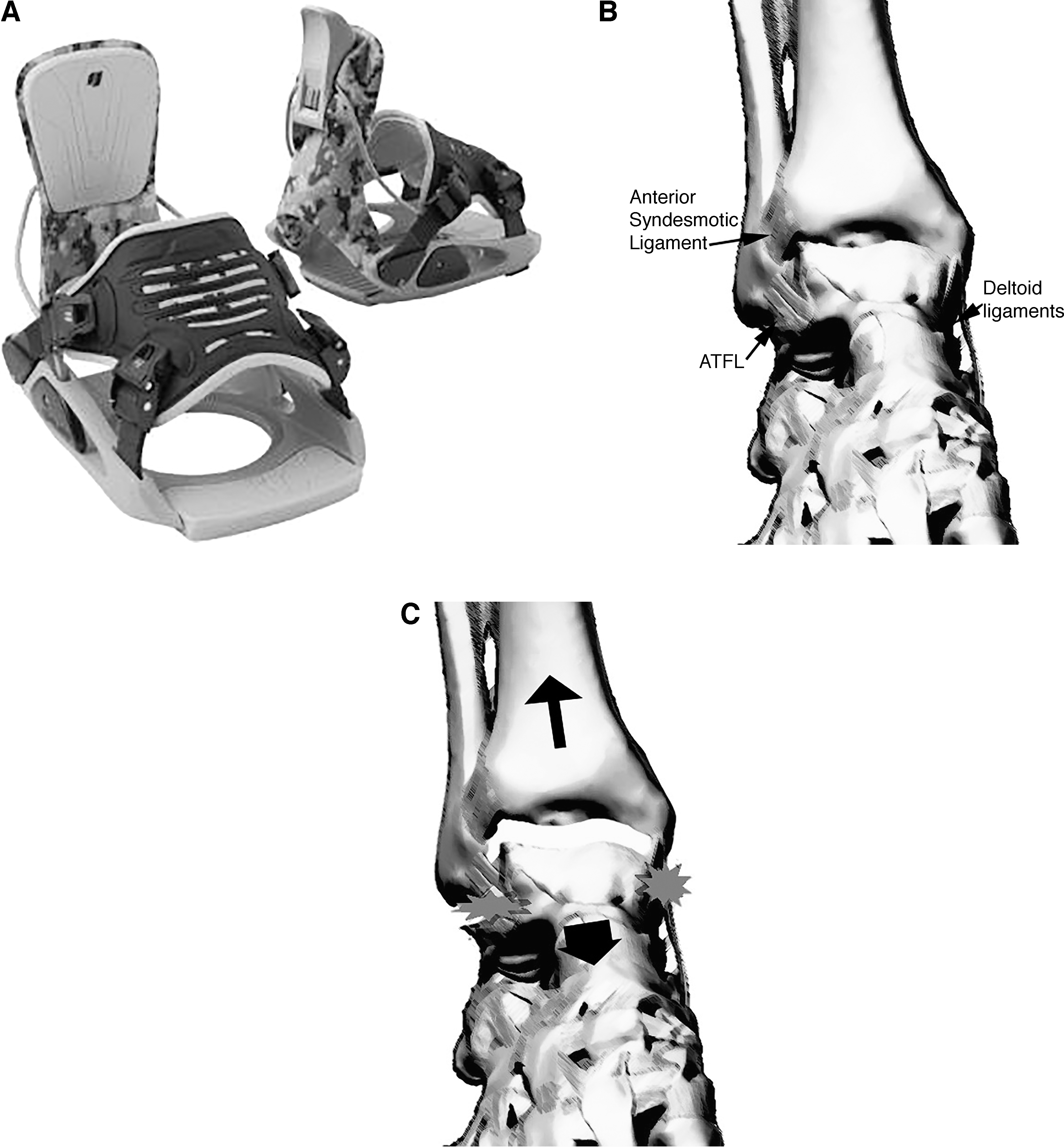
5 Because the deltoid ligament is considered to be stronger than the bone, fracture of the medial malleolous mainly occurs. The trauma mechanism of a pure ligamentous injury is identified as a fierce plantarflexion of the foot with traction, whereby the talus is forced out of the mortise. This could happen during snowboarding, where the tarsus is caught beneath the strap of a snowboard binding and held to the board, while the tibia and fibula are pulled away. (
Fig. 1A) One would expect that the external rotation of the talus that occurs in this case should cause a rupture of the syndesmosis; however, if the talus is freed from the mortise by the amount of energy necessary for this trauma to occur, it may remain intact, causing only a lateral and medial ligament rupture. (
Fig. 1B and C).
Figure 1.
A, Example of a FLOW snowboard binding. B, Normal ankle mortise with ligamenteous structures shown. C, Schematic drawing, the tarsus is kept to the board by the FLOW binding (arrow downward) while the kinetic energy of the body pulls the ankle out of its mortise (arrow upward), rupturing both medial and lateral ligaments.
Figure 1.
A, Example of a FLOW snowboard binding. B, Normal ankle mortise with ligamenteous structures shown. C, Schematic drawing, the tarsus is kept to the board by the FLOW binding (arrow downward) while the kinetic energy of the body pulls the ankle out of its mortise (arrow upward), rupturing both medial and lateral ligaments.
If a dislocation is present, this injury is not that difficult to recognize. However, if the talus tilts back into the mortise, this rare combination of isolated deltoid ligament and lateral ligament rupture can be missed. With this case report, we would like to point out the mechanism of injury, awareness of the injury, and treatment options.
Case Report
A 48-year-old male experienced a trauma during high speed off-piste (nonprepared slopes) snowboarding. His snowboard was equipped with a FLOW binding (FLOW, San Clemente, California), trapping the entire foot (tarsus) but leaving the ankle free (
Fig. 1B and C). During his descent, his board got stuck and caused the patient to be propelled forward with his ankle/foot staying secured to the board. The ankle was swollen and the patient was immediately unable to bear weight on the affected ankle.
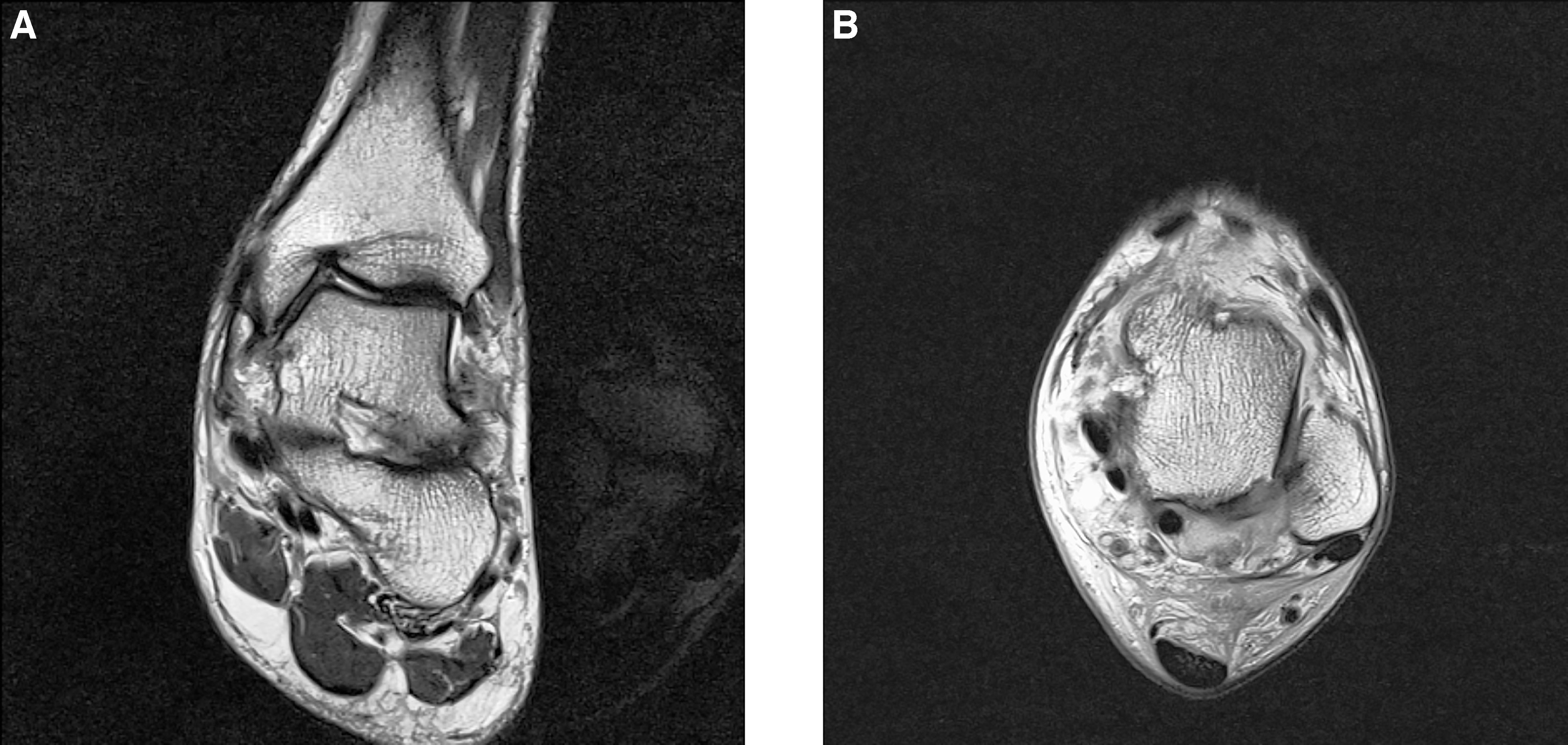
A snowboarder's fracture was suspected on the basis of clinical examination, radiography, and the mechanism of trauma, but this was ruled out by computed tomography (CT). For further analysis the patient was referred to us. On clinical examination there was massive swelling with lateral and medial ecchymosis. Stability could not be tested due to the pain. The clinical diagnosis was a grade III lateral and a grade III medial ligament injury, in which grade III means a total rupture (grading is according to the American Medical Association standard nomenclature system). Magnetic resonance imaging (MRI) confirmed this diagnosis (
Fig. 2A and B).
Figure 2.
Magnetic resonance images showing coronal (A) and axial (B) views of complete deltoid rupture and anterior talofibular ligament rupture.
Figure 2.
Magnetic resonance images showing coronal (A) and axial (B) views of complete deltoid rupture and anterior talofibular ligament rupture.
Magnetic resonance imaging showed a rupture of the anterior talofibular ligament (ATFL), with an intact calcaneofibular ligament and posterior talofibular ligament. No abnormalities were seen in the anterior and posterior tibiofibular ligaments (syndesmosis). A complete rupture of both the superficial and deep deltoid ligament is visible. Although not the gold standard, MRI is an accurate technique for evaluation of the ankle ligament, especially the ATFL. Sensitivity is reported to range from 75% to 100% and specificity from 86% to 100%. There were no suggestions of fractures, confirming the CT outcome (MRI was judged by all authors).
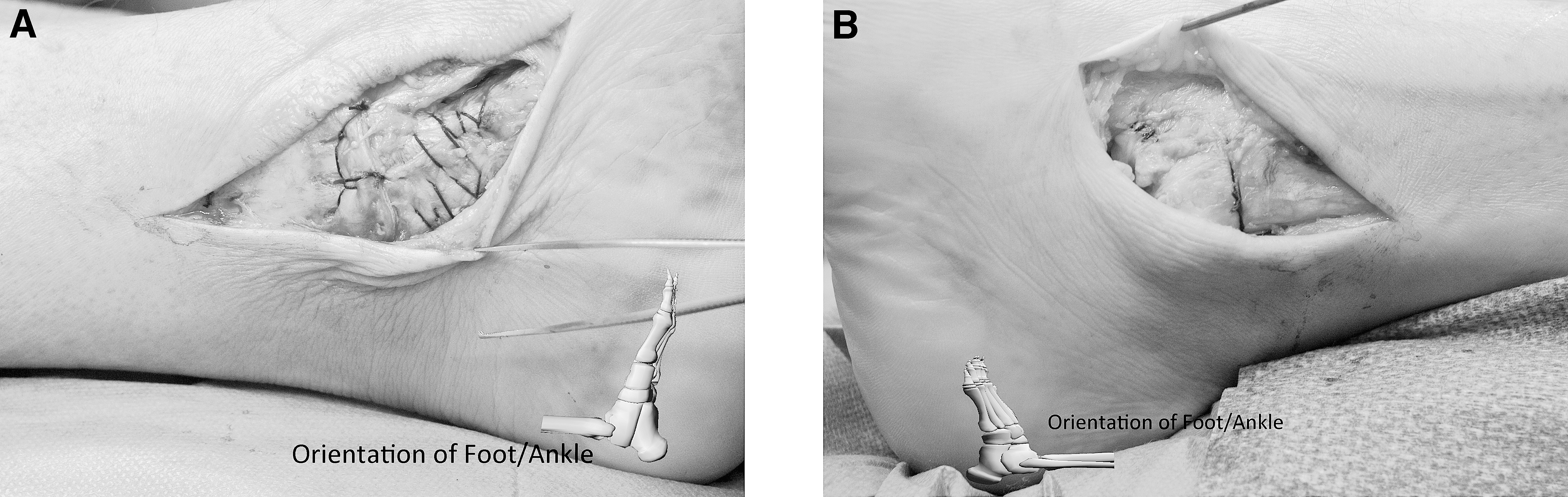
After allowing the swelling to reduce in a nonweightbearing cast, the patient was scheduled for surgery. The patient was aware of the surgical benefits and risks and gave consent. Surgery was performed in the supine position under regional anesthesia. A repair of the ATFL and deltoid ligament was performed after the swelling had subsided (
Fig. 3A and B). The deltoid ligament with the rupture was identified through a medial approach. The deltoid ligament was caught with two rows of three mattress sutures. Three drill holes were made through the medial malleolus, and the sutures were pulled through these drill holes using a suture retriever and then securely tightened. We prefer bone tunneling over anchors. The ruptured ATFL was identified through a standard lateral approach. An anatomical repair was performed with tightening of the ATFL by mattress suturing. These sutures were passed through the bone tunnel in the distal (decorticated) fibula and tightened. After wound closure, a plaster cast was applied. No postoperative complications occurred, and rehabilitation after immobilization with a plaster cast was done by a specialized physical therapist. After 6 months follow-up, the patient was fully recovered, pain free, and fully active in sports.
Figure 3.
Perioperative image of the reconstructed ligaments. A, Reconstructed deltoid ligaments. B, Reconstructed anterior talofibular ligament.
Figure 3.
Perioperative image of the reconstructed ligaments. A, Reconstructed deltoid ligaments. B, Reconstructed anterior talofibular ligament.
Discussion
In this case report, we show a diagnosis that can be easily missed but can also happen fairly often. Many snowboarders use this type of binding, and off-piste skiing is also very popular among boarders. During off-piste skiing the described trauma mechanism certainly can occur. In those cases in which snowboarders fracture (processus lateralis tali fracture) is not identified by radiography or CT scan, the conclusion of contusion/sprain is easily made.
6,7 However, more serious damage can be present as we show in this case report.
We chose a surgical repair in this case, although no conclusive evidence exists that surgery is better than a conservative approach. After discussing the pros and cons with the patient, the decision to surgically repair the injury was made.
8-10 Literature to date does not show which treatment option is best for these patients, meaning that an individual approach based on activity level and expectations of the patient is needed.
11 Bearing this in mind, we chose direct anatomic reconstruction of both ATFL and deltoid ligaments for this young and active patient.
The goal of this case report is to demonstrate the cause and existence of medial and lateral ankle ligament rupture without osseous and syndesmotic involvement and awareness.