The relationship between the plantar fascia and dorsiflexion in the first metatarsophalangeal joint has been well documented in the literature. The data have come especially from in vitro studies and through three-dimensional models that demonstrate the stability provided by the plantar fascia to the plantar longitudinal arch of the foot by means of the windlass mechanism.[
1-
5] Nevertheless, to our knowledge, studies of how the movement of the first metatarsophalangeal joint is related to plantar fasciitis (PF) have not had completely consistent results owing to, among other reasons, the different leg positions used to perform the measurements.[
6]
Hicks[
7] was the first to describe the windlass mechanism, in which passive dorsiflexion of the hallux provokes increased tension in the plantar fascia, elevation of the medial longitudinal arch, supination of the hindfoot, and external rotation of the leg. This description was subsequently verified in several studies.[
8-
10] Arangio et al[
11] investigated the load and support characteristics in the foot using a dimensional biomechanical model consisting of two joined rods with a spring representing the plantar fascia. This materially predicted and simulated a 17% reduction in the height of the arch. Huang et al[
12] showed that the plantar fascia provided stability to the longitudinal arch. In that work, the specimens were placed vertically under weightbearing conditions, and the structures providing important support—such as plantar ligaments, the spring ligament, and the plantar fascia—were sequentially sectioned and displaced to measure them directly with a potentiometer. The rigidity of the longitudinal arch decreased by 15%. Thordarson et al[
13] evaluated the effects of sectioning the plantar fascia, observing a decrease in longitudinal arch height together with an increase in its length and forefoot abduction with internal navicular rotation, suggesting that sectioning the plantar fascia produced instability of the foot.
Thordarson et al[
14] confirmed loss of the windlass mechanism after surgical release of the plantar fascia, thus indicating the importance of this structure in establishing this mechanism. The windlass mechanism occurs during the stance phase of gait, as soon as the hallux begins dorsiflexion at the time of heel-off. As the hallux dorsiflexes, the distance between the origin and the insertion of the plantar fascia shortens, creating tension in the plantar fascia and compression of the bones of the longitudinal arch. The result is foot supination and external rotation of the leg, allowing the foot to progress toward the swing phase.[
2] An inadequate propulsion due to an abnormal subtalar joint pronation will cause a transfer of excess tension to the plantar fascia that could limit hallux dorsiflexion by means of an inverse windlass mechanism and could, thus, contribute to the development of PF. This generates a vicious cycle, as subtalar joint pronation could also be the result of a delay in the start of the windlass mechanism.
The objectives of the present work were to determine 1) the existence of dorsiflexion limitation in the first metatarsophalangeal joint in patients with PF and 2) which type of foot, pronated or supinated, was most frequently associated with PF. The null hypothesis is that the hallux dorsiflexion presented by patients with PF is not different from that presented by their counterparts in the control group.
Materials and Methods
In a sample of 100 lower limbs of 100 individuals (34 men and 66 women; age range, 19–78 years), static standing foot posture and dorsiflexion of the first metatarsophalangeal joint were measured. The participants were patients attending the Orthopaedic Service of the Podiatric Clinical Area at the University of Seville (Seville, Spain) who met the selection criteria and agreed to voluntarily participate in the study after reading and signing the informed consent form. The work was performed between October 1, 2009, and March 31, 2011, and was approved by the research ethics committee of the University of Seville.
The minimum necessary sample size was calculated using the GPower 3.1.0 software package (Franz Faul, Universität Kiel, Kiel, Germany), assuming an α-error of 0.01 and a β-error of 10% (1 – β = 0.90; power = 90%) to estimate the difference between two independent samples using one-tailed tests and for a large effect size (0.8). The result was that a minimum of 43 participants per group were needed. We decided, therefore, to collect data from 50 participants with PF (experimental or PF group) and 50 matched control participants (control group). The patients who formed the control group were attending the Center to eliminate hyperkeratosis or for treatment of nail disorders. In cases in which PF was unilateral, the affected foot was the one included. In cases in which PF was bilateral, only the more affected foot was included; if both feet were affected equally, a coin toss was used to randomly select the foot to measure.
The inclusion criterion for the experimental group was a diagnosis of PF based on the clinical manifestations presented by the patient and palpatory maneuvers performed by the examiner. The inclusion criteria for the control group were patients with characteristics similar to those of the PF group with respect to sex, age, and body mass index (chosen by a pair-matching procedure) but who did not present the pathologic condition under study. The exclusion criteria, common to both groups, were any pathologic abnormality in the first metatarsophalangeal joint that caused pain on movement, neuromuscular diseases, any disorder that might cause symptoms similar to those of PF (eg, subcalcaneal bursitis, Achilles bursitis, Haglund exostosis, and calcaneal fracture), and a history of recent lower-limb elective surgery or trauma. Additional exclusion criteria for the PF group were the association of a direct trauma as the origin of plantar pain and any treatment for PF.
The main variables recorded were static standing foot posture and hallux dorsiflexion. These variables were measured three times, and the resulting mean value was used in the statistical analysis. Other variables recorded were sex (male or female) and age (years). Static standing foot posture was measured using the Foot Posture Index, a clinical diagnostic tool designed to quantify the foot's degree of neutrality, pronation, or supination. During the measurement, particular attention was given to the participant not leaning or moving to see what was being done because this would have significantly altered the outcome. Evaluation of the different foot posture criteria was on a simple ordinal scale, scored from −2 to +2, with 0 being neutral (neither pronated nor supinated); −2, clear signs of supination; and +2, clear signs of pronation. Because, following the indications of Redmond et al,[
15,
16] this examination consisted of six maneuvers, the final Foot Posture Index was a whole number between −12 and +12.
Hallux dorsiflexion was measured while the individual was in supine decubitus with the foot in a relaxed position and the hip and knee in neutral position. The measurement was performed with a universal two-arm goniometer according to a procedure used in other studies.[
17,
18] The literature value of normal passive extension of the first metatarsophalangeal joint is 70° to 90°, and the minimum extension necessary for proper development of gait is approximately 65°. In the present study, therefore, the authors used 60° as a criterion of normality in assessing hallux dorsiflexion.[
19] A margin of 5° was allowed to avoid confusion in cases where the hallux dorsiflexion was close to 65°.
The data were analyzed with the SPSS software program (SPSS Science, Chicago, Illinois). To analyze the intraobserver reliability of the quantitative variables, an intraclass correlation analysis was performed. Three individuals from each group were chosen at random, and these variables were measured three times with a 1-week separation between each set of measurements. The Kolmogorov-Smirnov test showed that the measurements were not normally distributed, so nonparametric tests had to be used for their analysis. The Mann-Whitney U test was used for comparisons, and the Spearman correlation coefficient with a two-tailed test of significance for the correlation analysis between hallux dorsiflexion and the Foot Posture Index.
The effect size was calculated as the Cohen d for comparisons using the following formula: (Mean1 – Mean2) / ([SD1 + SD2] / 2), in which the value of d is positive if the difference between the means is in the predicted sense. This parameter classifies the effect size as small if d ≥ 0.20, medium if d ≥ 0.50, and large if d ≥ 0.80. The effect size for correlations was considered small if ρ = .10, medium if ρ = .30, and large if ρ ≥ .50. Differences were considered to be statistically significant if P < .05.
Results
The values of the intraclass correlation coefficients (95% confidence intervals) for the variables Foot Posture Index and dorsiflexion of the hallux were 0.997 (0.990–0.999) and 0.938 (0.818–0.983), respectively. The reproducibility of the measurements with the methods used was, therefore, good.
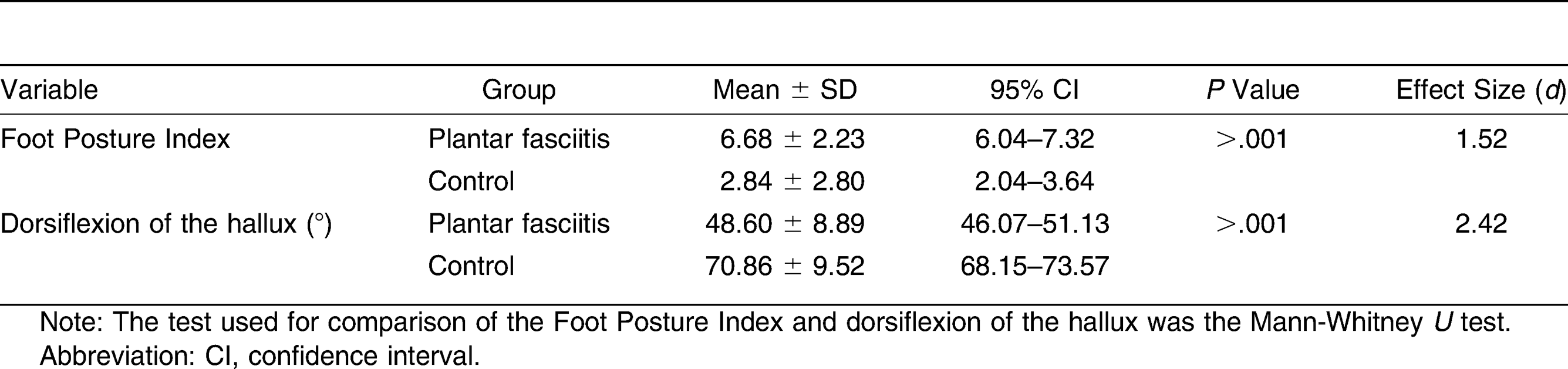
The values of the mean, SD, 95% confidence interval, and median and the results of the comparisons are presented in
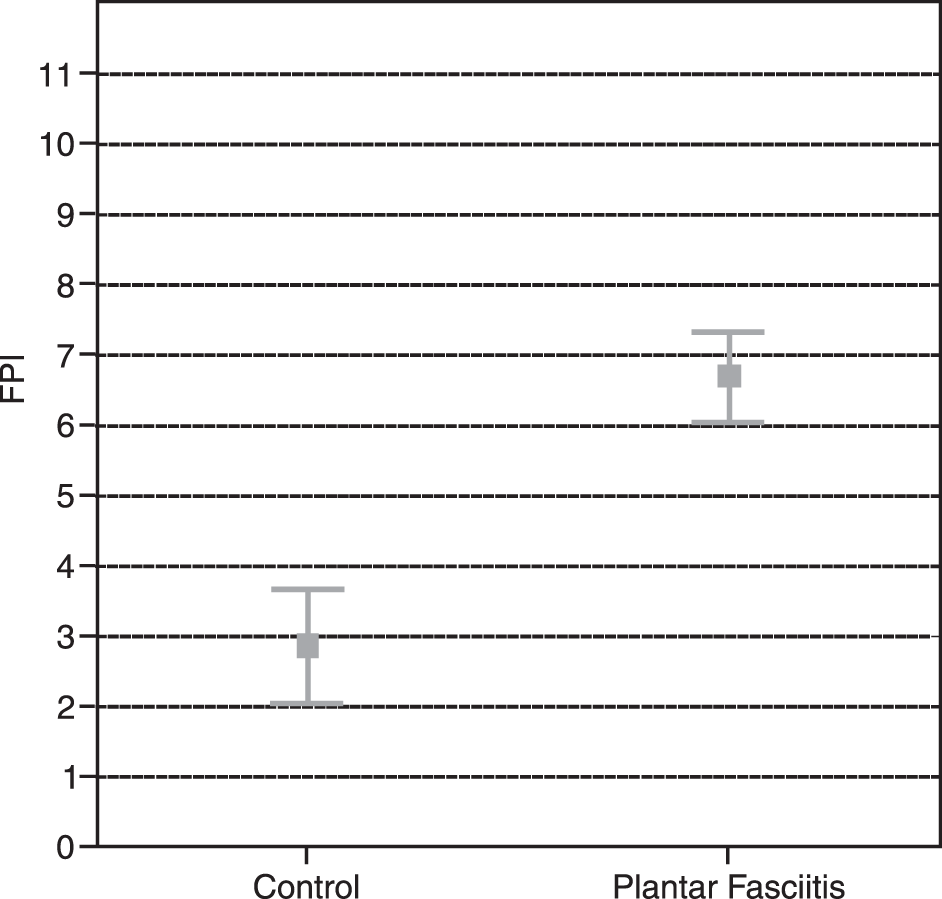
Table 1. As can be seen, participants with PF had higher Foot Posture Index values than those in the control group, indicative of a tendency toward pronated feet (
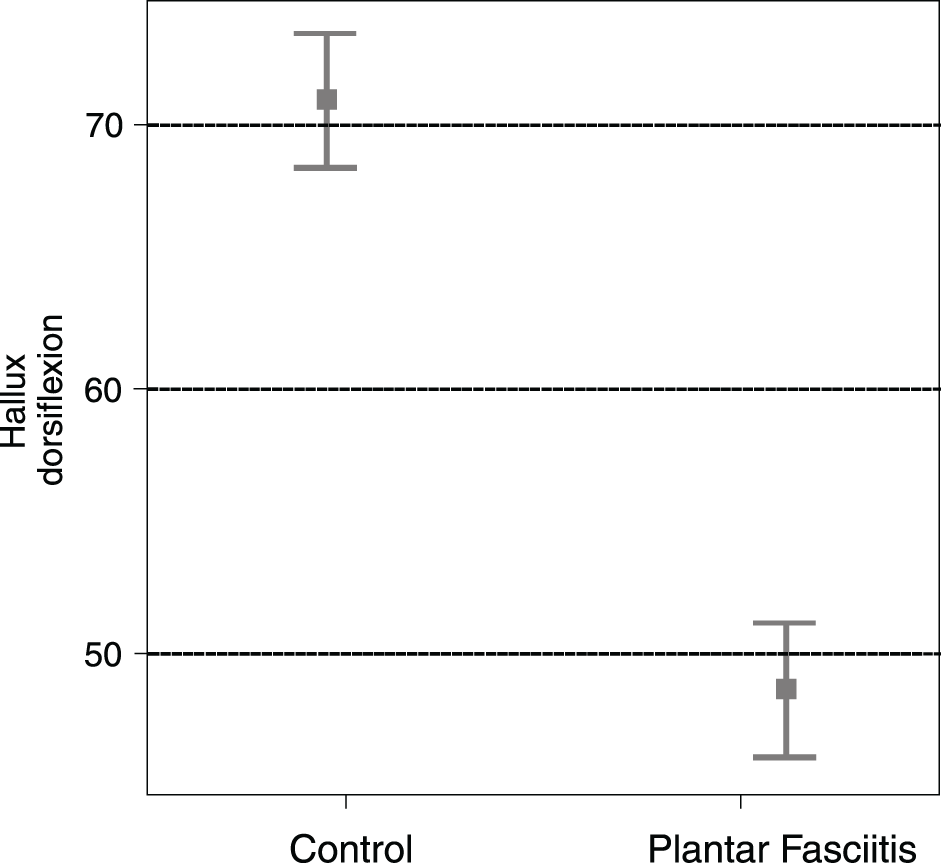
Fig. 1). The PF group also had mean hallux dorsiflexion of less than 50°, indicative of a slight limitation of this movement compared with the control group (
Fig. 2). These differences between the two groups were statistically significant, and the effect size calculated by the Cohen
d was large for the difference in hallux dorsiflexion and Foot Posture Index between the two groups.
Table 1.
Comparisons of the Main Variables Performed Between the Control Group and the Plantar Fasciitis Group
Table 1.
Comparisons of the Main Variables Performed Between the Control Group and the Plantar Fasciitis Group
Figure 1.
Mean Foot Posture Index (FPI) in the plantar fasciitis and control groups. Error bars represent 95% confidence intervals.
Figure 1.
Mean Foot Posture Index (FPI) in the plantar fasciitis and control groups. Error bars represent 95% confidence intervals.
Figure 2.
Mean hallux dorsiflexion in the plantar fasciitis and control groups. Error bars represent 95% confidence intervals.
Figure 2.
Mean hallux dorsiflexion in the plantar fasciitis and control groups. Error bars represent 95% confidence intervals.
The Spearman correlation coefficient between the two variables was −0.441 (P < .01). This showed hallux dorsiflexion to be moderately and inversely correlated with the Foot Posture Index (ie, the more pronated the foot, the less dorsiflexion presented by the first metatarsophalangeal joint), with a medium size effect.
Discussion
The main aim of this study was to determine whether there was reduced dorsiflexion of the first metatarsophalangeal joint in patients with PF compared with individuals without PF. The results allow the null hypothesis to be rejected because there was a statistically significant difference in the value of this variable between the two groups of participants, it being lower in the PF group.
Before any further discussion of the results, it is important to clarify that although the results found PF and diminished hallux dorsiflexion to be associated, the study design does not allow any cause-effect relationship to be established because it provided no data on the temporal relationships between these two conditions, by comparing cohorts for example.
Many authors have described foot pronation as a risk factor for the limitation of hallux dorsiflexion,[
20-
24] pointing to the plantar fascia and the peroneus longus muscle as two of the most important stabilizing elements of longitudinal arch and first-ray support. Hence, excessive pronation of the foot goes together with hypermobility of the first ray due to increased ground reaction forces on the first metatarsal and failure of the peroneus longus muscle to fully operate as a stabilizing element of the first ray. The greater the magnitude of the subtalar joint pronation or first metatarsal dorsiflexion moment, the greater will be the hallux resistance to dorsiflexion. Also, the greater the resistance to hallux dorsiflexion, the greater will be the tension generated in the plantar structures, with the consequent potential to influence the development of PF. When the equilibrium between the stabilizing structures of the first metatarsal and the ground reaction forces is broken, the medial column becomes unstable. This occurs in feet with a high subtalar joint pronation moment or with a reduced medial longitudinal arch in which there is great tension in the plantar fascia. The result is inadequate development of the windlass mechanism.[
25]
A study by Kappel-Bargas et al[
10] of the foot under dynamic weightbearing gave results consistent with the theory of Hicks[
7] finding that with passive dorsiflexion of the first metatarsophalangeal joint there occurred an elevation of the internal arch. There were also significant differences within their sample in the moment at which this arch began to rise. This led those authors to speak of two distinct subgroups of individuals: one in which longitudinal arch elevation began immediately after initiation of the first metatarsophalangeal joint dorsiflexion and another in which this elevation began with a certain lag. The latter subgroup had greater hindfoot pronation than the former. The authors, therefore, suggested that when an individual presents greater ranges of subtalar pronation, the effectiveness of the mechanism by which hallux dorsiflexion elevates the internal arch is reduced.
Most of the studies consulted by the authors relate PF and hallux limitus on the basis of an ineffective response of this mechanism. One could also argue, however, for a biomechanical connection between the two pathologic conditions, with pronation being an intermediary factor in exacerbating PF and limitation of the hallux's dorsiflexion. Creighton and Olson[
26] examined the range of movement of passive and active dorsiflexion of the first metatarsophalangeal joint in athletes with and without PF. The results showed an approximately 20° decrease of passive and active dorsiflexion in the PF group with respect to the control group. The authors argued that their results support the possibility that the reduced extensibility of the plantar fascia precedes the development of PF, acting, therefore, as a contributing factor.
The other possible explanation relating PF and the loss of hallux dorsiflexion, which is advocated by many researchers, is the shortness of the medial band of the plantar fascia.[
20,
27,
28] In a study by Calvo,[
29] 47 of 72 participants with hallux rigidus had heel spurs. Although heel spurs are not synonymous with PF, Calvo argued that the contraction of the plantar structures may be related to the pathogenesis of hallux rigidus, establishing that a congenitally short medial band of the plantar fascia could limit hallux dorsiflexion and first-ray plantarflexion owing to its anatomical position. In a pronated foot, with the reduced angle of plantarflexion of the first ray, the plantar fascia exerts a dorsal force on the first metatarsal head for an overly prolonged period. Consequently, if the first metatarsal is incapable of performing plantarflexion at the right time, there will be increased tension in the medial fascia. The increased tension at the proximal end of the medial fascia may give rise to PF and the presence of a heel spur.
Durrant and Siepert[
28] theorized on how a structure could limit dorsiflexion of the first metatarsophalangeal joint. The conditions they described for this to occur were the following: crossing the transverse axis of joint movement, located plantar-wise to that axis, inserted in the distal element of the joint or proximal phalanx, exerting a force parallel to the longitudinal axis of the first ray, and being equally present on both sides of the vertical joint axis. The medial band of the plantar fascia meets all of these criteria. Congenital, iatrogenic, or idiopathic shortening of the medial fascia could have a direct effect on the joint, with the possible development of hallux limitus. Studies about the effect of sectioning the plantar fascia on the range of movement of the first metatarsophalangeal joint have observed a significant increase in hallux dorsiflexion after release of the fascia.[
30] Murphy et al[
31] found that after a sequential release of the plantar fascia, the medial and lateral longitudinal arches underwent flattening, with the magnitude of the effect being 62% with partial sectioning and 100% with complete sectioning.
The reduced hallux dorsiflexion in most of the patients with PF who took part in this study suggests that stretching the plantar fascia by means of passive dorsiflexion of the hallux and lesser toes could well be an important exercise to include in the treatment of mild hallux limitus. The procedure could increase this structure's elasticity and achieve more degrees of movement in the first metatarsophalangeal joint in the case of hallux limitus. Besides the importance of performing stretching exercises, the marked presence of abnormal pronation and the limitation of the first metatarsophalangeal joint in patients with PF indicate that one might suggest to these patients the possibility of treatment using foot orthoses to provide control over the abnormal subtalar pronation. The aim would be to allow effective functioning of the windlass mechanism, and a consequent improvement and ultimate resolution of their PF, as well as the prevention or improvement of hallux limitus. Regarding this type of treatment, it is important to state that some theories note that limitation of hallux dorsiflexion could also be the precursor to abnormal subtalar joint pronation by not self-stabilizing the first ray and medial arch soon enough in the gait cycle. If this theory is assumed, then the decrease in visible dorsiflexion could reflect a decrease in the time when dorsiflexion should initiate and, therefore, it would result in a generalized decrease in total range of movement. If so, an additional treatment option for the management of PF and hallux limitus emerges, that is, primarily treating this with first-ray cutout on orthoses or by adding hallux dorsiflexion pads to the orthotic extension. Although some studies have reported results in this respect,[
32] further research is needed to clarify the effect of this kind of conservative treatment in hallux limitus.
Conclusions
Hallux dorsiflexion was reduced in patients with PF who participated in the present study. This characteristic may have favored development of the pathologic abnormality by creating additional tension in the plantar fascia. The pronated foot was the most frequent type in the PF group. It is possible, therefore, that excessive subtalar pronation may be a biomechanical alteration that influences the etiology of PF.