Idiopathic toe-walking (ITW), also previously known as habitual toe-walking, was first described in the literature in the 1960s.[
1] This toe-walking gait style was reported as a medical condition that resulted in a congenitally short tendo Achillis in children who frequently walked on their tiptoes.[
1] It was from this first paper that many authors have reported the presence of a toe-walking gait in children who were healthy and neurologically normal. There is a variety of literature on how often this gait type presents in clinical practice. There are also common associations of other developmental or lower-limb physical changes observed with this gait type.
A variety of treatment modalities for ITW are presented in the literature, with differing effectiveness. The treatments have all aimed to limit the ITW gait or reduce any associated muscular restriction at the ankle. There continues to be little published evidence on how or why this gait type develops in children and what, if any, long-term effects there may be on the foot and ankle. There is also limited evidence on the appropriateness and effectiveness of treatment options.
This article summarizes what is currently known about ITW, primarily relating to diagnosis of the gait type. Known effectiveness of treatment options for this gait type are also presented with reference to levels of evidence.[
2] Two case studies of children with an ITW gait are also discussed to demonstrate the impact of different treatment modalities based on the complexity of their presentations. These case studies serve to highlight the variability of the presentation and treatment options that have been used with children who present with this gait type.
The Definition of Toe-Walking
Toe-walking is the absence of heel contact during the initial contact phase of the gait cycle. In normal gait, the position of the leg, ankle, and foot during heel strike is designed to allow the muscles and joints to facilitate movement, prevent abnormal wear and tear on joint articular facets, absorb shock, and assist the body to smoothly function during the gait cycle.[
3] Without heel strike, there are altered forces at the ankle, knee, and hip that change the mechanics of movement through all of the joints.
The absence of heel strike occurs when there are deviations from the normal gait pattern caused by 1) anatomical variations in lower-limb anatomy or innervation making the heel unable to make contact with the ground or 2) an unknown or idiopathic cause in the presence of normally functioning anatomy and an ability of the heel to make contact with the ground.
The Development of Toe-Walking
From infancy to toddlerhood, a child's gait progresses and develops in stages. A baby progresses from lying on the floor, to seated play and crawling, to stilted leg shuffling, to cruising and flatfoot walking. Last, around age 3 years, the child starts to perfect a smooth heel-toe stride. The succession through these steps takes several years to perfect.[
4,
5] It is because of the complexity of these movements and the associated brain, muscle, and osseous development that the child generally masters one stage before advancing to the next.[
6‐
8]
The four foundation publications in pediatric gait development observed children without disabilities, and they all describe children's ability to walk on their toes.[
4,
7,
9,
10] Although many children can walk on their tiptoes and usually achieve this by age 2½ years, it is reported that toe-walking is also not a mandatory phase that each child progresses through or performs while learning and perfecting gait.[
11] This does indicate, though, that toe-walking can be a common component of gait development for the young child. Although it is not understood why a young child may adopt this gait style, it may be as simple as the child standing on his or her tiptoes attempting to make themselves taller to see over things or reach objects and liking this feeling, therefore maintaining this gait for a short period.
Pathologic Conditions that Cause Toe-Walking
There are many medical conditions that have been reported as either causing or being associated with a toe-walking gait. These conditions can be separated into four distinct groups: 1) neuromuscular changes in muscle length, innervation, or strength that prohibit heel strike; 2) traumatic or biomechanical changes in the skeletal framework of the pelvis or lower limb that prohibit or inhibit heel strike; 3) neurogenic influences that result in a toe-walking gait yet heel contact is physically possible during gait; and 4) ITW, or toe-walking when there is no medical condition causing or associated with the gait style.
The literature on the conditions in the first two groups is well established as to how anatomical variants, trauma, and muscular changes prohibit or inhibit heel contact. Less is known about why some neurogenic influences can be associated with a toe-walking gait.
Table 1 lists the medical conditions associated with the toe-walking gait style as documented in the literature.
Table 1.
Medical Conditions Causing or Associated with Toe-Walking Gait
Table 1.
Medical Conditions Causing or Associated with Toe-Walking Gait
Idiopathic Toe-Walking
Definition of ITW
The term idiopathic is a descriptor given to medical presentation with an unknown cause or associated condition. Therefore, the diagnosis of ITW can be given only for the child who toe-walks in the absence of medical conditions known to cause or be associated with this gait type.
Diagnosis of ITW
When presented with a child who toe-walks, careful and methodical history taking and biomechanical and neurologic examinations should be conducted. This ensures that there is a low likelihood of a medical condition causing or being associated with the toe-walking gait. An early reliability study conducted with the Toe Walking Tool demonstrated that methodological and targeted questioning of birth, medical, and developmental history together with lower-limb biomechanical measurements and neurologic tests can be appropriate to guide health professionals regarding when to refer children with a toe-walking gait for further comprehensive assessment.[
34] Because many of the associated medical conditions have the potential to greatly impact the life of the child, it is imperative that these are not missed during the assessment of a child who toe-walks. In all cases, where there is concern about global development or neurologic responses, a child who toe-walks should be referred for further investigation by a pediatrician or child neurologist.
Gait studies have also been used for the diagnosis of ITW and to differentiate between this diagnosis and cerebral palsy. Children with cerebral palsy who toe-walk seem to have a consistent gait pattern on retesting, whereas the ITW gait pattern is more variable because the child is generally able to self-correct.[
35,
36] It is this variability in presentation that is most in keeping with the diagnosis and should be considered together with history and assessment. Careful neurologic assessment will usually enable a diagnosis of cerebral palsy.
Sex, Family History, and Incidence of ITW
There continues to be investigation into how ITW typically presents, and it is well accepted that ITW is not sex specific and is observed in both boys and girls.[
11,
37‐
39] Many children who present with ITW have an immediate family member who also toe-walks or who toe-walked as a child,[
38,
40] and a possible autosomal dominant genetic link has been suggested.[
41,
42] This suggestion leads to the theory presented by one author that a positive familial history is one of the best ways to differentiate ITW from cerebral palsy.[
41]
There is also reference to ITW being a worldwide phenomenon,[
39,
43‐
45] with studies reporting the incidence of the gait pattern to be 1% to 24% in children.[
40,
44,
46‐
48] However, two of these reported figures were based on referrals to a general pediatric clinic[
47] and another to an orthopedic clinic,[
40] and are, therefore, not a reflection of the general population. There is no agreement on the true prevalence of ITW in the community of health professionals who treat or clinically observe a child's gait. Owing to the complex etiology of toe-walking, it is unlikely that a true number will be determined.
Associated Features of an ITW Gait
Ankle equinus has long been associated with ITW, with many authors reporting a restriction in the ankle joint range of motion[
38,
49,
50] seen in children with this gait type. However, the measurement techniques of this range of motion have often been unreliable or the actual degree of restriction not reported. The weightbearing lunge test[
51] has been determined to be a reliable measure of available ankle range of movement and more recently has been used in pediatric studies of foot and ankle conditions.[
52] Recent use of the weightbearing lunge test for measurement has determined that ITW is associated with a mild to greatly reduced available ankle range of motion compared with the normal ankle range of motion of children.[
53] This study found, in a group of 30 children with an ITW gait, that only one child had a normal ankle range of motion.[
53] A recent finding of localized stiffness at the ankle joint in children who have an ITW gait[
44] also supports this finding. This finding is interesting because it is not known whether the stiffness is what causes the initiation of this gait style or whether the stiffness is the result of frequent toe-walking. One other cause of this stiffness or restriction in ankle range of motion may be an observed change in muscle composition and an increase in type 1 muscle fibers found during muscle biopsies of children who have an ITW gait.[
54] This muscle fiber composition is similar to changes reportedly seen in children who have cerebral palsy,[
55] leading to the notion that ITW may, in fact, be neurologic in origin.
There are numerous studies investigating other associated developmental or neurologic features of ITW to better understand how the gait pattern is initiated. Some authors have found that the gait style is associated with developmental problems and that the children presented with speech and language difficulties.[
47,
56] In a small study, higher-than-average left-handedness was found in children with this gait type,[
57] along with hypersensitivity to localized vibration,[
39] some challenges with gross motor skills, balance, and some sensory processing difficulties[
58] observed in the same cohort. Sensory processing dysfunction has also been reported to be associated with ITW,[
59,
43] but there is currently limited evidence to support this claim.[
60]
Some authors have proposed that long-term skeletal changes may occur from the gait type or as compensation from soft-tissue changes.[
35,
50,
61] Gait studies have noted that children with a long-term ITW gait exhibit increased external tibial torsion.[
35,
50,
61] A statistically significant difference between anterior pelvic tilt and external hip rotation has also been observed between children with an ITW gait and their peers, with the ITW cohort exhibiting increased amounts of both.[
61] Although it is unknown whether these skeletal changes cause pathologic abnormalities or pain in the older child or adult, this small body of evidence lends support to health professionals introducing some form of monitoring of the gait style or giving consideration to treatment of the gait type.
Treatment of ITW Gait
The treatment options reported in the literature for an ITW gait are varied, and it seems that there is no “one size fits all” approach. The clinical question for this review of treatment options for ITW was generated using the PICO (patient, problem or population, intervention, comparison, and outcome[s]) format.[
62] The question was separated into search terms, and appropriate studies were identified from the earliest date until July 2012. A computer-based literature search was conducted on five databases: MEDLINE, the Cumulative Index to Nursing and Allied Health, Scopus, PubMed, and the Cochrane Database of Systematic Reviews. The reference lists of the articles selected were also examined. The key search terms and results are found in
Table 2. The eligibility criteria included all study designs, diagnosis of ITW, and treatment. Studies were excluded if there was no article abstract or if the article was not in English. Full articles were obtained, and where there was uncertainty from the abstract, the reference lists of each article were also reviewed, and any article meeting the inclusion criteria was also included.
Figure 1 displays the process of inclusion and exclusion.
Table 2.
Search Strategy Results
Table 2.
Search Strategy Results
Figure 1.
Article screening.
Figure 1.
Article screening.
The recommendations for nontreatment were grouped, and
Table 3 gives a list of these. Each of the studies was reviewed, and the level of evidence as measured against the Oxford Centre for Evidence Based Medicine 2011 Levels of Evidence[
2] was reported for the study with the highest level based on its design. Using this scale, studies with a reported level of 1 or 2 have a more rigorous design than those with level 4 or 5. There was no level 1 evidence in support of treatment or monitoring of ITW gait. There was level 2 evidence in support of serial casting and surgery as treatment methods appropriate for this gait type. There is some support for the use of botulinum toxin type A and letting nature take its course/no intervention with the gait pattern. Parental reminders for children to walk with their feet flat also have been noted to be effective.
Table 3.
Treatment of Idiopathic Toe-Walking
Table 3.
Treatment of Idiopathic Toe-Walking
Many of these treatment interventions were measured against immediate or short-term gait effect, and there is limited knowledge of long-term efficacy of any one treatment giving permanent normalization of gait. A variety of studies have reported that despite various conservative or surgical interventions, some children continued to toe-walk for more than 12 months after treatment, and some children continued to toe-walk into adulthood.[
16,
17,
40,
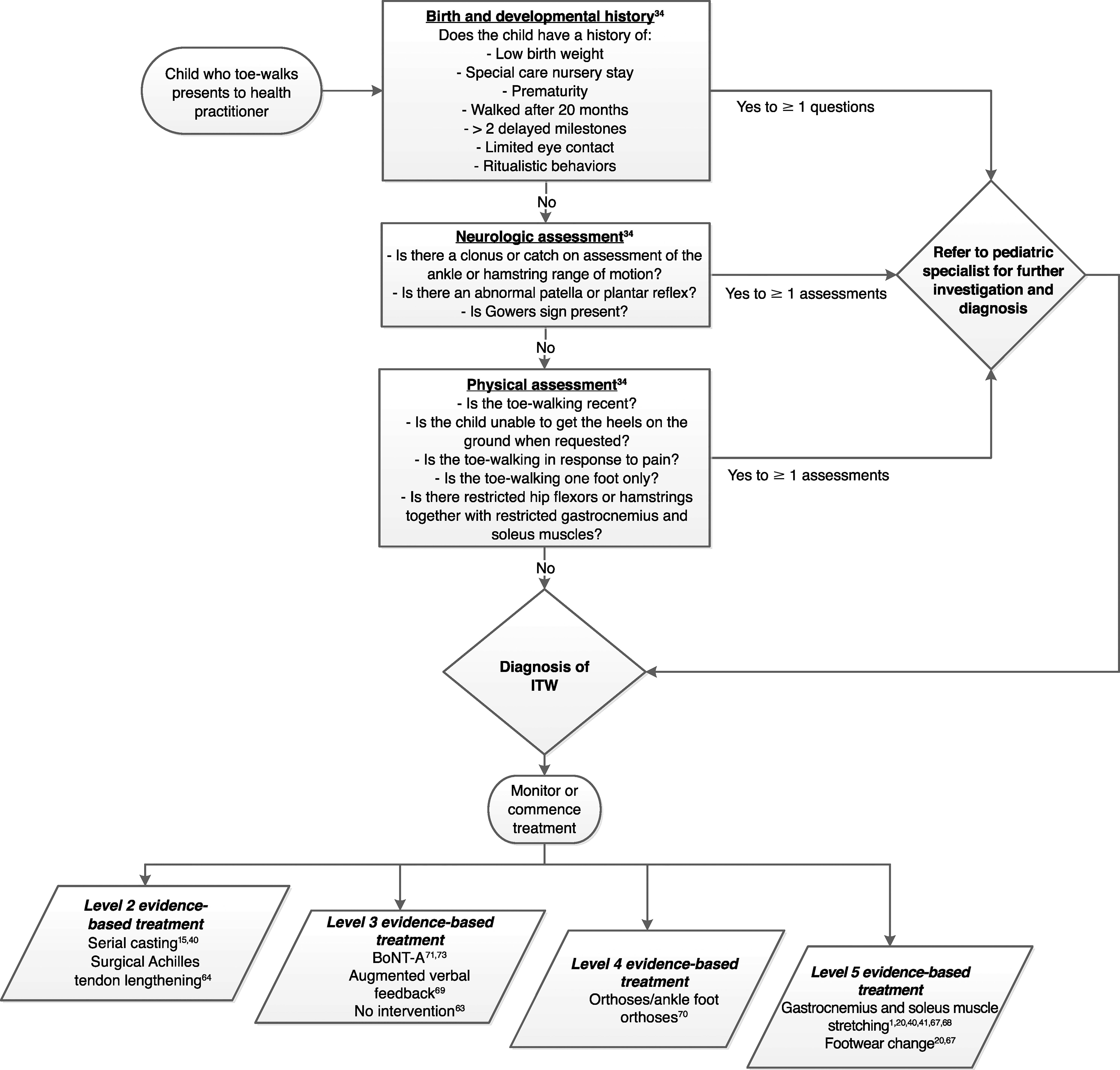
50] No studies of the impact or prevalence in adult toe-walkers were found. Most treatment interventions reported were also localized to the foot and ankle. A flowchart of assessment considerations and evidenced-based treatment options is presented in
Figure 2.
Figure 2.
Decision-making pathway for idiopathic toe-walking (ITW) diagnosis and treatment. BoNT-A, botulinum toxin type A.
Figure 2.
Decision-making pathway for idiopathic toe-walking (ITW) diagnosis and treatment. BoNT-A, botulinum toxin type A.
Although the diagnosis of ITW gait in the literature was consistent, the multitude of treatment or nontreatment options presented in the literature is a challenge for the treating health professional. Two case studies are included herein to highlight the difference in presentation and how different treatment options were tailored for each child together with the overall treatment success. We included these case studies to encourage health practitioners to consider associated factors of the gait type and how differing treatment options can be used. Parental permission was given for each of the case studies.
Case 1
A 7-year-old boy continues to be monitored for gait changes related to ITW in a community health service podiatry department. He initially presented at 4 years of age to the occupational therapist, referred by the maternal and child health service for concerns about his speech, language, and fine motor skills. It was noted at this appointment that he intermittently toe-walked, and he was referred for assessment and treatment as appropriate. At this time, the occupational therapist noted that the toe-walking appeared more in bare feet, with surface changes, and when anxious.
There was no history of pregnancy concerns; he was born via cesarean delivery after a labor that failed to progress. At birth, he did not require oxygen or any additional care, and he was a healthy birth weight. He developed normally, crawling at 9 months and walking at 15 months. His mother also noted that he fell over a little more than his peers. There was no family history of toe-walking.
On examination there were no signs of a neurologic cause for the toe-walking; he had no restrictions in any muscles and no clonus or catch at the ankle or hamstring, and his patella and plantar reflexes were normal. At gait assessment he was able, on request, to normalize an age-appropriate gait, yet he regularly reverted to toe-walking when he thought he was not being observed. The Foot Posture Index-6, a weightbearing measure of foot posture,[
75] was +4 at each foot, and an excess of 20° of dorsiflexion was noted on nonweightbearing ankle range measurement. Originally, he was observed to toe-walk almost 100% of the time out of footwear and less than 50% of the time in footwear.
Because footwear was demonstrating a positive effect on gait, a trial of a small arch filler was placed in the footwear to increase the sensation of full foot contact in the shoe. On review at 3 and 6 months, there was a notable decrease in toe-walking when in footwear only, and similar levels of toe-walking were reported out of footwear. Regular reviews of the toe-walking gait were conducted at 6-month intervals, and it was noted that the footwear with the arch filler continued to have a positive effect on gait, with minimal toe-walking after 18 months when in footwear. It was also observed that the child was toe-walking only about 10% of the time when walking in bare feet. At the last review, 36 months after treatment, there was minimal toe-walking in or out of footwear.
Although it is possible that the toe-walking gait style in this case was always going to self-resolve, where there were normal foot and ankle biomechanics and the toe-walking seemed to be related to tactile surface, footwear therapy may be an appropriate treatment method. The use of arch fillers may have increased the surface area of the foot that touched the ground and may have been useful in reinforcing full plantar contact. It is also proposed that careful monitoring of ankle range of motion was a key component of this treatment regimen.
Case 2
A 7-year-old girl has a long history of ITW gait. She had attended the pediatric rehabilitation, podiatric medicine, and physiotherapy departments.
She had a normal and uncomplicated birth history; she was a full-term baby, and she had an average birth weight. She had a normal developmental history, crawling and walking within the appropriate age ranges.
Initial examination determined restricted ankle range of motion, with a nonweightbearing range of 5° dorsiflexion on straight leg measurement and approximately 15° in flexion. Weightbearing serial casting was conducted; however, an allergy to casting materials developed over the following days and the casts were removed. Night splints were then prescribed, with an exercise program of eccentric heel raises on a small incline board. She was also encouraged to perform heel-only walking exercises with the foot in a dorsiflexed position. This conservative treatment resulted in minimal improvement in the available ankle range of movement.
Owing to the original allergy issue with serial casting, botulinum toxin type A was injected into the medial and lateral heads of the gastrocnemius muscle. A different casting material was used after this injection, and she remained in this weightbearing cast for 7 days. After this, full-length carbon fiber custom-made orthotic devices with some rearfoot control were fitted into footwear, and these were encouraged to be worn as much as possible. The previous eccentric heel-raise stretching program with the incline board was also reintroduced.
Three years after initial presentation, the patient displayed no toe-walking, and she wears normal athletic footwear. There is parental reporting of minimal toe-walking at home, and this occurs generally when out of footwear. At the last review of her toe-walking gait, there continued to be an early heel rise at the midstance part of gait and a recent presentation of pain on medial and lateral squeeze of the calcaneal apophysis. This may indicate that although an overall reduction in toe-walking gait has been observed, the residual equinus has been problematic, potentially exacerbating a common pediatric musculoskeletal condition.
Conclusions
Idiopathic toe-walking continues to be a complex presentation for health professionals. Careful examination of the child to ensure that there is no cause for the gait pattern is imperative, and in cases where there is uncertainty, referral for further investigation must be made.
There have been advances in understanding associative factors of the gait pattern since the last JAPMA review of this gait type,[
38] some of which have indicated that ITW may, in fact, be the result of mild neurologic changes. There have also been additional treatment options explored, including the introduction of botulinum toxin type A to reduce the power of the gastrocnemius muscles, allowing a stretching program to commence and a strengthening program of the dorsiflexor muscles to be implemented.
Although equinus is a common factor associated with ITW, little is known about the long-term effect on the foot and ankle of children who exhibit this gait pattern. Knowledge of the long-term influence of equinus on foot function may be relevant to predict how the child who has ITW gait may be impacted as an adult. Ankle joint and foot function should be considered when debating if, when, or how to treat. Because the literature is also inconclusive about the efficacy of treatment and the longevity of the gait pattern even with treatment, realistic expectations should be given to parents on the nature of the gait. Often the greatest impact of treatment seems to be at the available ankle range of motion, with the toe-walking gait sometimes continuing long after treatment has been introduced.
Because ITW gait is often associated with other global concerns, a multidisciplinary approach is recommended. Careful examination with knowledge of pediatric normative values is essential.