Diabetic foot lesions are a very serious and life-threatening condition with high morbidity and mortality rates. Nearly 5% to 10% of diabetic patients experience diabetic foot problems during their lifetimes; 50% to 70% of nontraumatic amputations are performed on diabetic patients. The risk of lower-extremity amputation is 15-fold higher in diabetic patients than in their nondiabetic counterparts. Although the rate of lower-extremity amputation in diabetic patients is about 5% to 15%, additional amputation is required in 30% to 60% of the cases in a 3-year period following amputation. Although amputation is not a desired method for patients and their relatives, it is a very important, life-saving, and cost-effective intervention in life-threatening situations. It has been well documented that treatment of diabetic foot lesions, and more importantly, preventing foot lesions, have decreased the amputation and morbidity rates by about 50%.[
1‐
3]
Deciding to amputate and determining the level of amputation are very difficult for both patients and surgeons. Because an amputation performed at the wrong level may result in additional surgery, a thorough preoperative evaluation is of crucial importance. In this study, we aimed to investigate the potential beneficial aspects of scintigraphy, along with other classical methods, while making a decision about how to determine the optimal amputation level.
Materials and Methods
A total of 30 patients admitted to the Department of Orthopaedics and Traumatology, Suleyman Demirel University Medical School (Cuncur, Isparta, Turkey), between September 2008 and July 2009, who were diagnosed with diabetic foot and classified as Grade 4 and 5 according to the Wagner Classification, were included in this study. Patients and their relatives were informed about the content of the study and written consent forms were obtained from the patients. The Suleyman Demirel University Medical School faculty ethical committee granted institutional review board approval at the beginning of the study. Exclusion criteria were: multiple and chronic organ failure; cancer at a terminal stage; pathological fractures; urinary, pulmonary, or dermatological infections; chronic rheumatologic disease; any condition requiring frequent blood transfusions; patients having had a surgical operation fewer than 3 months earlier; and those who refused further treatment. All participants were evaluated according to their age, gender, diabetes duration, 3-phase bone scintigraphy, Doppler ultrasound results, level of amputation, level of reamputation, and hospitalization periods. To achieve a multidisciplinary approach, all patients were consulted by the Endocrinology, Infectious Diseases, Cardiovascular Surgery, and Algology Departments (Department of Anesthesiology, Pain Clinic) during their hospitalization periods.
Diabetic foot was also clinically evaluated. During inspection, trophic changes, edema, extremity temperature, capillary and venous circulation time, and the most distal level with a pulse in the lower extremity were investigated. Indications of inflammation, suppuration, pus-filled tissue, bad odor, erythema with the presence of sinus tract, increase in temperature, and pain were also taken into consideration for deciding the amputation level.
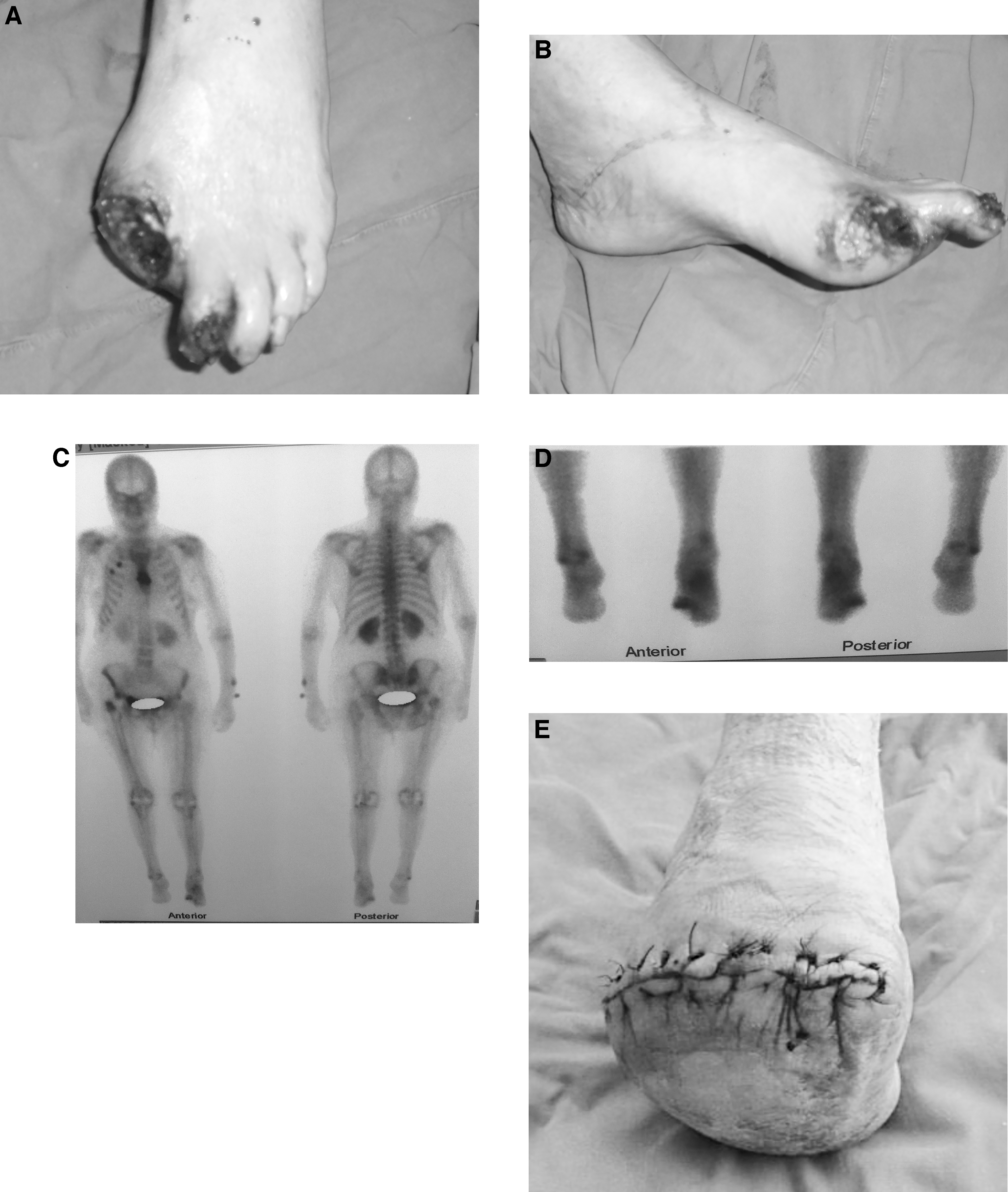
Patients underwent a 3-phase bone scintigraphy using technetium-99m (Tc-99m) methylene diphosphonate at the Suleyman Demirel University Medical School Department of Nuclear Medicine. In the evaluation of the 3-phase bone scintigraphy, the following steps were performed: 1) angiogram (perfusion evaluation phase), 2) blood pool (perfusion increment phase), and 3) metabolic (increase in osteoblastic activity phase). The first phase is also known as the nuclear angiogram or the flow phase. During this phase, serial scans are taken during the first 2 to 5 seconds after injection of the Tc-99m methylene diphosphonate. This phase typically shows perfusion to a lesion. In this first phase, 30 to 60 dynamic images are usually obtained over 1 min immediately after injection. This is radionuclide angiography and gives an idea about the local vasculature. During the first minute after injection, the injected dose is still intravascular and reflects initial blood flow. We used images of the first phase and the early blood-flow phase to determine local tissue perfusion for determination of proper amputation level. Additionally, Doppler ultrasound was obtained and correlated with scintigraphy. The most distal site with perfusion during the perfusion and early blood-flow phase was marked as the amputation level (
Figs. 1 A-E). Color Doppler ultrasound was performed (Esaote Color Doppler Device, Genova, Italy) at the Radiology Department in order to reveal a possible lower-extremity peripheral arterial stenosis or occlusion. The distal site of the region without arterial supply was determined.
Figure 1.
Preoperative clinical (A), lateral (B), whole body scintigraphic (C), local scintigraphic (D), and postoperative (E) views of one of the patients in the study.
Figure 1.
Preoperative clinical (A), lateral (B), whole body scintigraphic (C), local scintigraphic (D), and postoperative (E) views of one of the patients in the study.
Most surgical interventions were performed under spinal/epidural anesthesia, with only a few under general anaesthesia. In a few cases with inappropriate conditions, phalanx amputation or disarticulation with digital anesthesia was achieved. Amputation level was determined according to 3-phase bone scintigraphy, Doppler ultrasound, and inspection of the clear, infection-free region during surgery. The clear, infection-free region was determined according to clinical appearance, radiographic evidence of bone destruction, and scintigraphy. Routine postoperative care and treatment were applied to all patients, but decisions and adjustments were made on an intraoperative basis and planned for preoperatively.
Results
Out of the 30 patients, 23 (76.7%) were male and 7 (23.3%) were female. The mean age was 70.2 years (range, 46–91 years), and all patients had type 2 diabetes mellitus. The mean duration of diabetes was less than 5 years for three of the patients (10%), between 6 and 10 years for 11 patients (36.7%), between 11 and 20 years for 11 patients (36.7%), and 20 years or longer for five patients (16.6%). Patients have been followed for a mean of 12.9 years, with a range of 3 to 32 years with diabetes diagnosis. Blood glucose was controlled by oral antidiabetic drugs in 19 patients (63.3%) and with insulin treatment in 11 patients (36.7%). We initiated insulin treatment to all patients and tried to keep blood glucose levels between 110 and 200 mg/dL during hospitalization. The localization of the extremity lesions were as follows: on the right in 14 patients (46.7%), on the left in 16 (53.3%), on the finger in seven (23.3%), at the metatarsal in eight (26.6%), at the foot in seven (23.3%), and at the leg in eight (26.8%). In our study, 12 patients (40%) had Wagner Grade 4 and 18 (60%) had Wagner Grade 5 lesions.
For all patients who underwent surgical amputation, applied amputation levels were as follows: finger in six (20%), ray amputation in five (16.6%), transmetatarsal in one (3.3%), Lisfranc in two (6.6%), Chopart in seven (23.3%), Syme in one (3.3%), below the knee in six (20%), above the knee in one (3.3%), knee disarticulation in one (3.3%), and two patients had previously undergone amputation operations in other centers. After primary amputation, seven patients underwent additional amputations, and one patient was treated with debridement for necrosis and suppuration. Of the two patients who had previously undergone amputation, additional amputation was performed above the knee in one patient and below the knee in the other one. According to the color Doppler ultrasound results, arterial supply was decreased or totally stenotic in 27 patients; these patients underwent midfoot or above-level amputation. Only a finger amputation was performed and no amputation revision was considered in patients with normal arterial blood supply. Patients with either or both stenosis and decreased blood supply in the posterior tibial artery, arteria dorsalis pedis, or in a more proximal location underwent an upper-level amputation revision. All patients underwent surgery between 1 and 5 days following hospitalization; the mean hospitalization duration was 18.8 days (range, 3–38 days). The revision operations resulted in an increased hospitalization duration (mean duration, 11 days). No mortality was encountered during our study.
Discussion
Diabetic foot lesions are a very important health problem for both patients and physicians with respect to their high morbidity and mortality rates. About one-fourth of the whole patient population with diabetes mellitus encounter foot problems, which constitutes one of the most common reasons for longer hospitalization duration.[
4,
5] The mean annual incidence and prevalence of foot ulcerations in diabetic patients are between 1% and 4% and between 5% and 10%, respectively.[
6] In this study, we aimed to evaluate the possible effects of the use of the 3-phase bone scintigraphy method in determining the amputation level on treatment cost, morbidity and mortality, rates of additional amputation, and hospitalization periods. No mortality was encountered during our study, which was attributed to the exclusion of individuals with chronic or mortal disease from the study and the relatively short period of the study overall. Although the patients were admitted to the hospital with diabetic foot manifestation without knowing that they have diabetes mellitus in many instances, there is a relationship between the development of diabetic foot and the duration of diabetes.[
7] When the mean disease durations of the patients in the current study were taken into consideration, it was revealed that 16 of the cases (53.3%) have had diabetes for 10 years or more. Thus the increase in the number of patients who have undergone amputation operations correlates with the duration of diabetes.
In the current clinical practice, physical examination and the Doppler ultrasound method are generally used to determine the amputation level. In addition to color Doppler ultrasound, transcutaneous oxygen pressure measurement, lower-extremity arteriograms, and magnetic resonance imaging can be used for this purpose. We directed the patients to the Department of Radiology for color Doppler ultrasound monitoring to determine the levels of peripheral arterial stenosis, occlusions, or both in the lower extremities. In all of the patients, arterial blood flow was decreased or totally ceased at the posterior tibial artery or arteria dorsalis pedis levels in 11 cases and at the popliteal artery level in 16 cases. In a prospective study,[
8] approximately 15% of patients with diabetic foot ulcerations had accompanying osteomyelitis and about 16% of patients had lower-extremity amputations.
In diabetic foot wounds and in cases where osteomyelitis is present without radiological signs in the early period, 3-phase bone scintigraphy followed by labeled leukocyte bone scintigraphy are used to diagnose osteomyelitis, along with their indicative property in tissue perfusion. Increases in perfusion, hyperemia, and focal osteoblastic activity in scintigraphy monitoring predominantly suggest a possible osteomyelitis infection. Diabetes-associated vasculopathies can affect the vascular structures that supply the bone tissue, and for this reason, performing a 3-phase measurement after 24 hours increases the specificity of the method.[
9,
10] In the preoperative evaluation of the seven patients who underwent additional amputation surgeries, perfusion increased in the angiogram phase, hyperemia increased in the blood pool phase, and focal osteoblastic activity increased during the metabolic phase in five patients, whereas only perfusion defects were found during the angiogram phase in the other two patients. Perfusion increment in the angiogram phase and hyperemia in the blood pool phase suggest soft-tissue infection, whereas an increase in all three phases indicates osteomyelitis. Perfusion defects alone indicate that there is no blood supply in the bone tissue. In determining the level of amputation, the perfusion site was monitored via scintigraphy and was marked under a gamma camera. We considered that a more aggressive preoperative approach in determining the amputation level could lower the rates of additional amputations, as there were some scintigraphic findings that are indicative of soft-tissue infection and osteomyelitis in five out of seven patients (71.4%), who underwent additional amputation surgery. By taking into consideration the status of our patients with scintigraphically detected perfusion defects, we thought that the assessment of peripheral arterial blood supply in determining the amputation level could contribute to a reduction in the number of required additional amputation interventions.
In a retrospective study in which the amputation rates among 66 patients were investigated, Aksoy et al[
11] reported that the total amputation rate was 39.4%, and ray and below-the-knee amputations constituted 35% and 30%, respectively, while 66.6% of the patients had Wagner Grade 3 and Grade 4 lesions. Based on the results of this study, it was concluded that amputation is a commonly encountered condition in patients with diabetic foot infection and some accompanying conditions such as osteomyelitis and peripheral artery disease are important predictors of amputation. We suggest that 3-phase bone scintigraphy is an important tool in determining the appropriate level of amputation. Yorgancigil et al[
12] performed additional amputation surgery on 76 out of 473 patients (16.1%) with diabetic foot. Tükenmez et al[
13] operated on 66 extremities of 62 patients with diabetic foot for amputation, and they also carried out an additional amputation at one upper level in 16 extremities. In our study, the rate of reamputation was 23.3%. We consider that our results should be reevaluated after increasing the participant number, as the patient number was very limited in our study as to draw a firm conclusion and because of the variable rates in the literature. The mean hospitalization duration range of a diabetic patient has been reported to range from 22 to 48 days.[
3,
14,
15] In our study, the mean hospitalization duration was 18.8 days. The reason for this difference may be related to factors like medical comorbidity other than scintigraphy. At this point, it may be suggested that relatively shorter hospitalization periods can be attributed to the contribution of scintigraphy in determining the amputation level, along with other classical methods. Our opinion is that a clear and better determination of complicated levels in turn leads to shorter hospitalization periods.
Preoperative assessment has a crucial role, as inappropriate level determination may result in the need to perform additional amputation surgery. In the current study, we have taken into consideration the data gathered from 3-phase bone scintigraphy monitoring prior to surgery while determining the amputation level. We conclude that 3-phase bone scintigraphy prior to surgery could be a useful method to determine the amputation level in a diabetic foot. Additional comparative, comprehensive, long-term, and controlled studies are required.