Dermatophytes are a group of related fungi that belong to three genera:
Epidermophyton, Microsporum, and
Trichophyton, each of which includes several species. These fungi are keratinophilic and infect superficial keratinized tissues (skin, hair, and nails) in humans and animals, causing cutaneous mycoses known as dermatomycoses.[
1] The prevalence of dermatomycoses in European countries varies between 3% and 22%, and there has been a recent increase globally that is attributed to the growing levels of several pathologic conditions, such as immunodepressive syndromes, diabetes mellitus, organ transplants, and the use of corticosteroids and antineoplasic drugs.[
2,
3]
The habitual diagnosis of dermatomycosis is based on the detection of morphological structures of fungi by direct observation under the microscope, followed by in vitro culture and identification of the fungal species.[
4‐
9] In the case of onychomycosis in particular it is necessary to make a differential diagnosis owing to the existence of a variety of pathologic abnormalities that present similar symptoms, such as onychodystrophies originated by psoriasis, lichen planus, chronic paronychia, traumatisms, the physiologic changes of aging, yellow nail syndrome, and other unusual syndromes.[
4,
10]
The microbiological method of detecting or discarding fungal infection, however, has two main disadvantages: first, direct microscope examination gives false-negative results in 5% to 15% of cases[
6,
11,
12] and, second, fungal growth on plates with specific culture media requires 2 to 4 weeks.[
6,
8]
The development of molecular biology and the accessibility of databases of biological sequences have led, in general, to an improvement in the sensitivity and specificity of many diagnostic methods. However, in the field of mycoses, this application is just beginning to be used.[
12‐
15]
In our molecular diagnostics laboratory at Centro Universitario de Plascencia (Cáceres, Spain), we detect dermatophytes in nail samples by extracting DNA from nails, followed by polymerase chain reaction (PCR). This PCR is based on a method previously described[
11] that allows us to detect the presence of genetic material belonging to the dermatophyte genera while simultaneously identifying the most frequent causal agent:
Trichophyton rubrum.[
11,
16,
17] We performed a comparative study of the sensitivity of the two techniques to determine whether we could replace the plate culture with the new PCR.
Application of the PCR technique has brought about a remarkable improvement in the diagnosis of onychodystrophies at University Podiatric Clinic (Plascencia, Spain), especially regarding reduction in the time for diagnosis confirmation.
Materials and Methods
Clinical Nail Samples
This study was performed with samples harvested from three clinical centers in the north of the Cáceres province (Spain) between January 2, 2009, and December 22, 2011. These centers were the University Podiatric Clinic of Plasencia, the Psychiatric Hospital of Plasencia, and the Residential and Family Centre in Nuñomoral, Spain. Samples consisted of pieces of nails from 232 cases of suspected nail fungal infection. Before the start of this study, we obtained permission from the Bioethical Commission of the University of Extremadura (Badajoz, Spain) for working with human samples.
Cultures
The nail samples were sown on a plate with Sabouraud agar plus chloramphenicol culture medium, which is selective for the isolation of dermatophyte fungi and yeasts, and were kept at 30°C for 3 or 4 weeks. Identification of the morphological structures of the fungi was performed by optical microscopy using a lactophenol blue solution as a staining agent[
4] to determine the species.
Polymerase Chain Reaction
Molecular analysis was performed on fragments of the same nail samples. First, DNA extraction was made using the reactive agent InstaGene Matrix (Bio-Rad Laboratories, Hercules, California) in accordance with the manufacturer's instructions.
The PCR was performed using a reaction volume of 25 μL with the following composition: 4 μL of DNA solution, 2.5 μL of buffer reaction, 2 μL of a mixture of deoxynucleotide triphosphates (2.5 mM each), 2.5 μL of 25 mM magnesium chloride, 0.2 μL of 100 ng/μL oligonucleotides, and 0.3 μL of Taq polymerase (Biotools DNA Polymerase; Biotools B&M Labs SA, Madrid, Spain).
The reaction cycles were as follows: a first cycle for 5 min at 95°C; then 35 cycles for 30 sec at 94°C, 30 sec at 58°C, and 30 sec at 72°C; and, finally, a step at 72°C for 6 min.
For the first PCR, four previously described oligonucleotides[
11] were used: Derm1, Derm2, Tr, and uni. The first two amplified a fragment of the chitin synthase 1 of dermatophyte genera, with a size of 366 base pair (bp), as described by Brillowska-Dabrowska et al,[
11] who tested 12 dermatophyte reference strains, 89 clinical dermatophyte isolates, 22 nondermatophyte fungal isolates, and purified human DNA. The second primer pair amplified a sequence of
T rubrum located in an intergenic spacer region of ribosomal DNA. The length of the amplified DNA was 203 bp (
Fig. 1).
Figure 1.
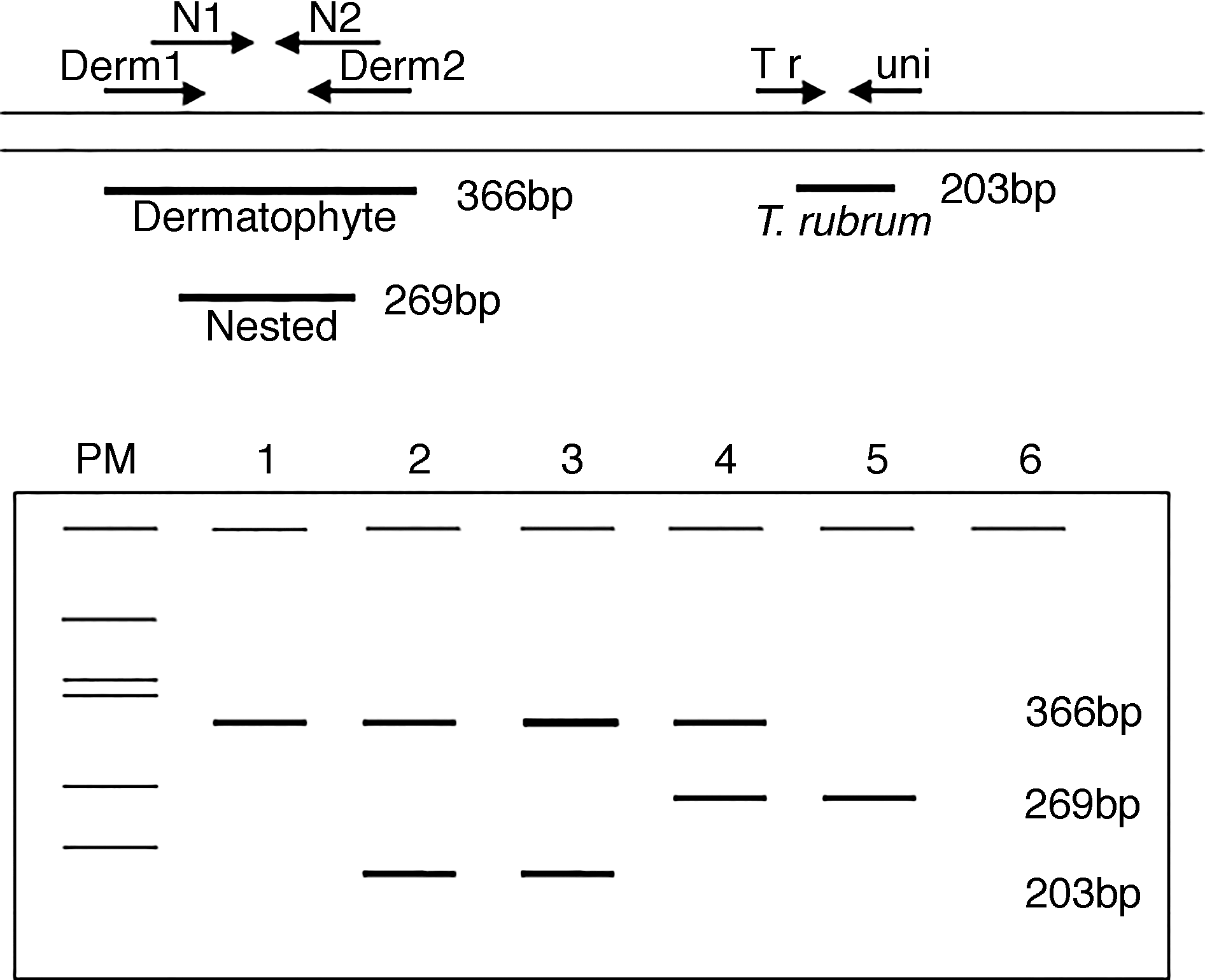
Schematic representation of the polymerase chain reaction (PCR) technique. Top, The genome is designed as two long parallel lines. The arrows represent the oligonucleotides used, and the DNA fragments amplified correspond to the thick lines, with their respective sizes expressed in base pair (bp). Bottom, The different results that can be found in an agarose gel: lines 1, 2, and 3 are the hypothetical results of the first PCR (line 1 corresponds to any species of dermatophyte other than Trichophyton rubrum, and lines 2 and 3 are T rubrum samples). Lines 4 and 5 correspond to the nested PCR of dermatophyte genera. Line 6 corresponds to negative control (a reaction tube without fungal DNA). Line PM represents a molecular weight marker in order to have a reference of DNA fragments size.
Figure 1.
Schematic representation of the polymerase chain reaction (PCR) technique. Top, The genome is designed as two long parallel lines. The arrows represent the oligonucleotides used, and the DNA fragments amplified correspond to the thick lines, with their respective sizes expressed in base pair (bp). Bottom, The different results that can be found in an agarose gel: lines 1, 2, and 3 are the hypothetical results of the first PCR (line 1 corresponds to any species of dermatophyte other than Trichophyton rubrum, and lines 2 and 3 are T rubrum samples). Lines 4 and 5 correspond to the nested PCR of dermatophyte genera. Line 6 corresponds to negative control (a reaction tube without fungal DNA). Line PM represents a molecular weight marker in order to have a reference of DNA fragments size.
Finally, to increase the sensitivity of the amplification, we designed another pair of primers named N1 (5′GCCGGTCTAGGTGTTTACCA3′) and N2 (5′GTTCCAGCATCGAGGAGAA3′) to perform a nested PCR, which amplified an internal fragment of 269 bp in the 366-bp segment described in the previous paragraph. To standardize the reaction, different conditions of reagent concentrations were tested, as were different temperatures of the steps (data not shown).
The results were visualized through a 1% agarose electrophoresis gel stained with ethidium bromide.
Figure 1 shows a diagram of a hypothetical gel, and
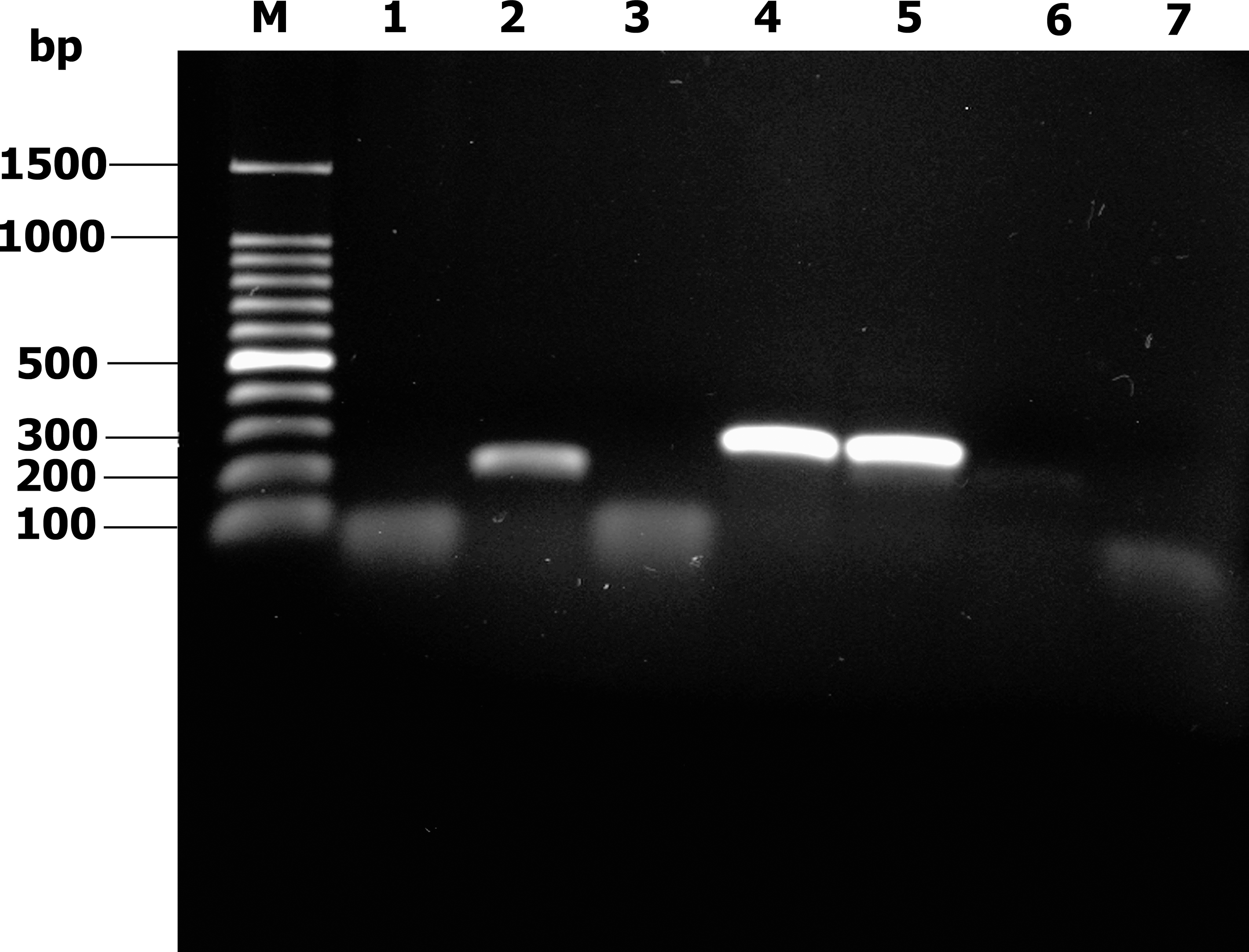
Figure 2 shows the amplification products of different samples.
Figure 2.
Polymerase chain reaction (PCR) products analyzed in an agarose gel electrophoresis. M represents the molecular weight marker (100–base pair [bp] DNA ladder); lines 1, 2, and 3 contain the product of the first PCR, where Trichophyton rubrum fragments can be seen but dermatophyte in specific DNA fragments are too light. Nested PCR products of the same samples are in lines 4 to 6. Lines 1 and 4 show the results corresponding to any dermatophyte species other than T rubrum. Lines 2 and 5 display the two bands corresponding to a sample containing T rubrum: (203 bp) and the 269-bp band corresponding to dermatophyte genera. Lines 3 and 6 display the negative results of a sample. Line 7 contains the negative control.
Figure 2.
Polymerase chain reaction (PCR) products analyzed in an agarose gel electrophoresis. M represents the molecular weight marker (100–base pair [bp] DNA ladder); lines 1, 2, and 3 contain the product of the first PCR, where Trichophyton rubrum fragments can be seen but dermatophyte in specific DNA fragments are too light. Nested PCR products of the same samples are in lines 4 to 6. Lines 1 and 4 show the results corresponding to any dermatophyte species other than T rubrum. Lines 2 and 5 display the two bands corresponding to a sample containing T rubrum: (203 bp) and the 269-bp band corresponding to dermatophyte genera. Lines 3 and 6 display the negative results of a sample. Line 7 contains the negative control.
Results
A total of 232 samples were examined by direct microscopy after treatment with 20% potassium hydroxide and were cultivated on plates with Sabouraud plus cloramphenicol medium for 3 to 4 weeks at 30°C. In the case of positive growth, a morphological study was performed with a microscope to identify the species. After 4 weeks, cultures that did not show growth were considered negative.
Direct DNA extraction was taken from 225 nail fragment samples (in seven cases the amount of sample was insufficient and the samples were discarded). From the DNA, two consecutive amplifications were made using the conditions described in the “Materials and Methods” section for the detection of two specific sequences of dermatophyte fungi.
The size of the nail sample taken is usually very small, which means that the number of copies of genetic material that can be detected is very low. For this reason, we decided to use a nested PCR, although it involved the adoption of greater control in the laboratory, taking steps to avoid contamination.
We verified that we had, in fact, obtained an increase in sensitivity of approximately 15% (data not shown), and no case showed evidence of contamination. A schematic representation of the design and the results of the PCR are shown in
Figure 1. An example of the results of the amplification of some samples in an agarose gel is shown in
Figure 2.
In agreement with previous studies, we obtained a high proportion of negative samples for dermatophyte detection using the two techniques: classical growth in culture and DNA amplification. We could not find any proof of dermatophyte fungal infection in 119 of 225 samples with suspected onychomycosis (52.9%). A high proportion of these negative samples presented growth of Candida species (30.3%, 36 of 119) (data not shown), although we consider that a high proportion of them are the product of a process of colonization but not a real infection.
We have to consider these data and emphasize that only half of the cases that seem to be mycoses are fungal infections to improve the differential diagnosis of pathologic conditions of the nails.
The two techniques are not fully coincident as we obtained concordance in only 78.2% of the samples (52.9% negative plus 25.3% positive results).
The number of samples that were positive with at least one of the two methods was 163 (72.4%). In 73 cases we detected DNA from the microorganism, and dermatophytes grew on 90 of 225 plates (
Table 1).
Table 1.
Results of the Analysis of Samples by PCR and Plaque Culture
Table 1.
Results of the Analysis of Samples by PCR and Plaque Culture
Of the 49 samples with discordant results, 16 were positive for PCR but did not grow in culture, and in the 33 cases that grew in culture, the PCR did not detect DNA corresponding to dermatophytes. The comparison of the results obtained from the two techniques was subjected to statistical analysis, and the significance test (the McNemar test) showed P = .023.
Discussion
Molecular biology has brought about important advances in diagnostic techniques in many fields of clinical medicine. In the case of identification of dermatophyte fungi, there are two fundamental advantages a priori: the quickness and, perhaps more importantly, the use of genetic material as a target because it is more consistent than phenotypic characterization.[
12,
14‐
16]
The present method can provide results in 24 hours compared with the 2 or 3 weeks that a culture takes to grow. This is in itself a significant advance regarding achieving a clinical diagnosis to begin suitable treatment at least 2 to 4 weeks sooner.
In this work, we sought to determine the viability of a PCR technique as an alternative method to traditional culture for the detection of dermatophyte fungi in nail samples. In the comparative study, we found first a coincidence of negativity with the two methods in 119 cases (52.9% of the total) of suspected onychomycosis. This means that most cases of apparent onychomycosis are actually dystrophies as a result of other pathologic conditions that are not caused by dermatophyte fungi, such as psoriasis. This fact confirms the need for improved differential diagnosis in onychodystrophies with new techniques that help clinical practice.
The results of the molecular and classical methods coincided in 78.2% of the samples analyzed, which places this technique close to other similar assays.[
12,
18,
19] The results were discordant in 21.8% of the cases. In 16 of these discordances, the analysis was positive for DNA amplification but not for culture. This was an expected result because of the theoretically higher sensitivity of the PCR to detect DNA in cases where the fungus is no longer viable but remains as genetic material in the sample.
However, we did not expect that in 33 samples the growth would happen on the plate culture while the DNA could not be amplified by PCR. This is an issue that needs further study to improve sensitivity. A possible explanation for this failure may lie in the fact that we used very small fragments of sample for DNA extraction, and some of the fragments had no copy or an insufficient amount of DNA. A partial solution to this problem is to make a duplicate of the extraction of the genetic material.
We must, however, study the sequence of these strains either to verify whether mutations exist regarding the consensus sequences used in the design of the primers or to confirm that they are atypical strains.[
16,
20]
Although this PCR technique did not have greater sensitivity than the traditional culture method, we believe that a considerable advance in the laboratory has been achieved because in most cases—85.3% of the samples—we can shorten the wait time for test results. In only 14.7% of the cases do we have to wait to get a possible positive culture result when the PCR result is negative (
Table 1).
We are sure that it is possible to improve this technique, and in the future a molecular method will be the definitive diagnostic method. At present, however, culture growth on plates is indispensable to confirm detection of the 14.7% of samples that would be false-negatives with PCR.
Culture growth is still the reference method for the detection of dermatophyte infection in nails, mainly because it allows identification of the etiologic agent and the subsequent study of sensitivity to antifungal agents[
6]; but, we can now compensate for the first disadvantage that is the long time that we have to wait to begin treatment in the case of fungal infection confirmation.
Conclusions
We conclude, then, that application of a PCR as a complementary technique to culture growth notably improved the diagnosis of onychodystrophies in a podiatric medical clinic, especially regarding reduction of time for confirmation of diagnosis.