Most people think of a callus as harmless, thickened tissue. To a podiatrist, however, a callus represents a danger zone, susceptible to possible future ulceration; its likelihood is especially magnified in a diabetic patient with peripheral neuropathy. This thickened layer of hyperkeratotic tissue initially forms as a protective barrier over high-pressure points. When left untreated for an extended period, the callus continues to thicken.[
1] It then begins to act as a foreign body, becoming a contributing factor to increased pedal pressure. Pataky and colleagues[
2] suggested that an average person’s callus may lead to 18,600 kg of excess pressure per day. It was also concluded that timely removal at approximately 3-week intervals decreased peak pressure by 58%. This is particularly true in people with diabetes, who frequently develop peripheral sensory neuropathy and may not be able to feel painful feedback from this high-pressure point. To that end, Murray and coworkers[
3] reported an 11-fold risk of ulceration in a callused area compared to a noncallused one. For the reasons noted above, regular podiatric care is important if not essential in this higher-risk population.[
4] Unfortunately, some neuropathic patients participate in self-treatment, often for no other reason than lack of knowledge of the potential dangers of self-care in the absence of painful feedback.
Personal pedicure devices are commonplace and can be purchased online and in various pharmacies throughout the United States. One particularly popular product is the Ped Egg (International Edge, New Jersey) (
Figs. 1–
3).[
4] Unfortunately, when used incorrectly, the 135 microfiles on the active end of the product may be capable of removing healthy skin as well as hyperkeratotic skin. Those lacking protective sensation may continue scraping past the healthy tissue, resulting in lacerations and wounds. We report such a case from the patient registry of the University of Arizona’s Southern Arizona Limb Salvage Alliance (SALSA).
Case Report
A 44-year-old male with type 2 diabetes, bipolar disorder, and schizophrenia presented to the emergency department of the southern campus of the University of Arizona College of Medicine (Tucson, Arizona) complaining of left foot and ankle pain. The physical examination was consistent with cellulitis and ulcers on the left lateral ankle and fifth metatarsal. Upon further questioning, the patient reported scraping his feet with a recently purchased personal grooming aid (Ped Egg, International Edge, New Jersey) until he noticed bleeding of his left foot. This occurred during a self-reported “manic” episode, attributed to ecstasy ingestion. The patient was afebrile with a normal white blood cell count of 7.2 × 10³/mm3 Magnetic resonance imaging ordered by the internal medicine service demonstrated possible osteomyelitis. Wound cultures grew methicillin-resistant Staphylococcus aureus (MRSA) and various less prevalent Gram-negative bacteria. The patient was subsequently admitted by the internal medicine service for management of his foot infections and psychiatric condition. He was initially treated with intravenous vancomycin and then switched to intravenous tigecycline and was discharged home on this medication via peripherally inserted central catheter-based infusion.
Figure 1.
Image of Ped Egg, including sharp micro files.
Figure 1.
Image of Ped Egg, including sharp micro files.
Figure 2.
Photograph showing advertisement for safety on the outside packaging.
Figure 2.
Photograph showing advertisement for safety on the outside packaging.
Figure 3.
Photograph showing advertisement for safety on the outside packaging.
Figure 3.
Photograph showing advertisement for safety on the outside packaging.
Two weeks later, the patient presented by referral to the University of Arizona’s Southern Arizona Limb Salvage Alliance (SALSA) outpatient unit for follow-up of his foot and ankle wounds. On physical examination, the patient had palpable foot pulses but profound peripheral sensory neuropathy with a vibration perception threshold in excess of 75 V bilaterally; normal vibration perception threshold is less than 25 V.[
4,
5] He also had absent deep tendon reflexes.
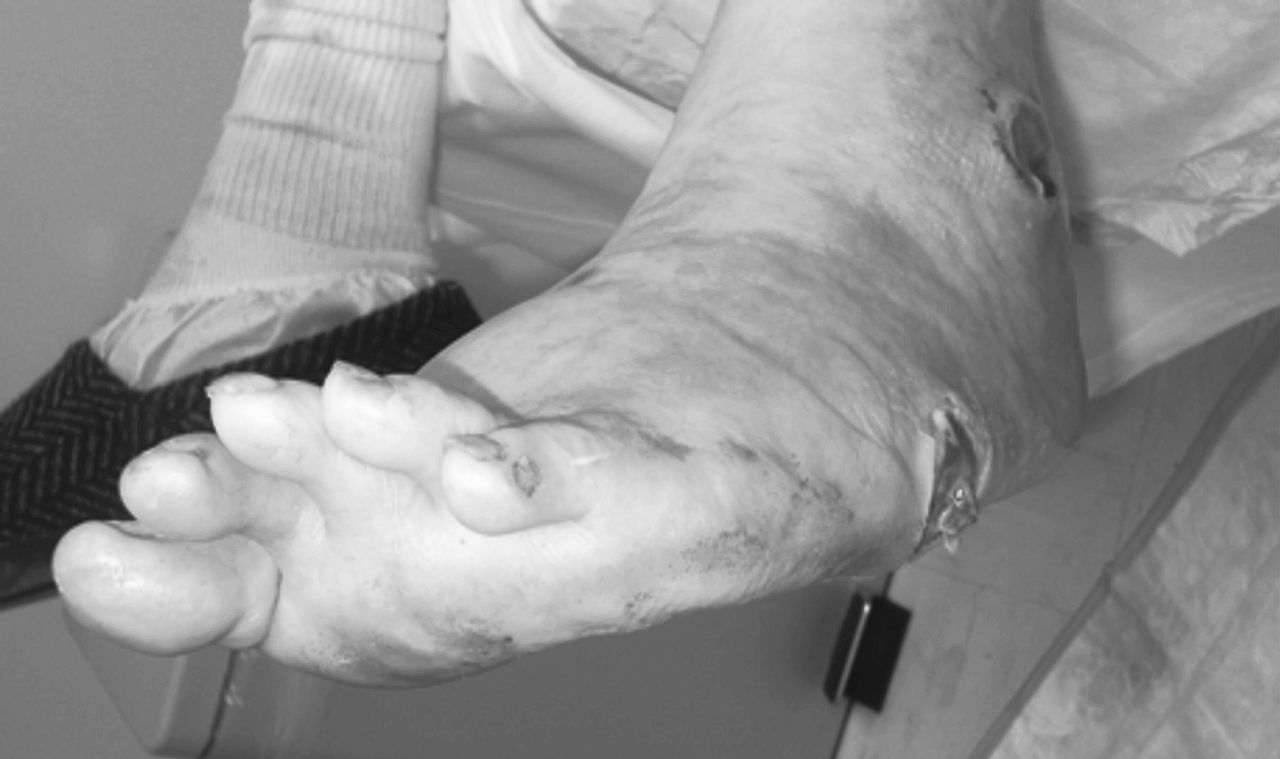
The patient’s wounds were grossly erythematous (
Fig. 4) with exposed peroneal tendons. The patient was taken to the operating room for debridement. Findings were most significant for an absence of purulence and the presence of necrotic tendon and soft tissue without evidence of pathologic or culture-proven osteomyelitis. He was subsequently started on a regime of moisture-balancing dressing changes and offloading (DH walker, Ossur, Reykjavik, Iceland). After the patient’s infection subsided, several treatment modalities were used to heal the ulcers, including surgical debridement with placement of a split-thickness skin graft and bioengineered tissue. The patient went on to heal uneventfully and was placed into a preventative “diabetic foot remission” care program.[
6]
Figure 4.
Photograph showing lesions on fifth toe, fifth metatarsal base, and lateral ankle caused by personal callus trimming aid.
Figure 4.
Photograph showing lesions on fifth toe, fifth metatarsal base, and lateral ankle caused by personal callus trimming aid.
Discussion
People with diabetes are often warned against self-treatment of corns and calluses. Unfortunately, some patients ignore such warnings. Though the personal pedicure device in question also contains a warning inside the packaging (
Fig. 2), a simple warning on the outside packaging might be somewhat helpful in guiding the high-risk patient.
The above case was complicated not only by neuropathy but by mental illness. Mental health is often overlooked when treating diabetic patients, yet literature shows that there may be a strong correlation between depression and diabetes course. A recent meta-analysis comparing depressed patients and use of medical treatment calculated a three-fold greater risk for depressed patients to fail to adhere to prescribed care when compared to those with diabetes but without diagnosed depression.[
1] Depressed patients are also more likely to undergo substance abuse such as the patient described by Gonzalez et al.[
1] All of the above ingredients, plus the personal pedicure procedure, conspired against the patient in question. We suggest that problems like this may be underreported and that vigilance on the part of physicians, nurses, and patients alike might prove pragmatic and preventive.