Next Article in Journal
Pedal Pathology Potentiated by Personal Pedicure Procedures in the Presence of Painless Peripheral Neuropathy
Previous Article in Journal
Traumatic Digital Amputations of the Foot Inflicted by Pet Cat upon Individual with Diabetic Peripheral Neuropathy
 
 
Journal of the American Podiatric Medical Association is published by MDPI from Volume 116 Issue 1 (2026). Previous articles were published by another publisher in Open Access under a CC-BY (or CC-BY-NC-ND) licence, and they are hosted by MDPI on mdpi.com as a courtesy and upon agreement with American Podiatric Medical Association.
Article

Congenital Onychoheterotopia Involving Multiple Toe Nails

Department of Dermatology, Venereology and Leprology, Postgraduate Institute of Medical Education & Research, Chandigarh, 160012, India
*
Author to whom correspondence should be addressed.
J. Am. Podiatr. Med. Assoc. 2013, 103(5), 445-447; https://doi.org/10.7547/1030445
Published: 1 September 2013

Abstract

Onychoheterotopia is an uncommon condition in which nail tissue is found beyond the common nail unit of the digits of the hands and feet, most often on the fifth digit of the hand. It represents an extra and independent nail that can be present either congenitally, or more commonly, acquired following trauma. The exact pathogenesis of the congenital type is undetermined. We report a 25-year-old male with multiple congenital ectopic nails of the toes since birth, which has not been reported before.

Onychoheterotopia, or ectopic nail, is a rare nail condition with multiple theories contributing to its pathogenesis. Most cases of this abnormality have been observed in Japan.[1] Its primary feature is the continuous growth of the nail plate outside the common nail unit of the digits of the hands and feet. Onychoheterotopia most commonly involves the fingers; it is extremely rare in the toes and extradigital locations. It is even more uncommon for onychoheterotopia to occur at multiple sites. We report a case of a 25-year-old male presenting with multiple ectopic nails involving second and third toes since birth.

Case Report

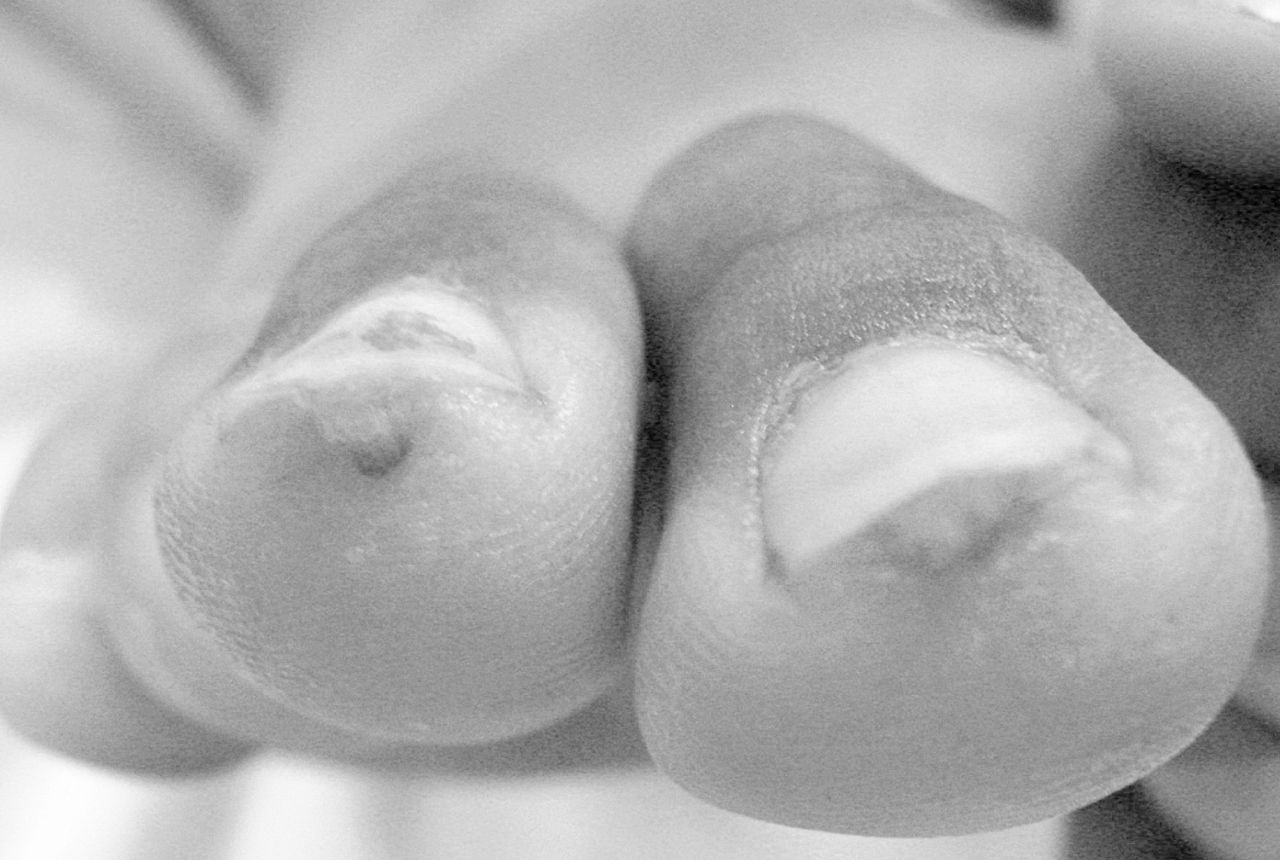
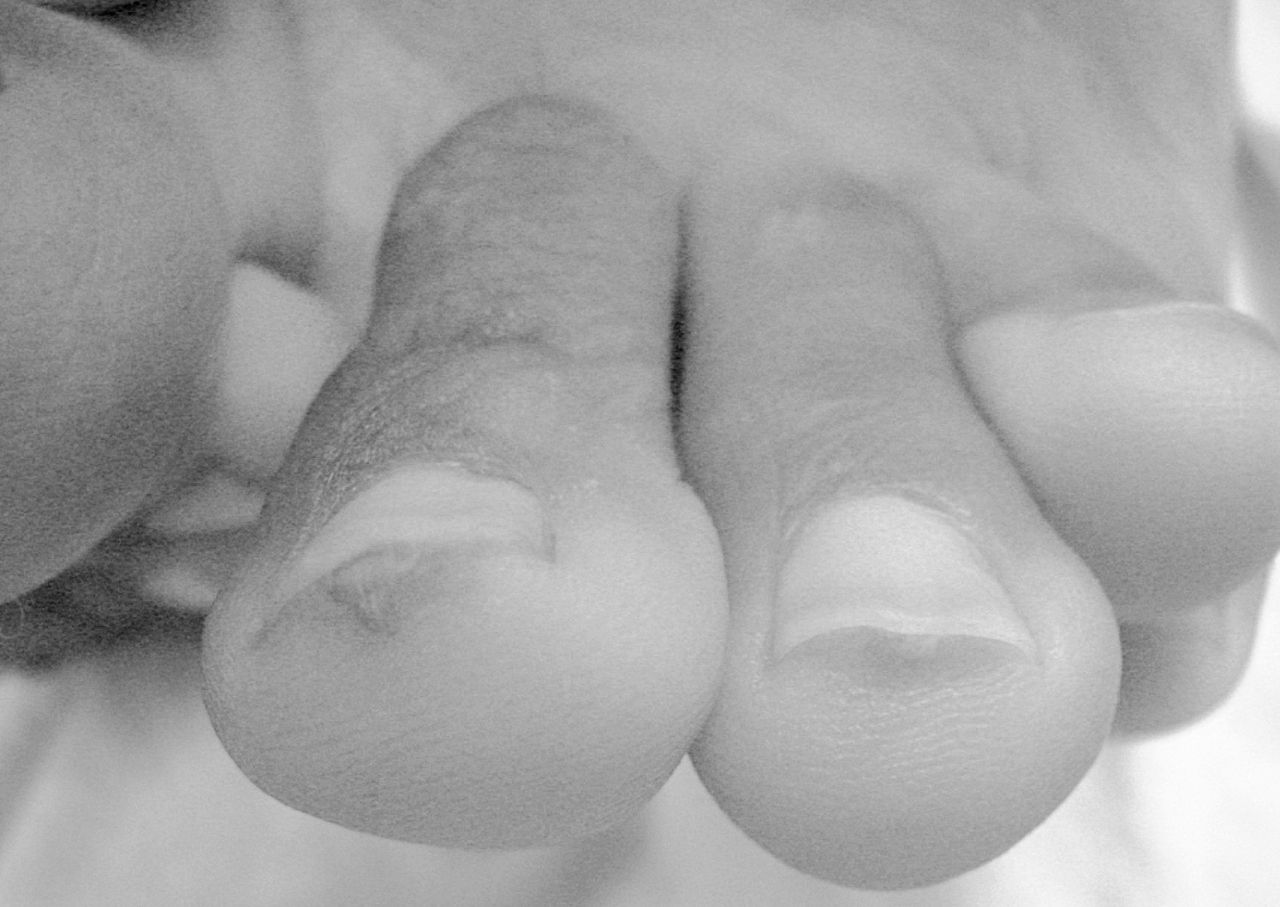
A 25-year-old male presented with multiple asymptomatic symmetric keratotic excrescences on the tip of the distal phalanges beyond the normal nail plate of the second and third toes of each foot since birth (Figs. 1 and 2). The keratotic growths were yellowish-brown in color, smaller in size compared to the respective nail plates, had a wider base varying between 4 and 6 mm in diameter, and were tapered distally. They grew vertically downward, toward the plane of skin at the same rate as the normal nail plate and required repeated trimming. There was no history of spontaneous regression of keratotic projections. The surrounding skin and shape of the distal phalanges of the affected toes were normal. There were no features to suggest ectodermal dysplasia and no evidence of similar condition in the patients’ family members. Based on the clinical findings, diagnosis of “congenital onychoheterotopia of multiple toes” was made. Radiographs of the affected toes did not show any bony abnormality. The patient declined an excisional biopsy after being informed that they were like normal extra nails.

Discussion

Onychoheterotopia is an extremely rare condition in which the nail tissue grows outside the classic nail unit of the fingers and toes. It is classified broadly into congenital and acquired types. In 1931, Ohia[2] reported the first case of congenital ectopic nail that was present on the thumb. Approximately 50 cases of congenital onychoheterotopia are reported in literature.[3] Multiple hypotheses have been proposed to explain the pathogenesis of this enigmatic entity. These include an ectopic existence of germ cells, the nail of a rudimentary or hidden polydactyly, and traumatic transfer and inoculation of oncocytes.[3] It has been hypothesized that congenital onychoheterotopia is an abnormality of development of the distal phalanx presenting as typically shorter crescent-shaped growth.[4] There are rare reports of familial occurrence of this abnormality.[4,5] Kopera[5] reported congenital ectopic nail at the same site in four family members. It has also been reported in relationship to other congenital conditions such as polydactyly,[6] congenital palmar nail syndrome[7] (triad of a palmar nail, absent flexion of interphalangeal joints and radiographic abnormalities of the distal phalanx), Pierre Robin syndrome,[8] and with aberration of the long arm of chromosome 6.[9]
Figure 1. Photograph showing extra nails beyond the normal nail plate on second and third toes of the right foot.
Japma 103 00445 g001
Ectopic nail is comprised of the nail matrix, rudimentary or complete nail plate, and nail bed, which may or may not be present. Its growth can be horizontal, paralleling the normal nail plate, especially when it is neighboring a normal nail. However, the more commonly observed growth pattern is vertical due to incomplete or lack of proper nail fold and nail bed.[10,11] A study demonstrated 17 different kinds of amino acids in the ectopic nail as compared to in a normal nail, suggesting that ectopic nail is not merely a smaller version of a normal nail.[12] Electron microscopy of an ectopic nail shows large desmosomes forming tight junctions between the nail plate and the matrix, which are absent in a normal nail.[4] Mazzarello et al[13] studied the ultrastructure of ectopic plantar nail in detail using light microscopy, scanning, and transmission electron microscopy. The ectopic nails presented morphologic characters of a rudimentary nail unit with typical findings of normal nails, except for altered angle between nail germinal matrix and proximal nail fold and occasional presence of rounded keratohyline granules in germinal matrix keratinocytes.
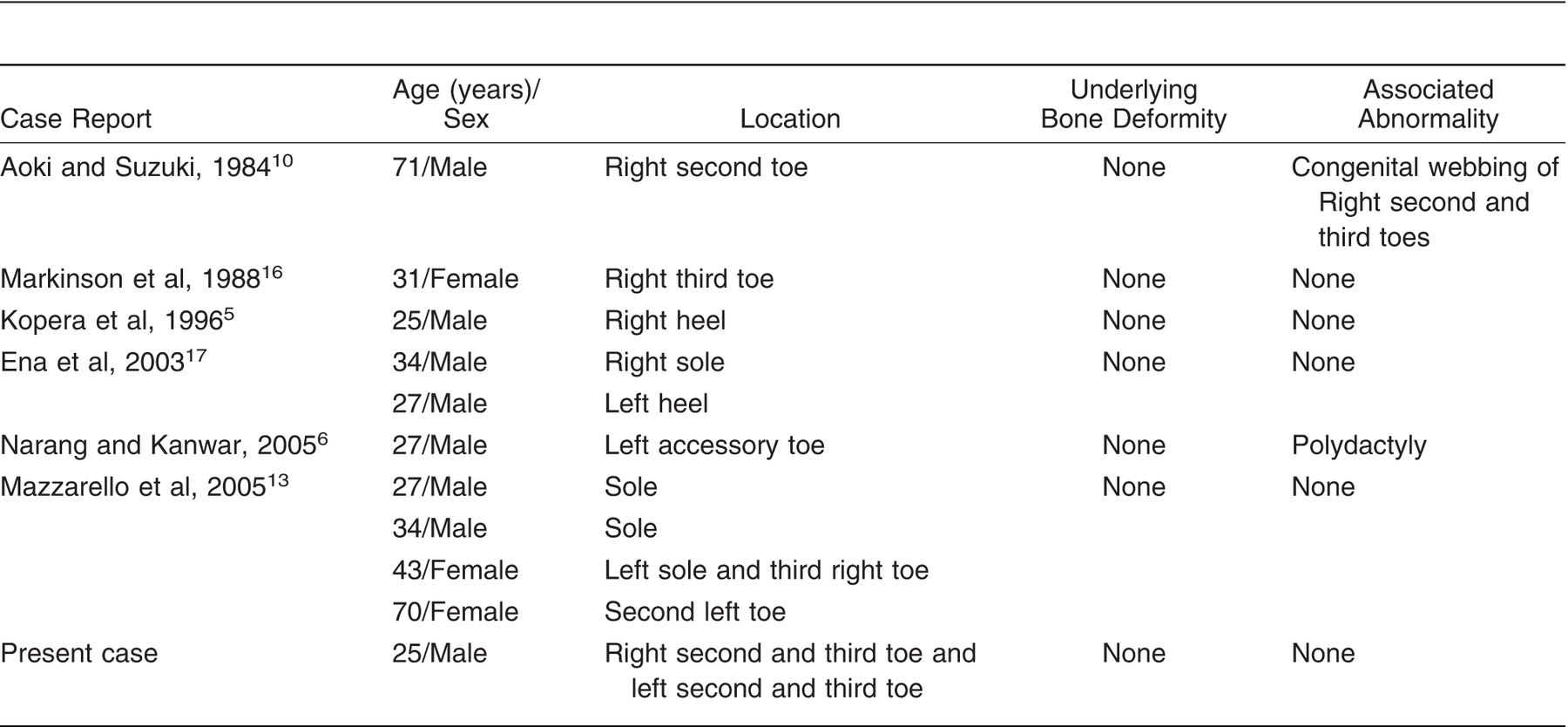
Congenital ectopic nail most commonly affects fingers, occasionally feet, and there is one report each of ectopic nail on the nose and thorax.[14,15] Ectopic nail on the hand usually occurs on the palmar surface of the distal phalanx alongside the normal fingernail, involving fifth, fourth, first, third, and second digits in decreasing frequency.[1 ]Table 1 enumerates all of the cases of congenital ectopic nail on toes and feet reported to date in English literature. There is male preponderance, and no specific site predilection. There are two reports of associated abnormality in the form of polydactyly[5] and congenital webbing of second and third toes. The present case is unusual as the patient had symmetric asymptomatic ectopic nails on second and third toes of both feet since birth with no associated anomalies of toes or features suggestive of any related syndrome. Cases reported by Mazzarello et al[13] and Ena et al[17] did not have ectopic nail at the time of birth. They appeared at a later age, varying between 10 and 45 years. In view of the absence of history of significant trauma, the authors considered them as late-appearing congenital ectopic nails, but we believe that the nosological status of these cases is not clear.
Figure 2. Photograph showing extra nails beyond the normal nail plate on second and third toes of the left foot.
Japma 103 00445 g002
Acquired onychoheterotopia is also uncommon. It usually occurs following an acute or a chronic injury whereby a section of the germinal matrix is implanted into a distant skin. It is most often seen on the dorsal aspect of the hand.[11]
In both congenital and acquired onychoheterotopia, contact of the ectopic nail matrix with the underlying bone can block intramembranous ossification, resulting in subsequent M- or Y-shaped deformation of the bone of distal phalanx.[18] Reports conflict on whether or not the bony deformity would undergo spontaneous remodeling after removal of ectopic nail.[1]
The important differential diagnoses include rudimentary polydactyly, cutaneous horn, acquired digital fibrokeratoma, wart, surfer’s nodule, and split-nail deformity. It is important to identify this condition in order to look for the related syndromes, associated bony deformity, and to plan the treatment. Patients can be informed about the nature of the lesion and can be left untreated as in our case. Treatment is warranted for cosmetic reasons or due to pain, irritation, and secondary infection. Complete excision of the nail along with the matrix should be performed to prevent recurrence.[19]
Table 1. Reports of Congenital Ectopic Nails on Feet
Japma 103 00445 g003

Financial Disclosure

None reported.

Conflict of Interest

None reported.

References

  1. Sano, K, Hyakusoku, H: Does a bone deformity of the distal phalanx undergo remodeling after removal of a congenital ectopic nail?: a case with periodic radiographic follow-up. J Nihon Med Sch 73: 332, 2006.
  2. Ohia, Z: Polyonychie congenita sine polydactylie. Acta Dermatol (Kyoto), cited in Ectopic plantar nail: a report of two cases. Br J Dermatol 149: 1071, 2003.
  3. Riaz, F, Rashid, RM, Khachemoune, A: Onychoheterotopia: pathogenesis, presentation, and management of ectopic nail. J Am Acad Dermatol 64: 161, 2011.
  4. Miura, T: Two families with congenital nail anomalies: nail formation in ectopic areas. J Hand Surg [Am] 3: 348, 1978.
  5. Kopera, D, Soyer, HP, Kerl, H: Ectopic calcaneal nail. J Am Acad Dermatol 35: 484, 1996.
  6. Narang, T, Kanwar, AJ: Ectopic nail with polydactyly. J Am Acad Dermatol 53: 1092, 2005.
  7. Al-Qattan, MM, Hassanain, J, Hawary, MB: Congenital palmar nail syndrome. J Hand Surg [Br] 22: 674, 1997.
  8. Roger, H, Souteryrand, P, Collin, JP, et al: Onychoheterotopia with polyonychia associated with Pierre Robin syndrome: apropos of a new case. (Trial of classifying nail ectopia). Ann Dermatol Venereol 113: 235, 1986.
  9. Kalisman, M, Goldberg, R, Ship, AG: Dorsal skin and finger-nails on the volar aspect of the hand: an unusual anatomic deformity. Plast Reconstr Surg 69: 694, 1982.
  10. Aoki, K, Suzuki, H: The morphology and hardness of the nail in two cases of congenital onychoheterotopia. Br J Dermatol 110: 717, 1984.
  11. Rajashekar, M, Bhandary, S, Shenoy, M, et al: Post traumatic ectopic nail. J Postgrad Med 53: 218, 2006.
  12. Aoki, K, Hataba, Y: A case of congenital onychoheterotopia on both fifth fingers. Clin Exp Dermatol 16: 285, 1991.
  13. Mazzarello, V, Ena, P, Dessy, LA: A morphological study of ectopic plantar nail. Am J Dermatopathol 27: 122, 2005.
  14. Bongiorno, MR, Aricò, M: Progressive symmetric erythrokeratosis associated with oligodontia, severe caries, disturbed hair growth and ectopic nail: a new syndrome?Dermatology 217: 347, 2008.
  15. Ishikawa, E, Matsumura, A, Enomoto, T, et al: Ectopic fingerlike structure in the thoracic region: case report. J Neurosurg 95 (Suppl 2):250, 2001.
  16. Markinson, B, Brenner, AR, McGrath, M: Congenital ectopic nail. A case study. JAPMA 78: 318, 1988.
  17. Ena, P, Mazzarello, V, Dessy, LA: Ectopic plantar nail: a report of two cases. Br J Dermatol 149: 1071, 2003.
  18. Kamibayashi, Y, Abe, S, Fujita, A, et al: Congenital ectopic nail with bone deformity. Br J Plast Surg 51: 321, 1998.
  19. Goikoetxea, X, Etxebarria, I, Careaga, M: Posttraumatic ectopic nail: case report. J Hand Surg Am 31: 819, 2006.