Pes cavus is a podiatric medical condition in which the arch is excessively high. Midfoot support is reduced, and the entire body weight is, therefore, borne on a smaller plantar area, in severe cases corresponding only to the forefoot and hindfoot. This means that the support surface is subjected to more load and, therefore, more pressure than normal. The abnormal elevation of the plantar arch and the reduced area of support put the plantar soft tissues under stress, which eventually leads to their contraction and the appearance of symptoms of localized pain, in most cases at the level of the forefoot.[
1]
Conservative management of the cavus foot focuses on the use of custom plantar orthotic devices and footwear in accordance with the particular deformity of the individual’s foot.[
1,
2,
3] Only in cases in which the plantar retraction is a direct cause of the onset of plantar fasciitis are these treatments combined with physical therapy,[
4,
5] which includes among its procedures stretching to elongate the plantar fascia. Studies have shown that neuromuscular stretching techniques are more effective than simple passive stretching in gaining articular amplitude.[
6,
7] This is due to the lower motor neuron excitation during the latter type of stretching caused by mechanisms of presynaptic and postsynaptic inhibition[
8] and to the individual’s altered sensitivity of perception of the stretch,[
9,
10] a key tool in active tension neuromuscular stretching.[
11] Although electrical stimulation techniques can be used to perform this stretching procedure, they are still not widely used for the sole of the foot. Recent studies have used low-frequency electro-stimulation for feet with plantar fasciitis but as a means to increase blood flow through muscle contraction in the soft tissues affected by the abnormality.[
12] Transcutaneous electrical neuromuscular stimulation for muscle stretching has, however, proven very effective, as reviewed by Maya Martı´n and Albornoz Cabello.[
13]
The question we sought to address in the present work was whether the pressure on the forefoot area—the pressure responsible for the metatarsal pain that is often reported by patients with this type of foot—decreases when the plantar soft tissues are stretched. Thus, the main objective was to determine plantar pressure values and how they change in the cavus foot, particularly in the metatarsal area, before and after the performance of neuromuscular stretching with low-frequency currents, specifically, symmetrical rectangular biphasic currents (SRBCs), because these are the most widely used currents in this procedure.[
14] We also set out to observe whether these changes, if they occurred, were maintained for at least a week after the intervention. The null hypothesis is that SRBCs do not reduce pressure supported by the forefoot.
Materials and Methods
Design and Participants
We conducted a nonrandomized, longitudinal, analytical, and prospective controlled experimental trial. The overall sample of the study consisted of 34 patients with pes cavus (21 women and 13 men; mean 6 SD age, 24.21 6 5.18 years; mean 6 SD body mass index [calculated as weight in kilograms divided by height in meters squared], 22.10 6 2.64). Diagnosis of pes cavus was by lateral weightbearing radiography, estimating the inner Costa-Bertani angle, which should be less than 1258.[
15] For the trial to involve only patients in whom cavus foot was the only possible structural alteration, individuals with degenerative bone and joint disorders or who had undergone some type of foot surgery or trauma were excluded. To rule out the development of an antalgic gait during the evaluation, individuals who at the time had any kind of pain anywhere in either leg were also excluded. At all times, the patients had to be tolerant of the passage of the SRBCs. The study was performed on the patient’s dominant foot, with the nondominant foot constituting the control group. After approval of the research design by the research ethics committee of the University of Seville, Seville, Spain, all of the participants gave their informed consent.
Equipment
To measure plantar pressures, the footscan USB Gait Clinical System pedobarometry platform (RSscan International, Olen, Belgium) was used (2 × 0.4 × 0.02 m, 16,384 sensors [3/cm
2], 500 Hz). The software automatically divides the footprint captured during the dynamic conditions into ten zones: the first, second, third, fourth, and fifth metatarsal heads; lateral heel; medial heel; midfoot; great toe; and a common zone that includes the second through fifth toes. The footscan system is a platform currently used in scientific research related to plantar pressures.[
16]
The electrotherapy device used to provoke stretching of the fascia and intrinsic musculature of the foot was a Med Tens 931 (Enraf-Nonius, Rotterdam, Netherlands). This device provides a symmetrical rectangular biphasic wave with a pulse width adjustable from 20 to 350 lsec and a pulse frequency of 2 to 100 Hz. Two self-adhesive electrodes were used, one measuring 10 × 5 cm placed in the retrocapital region and the other measuring 5 × 5 cm placed at the origin of the fascia on the sole of the foot.
Experimental Protocol
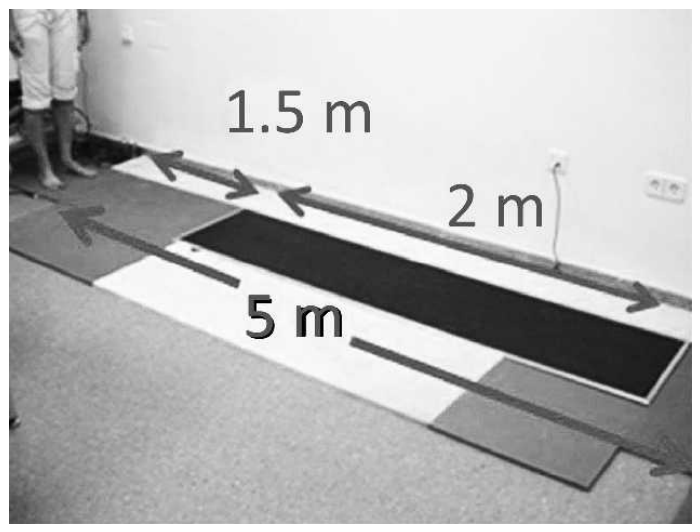
All of the participants meeting the inclusion criteria began the study with the measurement of pressure on both feet before application of the current. The measurements were taken on the footscan system platform situated in the center of a carpet approximately 5 m long so that the patient walked 1.5 m before making contact with the system’s plate (
Figure 1).
Before the actual measurement, it was explained to the participants what they were to do and what the system consisted of to familiarize them with the procedure. They were then asked to walk barefoot onto the platform at their normal walking rate. The patients made a series of trial runs to ensure that they would tread on the platform with their dominant foot. The data from the dynamic footprints were recorded six times during the outward half of the walk because the platform does not record the footprint when the patient is returning to the starting point. The mean forefoot pressure was obtained from the sum of the measurements made under the load area of the five metatarsal heads and toes. The mean hindfoot values were obtained from the sum of the measurements made under the medial heel and the lateral heel.
This first measurement was followed by application of the current. The stimulation electrodes were put in place on the dominant foot: the 10 × 5-cm electrode on the retrocapital region (on the forefoot behind the metatarsal heads) and the 5 × 5-cm electrode on the medial zone of the heel. The patient then stood on one leg on the dominant foot between two parallel bars to help maintain the unipedal stance. We established as treatment parameters a 300-lsec pulse duration at a 50-Hz frequency, increasing the current intensity until a grasping contraction of the toes was observed. At this point, the progressive increase in intensity was halted. When relaxation of the grasping contraction was evident to the examiner, the current intensity was again increased until the occurrence of a further toe retraction. This process was repeated thrice as recommended in postisometric muscle relaxation procedures.[
17]
After this SRBC neuromuscular stretching, the plantar pressures were again recorded in a procedure identical to that performed previously.
Finally, a third pedobarometric measurement was made 1 week after the plantar stretching procedure. It was explained to the patients that during these 7 days, they should follow their normal habits of physical activity and wear their usual footwear so that the conditions of this last measurement would be the same as those of the previous measurements.
All of the measurements were performed in the morning.
Statistical Analysis
Data analysis was performed using a statistical software program (SPSS 15.0 for Windows; SPSS Inc, Chicago, Illinois). The Shapiro-Wilk test for normality was used because the sample consisted of fewer than 50 patients. Variables satisfying the condition of normality were compared using the Student t test for paired samples, and the Wilcoxon test was used for nonnormally distributed variables. The significance level was taken to be P <.05.
Results
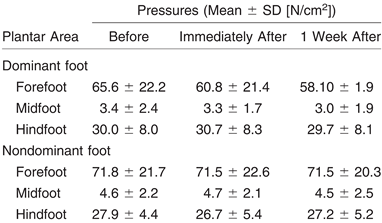
Table 1 gives the mean values of the forefoot, midfoot, and hindfoot plantar pressures measured in the dominant and nondominant feet before, immediately after, and 1 week after the SRBC neuromuscular stretching procedure.
Table 2 gives the mean pressure values under the metatarsal heads of the dominant foot at the three measurement times.
The data in
Table 2 not only show that there was a significant reduction in metatarsal pressure immediately and 1 week after applying the stretching procedure but also that there was no significant difference between these last two measurements. The pressure reduction obtained in the stretching procedure thus persisted for at least 1 week.
For the metatarsals considered individually, there were no major variations in the pressure they supported after neuromuscular stretching (
Table 3). Only the first and third metatarsals presented a significant reduction in pressure immediately after the stretching procedure. Thus, it was the metatarsal region considered as a whole that experienced significant variations in the pressure values.
Because the plantar stretching procedure was applied to each patient’s dominant foot only, the nondominant foot was used to constitute a control group to determine whether the observed changes were due solely to the application of the current. If this had not been so, the pedobarometry data for the control group before, immediately after, and 1 week after the intervention would have presented significant variations, as did the experimental group. These data are presented in
Table 4. Note that the only variation in pressure that was significant was under the hindfoot immediately after application of the current and that the difference was no longer significant 1 week later.
Discussion
The main footprint characteristic of pes cavus is that the zone of midfoot support, also known as the isthmus, is smaller than in a normal foot. Thus, it must be theoretically expected that some of this pressure will be redistributed between the forefoot and the hindfoot.
Table 1 lists the mean pressures supported by the cavus feet of this sample. In percentages, these figures correspond to the forefoot bearing 66.26% of the total pressure, the midfoot 3.43%, and the hindfoot 30.31%. The area that is subjected to the greatest stress is, therefore, the metatarsals. Sneyers et al[
18] studied the distribution of pressures during running for patients with different plantar architectures and also found that in individuals with cavus feet the greatest percentage of load is on the anterior zone. Although other studies on cavus feet[
19] have found the greatest index of load to be under the heel, according to Imamura et al,[
20] the static pressure supported by certain areas of the foot may be more than doubled under dynamic conditions. Measurements in this study were also made under dynamic conditions and, together with those of Sneyers et al, reveal indices of load under the anterior zone that are much higher than those of individuals with normal feet.[
21,
22] For this reason, it seems important to investigate the effectiveness of alternative therapies that may reduce metatarsal pressure in a population, such as patients with pes cavus, prone to experiencing metatarsalgia.
Pe´rez Machado and A´ lamo Arce[
23] demonstrated that passive neuromuscular stretching with SRBCs was more effective than active procedures. To provide a better distribution of plantar pressure in pes cavus, the soft tissues are relaxed by using custom plantar orthotic devices[
2,
24] and shoes with cushioning elements.[
25] Nonetheless, SRBC plantar stretching is not a widely used technique for this type of patient.
The statistical significance (
P < .001) (
Table 2) of the reduction in the pressures borne by the anterior zone of the dominant foot after applying the SRBC neuromuscular stretching procedure means that one can reject the null hypothesis at a
P < .05 significance level. Also, there were no significant changes between the time immediately after the procedure and 1 week later (
P = .471), showing that this reduction was maintained for at least 1 week. Indeed, the measured value at 1 week was actually lower, which could suggest that the body has the capacity to further adapt to the new situation after the intervention. The midfoot and hindfoot pressure changes were not significant so that the effectiveness of neuromuscular stretching with SRBCs can be determined in the zone of the cavus foot that usually presents the most symptoms, that is, the forefoot. Gaillet et al[
26] found that transcutaneous SRBC stimulation of the great toe adductor muscle in individuals with flat feet produced an increase in the longitudinal arch of the foot that was maintained over time. They explained these results as being due to the existence of a proprioceptive reflex, understood as a memory of the electrical stimulation persisting over time, and indicative of the individual’s capacity to learn.
Although various studies have shown the area under greatest stress in the cavus foot to be the anterior zone, there has been no specification of the mean pressure tolerated by each metatarsal head and toe.[
1,
27,
28] The effect of plantar stretching was not to redistribute load: at all three times of measurement, the greatest load was supported by the third metatarsal, followed by the second and fourth metatarsals (
Table 3). In this sense, the central zone of the foot is that which supports the most pressure, as is also found in studies of the dynamics of normal feet.[
22,
29,
30] After the plantar stretching, the variations in plantar pressure under the metatarsal heads were significant only for the third and first metatarsals (
Table 3). Because the third metatarsal head is one of the zones bearing the greatest pressure, this reduction after the stretching procedure seems worthy of note. Also, with respect to the first metatarsal, many authors have stressed the role of the first ray in the architecture of the cavus foot,[
31,
32] considering it to be the most important structure of the forefoot for the development of a normal gait. Therefore, as with the third metatarsal, the significant reduction in pressure in this zone of the forefoot after neuromuscular stretching also seems worthy of note.
A limitation of the present study is that it did not determine the time that the effect of neuromuscular stretching persisted. The authors initially set a week as the time after which to check the persistence of the effect of the treatment because this is approximately the time for patients to receive further noninvasive podiatric medical treatment in the case that they need it to help relieve symptoms. Although we have not found significant differences in the control group, in future studies we plan to select, as a control group, individuals different from the experimental group sampled herein.
Conclusions
Neuromuscular stretching performed with SRBCs has been an effective therapeutic tool in reducing metatarsal pressure in the patients with pes cavus studied, resulting in an improved load distribution. The procedure could also be used to prevent the appearance of metatarsalgia due to excessive pressure in this population because the present results show that stretching with these currents acted principally on the forefoot. It would be straightforward to teach patients to perform these stretches even at home because the devices that provide this type of current are portable and easy to use.