Next Article in Journal
Customized Foot Insoles Have a Positive Effect on Pain, Function, and Quality of Life in Patients with Medial Knee Osteoarthritis
Previous Article in Journal
Effect of a Forefoot Off-loading Postoperative Shoe on Muscle Activity, Posture, and Static Balance
 
 
Journal of the American Podiatric Medical Association is published by MDPI from Volume 116 Issue 1 (2026). Previous articles were published by another publisher in Open Access under a CC-BY (or CC-BY-NC-ND) licence, and they are hosted by MDPI on mdpi.com as a courtesy and upon agreement with American Podiatric Medical Association.
Article

Effects of Anthropometric Factors on Nerve Conduction. An Electrophysiologic Study of Feet

by
Nilgun Cinar
1,
Sevki Sahin
1,
Mustafa Sahin
2,
Tugba Okluoglu
1 and
Sibel Karsidag
1,*
1
Department of Neurology, Faculty of Medicine, Maltepe University, Istanbul, Turkey
2
Department of Orthopaedics and Traumatology, Faculty of Medicine, Maltepe University, Istanbul, Turkey
*
Author to whom correspondence should be addressed.
J. Am. Podiatr. Med. Assoc. 2013, 103(1), 43-49; https://doi.org/10.7547/1030043
Published: 1 January 2013

Abstract

Background: Previous studies have shown that age, sex, and body mass index (BMI) affect the amplitude of sensory nerve action potentials (SNAPs), but the total effects of multiple factors and the most prominently affected nerves have not been elucidated. We systematically investigated the effects of these factors on motor and sensory nerves of the feet. Methods: The amplitude, latency, and conduction velocity of compound muscle action potential (CMAP), SNAP, and mixed nerve action potential (MNAP) of the posterior tibial, calcaneal, distal posterior tibial, medial and lateral plantar, and sural nerves were measured in 30 healthy individuals (60 feet). The effects of age, sex, height, and BMI on each nerve were estimated by correlation and linear regression analyses. Results: The amplitude of posterior tibial CMAP and distal posterior tibial MNAP decreased with BMI. The amplitude of medial plantar MNAP and sural SNAP decreased with height. The conduction velocity of calcaneal SNAP and distal posterior tibial and lateral plantar MNAP decreased with height and BMI. The conduction velocity of medial plantar MNAP decreased only with height. The latency of posterior tibial CMAP increased with age and height. The latency of lateral plantar CMAP and calcaneal SNAP increased with height. The latency of lateral plantar MNAP increased with BMI. Conclusions: The effects of age, sex, height, and BMI in foot nerve conduction studies are not identical. Height and BMI were shown to strongly affect motor, sensory, and mixed nerve conduction. Further investigations are needed. (J Am Podiatr Med Assoc 103(1): 43–49, 2013)

Previous investigations have shown that distal nerves in the feet are usually affected in the early stages of dying-back polyneuropathy.[13] Routine nerve conduction studies (NCSs) of sural and superficial peroneal nerves that are commonly assessed for polyneuropathy have a limitation as they cannot evaluate the distal parts of the feet.[4] There is an obvious need for an additional NCS of the lower extremity to supplement the information from sural nerve studies. In recent studies, the clinical utility of NCSs of the medial plantar and dorsal sural nerves in the early diagnosis of polyneuropathy has been shown separately.[47] Nerve conduction parameters may be affected by anthropometric factors, such as age, sex, height, weight, and body mass index (BMI).[812] It has been reported that significant slowing of conduction velocities and sensory latencies occurs with increasing age and height.[13]
In the sural sensory nerve study, the effect of age and height, but not relation to BMI, was determined. Moreover, BMI has been shown to correlate with sensory nerve action potential (SNAP) amplitudes but not with nerve conduction velocities.[14] These reports indicate that a variety of intrinsic factors can affect NCS results, and these effects must be prominent particularly on the distal nerves of the feet.
This study was conducted to discover electrophysiologic findings regarding foot nerves in healthy adults selected from the local population and to evaluate the impact of anthropometric factors, such as age, sex, height, weight, and BMI, on motor and sensory nerves of the foot.

Materials and Methods

Recruitment

We included 30 healthy volunteers (60 feet) consisting of 12 women and 18 men with a mean ± SD age of 32.6 ± 7.7 years (range, 20–50 years) who were free of any symptoms or signs of peripheral neuropathy and without a history of diabetes; thyroid gland dysfunction; alcohol abuse; or chronic renal, hepatic, or rheumatologic disease. Patients with conditions such as forefoot malalignment (pes cavus, pes planus, hallux valgus, or hammer toes), previous foot surgery, or major trauma were also excluded. The BMI was calculated as the ratio of the measured weight in kilograms divided by height in meters squared.

Electrodiagnostic Measurements

In all cases, bilateral posterior tibial and medial and lateral plantar motor nerves; bilateral sural and medial calcaneal sensory nerves; and distal posterior tibial and medial and lateral plantar mixed nerves were studied with an electroneuromyography machine (Nihon Kohden, Europe). Surface bar recording and bipolar surface recording electrodes were used in the NCSs.

Motor NCSs

Posterior Tibial Motor Nerve.

In the study of the posterior tibial motor nerve, only distal stimulation was performed. The active surface electrode is placed over the abductor hallucis muscle. The distal stimulation is used just above the tarsal tunnel, along the lower tibial border at the upper edge of the medial malleolus.[15]

Medial and Lateral Plantar Motor Nerves.

For the study of the medial and lateral plantar motor nerves, the method of Fu et al[16] was used. For the medial plantar motor nerve study, the active surface electrode is placed over the abductor hallucis muscle, 1 cm behind and 1 cm below the navicular tubercle. For the lateral plantar motor nerve study, the active surface electrode is placed over the abductor digiti quinti muscle at half the distance from the sole of the foot to the tip of the lateral malleolus. An active stimulating electrode is placed posterior to the medial malleolus and above the flexor retinaculum at the ankle.[16]

Sensory NCSs

Sural Nerve.

Standard antidromic methods were used in the sural sensory NCS.[15]

Medial Calcaneal Nerve.

For the sensory NCS of the medial calcaneal nerve, the method of Park and Del Toro[17] was used. An active surface electrode is placed distal, one-third of the distance from the apex of the heel to the midpoint between the navicula and the tip of the medial malleolus. A reference surface electrode is placed at the apex of the heel. The posterior tibial nerve is stimulated 10 cm proximal to the active electrode.

Mixed NCSs

Distal Posterior Tibial Nerve.

A mixed NCS for the distal posterior tibial nerve is performed orthodromically with surface electrode stimulation. The stimulation site is near the point of the proximal one-third of the line connecting the navicular tuberosity and the medial malleolus and 10 cm distal to the active recording electrode. The recording surface electrodes are placed over the posterior tibial nerve above the flexor retinaculum at the ankle.[15]

Medial and Lateral Plantar Nerves.

The method of Saeed and Gatens[18] was used. For recording, an active surface electrode is placed on the posterior tibial nerve just proximal to the flexor retinaculum. The medial and lateral plantar nerves are stimulated with an active electrode 14 cm from the recording electrode in the sole.[18] Compound muscle action potential (CMAP) amplitude and distal latency were calculated for the motor NCS. Onset latency, sensory nerve conduction velocity, and amplitude were measured for the sensory NCS in the feet. Onset latency, mixed nerve conduction velocity, and amplitude were measured for the mixed NCS. Latency was measured to the onset of the first negative deflection. Sensory and mixed nerve conduction velocities were calculated using the onset latencies. Amplitudes of the SNAP and the mixed nerve action potential (MNAP) were measured from baseline to the negative peak. Filter settings were 5 Hz to 10 kHz for motor studies and 20 Hz to 2 kHz for sensory studies. Skin temperature was maintained between 31°C and 34°C in all of the participants.

Statistical Analysis

Correlations between neurophysiologic measurements and age, height, and BMI were sought. Correlations were analyzed with the Spearman rank correlation test. A P < .05 was considered significant. Linear regression analyses on the parameters were performed 1) to explore possible correlations with age, height, and BMI and 2) to provide regression equations for mean values and reference limits. The results of the linear regression analyses are presented in the tables, where those of the previously noted parameters that had a significant correlation either alone or in combination are included.
The study protocol was in accordance with the Helsinki declaration of human rights and was approved by the Maltepe University ethics committee (Istanbul, Turkey), and all of the participants gave written informed consent to participate in the study.

Results

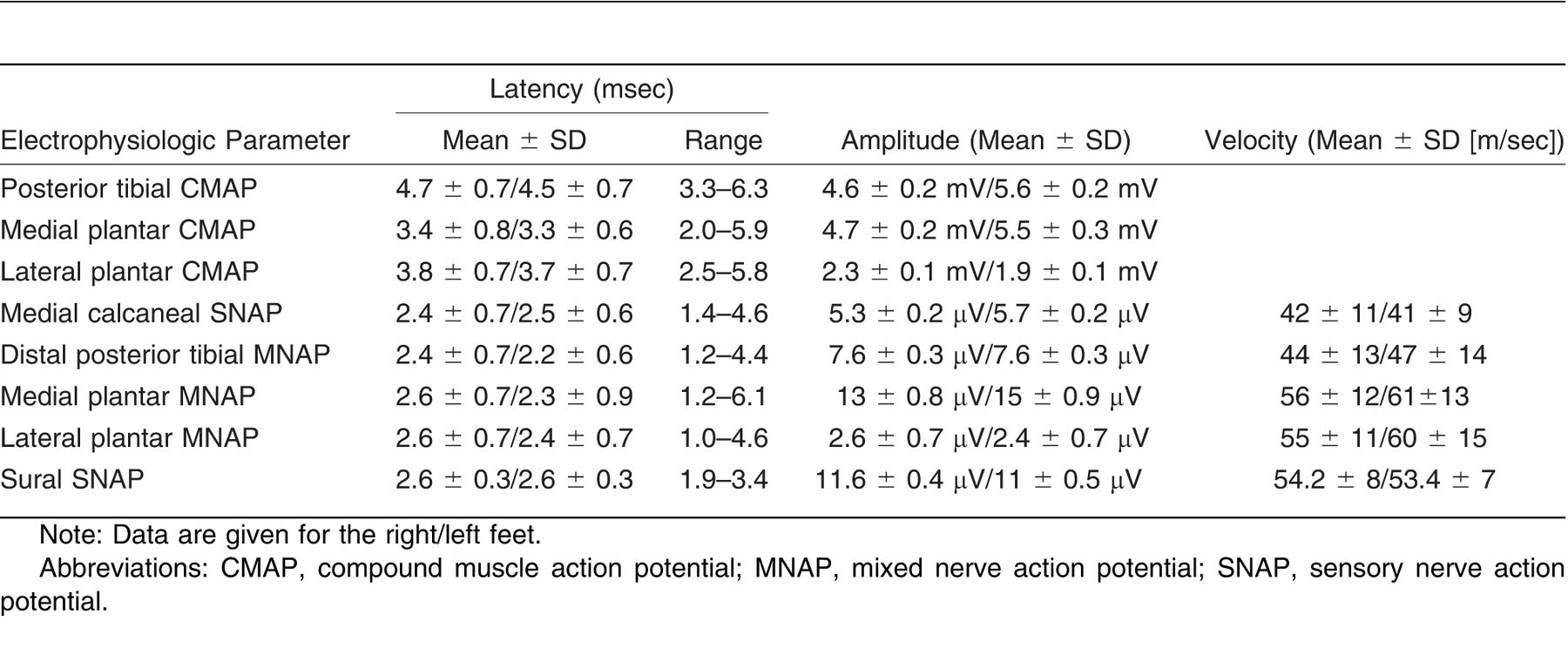
Thirty adults with a mean ± SD age of 32.6 ± 7.7 years were recruited to this study. The sex distribution was 40% women and 60% men. The values of electrophysiologic and anthropometric parameters are shown in Tables 1 and 2, respectively. Table 3 shows the effect of anthropometric factors on amplitude in motor, sensory, and mixed NCSs as the results of correlation and regression analyses. Tables 4 and 5 show the effects of CMAP, SNAP, and MNAP on conduction velocity and latency, respectively. The impact of different anthropometric factors is seen in Table 6.

Discussion

The posterior tibial nerve is divided into three branches as the medial and lateral plantar nerves and the calcaneal branch in the tarsal tunnel. In the feet, conduction studies of the posterior tibial nerve have technical difficulties. Motor NCSs are the easiest to obtain. However, the SNAP of the medial and lateral plantar nerves can be unelicitable in some healthy persons. The near-nerve needle technique has been developed for the sensory NCS of the plantar nerve.[19] The technical difficulty of obtaining the SNAP has been overcome by the near-nerve needle sensory nerve conduction technique. This study did not include medial and lateral plantar sensory NCSs because of these technical difficulties. The mixed nerve studies represent concomitant activation of sensory and motor axons, and their amplitudes typically are higher than the SNAP amplitudes recorded along the same nerve segment.[19] Therefore, the medial and lateral mixed nerve studies added to this investigation. The distal tibial posterior mixed nerve study can be performed with the near-nerve needle technique, but its amplitude is expected to be greater according to the calcaneal, medial, and lateral mixed nerve studies. Therefore, all sensory and mixed nerves are recorded with surface electrodes.
Table 1. Electrophysiologic Findings in the Feet
Japma 103 00043 i001

Impact of Different Anthropometric Factors

Age.

There was a significant positive correlation between posterior tibial CMAP latency and age in this study. It was found further by regression analysis that there is a 0.1-msec increase in latency per 5-year increase in age. Reduction of myelinated nerve fibers with aging has been demonstrated in peripheral nerves from autopsy specimens,[20] and neurophysiologic function declines with increasing age.[13,21,22] The SNAP amplitudes decrease with age owing to physiologic loss of primary sensory neurons.[12,21,2326] It has been stated that aging may make a stronger contribution to smaller SNAP amplitudes more particularly in lower-limb nerves than in upper-limb nerves. We did not observe an effect of age on NCSs of the distal leg except in the posterior tibial motor nerve. This finding may have been attributable to the fact that the population selected was 20 to 50 years old.
Table 2. Anthropometric Parameters in the 30 Healthy Study Participants
Japma 103 00043 i002

Height.

There were significant positive correlations for posterior tibial and lateral plantar CMAP and calcaneal SNAP latency. Regression analysis showed that for each 5-cm increase in length, the posterior tibial CMAP latency was 0.2 msec, and the lateral plantar CMAP and calcaneal SNAP latency were also prolonged to 0.1 msec. However, significant inverse correlations were found for calcaneal sensory nerve conduction velocity and distal tibial, medial, and lateral plantar mixed nerve conduction velocities. Regression analysis showed that each 5-cm increase in length was related to a 1.5- to 2.0-m/ sec reduction in sensory conduction velocities and a 2.5- to 3.0-m/sec reduction in mixed nerve conduction velocities. The effect of height on the proximal long nerves of the foot is not exactly known. However, this effect, particularly on the sensory and mixed nerves, has been reported in some studies.[13,18] Hence, the influence of height on speed of conduction reflects abrupt rather than gradual tapering of axons distally.

BMI.

A significant positive correlation was found between BMI and the lateral plantar MNAP latency. In regression analysis, 0.4-msec latency prolongation was accompanied by an increase of 5 points in BMI. A siginificant inverse correlation was found on the amplitudes of posterior tibial CMAP and distal tibial MNAP. In addition, for every 5-point increase in BMI, there was a 1-mV decrease in the amplitude of the posterior tibial CMAP, whereas the distal tibial MNAP amplitude decreased 1.5 μV. A conduction velocity of calcaneal and distal tibial MNAP and lateral plantar mixed nerve study was found to have a significant inverse correlation with BMI. In regression analysis, every 5-point increase in BMI with conduction velocities of 5 to 6 m/sec were being slow. Fujimaki et al[25] found that greater BMI was associated with smaller amplitudes in upper-limb nerves but not in lower-limb nerves. However, their research did not include the posterior tibial nerve and distal branches in the feet.
Table 3. Effect of Anthropometric Factors on Amplitude in Motor, Sensory, and Mixed Nerve Conduction Studies
Japma 103 00043 i003

Sex.

Sex difference was not found to be a significant predictor of foot nerve conduction measures in this study. Fujimaki et al[25] explained that sex affected SNAP amplitudes only in upper-limb nerves. In their study, women had greater SNAP amplitudes than men in the upper extremity.
Table 4. Correlation and Regression Analyses on Conduction Velocity of CMAP, SNAP, and MNAP
Japma 103 00043 i004

Changes in Nerve Conduction

The SNAP and MNAP latencies typically are affected at an earlier stage. Also, the SNAP and MNAP amplitudes usually are relatively more decreased than the corresponding CMAP amplitudes for any given degree of incomplete axon loss.[27] The present study found more pathologic findings to the sensory and mixed nerve studies in the feet. Thrainsdottir et al[28] suggested that myelinated nerve fiber density correlated negatively with BMI and that low myelinated nerve fiber density may predict progression of neurophysiologic dysfunction and links obesity to myelinated nerve fiber loss. The present results, similar to those of previous studies, showed that latency, amplitude, and conduction velocities are affected by BMI. The impression was gained that mixed and sensory conduction studies are more sensitive than are motor conduction studies. The relationship between obesity and peripheral nerve dysfunction and the mechanism behind this finding are complex and unclear.
Table 5. Correlation and Regression Analyses on Latency of CMAP, SNAP, and MNAP
Japma 103 00043 i005
A link between obesity and peripheral nerve dysfunction may be the effect of insulin as a vasoactive hormone.[29,30] The endothelial dysfunction, microangiopathy, and increased vascular tone may promote basement membrane thickening and later development of peripheral nerve dysfunction.[30] In the case of an individual with a higher BMI, the resulting increased mechanical pressure on the distal foot could lead to an increase in peripheral nerve dysfunction. The increase in the prevalence of polyneuropathy correlated significantly and independently with body weight.[31] An increase in waist circumference by 1 cm was associated with a 4% increase in the likelihood of polyneuropathy.[32] Obesity is an index of insulin resistance, which may account for poor glycemic control and predispose to peripheral neuropathy and other complications.[33]
Table 6. Impact of Different Anthropometric Factors
Japma 103 00043 i006
The foot-shank angle or gait patterns can influence the NCS results in feet. For this reason, NCSs can give more information if performed in conjunction with dynamic assessment. As a result, an increase in BMI may be a responsible factor in damage to small nerve fibers in the feet. However, more healthy individuals than were considered in this study are needed to clarify this issue.

Financial Disclosure

This study was supported by Maltepe University Department of Neurology, Instanbul, Turkey.

Conflict of Interest

None reported.

References

  1. Oh, SJ, ACMelo, DKLee, et al.: Largefiber neuropathy in distal sensory neuropathy with normal routine nerve conduction. Neurology56: 1570, 2001.
  2. Park, KS, SHLee, KWLee, et al.: Interdigital nerve conduction study of the foot for an early detection of diabetic sensory polyneuropathy. Clin Neurophysiol114: 894, 2003.
  3. Singleton, JR.: Evaluation and treatment of painful peripheral polyneuropathy. Semin Neurol25: 185, 2005.
  4. Killian, JM and PJForeman.: Clinical utility of dorsal sural nerve conduction studies. Muscle Nerve24: 817, 2001.
  5. Loseth, S, MNebuchennykh, EStalberg, et al.: Medial plantar nerve conduction studies in healthy controls and diabetics. Clin Neurophysiol118: 1155, 2007.
  6. Herrmann, DN, MLFerguson, VPannoni, et al.: Plantar nerve AP and skin biopsy in sensory neuropathies with normal routine conduction studies. Neurology63: 879, 2004.
  7. Turgut, N, SKarasalihoglu, YKucukugurluoglu, et al.: Clinical utility of dorsal sural nerve conduction studies in healthy and diabetic children. Clin Neurophysiol115: 1452, 2004.
  8. Mayer, RF.: Nerve conduction studies in man. Neurology13: 1021, 1963.
  9. LaFratta, CW and AZalis.: Age effects on sural nerve conduction velocity. Arch Phys Med Rehabil54: 475, 1973.
  10. Dorfman, LJ and TMBosley.: Age-related changes in peripheral and central nerve conduction in man. Neurology29: 38, 1979.
  11. Trojaborg, WT, AMoon, BBAndersen, et al.: Sural nerve conduction parameters in normal subjects related to age, gender, temperature, and height: a reappraisal. Muscle Nerve15: 666, 1992.
  12. Tong, HC, RAWerner, AFranzblau.: Effect of aging on sensory nerve conduction study parameters. Muscle Nerve29: 716, 2004.
  13. Falco, FJ, WJHennessey, GGoldberg, et al.: Standardized nerve conduction studies in the lower limb of the healthy elderly. Am J Phys Med Rehabil73: 168, 1994.
  14. Buschbacher, RM.: Body mass index effect on common nerve conduction study measurements. Muscle Nerve21: 1398, 1998.
  15. Oh, SJ. :Clinical Electromyography Nerve Conduction Studies, ,3rd Ed. ,Williams & Wilkins. ,Baltimore. ,2003.
  16. Fu, R, JADeLisa, GHKraft.: Motor nerve latencies through the tarsal tunnel in normal adult subjects: standard determinations corrected for temperature and distance. Arch Med Phys Rehabil61: 243, 1980.
  17. Park, TA and DRDel Toro.: The medial calcaneal nerve: anatomy and nerve conduction technique. Muscle Nerve18: 32, 1995.
  18. Saeed, MA and PFGatens.: Compound nerve action potentials of the medial and lateral plantar nerves through the tarsal tunnel. Arch Med Phys Rehabil68: 304, 1982.
  19. Oh, SJ, HSKim, BKAhmad.: The near-nerve sensory nerve conduction in tarsal tunnel syndrome. J Neurol Neurosurg Psychiatry48: 999, 1985.
  20. Schellens, RL, BKVan Veen, AAGabreels-Festen, et al.: A statistical approach to fiber diameter distribution in human sural nerve. Muscle Nerve16: 1342, 1993.
  21. Rivner, MH, TRSwift, KMalik.: Influence of age and height on nerve conduction. Muscle Nerve24: 1134, 2001.
  22. Stetson, DS, JWAlbers, BASilverstein, et al.: Effects of age, sex, and anthropometric factors on nerve conduction measures. Muscle Nerve15: 1095, 1992.
  23. Ochoa, J and WGMair.: The normal sural nerve in man: II. Changes in the axons and Schwann cells due to ageing. Acta Neuropathol13: 217, 1969.
  24. Tohgi, H, HTsukagoshi, YToyokura.: Quantitative changes with age in normal sural nerves. Acta Neuropathol38: 213, 1977.
  25. Fujimaki, Y, SKuwabara, YSato, et al.: The effects of age, gender, and body mass index on amplitude of sensory nerve action potentials: multivariate analyses. Clin Neurophysiol120: 1683, 2009.
  26. Saeed, S and MArkam.: Impact of anthropmetric measures on sural nerve conduction in healthy subjects. :J Ayub Med Coll Abbottabad20: 112, 2008.
  27. Wilbourn, AJ.: Nerve conduction studies: types, components, abnormalities, and value in localization. Neurol Clin20: 305, 2002.
  28. Thrainsdottir, S, RAMalik, IRos, et al.: Sural nerve biopsy may predict future nerve dysfunction. Acta Neurol Scand120: 38, 2009.
  29. Baron, AD.: Insulin resistance and vascular function. J Diabetes Complications16: 92, 2002.
  30. Mather, KJ, BMirzamohammadi, ALteif, et al.: Endothelin contributes to basal vascular tone and endothelial dysfunction in human obesity and type 2 diabetes. Diabetes51: 3517, 2002.
  31. Tomic, M, TPoljicanin, IPavlic-Renar, et al.: Obesity: a risk factor for microvascular and neuropathic complications in diabetes?Diabetol Croatia32: 73, 2003.
  32. Ziegler, D, WRathmann, TDickhaus, et al.: Prevalence of polyneuropathy in pre-diabetes and diabetes is associated with abdominal obesity and macroangiopathy: the MONICA/KORA Augsburg Surveys S2 and S3. Diabetes Care31: 464, 2008.
  33. Solomon, OU, OOMayowa, AUTokunbo, et al.: The association between body mass index and diabetic peripheral neuropathy. Hung Med J2: 63, 2008.