Next Article in Journal
Perceived Value of the Clinical Dual-degree Program to DPM/MHA Alumni
Previous Article in Journal
Effects of Anthropometric Factors on Nerve Conduction. An Electrophysiologic Study of Feet
 
 
Journal of the American Podiatric Medical Association is published by MDPI from Volume 116 Issue 1 (2026). Previous articles were published by another publisher in Open Access under a CC-BY (or CC-BY-NC-ND) licence, and they are hosted by MDPI on mdpi.com as a courtesy and upon agreement with American Podiatric Medical Association.
Article

Customized Foot Insoles Have a Positive Effect on Pain, Function, and Quality of Life in Patients with Medial Knee Osteoarthritis

by
Søren Thorgaard Skou
1,2,*,
Lea Hojgaard
1 and
Ole H. Simonsen
1
1
Orthopaedic Surgery Research Unit, Aalborg Hospital–Aarhus University Hospital, Aalborg, Denmark
2
Department of Health Science and Technology, Centre for Sensory-Motor Interaction, Aalborg, Denmark
*
Author to whom correspondence should be addressed.
J. Am. Podiatr. Med. Assoc. 2013, 103(1), 50-55; https://doi.org/10.7547/1030050
Published: 1 January 2013

Abstract

Background: Knee osteoarthritis (KOA) is a prevalent degenerative disease in older adults. Treatment strategies, including insoles, focus on reducing pain and physical disability. In medial KOA, insoles have been studied extensively with conflicting results, possibly due to heterogeneity in outcome measures and the intervention. We sought to investigate the effect of custom-made laterally wedged insoles on pain, function, and quality of life in patients with medial KOA. Methods: Fifty-one consecutive patients with medial KOA were prescribed custom-made insoles with arch support and a 5.0° to 8.7° lateral wedge. At follow-up, 42 of the 51 participants (22 men; mean age, 63 years; mean Kellgren-Lawrence, 3.4) participated. Retrospectively, participants were asked to rate the pain intensity in their affected knee before and after the intervention measured on a visual analog scale after 30 min of physical activity (primary outcome), at rest, at night, and after 50 m of walking. Additionally, they completed the Oxford Knee Score and the EQ-5D. The paired-samples t test was applied in the statistics. Results: The visual analog scale score after 30 min of physical activity was significantly reduced after the intervention (mean, 3.3 cm; 95% confidence interval, 2.1–4.5 cm; P < .001). The same significant changes were found in all of the secondary outcomes. Conclusions: There was a significant reduction in pain and improvements in function and quality of life with custom-made laterally wedged insoles with arch support in older adults with mild-to-severe medial KOA. The customization of laterally wedged insoles may be essential for the effect in medial KOA. (J Am Podiatr Med Assoc 103(1): 50–55, 2013)

Knee osteoarthritis (KOA) is a prevalent degenerative disease greatly contributing to pain and reduced functional levels, independence, and quality of life in older adults.[13] At the same time, the disease results in a considerable burden on society because of the cost of the interventions and the long-term course.[4,5] Millions of Americans are affected by KOA.[6] Approximately 5% to 6% of the population in the United States 26 years and older and 12% of the population 60 years and older have KOA.[5,7]
It is recommended internationally that nondrug conservative treatment is the first choice in treating KOA.[8,9] Treatment strategies, including insoles, focus on reducing pain, physical disability, and, in some cases, structural deterioration.[8,10]
In KOA, the medial tibiofemoral compartment is the most commonly affected, involved nearly ten times more often than the lateral compartment.[11] It has been suggested that this higher prevalence of medial compartment KOA is caused by an external adduction moment in the knee during walking, resulting in compression of the medial compartment of the knee.[12] Another contributing factor could be that the medial compartment holds 60% to 80% of the load during weightbearing.[13,14] Degeneration of the medial compartment may increase the loading of the compartment further and be a cause of pain.[15] Since increased medial knee joint loading at the same time is an important risk factor for disease progression of medial KOA,[16,17] conservative treatments that reduce medial load are important. Laterally wedged insoles reduce the knee adduction moment during walking and decrease the medial knee load[18,19]; they are also easily accessible, inexpensive, and easy to use.
Despite the recommendation of wedged insoles for KOA by 12 of 13 international guidelines,[8] the results concerning the impact of laterally wedged insoles on symptoms in medial compartment KOA are conflicting.[2,10,18,20,21] A possible explanation for these results could be heterogeneity in and lack of description of outcome measures and the intervention and the fact that 13% to 18% of patients with KOA using a lateral wedge have an adverse biomechanical response to it.[2,22,23] Finally, the use of noncustomized laterally wedged insoles without the medial arch support may influence the results.[24]
The objectives of the present study were to investigate the effect of custom-made laterally wedged insoles with medial arch support on pain, function, and quality of life in patients with medial compartment KOA.

Methods

Population

This interventional study was approved by the local ethics committee of North Denmark Region. Before the study, oral and written information was provided to the participants, and written consent was obtained from all of the participants.
We recruited participants referred to the Department of Orthopedic Surgery, Aalborg Hospital, Clinic Frederikshavn, between September 1, 2009, and June 30, 2010. The inclusion criteria were isolated medial compartment KOA diagnosed by weightbearing knee radiographs (Kellgren-Lawrence score 1–4 on the original scale),[25] radiologic knee alignment of 185° or less,[26] and pain located over the medial compartment of the knee. The exclusion criteria were KOA located in other areas of the knee, knee surgery or intra-articular cortico-steroid injection in the previous 6 months, systemic arthritic conditions, other conditions that could affect the function of the leg, ankle or foot problems that could affect the use of insoles, and previous use of laterally wedged insoles. Fifty-one consecutive patients with medial compartment KOA (26 men and 25 women; mean age, 62 years; mean Kellgren-Lawrence score, 3.4) were included in the study.

Intervention

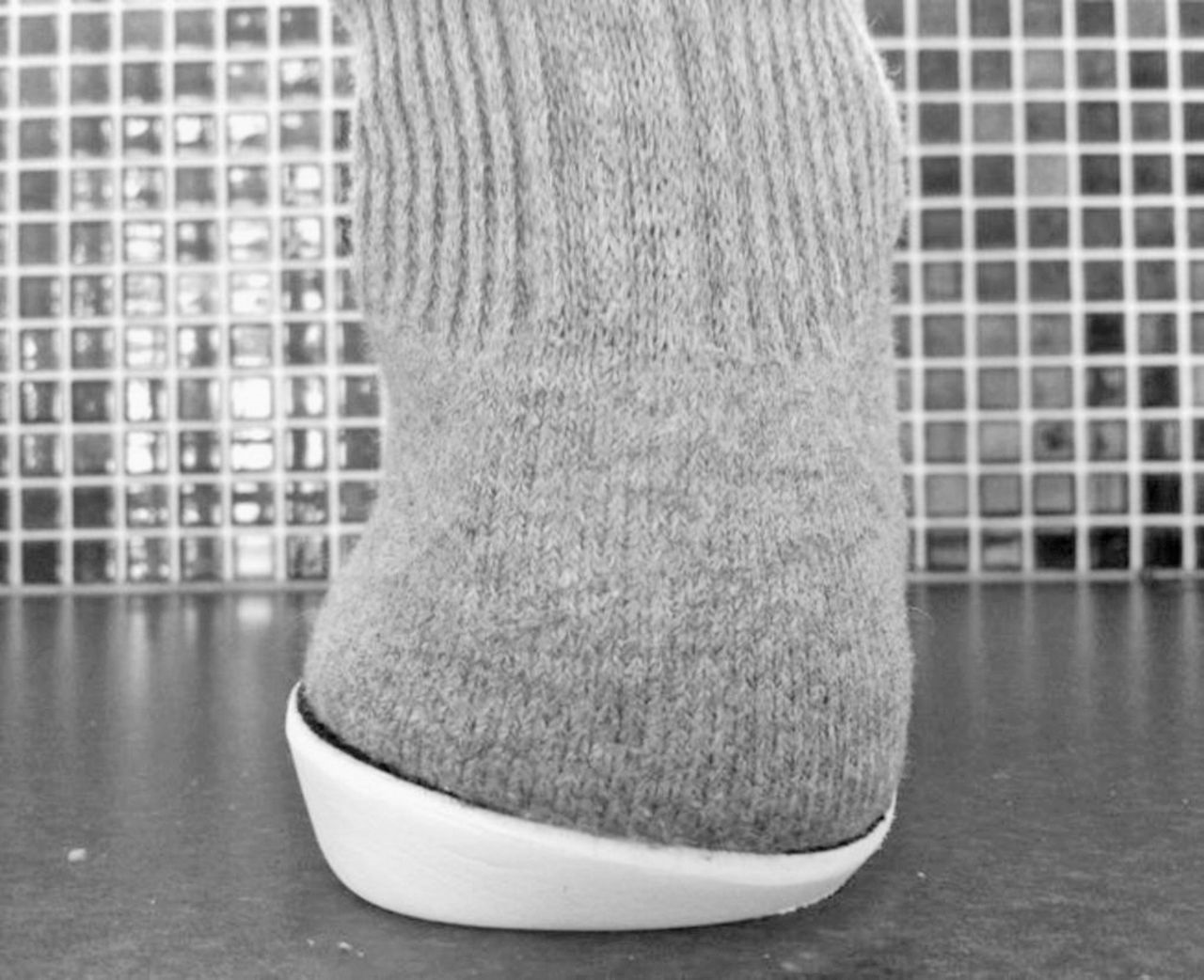
The participants were prescribed custom-made insoles with medial arch support and lateral wedging individually fitted to the patient by an experienced orthopedic shoemaker (Fig. 1). The insoles were made using Plastazote, which is a dynamic material that is fitted to the shoe and the patient. The full-length lateral wedge was 5.0° to 8.7°, covering approximately 75% of the width of the insole.
The participants were standing with their weight equally distributed on both feet. In this position, an impression of the foot was made in nonheated Orthotritt (Spigron Spin GmbH, Gronau, Germany). The impression was used to choose one of 15 different basic forms around which the preheated insoles were shaped. After this, the shaped insoles, including the medial arch support and the lateral wedge, were individually fitted with respect to the fabricated impression and the total lower extremity in standing and walking. Evaluation of the lower extremity consisted of assessment of hyperpronation/hypopronation, pes planus/cavus, hallux valgus, pes transverso planus, other malalignments of the foot, and leg-length differences. Furthermore, the extent of shock absorption and the hardness of the material were adjusted according to the individual regarding body mass index (BMI); a participant with a higher BMI got a harder insole. After fabrication of the insoles, the effect on the alignment of the knee and the rest of the lower extremity was evaluated. The aim was neutral knee alignment and reduction of pain.
Figure 1. The laterally wedged insole.
Japma 103 00050 g001
The participants were instructed to use the insoles every day and not to alter their level of activity. Four weeks after the initial prescription, the participants were reassessed and the insoles were refitted if needed. This adjustment was performed to reflect feedback from the participant regarding comfort and pain and reevaluation of the lower extremity. Most often it consisted of an increase in the degree of lateral wedging or a change in medial arch support.

Outcome Measures

Pretested questionnaires regarding pain, function, and quality of life before and after the intervention were sent to the participants in October 2010. The participants were asked to rate their pain intensity in the affected knee on a visual analog scale (VAS) in the following conditions: after 30 min of physical activity, at rest, at night, and after 50 m of walking. In addition, they completed the Oxford Knee Score in its original form, ranging from 12 to 60 with 12 being the best (Oxford Knee Score) and EQ-5D-3L (both the single index value [EQ-5D] and the EQ VAS). The primary outcome was the VAS value after 30 min of physical activity, and the hypothesis was that the intervention would reduce the pain after 30 min of physical activity.

Adherence to Treatment

To assess adherence to treatment, the participants were asked how much they had been using the insoles (all day, some hours every day, some hours every week, or not at all). Participants not using the insoles were asked the reason for their nonadherence.

Statistical Analysis

Data were normally distributed, confirmed by visual inspection of Q-Q plots. The paired-samples t test was applied to compare the means at baseline with the means at follow-up for all of the participants. A P < .05 was considered significant. The P values were adjusted using Bonferroni post hoc analysis due to multiple comparisons. Results are presented as estimated differences with 95% confidence intervals and as relative improvements with standard deviations. All of the analyses were performed with a statistical software program (IBM SPSS Statistics, version 19; IBM Corp, Armonk, New York).

Results

Forty-two of the 51 participants (82%) filled out the questionnaires in October 2010. The characteristics of the 42 participants were similar to those of the total 51 participants enrolled in the study (22 men and 20 women; mean age, 63 years; mean Kellgren-Lawrence score, 3.4). Thirty-three of the 42 participants (79%) used the insoles daily (all day or some hours every day) during an average of 7.75 months, one used the insoles some hours every week, and eight did not use the insoles. Four of the participants who had not been using the insoles stated that their foot could not grow accustomed to using the insoles or that they experienced more pain from using the insoles, and the remaining four gave no reason for their lack of adherence to the treatment.
The VAS value after 30 min of physical activity was significantly reduced after the intervention (Table 1). The mean reduction was 3.3 cm (P < .001). The VAS values at rest, at night, and after 50 m of walking and the Oxford Knee Score were also significantly reduced. The mean reductions were 3.0 cm (P < .001), 2.8 cm (P < .001), 2.7 cm (P < .001), and 8.0 cm (P < .001), respectively (Table 1). The EQ-5D and EQ VAS values were significantly increased after the intervention. The mean increases were 0.20 (P < .001) and 19 (P < .001), respectively (Table 1).

Discussion

This study found a significant reduction in pain and improvements in function and quality of life in older adults with mild-to-severe isolated medial compartment KOA after an intervention consisting of custom-made laterally wedged insoles. The relative improvements were all higher than the minimal clinically important improvement of pain, patient’s global assessment, and functional impairment previously reported in patients with KOA.[27] The results support the recommendations of most of the clinical guidelines[8] and contribute to the understanding of the conflicting results concerning the impact of laterally wedged insoles on symptoms in medial compartment KOA.[2,10,20,21]
The participants in this study had varus knee alignment. Because increased medial knee joint loading is an important risk factor for progression of KOA in the medial compartment,[16,17] one could hypothesize that the participants would benefit from this intervention in the longer term, although a previous study did not show this relationship.[21] In this study, the significant effect of insoles on pain, function, and quality of life are in agreement with the fact that laterally wedged insoles decrease the medial knee joint compartment load,[18,19] that degeneration of the medial compartment could increase loading and be a cause of pain,[15] and the rather common belief that reduced knee load results in pain relief.
Table 1. Changes in Outcome Measures After the Intervention
Japma 103 00050 i001
Four published randomized controlled trials have not shown an effect on pain using laterally wedged insoles.[15,21,28,29] However, one of the studies showed that individually modeled, laterally elevated insoles worn for 2 years were related to reduced nonsteroidal anti-inflammatory drug intake in the treatment group compared with the control group.[29] Furthermore, one of the studies, a prospective controlled trial, showed earlier improvements in function in the treatment group compared with the control group, measured by the 6-min walk test.[28]
In this study, the laterally wedged insoles were custom-made. In all four randomized trials, the insoles were prefabricated[15,21] or only the amount of lateral wedging was individualized using either additional wedges of 3° or 5°[28] or extra material.[29] Because KOA is a multifactorial condition that affects several structures related to the knee,[30,31] and because great variability exist in the biomechanical response to lateral wedges in patients with medial KOA possibly attributed to anatomical differences and variations in neuromotor activity,[22] one could speculate that customization of the insoles to the individual, as in this study, is an important aspect when prescribing it to patients with KOA. This is supported by two studies favoring custom-made insoles in reducing pain,[24,32] one in the treatment of medial KOA[24] and the other comparing it with prefabricated insoles in a crossover randomized controlled trial in lower-extremity musculoskeletal pain.[32] Custom-made laterally wedged insoles might minimize the discomfort and adverse events that have previously been reported with the use of prefabricated lateral wedges[19,21] and at the same time optimize the reduction in the knee adduction moment.[33] The use of well-fitted custom-made insoles might also be the reason for the high adherence to treatment in the participants using the insoles in the present study.
The length of the wedge may also be an important factor. One of the randomized trials did not use a full-length lateral wedge.[29] The knee adduction moment is reduced only with a full-length insole and not with a lateral wedge only in the heel region.[34] This might also be part of the explanation in previous studies that have not found a reduction in the knee adduction moment in patients with KOA using insoles.[12,35]
The use of laterally wedged insoles increases the step width in patients with KOA,[36] which can increase the knee adduction moment.[12] However, adding a medial arch support to an insole with a lateral wedge, as in the present study, normalizes the step width[37] and might also be important for the comfort of the insole,[24] possibly leading to higher adherence. Three of four of the randomized trials had no medial arch support in the insoles,[15,21,29] and the fourth used walking shoes and “contoured foot orthoses.”[28] Perhaps the use of laterally wedged insoles without the arch support could be part of the explanation for the lack of effect on pain found in the randomized trials.
Some attention should be given to the group of participants not using the insoles daily. This study reported that 79% had been using the insoles daily and that four of the participants stated that the reason for their nonadherence was discomfort using the insoles. These findings are in line with previous studies in the area.[19,21,28,38] One study reported adherence to laterally wedged insoles of 88% after 6 months,[38] whereas in another lateral wedge study only 57% remained in the treatment group because of adverse events and inefficacy among others.[28] Furthermore, studies have reported discomfort in participants using laterally wedged insoles of 47%[21] and up to 100%.[19] It has been suggested that the variability in the response to laterally wedged insoles could be mediated by differences in anatomy, static and dynamic foot posture, gait patterns, or neuromuscular activity.[22] Because of the biomechanical effects of laterally wedged insoles, screening for and monitoring against the development of foot/ankle abnormalities is essential because the increase in frontal plane load and rearfoot eversion due to the insoles could worsen the condition.[22,39,40]
Another explanation could be related to the fabrication of the insoles. In the present study, the extent of shock absorption and hardness were regulated according to the BMI of the individual. One could speculate that some patients with low BMI would improve from a harder insole and vice versa for patients with a high BMI. In the future, the regulation of insoles could possibly benefit from being based on other parameters, such as wearing comfort and biomechanics, in addition to BMI to allow for further customization of the insoles. Future research should try to explore why some patients experience inefficacy and discomfort and others have a positive effect from using laterally wedged insoles by evaluating subgroups of patients.[22]
Limitations of the present study are the sample size and the noncontrolled, retrospective study design. The design of the study limits the degree to which the improvements can be directly attributed to the intervention and at the same time questions the size of the actual improvement. However, laterally wedged insoles reduce the knee adduction moment during walking and decrease the medial knee load,[18,19] suggesting that the intervention might have a symptomatic effect when used properly.

Conclusions

This study found a significant reduction in pain and improvements in function and quality of life with the use of custom-made laterally wedged insoles in older adults with mild-to-severe medial compartment KOA. The customization of laterally wedged insoles, including the arch support, could be a key factor in the effect of insoles in medial KOA. Future randomized trials comparing custom-made laterally wedged insoles and prefabricated insoles with a thorough description of the insoles are warranted.

Financial Disclosure

This trial was partially funded by The Bevica Foundation.

Conflict of Interest

None reported.

References

  1. Peat, G, RMcCarney, PCroft.: Knee pain and osteoarthritis in older adults: a review of community burden and current use of primary health care. Ann Rheum Dis2: 91, 2001.
  2. Raja, K and NDewan.: Efficacy of knee braces and foot orthoses in conservative management of knee osteoarthritis: a systematic review. Am J Phys Med Rehabil3: 247, 2011.
  3. Hinman, RS, KABowles, KLBennell.: Laterally wedged insoles in knee osteoarthritis: do biomechanical effects decline after one month of wear?BMC Musculoskelet Disord10: 146, 2009.
  4. Healy, WL, RIorio, JKo, et al.: Impact of cost reduction programs on short-term patient outcome and hospital cost of total knee arthroplasty. J Bone Joint Surg Br84: 348, 2002.
  5. Lawrence, RC, DTFelson, CGHelmick, et al.: Estimates of the prevalence of arthritis and other rheumatic conditions in the United States: part II. Arthritis Rheum1: 26, 2008.
  6. Lohmander, LS and DFelson.: Can we identify a “high risk” patient profile to determine who will experience rapid progression of osteoarthritis?Osteoarthritis Cartilage12 ( suppl A:):S49, 2004.
  7. Felson, DT and YZhang.: An update on the epidemiology of knee and hip osteoarthritis with a view to prevention. Arthritis Rheum41: 1343, 1998.
  8. Zhang, W, RWMoskowitz, GNuki, et al.: OARSI recommendations for the management of hip and knee osteoarthritis, part II: OARSI evidence-based, expert consensus guidelines. Osteoarthritis Cartilage16: 137, 2008.
  9. Jordan, KM, NArden, MDoherty, et al.: EULAR recommendations 2003: an evidence based approach to the management of knee osteoarthritis: report of a Task Force of the Standing Committee for International Clinical Studies Including Therapeutic Trials (ESCISIT). Ann Rheum Dis62: 1145, 2003.
  10. Brouwer, RW, TSJakma, APVerhagen, et al.: Braces and orthoses for treating osteoarthritis of the knee. Cochrane Database Syst Rev1: CD004020, 2005.
  11. Ahlback, S.: Osteoarthritis of the knee: a radiographic investigation. Acta Radiol Suppl277: 7, 1968.
  12. Reeves, ND and FLBowling.: Conservative biomechanical strategies for knee osteoarthritis. Nat Rev Rheumatol7: 113, 2011.
  13. Yasuda, K and TSasaki.: The mechanics of treatment of the osteoarthritic knee with a wedged insole. Clin Orthop215: 162, 1987.
  14. Andriacchi, TP.: Dynamics of knee malalignment. Orthop Clin North Am25: 395, 1994.
  15. Baker, K, JGoggins, HXie, et al.: A randomized crossover trial of a wedged insole for treatment of knee osteoarthritis. Arthritis Rheum4: 1198, 2007.
  16. Miyazaki, T, MWada, HKawahara, et al.: Dynamic load at baseline can predict radiographic disease progression in medial compartment knee osteoarthritis. Ann Rheum Dis61: 617, 2002.
  17. Bennell, KL, KABowles, YWang, et al.: Higher dynamic medial knee load predicts greater cartilage loss over 12 months in medial knee osteoarthritis. Ann Rheum Dis10: 1770, 2011.
  18. Hinman, RS, CPayne, BRMetcalf, et al.: Lateral wedges in knee osteoarthritis: what are their immediate clinical and biomechanical effects and can these predict a three-month clinical outcome?Arth Rheum59: 408, 2008.
  19. Kerrigan, DC, JLLelas, JGoggins, et al.: Effectiveness of a lateral-wedge insole on knee varus torque in patients with knee osteoarthritis. Arch Phys Med Rehabil83: 889, 2002.
  20. Reilly, KA, KLBarker, DShamley.: A systematic review of lateral wedge orthotics: how useful are they in the management of medial compartment osteoarthritis?Knee3: 177, 2006.
  21. Bennell, KL, KBowles, CPayne, et al.: Lateral wedge insoles for medial knee osteoarthritis: 12 month randomized controlled trial. BMJ342: d2912, 2011.
  22. Hinman, RS, KABowles, BBMetcalf, et al.: Lateral wedge insoles for medial knee osteoarthritis: effects on lower limb frontal plane biomechanics. Clin Biomech (Bristol, Avon)27: 27, 2012.
  23. Chevalier, TL and NChockalingam.: Foot orthoses: a review focusing on kinematics. JAPMA101: 341, 2011.
  24. Rubin, R and HBMenz.: Use of laterally wedged custom foot orthoses to reduce pain associated with medial knee osteoarthritis: a preliminary investigation. JAPMA95: 347, 2005.
  25. Altman, RD, MHochberg, WAMurphy, et al.: Atlas of individual radiographic features in osteoarthritis. Osteoarthritis Cartilage3 ( suppl A:):3, 1995.
  26. Kraus, VB, TPVail, TWorrell, et al.: A comparative assessment of alignment angle of the knee by radiographic and physical examination methods. Arthritis Rheum52: 1730, 2005.
  27. Tubach, F, PRavaud, GBaron, et al.: Evaluation of clinically relevant changes in patient reported outcomes in knee and hip osteoarthritis: the minimal clinically important improvement. Ann Rheum Dis64: 29, 2005.
  28. Barrios, JA, JRCrenshaw, TDRoyer, et al.: Walking shoes and laterally wedged orthoses in the clinical management of medial tibiofemoral osteoarthritis: a one-year prospective controlled trial. Knee16: 136, 2009.
  29. Pham, T, JFMaillefert, CHudry, et al.: Laterally elevated wedged insoles in the treatment of medial knee osteoarthritis: a two-year prospective randomized controlled study. Osteoarthritis Cartilage12: 46, 2004.
  30. Dieppe, PA and LSLohmander.: Pathogenesis and management of pain in osteoarthritis. Lancet9463: 965, 2005.
  31. Bijlsma, JW, FBerenbaum, FPLafeber.: Osteoarthritis: an update with relevance for clinical practice. Lancet9783: 2115, 2011.
  32. Trotter, LC and MRPierrynowski.: The short-term effectiveness of full-contact custom-made foot orthoses and prefabricated shoe inserts on lower-extremity musculoskeletal pain: a randomized clinical trial. JAPMA98: 357, 2008.
  33. Butler, RJ, JABarrios, TRoyer, et al.: Effect of laterally wedged foot orthoses on rearfoot and hip mechanics in patients with medial knee osteoarthritis. Prosthet Orthot Int33: 107, 2009.
  34. Hinman, RS, KABowles, CPayne, et al.: Effect of length on laterally-wedged insoles in knee osteoarthritis. Arthritis Rheum59: 144, 2008.
  35. Maly, MR, EGCulham, PACostigan.: Static and dynamic biomechanics of foot orthoses in people with medial compartment knee osteoarthritis. Clin Biomech (Bristol, Avon)17: 603, 2002.
  36. Shimada, S, SKobayashi, MWada, et al.: Effects of disease severity on response to lateral wedged shoe insole for medial compartment knee osteoarthritis. Arch Phys Med Rehabil87: 1436, 2006.
  37. Nakajima, K, WKakihana, TNakagawa, et al.: Addition of an arch support improves the biomechanical effect of a laterally wedged insole. Gait Posture29: 208, 2009.
  38. Maillefert, JF, CHudry, GBaron, et al.: Laterally elevated wedged insoles in the treatment of medial knee osteoarthritis: a prospective randomized controlled study. Osteoarthritis Cartilage9: 738, 2001.
  39. Butler, RJ, JABarrios, TRoyer, et al.: Effect of laterally wedged foot orthoses on rearfoot and hip mechanics in patients with medial knee osteoarthritis. Prosthet Orthot Int33: 107, 2009.
  40. Kakihana, W, MAkai, KNakazawa, et al.: Effects of laterally wedged insoles on knee and subtalar joint moments. Arch Phys Med Rehabil86: 1465, 2005.