The general public has become increasingly concerned about the accomplishments of education. Accrediting bodies are holding institutions of higher education accountable for educational services and are demanding a variety of assessment activities. The Higher Learning Commission of the North Central Association of Colleges and Schools, one of six regional institutional accreditors in the United States, requires that an institution describe its assessment program and document the academic achievement of its students [
1]. The specialized/professional accrediting body of podiatric medical educational programs, the Council on Podiatric Medical Education, requires that colleges have an ongoing evaluation process to assess achievement of goals and objectives, including the outcomes of the educational program [
2]. In response to internal and external pressures for outcomes assessment, the Kent State University College of Podiatric Medicine (KSUCPM) has developed a comprehensive institutional assessment program based on the mission and goals generated and accepted by the College community. This article presents the perspective of one college of podiatric medicine.
In addition to meeting external requirements of accrediting organizations, a firmly established assessment program has other advantages. It demonstrates to the public that a good quality education is being conducted and that continued investment by governmental, private, and personal sources is warranted. An assessment program also provides an effective way to document progress and achievement, which results in constructive change in the institution through self-improvement and strategic planning.
Published guidelines regarding the assessment of outcomes are available for various schools of the health professions. The KSUCPM assessment program was derived after review and consideration of guidelines. Outcome measures of value to an institution are appropriate to its purpose, ie, the institutional mission and goals. The KSUCPM’s assessment plan is based on the mission and goals generated and accepted by the College community. The mission of the KSUCPM is to educate students to be highly competent doctors of podiatric medicine who excel in residency training.
The institutional goal specific to the education of students at the KSUCPM is to provide a quality, comprehensive educational program by which students will acquire the requisite knowledge, skills, judgment, leadership, and ethical values necessary to deliver quality podiatric medical and surgical care to meet the health needs of the public. This goal is directly evaluated by the assessment plan; therefore, the assessment plan is linked to the College’s mission and goals.
The groundwork for the current KSUCPM’s assessment plan began in 1990, when the College started evaluating information concerning student performance on national board examinations. A formal assessment plan was founded by the KSUCPM’s Academic Council, whose main goal is to review, evaluate, and develop academic policies and procedures. This group consists of academic administrators, department chairpersons, and student representatives. After requesting input from all levels of the KSUCPM community, including administrators, faculty, staff, and students, over the intervening years, the KSUCPM broadened the assessment plan’s scope, providing for multiple measures. The academic dean and Academic Council members evaluate and modify the academic assessment plan. The Academic Council is also responsible for sharing the assessment plan and its results with all levels of the College community to allow for greater input in the assessment process.
The KSUCPM’s assessment plan is designed around three phases of the student educational experience: enrollment; success in the educational program; and postgraduate performance, experience, and career choice. Students are assessed in various academic areas as they apply and matriculate into the College, as they progress through the academic program and continuing after graduation while finishing their first year of residency, and then as alumni. Incoming student entrance data are correlated with academic achievement data as students progress through the podiatric medical curriculum. Comparative studies regarding student performance are conducted as well, and students, in turn, are afforded the opportunity to provide feedback regarding their satisfaction with the KSUCPM through a satisfaction survey administered every 3 years.
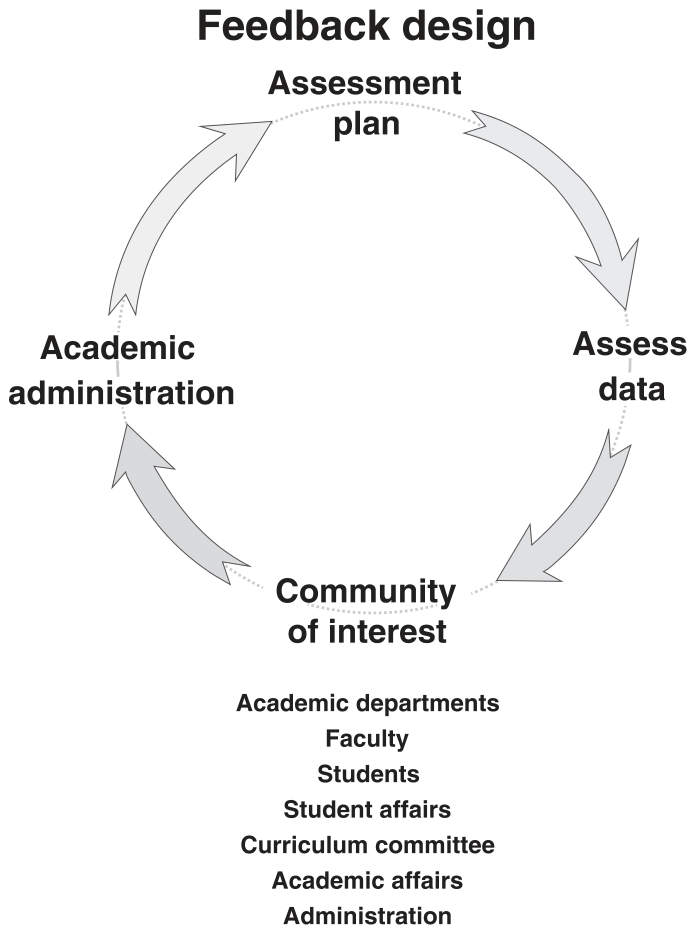
Once graduated, a recent alumnus has an opportunity to evaluate the didactic and clinical education they received at the KSUCPM in relation to how prepared they were for their first year of residency. Recent graduates also assess how they feel they performed in their first year of residency. Postgraduate program directors similarly evaluate the didactic and clinical preparation and performance of KSUCPM graduates. Last, 5 and 10 years after graduation, alumni evaluate their practice experience, income-debt ratios, and various aspects of their career, such as association participation, professional activities, and licensure opportunities. The assessment plan is designed to create a continuous feedback design, as represented in
Figure 1.
Following is a summary of assessment activities at the KSUCPM that serve to indicate whether institutional goals have been achieved, and to assist the College in developing plans for continuous improvement.
Tables 1 to
3 outline each phase of the program and include activities for purposes of enrollment and recruitment (
Table 1), success in the educational program (
Table 2), and success in postgraduate training and career choice (
Table 3). The tables list the specific measurements evaluated, the communities of interest supplied with the data and information obtained, use of the assessment data, and, last, the specific instruments used.
Figure 1.
Feedback diagram. An assessment plan must provide for continuous feedback from the designed plan to the community of interest for their immediate use or long-term planning in evaluating student and curricular performance. To close the assessment loop, the community of interest makes recommendations for modifications of the plan to meet specific needs and for implementing changes in the educational curriculum or student services. An example of immediate use of the data is identifying academically at-risk students for early intervention.
Figure 1.
Feedback diagram. An assessment plan must provide for continuous feedback from the designed plan to the community of interest for their immediate use or long-term planning in evaluating student and curricular performance. To close the assessment loop, the community of interest makes recommendations for modifications of the plan to meet specific needs and for implementing changes in the educational curriculum or student services. An example of immediate use of the data is identifying academically at-risk students for early intervention.
Enrollment assessment is presented in
Table 1. Measurements address undergraduate performance, Medical College Admission Test scores, and other factors important for recruitment and admission. Analysis of these data has resulted in changes in admission criteria and has been useful in identifying specific key predictors of future academic performance.
Table 1.
Enrollment Assessment (Recruitment and Admissions)
Table 1.
Enrollment Assessment (Recruitment and Admissions)
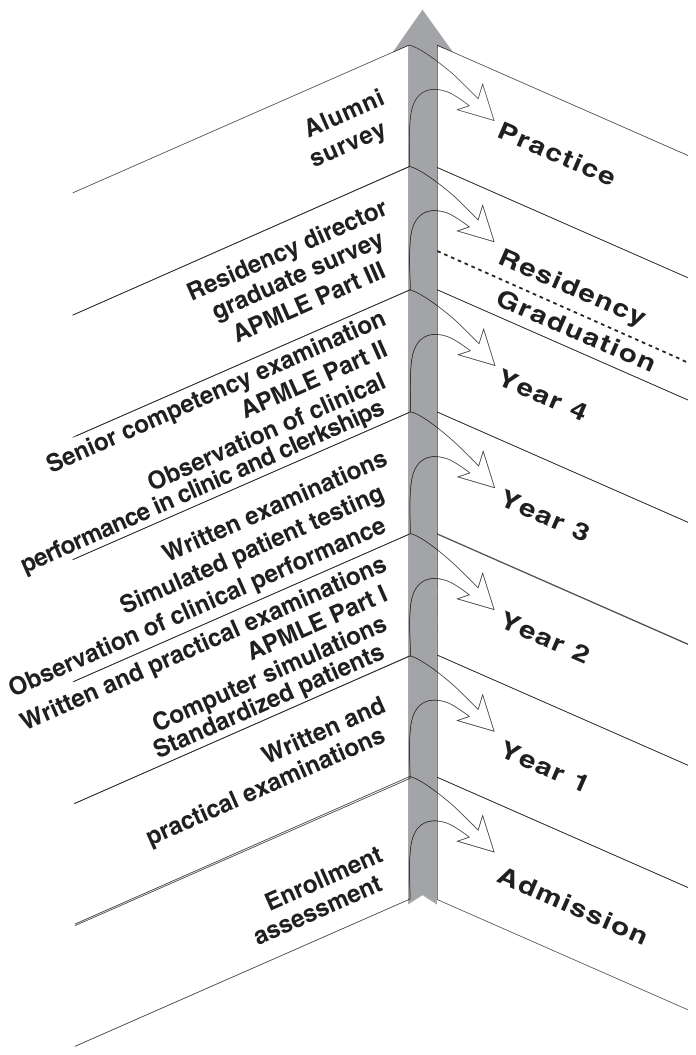
Figure 2.
Fishbone diagram. The assessment continuum can be viewed as a linear process from application and admission to postgraduate training and practice for specific individuals or classes. APMLE, American Podiatric Medical Licensing Examination.
Figure 2.
Fishbone diagram. The assessment continuum can be viewed as a linear process from application and admission to postgraduate training and practice for specific individuals or classes. APMLE, American Podiatric Medical Licensing Examination.
Table 2 refers to items evaluating success in the educational program at the KSUCPM and has three parts. The first part looks at the evaluation of student performance in preclinical and clinical coursework, which includes classroom, laboratory, and workshop experiences. Measurements include written and skills assessment in the preclinical and clinical courses. This information is important to assess student progress through the curriculum and to identify individual strengths and weaknesses for students in the 4-year and 5-year programs. It helps to identify students experiencing academic difficulty so that the cause of the academic difficulty may be addressed, regardless of the cause, and that the appropriate intervention may be initiated. The second portion of
Table 2 addresses the evaluation of students’ clinical performance and elements critical to their progress through the curriculum. Although there are examinations given at the end of each clinical rotation, a senior competency examination is also completed before graduation. This examination consists of several components, including written, problem-solving, and skill examinations (Objective Structured Clinical Examination); simulated patient examination; and direct observation of clinical performance by college faculty. Passage of the senior competency examination is a graduation requirement. The third portion of
Table 2 is the student assessment of the curriculum and instruction. This assessment includes basic science and clinical faculty as well as clinical clerkships and has proved important in curricular revisions, improvement in teaching, and faculty assessment.
Table 2.
Success in the Educational Program
Table 2.
Success in the Educational Program
Table 3.
Success in Postgraduate Education and Career Choice
Table 3.
Success in Postgraduate Education and Career Choice
Table 3 addresses the efforts that the KSUCPM makes in assessing the performance of graduates at graduation and into their careers. This material provides feedback for the development of programmatic revisions to improve the quality of the graduates. Ultimately, this information is distributed to the College community, and the data are provided for feedback to all phases of the assessment plan, including enrollment criteria and overall success in the educational program (
Figure 2).
Financial Disclosure: None reported.
Conflict of Interest: None reported.