The first ray is an essential component in the normal anatomy of the foot. By definition, the first ray consists of the hallux and the first metatarsal. Biomechanically, the first ray, with the assistance of the subtalar joint, helps to absorb and evenly distribute shock during the contact phase of gait as well as aids in making the foot a rigid lever during propulsion. Since the first ray is an essential structure in terms of normal biomechanics, impressive loads are put on it, and as a result, it is often a common site of pathology.
The first ray, like any structure in the foot, is susceptible to pathology such as osteomyelitis, gangrene, or both. Traditionally, the end-stage cure for osteomyelitis and gangrene in the foot is surgical debridement with or without amputation. This is especially true for the diabetic population. Because of hyperglycemia and an overall decreased immune response, diabetic patients are frequently targeted for lower-extremity infections resulting in amputation. According to Murdoch et al [
1], ‘‘between 5 and 15% of all people with diabetes will require a lowerextremity amputation in their lifetime.’’
(p204) Those who are fortunate enough to have an isolated firstray infection tend to end up with a partial first-ray amputation in which the hallux and the distal portion of the first metatarsal are resected. With all surgical cures, patients are at risk of developing subsequent complications leading to further amputations such as a transmetatarsal amputation (TMA) or even a below-knee amputation. Regarding solitary ray resection, Cohen et al [
2] states, ‘‘.. . a failure rate of 62.9% is to be expected in less than 24 months [from initial date of surgery]’’
(p32) The amputation of the first ray changes the biomechanics of the foot. As pressures normally distributed to the first ray are often transferred laterally, new deformities such as toe contractions, can develop and lead to new ulcerations, thereby putting the patient at risk for infection and further amputation [
3,
4,
5].
The TMA is a procedure that is usually used when there are multiple digits that require amputation from ischemia or infection [
5]. The TMA preserves foot function and unlike ray resections, the TMA preserves the metatarsal parabola, allowing pressure distribution to be fairly even across the stump [
1]. With the TMA, the main deformity that may occur postoperatively is equinovarus, which may be prevented at the time of surgery by preserving metatarsal length (if possible), releasing the tendo Achilles, or performing a tendon transfer [
5].
The purpose of this retrospective study is to analyze partial first-ray amputations. We hypothesize that partial first-ray amputations that require additional resection of the first metatarsal will tend to need additional surgery, including more proximal amputations such as transmetatarsal amputation or below- or above-knee amputations. We believe that the development of transfer ulceration secondary to poor biomechanics from partial first-ray amputation leads to this.
Methods
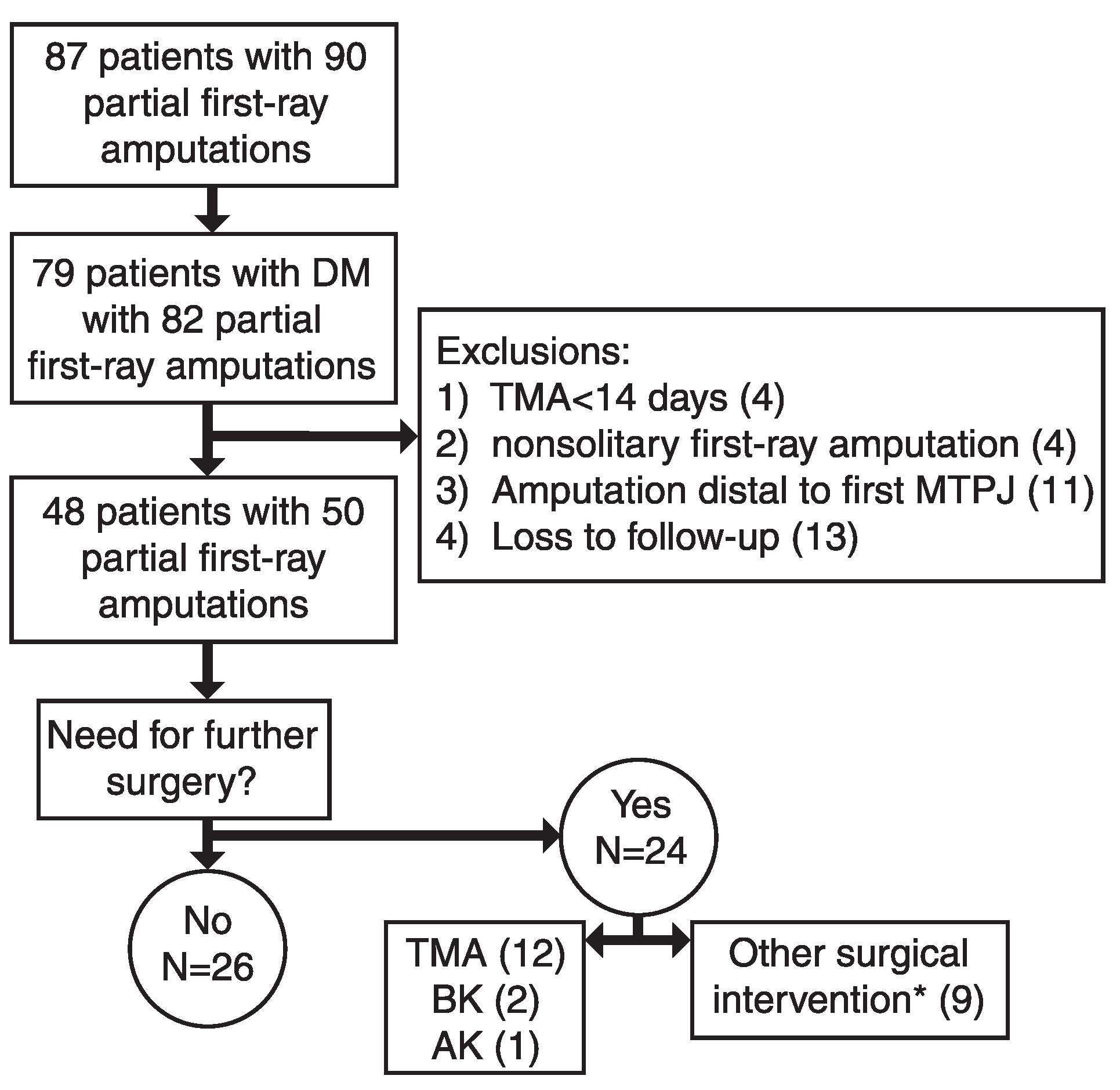
A retrospective review was taken of 87 patients who underwent a solitary first-ray amputation between April 1, 2003, and July 31, 2009 at our institution. Any patient who was not documented to have diabetes mellitus was excluded. This left us with 79 patients. Of these 79 patients, 53 had non–insulindependent diabetes mellitus and 26 had insulindependent diabetes mellitus. The patients were operated on by one of eight attending surgeons and were followed at their respective offices. Any patients lost to follow-up at fewer than 4 months (120 days) were excluded. Any first-ray amputations distal to the first metatarsophalangeal joint (MPJ) were excluded. Any first-ray amputation that went on to a TMA within 2 weeks (14 days) were also excluded, as these first-ray amputations were considered staged procedures toward a TMA in order to prevent bacteremia, sepsis, and death. After all exclusions were accounted for, we were left with 50 partial first-ray amputations from 48 patients to review (
Figure 1). Hospital records and office charts were reviewed to obtain the patient’s demographics, past medical history, operative report, and follow-up data. Cases were considered a failure if the patient who had a first-ray amputation went on to have a proximal amputation of the ipsilateral limb or a surgery to correct a complication as a result of the first-ray amputation. Any surgical wound that demonstrated delayed healing was not considered a complication. The 50 cases were then evaluated based on their level of amputation.
Results
A total of 50 partial first-ray resections from 48 patients were analyzed in this study. All 48 patients were diabetic; 32 were male and 16 were female. A total of 23 partial first-ray resections were done on the right foot and 27 were done on the left foot. Thirty of these patients had non–insulin-dependent diabetes, and the other 18 were insulin dependent. Forty-two of the patients were documented to have peripheral artery disease clinically, and the majority of these patients had abnormal arterial brachial indices. The mean age for our sample size was 62.44 years.
Out of 50 first-ray resections, a total of 13 were resected at the metatarsophalangeal joint, five at the distal metatarsal head, 25 at the metatarsal neck, four at the diaphysis of the metatarsal, and three at the base of the first metatarsal or proximal to that level. Out of 50 first-ray resections, 34 were performed because of infection alone (abscess or osteomyelitis); six because of ischemia; seven because of a combination of infection and ischemia (wet gangrene); and three secondary to a chronic wound (
Table 1).
Following surgery, all 50 cases had at least 4 months of post-operative follow-up by their respective surgeon at regular intervals. Twelve out of the 50 cases went on to have a TMA (29%), and an additional 12 went on to develop a wound complication that required additional surgery (29%) resulting in a total complication/failure rate of 48%. Of the 12 total TMAs, five were done secondary to infection alone, three due to ischemia alone, three due to infection and ischemia combined, and one due to a chronic wound. Of the 12 other complications not attributable to TMA, six were due to infection alone, two due to ischemia, one due to combined infection and ischemia, three due to a chronic wound, and one due to a non-healing postsurgical wound.
This study examined if there was any correlation between the level of first-ray resection and the need for further surgery (
Table 2). We found that out of 14 first-ray resections at the MPJ, there were five complications. Out of 30 resections at the metatarsal neck, there were 12 complications. Two complications occurred out of three resections done at the diaphyseal level of the metatarsal, and three complications occurred out of three resections done at the metatarsal base or proximal to that. To test our hypothesis, we compared our data using the
X2 test. Our population was divided into two groups: those with first-ray resections at the metatarsal neck or distal to that, or those with first-ray resections proximal to the metatarsal neck. The
X2 value was 4.638, which was statistically significant (
P>0.05).
Discussion
The first ray is an important component during gait. Loss of the first MPJ by amputation disrupts the integrity of the medial column during gait and causes the arch to collapse [
3,
4]. The pressures normally distributed by the first ray are then transferred laterally to the lesser toes and may lead to new deformities such as digital contractures [
3,
4,
5]. In the presence of diabetes and peripheral neuropathy, these new deformities put the patient at risk for new ulcerations and further amputation [
3,
4,
5]. Quebedeaux et al [
3] showed that diabetic patients with amputations of the great toe develop more frequent and more severe deformities of the lesser toes and MPJs compared with their contralateral foot. It is also important to note that diabetic patients who undergo amputation usually have multisystem compromise, including cardiovascular disease, renal disease, peripheral vascular disease, and neuropathy [
2,
5], which can all lead to delayed healing.
In our study, we found that resections of the first metatarsal performed from the metatarsophalangeal joint to the metatarsal neck are less likely to fail compared to resections of the first metatarsal proximal to the metatarsal neck. This may be attributable to improved distribution of weightbearing forces on the medial column when length of the first metatarsal is preserved as much as possible. In fact, our most common complication was a transfer ulceration resulting from new deformities that developed after, or as a result of their first-ray resection. This often led to either a chronic nonhealing wound, osteomyelitis, cellulitis, or abscess formation. This ties into previously reported data regarding the correlation between an initial amputation and the need for additional surgery. For example, Murdoch et al [
1] reported that out of 90 diabetic patients with first-ray amputations, 60% went on to a second amputation, 21% a third amputation, 7% a fourth amputation, 11% had a TMA, and 17% had a subsequent below-the-knee amputation on the ipsilateral extremity. This can be taken a step further in terms of the effects an amputation has on the contralateral limb. Kucan and Robson [
6] reported that 49% of patients with amputations developed a contralateral foot infection within 18 months following an amputation, and 50% of patients who undergo a lower extremity amputation will require an amputation on the contralateral limb within 2 years.
An important goal of partial-foot amputation is to maintain bipedal ambulation, as there have been reportedly high morbidy and mortality of patients who undergo below-the-knee amputations [
2]. Partialfoot amputations such as ray resections and TMAs are often able to help patients maintain their bipedal ambulation, but they have had differing success rates [
2]. Cohen et al [
2] compared success rates between solitary partial-ray resections and TMAs. They had a success rate of 37.1% with solitary partial-ray resections compared to a 93.3% success rate with TMAs. Out of the solitary partial-ray resections, Cohen et al [
2] found that their first-ray resections only succeeded at a rate of 36.4%. Their most common complication was a transfer ulceration with subsequent cellulitis and osteomyelitis of adjacent metatarsals that required further surgical intervention such as incision and drainage, additional ray resections, and amputations. Gianfortune et al [
7] also looked at success rates of partial-ray resections and found only a 34% success rate. Pinzur et al [
8] looked at ray resections in the dysvascular foot and also noted a similar success rate of 31%. They concluded that ray resections had poor potential for success in the presence of localized gangrene and were only moderately successful for treatment of chronic resistant localized infection.
The results of this study suggest that a fairly large portion of patients who undergo a first-ray amputation will go on to have complications of the same foot that require a more proximal amputation (TMA, below-the-knee amputation or above-the-knee amputation) or other surgical intervention (incision and drainage, additional ray amputation, or metatarsal head resection). According to our study, 52% of patients did not require further surgical intervention and were considered a success. This is higher than what Cohen et al [
2] (36.4%), Gianfortune et al [
7] (34%), and Pinzur et al [
8] (31%) have reported for their solitary ray resections.
There are some limitations to this study that are important to note. This was a retrospective study, which could introduce bias and inaccurate information. Our sample size is admittedly small. Only six out of the 50 first-ray resections were distal to the metatarsal neck. Although the results of our comparison were statistically significant, a larger sample size would have given this study more power. Additionally, many of our patients were either lost to follow-up or were noncompliant with follow-up appointments. As a result, we could only base this study on a follow-up of 4 months. Only 30 of the original 50 patients had a follow-up of at least 1 year, and it would have been beneficial to see more patients beyond 1-year follow-up. Our data showed that out of the 30 patients who were seen for follow-up for at least 1 year, nine of the 30 went on to have a TMA (30%), and seven developed a wound complication (23.33%) resulting in a total complication rate of 53.33%. Finally, a total of eight attending surgeons managed and followed our patient population. Varying surgical techniques, opinions, and treatment preferences of each surgeon may have been considered for each patient, adding new variables that may have contributed to the success or failure of their first-ray amputations.
In summary, we have shown a retrospective study that partial first-ray resections do not have a great success rate. However, a higher success rate was found compared to a previous study done by Cohen et al in 1991 [
2]. Partial first-ray amputations can be beneficial in that they may be a good initial procedure to salvage the foot in an effort to prolong a patient’s biped ambulatory status, thereby lowering their morbidity and mortality.