Next Article in Journal
Nephrogenic Systemic Fibrosis in the Podiatric Patient
Previous Article in Journal
Assessment of Partial First-Ray Resections and Their Tendency to Progress to Transmetatarsal Amputations. A Retrospective Study
 
 
Journal of the American Podiatric Medical Association is published by MDPI from Volume 116 Issue 1 (2026). Previous articles were published by another publisher in Open Access under a CC-BY (or CC-BY-NC-ND) licence, and they are hosted by MDPI on mdpi.com as a courtesy and upon agreement with American Podiatric Medical Association.
Article

Pilomatrixoma. An Infrequently Encountered Lesion on the Lower Extremity

by
Billy R. Martin
,
Katherine Neiderer
* and
James F. Dancho
Department of Surgery, Southern Arizona VA Health Care System, Tucson, Arizona
*
Author to whom correspondence should be addressed.
J. Am. Podiatr. Med. Assoc. 2012, 102(5), 417-418; https://doi.org/10.7547/1020417
Published: 1 September 2012

Abstract

We discuss the clinical presentation and treatment of pilomatrixoma as it occurs in the lower extremity. Although pilomatrixoma is far more common on the head, neck, and upper extremity, it can be found on the lower extremity. Treatment is aimed primarily at excision if the lesion is symptomatic or suspicious for malignancy. The authors present a case of a 73-year-old male who presented to the diabetic foot center with this condition. (J Am Podiatr Med Assoc 102(5): 417–418, 2012)

Pilomatrixoma, also known as pilomatricoma and calcifying epithelioma of Malherbe, is a slow-growing benign dermal tumor of the hair matrix cells [1,2]. Locally aggressive behavior of these lesions in some cases was suggested by Gromiko in 1927 [3]. The malignant variation of pilomatrixoma was reported in 1980 by Lopansri and Mihm [4]. Pilomatrix carcinoma is rare, and differs from its benign counterpart by its histological features and its locally aggressive behavior. Pilomatrixoma has been considered a rare lesion, accounting for one in 500 histological specimens submitted from dermatologists [5]. The most common location of these lesions is the head and neck region, with 60% presenting within the first two decades of life [5,6]. The lesion is more frequently seen in females than males. The most common presenting symptom is of a firm, slow-growing, subcutaneous mass. The lesion may be painful, and abscess formation is seen in more than 20% of cases [6]. The surface of the lesion is typically skin colored and smoothly elevated compared to the surrounding tissue. The size of the lesion can vary from 0.5 cm to 6 cm, with most tumors being between 1.0 and 1.5 cm [5]. Treatment is aimed at surgical excision, usually due to pain, cosmetic issue, or suspicion that the lesion could be a more detrimental problem. Recurrences are rare, but when they do occur, a malignant variant should be suspected [4]. In this case of a 73-year-old male, the lesion presents as an irregular, painful, pigmented lesion on the anterior right leg.

Case Report

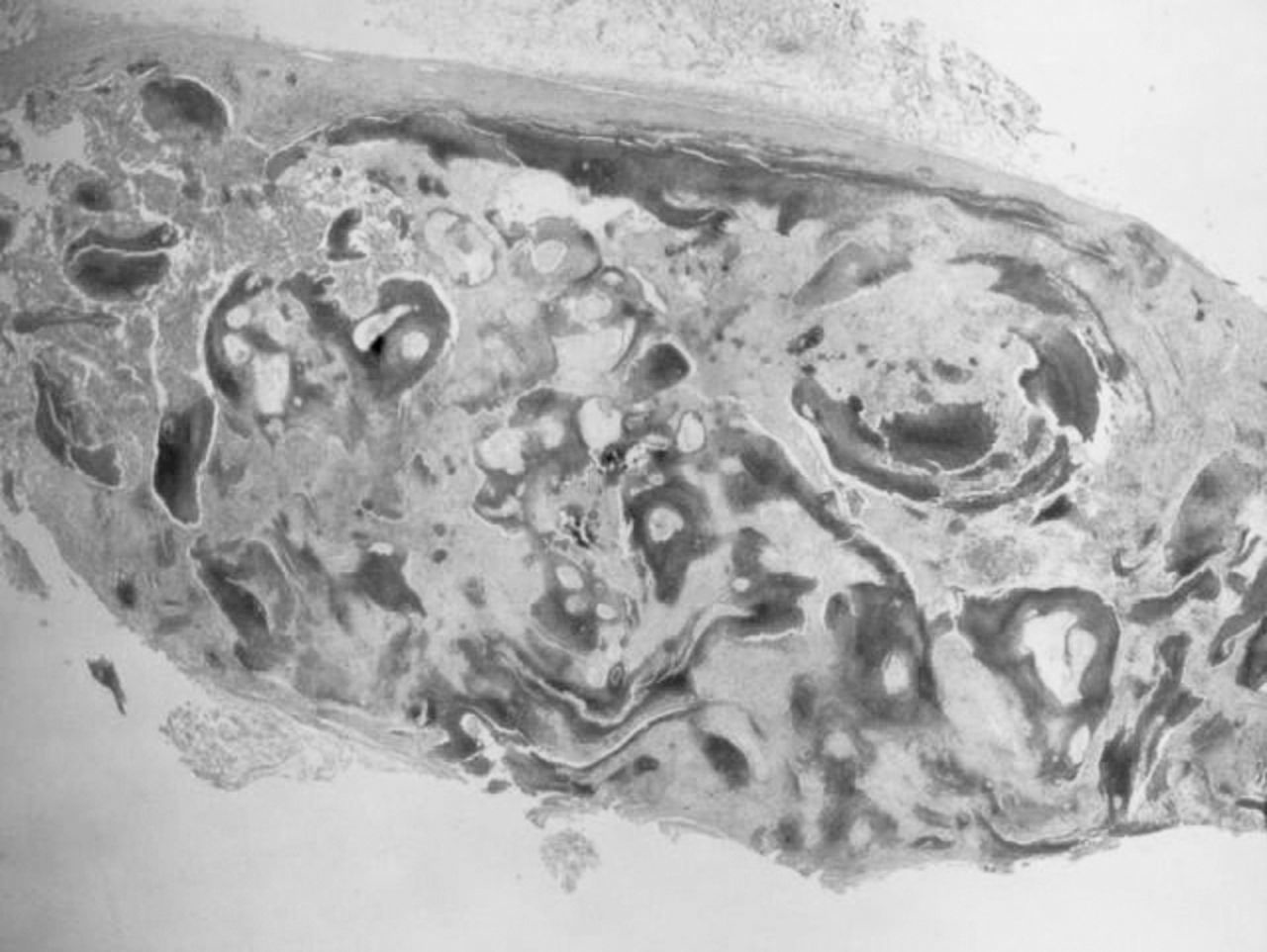
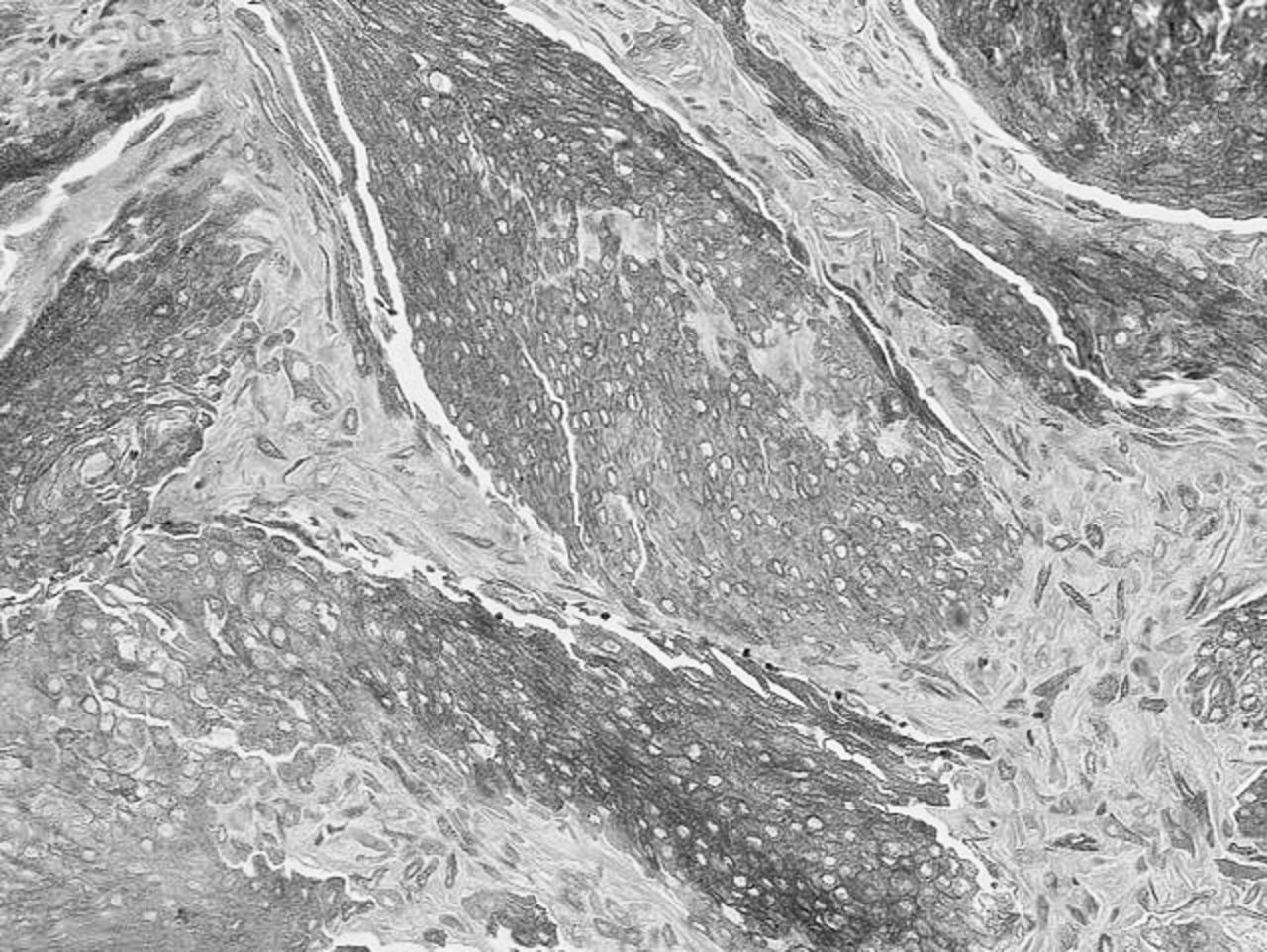
A 73-year-old male presented to the Southern Arizona VA Health Care System, Tucson, Arizona, in June 2006 complaining of a lesion to his anterior right leg. He stated that the lesion had been present for the past year, and seemed to be growing over time. He reported that the lesion bled on occasion, usually after bumping it or when attempting to apply his compression stockings over the area. The patient had not sought prior treatment for this lesion. Clinical examination revealed a firm nodule to the anterior right leg measuring 0.5 cm in diameter. The overlying skin was unevenly pigmented purple and brown, with a small rim of surrounding erythema. Punch biopsy was performed, removing the lesion in toto. Histological diagnosis revealed pilomatrixoma with overlying epidermal pseudoepitheliomatous hyperplasia and organizing dermal hematoma (Figs. 1 and 2). The overlying epidermal hyperplasia and dermal hematoma was attributed to rubbing or scratching of the lesion.

Discussion

Pilomatrixoma usually presents itself as a solid lump in or attached to the skin. It is agreed that this neoplasm arises from the cells of the epithelial hair matrix. Calcification is said to be present in 70 to 95% of cases, with ossification present in 10 to 20% [7]. Forty percent of cases occur before the age of ten. The lesions are more common in women than men (male to female ratio of 2:3) [8]. The most frequent site is in the head and neck with more than 75% of the pilomatrixomas being located on the scalp, face, neck, or arms [9]. In this case, the lesion presents on the lower leg of a 73-year-old male.
Figure 1. Dystrophic calcification is noted, signifying secondary degenerative changes.
Japma 102 00417 g001
Figure 2. Shadow cells and basaloid cells are seen. Hemorrhage is also noted, which is common for this type of lesion.
Japma 102 00417 g002
The unusual presentation is notable, and has not yet been documented in the literature. It is not our intention to determine the etiology or incidence of pilomatrixoma in the lower extremity, but to bring what we consider to be an uncommon malady to the attention of the podiatric community. The treatment of choice is complete excision together with the adherent skin, although incision and curettage may be adequate [9]. Incomplete resection has been shown to result in local recurrence, so wide resection is recommended. A recurrence rate of 2 to 6% has been reported [10]. In the event of the lesion recurring, the possibility of pilomatrixoma carcinoma should be considered. In this case, no regrowth was noted 6 months after resection. In conclusion, pilomatrixoma should be included as one of the possible differential diagnoses in the patient who presents with a skin lesion to the lower extremities. The correct management of the patient can be maximized by awareness of such an entity, careful clinical examination, and correct surgical treatment.

Acknowledgment

This material is the result of work supported with resources and the use of facilities at the Southern Arizona VA Medical Center.
Financial Disclosure: None reported.
Conflict of Interest: None reported.

References

  1. Malherbe, A and JChenantais. Note sur l’épithéliome calcifié des glandes sébacées. Prog Med8, 826, 1880.
  2. Lever, WF and RDGriesemer. Calcifying epithelioma of Malherbe. Arch Dermatol83, 66, 1961.
  3. Gromiko, N. Zur kenntnis der bøsartigen umwandlung des verkalkten hautepithelioms. Arch Pathol Anat265, 103, 1927.
  4. Lopansri, S and MCMihmJr. Pilomatrix carcinoma or calcifying epitheliocarcinoma of Malherbe: a case report and review of literature. Cancer45, 2368, 1980.
  5. Julian, CG and PWBowers. A clinical review of 209 pilomatrixomas. J Am Acad Dermatol39, 191, 1998.
  6. Dufflo, S, RNicollas, SRoman, et al. Pilomatrixoma of the head and neck in children. Arch Otolaryngol Head Neck Surg124, 1239, 1998.
  7. Behnka, N, KSchulte, TRuzicka, et al. Pilomatrixoma in elderly individuals. Dermatology197, 391, 1998.
  8. Moehlenbeck, FW. Pilomatrixoma (calcifying epithelioma); a statistical study. Arch Dermatol108, 532, 1973.
  9. Youshimura, Y, SObara, TMikami, et al. Calcifying epithelioma (pilomatrixoma) of the head and neck. Analysis of 37 cases. Br J Oral Max Surg35, 429, 1997.
  10. ForbisJr, R and EBWelwig. Pilomatrixoma (calcifying epithelioma). Arch Dermatol83, 606, 1961.