The complexity of work in health care and workload pressures are constantly increasing, as is financial strain. These challenges have led to increased demands on staff to handle not only medical but also ethical issues, with the result that ethics have come more clearly into focus. Health-care staff often experience ethical demands, and discussion of ethical prioritization has increasingly become a required component of clinical practice. Ethical dilemmas can stem from opposing demands, conflicts of interest, lack of resources, or a mismatch between demands and resources[
1] in ways that contribute to moral distress.
The concept of moral distress was first introduced by Jameton[
2] in 1984 and has since been further developed. It has been defined as knowing the ethically correct action to take but being unable to act because of internal or external barriers.[
2] Considering this, it is not surprising that many health-care professionals experience stress-related disorders. To these pressures can be added the professional obligations of conduct and quality in all aspects of health care.[
3] Although most of the research on moral distress has been conducted with nurses, there is evidence that many other health-care professionals also experience moral strain, although the level of moral distress differs by health-care setting.[
4]
The aims of this study were to evaluate the impact of, and identify possible differences in, moral distress in podiatric physicians in the United States and Spain and to determine the ethical principles most closely related to moral distress.
Methods
E-mail questionnaires were collected between July 9, 2008, and September 9, 2008, from 485 of 1,083 podiatric physicians across Spain who were voluntarily included in a database to receive information relevant to meetings and courses and from 93 of 1,200 podiatric physicians in the United States affiliated with the New York State Podiatric Medical Association. Data were collected through Google spreadsheets and are available from the authors upon request.
The survey asked questions about the following topics: job satisfaction, prioritization dilemmas, the interpretation of new regulations on patients’ rights, and continued medical education. The survey also presented statements about ethical dilemmas and values and goals in the workplace. Using Epidat 3.1 for Windows (Epidemiological Analysis From Tabulated Data; software developed for the government of Galicia, Spain, and the Pan American Health Organization [
http://www.sergas.es/MostrarContidos_N3_T01.aspx?IdPaxina=62715]), we harmonized the Spanish sample to 93 respondents.
Moral Distress
Moral distress was explored by means of the following nine statements, some of which were modified from the study by Kälvemark et al in 2004.[
3] Podiatric physicians were asked, “To what extent do you find that these statements apply to your particular situation?”
The patient who “cries loudest” gets more or quicker treatment.
Patients must wait long for treatment.
The care of patients is limited owing to time constraints.
Patients who should be admitted to other institutions take up places.
Much of the working day is spent on administration and documentation.
Patients are not treated adequately owing to economic constraints.
Treatment is given that is not likely to be effective.
Elderly patients are not prioritized.
I must sometimes act against my conscience.
The following five response alternatives were given: not distressing at all, a little distressing, somewhat distressing, very distressing, and do not know.
Values and Goals in the Workplace
The following five statements were used to explore the physicians’ values and goals in their work organization, and the podiatric physicians were asked to report how well the statements could be applied to their particular situation.
Ethical problems often arise at my workplace.
At my workplace, we have strategies to solve ethical problems.
My own job values match well with the values of my work organization.
I strongly identify with the goals and the framework of my work organization.
I often feel that I must compromise my own values to cope with job demands.
The following five response alternatives were given: applies completely, applies mostly, does not apply very well, does not apply at all, and not applicable.
Statistical Analyses
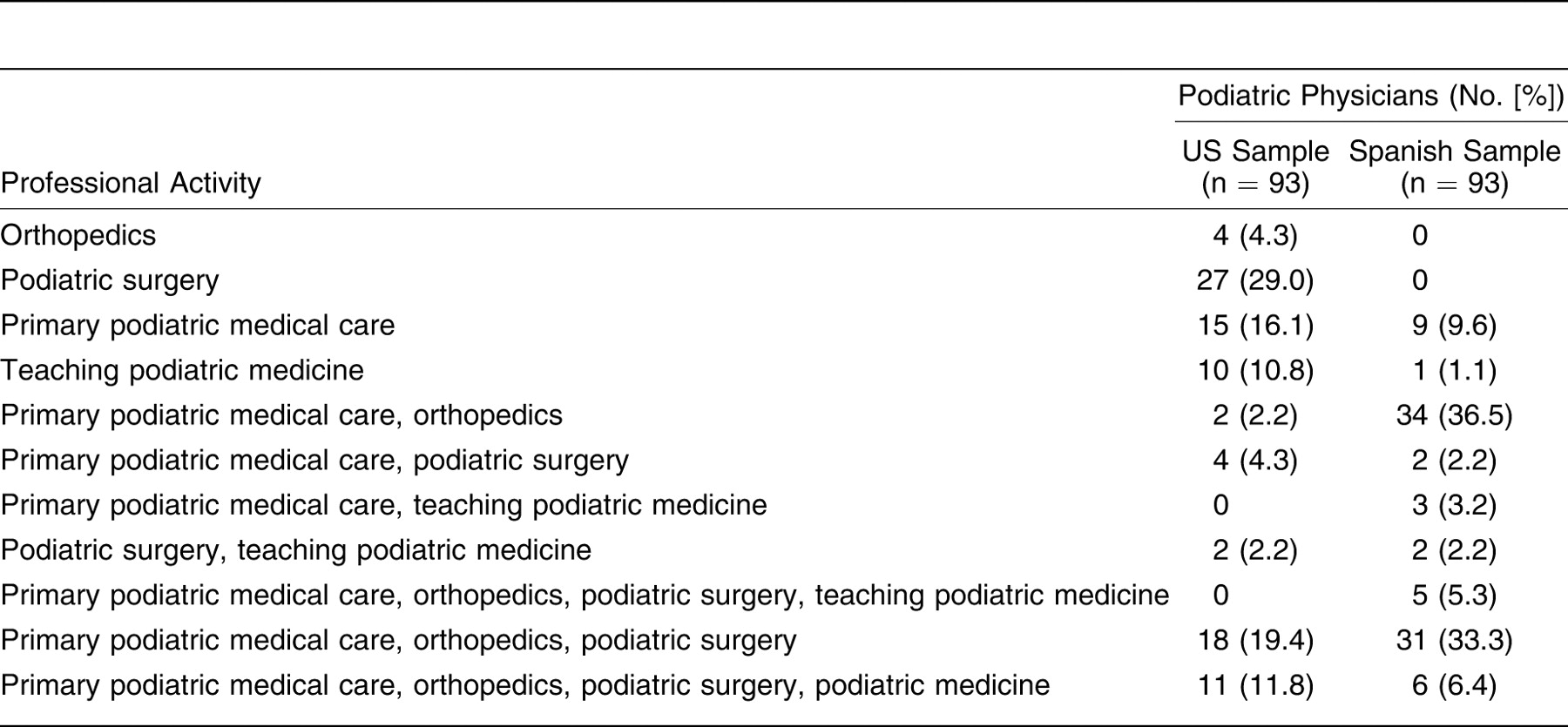
We analyzed the data using a statistical software program (SPSS for Windows version 16.0; SPSS Inc, Chicago, Illinois). Responses are reported as the number (percentage) of podiatric physicians who chose the different response alternatives for the type of professional activity in podiatric medicine (
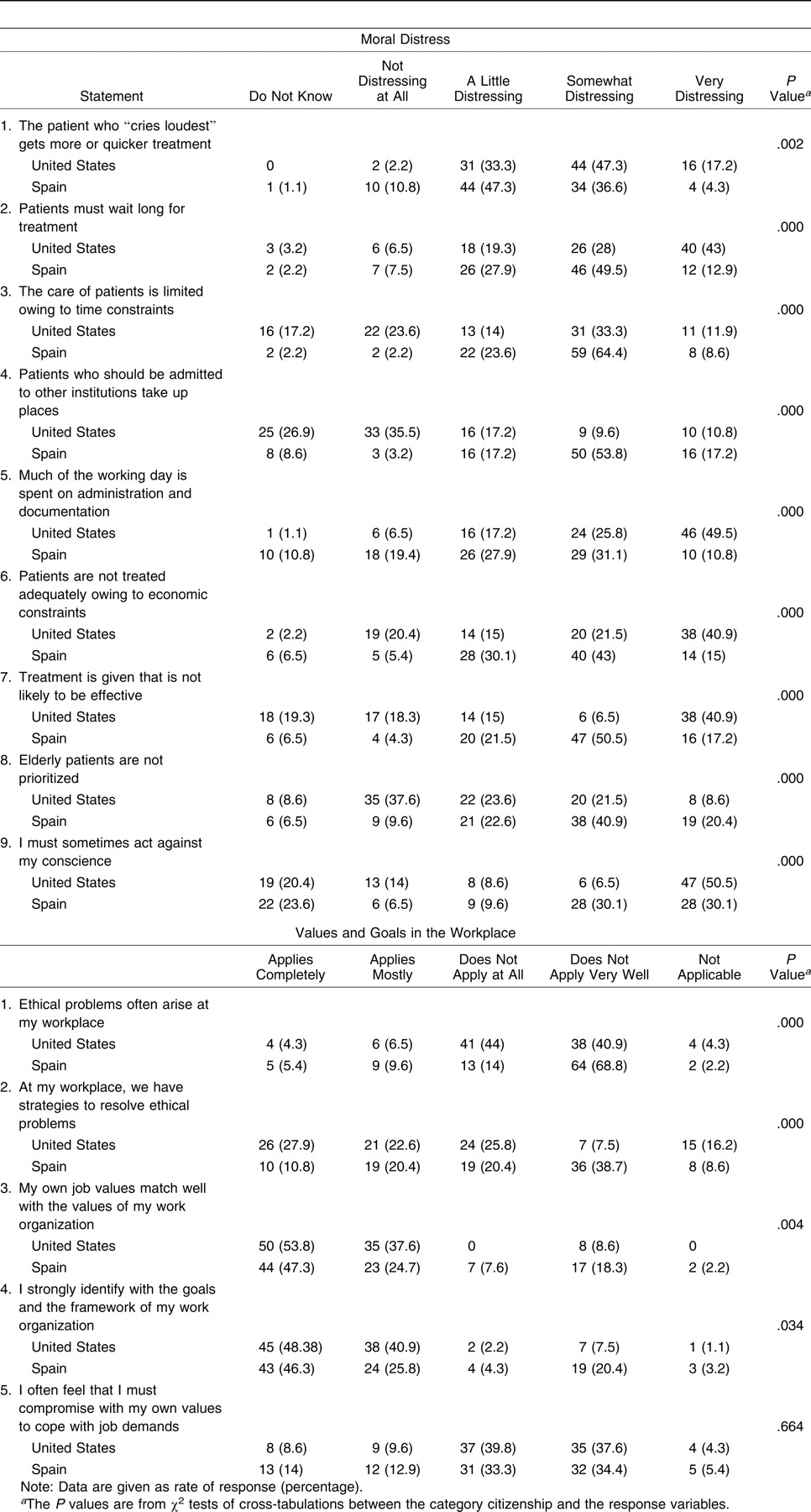
Table 1) and for each of the grouping variables. We cross-tabulated citizenship (United States and Spain) against each of the nine statements on moral distress and the five statements on values and goals, and we used the Pearson χ
2 test to test for statistically significant differences (
Table 2). To facilitate interpretation of these rather extensive cross-tables, we also indicate which cells have the largest differences between observed and expected frequencies under the null hypothesis.
Discussion
To our knowledge, this is one of the first attempts to compare ethical conflicts experienced by US and Spanish podiatric physicians. Previous research has mostly focused on moral distress experienced by nurses and nursing students, especially in critical care and acute care settings. This study did not explore moral distress resulting from traditional ethical dilemmas, such as end-of-life situations, palliative care, or confidentiality and patient informed consent. Instead, we focused on moral distress of quotidian moral problems with patients, decision making, and work organization and compared two groups of podiatric physicians, one in North America (United States) and the other in Europe (Spain).
This study focused on preconditions of moral distress, including external and internal constraints, such as institutional values of the work organization, organizational matters, and how patients are treated and prioritized. Most podiatric physicians reported that their individual job values match well with the values of their work organization. If an organization’s values are similar to those of its employees, higher satisfaction and lower levels of burnout are likely to occur.[
7] Although more than 91% of the US podiatric physicians identified with the goals and the framework of their work organization, they feel distressed, making it clear that moral distress does not occur only as a consequence of institutional constraints preventing the health-care professional from acting on his or her moral considerations, which is the traditional definition of moral distress. Indeed, other organizational characteristics may impact ethical conflicts. For example, one ethical dilemma to be considered in the health-care environment is that patient interests have to be weighed against those of the organization’s resources[
8] and the relation between the care provider’s own conscience and a complex health-care reality. Health-care professionals may be stressed because they are working very long hours, but they are likely to become morally distressed only if they are worried that this impacts negatively on the quality of their care.[
9]
The podiatric physicians in the present study reported stress related to patient demands. This finding is in line with that of the study by Saarni et al[
10] in which approximately 30% of Finnish general practitioners reported ethical and problematic decisions related to patient demand. Concretely, lack of time is one of the main issues reported to cause distress in that physicians find it distressing when their patients have to wait a long time for treatment because they feel that the care of these patients suffers owing to time constraints. Similarly, previous studies[
3,
11] have found that health-care providers experience heavy moral strain due to lack of time to attend to individual patients and other issues.
Prioritization of elderly patients is another cause of distress, particularly in the Spanish sample, because this distress could be related to unsatisfactory services for older patients. This aspect is of interest because podiatric physicians have to attend to many elderly patients. In theory, geriatric health care is a field that has been prioritized in many countries for more than two decades, but, more than ever, a gap between needs and available resources is being experienced. In a recent prioritization study on older patients, doctors and nurses alike saw lack of time as the most emotionally distressing factor.[
12] It is worth noting that one in two doctors finds it morally distressing that stronger patients are prioritized at the expense of weaker patients. Increased health consumerism and strengthened patients’ rights may have expanded this dilemma, and increased emphasis on the principle of patient autonomy may make it harder for doctors to act as gatekeepers.[
13]
Distress related to inadequate treatment and economical constraints was also reported for both samples, although more so for US podiatric physicians. Organizational reforms have been undertaken to make health care more efficient, but lack of resources is still considered one of the main reasons for moral dilemmas. Deception through lack of effectiveness of the treatment administered is another cause of distress frequently reported by podiatric physicians (although more so among Spanish podiatric physicians).
Documentation of medical practice is necessary for transparency, accountability, and quality improvement. When time has to be spent on administration and documentation, less time is left for direct patient care. Strengthened patients’ rights and better accountability and transparency are new demands that may create conflicts and give rise to moral distress. The present samples were very aware of this issue, with 50% of the US sample reporting that they found these issues distressing. Moreover, in the international context, the level of moral distress in this study for both samples is higher than that in other European studies focused on medical doctors.[
14]
The present results show that there are situations when staff members are distressed because they cannot follow their moral decisions and have to abandon their principles, acting only for pragmatic reasons based on expedience, limited resources, and self-preservation; but, in doing so, they compromised their personal integrity and values.[
15] How should health care be organized so that physicians can better cope professionally with conflicting demands and values? How can ordinary rank-and-file health-care professionals acquire time and opportunity to discuss ethical dilemmas, uncertainty, and moral disagreement?[
16] A comparative study[
17] in four European countries found that physicians frequently described ethical dilemmas, but very few had access to assistance for resolving these dilemmas. Today, ethics committees are established in many European countries. However, substantial work remains for these committees to be able to meet the needs of health-care workers, patients, and their relatives. Lack of openness to outsiders and conflict aversion among medical professionals may explain why few ethically problematic cases are deliberated in the ethics committees.[
18] The fundamental challenge for the medical community is to create a culture in which discussion and handling of ethically and emotionally difficult issues is welcomed and encouraged.
The limitations of this study include a moderate response rate in the US sample and, as in previous research on moral distress,[
19] possible selection bias that favors podiatric physicians who had lingering, unresolved moral distress. The way that the statements are posed implies that the situations described may cause distress, which may influence the answers in a positive direction. A thorough investigation of the international literature reveals the existence of many other factors associated with moral distress that were not evaluated in the present study. Therefore, future studies should use variables other than age, sex, and years working in podiatric medicine to measure the impact of moral distress. In addition, the importance of including younger podiatric physicians in strategies for the prevention and management of moral distress should be considered.
In conclusion, this study underlines not only the significance of moral distress among podiatric physicians worldwide, mainly related to time constraints and organizational aspects in relation to patient demands and lack of resources, but also the particularities of this issue in two different countries. Podiatric physicians in the United States and Spain are working daily with moral conflicts that cause distress, and, consequently, health-care organizations must provide better support resources and structures to decrease moral distress. The results point to the need for additional education in ethics in podiatric academic institutions for both countries to recognize and discuss ethically troubling situations in podiatric medical care. Such a strategy would enable new generations of podiatric physicians to better resolve ethical issues that arise in daily clinical practice.