Pigmented villonodular synovitis (PVNS) is a rare benign proliferative growth of the synovium, with an incidence of 1.8 per million persons in the United States.[
1] The most common site is the knee, followed by the hip, ankle, shoulder, and elbow,[
2–
4] and less than 2.5% of cases occur in the ankle.[
5,
6] In 1975, Leszczynski et al[
7] reported the first case of PVNS of the ankle. Clinical findings include swelling around the ankle.[
8–
11] Studies of the radiologic characteristics of ankle PVNS are sparse.[
12–
14] We retrospectively reviewed the radiologic findings in five cases of confirmed ankle PVNS at two hospitals (Affiliated Hospital of Medical College Qingdao University and Beijing Tongren Hospital) to identify the imaging features of these unusual lesions.
Materials and Methods
Between January 1, 2004, and December 31, 2008, five cases of histologically proven PVNS of the ankle were identified from electronic data from the two hospitals after approval from their institutional review boards. The five cases had radiographs and magnetic resonance images (MRIs), and two also had computed tomographic (CT) scans. All of the patients were female, ranging in age from 17 to 66 years. The main symptoms and signs were pain, swelling, and enlarging soft-tissue masses around the ankle with no history of trauma. There was no other medical history of note.
Each case had frontal and lateral radiographs of the ankle. The CT examinations were performed with a 64-row detector Philips spiral CT scanner (Philips Medical System, Eindhoven, Holland) in two patients: axial, sagittal, and coronal images were obtained with bone and soft-tissue algorithm multiplanar reconstruction, a slice thickness of 3 mm, and an intersection gap of 1 mm. The MRI examinations were performed on a 1.5-T GE Twin-Speed Signa scanner (GE Healthcare, Waukesha, WI) in four cases and on a 3-T GE HDx Signa scanner in one case. A quad knee coil was used. Supine patients were examined with the sole of the foot at 90° to the axis of the lower leg. Routine spin-echo T1-weighted images (repetition time, 500–600 msec; echo time, 10–15 msec; number of excitations, 2; and matrix, 320 × 224 pixels) and fat-suppressed fast spin-echo T2-weighted images (repetition time, 3600–4500 msec; echo time, 80–120 msec; number of excitations, 2; and matrix, 320 × 256 pixels) were acquired in the axial, sagittal, and coronal planes. Other parameters included a 3-mm section thickness, a 1-mm intersection gap, and a 16-cm field of view. A T1-weighted sequence after gadolinium contrast administration was acquired in one patient: gadolinium diethylenetriamine pentaacetic acid (0.2 mL/kg) was administered at a rate of 2.0 mL/sec through a 22-gauge intravenous line with a power injector; after injection, axial, sagittal, and coronal T1-weighted images with fat suppression were acquired with the same parameters as the nonenhanced T1-weighted images.
The signal intensity of the MRIs was compared with that of the adjacent muscles. Other imaging findings were also described, including the location, morphological features, extension, and margin of the lesion and bone involvement. After contrast administration, the enhancement was graded as mild, moderate, or marked. All radiographs and scans were retrospectively reviewed by two experienced musculoskeletal radiologists (D.P.H. and W.J.X.).
Discussion
Pigmented villonodular synovitis is a commonly used synonym for what the World Health Organization officially terms
diffuse-type giant cell tumor.[
15] Although Chassaignac[
16] first described the lesion in 1852, the term
pigmented villonodular synovitis was introduced by Jaffe et al[
17] in 1941. The most common locations are the knee and hip joints.[
5,
15] Ankle PVNS is rare. Apart from isolated case reports, there are only five published studies describing fewer than 100 patients,[
6,
8–
11] and we identified only five cases during a 5-year period in two hospitals.
Pigmented villonodular synovitis is an aggressive disease that attacks the synovium. There are many joints in the ankle area, and the superficial muscle layers around the ankle lack integrity. The nature of the pathologic abnormality of the disease and the anatomy of the ankle make PVNS likely to spread to adjacent joint spaces or tendons. Consequently, ankle PVNS is a diffuse disorder involving more than one joint or tendon in the same area.[
9] All five cases in the present study had some extension of the lesion into the adjacent articular space, resulting in lesions in the distal tibiofibular joints in all of the cases and in the subtalar joints in three cases. All of the cases involved the flexor hallux longus tendon.
Figure 1.
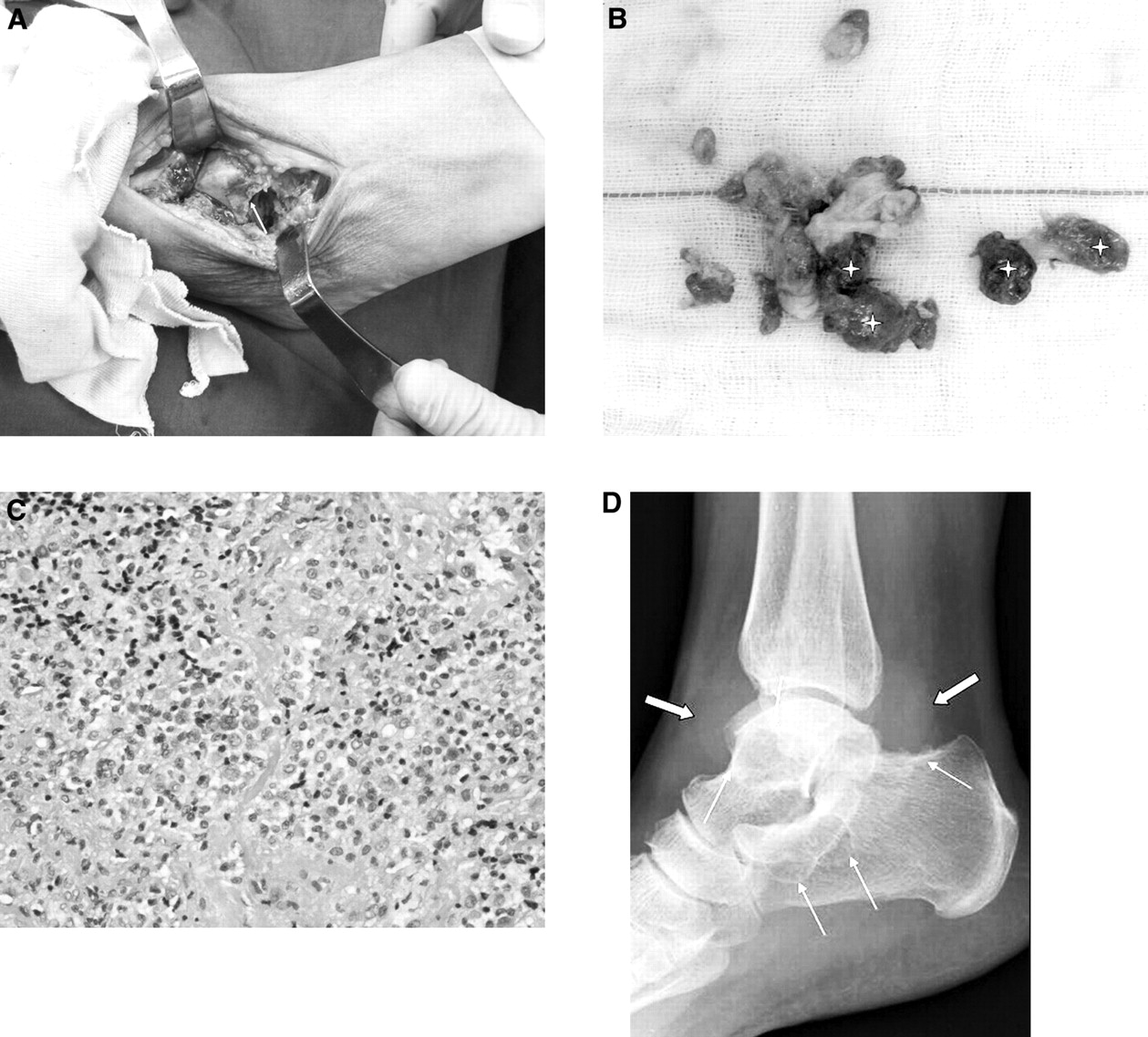
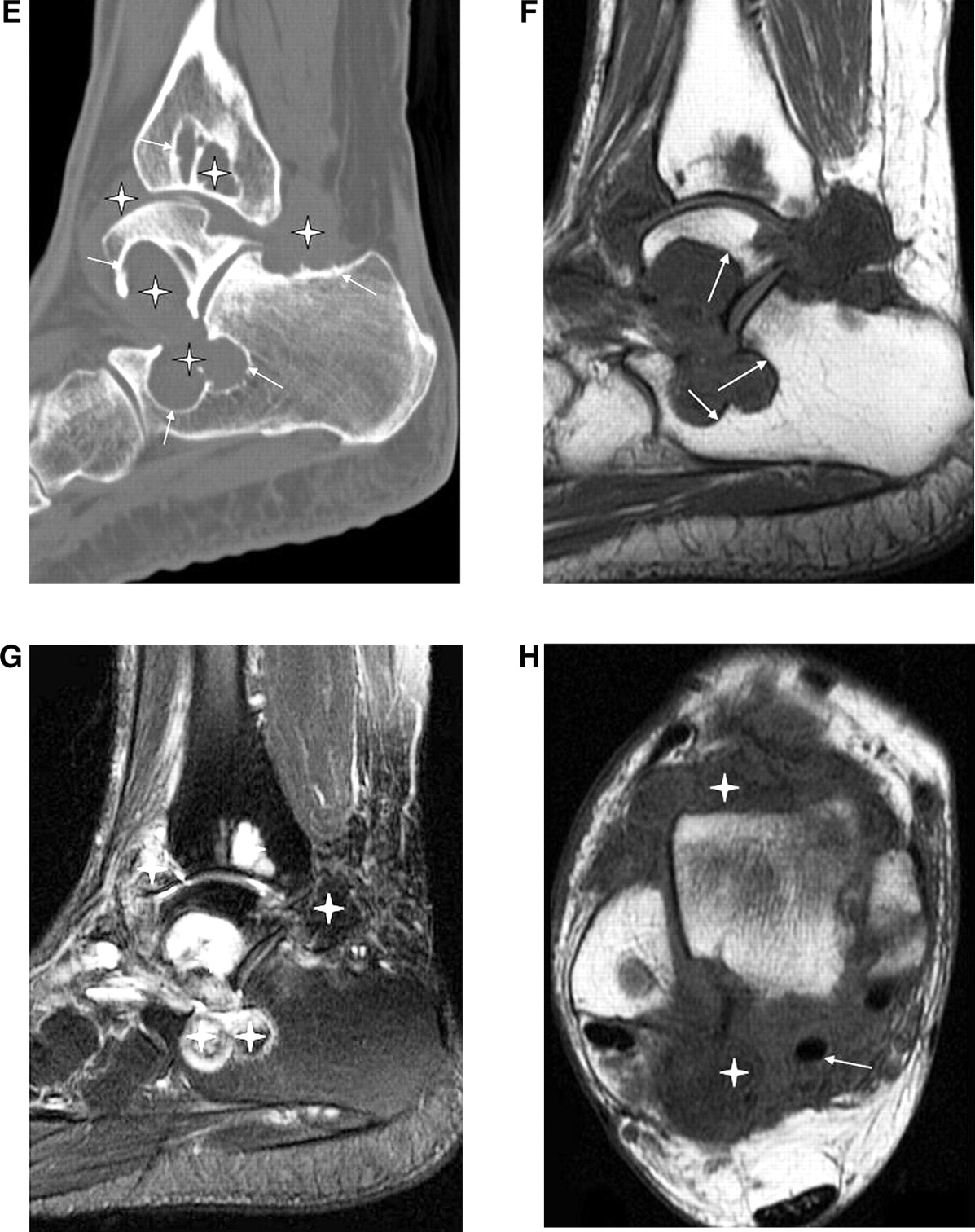
Pigmented villonodular synovitis of the ankle in a 50-year-old woman. A and B, Intraoperative photographs demonstrating extrinsic bone erosion of the subtalar joint (arrow in A) and nodular, brownish, hemosiderin-laden tissue (* in B). C, Photomicrograph showing numerous giant cells, hemosiderin deposits, and foam cells (H&E, ×200). D, Lateral radiograph of the ankle revealing soft-tissue masses (thick arrows) and extrinsic bone erosions with marginal sclerosis (thin arrows); the joint space is relatively preserved. E, Sagittal multiplanar reconstruction of a helical computed tomographic scan (which demonstrates the features much better than does the standard film seen in D) showing multiple soft-tissue masses (*) and bone erosions with marginal sclerosis (arrows). Sagittal T1-weighted (F), fat-suppressed T2-weighted (G), and axial T1-weighted (H) magnetic resonance images revealing soft-tissue masses involving the ankle, distal tibiofibular joint, and subtalar joint. The masses are hypointense on T1-weighted images (* in H) and have a heterogeneous signal on fat-suppressed T2-weighted image (* in G). Hypointense lines are seen between the soft-tissue masses and adjacent bone erosions on T1-weighted images (arrows in F). Soft-tissue masses surround the flexor hallux longus tendon (arrow in H).
Figure 1.
Pigmented villonodular synovitis of the ankle in a 50-year-old woman. A and B, Intraoperative photographs demonstrating extrinsic bone erosion of the subtalar joint (arrow in A) and nodular, brownish, hemosiderin-laden tissue (* in B). C, Photomicrograph showing numerous giant cells, hemosiderin deposits, and foam cells (H&E, ×200). D, Lateral radiograph of the ankle revealing soft-tissue masses (thick arrows) and extrinsic bone erosions with marginal sclerosis (thin arrows); the joint space is relatively preserved. E, Sagittal multiplanar reconstruction of a helical computed tomographic scan (which demonstrates the features much better than does the standard film seen in D) showing multiple soft-tissue masses (*) and bone erosions with marginal sclerosis (arrows). Sagittal T1-weighted (F), fat-suppressed T2-weighted (G), and axial T1-weighted (H) magnetic resonance images revealing soft-tissue masses involving the ankle, distal tibiofibular joint, and subtalar joint. The masses are hypointense on T1-weighted images (* in H) and have a heterogeneous signal on fat-suppressed T2-weighted image (* in G). Hypointense lines are seen between the soft-tissue masses and adjacent bone erosions on T1-weighted images (arrows in F). Soft-tissue masses surround the flexor hallux longus tendon (arrow in H).


The etiology of PVNS is unknown. Probable mechanisms include disturbances in fat metabolism, inflammatory synovial hyperplasia, bleeding into the joint, trauma, and neoplasia.[
1,
8,
10] There was no medical history of trauma or neoplasm in this group, but the small sample size makes it is impossible to draw conclusions about the exact mechanism.
The specimens obtained during attempted total synovectomy were red or brown in all of the cases. The color was probably attributable to pigmentation in the lesions. Grossly, PVNS has diffuse hemosiderin staining. Microscopic findings include a broad sheet of histiocytes with scattered lymphocytes, lipid and hemosiderin-laden foam cells, and multi-nucleated giant cells. The giant cells and foam cells seen in PVNS are not classically seen in other conditions.[
6,
8]
At an early stage, radiographs may appear normal. At an advanced stage, PVNS may cause uncalcified radiodense masses, with press erosions of the bone and marginal sclerosis. The remaining bones appear dense and healthy in texture. The joint space is relatively preserved.[
5,
12,
18] All of the cases in the present group had extrinsic bone erosions with marginal sclerosis in the involved joints on radiography. The mechanism of bone erosion by PVNS is not clear. It has been suggested that multinucleated cells with osteoclastic properties may arise from the synovium in PVNS. The bone erosion may be mediated by matrix metalloproteinases. Increased joint pressure from synovial overgrowth and external compression by the lesion are probably also involved. It seems that chemical and mechanical factors participate in the bone erosion.[
10,
19] The sclerotic margin reflects a slowly progressive disease.
Figure 2.
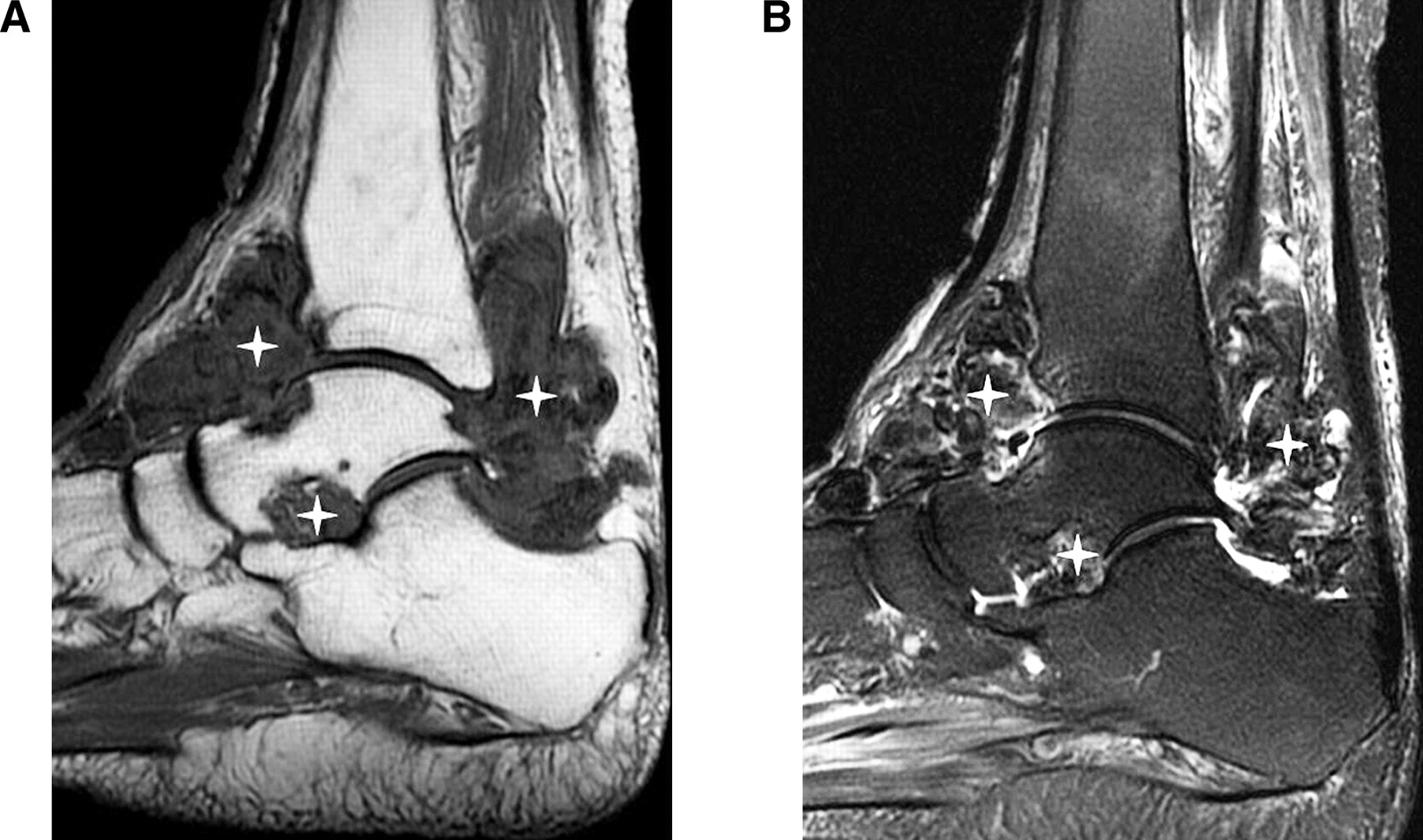
Pigmented villonodular synovitis of the ankle in a 66-year-old woman. Sagittal T1-weighted (A) and fat-suppressed T2-weighted (B) magnetic resonance images revealing soft-tissue masses involving the ankle and subtalar joint. The masses show hypointensity (*) in both images.
Figure 2.
Pigmented villonodular synovitis of the ankle in a 66-year-old woman. Sagittal T1-weighted (A) and fat-suppressed T2-weighted (B) magnetic resonance images revealing soft-tissue masses involving the ankle and subtalar joint. The masses show hypointensity (*) in both images.
Figure 3.
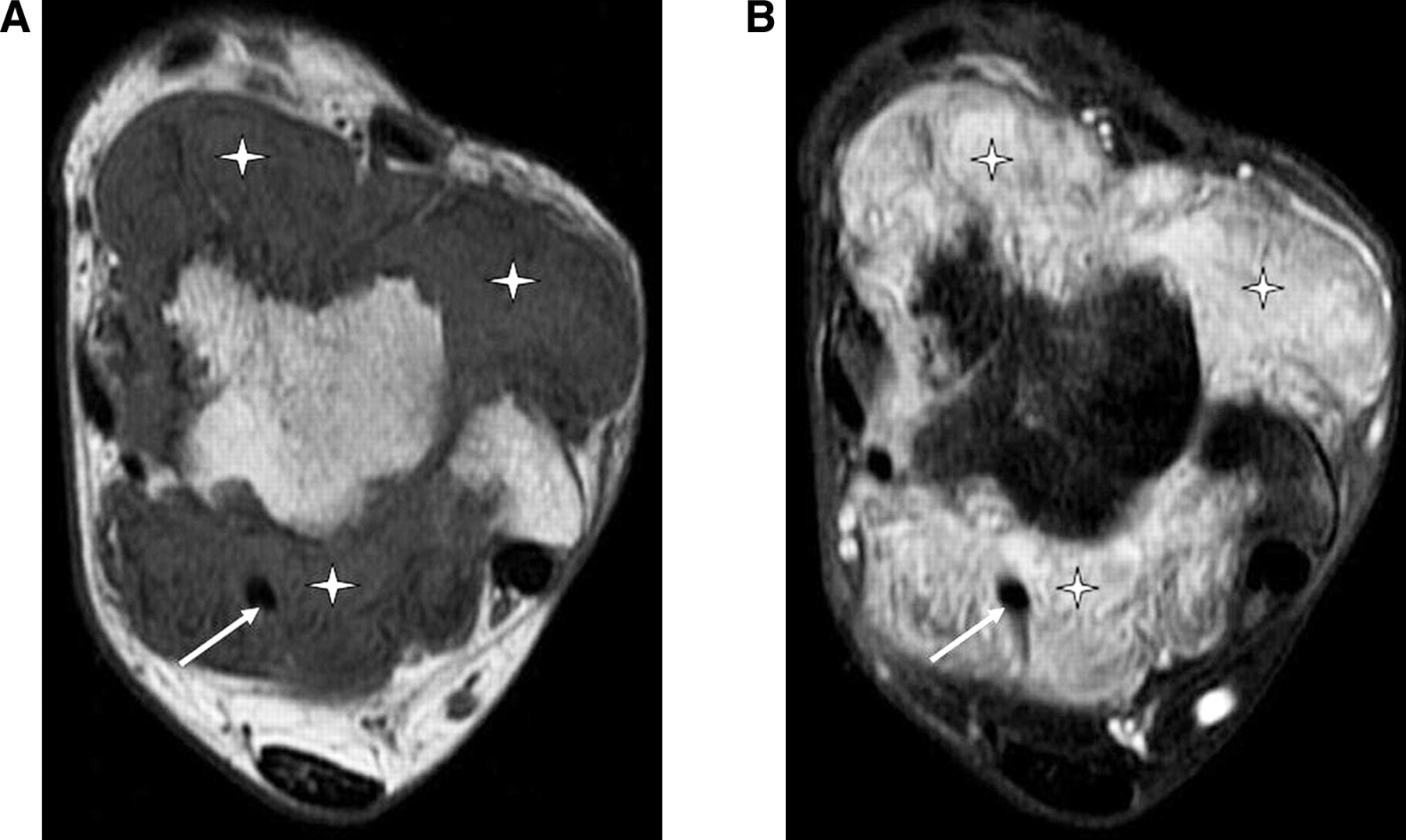
Pigmented villonodular synovitis of the ankle in a 46-year-old woman. Axial T1-weighted precontrast (A) and fat-suppressed T1-weighted postcontrast (B) magnetic resonance images revealing soft-tissue masses surrounding the flexor hallux longus tendon (arrows). The masses were hypointense on T1-weighted precontrast images (* in A) and had intense enhancement on fat-suppressed T1-weighted postcontrast images (* in B).
Figure 3.
Pigmented villonodular synovitis of the ankle in a 46-year-old woman. Axial T1-weighted precontrast (A) and fat-suppressed T1-weighted postcontrast (B) magnetic resonance images revealing soft-tissue masses surrounding the flexor hallux longus tendon (arrows). The masses were hypointense on T1-weighted precontrast images (* in A) and had intense enhancement on fat-suppressed T1-weighted postcontrast images (* in B).
Computed tomography can demonstrate the overlapping structures of the ankle. Although CT is not required to diagnose PVNS of the ankle joint, it reveals areas of bone erosion with marginal sclerosis and multiple lobulated soft-tissue masses. Also, CT can clearly define the extent of the lesion because the lesion has a different density compared with the surrounding muscles, and it is well suited for imaging guidance of diagnostic core needle biopsy.[
20,
21]
However, MRI is the best imaging technique for ankle PVNS. It has superior tissue contrast and is suitable for depicting synovial proliferation, joint effusion, bone erosion, and hemosiderin deposits. Also, MRI provides exquisite anatomical detail. Compared with adjacent muscles, all of the cases in the present group had hypointensity on T1-weighted images. On fat-suppressed T2-weighted images, the lesions exhibited a heterogeneous signal in two cases and homogenous hypointensity in three cases. The hypointensity on all pulse sequences reflects the hemosiderin deposition.[
10,
21] Hemosiderin causes preferential shortening of the T2 relaxation time, especially at higher field strengths. The magnetic susceptibility artifact caused by hemosiderin is particularly pronounced on gradient-echo images, which demonstrate enlargement of the hypointense areas (“blooming”).[
5] The synovial fluid surrounding the lesion may show hyperintensity on fat-suppressed T2-weighted images.[
10] The edges between the soft-tissue masses and adjacent bone erosions are well demarcated by hypointense lines on all pulse sequences. The hypointense line reflects the sclerotic margin of the bone erosion. One patient underwent contrast-enhanced MRI, which demonstrated intense enhancement after contrast injection. The enhancement pattern of ankle PVNS varies considerably depending on the degree of fibrosis and the amount of hemosiderin present.[
21]
Although radiography, CT, and MRI are useful in diagnosing PVNS of the ankle, different imaging methods have different diagnostic values. Radiographs can clearly demonstrate bone erosions but are less able to reveal soft-tissue masses. Computed tomography has advantages over radiography in demonstrating the complex ankle joint but cannot be used to presume the components of the lesions. Magnetic resonance imaging offers multiplanar and multiparameter imaging and can be used to presume the components of the lesions. Therefore, MRI is the most effective means of diagnosing ankle PVNS and is a crucial part of the surgical decision-making process.[
8]
Because of the location, the differential diagnosis of PVNS of the ankle includes other tumors and tumorlike lesions, such as rheumatoid arthritis, synovial osteochondromatosis, synovial sarcoma, hemophilic arthritis, and lipoma arborescens. The changes of rheumatoid arthritis of the ankle include bursitis, rheumatoid nodules, joint space narrowing, marginal erosions, and subchondral erosions with marrow edema. On MRI, bursitis and rheumatoid nodules appear hypointense on T1-weighted images and hyperintense on T2-weighted images. Rheumatoid synovitis manifests typically as peritenonitis of the tendons around the ankle, particularly in the posterior tibialis tendon and the extensor tendons.
Synovial osteochondromatosis is an uncommon benign disorder in which multiple hyaline cartilage nodules form in a joint, tendon sheath, or bursa. Radiographs show multiple similar-sized calcification or ossification bodies in most cases. Cartilaginous hypertrophy produces lobulated hyperintensity on T2-weighted images and septal enhancement on contrast-enhanced MRI. Calcification or ossification bodies appear as signal voids resulting from dense mineralization. Synovial sarcoma is the most common malignant soft-tissue tumor in the foot and ankle. It is not a tumor derived from synovial cells but a mesenchymal spindle cell tumor displaying epithelial differentiation and biphasic morphological features. Synovial sarcoma commonly occurs in deep tissues adjacent to joints. Radiographs may show dystrophic calcification. Magnetic resonance images show that the tumor tends to push on, infiltrate into, and interdigitate with adjacent tissues.
Hemophilic arthritis is a chronic nonspecific synovitis resulting from repeated intra-articular hemorrhage; there are no characteristic MRI findings, but a combination of imaging and laboratory examinations can give the diagnosis. Lipoma arborescens is an uncommon condition of the synovial joints and bursae characterized by hyperplasia of mature fat tissue in the subsynovial layer. The characteristic MRI feature is arborescent or frond-like proliferation of the thickened synovium containing globules or lobules of fat signal intensity.[
13,
22–
25]