The timely and accurate noninvasive evaluation of peripheral arterial disease (PAD) before embarking on interventional therapy, when appropriate, is a critical component of a limb preservation initiative in patients with diabetes mellitus. Noninvasive vascular studies provide crucial information on the presence of PAD, its location and severity, and the physiologic consequences of the disease. Noninvasive vascular studies can also give clinically useful information about the potential for primary healing of a wound or surgical incision and can provide essential information to determine whether and what type of intervention might be most appropriate under given clinical circumstances.
Screening for PAD
Noninvasive vascular assessment can be used for the early detection of atherosclerotic vascular disease in patients with diabetes, thus serving as a guide for medical management. The American Diabetes Association consensus statement on PAD recommended screening of diabetic patients older than 50 years for PAD using ankle-brachial index determinations.[
1] An abnormal ankle-brachial index is an early marker for generalized atherosclerotic vascular disease.[
2] Early detection of atherosclerotic vascular disease is important because studies have demonstrated that early identification of vascular disease and control of risk factors are effective in slowing the progression of cardiovascular disease in patients with diabetes.[
3] Because PAD is part of a systemic atherosclerotic disease process, patients with PAD are at higher perioperative risk for cardiovascular complications. Therefore, preoperative identification of atherosclerosis may modify perioperative management in patients with diabetes undergoing a surgical procedure.[
4]
Physiologic or Hemodynamic Testing
The first step in the noninvasive assessment of PAD is a physical examination that carefully and completely documents pulses, pulsatile masses, bruits, the presence or absence of atrophic skin changes, dependent rubor, pallor on elevation, and the presence of ulcers or skin breakdown. If there is any question of PAD on the physical examination, performance of an ankle-brachial index or referral to the noninvasive vascular laboratory is appropriate, especially if the patient has a wound or if a surgical procedure is being contemplated.[
5]
The ankle-brachial index is most often the initial step in the noninvasive evaluation. It is obtained by comparing the higher brachial systolic pressure with the higher pressure at the ankle (either the dorsal pedal or posterior tibial artery). This can be performed with a handheld Doppler probe and a blood pressure cuff. If there is no hemodynamically significant PAD at rest, the ankle pressure is the same as or slightly higher than the arm pressure, yielding an ankle-brachial index of 1.0 to 1.2. As PAD develops, the ankle pressure decreases and the ankle-brachial index, therefore, decreases. An ankle-brachial index less than 0.6 generally indicates inadequate perfusion to heal a wound on the foot. An ankle-brachial index less than 0.5 is indicative of multilevel disease in 95% of cases.[
6] However, it is possible to have an ankle-brachial index that is higher and still have significant PAD of the foot. An ankle-brachial index less than 0.3 is compatible with severe ischemia, ischemic rest pain, and tissue necrosis (gangrene).[
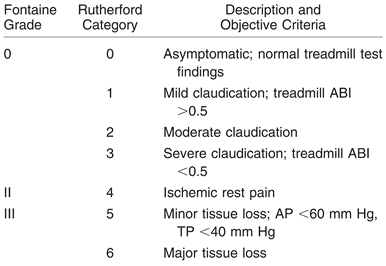
7] The severity of PAD may be categorized based on symptoms and results of resting and postexercise ankle-brachial index measurements (
Table 1). The Doppler signal heard at the ankle can also be characterized as triphasic, biphasic, or monophasic. As PAD progresses, the signal changes from triphasic to biphasic, and with severe PAD to a monophasic signal. These findings can be recorded using corresponding Doppler arterial waveforms. A normal ankle-brachial index in the face of a monophasic Doppler signal or flattened Doppler waveform indicates that the ankle-brachial index is falsely elevated. Falsely elevated or suprasystolic ankle-brachial indexes are relatively common in patients with diabetes because the presence of calcification in the arterial wall (medial calcinosis) makes the artery noncompressible.[
8] Such findings can be deceptive or misleading in that a diabetic patient without palpable pulses and monophasic Doppler signals may have an ankle-brachial index greater than 1.0. Therefore, in patients with diabetes, it is important to evaluate and characterize the arterial waveforms and the absolute pressures and ankle-brachial indexes. The digital vessels are usually spared from calcification; therefore, toe pressures are often more accurate in quantifying PAD in the diabetic patient.
Toe pressures are obtained by placing cuffs around each toe with a digital flow sensor beyond the cuff.[
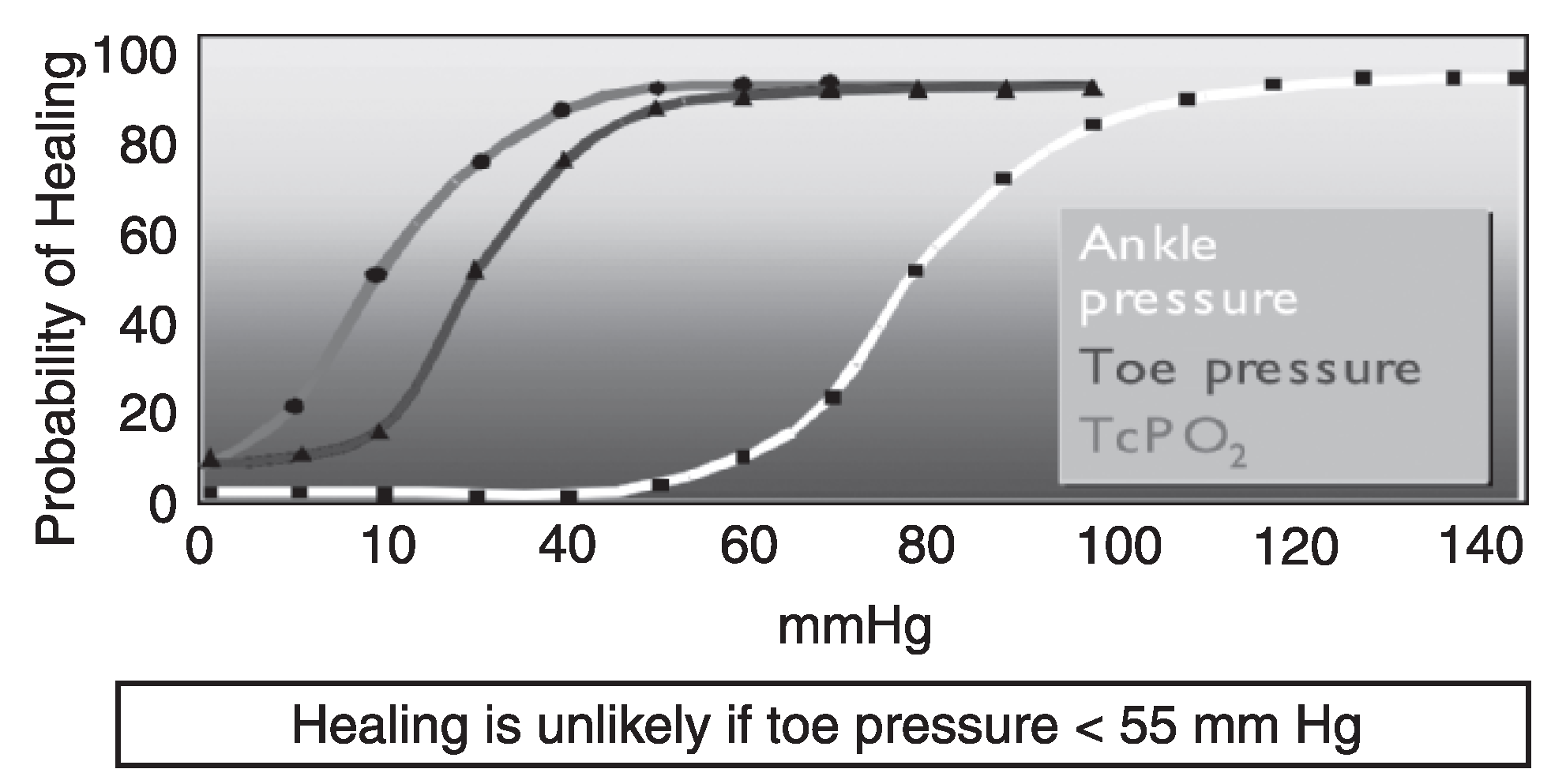
9] A toe to brachial index greater than 0.75 is generally considered normal, whereas a toe to brachial index less than 0.25 is consistent with severe PAD. An absolute systolic toe pressure of 55 mm Hg or greater has been correlated with the ability to heal a foot ulcer in diabetic patients (
Fig. 1).[
10]
Serial ankle-brachial indexes are useful in observing patients with PAD for disease progression. In patients with diabetes, serial ankle-brachial indexes with waveforms or serial toe pressures may be required.
Segmental pressures are used to localize PAD and can be measured by placing blood pressure cuffs at various levels on the leg. Most commonly, either three or four cuffs are used. In the four-cuff test, appropriately sized cuffs are placed at the following levels: high thigh, above the knee, below the knee, and ankle. Pressures are measured at each level. The above-the-knee cuff is omitted in the three-cuff version of the test. A thigh pressure equal to or lower than brachial pressure suggests aortoiliac disease. By looking for pressure gradients between the cuffs, the location of the PAD can be determined. A gradient greater than 20 mm Hg is indicative of significant disease in the intervening segment.[
11]
Another useful noninvasive physiologic test is pulse volume recording. A segmental air plethysmograph is used to assess blood flow at various levels of the limb. For this procedure, fitted blood pressure cuffs are placed on the thigh, on the calf, and over the metatarsal heads of the foot. The waveform created is similar to that derived from an arterial line. In the patient without peripheral vascular disease, there is a prominent dicrotic notch; however, as atherosclerotic occlusive disease develops, the dicrotic notch is lost and the waveform becomes more dampened. The value of this test is that it is not affected by medial wall calcification[
12] and, therefore, is useful in the diabetic population. Segmental limb pressures and toe pressures can also be measured with pulse volume recordings. Such studies have also been used as a screening test for PAD that can be performed in a primary-care setting. There are commercially available systems that can transmit this information from a primary-care setting to a vascular specialist for interpretation.[
13] Pulse volume recording tracings at the foot level have also been used as an indicator of healing potential of foot procedures.[
14]
Stress testing involves the measurement of ankle-brachial indexes at rest and after exercise and can be useful in determining whether exertional pain is vascular in origin, that is, in differentiating vaculogenic from neurogenic claudication. Patients walk on a treadmill at a standard rate and incline until they develop pain. The standard test is to have patients walk on a treadmill at 2 mph up a 10% grade for 5 min or until forced to stop because of leg pain or other restrictions. A healthy individual can generally walk for 5 min with little or no decrease in postexercise ankle pressures. If the pain is vascular in etiology, patients generally cannot walk for 5 min and experience a decline in ankle pressures with exercise. The magnitude of the decrease in ankle pressures reflects the degree of functional disability and correlates with the degree of PAD. Patients with multilevel disease generally experience a more extreme decrease in postexercise ankle pressures. With severe disease, ankle pressures may not be obtainable for several minutes after exercise.[
15] In patients with claudication, stress testing carefully documenting the time of onset of claudication and the degree of decrease in postexercise ankle-brachial indexes can be useful in carefully documenting the degree of claudication for research on interventions and medications.[
15]
Anatomical Imaging and Velocity Detection (Duplex Ultrasound)
Another important tool in the vascular laboratory is duplex ultrasound, a technique that allows direct visualization of the artery. Duplex ultrasound can identify the anatomical site of arterial lesions and evaluate their hemodynamic consequences by measuring the velocity of the blood flow across them. Doppler ultrasound techniques are based on using a Doppler probe that couples an ultrasound transducer and receiver. The reflected ultrasound waves are analyzed for energy loss and frequency shift by the receiver. With the duplex ultrasound machines, the reflected ultrasound waves are processed to produce an image (B-mode image) and a velocity waveform. With the B-mode image, the probe can be placed at any area in the image, and the selected velocity spectra can be recorded. The velocity waveforms are based on the Doppler principle: the ultrasound waveform undergoes a frequency shift proportional to the velocity of a moving object. Velocity waveforms, therefore, provide hemodynamic information on the velocity of red blood cells. Changes in the measured velocity of red blood cells correlate with the degree of stenosis. Unlike purely physiologic testing, duplex ultrasound can differentiate an occlusion from a stenosis and can provide potentially clinically important information regarding lesion length. Duplex ultrasound is accurate in detecting and grading lesions in the aortoiliac region. This noninvasive method provides important clinically useful hemodynamic information in patients with suspected aortoiliac occlusive disease. Aortoiliac duplex ultrasound can accurately diagnose the presence and extent of disease without arteriography. Unlike conventional arteriography (or other pure imaging tests, such as computed tomographic angiography and magnetic resonance angiography), duplex ultrasound also provides important hemodynamic information about the anatomical lesion. Duplex ultrasound can guide selective arteriography and intervention when a lesion has been identified by duplex ultrasound but may not initially be appreciated on anteroposterior arteriography. With the accuracy of duplex ultrasound in the aortoiliac region, arteriography is generally performed only if there is the intent to treat the disease with endovascular therapy or surgical bypass.[
16]
Duplex classification of stenoses in the aortoiliac segment has been reported to correlate well with angiographic results. In one report[
16] evaluating 60 limbs, there was exact agreement in 194 of 211 arterial segments (92%). Three patients with disparity between duplex ultrasound and angiography findings were further investigated with intra-arterial pressure measurements, which demonstrated that these lesions were underestimated by angiography.[
16]
Duplex scanning of infrainguinal vessels has been used in place of arteriography for planning endovascular or surgical infrainguinal interventions.[
17] Duplex scanning of the superficial femoral artery is also used as a screening tool for atherosclerosis and may be a more sensitive indicator of early generalized atherosclerosis than are ankle-brachial index measurements.[
18]
Measurements of Tissue Perfusion
Transcutaneous oxygen tension is a valuable tool used to examine the metabolic state of the target tissue. It is measured by placing probes on the foot and leg using the chest as a reference site. Normal transcutaneous oxygen tension levels are approximately 60 mm Hg. Transcutaneous oxygen tension values can be used to predict the presence of vascular disease, the need for revascularization, and the success of healing major/minor amputations with or without revascularization. Transcutaneous oxygen tension levels of 20 mm Hg or less are indicative of severely reduced blood flow to the area of evaluation and strongly suggest that revascularization will be required to achieve healing (
Fig. 1). Transcutaneous oxygen tension measurements with an oxygen challenge are also used as an indicator of whether hyperbaric therapy will be beneficial.[
19]
Measurement of skin perfusion pressure is another microcirculatory assessment tool that can be used to assess wound-healing potential.[
20] Skin perfusion pressure is the blood pressure required to restore microcirculatory or capillary flow after inducing controlled occlusion and return of flow with a laser Doppler. Skin perfusion pressure has also been used in combination with pulse volume recording tracings as a tool for rapid assessment of PAD.[
21] Systems are available that support measurements of skin perfusion pressure in a primary-care setting or a podiatric surgeon’s office with Web-based transmission to a vascular specialist for interpretation.
Hyperspectral tissue oxygenation measurements have been used to predict healing of diabetic foot ulcers. Although this technology is currently being used mainly as a research tool, it has the capability to identify microvascular abnormalities and tissue oxygenation in the diabetic foot and to predict ulcer healing.[
22]
The diagnosis of PAD and the appropriate use of the noninvasive vascular laboratory in the diabetic patient can be even more challenging because patients with diabetes may have significant PAD and yet be asymptomatic. The lack of symptoms can occur because of either associated neuropathy (loss of the “gift of pain”) or lack of activity.[
23] The first manifestation of PAD may be a nonhealing ulcer or failure to heal a surgical wound. It is, therefore, important to assess patients with diabetes for PAD, even when asymptomatic, especially if a surgical procedure on the foot is being contemplated.
A major factor in the high amputation rates in patients with diabetes and associated PAD is delayed recognition and treatment of PAD or late referral to a vascular surgeon or a limb preservation service.[
24,
25] More liberal use of hemodynamic testing may lead to early recognition of vascular disease and may allow more proactive treatment of the disease at an earlier stage compared with reactive treatment when the patient has a significant wound or infection. Identification of PAD before development of a wound may influence the revascularization required. Patients without wounds or infection with significant vascular disease meeting the criteria for intervention may require only inflow augmentation of perfusion. For example, patients with a combination of aortoiliac occlusive disease and superficial femoral occlusion may require only treatment of the aortoiliac disease if there is only claudication, rest pain, or a small ischemic ulcer. Advanced forefoot ischemia or infection may, on the other hand, require more complex multilevel vascular reconstruction. Another example is patients with combined superficial femoral-popliteal and tibial occlusive disease. Patients without major wounds may require only treatment of the femoral-popliteal level of disease. In contrast, patients with large ulcers or infections usually require in-line flow to the foot to ensure that healing will take place, necessitating what tends to be a more extensive endovascular or open surgical procedure. This concept is important in patients with severe claudication or rest pain from PAD. Careful foot care with appropriate off-loading, when indicated, to minimize or prevent wounds is critical to the short- and long-term success of limb salvage efforts.
The indications for a consultation with a vascular specialist include an ankle-brachial index less than 0.7, systolic toe pressures less than 40 mm Hg, and transcutaneous oxygen tension less than 30 mm Hg. A nonhealing foot ulcer is nearly always an additional indication for a formal vascular evaluation. Regional ischemia in the diabetic foot may be present even with palpable pulses or grossly normal toe pressures; heel ulcers often occur in diabetic patients, especially those with end-stage renal disease, and more detailed evaluation of heel perfusion may be needed. In a patient with diabetes, the absence of palpable pedal pulses is an indication for vascular consultation if elective reconstruction of the foot is being contemplated.[
26]
Hemodynamic monitoring is important after either an endovascular procedure or a surgical bypass. Surveillance studies, usually with a combination of physiologic testing and duplex ultrasound, accurately identify recurrent disease before the occurrence of thrombosis; in selected cases, especially after infrainguinal bypass with autogenous vein, timely repeated intervention based on graft-threatening lesions identified by surveillance will avoid graft thrombosis.
Failure to heal a reconstructive foot procedure may indicate inadequate revascularization or recurrent disease or thrombosis of a previously performed procedure. Failure of an index wound or surgical incision to heal or breakdown of a surgical incision or reconstruction is an indication for repeated noninvasive vascular studies and hemodynamic evaluation.[
27]
Summary
Hemodynamic monitoring is a critical component of a limb preservation initiative. Noninvasive vascular studies can be grouped into three broad categories: 1) physiologic or hemodynamic (ankle-brachial index, toe to brachial index, pulse volume recording, segmental limb pressures, and exercise treadmill testing), 2) anatomical and physiologic (duplex ultrasound), and 3) measurements of tissue perfusion (transcutaneous oxygen tension and skin perfusion pressure).
Physiologic or hemodynamic monitoring can be used for the early detection of disease with ankle-brachial indexes, pulse volume recordings, or duplex scanning of the superficial femoral and popliteal arteries. The presence and anatomical location of disease and, also importantly, its hemodynamic consequences can be determined with a combination of ankle-brachial indexes, segmental pressures, Doppler-derived or pulse volume recording waveforms, and direct duplex ultrasound. Tissue perfusion and healing potential can be assessed with transcutaneous oxygen tension, skin perfusion pressure, or spectral imaging. Noninvasive vascular studies are important in monitoring and reevaluating patients after endovascular or surgical revascularization. Anatomical duplex ultrasound and arteriography are generally reserved for patients believed to be candidates for endovascular or open surgical intervention. Recognition and quantification of the presence and degree of PAD are essential components of an effective limb salvage initiative.