Next Article in Journal
Noninvasive Assessment of Lower-extremity Hemodynamics in Individuals with Diabetes Mellitus
Previous Article in Journal
Medical Therapy of Diabetic Foot Infections
 
 
Journal of the American Podiatric Medical Association is published by MDPI from Volume 116 Issue 1 (2026). Previous articles were published by another publisher in Open Access under a CC-BY (or CC-BY-NC-ND) licence, and they are hosted by MDPI on mdpi.com as a courtesy and upon agreement with American Podiatric Medical Association.
Article

A Stepwise Approach for Surgical Management of Diabetic Foot Infections

by
Timothy K. Fisher
,
Christy L. Scimeca
,
Manish Bharara
,
Joseph L. Mills
and
David G. Armstrong
*
Southern Arizona Limb Salvage Alliance, Department of Surgery, University of Arizona, 1501 N Campbell Ave, Tucson, AZ 85724
*
Author to whom correspondence should be addressed.
J. Am. Podiatr. Med. Assoc. 2010, 100(5), 401-405; https://doi.org/10.7547/1000401
Published: 1 September 2010

Abstract

Diabetic foot disease frequently leads to substantial long-term complications, imposing a huge socioeconomic burden on available resources and health-care systems. Peripheral neuropathy, repetitive trauma, and peripheral vascular disease are common underlying pathways that lead to skin breakdown, often setting the stage for limb-threatening infection. Individuals with diabetes presenting with foot infection warrant optimal surgical management to affect limb salvage and prevent amputation; aggressive short-term and meticulous long-term care plans are required. In addition, the initial surgical intervention or series of interventions must be coupled with appropriate systemic metabolic management as part of an integrated, multidisciplinary team. Such teams typically include multiple medical, surgical, and nursing specialties across a variety of public and private health-care systems. This article presents a stepwise approach to the diagnosis and treatment of diabetic foot infections with emphasis on the appropriate use of surgical interventions and includes the following key elements: incision, wound investigation, debridement, wound irrigation and lavage, and definitive wound closure.

Diabetes is a global problem with significant socioeconomic and health-care implications in developed as well as developing nations. In the United States, 23.6 million people (7.8% of the population) are affected by diabetes and its attendant increased mortality.[1,2]
Diabetes continues to be the single most common underlying factor contributing to lower-extremity amputation in the United States and Europe,[3-6] primarily due to the development of diabetic peripheral neuropathy and the resultant loss of protective sensation in the feet. A simple neuropathic foot ulcer is the major antecedent risk predisposing to diabetic foot infection[7] and precedes 85% of all nontraumatic lower-limb amputations in the United States.[8]
We herein present a stepwise approach to the diagnosis and treatment of diabetic foot infections with emphasis on appropriate and timely surgical intervention. Optimal management often involves a multidisciplinary team that integrates the complementary expertise of different specialties, which may include internal medicine, diabetology, infectious disease, medical microbiology, vascular surgery, podiatric medicine, plastic surgery, emergency medicine, nursing, prosthetics/orthotics, and physical therapy.

A Stepwise Surgical Approach to Management of Diabetic Foot Infections

Determination of the presence and severity of infection is the first step in its treatment. The diabetic foot infection classification system (Infectious Diseases Society of America–International Working Group on the Diabetic Foot) displayed in Table 1 is a simple and clinically useful tool that has been validated by Lavery et al.[9] This system facilitates accurate risk classification and identifies high-risk patients who are prone to adverse outcomes and increased risk of major limb amputation.[9]
Although many diabetic foot infections are considered superficial because they do not extend beneath the superficial fascia,[10] the infection commonly penetrates more deeply into underlying soft tissue and creates a deep-space abscess.[11,12] In such cases, surgical intervention is mandated to evacuate the abscess, remove necrotic tissue, and minimize the risk of further spread. In this section, we discuss the surgical steps, including incision, investigation, debridement, lavage, and considerations for closure.

Incision

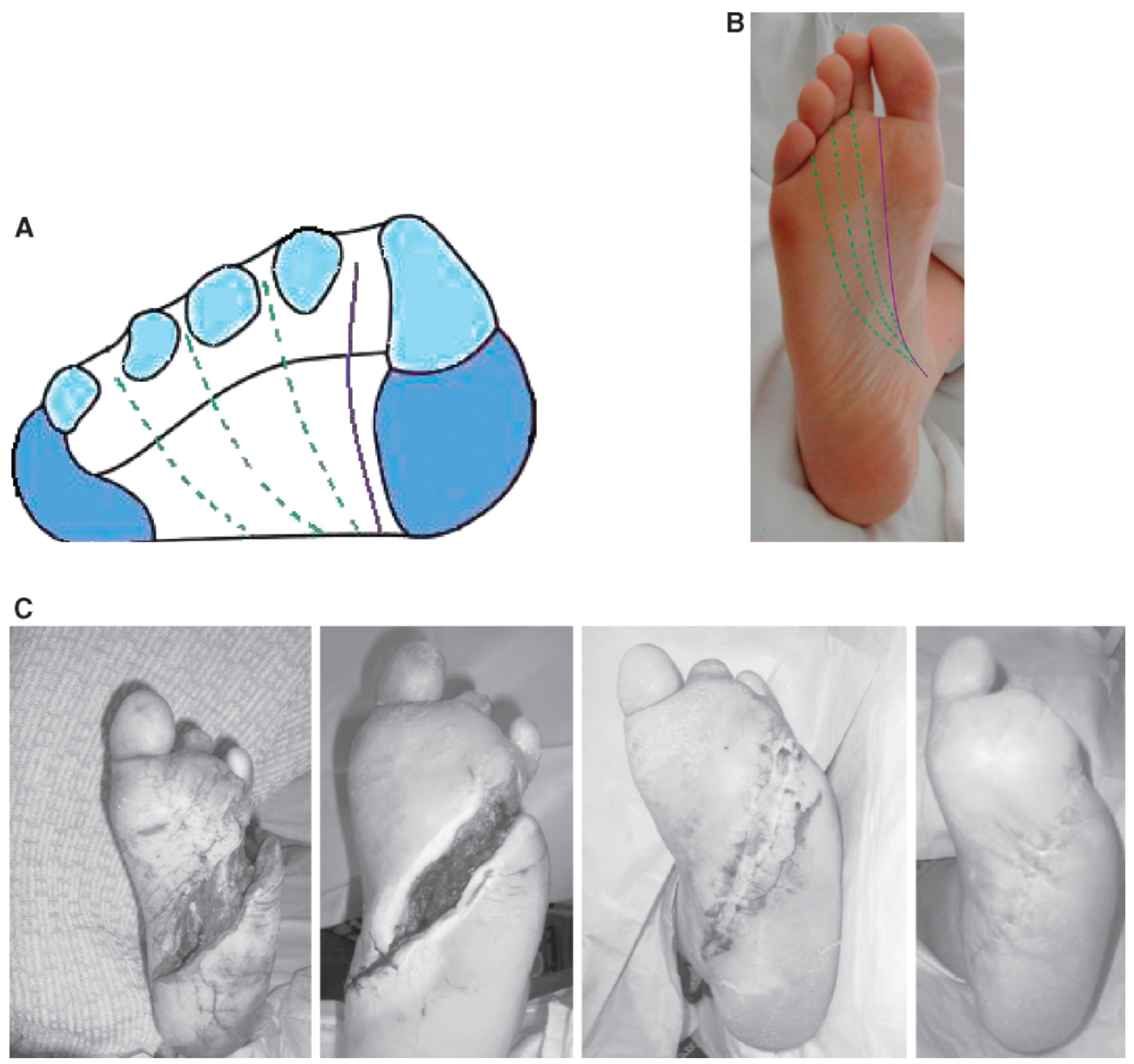
The concept of fascial spaces is of critical importance when performing an incision and draining the foot. All but the simplest infections may require staged procedures; thus, the initial skin incision and dissection should take into account future surgical plans.[13] Grodinsky[14] identified three major plantar spaces: the medial, central (superficial and deep), and lateral spaces. He recommended a medial surgical approach owing to the potential discomfort of a plantar incision.[14] However, Loeffler and Ballard[15] described success with a plantar-based incision for drainage of foot infections. They described it as beginning proximally, posterior to the medial malleolus, and extending distally and laterally toward the midline, ending between the heads of the first and second metatarsals.
The current approach in many diabetic foot units, including our own, reverses the proximal to distal approach as described by Loeffler and Ballard.[15] We prefer a distal to proximal approach in class IV, emergency, diabetic foot infections. The starting point coincides with the distalmost area of infection or ulceration and extends proximally. The incision continues until evidence of infection has been eradicated or until viable, healthy-appearing tissue is observed. This approach eliminates the need for unnecessarily long incisions that could pose future problems, particularly in a patient with vascular insufficiency. As stated previously herein, plans for closure or future reconstruction should always be considered. In any case, the infected space(s) must be drained completely and all grossly necrotic tissue debrided. After the incision, drainage, and debridement of all nonviable and necrotic-appearing tissue, the wound should be thoroughly examined.[10] The presence of further abscess, sinus tracts, or exposed bone should be sought and treated accordingly.
When planning a surgical intervention for deep diabetic foot infections, the Loeffler-Ballard incision uses a single incision approach to diabetic foot infections of the plantar compartment to expose all five central plantar spaces. This incision begins at the distal aspect of the first intermetatarsal space and proceeds, as needed, proximally through the medial longitudinal arch toward the medial malleolus. This approach follows the natural anatomy of the flexor tendons and soft tissues. A suggested modification to this approach involves termination of the incision into each of the interspaces (Fig. 1).

Investigation

Wound evaluation should include the size and extent of soft-tissue involvement and the presence of any foreign bodies, abscesses, or sinus tracts. Surgical exploration should then follow the appropriate tissue planes and enable the surgeon to examine the compartments and open all adjacent areas to remove any possible remaining infection. The surgeon must decide if additional exploration or blunt dissection is needed based on their knowledge of compartmental anatomy and the communications between each of these compartments. Tissue planes should also be investigated either manually or with instrumentation. If tissue planes are easily separated, this may be an indication of potential necrotizing fasciitis in need of debridement.[16]

Debridement

After wound investigation and determination of any tissue planes and foot compartments that are violated, debridement of nonviable tissue and bone should be completed regardless of size and quantity.[17,18] This should commence with the removal of all sloughed, ischemic-appearing (purple) and grossly necrotic (black, gray) tissue. After soft-tissue debridement, exposed tendons should also be removed to reduce the spread of infection along these pathways (that serve as pus highways). We avoid using a tourniquet in this situation because it obscures the identification of viable tissue, potentially leading to overdebridement. Once adequate soft-tissue debridement has been completed, exposed bone is frequently evident. Removal of this exposed bone is recommended to assist the surgeon in planning soft-tissue coverage in the future. Multiple surgical debridements are common in the infected diabetic foot before wound closure, and it has been shown that the adequate removal of all nonviable tissue is associated with quicker healing times and better outcomes.[17,19]

Wound Lavage

Wound cleansing after surgical debridement of infected tissue has been reported as a good complement to systemic antibiotics and seems to be safe in reducing the incidence of continued infection.[10] However, there is no consensus regarding the most effective solution(s) due to the lack of appropriate randomized controlled human studies, and irrigant selection has largely been left to surgeon preference. Results of animal studies[20,21] suggest that the use of saline alone on infected wounds is effective in reducing the bacterial counts compared with untreated controls; saline has also performed favorably compared with povidone-iodine solution and cefazolin solution. Recently, Parcells et al[22] reported a comparative study of irrigation with solutions of normal saline (0.9%), Dakin’s (0.25%), and imipenem (1 mg/mL) in a series of 1,063 appendectomy sites. They found that the use of an antibiotic solution irrigation resulted in a wound infection rate of 0.5% compared with 7.3% and 15.9% when using normal saline and Dakin’s solution, respectively.[22] Although this study may not be directly applicable to diabetic foot wounds with preexisting infections, it does suggest a potential use for irrigation with antibiotic solutions to assist in the complete eradication of infection and allow earlier wound closure.[23] More investigation in this area is necessary.

Closure

Once clinical signs of infection have been eliminated in the infected diabetic foot wound, closure of the wound is usually conducted. However, it is common for heavily contaminated wounds and previous amputation sites to require revision or repeated debridement to a higher level.[10] There are three methods for wound closure: primary, delayed primary, and secondary intention. In primary closure, the wound is closed at the time of the initial surgical intervention. In secondary closure, the wound is left open at the end of the surgical intervention to granulate and contract. Delayed primary closure refers to when the wound is left open at the time of the initial surgical intervention and then closed at a later date, usually once the wound is free of any sign of infection. Such an approach is usually performed in conjunction with wet-to-dry dressings or negative-pressure wound therapy to facilitate granulation before closure and is associated with fewer wound complications than is primary closure.[24,25] In addition, the use of split-thickness skin grafts, local flaps, muscle flaps, pedicle flaps, and musculotendinous flaps are options for achieving proper wound closure. Decisions regarding closure ultimately depend on the volume of viable soft tissue remaining after surgery, the amount of drainage, and the presence of any residual infection.[10]

Conclusions

Diabetic foot wounds complicated by infection all too commonly result in amputations, thereby imposing a major socioeconomic burden on available health-care resources. Accurate identification of the infecting pathogens is the sine qua non in selecting the choice and duration of antimicrobial therapy. Because the standard current microbiologic approach is lengthy and time-consuming, broad-spectrum antibiotics directed against the most likely pathogens are typically administered until tissue culture and sensitivity results are available. This approach has obvious inherent disadvantages, but these are outside the scope of this review and are discussed elsewhere.[26] Improved, advanced diagnostic modalities are now or soon will be available that may further reduce the health-care costs associated with diabetic foot infections.[26]
When considering the surgical intervention itself, especially for moderate and severe infections, a stepwise approach as presented in this article facilitates patient care. In the patient with diabetes and neuropathy, the interdisciplinary team can ideally operate in inpatient and outpatient settings to identify people at risk for amputations. It is generally the combination of infection and ischemia that complicates the wound and results in major limb amputation. Therefore, the combined roles of podiatric medicine and vascular surgery working in tandem, in a coordinated manner, with complementary skill sets, cannot be overstated. We believe that combining podiatric medicine and vascular surgical skill sets in a single, highly integrated service may equal more than the sum of its collective parts.

Financial Disclosure

None reported.

Conflict of Interest

None reported.

References

  1. Centers for Disease Control and Prevention: National Diabetes Fact Sheet 2007, Centers for Disease Control and Prevention Atlanta, GA, 2008.
  2. World Health Organization: Diabetes Fact Sheet, World Health Organization, Geneva, Switzerland, 2009.
  3. Boulton AJ, Vileikyte L: The diabetic foot: the scope of the problem. J Fam Pract49 (suppl): S3, 2000.
  4. Van Houtum WH, Lavery LA: Outcomes associated with diabetes-related amputations in The Netherlands and in the state of California, USA. J Intern Med240: 227, 1996.
  5. van Houtum WH, Lavery LA, Harkless LB: The impact of diabetes-related lower-extremity amputations in The Netherlands. J Diabetes Complications10: 325, 1996.
  6. Lavery L, Ashry HR, van Houtum W, et al: Variation in the incidence and proportion of diabetes-related amputations in minorities. Diabetes Care19: 48, 1996.
  7. Lipsky BA, Berendt AR, Deery HG, et al: Diagnosis and treatment of diabetic foot infections. Clin Infect Dis39: 885, 2004.
  8. Galer BS, Gianas A, Jensen MP: Painful diabetic polyneuropathy: epidemiology, pain description, and quality of life. Diabetes Res Clin Pract47: 123, 2000.
  9. Lavery LA, Armstrong DG, Murdoch DP, et al: Validation of the Infectious Diseases Society of America’s diabetic foot infection classification system. Clin Infect Dis44: 562, 2007.
  10. Armstrong DG, Lipsky BA: Diabetic foot infections: stepwise medical and surgical management. Int Wound J1: 123, 2004.
  11. Boulton AJ, Meneses P, Ennis WJ: Diabetic foot ulcers: a framework for prevention and care. Wound Repair Regen7: 7, 1999.
  12. Eneroth M, Larsson J, Apelqvist J: Deep foot infections in patients with diabetes and foot ulcer: an entity with different characteristics, treatments, and prognosis. J Diabetes Complications13: 254, 1999.
  13. Frykberg RG, Wittmayer B, Zgonis T: Surgical management of diabetic foot infections and osteomyelitis. Clin Podiatr Med Surg24: 469, 2007.
  14. Grodinsky M: A study of the fascial spaces of the foot and their bearing on infections. Surg Gynecol Obstet49: 739, 1929.
  15. Loeffler RD Jr, Ballard A: Plantar fascial spaces of the foot and a proposed surgical approach. Foot Ankle1: 11, 1980.
  16. Childers BJ, Potyondy LD, Nachreiner R, et al: Necrotizing fasciitis: a fourteen-year retrospective study of 163 consecutive patients. Am Surg68: 109, 2002.
  17. Wieman TJ: Principles of management: the diabetic foot. Am J Surg190: 295, 2005.
  18. Attinger CE, Bulan E, Blume PA: Surgical debridement: the key to successful wound healing and reconstruction. Clin Podiatr Med Surg17: 599, 2000.
  19. Steed DL, Donohoe D, Webster MW, et al; Diabetic Ulcer Study Group: Effect of extensive debridement and treatment on the healing of diabetic foot ulcers. J Am Coll Surg183: 61, 1996.
  20. Badia JM, Torres JM, Tur C, et al: Saline wound irrigation reduces the postoperative infection rate in guinea pigs. J Surg Res63: 457, 1996.
  21. Howell JM, Stair TO, Howell AW, et al: The effect of scrubbing and irrigation with normal saline, povidone iodine, and cefazolin on wound bacterial counts in a guinea pig model. Am J Emerg Med11: 134, 1993.
  22. Parcells JP, Mileski JP, Gnagy FT, et al: Using antimicrobial solution for irrigation in appendicitis to lower surgical site infection rates. Am J Surg198: 875, 2009.
  23. Giovinco NA, Bui TD, Fisher T, et al: Wound chemotherapy by the use of negative pressure wound therapy and infusion. Eplasty10: e9, 2010.
  24. Zgonis T, Stapleton JJ, Roukis TS: A stepwise approach to the surgical management of severe diabetic foot infections. Foot Ankle Spec1: 46, 2008.
  25. Fisher DF Jr, Clagett GP, Fry RE, et al: One-stage versus two-stage amputation for wet gangrene of the lower extremity: a randomized study. J Vasc Surg8: 428, 1988.
  26. Fisher TK, Wolcott R, Wolk DM, et al: Diabetic foot infections: a need for innovative assessments. Int J Low Extrem Wounds9: 31, 2010.

Table 1. Diabetic Foot Infection Classification Schemes. 
Japma 100 00401 i001
Figure 1. A, Anatomical drawing depicting the original Loeffler-Ballard description (solid purple line) and the proposed modifications (broken lines). (Adapted from Loeffler and Ballard.[15]) B, The original Loeffler-Ballard incision is depicted by the purple solid line. The modified Loeffler-Ballard incisions are depicted by the green broken lines. C, The modified incision during a 9-week period after postoperative care, including negative-pressure wound therapy and bioengineered tissue.
Japma 100 00401 g001