Pain is God’s greatest gift to mankind.
Paul Brand, MD
It was Dr. Paul Brand working with patients with Hansen’s disease in South India who recognized that it was the loss of peripheral sensation in the limbs of those patients with leprosy that resulted in the terrible scarring and ulceration that occurred in these individuals. Pain is indeed a gift, but the gift of pain is recognized only when it is lost because it is the protective sensation that prevents us from further damaging areas of injury. Similar to patients with Hansen’s disease, patients with sensory loss secondary to diabetes that predominates in the lower limb frequently develop ulcers and even more serious conditions, such as Charcot’s neuroarthropathy, because they have lost this gift of pain. A reduction in neuropathic foot problems will be achieved only if we remember that those with insensitive feet have lost this warning signal of pain that ordinarily brings them to their physicians.
The identification and care of a patient with no pain sensation is a new challenge for which most of us have little, if any, training. It is difficult for us to understand, for example, that an intelligent patient would buy and wear a pair of shoes several sizes too small and come to our clinic with an extensive shoe-induced ulcer. The explanation, however, is simple: with reduced sensation, a very tight fit stimulates the remaining pressure nerve endings, which is interpreted by that individual as a normal fit; hence, the common complaint when we provide patients with custom-designed shoes is, “These shoes are too loose.” We can learn much about the management of patients with diabetic neuropathy from the treatment of patients with Hansen’s disease [
1]. If we are to succeed, we must realize that with loss of pain there is also diminished motivation in the healing and prevention of injury.
Because the lifetime incidence of foot ulceration in diabetic patients has been estimated to be as high as 25% [
2], understanding the pathways that result in the development of an ulcer is increasingly important. The Scottish poet Thomas Campbell wrote, “Coming events cast their shadows before.” These words can usefully be applied to the breakdown of the diabetic foot because ulceration does not spontaneously occur but is a combination of causative factors that results in the development of a lesion. Thus, there are many warning signs or “shadows” that can identify those at risk. Other articles in this issue cover the important area of peripheral vascular disease in the causation of lower-extremity problems, and in this review, I focus on the most common of the diabetic neuropathies, chronic sensorimotor neuropathy, which is a major contributory factor in the pathway to ulceration in diabetes. In the final section of this article I discuss simple methods to screen for the high-risk patient with foot ulcer that are based on the recently published Comprehensive Diabetic Foot Examination by a task force of the American Diabetes Association [
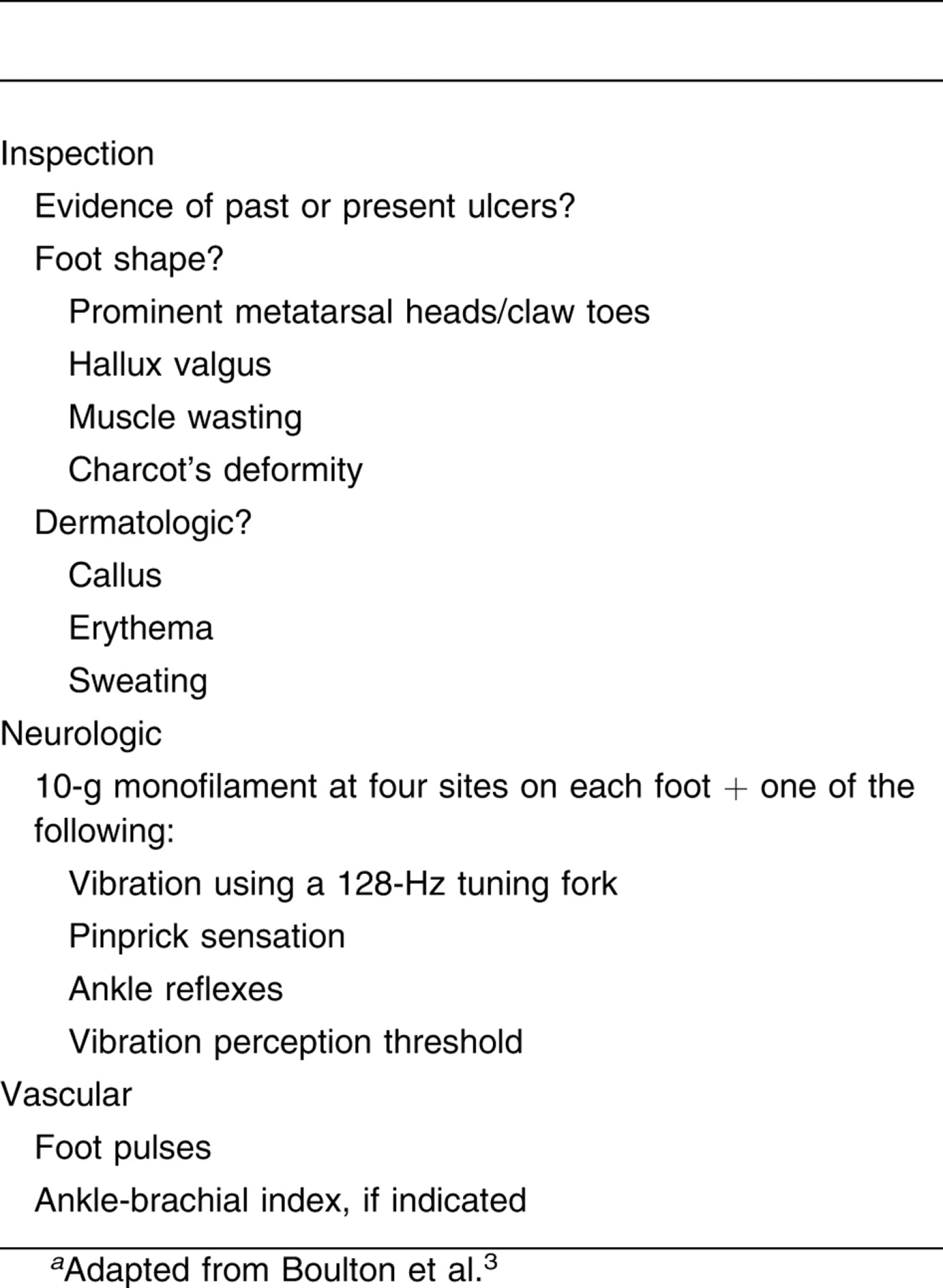
3].
Chronic Sensorimotor Diabetic Peripheral Neuropathy
Of all of the neuropathies of diabetes, the chronic sensorimotor variety, diabetic peripheral neuropathy, is by far the most common. Indeed, it has been estimated that up to 50% of older type 2 diabetic patients may have evidence of sensory loss on clinical examination and, therefore, must be considered at risk for insensitive foot injury [
4]. In the large United Kingdom Prospective Diabetes Study [
4], 13% of patients at diagnosis of type 2 diabetes were found to have sensory loss of sufficient severity to put them at risk for insensitive foot lesions: this provides a clear message, and that is people with any duration of type 2 diabetes might be at significant risk for foot problems.
Diabetic peripheral neuropathy commonly results in sensory loss confirmed on examination by a deficit in the stocking distribution to all sensory modalities: evidence of motor dysfunction in the form of small muscle wasting is also often present. Whereas some patients might give a history (past or present) of typical neuropathic symptoms, such as burning pain, stabbing discomfort, and paresthesia with nocturnal exacerbation, others might develop sensory loss without ever having any such history. Some patients might have the “painful-painless” leg with spontaneous discomfort secondary to neuropathic symptoms but on examination have small and large fiber sensory deficits. Such patients are also at great risk for painless injury to their feet.
From these points it should be clear that a spectrum of symptomatic severity may be present, with some patients experiencing severe pain and, at the other end of the spectrum, others who have no spontaneous symptoms, but both groups may have significant sensory loss on clinical examination. The most challenging patients are, indeed, those who develop sensory loss with no history of symptoms because it is often difficult to convince them that they are at risk for foot ulceration because they feel no discomfort, and motivation to perform regular foot self-care is difficult. The key message is that neuropathic symptoms correlate poorly with sensory loss, and their absence must never be equated with lack of foot ulcer risk. Thus, in the assessment of foot ulcer risk, a careful foot examination after removal of shoes and socks must always be included whatever the symptom history [
4], hence the clinical observation by Dr. Paul Brand that any patient who walks into the clinic with a foot ulcer but without a limp must have neuropathy because those with normal pain sensation would not be able to put weight on the lesion.
Most patients with significant risk of foot ulceration due to sensory loss also have peripheral autonomic dysfunction affecting the sympathetic nervous system. This results in reduced sweating and, in the absence of large vessel obstructive vascular disease, increased blood flow to the foot with arteriovenous shunting leading to the warm, but insensate foot.
Other Risk Factors
The neuropathic insensate foot does not ulcerate spontaneously: it is a combination of factors that ultimately results in breakdown and ulceration. Factors that increase the risk of foot ulceration are listed in
Table 1. The highest-risk populations are those with a history of ulceration or even amputation. Several studies have shown that other late complications of diabetes include nephropathy (particularly in those undergoing dialysis or after transplantation) and retinopathy (particularly if there is visual loss). There seems to be a temporal relationship between starting dialysis and risk of foot ulcers [
5].
Table 1.
Factors That Increase the Risk of Diabetic Foot Ulceration.
Table 1.
Factors That Increase the Risk of Diabetic Foot Ulceration.
Other important contributory factors to ulcers include the presence of callus or hard skin under weightbearing areas (this occurs as a consequence of pressure plus dry skin due to autonomic neuropathy) and foot deformity. A combination of motor neuropathy, limited joint mobility, and altered gait patterns are thought to result in the “high-risk” neuropathic foot with clawing of the toes, prominent metatarsal heads, a high arch, and small muscle wasting.
Pathway to Ulceration
It is the combination of two or more risk factors that ultimately results in breakdown of the diabetic foot. In a study of instant foot ulcers, Reiber et al. [
6] showed that the most common triad of component causes resulting in ulceration is neuropathy (loss of pain sensation), foot deformity, and trauma. Other important component causes in the pathway to ulceration include edema and ischemia.