Hallux abducto valgus deformity remains one of the most common and yet challenging pathologic conditions that we face daily in our profession. Genetic and biomechanical factors have been described as contributing to the development of hallux abducto valgus. The deformity is progressive and may become symptomatic even in its milder stages. Patient-specific factors, such as job requirements, shoe style choices, and activity level, also play a role in the level of symptoms the patient may experience. Symptoms include pain and inflammation about the first metatarsophalangeal joint, with the hallux deviating laterally. The hallux abductus angle increases as the hallux deviates further laterally toward the second digit. As the hallux position becomes more irregular, the cartilage of the first metatarsophalangeal joint can degenerate, resulting in progressive osteoarthritis and limited dorsiflexion. The hallux also plantarflexes and impinges on the second digit as it is pulled by the adductor hallucis tendon, resulting in partial or complete dislocation of the second metatarsophalangeal joint.
Conservative care, such as cushion padding, strapping, custom functional orthotic devices (to control pronation), and footwear modifications, may offer symptom relief to patients and help control biomechanical pathologic abnormalities. However, the more significant the intermetatarsal angle, the less likely these modalities are to be of benefit.[
1] These patients often require definitive surgical intervention to correct the relative or actual intermetatarsal angle. Typically, closing base wedge osteotomies or Lapidus arthrodesis procedures are used for significant angle correction. Although these procedures offer substantial correction, they demand experience and skill and have an involved postoperative course with several key potential complications. The Lapidus, for example, allows for the most angular correction and stability of the first ray, but it also requires a strict 6 to 8 weeks of nonweightbearing, usually in a below-the-knee cast.[
2] Potential complications include elevation or shortening of the first ray, delayed union or nonunion, cast complications, screw breakage or failure if weight is applied too soon, and malalignment.[
3]
Patients with a severe hallux abducto valgus deformity who cannot tolerate the postoperative course of more aggressive procedures are left with few options. One may elect to manage the problem conservatively, with accommodative orthotic devices and custom shoes, or with less aggressive procedures such as a distal osteotomy or a Keller arthroplasty. These procedures offer only limited angular correction, however, and patients may continue to have painful symptoms and may face the possibility of recurrence. The Mini TightRope (Arthrex Inc, Naples, Florida) may offer a possible alternative to these caveats. I used this system to substantially reduce a markedly increased intermetatarsal angle in a high-risk patient while allowing immediate postoperative weightbearing in a surgical shoe.
Case Report
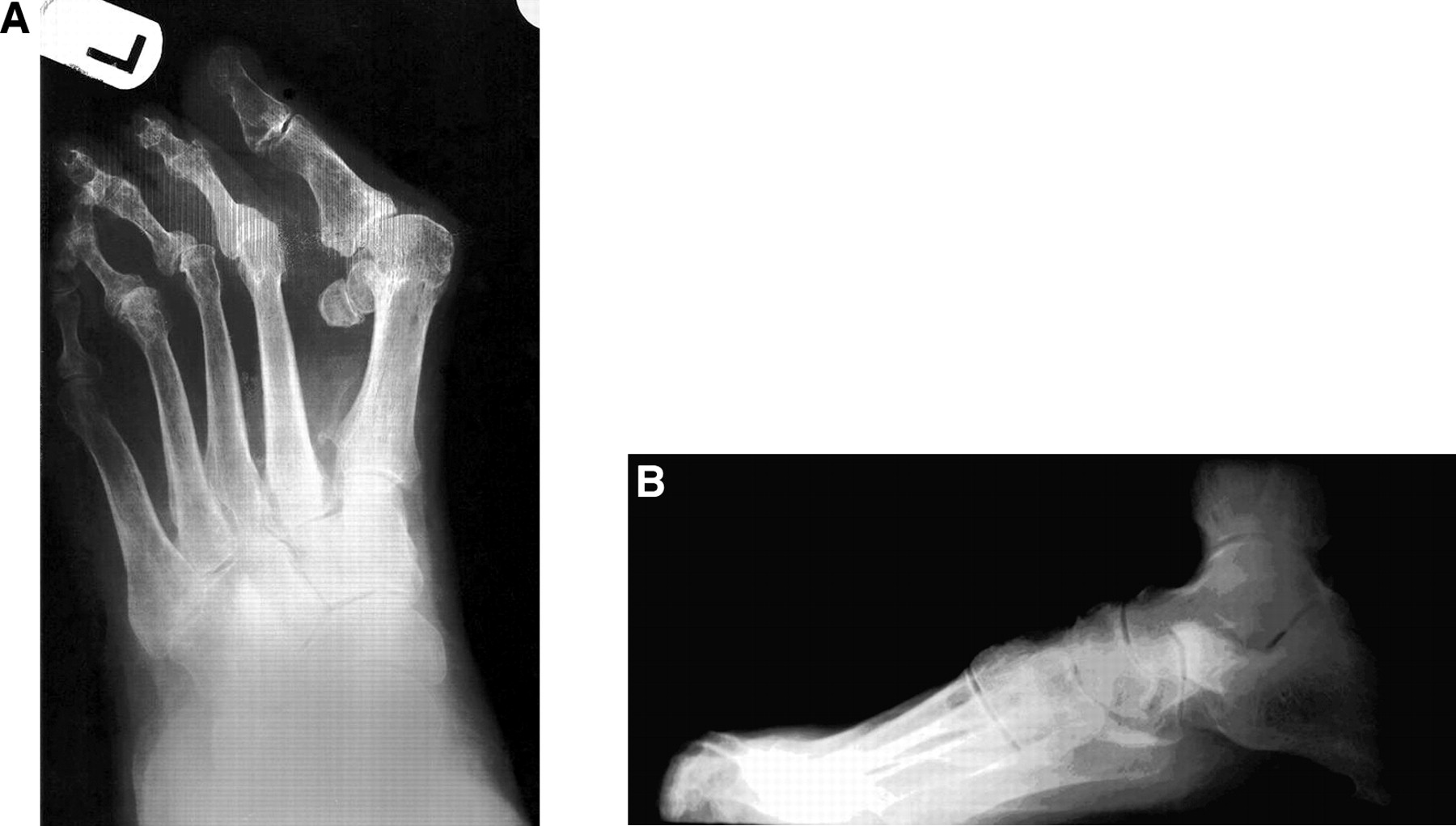
A 68-year-old diabetic woman presented with a painful bunion deformity and joint stiffness that had worsened in the previous several years (
Fig. 1). She had attempted numerous diabetic shoe adjustments, padding, orthotic therapy, local injections, and nonsteroidal anti-inflammatory drugs with minimal benefit. She stated that the deformity was decreasing her quality of life and limiting her ability to walk and to wear shoes comfortably. Her medical history was positive for well-controlled type 2 diabetes and two distinct episodes of deep venous thrombosis, both occurring after surgical procedures while the patient was immobilized in a below-the-knee cast.
Figure 1.
A, Anteroposterior preoperative radiograph demonstrates a complex hallux abducto valgus deformity with marked osteoarthritis at the first metatarsophalangeal joint. B, Lateral preoperative radiograph shows modest first metatarsal elevatus. Contracture of the hallux is present but asymptomatic.
Figure 1.
A, Anteroposterior preoperative radiograph demonstrates a complex hallux abducto valgus deformity with marked osteoarthritis at the first metatarsophalangeal joint. B, Lateral preoperative radiograph shows modest first metatarsal elevatus. Contracture of the hallux is present but asymptomatic.
After several discussions with her primary-care physician, the patient was cleared for surgery provided that she could bear weight immediately. It was decided that the greatest risk of repeated deep venous thrombosis for this specific patient would be from cast immobilization and that the risk of tourniquet and surgery trauma could be managed with early weightbearing and enoxaparin (Lovenox; sanofi-aventis, Bridgewater, New Jersey) therapy.
The surgical options were to perform a Keller with implant arthroplasty, a distal osteotomy (such as an Austin), or a somewhat experimental procedure using the Mini TightRope system to reduce a significant intermetatarsal angle and yet allow the patient to immediately bear weight postoperatively. The patient was informed of all of the available options and their potential complications, and she elected the TightRope procedure.
This procedure is similar to a routine bunionectomy except that a separate dorsal linear incision is made over the mid-diaphyseal portion of the second metatarsal. After dissection, a 0.045 Kirschner wire is inserted proximal to the surgical neck of the second metatarsal and is carried through the lateral and medial cortices of the second and then the first metatarsals. Care must be taken to avoid the surgical neck and to ensure a central position through the metatarsal to avoid a stress fracture. Once the Kirschner wire is properly placed, the drill is engaged along its path. The surgeon then introduces the Mini TightRope through the drill holes and manually reduces the intermetatarsal angle to the desired correction while engaging the pulley system. The apparatus consists of FiberWire (Arthrex Inc) laced in a pulley design between two titanium buttons, one round and one oblong. I have found it more efficient to remove the large insertion needle that comes attached to the device and to use a Micro Suture Lasso (Arthrex Inc) instead when actually inserting the apparatus through the corresponding metatarsals. A C-arm is used to confirm correction and placement, and it may be adjusted as necessary before closing. An Integra K2 hemi-joint implant (Integra, Plainsboro, New Jersey) is inserted to address the marked hallux limitus.
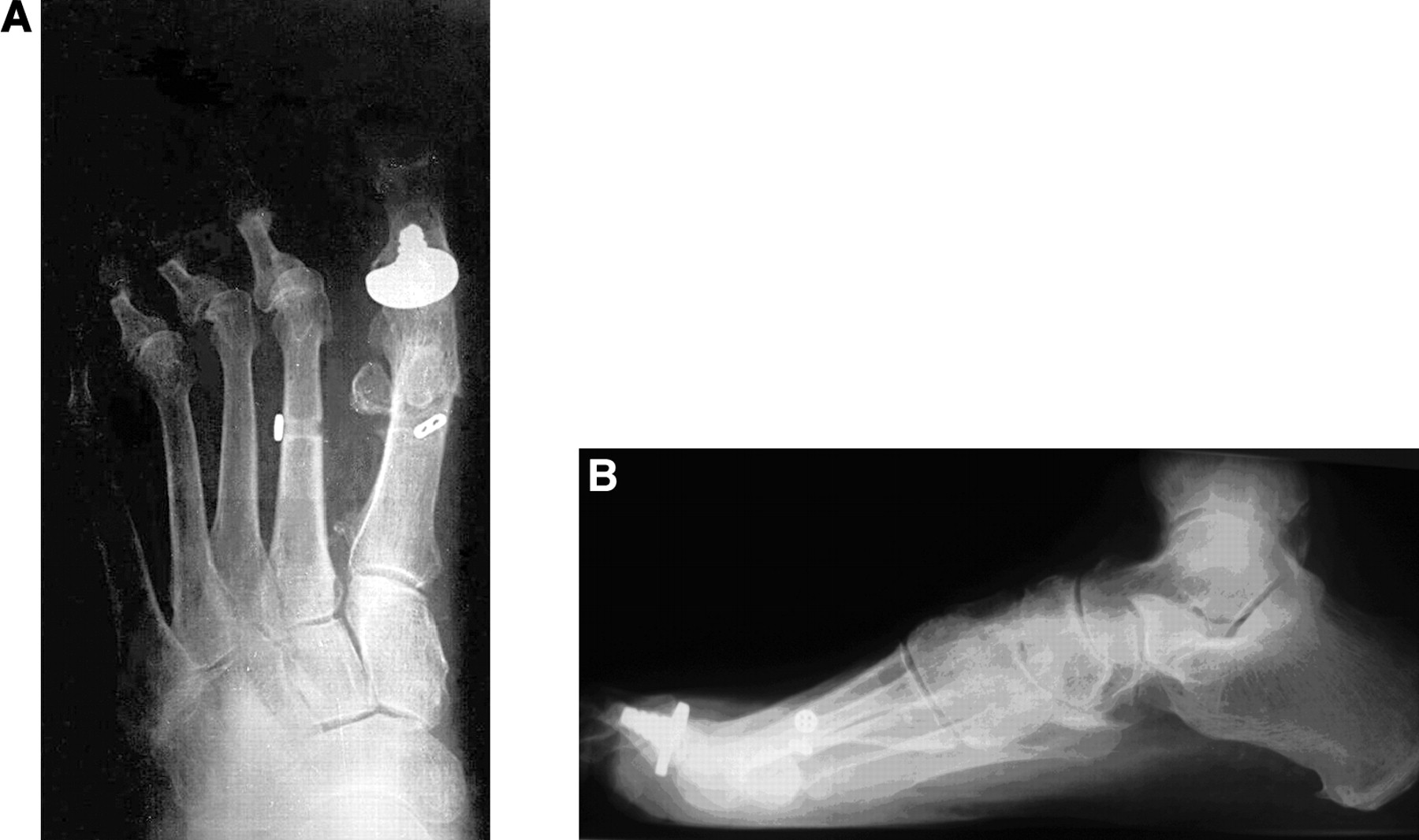
The patient was permitted to bear weight immediately after surgery with a compression dressing and a surgical shoe. Passive range-of-motion exercises were initiated after the first week and were continued until week 6. The patient was maintained in a surgical shoe for approximately 5 weeks, at which time she was returned to normal supportive shoes. Postoperative radiographs were obtained at 6 weeks, and the patient was allowed to return to all of her normal activities as tolerated (
Fig. 2). A standard bunion splint was used for 60 days beginning the third postoperative week. For deep venous thrombosis prophylaxis, her primary-care physician recommended the administration of enoxaparin, 40 mg, for 5 days beginning immediately after surgery. The patient was discharged after 3 months but returned for 1-year and 18-month follow-up visits (
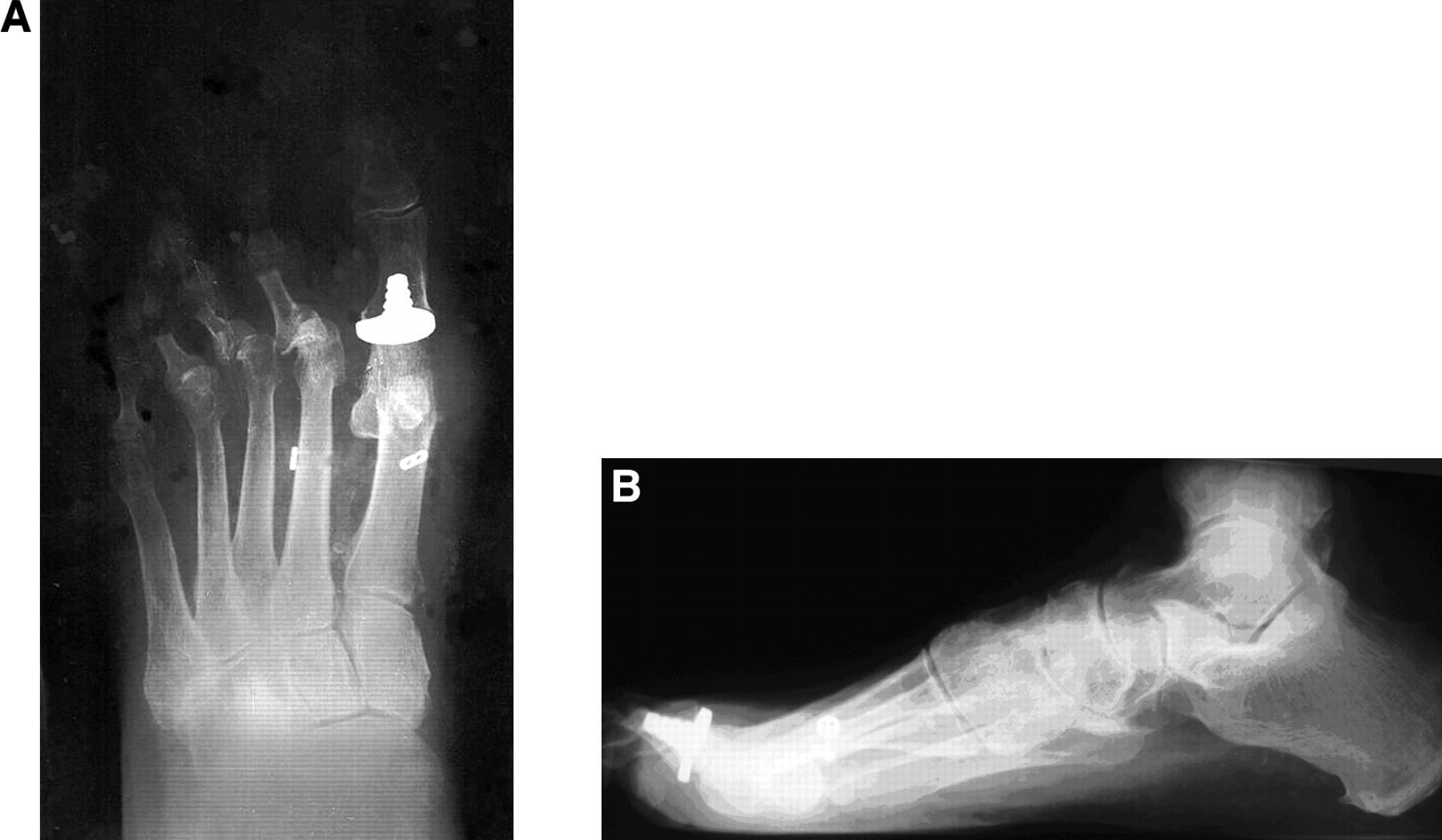
Fig. 3).
Figure 2.
A, A 6-week postoperative anteroposterior radiograph reveals 16.5° of intermetatarsal angle correction and 40° of hallux abductus angle correction. The Integra K2 hemi-joint implant is noted at the proximal phalanx base. The Mini TightRope system is in position about the first and second metatarsals. B, Lateral view shows no change in first metatarsal elevatus and placement of the Mini TightRope.
Figure 2.
A, A 6-week postoperative anteroposterior radiograph reveals 16.5° of intermetatarsal angle correction and 40° of hallux abductus angle correction. The Integra K2 hemi-joint implant is noted at the proximal phalanx base. The Mini TightRope system is in position about the first and second metatarsals. B, Lateral view shows no change in first metatarsal elevatus and placement of the Mini TightRope.
Figure 3.
A, An 18-month postoperative anteroposterior radiograph demonstrates 3° of increase to the intermetatarsal angle compared with 6 weeks after surgery. The hallux abductus angle has a 0.5° increase from 6 weeks postoperatively. B, Lateral view shows no change in first metatarsal elevatus or in placement of the Mini TightRope.
Figure 3.
A, An 18-month postoperative anteroposterior radiograph demonstrates 3° of increase to the intermetatarsal angle compared with 6 weeks after surgery. The hallux abductus angle has a 0.5° increase from 6 weeks postoperatively. B, Lateral view shows no change in first metatarsal elevatus or in placement of the Mini TightRope.
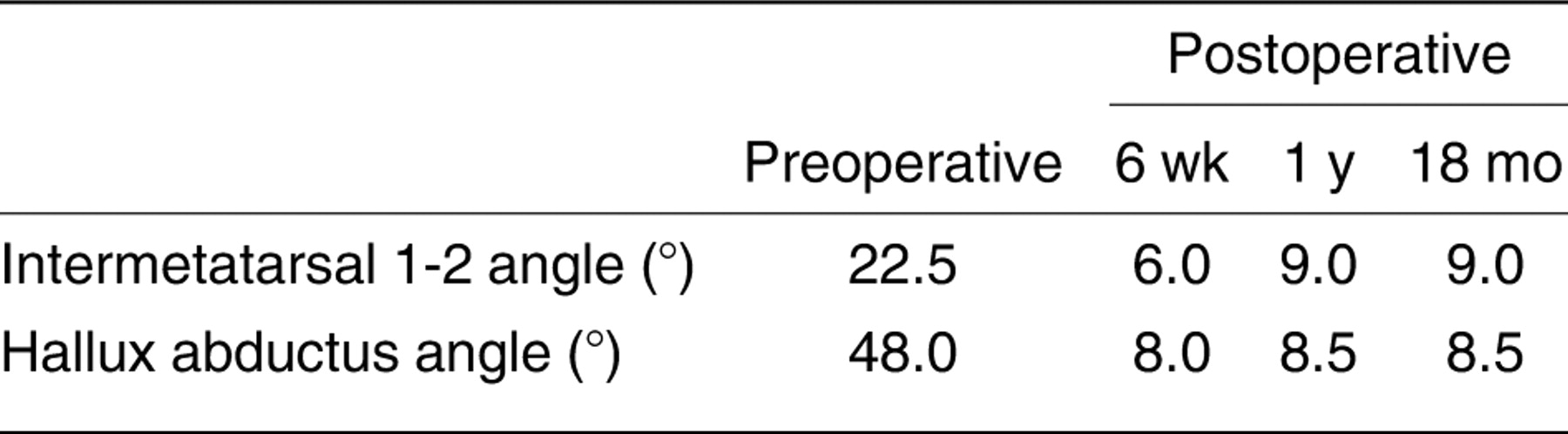
This patient presented with a measured intermetatarsal angle of 22.5°, with a hallux abductus angle of 48.0°. Serial weightbearing radiographs (anteroposterior and lateral) were obtained every 2 weeks until week 6. The patient tolerated the postoperative course well and developed no complications. Measurements obtained from weightbearing radiographs beginning after surgery and through week 6 demonstrated a corrected intermetatarsal angle of 6.0° and a corrected hallux abductus angle of 8.0°. Radiographs obtained after 1 year revealed an intermetatarsal angle of 9.0° and a hallux abductus angle of 8.5°. At 18-month follow-up, the patient rated her experience as excellent and continued to deny pain, limitations, and other concerns. The measured intermetatarsal angle at 18 months was 9.0°, and the hallux abductus angle was 8.5°. Total intermetatarsal angle correction 6 weeks postoperatively was 16.5°, and at 1 year and at 18 months it was 13.5°. Total hallux abductus angle correction was 40° 6 weeks postoperatively and 39.5° at 1-year and 18-month follow-up. The radiographic angular measurements taken at 18 months demonstrated no measurable increases from those taken at 1 year. The patient had approximately 3° of first metatarsal elevatus noted on preoperative lateral radiographs. There was no measurable change in the amount of first metatarsal elevatus postoperatively.
Table 1 summarizes these findings.
Table 1.
Preoperative and Postoperative Angular Measurements.
Table 1.
Preoperative and Postoperative Angular Measurements.
Discussion
The Mini TightRope system has been indicated for hallux abducto valgus deformity of mild-to-moderate severity; however, literature on its use in the forefoot is scarce, and even more lacking is documentation of its ability to obtain and maintain extensive intermetatarsal angle correction. The TightRope system has been used for several years with favorable results in shoulder and ankle syndesmotic repairs.[
4] The new mini-sized version now adds more potential podiatric medical applications, such as Lisfranc repair and hallux abducto valgus correction.[
5]
The results obtained herein demonstrate that it is possible to achieve substantial intermetatarsal angle correction without osteotomy or arthrodesis and to maintain most of this correction through 18 months. There was an approximate 3° of correction lost between 6-week and 1-year follow-up. There was no measureable angular change between 1-year and 18-month radiographs. This finding suggests that the loss of correction was transient and occurred early in the postoperative course. Based on these findings, there is no evidence to suggest that the angle will change further. I suggest that the slight loss of intermetatarsal angle correction noted may have been avoided with the two Mini TightRope devices. The patient had a modest amount of first metatarsal elevatus noted on preoperative lateral radiographs. The procedure performed neither increased nor decreased the amount of observed elevatus. Based on the nature of the Mini TightRope procedure, it is not possible to significantly plantarflex the first metatarsal because it must remain in alignment with the second metatarsal during the insertion process. In cases in which there is a high degree of first metatarsal elevatus and significant plantarflexion is desired, one should select an alternative procedure to allow such correction. I believe that in situations in which substantial intermetatarsal angle reduction is necessary, consideration should be given to using two implants to better deter any potential loss of correction. This particular patient will be followed up annually to determine whether the migration has arrested or whether it continues slowly across time.
Traditional procedures, such as the Lapidus and closing base wedge osteotomy, have proven success and reliability in reducing extreme intermetatarsal angle abnormalities. They remain the procedures of choice for most patients with severe hallux abducto valgus. In various situations, such as that documented herein, certain patients may be unable or unwilling to assume the risk and complications associated with these classic procedures. In these circumstances, I suggest considering the Mini TightRope procedure. It allows an opportunity to obtain substantial intermetatarsal angle correction similar to that obtained with a Lapidus bunionectomy without the lengthy period of cast immobilization. In the present case, it was used successfully in a patient who had developed a postoperative deep venous thrombosis on two separate occasions while immobilized in a cast. Medical clearance was obtained provided that a cast would not be required. A distal procedure could have been performed without the need for cast immobilization, but the level of correction obtained herein would not have been possible and recurrence would have been a concern.
This procedure is not without inherent potential complications, which may include stress or overt fracture about the second metatarsal, failure or pull through of the device in osteopenic bone, and failure to obtain adequate correction if the deformity is rigid. Also lacking are long-term studies demonstrating the longevity of this device in maintaining correction across a lifespan. If the patient has significant osteoarthrosis or marked hypermobility at the first metatarsocuneiform joint, the procedure is doomed to fail. Also, one must be prepared to change procedures intraoperatively and must have the patient consented accordingly. If after thorough dissection the angular deformity is not satisfactorily reduced with manual compression, then one should abort the TightRope and perform a more classic procedure. If there is too much tension holding the reduction, a stress fracture of the second or even the first metatarsal may develop. An adequately powered study is needed to demonstrate the success of the TightRope procedure and to determine whether every patient experiences some loss of initial correction and how significant that loss proves to be.
Conclusions
The Mini TightRope procedure provides an opportunity to obtain substantial correction in a patient with severe angular deformity without the typical period of immobilization associated with more classic procedures. The procedure also avoids possible delayed unions and nonunions, iatrogenic metatarsal elevation or shortening, cast disease and associated thrombosis, and other morbidities and complications associated with typical osteotomy procedures. It may offer a specific population of patients the opportunity to obtain intermetatarsal angle correction similar to that of a proximal base or Lapidus procedure without many of the inherent risks and the extended postoperative course. In certain cases, these patients may never have had the opportunity to obtain such definitive and dramatic correction of their deformity.
Patient selection and education is extremely important with this procedure. Although the Mini TightRope procedure will not replace more traditional procedures, it can be effective when used appropriately. It is interesting to consider the use of a second TightRope to deter any loss of correction. If these results continue to be favorable, then the Mini TightRope may have a lasting position in our procedure list against hallux abducto valgus deformity.