Metatarsus adductus is a structural foot deformity defined by the presence of medial deviation of the metatarsal bones with respect to the lesser tarsals.[
1,
2] Metatarsus adductus has been cited as a cause of hallux valgus, particularly in the juvenile foot,[
3] and it has been suggested that metatarsus adductus deformity could be a cause of recurrence of hallux valgus deformity after surgery.[
4]
Surgical treatment of hallux valgus with associated metatarsus adductus deformity could be difficult because of the space between the first and second metatarsals. During preoperative planning, metatarsus adductus can lead to underestimation of the first metatarsal lateral translation necessary to correct the intermetatarsal angle. Satisfactory correction of hallux valgus in patients with metatarsus adductus is challenging. Aggressive surgery on the lesser metatarsal bone is often required to obtain more space for first metatarsal correction.[
5] However, surgical impact must be considered in patients affected by systemic comorbidity. Multiple distal oblique osteotomies may be particularly suitable for elderly patients with low functional demands and who may have a longer healing time. We describe a patient with hallux valgus and metatarsus adductus treated with distal oblique osteotomy of the first, second, and third metatarsals.
Case Report
A 76-year-old woman presented to the University Campus Bio-Medico of Rome outpatient department with a painful bunion deformity of her right foot of more than 15 years’ duration. The pain was exacerbated by orthostatism and had increased in recent months. In addition, in the past 2 years, the patient developed metatarsalgia, with limitation of daily-living activities. There was no family history of hallux valgus or metatarsus adductus. Physical examination revealed a painful bursa over the first metatarsophalangeal joint and painful plantar keratosis on the second and third metatarsal heads. The second metatarsal head was palpable in the first intermetatarsal space. The second and third toes had severe valgus deformity. The range of motion of the hallux was 90°.
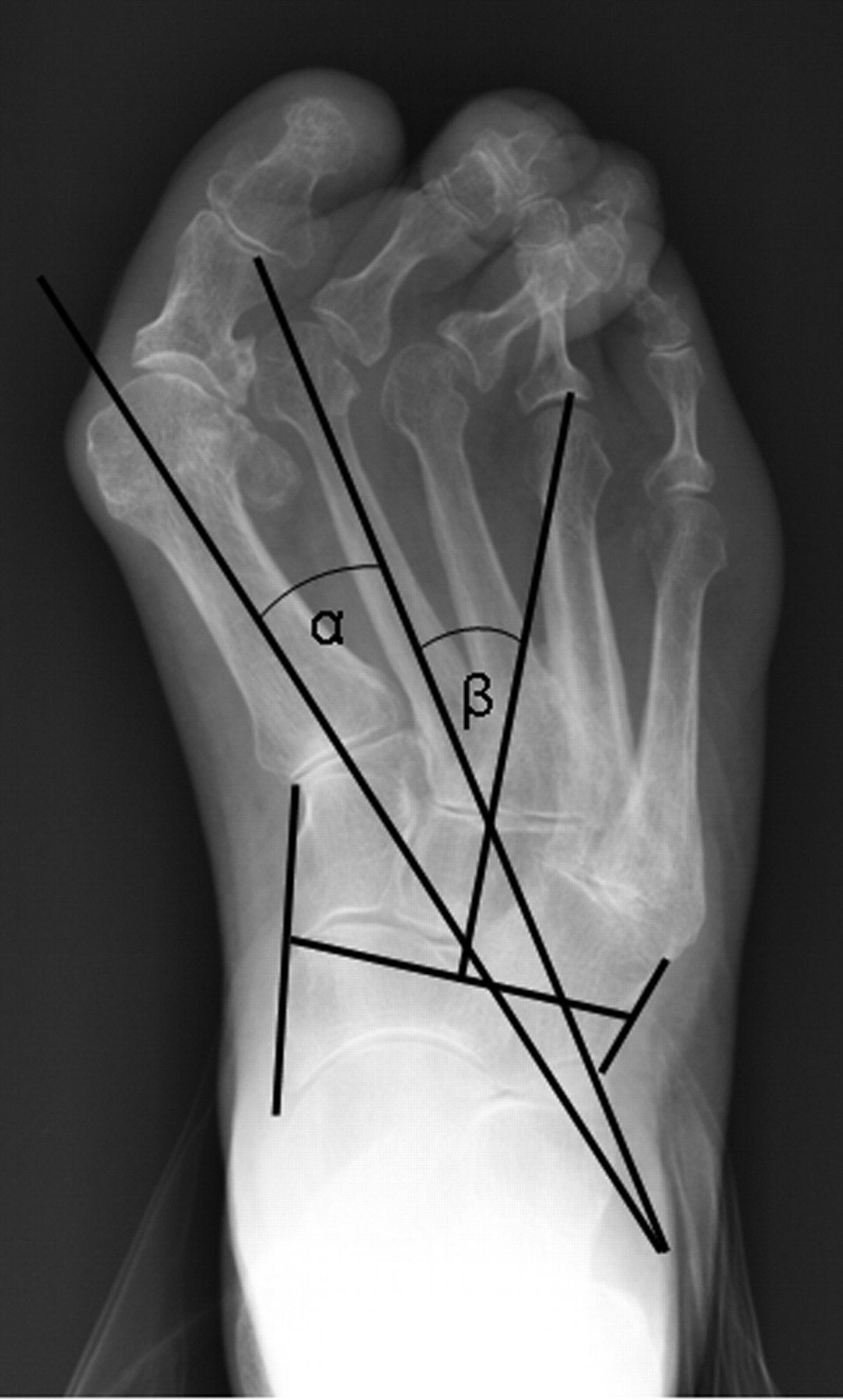
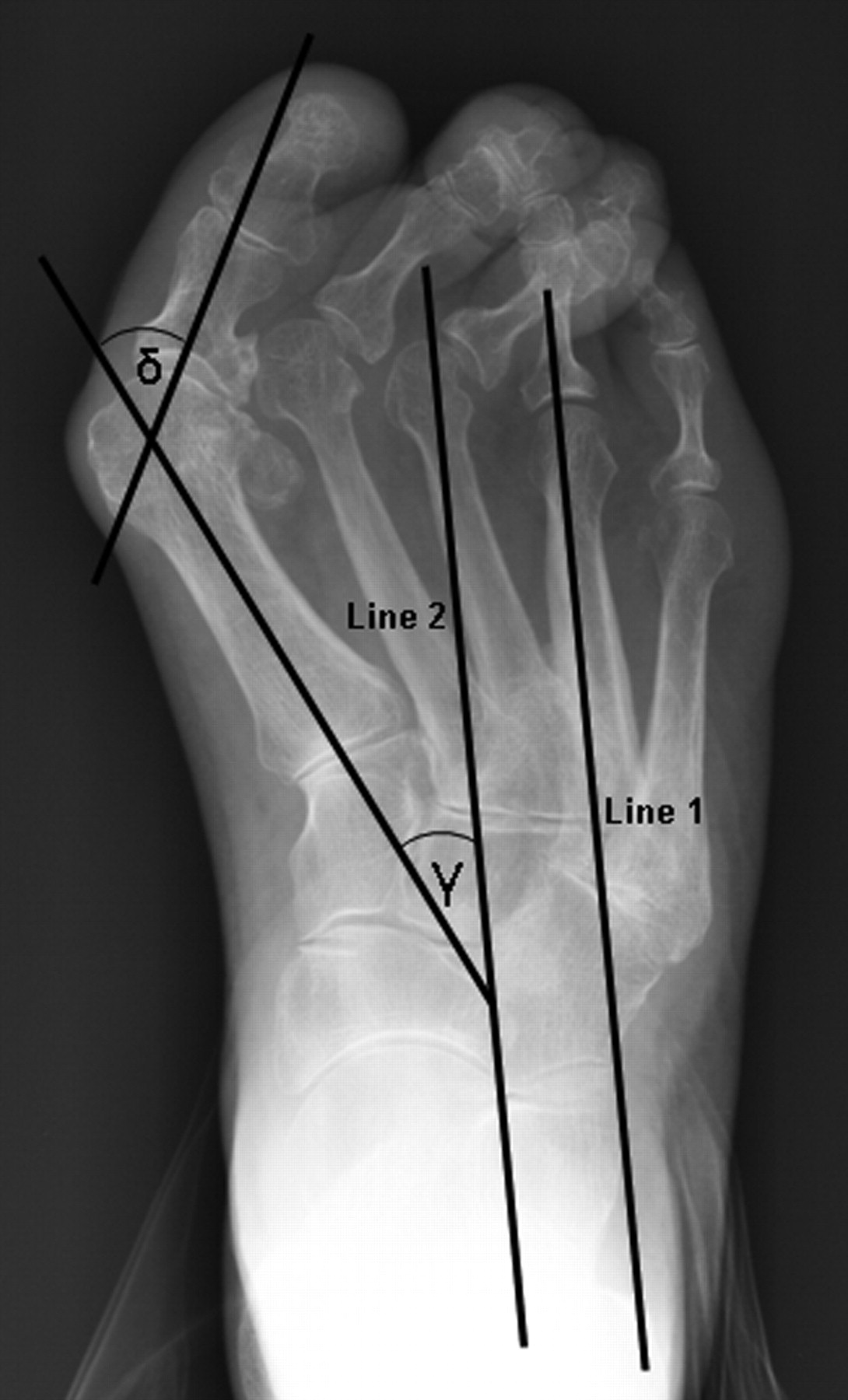
The medical history of this patient revealed a pulmonary nodule, hypertension, and lower-limb venous insufficiency. She did not experience any central nervous system or rheumatologic diseases. Weightbearing dorsoplantar radiographs of the right foot revealed a severe metatarsal adductus deformity of the forefoot with hallux valgus deformity and valgus deformity of the second and third toes (Figs. 1
and 2
). The hallux valgus angle, the first intermetatarsal angle, and the metatarsus adductus angle[
6] were 53°, 9°, and 36°, respectively. Because of the presence of metatarsus adductus, the first intermetatarsal angle was assessed by measuring the Kilmartin angle,[
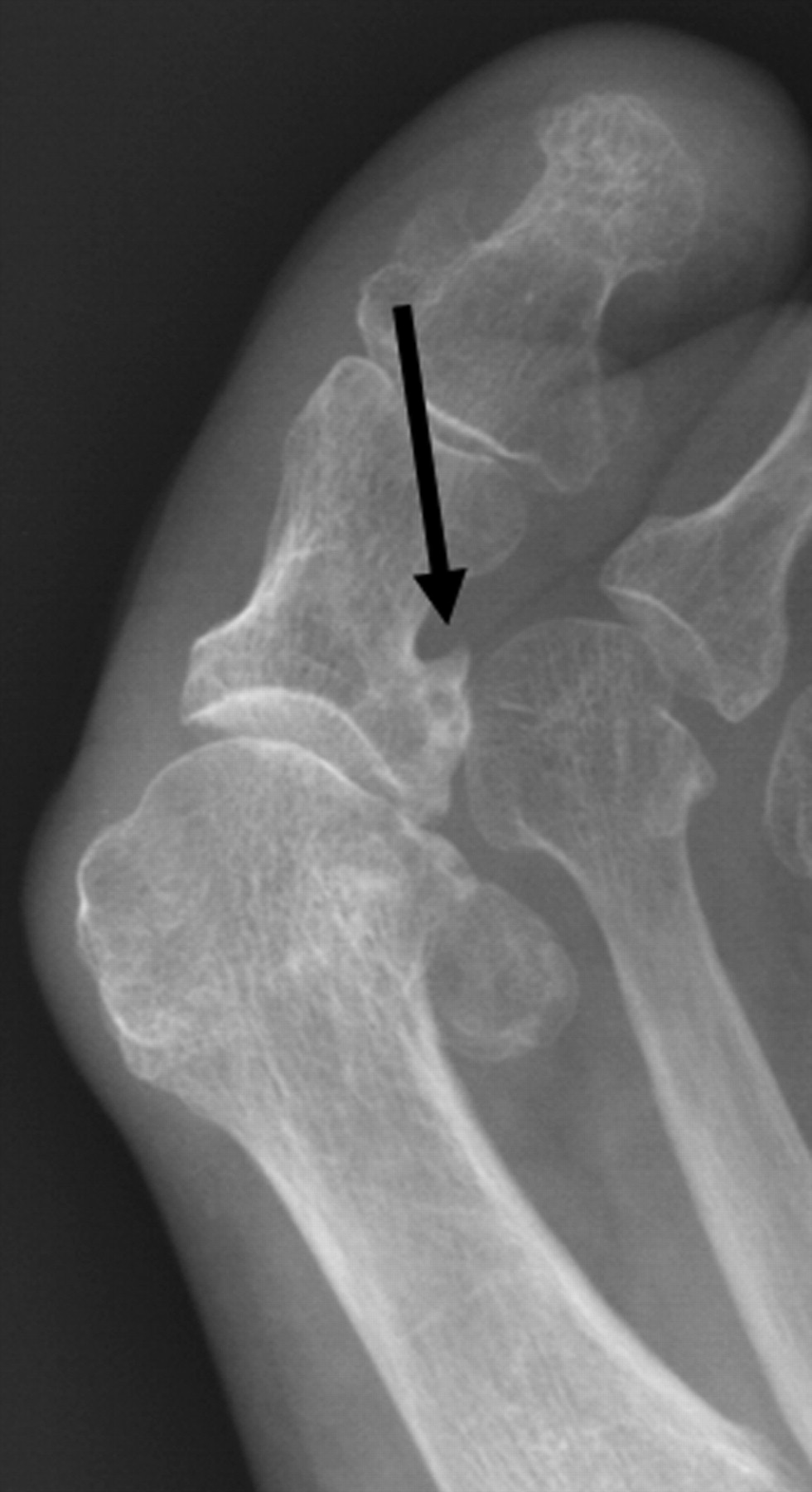
7] resulting in 28°. Osteophytes were observed on the lateral margin of the base of the first proximal phalanx owing to the contact between the first metatarsal head and the base of the first proximal phalanx (Fig. 3
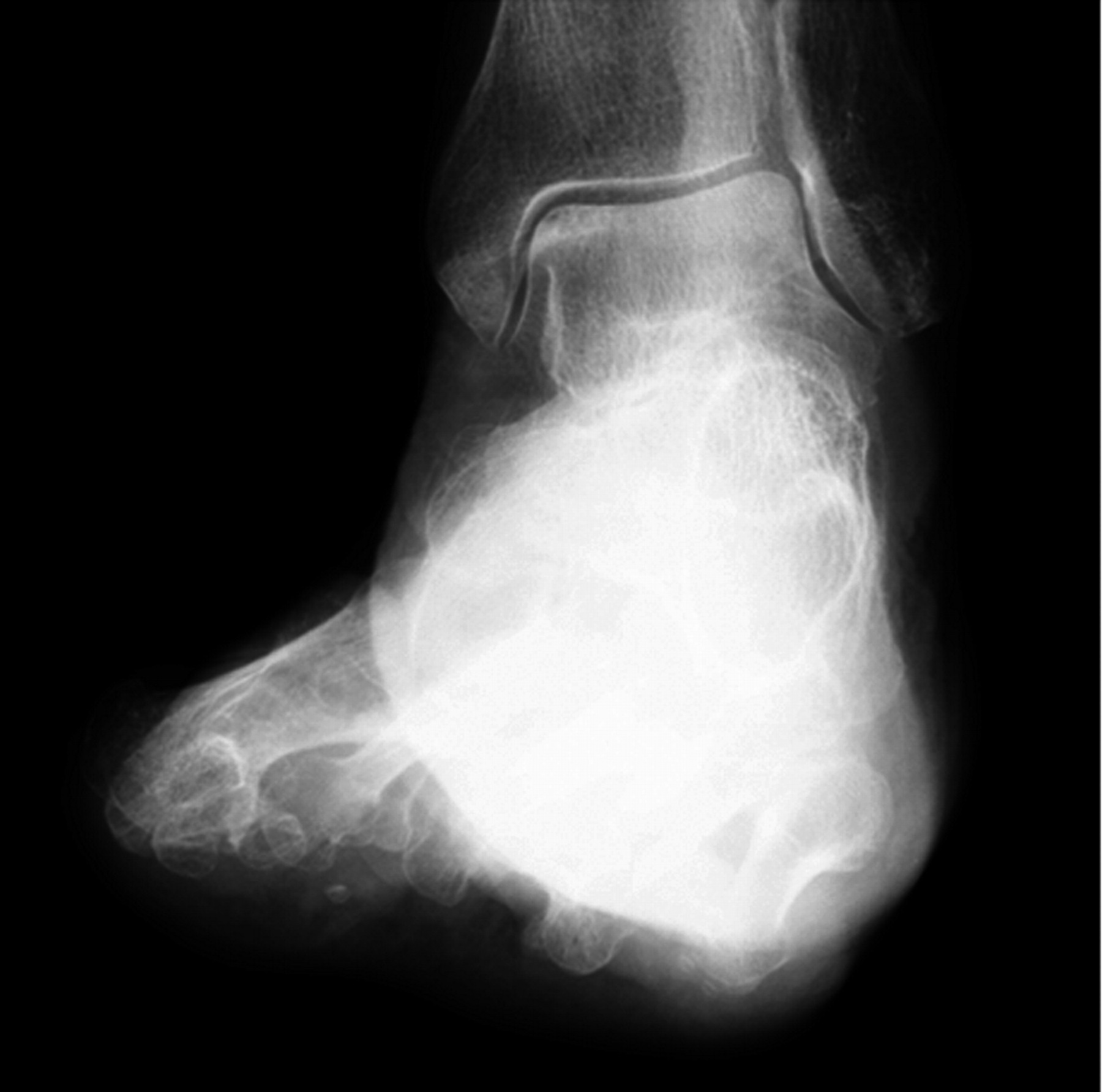
). A weightbearing axial radiograph of the right foot revealed lateral dislocation of the sesamoids (Fig. 4
).
The patient received sciatic and femoral nerve block with 0.75% ropivacaine. A midthigh pneumatic tourniquet (300 mm Hg) was used. Distal oblique osteotomy on the second and third metatarsals was chosen to provide space for hallux valgus correction.
A dorsal incision was made over the third and second metatarsophalangeal joints, and a longitudinal capsulotomy was performed. The extensor digitorum brevis tendon was divided, and then a Z-tenotomy was performed on the extensor digitorum longus tendon. A microsagittal saw was used to make an osteotomy parallel to the weightbearing surface. The third and second metatarsal heads were shortened, rotated, and translated laterally. Owing to the extensor’s contracture, Z-lengthening of the extensor digitorum longus tendons was performed.
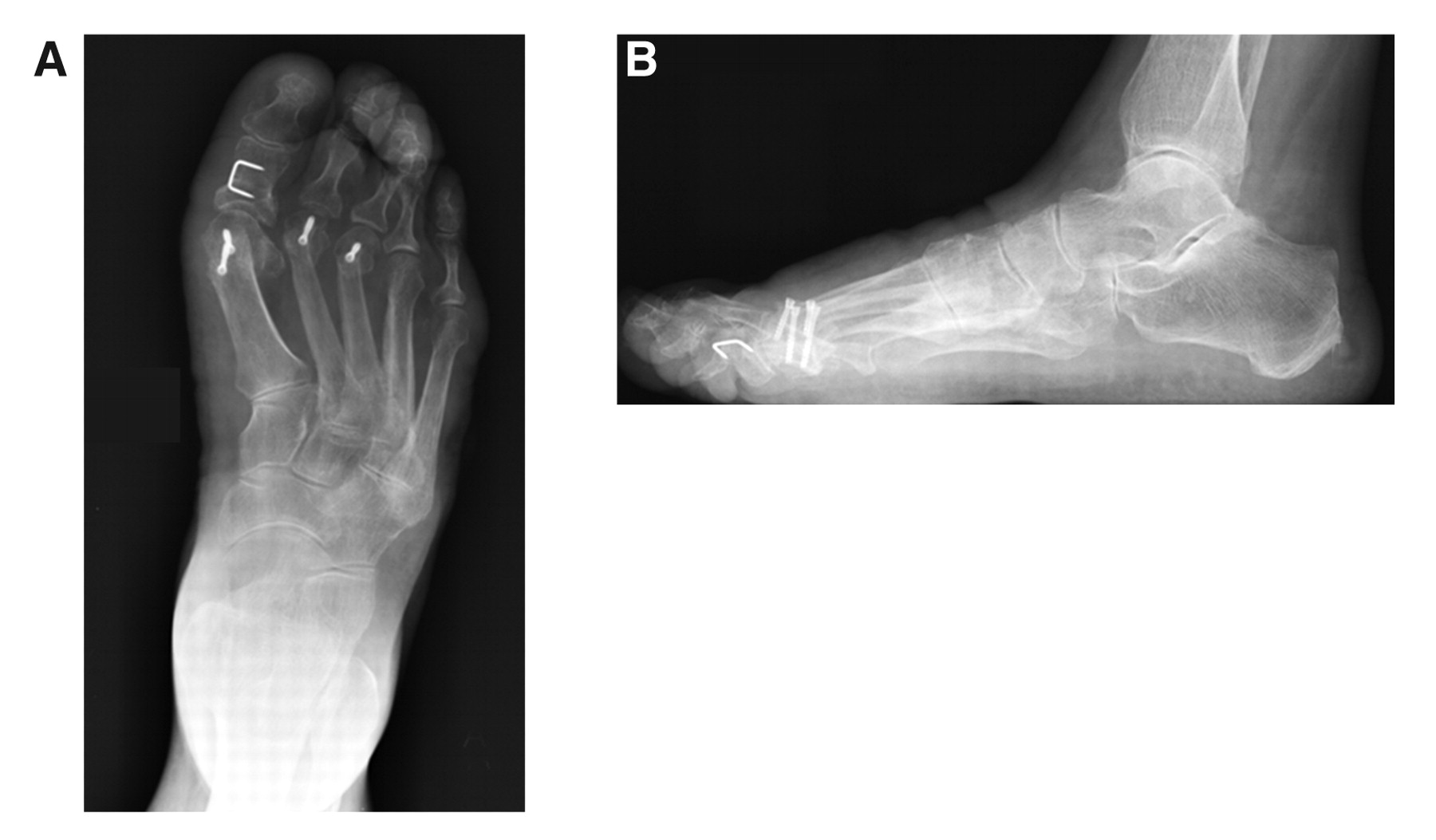
Release of the distal soft tissues, adductor tenotomy, excision of the medial eminence, and distal oblique osteotomy of the first metatarsal were performed. The distal fragment was translated 6 mm laterally and shortened. After completion of the osteotomies, the capital fragments were fixed with a single mini-fragment screw for the second and third metatarsals, and two mini-fragment screws were used for the first metatarsal. A closing wedge proximal phalangeal Akin osteotomy was performed and was secured with a staple. A postoperative shoe was worn for 4 weeks with partial weightbearing. Hallux range-of-motion exercises were started 1 day after surgery. Full weightbearing was allowed 4 weeks after surgery. Twelve months after surgery, the patient had no pain at the first metatarsophalangeal joint, and plantar callosities at the second and third metatarsal heads were still present but asymptomatic. Hallux range of motion at 12 months of follow-up was 70°. The hallux metatarsophalangeal-interphalangeal score according to the system of the American Orthopaedic Foot and Ankle Society was 46 points before surgery and 87 points after surgery. The patient was satisfied with the result of this procedure. A radiograph obtained 12 months after surgery revealed that the valgus deformities of the great, second, and third toe metatarsals were decreased, and the patient was pain free and walked without restriction (Fig. 5
).
Discussion
Metatarsus adductus is a common congenital foot deformity characterized by adduction of the forefoot in relation to the hindfoot at the tarsometatarsal joints. Many authors have agreed with the self-resolving nature of this deformity, but residual deformity may be observed in untreated patients.[
8,
9]
Juvenile hallux valgus has been associated with metatarsus adductus.[
10] McCluney and Tinley[
11] found a higher metatarsus adductus angle in patients affected by juvenile hallux valgus compared with an age-matched control group. Coughlin[
12] reported 22% moderate-to-severe metatarsus adductus deformity in patients affected by juvenile hallux valgus. However, Farsetti et al[
8] found that hallux valgus is not a common outcome in patients treated for metatarsus adductus deformity.
In adults, an association between metatarsus adductus and hallux valgus deformity has been identified in previous studies.[
13] Residual deformity may be at increased risk for stress fractures involving the lateral metatarsal bones, likely owing to the presence of altered biomechanics that place greater loads across the lateral aspect of the foot.[
14]
Surgical intervention for metatarsus adductus correction often requires multiple osteotomies and lengthy immobilization. Okuda et al[
15] described a 56-year-old woman affected by hallux valgus and metatarsus adductus. They chose a distal soft-tissue procedure combined with a proximal osteotomy of the first metatarsal and corrective osteotomies of the second and third metatarsals; full weightbearing was allowed 9 weeks after surgery. Mahan and Jacko[
16] described a 9-year-old girl with hallux valgus with metatarsus adductus in which closing wedge abductory osteotomies of the first through fifth metatarsals and modified McBride bunionectomy, Evans calcaneal osteotomy, and percutaneous tendo Achillis lengthening were performed.
Regarding our treatment choice, the main reason is that the patient began partial weightbearing on the first postoperative day with the use of a postoperative shoe to decrease deep venous thrombosis and complex regional pain syndrome.[
17,
18] Mizel et al[
18] found that nonweightbearing status and immobilization after foot and ankle surgery were correlated with an increased incidence of deep venous thrombosis. Allen et al[
17] reported on 134 patients affected by complex regional pain syndrome: 47% had been physically immobilized with a cast or splint. Considering the patient’s age and the severity of the deformity, an arthrodesis of the first metatarsophalangeal joint coupled with a panmetatarsal head resection would have been a feasible choice.
Arthrodesis is effective at reducing pain and maintaining stability of the first ray during gait, but it eliminates first metatarsophalangeal joint mobility without regaining normal gait.[
19] Preoperative range of motion was normal, and we chose a motion-sparing approach to achieve greater patient satisfaction. Therefore, metatarsus adductus deformity leads to overloading of the lateral side of the foot, which put the lateral metatarsals at increased risk for stress fractures.[
14] After first metatarsophalangeal joint arthrodesis, the lateral metatarsals would be subjected to an even greater load, leading to an expected development of lateral metatarsalgia or stress fractures of the lateral metatarsals. Panmetatarsal head resection is a safe procedure for the relief of pain and deformity in patients affected by rheumatoid arthritis.[
20] However, high residual plantar pressure may occur despite resection of all of the metatarsal heads.[
21] In rheumatoid arthritis, the relief of pain after panmetatarsal head resection seems to be related to the removal of inflamed joints and not to the reduction of plantar pressure. In this patient, the metatarsalgia was probably related to an abnormal loading pattern in the forefoot, and after a panmetatarsal head resection, she would have more difficulties adapting to the new anatomical situation.
Distal oblique osteotomy is a simple and stable osteotomy that allows a relatively short period of immobilization. We preferred to treat metatarsalgia and to obtain moderate hallux valgus correction. Although, radiographic results showed undercorrection of hallux valgus deformity, the patient was satisfied with the result, in particular for metatarsalgia resolution. To our knowledge, this is the first case of hallux valgus correction in a patient with metatarsus adductus performed with multiple distal oblique osteotomies of the metatarsal bones.
Conclusions
The result of surgical treatment of hallux valgus deformity associated with metatarsus adductus in an elderly patient suggests that multiple distal oblique osteotomies are safe and satisfactory procedures.
Figure 1.
Weightbearing dorsoplantar radiograph showing the intermetatarsal angle (α) and the metatarsus adductus angle (β).
Figure 1.
Weightbearing dorsoplantar radiograph showing the intermetatarsal angle (α) and the metatarsus adductus angle (β).
Figure 2.
Weightbearing dorsoplantar radiograph showing the hallux valgus angle (δ) and the Kilmartin angle (γ). Line 1 is drawn parallel to the lateral border of the calcaneum. Line 2 is drawn parallel to line 1, bisecting the base of the second metatarsal.
Figure 2.
Weightbearing dorsoplantar radiograph showing the hallux valgus angle (δ) and the Kilmartin angle (γ). Line 1 is drawn parallel to the lateral border of the calcaneum. Line 2 is drawn parallel to line 1, bisecting the base of the second metatarsal.
Figure 3.
Osteophytes are seen on the lateral margin of the proximal phalanx (arrow).
Figure 3.
Osteophytes are seen on the lateral margin of the proximal phalanx (arrow).
Figure 4.
Weightbearing axial radiograph showing lateral dislocation of the sesamoids.
Figure 4.
Weightbearing axial radiograph showing lateral dislocation of the sesamoids.
Figure 5.
Dorsoplantar (A) and lateral (B) radiographs 12 months after surgery.
Figure 5.
Dorsoplantar (A) and lateral (B) radiographs 12 months after surgery.