Osteochondral lesions of the talus are defined as lesions simultaneously involving the hyaline cartilage of the talar dome and its underlying subchondral bone.[
1] Osteochondral lesions of the talus should be treated if the hyaline cartilage has lost integrity.[
2] Magnetic resonance imaging (MRI) has been demonstrated to be a valuable tool in diagnosing osteochondral lesions of the talus.[
3–
7] The MRI diagnostic criteria include bone marrow edema, cysts, and the signal intensity of the articular surface. All of these criteria are indirect markers of the state of the articular cartilage. T1-weighted three-dimensional (3-D) fat-suppressed fast spoiled gradient-echo (FSPGR) images provide morphological presentations of cartilage contour in short imaging times.[
8] Three-dimensional fat-saturated SPGR imaging has been shown to be more accurate than conventional MRI in the detection of cartilage defects in the knee.[
9,
10] Ba-Ssalamah et al[
11] suggested that 3-D fat-saturated SPGR provided high image quality in imaging articular cartilage defects in the ankle joint. However, no study has evaluated the diagnostic ability of this method in osteochondral lesions of the talus. The purpose of this study was to compare the diagnostic ability of T1-weighted 3-D fat-suppressed FSPGR with that of conventional MRI in the detection of cartilage defects in the ankle by looking at sensitivity, specificity, and accuracy of diagnosis compared with arthroscopic findings.
Materials and Methods
Patients
The prospective study included 32 consecutive patients (15 men and 17 women; median age, 50 years; age range 18–73 years) with a history of ankle sprain and symptoms of intra-articular ankle pain. Patients with a history of ankle joint surgery were excluded. All of the patients underwent MRI including conventional sequences and a T1-weighted 3-D fat-suppressed FSPGR sequence. Ankle arthroscopy was performed subsequently by a single orthopedist (J.Z.Z.). Written informed consent was obtained from each patient. The study was approved by the Beijing Tongren Hospital institutional review board.
Imaging
All of the images were obtained with a 1.5-T superconducting imager (Signa Horizon; GE Healthcare, Waukesha, Wisconsin) and a quadrature knee coil. Supine patients were examined with the ankle placed at an angle of 90° between the axis of the lower leg and the sole of the foot. The conventional MRI protocol consisted of a T1-weighted spin-echo sequence (repetition time, 540 msec; echo time, 11 msec) and a fat-suppressed proton density–weighted fast spin-echo sequence (repetition time, 2,000 msec; echo time, 33 msec) in the coronal and sagittal planes. The other parameters were section thickness, 3 mm; intersection gap, 1 mm; field of view, 16 cm; matrix size, 512 × 512; and number of acquisitions, 2.
The T1-weighted 3-D fat-suppressed FSPGR sequence was acquired in the coronal plane with the following parameters: repetition time, 11 msec; echo time, 2.5 msec; flip angle, 10°; section thickness, 1 mm; in-plane resolution, 0.5 mm; field of view, 16 cm; matrix size, 256 × 256; and number of acquisitions, 2. Imaging time was 4 min 20 sec.
Image Analysis
Two musculoskeletal radiologists (D.P.H. and B.T.Y.) with 8 and 12 years of experience, respectively, blinded to the arthroscopic findings reviewed the conventional MRIs (method A). Final decisions were reached by consensus. One month later, the T1-weighted 3-D fat-suppressed FSPGR coronal images (method B) were reviewed.
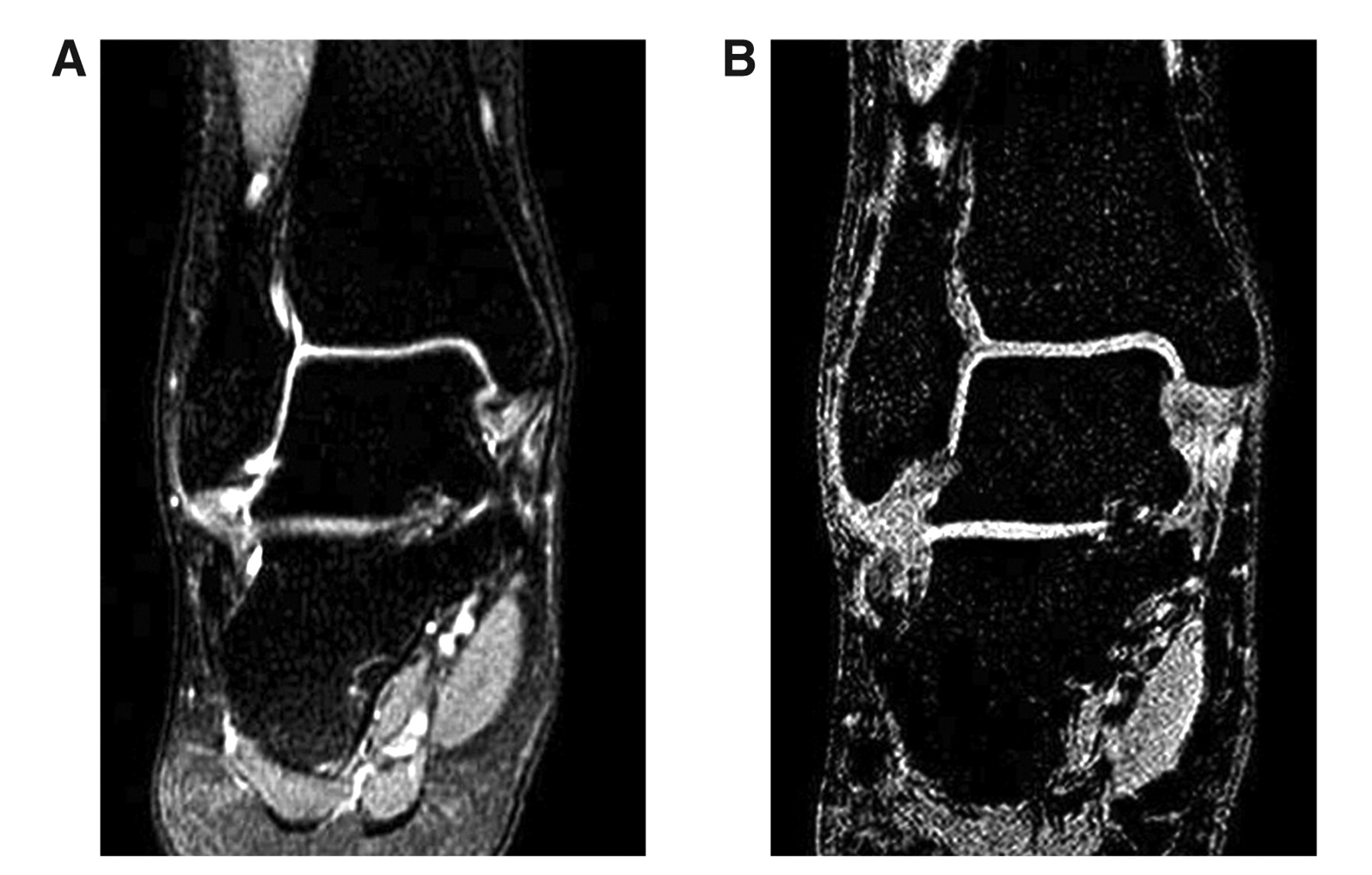
Articular cartilage, location of the lesion, bone marrow edema, and cystic foci beneath the articular cartilage were assessed. In method A, the articular cartilage was classified according to signal intensity and contour as either normal (homogeneous signal intensity and regular shape) (Fig. 1A
) or abnormal (hyperintense on fat-suppressed proton density–weighted imaging or irregular shape). In method B, articular cartilage was classified according to the continuity of the hyaline cartilage as either normal (intact cartilage surface) (Fig. 1B
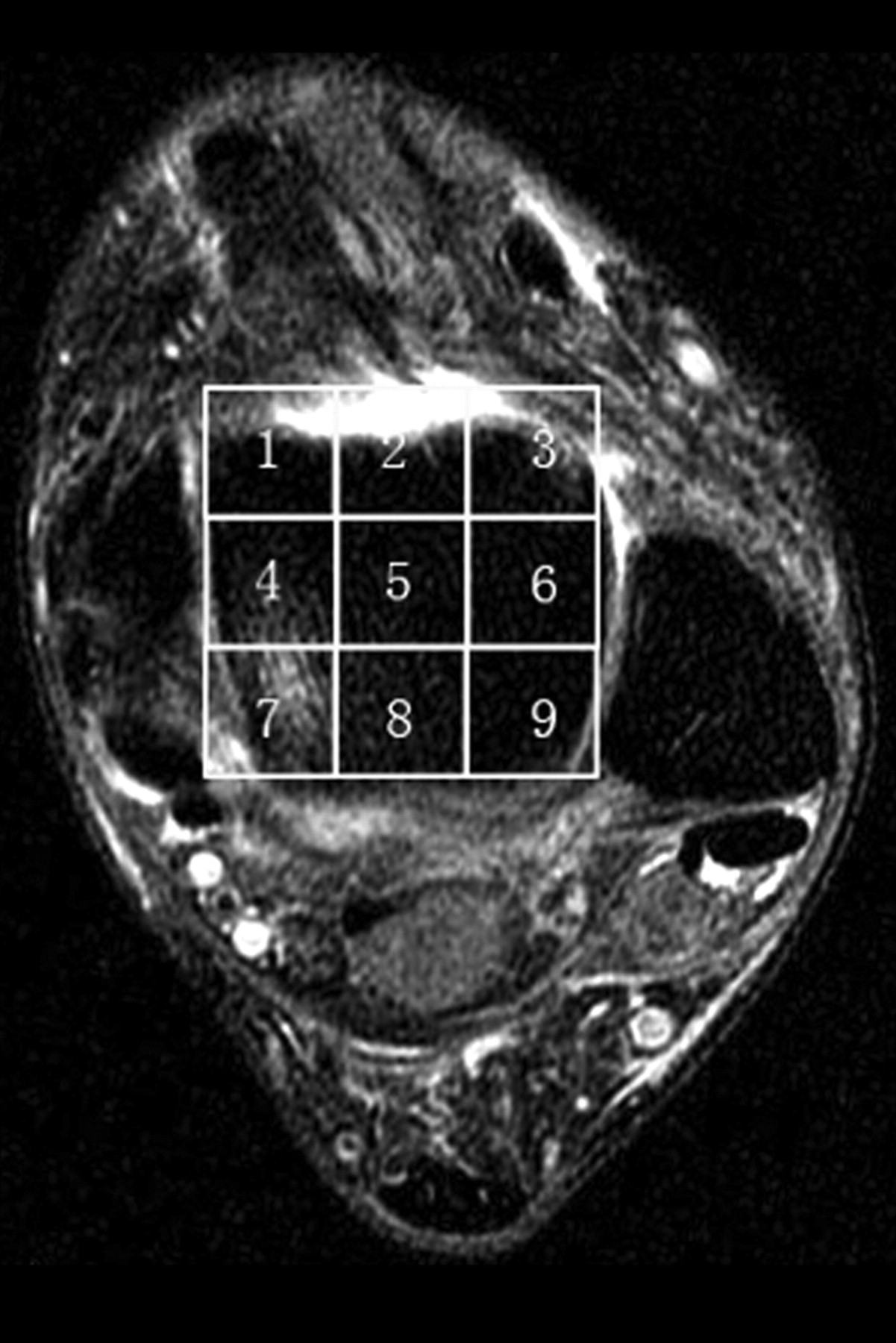
) or abnormal (contour interruption). The location of the lesion was recorded on the nine-zone anatomical grid proposed by Raikin et al[
12] (Fig. 2
). Bone marrow edema and cystic foci beneath the articular surface were assessed on conventional MRI and coronal fat-suppressed FSPGR imaging.
Statistical Analysis
The sensitivity, specificity, and accuracy of both imaging methods for determining articular cartilage defects were calculated using the arthroscopic findings as the gold standard. The differences in the sensitivities and specificities between the two methods were examined using a McNemar test. Differences were considered significant at P < .05.
Results
Arthroscopy revealed 21 patients with hyaline cartilage defects and 11 with normal ankle joints. Conventional MRI (method A) demonstrated 13 true positives, 0 false positives, 11 true negatives, and eight false negatives. T1-weighted 3-D fat-suppressed FSPGR coronal imaging (method B) demonstrated 19 true positives, 0 false positives, 11 true negatives, and two false negatives.
The sensitivity, specificity, and accuracy of the two methods for articular cartilage defect were 62%, 100%, and 75%, respectively, for method A, and 91%, 100%, and 94% for method B. The sensitivity and accuracy of FSPGR imaging were significantly better than those of conventional MRI (
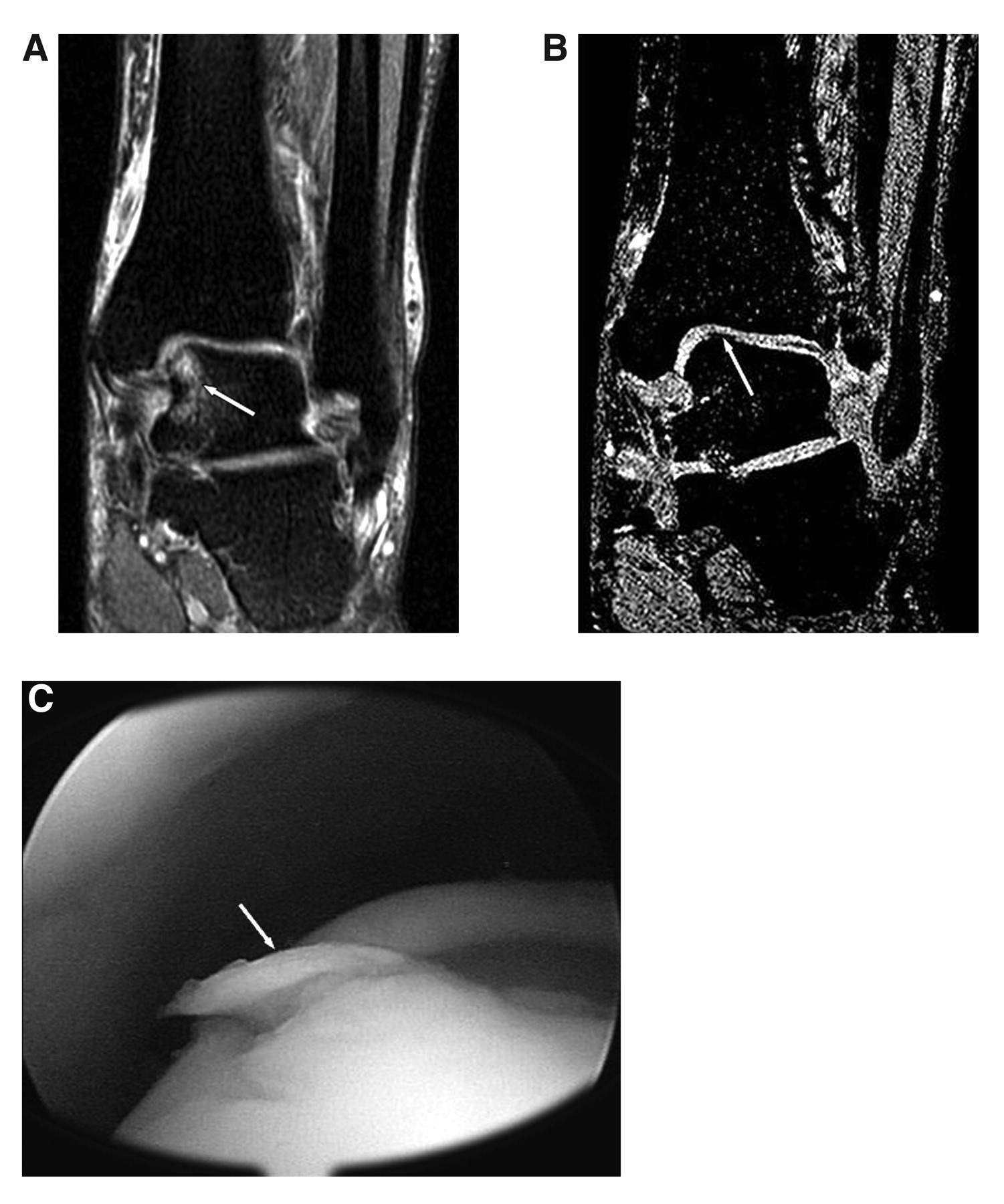
P < .05) (Fig. 3
). However, there was no difference in specificity.
Using MRI, the correct location of the lesion could be identified. According to the nine-zone grid, there were 16 lesions (76%) at zone 4, two lesions at zone 7, one lesion at zone 1, one lesion at zone 3, and one lesion at zone 6. Coronal fat-suppressed FSPGR could not show edema (Fig. 3
). Cystic foci were hyperintense on fat-suppressed proton density–weighted imaging and hypointense to hyperintense on fat-suppressed T1-weighted FSPGR.
Discussion
Osteochondral lesion of the talus is a common cause of ankle sprain and subjective instability.[
13] Articular cartilage has a limited capacity for intrinsic repair. If the articular cartilage is preserved, management is often conservative. However, if the articular cartilage is damaged, surgical intervention may be warranted. Accurate diagnosis of cartilage lesions may not only explain a patient’s symptoms but may also help the surgeon plan the therapeutic approach. Ankle arthroscopy can clearly identify chondral lesions; however, arthroscopy is an invasive method, particularly in patients for whom nonoperative therapy is warranted.
Conventional MRI can clearly identify subchondral lesions but cannot always show chondral lesions because of technological limitations in visualizing thin cartilage.[
14] The articular cartilage of the talar dome is relatively thin cartilage (0.4–2.1 mm),[
15] and the ankle joint surfaces are closely applied. Most conventional MRI signal emitted from cartilage is accounted for by the free water. The thin cartilage of the talar dome may not be discernible on conventional MRIs because of partial volume artifacts of the interspersed cartilage, which are a consequence of the thicker slices used, and joint fluid signal intensities. Three-dimensional SPGR imaging allows the acquisition of thin section images with high contrast between bright cartilage and surrounding tissues, which can be reformatted into multiple planes. Thinner slices can reduce partial volume artifacts. With 3-D SPGR imaging, cartilage abnormalities are seen as morphological abnormalities of cartilage contour rather than as areas of signal abnormality.[
13,
16–
18]
Fat-suppressed 3-D SPGR imaging has been shown to be more sensitive than conventional MRI for the detection of hyaline cartilage defects of the knee.[
9] The limitation of SPGR is its relatively long acquisition time of approximately 10 min.[
9,
18] Fat-suppressed FSPGR decreases imaging time to approximately 4 min and has been used in anterolateral soft-tissue impingement.[
19] The imaging time in the present study was 4 min 20 sec. These results show that hyaline cartilage defects of the ankle could be accurately identified on T1-weighted 3-D fat-suppressed FSPGR imaging.
Three-dimensional fat-suppressed SPGR imaging for detecting cartilage defects was described in the 1990s.[
20] Disler et al[
9] compared 3-D fat-suppressed SPGR imaging and standard MRI in the evaluation of hyaline cartilage defects in the knee in 1996. They found a markedly higher sensitivity of 75% to 85% for 3-D fat-suppressed SPGR imaging compared with 29% to 38% for standard MRI. The present results, which were obtained in the ankle joint, demonstrate that T1-weighted 3-D fat-suppressed FSPGR imaging was more useful for detecting hyaline cartilage abnormalities than was conventional MRI and that there were significant differences in sensitivity and accuracy.
Magnetic resonance imaging can accurately localize the lesion. Raikin et al[
12] reported the largest series of MRI evaluating osteochondral lesions of the talar dome. They introduced an anatomical nine-grid system to localize the lesion. They concluded that osteochondral lesions were most frequently located in zone 4 at the medial talar dome. The present study likewise showed that 76% of the lesions were located in zone 4. This is consistent with the results of a meta-analysis[
21] of 879 osteochondral lesions of the talar dome in which 58% of the lesions were located on the medial aspect. Inversion injury, the most frequent type of ankle sprain, is one of the probable reasons for the higher incidence of medial talar dome osteochondral lesions. Another probable reason is that the talar dome equator bears maximal stresses during weightbearing activities.[
12] Correct location of the lesions is essential for making operative plans and for monitoring response to therapy. The anatomical nine-grid system can provide an effective scheme for reproducible and accurate localization of osteochondral lesions of the talus for musculoskeletal radiologists and orthopedic surgeons.
There were two false-negative examinations, which were present simultaneously on both fat-suppressed 3-D FSPGR imaging and conventional MRI. One probable reason for these false negatives, which were located in zone 7, is that the lesions were not as severe as the other lesions and did not have edema and cystic foci on MRI. The other probable reason is that we assessed the lesion using coronal MRI only. Zone 7 is the posteromedial location of the talus, and coronal MRIs of the talus cannot provide exact information for the marginal area. Multiplanar MRIs are essential for assessing the marginal areas of the talus.
A fat-suppressed proton density–weighted sequence can demonstrate subchondral bone marrow edema and cystic change. T1-weighted 3-D fat-suppressed FSPGR imaging can demonstrate some subchondral cystic change. The cystic change associated with talar dome osteochondral lesions may vary from a predominantly fibrotic to a predominantly fluid content.[
22] In the present study, fat-suppressed FSPGR imaging could not show edema. All of the cystic foci demonstrated hypointense to hyperintense signals on fat-suppressed FSPGR images.
Schibany et al[
7] compared 3.0-T MRI with 1.0-T MRI for imaging osteochondral lesions of the talus in three cadaveric talus specimens. Their 3.0-T MRI protocol produced better delineation of the disruption of the articular cartilage. There is no study on osteochondral lesions of the talus using 3.0-T MRI in large series. We used a 1.5-T MRI and cannot exclude the possibility that there would have been higher sensitivity for detecting osteochondral lesions of the talus if 3.0-T MRI had been used.
A limitation of this study is the use of arthroscopy as the standard of reference. Arthroscopy cannot detect cartilage lesions that have an intact surface. Therefore, determining the accuracy of the fat-suppressed FSPGR sequence in detecting early articular cartilage lesions is not possible. Comparing MRI appearances of subchondral bone marrow edema and cystic change with actual pathologic abnormalities is impossible. Another limitation is the small number of patients, which may have affected the results.
In conclusion, these results indicate that T1-weighted 3-D fat-suppressed FSPGR imaging offers a significant advantage over conventional MRI in detecting defects of the articular cartilage covering osteochondral lesions of the talus. Combining T1-weighted 3-D fat-suppressed FSPGR imaging and conventional MRI can accurately assess the articular cartilage and subchondral changes.
Figure 1.
Normal magnetic resonance imaging (MRI) appearance of hyaline cartilage in the talar dome. A, Coronal fat-suppressed proton density–weighted MRI shows homogeneous signal intensity and a regular shape. B, Coronal T1-weighted three-dimensional fat-suppressed fast spoiled gradient-echo image shows an intact cartilage surface.
Figure 1.
Normal magnetic resonance imaging (MRI) appearance of hyaline cartilage in the talar dome. A, Coronal fat-suppressed proton density–weighted MRI shows homogeneous signal intensity and a regular shape. B, Coronal T1-weighted three-dimensional fat-suppressed fast spoiled gradient-echo image shows an intact cartilage surface.
Figure 2.
Nine-zone anatomical grid. Diagram shows the nine equal surface area zones, with zones 1, 4, and 7 positioned on the medial talus and zones 1, 2, and 3 positioned anteriorly.
Figure 2.
Nine-zone anatomical grid. Diagram shows the nine equal surface area zones, with zones 1, 4, and 7 positioned on the medial talus and zones 1, 2, and 3 positioned anteriorly.
Figure 3.
Cartilage defect in the left talar dome of a 45-year-old woman. A, Coronal fat-suppressed proton density–weighted magnetic resonance image shows bone marrow edema (arrow) beneath the cartilage but a normal cartilage surface. B, Coronal T1-weighted three-dimensional fat-suppressed fast spoiled gradient-echo image shows the interruption of the hyaline cartilage (arrow) but not the bone marrow edema. C, The corresponding arthroscopic photograph shows a cartilage flap (arrow).
Figure 3.
Cartilage defect in the left talar dome of a 45-year-old woman. A, Coronal fat-suppressed proton density–weighted magnetic resonance image shows bone marrow edema (arrow) beneath the cartilage but a normal cartilage surface. B, Coronal T1-weighted three-dimensional fat-suppressed fast spoiled gradient-echo image shows the interruption of the hyaline cartilage (arrow) but not the bone marrow edema. C, The corresponding arthroscopic photograph shows a cartilage flap (arrow).