There are various techniques for the treatment of Achilles tendon ruptures, both conservative and surgical.[
1–
4] However, it has been demonstrated that surgical repair results in a stronger tendon with a lower incidence of repeated rupture and a higher patient satisfaction rate compared with patients treated non-surgically.[
5] The choice between open repair, percutaneous repair, and a combination of the two is also debatable and may be based on surgeon preference and comfort. The size and type of suture material used in repairing a ruptured Achilles tendon is also variable and driven by surgeon preference.
We contend that the strongest suture with the least amount of suture material should be used when surgically repairing an Achilles tendon rupture. Previous studies by Dona et al[
6] and D. Campbell et al (unpublished data, 2004) have proposed that the strength and stiffness of a braided polyblend polyethylene suture (FiberWire; Arthrex Inc, Naples, Florida) allows for soft-tissue repairs with a smaller-caliber suture than would traditionally be used. Previous suture anchor studies[
7,
8] have also shown that FiberWire is superior to braided polyester suture (Ethibond; Ethicon Inc, Somerville, New Jersey) in strength and abrasion resistance.
Therefore, we propose that a smaller-caliber Fiber-Wire may be used in Achilles tendon repairs while maintaining a greater load-to-failure strength compared with Ethibond. The purpose of this study was to compare the strength of 2-0 FiberLoop (Arthrex Inc) and #2 Ethibond suture materials in Achilles tendon repairs.
Materials and Methods
Twelve Achilles tendons (six matched pairs) were harvested from human cadavers aged 18 to 62 years (median age, 42 years). Specimens were thawed at room temperature overnight before preparation. The tendons were harvested from the musculotendinous junction to their calcaneal insertion, including the calcaneal bone. All of the specimens were examined by the lead author (K.D.C.) and were found to be free of pathologic abnormalities. The tendons were kept moist by wrapping them in normal saline–soaked gauze until they were transected, repaired, and tested. During testing, the specimens were kept moist by misting them with normal saline.
A 3-inch-diameter PVC pipe and quick-setting cement (Quickrete, Atlanta, Georgia) were used to pot each specimen’s calcaneus. The calcaneus was fit in the PVC pipe, and a 1.5-inch wood screw was advanced through the pipe and calcaneus, avoiding the Achilles tendon insertion. The calcaneus was then potted with quick-setting cement with the bone positioned so that the tendon could be pulled in an anatomical direction without contacting the PVC pipe. Care was taken during potting to ensure that the tendon did not contact the cement and that there was adequate space to transect and repair the tendons.
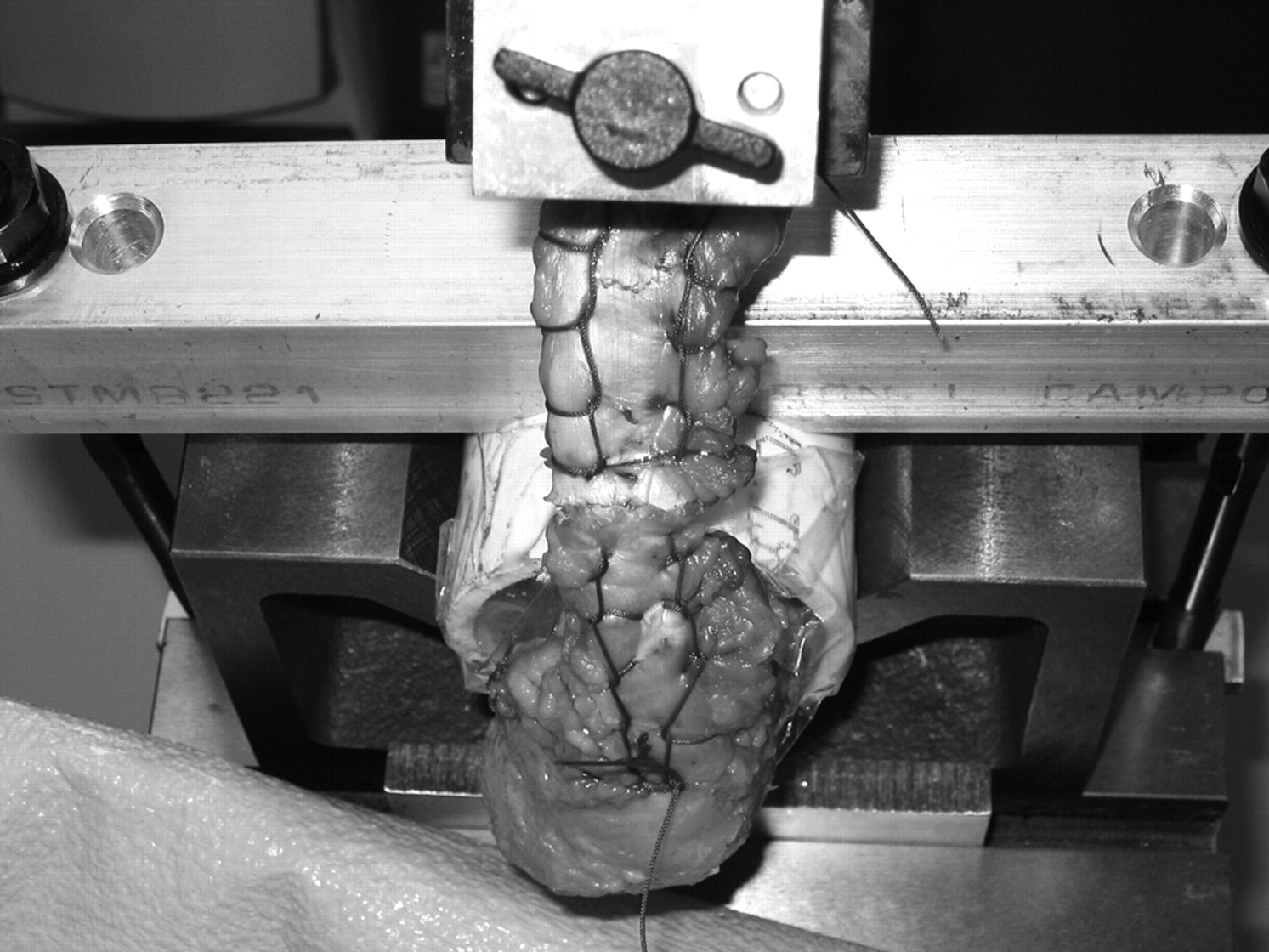
All of the Achilles tendons were transected and repaired by the lead author (K.D.C.). A modified Krackow Achilles tendon repair technique was performed using either a braided polyester #2 Ethibond suture material or a long-chain polyethylene core and woven polyester jacket 2-0 FiberLoop suture material (Fig. 1
). Tendons from the right limb were repaired with 2-0 FiberLoop, and those from the contralateral limb with #2 Ethibond. The cross-sectional areas of one pass of each suture type was calculated before testing. Each specimen was mounted to the base of an Instron materials testing system (Instron, Canton, Ohio) by clamping the potted calcaneus in a V-block clamp attached to an adjustable angle plate (MSG, Atlanta, Georgia). The adjustable angle plate was positioned so that each tendon could be pulled in an anatomical direction. The proximal ends of the repaired tendons were then fixed to the Instron system using custom-made clamps with interdigitating grooves (Fig. 1
). Repairs were preloaded to 10 N and then were pulled to failure per the protocols of Jaakkola et al[
9] and Watson et al[
10] in an anatomical direction at 25.4 mm/sec while data were collected at 200 Hz or every 1 N.
Statistical comparisons of ultimate tensile strength (suture failure) and yield load (the point at which the suture material undergoes damage) were performed using a t test. Significance was measured as P ≤ .05.
Results
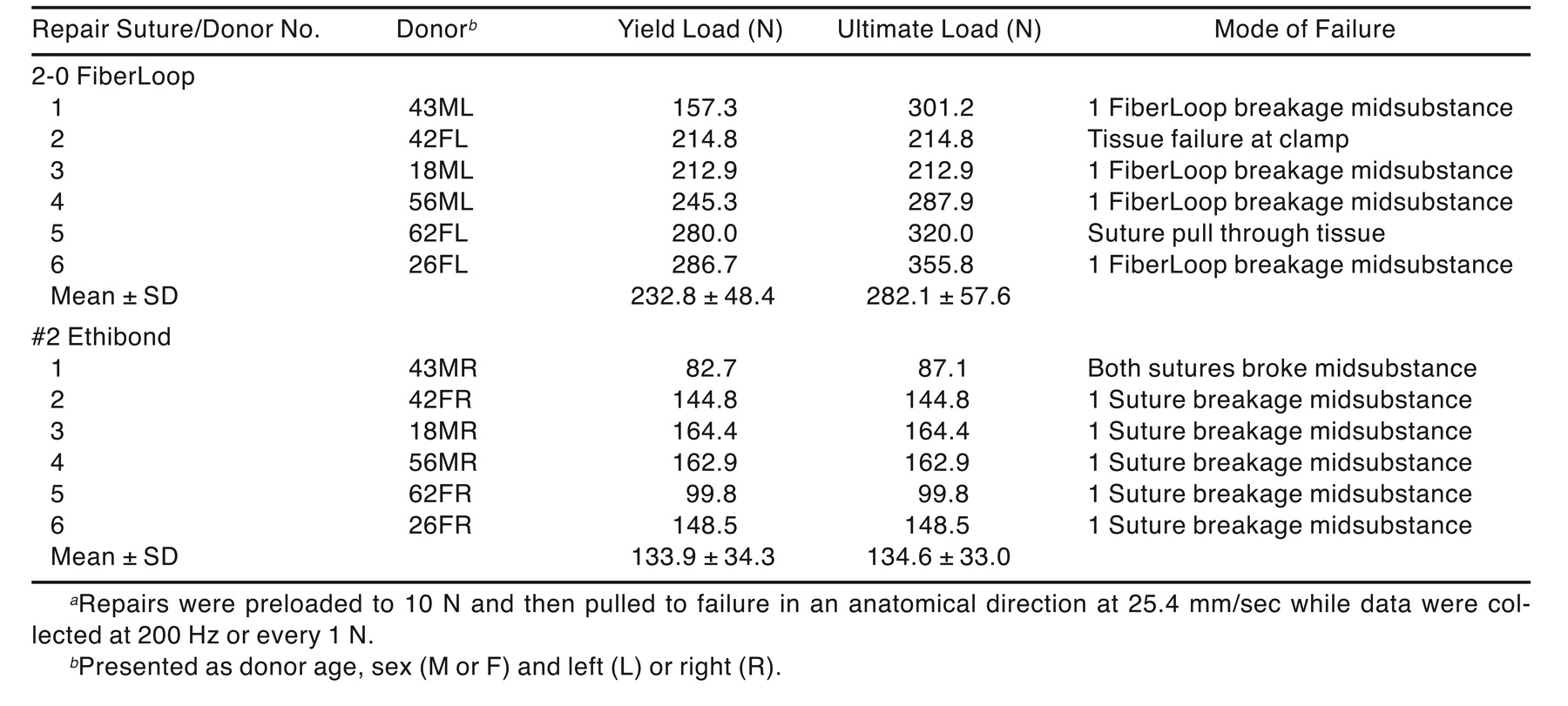
The 2-0 FiberLoop modified Krackow repair group had a mean ± SD yield load of 233 ± 48 N and a mean ± SD ultimate load of 282 ± 58 N. The #2 Ethibond modified Krackow repair group had a mean ± SD yield load of 134 ± 34 N and a mean ± SD ultimate load of 135 ± 33 N.
The mode of failure for four of the repaired specimens in the FiberLoop group was due to one FiberLoop breaking midsubstance, one specimen having tissue failure at the clamp, and one having suture pull through the Achilles tendon. The mode of failure for five of the repaired specimens in the Ethibond group was one strand of Ethibond breaking at midsubstance and for one specimen was both strands of Ethibond breaking at midsubstance (Table 1
). None of the sutures in either group failed at the level of the knot.
The 2-0 FiberLoop repair group had significantly greater yield (
P = .002) and ultimate (
P < .001) loads compared with the #2 Ethibond repair group (Fig. 2
). The cross-sectional area of the 2-0 FiberLoop suture (two strands) was calculated to be 0.21 mm
2, whereas the cross-sectional area of the #2 Ethibond suture was calculated to be 0.28 mm
2.
Discussion
Many suture materials are available to the foot and ankle surgeon; however, none have been universally accepted for tendon repairs. The ideal suture for tendon repair should be relatively inextensible and have a high tensile strength.[
11] Several studies (by Dona et al[
6] and D. Campbell et al, unpublished data, 2004) have shown that the strength and stiffness of Fiber-Wire allows for tendon repairs with a smaller-caliber suture, which is as efficacious as those using larger-caliber sutures of a different material.
Although a small sample size was used in this study, the 2-0 FiberLoop, with a 25% smaller diameter, was found to be more than 100% stronger than the #2 Ethibond. Furthermore, it can be inferred that the thickness of the suture knot with a smaller-diameter suture would be decreased compared with one repaired with a larger suture.
In a study by Jaakkola et al,[
9] the mean ± SD repair strength of #1 Ethibond suture material used for a Krackow locking loop Achilles tendon repair was 161 ± 31 N. Although this load is higher than that found for the #2 Ethibond group in the present study, the difference is not significant (
P >.05). Although the suture was smaller, the repair technique, while similar, was slightly different in that the sutures were tied at the repair site rather than away from the transected part of the tendon, as was performed in this study. Several studies[
12–
15] demonstrate that a braided polyblend polyethylene suture (FiberWire) has superior mechanical properties compared with other sutures, including polyester suture (Ethibond), for tendon repair.
While realizing the abundance of suture material studies for tendon repairs in existence, the results of this study demonstrate that a braided polyblend polyethylene suture is a biomechanically superior alternative to the commonly used nonabsorbable braided polyester suture for Achilles tendon repairs. The higher tensile strength of the polyblend polyethylene was demonstrated in the present study as this suture material pulled through one of the Achilles tendon specimens, whereas the polyester suture tended to rupture more frequently at its midsubstance.
Owing to the slippery nature of braided polyblend polyethylene, more knots are required to provide for adequate knot security.[
16–
18] A total of seven knots provides ultimate tensile strength with the lowest incidence of suture rupture.[
16] Komatsu et al[
16] believed that FiberWire is most suitable for regions covered with subcutaneous fat, where a large knot is not a burden. We suggest using a buried knot for Achilles tendon repairs, where the knot can be in the subcutaneous fat in Kager’s triangle.
Several authors have looked at optimal suture techniques for repairing tendons with a polyblend suture. Yamagami et al,[
17] using gastrocnemius tendons, found that the optimal suture technique that provided the highest antigap strength was the single-locking technique (locking Kessler suture). Watson et al[
19] compared the Kessler, Bunnell, and Krackow sutures and found that the Krackow was the strongest. Sclamberg et al[
20] found no difference in failure strength with the same three suture techniques.
We recognize that there are weaknesses to this study, which include using only one suture technique (Krackow) and using only one type and size of nonabsorbable suture material versus FiberWire. Although we consider the Krackow technique to be a strong construct, other techniques are available. It is unclear whether the results would have changed if varied suture techniques were used along with a larger selection of suture materials and sizes. It is also uncertain whether the results of this study are applicable in vivo. This may be determined via new research.
Conclusions
The smaller 2-0 FiberLoop suture was significantly stronger than the #2 Ethibond suture when tested with cadaveric Achilles tendons. This study suggests that there is no advantage to using the traditional larger suture material for Achilles tendon repairs and that a smaller-caliber suture material may be a viable option for repairing Achilles tendon ruptures. However, further clinical testing is needed to determine the optimal suture size and repair technique.
Table 1.
Modified Krackow Achilles Tendon Repair Yield and Ultimate Loads and the Mode of Failure Using 2-0 FiberLoop or #2 Ethibonda
Table 1.
Modified Krackow Achilles Tendon Repair Yield and Ultimate Loads and the Mode of Failure Using 2-0 FiberLoop or #2 Ethibonda
Figure 1.
Preloaded repaired Achilles tendon.
Figure 1.
Preloaded repaired Achilles tendon.
Figure 2.
Differences in yield loads and ultimate loads between 2-0 FiberLoop and #2 Ethibond in modified Krackow Achilles tendon repair. Error bars represent SD.