1. Introduction
The institutional framework of contemporary financial services has experienced significant structural changes, increasing systemic complexity and operational uncertainty for market participants (
Haldane & May, 2011). In such volatile environments, interorganizational trust is widely recognized as a vital relational asset that diminishes transaction costs, reduces information asymmetries, and supports coordinated organizational efforts (
Dyer & Chu, 2003;
Zaheer et al., 1998). In derivative and futures markets—where transactional integrity, clearing guarantees, and compliance measures are crucial—the reliance on relational governance becomes especially important. In these ecosystems, licensed brokerage firms do not merely interact with futures exchanges as transactional platforms; they rely on them as regulatory authorities, infrastructure providers, and market facilitators. Therefore, interorganizational trust plays a fundamental role in relational governance, influencing how brokerage firms coordinate with exchanges to accomplish their organizational objectives.
Although the conventional academic consensus underscores the performance-enhancing benefits of interorganizational trust, the recent literature has begun to question this perspective. Emerging studies suggest that relational governance may also produce unintended organizational consequences, often referred to as the dark side of trust. While trust provides a foundation for operational stability, excessive reliance on institutional partners can undermine organizational vigilance, hinder critical evaluation, and lead to an over-dependence on external safeguards (
Gargiulo & Ertug, 2006;
Villena et al., 2011). These unintended impacts are particularly pronounced in highly dynamic financial environments, where organizational resilience depends not only on stable external relationships but also on the ongoing development of internal adaptive capabilities. Consequently, the concept of the dark side of trust has gained importance by emphasizing that interorganizational trust does not invariably translate into improved firm performance. This underscores the need for capability-based explanations of such phenomena. Despite increasing conceptual interest, the organizational processes through which these adverse outcomes arise remain insufficiently understood, especially within institutionally dependent financial contexts.
Existing studies have documented the dark side of trust and begun to explain why these unintended organizational consequences arise. A prominent line of reasoning suggests that excessive reliance on trusted interorganizational relationships may gradually weaken internally developed adaptive capabilities by reducing incentives for independent learning, proactive diagnosis, and continuous capability development—a condition commonly referred to as capability erosion (
Gargiulo & Ertug, 2006;
Villena et al., 2011). This perspective aligns with the broader organizational capability literature, which contends that firms sustain long-term competitiveness through the continuous development, renewal, and deployment of internal capabilities that enable effective responses to changing environmental conditions (
Helfat & Peteraf, 2003;
D. J. Teece et al., 1997). Although the notion of capability erosion offers a compelling theoretical explanation for the unintended consequences of interorganizational trust, empirical evidence remains limited regarding how changes in internally developed adaptive capabilities shape the relationship between interorganizational trust and organizational performance. As a result, the capability-related mechanisms through which interorganizational trust influences organizational performance remain an open empirical question.
To address these capability-related processes, it is useful to adopt a theoretical perspective that places organizational capabilities at the center of value creation. The Knowledge-Based View (KBV) asserts that organizational capabilities serve as the fundamental mechanisms through which firms integrate, develop, and utilize knowledge to attain a sustainable competitive advantage (
Grant, 1996). From this perspective, variations in organizational performance reflect not only differences in the quality of external relationships but also differences in how organizations develop and deploy internally developed adaptive capabilities (
D. J. Teece, 2007). Adopting a capability-based perspective provides a complementary approach to understanding how interorganizational trust influences firm performance beyond the relational governance mechanisms emphasized in previous studies. Within this broader framework, problem-solving capability (PSC) represents a particularly critical organizational capability, enabling firms to recognize emerging anomalies, interpret complex market signals, evaluate strategic alternatives, and implement timely organizational responses (
Cummings & Nickerson, 2024;
Nickerson & Zenger, 2004).
Building on these theoretical tensions, further empirical investigation is needed to examine how organizational capabilities shape the nexus between interorganizational trust and firm performance. While the notion of capability erosion offers a compelling theoretical rationale for why excessive reliance on trusted interorganizational relationships may undermine internally developed adaptive capabilities, empirical evidence on how this process unfolds remains scarce. Addressing this theoretical gap, this study adopts a capability-based perspective to examine the relationship between interorganizational trust and firm performance, positioning problem-solving capability (PSC) as an empirically observable adaptive capability through which this mechanism can be comprehensively understood. In doing so, this study responds to calls for a deeper understanding of the organizational processes underlying the dark side of trust (
Schoorman et al., 2007) and extends the literature by providing empirical insights that complement the capability erosion argument in institutionally dependent settings.
The Indonesian derivatives ecosystem provides a highly relevant empirical setting for examining these theoretical arguments due to the heavy structural dependence of brokerage firms on the futures exchange. As the nation’s primary futures trading authority, the Jakarta Futures Exchange (JFX) operates within a regulatory environment marked by stringent compliance requirements, evolving investor participation, and high informational dynamism (
BAPPEBTI, 2023). Indonesian futures brokerage firms rely extensively on the exchange for transaction execution, regulatory oversight, market infrastructure, and institutional legitimacy. Operating within this highly centralized governance structure while facing continuous market uncertainty renders the Indonesian derivatives ecosystem exceptionally suitable for investigating how interorganizational trust influences organizational performance through organizational capabilities. Accordingly, this study investigates the interrelationships among interorganizational trust, problem-solving capability, and firm performance within the Indonesian derivatives ecosystem from a capability-based lens.
This study contributes to the literature in several important ways. First, although prior research increasingly recognizes that interorganizational trust can yield unintended consequences—often termed the dark side of trust (
Gargiulo & Ertug, 2006;
Villena et al., 2011)—few studies explicitly examine the underlying organizational mechanisms through which trust translates into firm performance. Most existing studies focus on the direct link between trust and performance (
Cao & Lumineau, 2015;
Zaheer et al., 1998), implicitly assuming uniform relational outcomes. By conceptualizing problem-solving capability as an internally developed adaptive mechanism, this study expands the dark side of the trust literature, demonstrating how adverse organizational outcomes arise when relational reliance undermines internal capability development.
Furthermore, while the Knowledge-Based View emphasizes organizational capabilities as the foundation for knowledge integration and sustainable competitive advantage (
Grant, 1996;
D. J. Teece, 2007), limited attention has been paid to how these capabilities interface with external relational governance. Existing studies predominantly treat capabilities as internally oriented strategic assets (
Nickerson & Zenger, 2004;
D. J. Teece, 2007). This study extends KBV by demonstrating how an internal adaptive capability translates external relational conditions into firm performance, broadening the theory’s application in institutionally dependent governance contexts.
In addition, although capability erosion has been proposed as a plausible explanation for why excessive trust may weaken internal capabilities (
Gargiulo & Ertug, 2006;
Ritter & Walter, 2012;
Villena et al., 2011), empirical validation remains limited. Utilizing population-wide census data from Chief Executive Officers of all licensed Indonesian futures brokerage firms and employing Partial Least Squares Structural Equation Modeling (PLS-SEM) for analysis, our findings indicate that interorganizational trust is negatively related with both problem-solving capability and firm performance. Conversely, problem-solving capability is positively associated with firm performance and mediates the relationship between trust and performance. These empirical results suggest that the unintended consequences of trust stem partly from diminished problem-solving capabilities, offering empirical alignment with the capability erosion perspective and establishing a baseline for future longitudinal inquiries.
Finally, prior research on interorganizational trust has concentrated primarily on interfirm buyer–supplier settings, strategic alliances, and supply chain networks (
Cao & Lumineau, 2015;
Dyer & Chu, 2003;
Dyer & Singh, 1998). Institutionally dependent financial ecosystems in emerging economies remain under-researched, despite being shaped by centralized governance, regulatory oversight, and institutional dependence. By examining these relationships within the Indonesian derivative ecosystem, this study extends the contextual boundaries of relational governance literature to highly regulated, institutionally dependent financial settings.
We organize the remainder of this paper as follows.
Section 2 reviews the theoretical background and develops the testable hypotheses.
Section 3 outlines the research design, census methodology, and construct operationalization.
Section 4 presents the empirical findings and structural model evaluations.
Section 5 discusses the theoretical and practical implications, and
Section 6 concludes the paper.
2. Hypotheses Development
2.1. Interorganizational Trust and Firm Performance
Within the landscape of relational governance, interorganizational trust operates as a foundational informal mechanism that facilitates strategic cooperation, operational coordination, and collective value creation among corporate partners (
Dyer & Singh, 1998;
Zaheer et al., 1998). In this context, trust reflects the expectation that a partner organization will conduct its operations in a reliable, predictable, honest, and non-opportunistic manner (
Mayer et al., 1995). These shared expectations effectively reduce localized environmental uncertainty and foster confidence within interorganizational exchanges (
Zaheer et al., 1998). As organizations increasingly depend on external relationships to access complementary resources, coordinate interdependent activities, and respond to dynamic market conditions, interorganizational trust emerges as a critical relational governance mechanism. Such trust enables more effective collaboration and lowers the costs of interorganizational exchanges, thereby contributing to superior firm performance (
Dyer & Singh, 1998;
Zhong et al., 2017).
This positive paradigm within the interorganizational trust–firm performance relationship is conceptually grounded in Social Exchange Theory (SET), which frames interfirm dynamics as a series of evolving, iterative exchanges governed by norms of reciprocity, mutual obligation, and long-term cooperative expectations (
Blau, 1964). According to the core tenets of SET, higher levels of mutual trust minimize transaction-specific concerns regarding opportunistic behavior, thereby enhancing managerial confidence in exchange partners and encouraging firms to embed themselves in mutually beneficial cooperative routines. Within high-trust partnerships, participating firms exhibit a greater willingness to share proprietary information, commit relationship-specific capital, and synchronize operational workflows. This operational fluidity occurs because decision-makers perceive lower relational hazards and anticipate greater predictability from their counterparties (
Zaheer et al., 1998). Drawing on Social Exchange Theory, interorganizational trust establishes a stable relational environment that enables firms to reallocate managerial attention and organizational resources from intensive monitoring activities to value-creating initiatives. This reallocation, in turn, creates conditions that facilitate superior firm performance (
Dyer & Chu, 2003).
In practice, interorganizational trust supports organizational performance through several complementary operational pathways. As an efficient substitute for formal governance, trust curtails the necessity for exhaustive contractual specifications and dense legal monitoring, thereby reducing transaction and governance costs (
Aulakh et al., 1996;
Dyer & Chu, 2003). These governance efficiencies foster a more collaborative operating environment by promoting open communication, joint strategic planning, and coordinated problem-solving among exchange partners (
Cao & Lumineau, 2015;
Zaheer et al., 1998). In turn, such collaboration facilitates more extensive knowledge transfer and more effective resource integration, as firms become increasingly willing to share valuable knowledge assets and specialized resources when concerns about opportunistic appropriation are alleviated (
Hernández-Espallardo et al., 2010;
Inkpen & Tsang, 2005). Collectively, these relational processes enhance organizational learning, improve strategic agility, and ultimately contribute to superior firm performance (
Zhong et al., 2017).
This performance-enhancing paradigm has accumulated substantial empirical support across multiple research domains. In their foundational study,
Zaheer et al. (
1998) demonstrated that interorganizational trust reduces negotiation friction and interfirm conflict while concurrently maximizing overall exchange performance. This positive association extends to cross-border environments, where
Aulakh et al. (
1996) provided evidence that trust directly underpins superior market performance within international partnerships. More recently, meta-analytic evidence has reinforced the robustness of these findings, indicating that interorganizational trust is consistently associated with more effective collaborative relationships and improved performance outcomes across diverse organizational settings (
Li et al., 2025;
Zhong et al., 2017). Taken together, the prevailing consensus establishes that interorganizational trust operates as a pivotal relational catalyst that fosters superior firm performance by optimizing transaction costs, tightening operational coordination, and facilitating collaborative knowledge networks.
The relevance of these relational governance mechanisms becomes particularly salient in futures market environments. In these settings, licensed brokerage firms operate within a centralized, interdependent institutional matrix comprising clearinghouses, regulatory bodies, and exchanges. Orderly and efficient derivative market operations depend heavily on near-instantaneous information transmission, synchronized clearing adjustments, and systematic compliance with evolving mandates (
Pirrong, 1999,
2011). Within this structure, trust between brokerage firms and the futures exchange facilitates fluid communication, reduces operational friction, expands access to macro market intelligence, and stabilizes systemic coordination (
Gulati & Nickerson, 2008;
Zaheer et al., 1998). Through these channels, interorganizational trust enhances operational efficiency and strengthens firms’ responsiveness to changing market conditions (
D. J. Teece, 2007).
Collectively, Social Exchange Theory and the accumulated empirical literature establish that interorganizational trust constitutes a vital relational asset that yields superior firm performance by strengthening coordination, reducing uncertainty, and enabling collaborative value creation. Accordingly, we formulate the baseline hypothesis as follows:
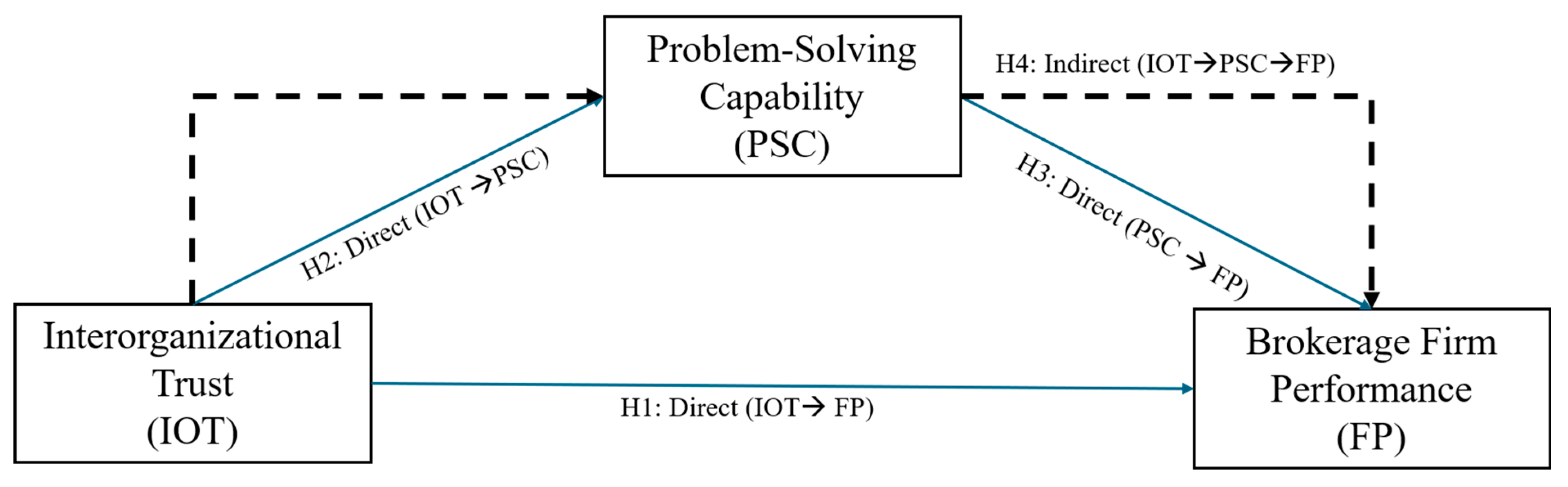
Hypothesis 1 (H1). Interorganizational trust is positively associated with firm performance in the futures brokerage sector.
2.2. Interorganizational Trust and Problem-Solving Capability
Although interorganizational trust is widely recognized as a critical relational governance mechanism that creates favorable conditions for superior organizational performance (
Aulakh et al., 1996;
Dyer & Chu, 2003;
Zaheer et al., 1998), emerging studies increasingly suggest that trust also influences organizational performance through mechanisms that extend beyond relational governance. Such nuance indicates that the relationship between trust and performance is far more complex than previously understood. These insights highlight the imperative of adopting a capability-based perspective. Grounded in the Knowledge-Based View, this perspective posits that sustained organizational performance depends not only on the quality of interorganizational relationships but also on an organization’s incentives to cultivate internally developed adaptive capabilities (
Grant, 1996). Within this broader framework, the literature on the dark side of trust provides a critical conceptual lens, establishing that excessive reliance on trusted interorganizational relationships can weaken an organization’s incentives to cultivate such capabilities (
Gargiulo & Ertug, 2006;
Villena et al., 2011).
The Knowledge-Based View (KBV) asserts that sustained competitive advantage is rooted in an organization’s capacity to develop, integrate, and apply knowledge through internally developed adaptive capabilities (
Grant, 1996). From this viewpoint, organizational capabilities are not static assets but dynamic routines that enable firms to interpret environmental signals, integrate dispersed knowledge, and continuously adapt strategic responses to changing competitive conditions (
Grant, 1996;
D. J. Teece, 2007). Although interorganizational relationships provide valuable external knowledge and resources, the ultimate strategic value of these relationships hinges on an organization’s internal capacity to absorb, refine, and transform external knowledge into capabilities that support independent learning and adaptation. Accordingly, organizations that systematically cultivate internally developed adaptive capabilities are better equipped to preserve strategic flexibility and sustain superior performance within dynamic market environments.
While the Knowledge-Based View underscores the strategic imperative of cultivating adaptive capabilities, the dark side of trust literature offers a compelling conceptual explanation for why organizations may become less motivated to do so, even when maintaining robust interorganizational partnerships. In this sense, excessive reliance on trusted partners gradually redirects organizational attention away from independent evaluation and internal capability development, fostering an over-dependence on established relational arrangements (
Gargiulo & Ertug, 2006;
Villena et al., 2011). Instead of actively questioning underlying assumptions, seeking alternative information sources, and strengthening internal learning routines, organizations increasingly rely on relational assurances to interpret environmental conditions and guide strategic decisions (
Langfred, 2004;
Villena et al., 2011). This tendency is further reinforced by structural overembeddedness, whereby dense and enduring interorganizational ties narrow an organization’s informational search horizons, reduce exposure to diverse perspectives, and suppress independent critical inquiry (
Gargiulo & Benassi, 2000;
Schilke et al., 2021;
Uzzi, 1997). Consequently, excessive reliance on interorganizational trust attenuates an organization’s incentives to cultivate the adaptive capabilities necessary to sustain independent learning and long-term strategic adaptation.
Among the various adaptive capabilities highlighted by the Knowledge-Based View, this study focuses on Problem-Solving Capability (PSC) as a pivotal organizational capability that enables firms to respond effectively to environmental uncertainty. PSC reflects an organization’s capacity to identify emerging operational anomalies, interpret complex or ambiguous information, generate alternative strategic responses, and implement timely solutions in rapidly changing environments (
Grant, 1996;
Nickerson & Zenger, 2004). Instead of serving merely as a routine administrative function, PSC functions as a higher-order organizational mechanism that integrates knowledge, supports strategic learning, and facilitates adaptation through continuous problem identification, evaluation, and resolution (
Crossan et al., 1999;
Shu, 2019;
D. J. Teece, 2007). Accordingly, organizations possessing robust problem-solving capabilities are better equipped to detect environmental shocks, independently evaluate strategic alternatives, and formulate adaptive responses that protect long-term performance.
These theoretical arguments are particularly salient in futures brokerage markets, where firms operate amidst high price volatility, rapid information flows, and evolving regulatory mandates. In such environments, brokerage firms must continuously interpret emerging market signals, independently reassess changing risk exposures, and formulate timely strategic responses to sustain competitive standing. Although close relationships with futures exchanges and institutional partners provide critical market intelligence and governance support, these external relationships are most effective when complementing—rather than substituting for—internally developed problem-solving capabilities. Excessive reliance on trusted institutional partners weakens a brokerage firm’s incentives to cultivate these internal capabilities, thereby eroding its capacity to independently diagnose emerging challenges and adapt to shifting market conditions. Consequently, while interorganizational trust provides significant relational and governance advantages, excessive reliance on trusted institutional relationships impairs problem-solving capability, constraining long-term organizational adaptability within the futures brokerage sector. Based on these theoretical considerations, we formulate the hypothesis as follows:
Hypothesis 2 (H2). Interorganizational trust is negatively associated with problem-solving capability in the futures brokerage sector.
2.3. Problem-Solving Capability and Firm Performance
The Knowledge-Based View (KBV) posits that sustained organizational performance depends on an organization’s capacity to develop, integrate, and deploy internally developed adaptive capabilities (
Grant, 1996). Within this theoretical perspective, differences in organizational performance are attributed not merely to raw access to valuable knowledge, but to an organization’s capacity to translate that knowledge into effective organizational action. Among the various internally developed adaptive capabilities that enable this translation, Problem-Solving Capability (PSC) represents a particularly critical organizational asset because it enables firms to interpret complex information, integrate dispersed knowledge, evaluate strategic alternatives, and formulate adaptive responses to environmental uncertainty (
Grant, 1996;
Nickerson & Zenger, 2004).
Problem-solving capability enables organizations to convert knowledge into effective organizational action by supporting the ongoing interpretation of rapidly changing environmental information, the assessment of strategic alternatives, and the execution of timely organizational responses (
Nickerson & Zenger, 2004). Instead of relying solely on accumulated static knowledge, organizations with strong problem-solving capabilities continually process new information, re-evaluate existing assumptions, and adjust their decisions in response to shifting environmental conditions. This capability is especially vital in dynamic business environments, where organizations must address non-routine problems, emerging risks, and shifting competitive conditions both rapidly and accurately (
D. Teece et al., 2016). Consequently, firms with stronger problem-solving capabilities are better equipped to identify emerging challenges and design appropriate strategic responses, thereby creating organizational conditions that support superior firm performance in dynamic environments (
Cummings & Nickerson, 2024;
D. J. Teece, 2018).
The organizational value of problem-solving capability extends beyond facilitating effective decision-making to underpinning sustained organizational performance. By systematically interpreting environmental information, assessing strategic alternatives, and implementing suitable organizational responses, firms allocate resources more efficiently, respond proactively to emerging challenges, and exploit evolving market opportunities (
Cummings & Nickerson, 2024;
Nickerson & Zenger, 2004). These processes reinforce strategic learning, enhance decision quality, and improve adaptive responsiveness, enabling organizations to preserve operational effectiveness amid growing environmental complexity (
D. J. Teece, 2007;
D. Teece et al., 2016). Accordingly, organizations with stronger problem-solving capabilities maintain superior firm performance, as they consistently translate knowledge into effective strategic actions that underpin long-term organizational competitiveness.
The capability-based perspective adopted in this study has received growing empirical support across the strategic management literature. Consistent with the Knowledge-Based View, this body of research demonstrates that organizational performance is driven not only by access to external knowledge assets but also by an organization’s internal capacity to deploy adaptive routines. For instance,
Helfat and Peteraf (
2015) show that systematic problem-solving processes enhance organizational resilience and decision quality under conditions of high environmental uncertainty and informational complexity. Similarly,
Cummings and Nickerson (
2024) conceptualize firms as dynamic problem-solving systems, demonstrating that superior problem-solving capability enables organizations to generate effective solutions to complex transactional challenges. In line with these theoretical arguments, empirical research further establishes that stronger problem-solving capability improves both operational and financial performance (
Carmeli et al., 2013) while reinforcing strategic flexibility and competitive advantage in turbulent environments (
Shu, 2019). Taken together, this body of evidence provides robust support for the view that problem-solving capability functions as a critical internally developed adaptive capability through which organizations achieve and sustain superior firm performance.
These implications are especially pronounced in futures brokerage markets, where organizations operate amidst high environmental uncertainty, rapid information flows, and evolving regulatory frameworks. In such conditions, brokerage firms must constantly interpret complex market signals, reassess evolving risk exposures, and devise timely strategic responses to maintain organizational performance. Although futures exchanges and institutional partners offer valuable market information, governance support, and regulatory guidance, these external resources are insufficient on their own to secure superior firm performance. Instead, brokerage firms require robust, internally developed problem-solving capabilities that enable them to critically evaluate available information, respond effectively to non-routine challenges, and translate market knowledge into appropriate strategic actions. Consequently, firms with stronger problem-solving capabilities are better equipped to exploit emerging market opportunities, mitigate evolving risks, and sustain superior performance within the highly dynamic futures brokerage sector. Based on these theoretical considerations, we formulate the hypothesis as follows:
Hypothesis 3 (H3). Problem-solving capability is positively associated with firm performance in the futures brokerage sector.
2.4. The Mediating Role of Problem-Solving Capability
Although interorganizational trust is widely acknowledged as a crucial relational asset that facilitates cooperation, lowers transaction costs, and enhances organizational performance, clarifying how these benefits actually arise remains a significant theoretical challenge (
Schoorman et al., 2007;
Zaheer et al., 1998). Existing research has largely accounted for the relationship between interorganizational trust and firm performance through direct-effect models, arguing that trust improves outcomes by strengthening relational governance, enabling more effective information exchange, and supporting collaborative coordination (
Gulati & Nickerson, 2008;
Zhong et al., 2017). While these explanations offer valuable insights into the relational advantages of trust, they provide only a limited understanding of the internal organizational processes through which external relational conditions are transformed into superior firm performance. Therefore, moving beyond direct-effect explanations to investigate the organizational mechanisms underlying this relationship represents an important step toward developing a more comprehensive understanding of how interorganizational trust ultimately shapes firm performance (
Schoorman et al., 2007).
The capability-based perspective adopted in this study offers a robust theoretical framework for explaining how interorganizational trust influences firm performance through specific organizational mechanisms. Drawing on the Knowledge-Based View (KBV), this perspective contends that sustainable organizational performance depends not only on firms’ access to valuable external knowledge and relational resources but also on their capacity to develop and deploy internally developed adaptive capabilities (
Grant, 1996). Within this theoretical perspective, external relational conditions enhance organizational performance only as long as they strengthen the internal capabilities through which organizations interpret information, assess strategic alternatives, and design effective organizational responses (
Nickerson & Zenger, 2004;
D. Teece et al., 2016). Among these internally developed adaptive capabilities, Problem-Solving Capability (PSC) is particularly critical because it enables firms to translate externally sourced knowledge into effective strategic actions amid environmental uncertainty (
Cummings & Nickerson, 2024;
Nickerson & Zenger, 2004). From this standpoint, explaining how interorganizational trust shapes firm performance requires examining its influence on the development and deployment of internal problem-solving capability, rather than presuming that relational benefits automatically lead to superior organizational outcomes.
This capability-based perspective also offers a valuable basis for understanding why the organizational benefits of interorganizational trust may not always be sustained over time. Instead of presuming that relational resources consistently reinforce internally developed adaptive capabilities, the more recent literature indicates that excessive dependence on trusted external relationships gradually diminishes an organization’s motivation to preserve independent analytical routines, ongoing environmental scanning, and critical problem-solving activities (
Gargiulo & Benassi, 2000;
Gargiulo & Ertug, 2006;
Villena et al., 2011). From this vantage point, the notion of capability erosion, as articulated by
Ritter and Walter (
2012), provides a crucial theoretical lens for explaining how excessive dependence on external relational support can gradually weaken the internal capabilities that organizations employ to interpret information, assess strategic alternatives, and formulate adaptive organizational responses. As organizations increasingly depend on external relational safeguards and institutional protections, managerial attention progressively shifts away from exploratory learning, independent problem diagnosis, and iterative capability development, thereby undermining the continuous cultivation of critical problem-solving activities (
Cummings & Nickerson, 2024;
D. Teece et al., 2016).
Since problem-solving capability constitutes an internally developed adaptive capability through which organizations convert external knowledge into effective strategic actions, any slowdown in its continuous development inevitably weakens an organization’s capacity to transform relational resources into superior performance outcomes. When problem-solving activities become less systematic and autonomous, organizations find it more difficult to interpret complex environmental signals, rigorously assess strategic alternatives, and formulate timely responses to emerging operational challenges (
Cummings & Nickerson, 2024;
D. Teece et al., 2016). As a result, the benefits derived from interorganizational trust increasingly depend on a firm’s ability to maintain a strong problem-solving capability, rather than arising automatically from relational exchanges. From a capability-based perspective, problem-solving capability therefore serves as the central organizational mechanism through which the positive and negative effects of interorganizational trust are ultimately translated into firm performance.
This capability-mediated mechanism is especially pertinent to the futures brokerage industry, where firms operate amid pronounced market volatility, continuous information flows, and evolving regulatory frameworks. In such an environment, brokerage firms must persistently interpret rapidly shifting market conditions, assess emerging trading risks, and devise timely strategic responses under significant time pressure. Although exchanges and regulatory bodies offer extensive market data, governance support, and institutional safeguards, these external resources cannot replace the internally developed problem-solving capability required to interpret, evaluate, and act on market information effectively. In such settings, firms that become overly reliant on external relational support gradually erode the independent analytical activities that underpin a robust problem-solving capability. This gradual erosion, in turn, diminishes their capacity to respond effectively to localized operational challenges and ultimately constrains organizational performance. Accordingly, the futures brokerage sector constitutes a highly suitable organizational setting in which the mediating role of problem-solving capability can be meaningfully conceptualized and empirically investigated.
Taken together, these theoretical arguments establish that the organizational implications of interorganizational trust are better understood by accounting for the internal capabilities that convert relational resources into organizational performance. From a capability-based perspective, problem-solving capability functions as the core organizational mechanism linking external relational conditions to firm performance, whereas capability erosion explains how excessive reliance on external relational support can gradually undermine this mechanism over time. Accordingly, the effect of interorganizational trust on firm performance operates, at least in part, through its impact on problem-solving capability. Based on these integrated theoretical considerations, we formulate the hypothesis as follows:
Hypothesis 4 (H4). Problem-solving capability mediates the relationship between interorganizational trust and firm performance within the futures brokerage sector.
Figure 1 illustrates the conceptual framework that underpins the proposed relationships among interorganizational trust, problem-solving capability, and firm performance.
5. Discussion
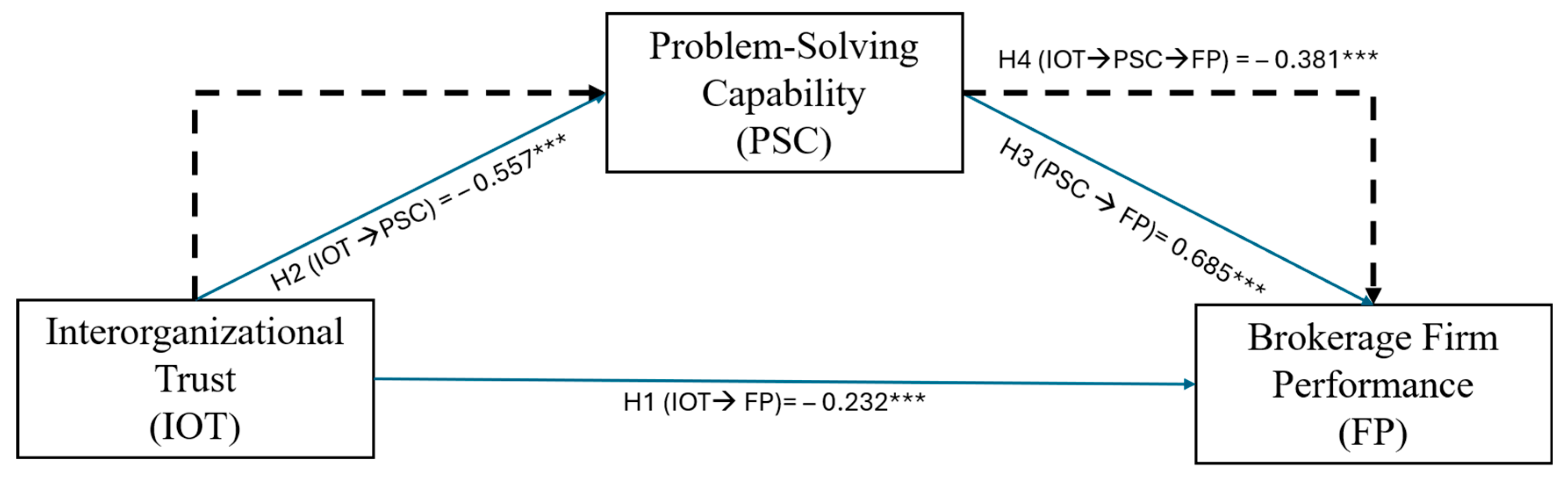
Contrary to conventional expectations grounded in Social Exchange Theory, our empirical evidence indicates that interorganizational trust is negatively associated with firm performance in the Indonesian futures brokerage industry (
,
). At first glance, this finding appears to conflict with the dominant relational governance literature, which has consistently characterized interorganizational trust as a vital relational asset that enhances firm performance by fostering cooperation, reducing transaction costs, and tightening interorganizational coordination (
Aulakh et al., 1996;
Dyer & Chu, 2003;
Zaheer et al., 1998). Instead of directly refuting these well-established theoretical arguments, our empirical results prompt a more fundamental question: why does interorganizational trust fail to yield superior firm performance within this specific institutional environment?
A plausible explanation is that the traditional relational governance perspective clarifies how trust promotes interorganizational cooperation, but offers only limited insight into how these relational advantages translate into superior organizational performance. Although trust-based relationships undoubtedly facilitate information exchange, operational coordination, and strategic collaboration (
Dyer & Singh, 1998;
Gulati & Nickerson, 2008;
Zaheer et al., 1998), these relational benefits do not automatically guarantee improved performance outcomes. Relational advantages are more likely to yield superior firm performance when organizations possess the requisite internally developed adaptive capabilities needed to interpret external information, assess strategic options, and execute effective organizational responses (
Grant, 1996;
Nickerson & Zenger, 2004;
D. J. Teece, 2007). Accordingly, our findings indicate that relational governance alone provides an incomplete account of the trust–performance relationship. In this regard, a complementary capability-based perspective is imperative to elucidate the internal organizational mechanisms through which relational resources are converted into firm performance.
Our empirical findings address this question by demonstrating that problem-solving capability functions as a critical organizational mechanism linking interorganizational trust to firm performance. Specifically, interorganizational trust is negatively related to problem-solving capability (, ), whereas problem-solving capability is positively associated with firm performance (, ). Taken together, these results suggest that the organizational consequences of interorganizational trust cannot be fully captured by evaluating only the quality of external relational governance. Instead, they also hinge on whether firms continuously cultivate and maintain internally grounded adaptive capabilities that enable them to interpret external information, assess strategic alternatives, and design effective organizational responses.
This interpretation directly aligns with the capability-based perspective adopted in this study. From the standpoint of the Knowledge-Based View, organizational performance is driven not only by a firm’s access to valuable relational resources but also by its capacity to convert these resources into effective strategic actions through internally developed adaptive capabilities (
Grant, 1996). Within this theoretical framework, problem-solving capability represents a pivotal organizational routine, enabling firms to critically interpret environmental signals, synthesize dispersed knowledge, and formulate timely strategic responses under high uncertainty (
Nickerson & Zenger, 2004;
D. J. Teece, 2007). Although interorganizational trust provides substantial relational and governance advantages, its ultimate contribution to firm performance appears to depend on whether these advantages augment, rather than replace, an organization’s internally developed adaptive capabilities.
The mediation analysis further substantiates this interpretation by establishing that problem-solving capability operates not merely as a direct driver of firm performance, but as the underlying organizational mechanism through which interorganizational trust affects performance. The indirect pathway linking interorganizational trust to firm performance via problem-solving capability is statistically significant (, ), indicating that the negative relationship between trust and firm performance is conveyed, at least in part, through its detrimental influence on a firm’s problem-solving capability. Overall, the combination of direct and indirect path estimates suggests that the organizational implications of interorganizational trust extend beyond the relational governance benefits emphasized in conventional paradigms, highlighting internal capability development as a crucial transmission mechanism.
More importantly, the observed mediation pattern situates our empirical findings within the broader literature on the interface between relational governance and organizational capability. Prior studies have typically examined these perspectives in isolation, focusing either on the governance benefits of interorganizational trust (
Dyer & Singh, 1998;
Gulati & Nickerson, 2008;
Zaheer et al., 1998) or on the strategic importance of internal capabilities (
Grant, 1996;
Nickerson & Zenger, 2004;
D. J. Teece, 2007). Our findings indicate that these theoretical perspectives represent complementary elements of a unified capability-based process. Specifically, interorganizational trust supplies external relational inputs, whereas problem-solving capability dictates the degree to which these relational inputs translate into superior firm performance. Accordingly, the observed mediation pattern provides empirical support for conceptualizing organizational capability as the vital bridge linking external relational conditions to organizational outcomes.
At the same time, the observed mediation pattern raises an equally critical theoretical question: if problem-solving capability constitutes the mechanism through which relational resources enhance firm performance, why does stronger interorganizational trust undermine the development of this capability? Although this study does not trace this process longitudinally, the literature on capability erosion offers a compelling theoretical explanation (
Ritter & Walter, 2012;
Villena et al., 2011). From this viewpoint, organizations that become excessively reliant on trusted external partners gradually reduce their commitment to internal adaptive capabilities, allowing relational resources to substitute for—rather than reinforce—independent organizational learning and problem-solving routines. Interpreted through this theoretical lens, our findings provide an initial empirical foundation that aligns with the capability erosion argument, explaining why interorganizational trust does not invariably lead to superior firm performance.
Beyond establishing empirical alignment with the capability erosion perspective, our findings underscore the broader relevance of a capability-based framework for understanding the consequences of interorganizational trust within highly regulated financial ecosystems. Although prior research has predominantly applied capability-based explanations within manufacturing, technology, and supply chain settings (
Cummings & Nickerson, 2024;
Nickerson & Zenger, 2004;
Shu, 2019;
D. J. Teece, 2007), this study demonstrates that similar capability-based dynamics operate within the Indonesian futures brokerage sector, where firm activities are shaped by dense institutional coordination, stringent regulatory oversight, and heavy structural dependence on central governance bodies. These insights imply that the organizational implications of interorganizational trust cannot be fully explained by relational governance mechanisms alone, even within institutional environments characterized by formal governance and oversight arrangements.
Building on this contextual perspective, our results suggest that the identified capability-based mechanisms may extend beyond the specific context of the Indonesian futures brokerage sector. Although we do not assert that identical organizational outcomes necessarily emerge across all institutional settings, the observed mediation pattern provides a baseline for comparative research examining whether these capability-based processes operate across different industrial sectors, regulatory regimes, and national environments. From this vantage point, our empirical findings highlight the capability-based framework as a promising avenue for future comparative inquiries investigating how interorganizational trust shapes firm performance across diverse institutional contexts.
Taken together, these findings offer several key contributions to the literature on interorganizational trust and organizational capability. By demonstrating that the organizational consequences of interorganizational trust are better understood through a capability-based lens, this study extends the dominant relational governance perspective and offers a more refined explanation of why trust does not consistently yield superior firm performance. Furthermore, by identifying problem-solving capability as the core organizational mechanism connecting interorganizational trust to firm performance, this study integrates the relational governance and Knowledge-Based View literatures into a unified capability-based framework detailing how relational resources are converted into organizational outcomes. Finally, by providing an initial empirical foundation that aligns with the capability erosion argument within a highly regulated financial ecosystem, this study broadens the contextual scope of the existing literature and establishes a promising platform for future comparative research to investigate whether similar capability-based processes operate across diverse institutional, industrial, and national settings.
6. Conclusions, Implications, and Future Research Agenda
6.1. Conclusions
Why interorganizational trust does not consistently translate into superior firm performance remains a key unresolved question in the relational governance literature. On the one hand, conventional studies have repeatedly demonstrated that trust promotes cooperation, mitigates behavioral uncertainty, and enhances organizational outcomes. On the other hand, a growing body of literature indicates that these relational advantages do not invariably yield positive organizational performance across diverse institutional environments. Addressing this theoretical tension, the present study investigates the role of problem-solving capability within the Indonesian futures brokerage industry. This highly regulated, institutionally dependent financial ecosystem provides an ideal setting for examining the organizational mechanisms through which interorganizational trust shapes firm performance.
Our empirical findings suggest that the organizational consequences of interorganizational trust are better understood through a capability-based perspective than by relying on relational governance mechanisms alone. While interorganizational trust provides important relational and coordination benefits, these advantages are more likely to translate into superior firm performance when organizations systematically cultivate and sustain internally developed adaptive capabilities. These internal routines enable firms to interpret environmental signals, critically evaluate strategic alternatives, and execute effective organizational responses under uncertainty. Specifically, our results highlight problem-solving capability as the key organizational mechanism through which relational resources are converted into firm performance, underscoring the indispensable role of internal capability development in preserving and extracting the organizational value of trusted interorganizational relationships.
From a capability-based lens, the organizational implications of interorganizational trust function as an internally mediated process rather than a direct consequence of relational governance alone. Although this study does not trace capability erosion longitudinally, the observed mediation pattern provides an initial empirical foundation that aligns with the capability erosion perspective, offering a plausible theoretical explanation for why the organizational benefits of interorganizational trust may attenuate over time. Overall, this study demonstrates that the ultimate value of interorganizational trust depends not only on the quality of external relational governance but also on an organization’s commitment to continuously developing and preserving the internal adaptive capabilities through which relational resources are converted into superior firm performance.
6.2. Theoretical Contribution
This study makes four interrelated theoretical contributions to the management and strategy literature. First, it advances research on relational governance by offering a capability-based explanation of how interorganizational trust is converted into firm performance. Whereas prior studies have largely accounted for the organizational consequences of interorganizational trust in terms of its direct relational benefits, this study demonstrates that such advantages do not automatically produce superior performance outcomes. Instead, their positive effects appear conditional on an organization’s ability to continuously develop and preserve internally grounded adaptive capabilities. By identifying problem-solving capability as the core organizational mechanism through which relational resources are converted into firm performance, this study provides a more comprehensive explanation of why interorganizational trust does not consistently lead to superior firm performance.
Second, this study advances the Knowledge-Based View by illustrating how internally developed adaptive capabilities shape the organizational outcomes of interorganizational relationships. Prior capability-based research has predominantly highlighted the strategic importance of internal capabilities for knowledge integration, organizational learning, and competitive advantage (
Grant, 1996;
D. J. Teece, 2007). This study expands on this perspective by demonstrating that such capabilities also dictate the degree to which external relational resources translate into firm performance. In doing so, it bridges the literatures on relational governance and the Knowledge-Based View into a unified, capability-based framework detailing how relational resources are transformed into superior firm performance.
Third, this study advances the emerging literature on capability erosion by providing an initial empirical foundation that aligns with its core theoretical premises. Instead of conceptualizing capability erosion as an immediately observable longitudinal process, this study treats it as a plausible theoretical lens for understanding why interorganizational trust does not invariably lead to superior organizational outcomes. The mediation pattern observed in our findings indicates that reduced problem-solving capability may constitute a key organizational pathway through which the dark side of interorganizational trust manifests. In this way, the study establishes a theoretically grounded foundation for future research to investigate the process of capability erosion more directly employing longitudinal and qualitative process-oriented research designs.
Finally, this study extends the contextual boundaries of capability-based models by demonstrating the relevance of these internal mechanisms within a highly regulated financial ecosystem. Whereas previous research has predominantly examined the trust–performance relationship in interfirm supply chain and alliance settings (
Cao & Lumineau, 2015;
Dyer & Chu, 2003), our findings demonstrate that the same underlying capability-based process operates within the Indonesian futures brokerage industry, where organizational relationships are shaped by centralized governance structures, intensive regulatory oversight, and institutional dependence. In doing so, this study broadens the contextual scope within which capability-based explanations of relational governance can be meaningfully applied, providing an empirical baseline for future comparative research investigating whether these capability-based mechanisms are similarly observed across diverse institutional, industrial, and national settings.
6.3. Practical Implication
The empirical findings of this study offer important practical and policy implications for corporate executives, market participants, and regulatory bodies operating within highly regulated financial ecosystems. First, executive decision-makers should not treat interorganizational trust as a substitute for internally developed adaptive capabilities. While trustworthy interorganizational relationships provide substantial coordination and governance advantages, these benefits are more likely to improve firm performance when they complement, rather than replace, continuous investment in problem-solving routines. Consequently, executives must manage relational governance and internal capability development as mutually reinforcing organizational assets that require simultaneous cultivation.
For executive management within brokerage firms, our findings indicate that sustaining long-term organizational performance depends on continuous investment in problem-solving capabilities rather than an increasing reliance on established institutional relationships. Accordingly, brokerage firms must systematically strengthen internal capacities that facilitate autonomous environmental scanning, rigorous evaluation of strategic alternatives, proactive problem diagnosis, and continuous organizational learning. Furthermore, corporate leadership should cultivate an organizational culture that encourages critical inquiry, continuous learning, and periodic re-evaluation of strategic assumptions. Such internal routines ensure that trusted institutional partnerships reinforce—rather than erode—the firm’s capacity to respond adaptively to shifting market conditions.
For futures exchanges and regulatory authorities, these results suggest that effective market governance should incentivize and reinforce—rather than supplant—the internal capability development of participating brokerage firms. Although centralized governance and regulatory oversight remain essential for preserving market integrity, operational transparency, and financial stability, oversight frameworks should actively encourage brokerage firms to advance their own analytical, compliance, risk management, and problem-solving infrastructure. By designing governance mechanisms that support capability building alongside compliance, regulatory authorities can foster institutional coordination while preserving firm-level adaptability, thereby strengthening the overall resilience of the derivatives industry.
Overall, this study underscores that the performance advantages derived from interorganizational trust depend not merely on the existence of strong external relationships, but on an organization’s sustained commitment to preserving the internal adaptive capabilities that transform relational resources into superior firm performance. From a strategic management standpoint, interorganizational trust must be actively managed as a relational complement to, rather than a substitute for, internal capability development.
6.4. Limitations and Future Research Agenda
While this study provides a capability-based account of how interorganizational trust translates into firm performance, its empirical findings should be interpreted in light of several methodological and contextual limitations. First, the cross-sectional, survey-based research design captures organizational relationships at a single point in time, and therefore cannot fully elucidate how internally developed adaptive capabilities evolve as interorganizational ties mature. Second, the empirical context is restricted to licensed brokerage firms operating within the Indonesian futures brokerage industry, where highly centralized institutional governance creates a distinctive organizational environment. Third, the study relies on executive-level perceptual assessments, which, although appropriate for evaluating firm-level strategic dynamics, may not fully capture operational capability development across different organizational tiers. Accordingly, future research should employ longitudinal and multi-wave panel designs, incorporate multi-informant data across organizational levels, and conduct comparative analyses across diverse institutional settings to strengthen causal inference and evaluate the generalizability of our findings.
Beyond these methodological considerations, our findings point to several promising conceptual avenues for future research. While this study focused on problem-solving capability as the primary organizational mechanism connecting interorganizational trust to firm performance, future research should examine whether other internally developed adaptive capabilities function through similar capability-based pathways. Rather than concentrating on a single capability, subsequent inquiries could investigate whether constructs such as absorptive capacity, strategic flexibility, organizational resilience, innovation capability, or dynamic capabilities serve as parallel or alternative mechanisms linking relational governance to competitive outcomes. Future research should also explore the contingency factors that moderate these capability-based processes. Environmental turbulence, technological disruption, market volatility, organizational learning orientation, and multidimensional facets of trust may significantly influence whether relational governance complements—rather than gradually substitutes for—internal capability development.
More broadly, our findings suggest that future scholarship should move beyond simply evaluating whether interorganizational trust directly enhances or impairs firm performance. Instead, researchers should examine how internal capability-based processes convert relational resources into organizational performance across diverse governance environments. Such a perspective encourages future studies to investigate how varying institutional structures affect the preservation, renewal, and deployment of internally generated adaptive capabilities over time, while maintaining a healthy balance between relational reliance and internal capability development. Advancing this research agenda will ultimately yield a more comprehensive, capability-grounded understanding of the dark and bright sides of interorganizational trust across a broad spectrum of industrial, institutional, and national contexts.