1. Introduction
The stability of financial institutions has progressively become one of the central concerns of both academic research and prudential regulation, primarily because of its critical role in preserving continuous economic growth, fostering financial inclusion, and maintaining systemic resilience. The succession of global financial crises over the last two decades has unequivocally demonstrated that financial instability rarely originates from a single, isolated source of risk. Rather, systemic crises emerge through the complex, cumulative interaction of deteriorating credit quality, funding constraints, severe liquidity shortages, and adverse market conditions. These interacting vulnerabilities progressively weaken institutions’ structural capacity to absorb losses, transforming localized shocks into systemic events. The 2008 global financial crisis profoundly illustrated how solvency and liquidity shocks rapidly propagated through highly interconnected financial networks. More recently, the macro-financial disruptions triggered by the COVID-19 pandemic exposed the inherent fragility of financial institutions serving low-income households and small enterprises, particularly within the volatile economic environments of emerging economies (
Claessens et al., 2010;
Drehmann & Juselius, 2014;
Sarsoza & Pallasco, 2025).
These severe episodes fundamentally transformed the core philosophy of prudential regulation worldwide. They catalyzed a necessary paradigm shift, accelerating the transition from static, backward-looking capital requirements toward forward-looking supervisory frameworks capable of assessing institutions’ survival capacities under adverse macro-financial conditions. In response, the Basel III reforms transformed prudential regulation by significantly expanding the traditional, narrow focus on capital adequacy to include stringent liquidity standards, leverage constraints, and dynamic forward-looking stress testing. This evolution recognized a fundamental economic reality: financial stability depends entirely on an institution’s capacity to withstand simultaneous shocks affecting multiple sources of risk, rather than simply maintaining a compliance buffer against a single metric (
Basel Committee on Banking Supervision, 2019).
Recent advances in financial stability theory increasingly recognize liquidity not just as another risk category, but as the principal transmission mechanism through which financial shocks are amplified. Rather than resulting from isolated credit defaults, systemic crises emerge through dangerous interactions among funding constraints, market liquidity, leverage limits, and rapid balance-sheet adjustments that generate self-reinforcing liquidity spirals (
Brunnermeier & Pedersen, 2009). These amplification mechanisms are particularly threatening for cooperative financial institutions. Due to their unique business models, their limited access to external wholesale capital markets makes agile liquidity management a critical, existential determinant of financial stability (
Avila et al., 2025).
Within this context, Colombia’s solidarity financial sector plays a fundamental role in the nation’s economic ecosystem. Serving more than seven million members through savings and credit cooperatives, employee funds, and mutual associations (
Superintendencia de la Economía Solidaria de Colombia, 2025), this sector is vital for financial inclusion. However, it exhibits financial architectures that differ substantially from those of traditional commercial banks. Because these solidarity institutions rely almost exclusively on members’ deposits for funding, and increase their equity predominantly through the slow accumulation of retained surpluses rather than immediate external capital injections (
Esther et al., 2023;
Superintendencia de la Economía Solidaria de Colombia, 2025), their available equity becomes their absolute and principal mechanism for absorbing financial losses. Consequently, their long-term financial sustainability is highly dependent on their structural capacity to withstand the combined, simultaneous effects of credit, market, and liquidity risks.
Recent empirical research on cooperative finance in Latin America increasingly recognizes that these big institutional differences require supervisory approaches specifically tailored to the organizational and financial realities of solidarity institutions, rather than mere copy-paste applications of commercial banking standards. As
Calomiris and Haber (
2014) argue, prudential regulation must explicitly consider the historical and institutional characteristics of domestic financial systems rather than relying exclusively on standardized international requirements. Studies by
Hameed and Ghafoor (
2022) demonstrate that cooperative and microfinance institutions exhibit substantially different and often more severe responses to liquidity disturbances than commercial banks, primarily because their funding structures severely constrain external financing options during periods of acute economic stress. Likewise,
Bermeo-Cisneros and Moreno-Narváez (
2024) show that localized provisioning policies and internal governance mechanisms significantly influence the overall financial sustainability of cooperative organizations. Parallel research by
Jarama-Jarama and Jaramillo-Calle (
2024) highlights the utmost importance of sophisticated liquidity management for preserving institutional stability in Ecuadorian employee funds. This emerging literature suggests that cooperative financial institutions urgently require supervisory methodologies capable of simultaneously evaluating solvency, liquidity, funding conditions, and balance-sheet sustainability. Despite these important theoretical advances, most empirical research continues to analyze each financial risk separately, leaving largely unexplored the critical problem of measuring an institution’s aggregate capacity to absorb simultaneous adverse shocks.
This fragmentation is not confined to academic literature; it is deeply entrenched in modern regulatory practice. In Colombia, prudential supervision has progressively evolved through the deployment of highly specialized risk management systems covering credit risk, liquidity risk, operational risk, market risk, and anti-money laundering. Unquestionably, these regulatory frameworks have substantially strengthened institutional risk management by introducing standardized, rigorous methodologies for identifying, measuring, monitoring, and controlling each source of financial risk (
Arias-Serna et al., 2023). Nevertheless, the current supervisory architecture continues to rely on specialized indicators developed independently for each risk category. Credit risk is exclusively assessed through expected loss models; liquidity risk is evaluated through isolated liquidity gaps and regulatory liquidity ratios; market risk is measured through independent Value at Risk methodologies; while capital adequacy is evaluated separately through static technical equity indicators. Although this specialized, siloed approach has significantly improved the measurement of individual risks, it provides only a fragmented and potentially misleading representation of institutional financial soundness. By treating these dimensions independently, current frameworks largely overlook the institution’s structural ability to absorb their combined effects.
The opportunity to develop an integrated indicator, such as the Risk Capacity Index (ICR) proposed in this study, is closely associated with the recent, mature evolution of the prudential regulatory framework governing the Colombian solidarity sector. Over the last several years, the Superintendencia de la Economía Solidaria has aggressively and progressively implemented the sector’s risk management systems. The Market Risk Management System (SARM) began its implementation during 2022 (
Superintendencia de la Economía Solidaria de Colombia, 2025). Most importantly, the regulatory Expected Credit Loss (EL) model entered its pedagogical reporting phase throughout 2024, whereas its mandatory recognition in financial statements became legally effective on 1 January 2025, under a transitional implementation period extending until June 2026 and concluding for certain groups of supervised entities on 1 July 2026 (
Superintendencia de la Economía Solidaria de Colombia, 2025).
As a result of this timeline, the prudential information required to mathematically integrate Technical Equity, Expected Loss (EL), Value at Risk (VaR), and the Liquidity Gap (LG) into a single, reliable supervisory metric has only recently reached a sufficient degree of maturity, standardization, and statistical consistency.
Within this regulatory context, the proposed Risk Capacity Index (ICR) emerges at a particularly timely stage in the evolution of prudential supervision. By leveraging, for the first time, a complete set of standardized supervisory variables whose estimation is now mandatory for all supervised entities, the proposed framework provides the technical conditions necessary to complement the traditional fragmented assessment of individual risks with an integrated evaluation of institutions’ structural risk-bearing capacity. At the same time, because the regulatory Expected Loss (EL) framework only became mandatory in January 2025, sufficiently long and homogeneous supervisory time series are only beginning to become available. Accordingly, the present study focuses on the methodological development and analytical validation of the proposed framework using the prudential information currently available, while comprehensive predictive validation through out-of-sample backtesting and longitudinal supervisory databases constitutes a natural avenue for future research.
It is important to note that although supervised entities differ considerably in size, business models, funding structures, and portfolio composition, these differences affect the magnitude of the prudential variables rather than the conceptual validity of the proposed indicator. The Risk Capacity Index is not calibrated to institution-specific behavioral parameters that would limit its scope; rather, it is constructed exclusively from standardized regulatory measures calculated under common supervisory methodologies. Although the calculation procedure is replicable across supervised institutions because it relies on standardized prudential variables, the results, empirical behavior, distributional properties, thresholds, and predictive performance of the ICR cannot be assumed to be homogeneous across institutions. Therefore, the current results should not be interpreted as representative of the Colombian solidarity sector as a whole.
From a theoretical perspective, the macro-financial concept of “financial capacity” proposed by
Bigio and d’Avernas (
2021) provides the conceptual foundation for understanding available equity as an institution’s ultimate loss-absorbing constraint. Building upon this principle, this study proposes the Risk Capacity Index (ICR) as an integrated prudential metric designed to quantify the structural risk-bearing capacity of organizations in the Colombian solidarity sector. The ICR relates available equity directly to aggregate financial exposure by combining Expected Loss (EL), Value at Risk (VaR), and the Liquidity Gap (LG) into a unified denominator. By doing so, it evaluates an institution’s risk-bearing capacity by recognizing that financial resilience depends on the ability to absorb the combined effects of concurrent financial risks rather than satisfying individual risk measures in isolation (
Bigio & d’Avernas, 2021;
Brunnermeier & Pedersen, 2009).
Unlike conventional prudential indicators that separately assess capital adequacy, liquidity coverage, structural funding stability, or systemic capital shortfalls, the proposed ICR provides an integrated balance-sheet measure of financial risk-bearing capacity. Capital adequacy frameworks relate regulatory capital to risk-weighted exposures, while the Liquidity Coverage Ratio (LCR) and Net Stable Funding Ratio (NSFR) focus on short-term liquidity resilience and structural funding stability, respectively (
Basel Committee on Banking Supervision, 2013,
2014,
2017). The Z-score provides an accounting-based approximation of distance to insolvency by combining capitalization, profitability, and earnings volatility (
Boyd et al., 2006;
Laeven & Levine, 2009), whereas SRISK estimates the expected capital shortfall of a financial institution under severe market-wide stress (
Acharya et al., 2012;
Brownlees & Engle, 2017). By relating available equity to the aggregate exposure arising from expected credit losses, market VaR, and liquidity gaps, the ICR complements these established measures. Its contribution is therefore not to replace existing regulatory indicators, but to provide an additional analytical layer for evaluating whether available loss-absorbing capital is sufficient to absorb multiple sources of financial vulnerability simultaneously (
Bigio & d’Avernas, 2021;
Basel Committee on Banking Supervision, 2018).
Methodologically, the proposed framework elevates the analysis by combining analytical sensitivity evaluations with rigorous, forward-looking stress testing. The stress-testing framework incorporates Moderate and Severe scenarios fully consistent with Basel III principles (
Basel Committee on Banking Supervision, 2018), together with an Extreme Scenario strictly based on the Reverse Stress Testing approach recommended by the
Prudential Regulation Authority (
2026). This specific methodology allows for the precise identification of the financial viability threshold (where ICR = 1), providing a comprehensive assessment of an institution’s risk-bearing capacity under progressively adverse, destructive conditions.
From a regulatory perspective, the ICR responds to the need for integrated supervisory metrics capable of supporting holistic risk assessment and decision-making. As the Colombian solidarity sector continues to consolidate supervisory information on market, credit, and liquidity risks, the ICR is proposed as a complementary prudential indicator with potential applications in forward-looking risk monitoring, stress testing, recovery planning, capital allocation, and advanced risk-based supervision. Its potential contribution to early-warning systems should be understood as a prospective application requiring further validation through out-of-sample backtesting and real-event testing.
The remainder of this paper is organized as follows.
Section 2 presents the theoretical foundations of the Risk Capacity Index (ICR), formally develops its analytical formulation, and describes the advanced methodology for sensitivity analysis and macro-financial stress testing.
Section 3 reports the empirical application and results of the proposed framework utilizing real institutional data.
Section 4 discusses the theoretical, empirical, and regulatory implications of these results, with a strong emphasis on nonlinear financial deterioration, aggregate risk-bearing capacity, and the practical implementation of the ICR within an integrated supervisory framework. Finally,
Section 5 summarizes the principal conclusions and outlines vital future research directions.
2. Materials and Methods
2.1. Defining and Formulating Financial Risk Capacity
Financial risk capacity is a key financial concept for explaining how well institutions withstand shocks. Simply put, risk appetite is the level of risk an institution is willing to take, while risk capacity is the hard limit set by its available capital and regulatory or liquidity rules.
Bigio and d’Avernas (
2021) define financial risk capacity as the real limit that financial firms face when taking on risk. It is the share of capital assets that is supported by intermediaries’ net worth. This caps the system’s lending capacity. In short, financial risk capacity is:
where
is the financial risk capacity in period t
is the aggregate net worth of financial intermediaries in period t.
denotes the total capital stock of the economy in period t.
This expression summarizes the proportion of real assets that can be sustained for each unit of financial wealth, and therefore the limit to efficient intermediation. The intuition behind this formulation is that intermediaries’ equity strength determines the extent to which they can support the financing of productive investments and absorb losses from shocks. A reduction in , whether due to accounting losses, impairment in asset valuation, or capital withdrawals, translates into a contraction of . Similarly, an increase in that is not accompanied by a proportional increase in financial wealth also reduces the system’s relative capacity to sustain the new asset volume.
Bigio and d’Avernas (
2021) define both terms based on integrals that reflect the aggregate valuation of assets and liabilities in general equilibrium:
2.2. Construction of the Risk Capacity Index
The Risk Capacity Index (ICR) proposed in this study empirically operationalizes the structural micro-foundation of the model developed by
Bigio and d’Avernas (
2021): the individual limited liability constraint. By adapting this analytical logic to the Colombian solidarity sector, the index defines how the net worth of entities acts as a strict upper bound for absorbing financial losses and extreme negative events. The ICR does not constitute a direct estimation of the aggregate general-equilibrium model proposed by
Bigio and d’Avernas (
2021). Instead, it preserves its underlying economic intuition that loss-absorbing equity imposes a binding constraint on risk-bearing capacity and operationalizes this principle using institution-level balance-sheet and prudential variables. Consequently, the concept of capacity, which in the macroeconomic model relates equity and productive capital, translates into a simplified balance sheet for solidarity organizations:
The empirical application of this balance-sheet constraint is structurally more binding for institutions in the solidarity sector than for traditional commercial banking, precisely because of their idiosyncratic business models and liability structures (
Esther et al., 2023). Standardized banking institutions enjoy access to wholesale capital markets, allowing them to rapidly recapitalize in the face of negative events. In contrast, solidarity entities face highly restricted access to external sources; their funding depends intrinsically on their members’ deposits as a primary source
Superintendencia de la Economía Solidaria de Colombia (
2025), and their equity growth is contingent on the organic retention of surpluses. In the event of severe losses, the cooperative model lacks immediate recapitalization mechanisms. Consequently, the existing technical equity represents the absolute frontier for loss absorption.
2.2.1. The Numerator: Technical Equity () as a Limited Liability Cushion
In the theory of financial constraints, intermediaries operate under a limit where their net wealth acts as real collateral against potential losses. If losses exceed this level, the entity’s capacity to sustain its operations collapses. In the solidarity sector, this absorption cushion is formalized through Technical Equity (
) (
Arias-Serna et al., 2023;
Superintendencia de la Economía Solidaria de Colombia, 2025):
where
: Share capital in the period,
: Reservations in the period,
: Funds for specific allocation in the period
t,
: Surpluses or losses for the year in period
t,
: Cumulative results for first-time adoption in period
t,
: Another comprehensive result in the period,
: Surpluses or losses of non-controlling participations in the period, and
: Profit or loss for prior years in the period.
Each component of the numerator fulfills a structural function to mitigate contingencies and absorbs the net result of the recurrent intermediation process.
2.2.2. The Denominator: Total Risk Exposure () and Additive Aggregation
The size of the balance sheet is bounded by an implicit limit, where the volume of assets cannot exceed the capital’s capacity to cover adverse loss scenarios. To align the model with microprudential supervision adapted to the specificities of the Latin American solidarity sector (
Avila et al., 2025;
Sarsoza & Pallasco, 2025) and international Basel III guidelines (
Basel Committee on Banking Supervision, 2017), the Total Risk Exposure (
) is decomposed into a vector of quantifiable risks. From a general formulation, the aggregation of total exposure can be expressed by introducing sensitivity parameters (
) for each risk component:
where
: Expected loss in period t for credit risk (taken from the CRMS Credit Risk Management System),
: Value at risk in period t or maximum loss associated with market risk (Taken from the MRMS Market Risk Management System) and
: Liquidity gap in the period (Liquidity Risk Management System LRMS).
Mathematically, alternative parameter choices where would allow capturing risk subadditivity and diversification benefits during periods of financial stability. However, the choice of a linear functional form with equivalent weightings () follows a maximum-stress macroprudential approach. By directly summing expected losses, Value-at-Risk, and the liquidity gap, the model implicitly assumes a perfect correlation () in the materialization of the three vulnerability factors.
This mathematical specification guarantees that the ICR captures the worst-case scenario: a systemic negative event where the severe deterioration of the credit portfolio simultaneously triggers massive funding outflows and pressures on the valuation of liquid reserve assets. During episodes of acute stress, evidence indicates that diversification benefits vanish, often triggering amplification mechanisms and liquidity spirals where funding constraints exacerbate asset fire sales (
Brunnermeier & Pedersen, 2009). Therefore, the additive approach ensures that solidarity organizations evaluate their resilience against the exact concurrence of these extreme losses, strictly penalizing information asymmetries that paralyze cooperative intermediation—a structural challenge recently emphasized in the vanguard literature on Latin American microfinance and credit unions (
Bermeo-Cisneros & Moreno-Narváez, 2024;
Jarama-Jarama & Jaramillo-Calle, 2024).
The structural scope of the ICR focuses strictly on these quantifiable balance sheet risks (credit, market, and liquidity), where exposures directly impact asset valuations and immediate cash flow through prospective parameters. Therefore, operational risk is excluded from the core of the index, providing a clear separation between financial and operational loss dynamics. Each component of this additive vector is estimated using standardized methodologies (
Superintendencia de la Economía Solidaria de Colombia, 2025) as described below.
The expected loss (
) associated with credit risk is defined as the product of the value exposed to the risk (EAD), the probability of default (PD), and the loss given default (LGD):
The loss associated with market risk was approximated using Value-at-Risk (VaR) methodologies, which is a technique widely used in financial management (
Danielsson et al., 2016;
Jorion, 2007). For a diversified portfolio, it is calculated as:
where
is the vector of individual exposure,
is the transposed exposure vector, and Σ is the correlation matrix between the risk factors that make up the portfolio. In this study, the calculation was carried out at a confidence level of 99% and a horizon of 1 month (20 business days on average), following the methodology defined in the Market Risk Management System (
Superintendencia de la Economía Solidaria de Colombia, 2025). The use of Value-at-Risk as a monetary measure of market exposure is consistent with the broader literature on quantitative risk measurement, including recent developments in multivariate and matrix-variate risk measures that extend conventional VaR frameworks to more complex dependence structures (
Arias-Serna et al., 2024a,
2024b).
Liquidity risk was represented through the liquidity gap (LG), defined as the difference between expected revenues and contractual and non-contractual outflows in each time horizon:
where
is the expected revenue,
are contractual departures and
non-contractual ones. This indicator is required by the LRMS (
Superintendencia de la Economía Solidaria de Colombia, 2025) and supported by the literature (
Stoika et al., 2025). It allows you to capture the risk of funding in short-term horizons.
By replacing Equations (7)–(9) in Equation (6), we will obtain the total risk exposure expressed as:
Therefore, the proposed Risk Capacity Index will be obtained by replacing Equations (5) and (10) in Equation (4) as follows:
Additionally, given that this additive formulation deliberately suppresses statistical diversification, the sensitivity of the index to relative variations and non-linear perturbations of these parameters (
,
,
) is rigorously discussed and evaluated through the analysis of partial derivatives and the stress-testing framework detailed in
Section 2.3.
The proposed index synthesizes, in a single measure, the relationship between capital resources and risks, providing a comprehensive indicator of the sector’s effective capacity to absorb financial losses. Unlike isolated regulatory models, this approach recognizes the simultaneous interaction among vulnerabilities, consolidating a practical tool for institutional and sectoral monitoring.
2.3. Positioning the Risk Capacity Index Relative to Existing Prudential and Systemic Risk Measures
Existing prudential and systemic risk indicators provide valuable but conceptually distinct perspectives on financial resilience. The Capital Adequacy Ratio (CAR) evaluates the relationship between regulatory capital and risk-weighted assets, thereby measuring an institution’s capacity to absorb unexpected losses within a risk-sensitive capital framework (
Basel Committee on Banking Supervision, 2017). Similarly, the Solvency Ratio evaluates the adequacy of technical equity relative to risk-weighted exposures under the applicable prudential framework and therefore provides a particularly relevant regulatory benchmark for institutions operating in the Colombian solidarity sector. The Liquidity Coverage Ratio (LCR) assesses whether an institution holds sufficient high-quality liquid assets to withstand projected net cash outflows over a short-term stress horizon, whereas the Net Stable Funding Ratio (NSFR) focuses on the structural stability of funding over a longer horizon (
Basel Committee on Banking Supervision, 2013,
2014). Together, these indicators address important but distinct dimensions of institutional resilience, including regulatory capital adequacy, solvency, short-term liquidity, and structural funding stability.
Other indicators address broader dimensions of financial resilience. The Z-score combines profitability, capitalization, and earnings volatility to approximate the distance between an institution’s financial position and insolvency (
Boyd et al., 2006;
Laeven & Levine, 2009). By contrast, SRISK estimates the expected capital shortfall of a financial institution under a severe market-wide stress event and therefore captures the institution’s potential contribution to systemic financial vulnerability (
Acharya et al., 2012;
Brownlees & Engle, 2017). These measures consequently address different analytical dimensions, ranging from institution-level capital adequacy and liquidity resilience to accounting-based insolvency distance and systemic capital shortfall.
Against this background, the proposed Risk Capacity Index (ICR) adopts a different analytical perspective. Rather than evaluating capital adequacy exclusively against risk-weighted assets, the ICR directly relates available technical equity to the aggregate exposure arising from three quantifiable balance-sheet risks: expected credit losses, market risk measured through Value-at-Risk, and liquidity risk represented by the liquidity gap. The use of expected loss, Value-at-Risk, and liquidity-gap measures is consistent with established approaches to credit, market, and liquidity risk measurement (
Crouhy et al., 2000;
Jorion, 2007;
Brunnermeier & Pedersen, 2009).
The ICR is therefore designed to answer a distinct question: how many times can the institution’s available loss-absorbing capital cover its aggregate quantified financial exposures? Formally, the index expresses the relationship between available technical equity and the combined exposure generated by expected credit losses, market risk, and liquidity risk. This formulation is conceptually related to the broader notion of financial risk-bearing capacity developed in the macro-financial literature, but provides an institution-level methodological operationalization adapted to the balance-sheet and regulatory context of Colombian solidarity-sector entities (
Bigio & d’Avernas, 2021).
This distinction is particularly relevant for cooperative and solidarity-sector institutions. The ICR is not intended to replace CAR, the Solvency Ratio, LCR, NSFR, or other regulatory indicators. Instead, it complements them by placing credit, market, and liquidity exposures within a common capital-absorption framework. While conventional prudential indicators generally assess specific regulatory dimensions separately, the ICR aggregates quantified financial exposures into a single balance-sheet-based measure of institutional risk-bearing capacity. This perspective is particularly relevant for cooperative financial institutions, whose funding structures, member-based ownership models, and institutional characteristics may differ from those of commercial banks (
Cuevas & Fischer, 2006;
Fonteyne, 2007).
The novelty of the ICR therefore lies not in proposing another isolated capital or liquidity ratio, but in establishing an analytical bridge between available loss-absorbing capital and multiple financial risk exposures. In this sense, the ICR extends the analytical logic of financial risk-bearing capacity from an aggregate macro-financial setting to the institutional level while preserving the central principle that available capital constrains the amount of financial risk that an entity can absorb (
Bigio & d’Avernas, 2021). Its contribution is consequently the integration of credit, market, and liquidity exposures into a common institution-level measure that can complement existing prudential frameworks, particularly in cooperative and solidarity-sector institutions whose risk profiles and funding structures may differ from those of commercial banks (
Cuevas & Fischer, 2006;
Fonteyne, 2007).
The ICR should therefore be interpreted as a complementary indicator rather than as a substitute for established prudential metrics. CAR and the Solvency Ratio remain essential for assessing regulatory capital adequacy; LCR and NSFR provide standardized measures of short- and long-term liquidity resilience (
Basel Committee on Banking Supervision, 2013,
2014); the Z-score offers an accounting-based approximation of distance to insolvency (
Boyd et al., 2006;
Laeven & Levine, 2009); and SRISK captures systemic capital shortfall under market-wide stress (
Acharya et al., 2012;
Brownlees & Engle, 2017). The ICR contributes an additional perspective by measuring the relationship between available capital and the aggregate exposure generated simultaneously by credit, market, and liquidity risks. This complementary role is consistent with the broader prudential literature, which emphasizes that no single indicator fully captures the multidimensional nature of financial resilience (
Borio, 2003;
Drehmann & Juselius, 2014).
A structured comparison of these established indicators alongside the proposed ICR is summarized in Table 1.Accordingly, the proposed index occupies an intermediate analytical position between traditional single-dimension prudential ratios and broader systemic-risk measures. Its contribution is the construction of an institution-level, balance-sheet-based measure of integrated financial risk-bearing capacity that can be used alongside existing regulatory indicators for internal risk management, supervisory monitoring, and stress-testing applications (
Basel Committee on Banking Supervision, 2018;
Bigio & d’Avernas, 2021). Among the existing prudential measures, the Solvency Ratio provides the closest empirical benchmark to the ICR because both relate a measure of available capital to an assessment of institutional risk exposure. For this reason, their comparative interpretation is examined in greater detail in
Section 4, while the remaining indicators are retained primarily as conceptual benchmarks for positioning the contribution of the proposed index.
2.4. Risk-Bearing Capacity Assessment
The proposed Risk Capacity Index (ICR) is designed to quantify the structural ability of a financial institution to absorb aggregate quantified financial exposures using its available loss-absorbing capital. Evaluating this capacity therefore requires examining both the marginal sensitivity of the index to changes in its underlying components and its behavior under progressively adverse financial conditions.
To this end, the study combines local sensitivity analysis with forward-looking stress testing. This dual approach is consistent with the supervisory principles established by the
Basel Committee on Banking Supervision (
2018), the
Prudential Regulation Authority (
2026) under the Internal Capital Adequacy Assessment Process (ICAAP), and macroprudential stress-testing practices adopted by the Banco de la República de Colombia. These frameworks emphasize the importance of evaluating financial resilience under adverse but plausible conditions and of considering the interaction among multiple sources of risk.
From a methodological perspective, local sensitivity analysis evaluates the functional properties of the ICR by quantifying how marginal changes in available equity and its underlying risk components affect the estimated level of risk-bearing capacity. In particular, it allows the direction and relative magnitude of the marginal effects associated with expected credit losses, market risk, and liquidity risk to be examined, while also providing a basis for assessing nonlinear responses in the proposed indicator (
Saltelli et al., 2008).
Stress testing complements this local analysis by evaluating the behavior of the ICR under progressively adverse financial conditions. Rather than examining isolated shocks, the framework considers the simultaneous deterioration of credit, market, and liquidity exposures, following the forward-looking supervisory philosophy recommended by the
Basel Committee on Banking Supervision (
2018) and the
Prudential Regulation Authority (
2026). This approach is also consistent with the concept of financial risk-bearing capacity developed by
Bigio and d’Avernas (
2021), according to which available capital represents a structural constraint on the amount of aggregate financial risk that an institution can absorb.
The assessment therefore combines two complementary perspectives. Sensitivity analysis identifies how the index responds to marginal changes in its determinants, whereas stress testing evaluates the extent to which the institution’s risk-bearing capacity is preserved under progressively adverse conditions. The latter includes the identification of the boundary at which aggregate quantified exposure exhausts available loss-absorbing capital. This integrated methodological approach allows the ICR to be assessed not only under observed operating conditions but also across alternative adverse environments, while maintaining a clear distinction between the construction of the indicator and the subsequent interpretation of its empirical and prudential implications.
2.4.1. Local Sensitivity Analysis
The local sensitivity of the proposed Risk Capacity Index (ICR) is evaluated through its partial derivatives with respect to each of its underlying components. These derivatives quantify the marginal effect of infinitesimal changes in available capital and aggregate financial risks on the institution’s estimated risk-bearing capacity. Formally, we have the following:
where
denotes the aggregate risk exposure.
These expressions reveal several structural properties of the proposed indicator. First, the ICR satisfies the property of structural monotonicity, since increases in available capital improve the institution’s risk-bearing capacity, whereas increases in any source of financial risk reduce it. This behavior is fully consistent with the economic interpretation of the index and with the concept of financial capacity proposed by
Bigio and d’Avernas (
2021), according to which capital constitutes the fundamental constraint determining the amount of aggregate risk that an institution can effectively bear.
Second, the ICR exhibits nonlinear sensitivity, as the marginal effect of each risk component is inversely proportional to the square of aggregate risk exposure. Consequently, the deterioration in risk-bearing capacity accelerates as total financial exposure increases, indicating that institutions operating with higher aggregate risk become progressively more vulnerable to additional adverse shocks. This nonlinear behavior justifies complementing the local sensitivity analysis with macro-financial stress scenarios capable of capturing large simultaneous deteriorations in multiple risk factors (
Saltelli et al., 2008).
Finally, the additive structure of the denominator implies marginal symmetry among the following three financial risk components:
Since each additional monetary unit of expected credit loss, market risk or liquidity risk reduces the institution’s risk-bearing capacity by exactly the same marginal amount. Therefore, differences in the contribution of each risk source arise exclusively from their relative magnitudes rather than from the mathematical structure of the indicator. This property reinforces the integrated nature of the proposed ICR, emphasizing that capital absorbs aggregate financial risk regardless of its origin and supporting a holistic balance-sheet approach to prudential risk management.
2.4.2. Stress-Testing Framework for Assessing Risk-Bearing Capacity
To evaluate the resilience of the proposed Risk Capacity Index (ICR) under adverse economic conditions, a forward-looking stress-testing framework was developed following the Stress Testing Principles of the
Basel Committee on Banking Supervision (
2018), the supervisory expectations established by the
Prudential Regulation Authority (
2026) under the Internal Capital Adequacy Assessment Process (ICAAP), and the macroprudential stress-testing approach adopted by the Banco de la República de Colombia in its Financial Stability Reports. These supervisory frameworks recommend assessing capital adequacy under severe but plausible macroeconomic conditions through the simultaneous interaction of multiple sources of financial risk, rather than through isolated sensitivity analyses (
Basel Committee on Banking Supervision, 2018;
Prudential Regulation Authority, 2026).
Accordingly, the stressed Risk Capacity Index is defined as:
where
,
,
, and
denote the values of technical equity, expected credit losses, market risk and liquidity risk under stressed macroeconomic conditions.
Rather than imposing predetermined proportional shocks on each component, the proposed framework represents stress conditions through the following vector:
where each element denotes the deterioration induced by a particular macro-financial scenario. Consequently, the stressed ICR can be expressed as:
or, equivalently,
where
represents the nonlinear transformation describing the institution’s loss-absorbing capacity under joint adverse shocks. This formulation explicitly recognizes the simultaneous interaction among credit, market and liquidity risks, consistent with the macroprudential perspective advocated by the Basel Committee (
Basel Committee on Banking Supervision, 2018), and the financial-capacity framework proposed by
Bigio and d’Avernas (
2021).
2.4.3. Macro-Financial Stress Scenarios
Following the stress-testing methodologies employed by the Banco de la República and the Prudential Regulation Authority, three progressively adverse macro-financial scenarios are considered to evaluate the resilience of the proposed Risk Capacity Index. Unlike traditional approaches that prescribe arbitrary percentage shocks, the proposed methodology determines the minimum joint deterioration in aggregate financial risks required to attain different levels of financial resilience.
Let
denote the vector of simultaneous perturbations affecting expected credit losses, market risk and liquidity risk, and let
denote the magnitude of the aggregate disturbance.
Moderate Stress Scenario
The moderate scenario represents a cyclical deterioration in macroeconomic conditions associated with a normal economic slowdown. These conditions involve moderate declines in economic activity, limited increases in interest rates, and manageable funding pressures, producing proportional increases in expected credit losses, market risk, and liquidity risk. The scenario is conceptually consistent with the cyclical deterioration considered in financial stability analysis and in the development of forward-looking monitoring and early-warning indicators (
Drehmann & Juselius, 2014).
The moderate scenario is formally defined as:
where
represents a prudential target level corresponding to a comfortable capital buffer above the regulatory viability threshold.
Severe Stress Scenario
The severe scenario represents macroeconomic conditions comparable to the adverse scenarios employed by the Banco de la República in its Financial Stability Reports. These conditions are characterized by a pronounced contraction in economic activity, deterioration in borrowers’ repayment capacity, significant increases in market volatility and severe funding constraints. The simultaneous interaction among these factors reflects the amplification mechanisms associated with financial crises and liquidity spirals (
Brunnermeier & Pedersen, 2009).
The severe scenario is defined as:
where
represents a substantially reduced resilience margin while preserving institutional solvency.
Extreme Scenario (Reverse Stress Test)
The extreme scenario follows the Reverse Stress Testing philosophy recommended by the
Prudential Regulation Authority (
2026) and the
Basel Committee on Banking Supervision (
2018). Rather than evaluating the consequences of predefined shocks, reverse stress testing identifies the minimum combination of adverse events capable of exhausting the institution’s structural loss-absorbing capacity.
Formally, the institution reaches its structural viability limit when:
Accordingly, the reverse stress scenario is defined as:
The solution
identifies the minimum simultaneous deterioration in expected credit losses, market risk and liquidity risk capable of exhausting the institution’s available capital. Consequently, any additional deterioration beyond this point implies:
indicating that the institution no longer possesses sufficient capital to absorb its aggregate financial risk and therefore ceases to remain financially viable. This interpretation is fully consistent with the reverse stress-testing framework proposed by the
Prudential Regulation Authority (
2026) and the
Basel Committee on Banking Supervision (
2018), as well as with the concept of financial capacity developed by
Bigio and d’Avernas (
2021).
To assess the sensitivity of the ICR to alternative parameter choices, the analysis evaluates different shock magnitudes applied to the principal risk components. The moderate and severe scenarios modify the parameters associated with Expected Loss, Value at Risk, and the Liquidity Gap using progressively increasing shock intensities, while the reverse stress-testing scenario identifies the combination of shocks that reduces the ICR to the viability threshold. This approach allows the robustness of the index to be examined under alternative parameter configurations rather than relying on a single calibration of risk exposures.
2.5. Characterization of the Study Entity
The unit of analysis for this study corresponds to a closed savings and credit cooperative belonging to the Colombian solidarity financial sector, whose identity is protected by confidentiality agreements. These entities are characterized by providing financial intermediation exclusively to their associates, who share a common labor relationship, operating under the core principles of cooperation and mutual aid.
This specific organization was selected using a convenience sampling approach due to its advanced maturity in risk management, which guaranteed the comprehensive availability of the required monthly data series covering the study period. Because of its regulatory classification as a specialized financial cooperative, the institution is legally mandated to implement the Comprehensive Risk Management System (IRMS) dictated by national supervisory authorities. This macroprudential compliance framework requires the systematic deployment of specialized systems to identify, measure, control, and monitor core financial and operational vulnerabilities. The robust risk architecture of the target cooperative ensured the availability of high-fidelity data covering the expected credit loss, the Value-at-Risk, and the liquidity gap.
In terms of financial magnitude, the institution demonstrated moderate balance sheet slack, with its technical assets fluctuating within a stable range during the study period, establishing a solid baseline to test the Risk Capacity Index (ICR) against idiosyncratic shocks. The entity’s financial model is structured around a traditional retail intermediation matrix. On the liability side, funding is captured primarily through demand deposits, fixed-term deposit certificates structured across multiple maturity bands and scheduled contractual savings plans. On the asset side, resources are allocated into the credit market through multiple lending modalities, focusing on payroll-deductible and over-the-counter lines for both consumer and housing purposes, alongside commercial credit allocations.
Its structural funding architecture reflects the classic model of the solidarity sector, remaining intrinsically dependent on the deposits of its associates. This concentration exposes the balance sheet to pronounced, highly predictable liquidity cycles, characterized by concentrated seasonal outflows of contractual savings that the organization must support at the end of the fiscal year.
An analysis of the cooperative’s risk profile reveals a specific multi-dimensional exposure configuration across its portfolio. Credit risk is highly concentrated within the consumer lending portfolio, which represents most total loan placements and exhibits material degradation across impaired regulatory categories, signaling a heightened latent non-performing loan ratio. Concurrently, liquidity risk is driven by a profound structural dependence on term resources, where fixed-term deposit certificates constitute most total captured deposits. The concentration of these instruments within short-term maturity horizons creates substantial refinancing and roll-over pressures, generating systemic liquidity stress during contractionary cycles.
Conversely, market risk exposure remains structurally bounded due to a highly conservative and restricted investment portfolio primarily earmarked for the statutory liquidity reserve; thus, market risk is predominantly constrained to interest rate risk in the banking book. Operational risk exposures stem from a hybrid operational model that integrates physical branch offices with digital transactional channels, subjecting the institution to infrastructure vulnerabilities, fraudulent events, and administrative underwriting errors under the oversight of standardized protocols.
To holistically evaluate these dimensions, the study integrates this institutional characterization into a comprehensive risk assessment framework that operationalizes the management cycle by synthesizing the core parameters of international standards with enterprise risk management frameworks, ensuring full alignment with the macroprudential guidelines established by the Basel Committee on Banking Supervision and domestic financial regulations.
The empirical application presented in this study should be interpreted as an initial implementation of the proposed methodological framework rather than as a comprehensive statistical validation of the Colombian solidarity sector as a whole. This delimitation is primarily determined by the availability of supervisory information. Although all entities supervised by the Superintendencia de la Economía Solidaria are required to periodically calculate Technical Equity, Expected Loss (EL), Value at Risk (VaR), and the Liquidity Gap (LG) in accordance with the applicable prudential regulations, the results of these measurements constitute confidential supervisory information and are not disclosed through publicly accessible databases. Consequently, external researchers cannot systematically obtain homogeneous supervisory data for a broad sample of institutions.
Nevertheless, this limitation affects only the availability of the data and not the applicability of the proposed framework. Because the Risk Capacity Index (ICR) is constructed exclusively from regulatory variables whose estimation is mandatory for all supervised organizations, its implementation procedure is conceptually identical for every entity within the Colombian solidarity sector. Therefore, the proposed methodology has a general scope and can be directly replicated by both supervised institutions and the supervisory authority using prudential information that is already calculated periodically under the current regulatory framework.
3. Results
As mentioned in the previous section, the formulation of risk capacity in the Colombian solidarity sector is based on the notion proposed by
Bigio & d’Avernas (
2021), which defines the maximum level of exposure an institution can tolerate without compromising its stability. In this case study, this notion was operationalized through the ICR which integrates, in a single indicator, technical equity, expected loss, value at risk, and liquidity gap. The proposal seeks to overcome the limitations of current regulatory models, which assess these risks independently, and instead offers a comprehensive measure of financial resilience. This structure allows the absorption capacity of potential losses to be measured uniformly, so that ICR > 1 values indicate equity sufficiency and ICR < 1 values indicate vulnerability. The application of this model was carried out using monthly data from January to December 2025, the period during which the expected loss model issued by Supersolidaria came into force (
Superintendencia de la Economía Solidaria de Colombia, 2025).
Results Obtained from the ICR and Its Components
The calculations presented here are based on the monthly data series provided by the entity under study: technical equity, Value-at-Risk (VaR), expected credit loss (PE), and liquidity gap. The Risk Capacity Index (ICR) is defined as the ratio of equity to aggregate exposure (ER).
Table 2 shows the monthly values calculated by the entity for each ICR component in 2025 (in millions of COP pesos).
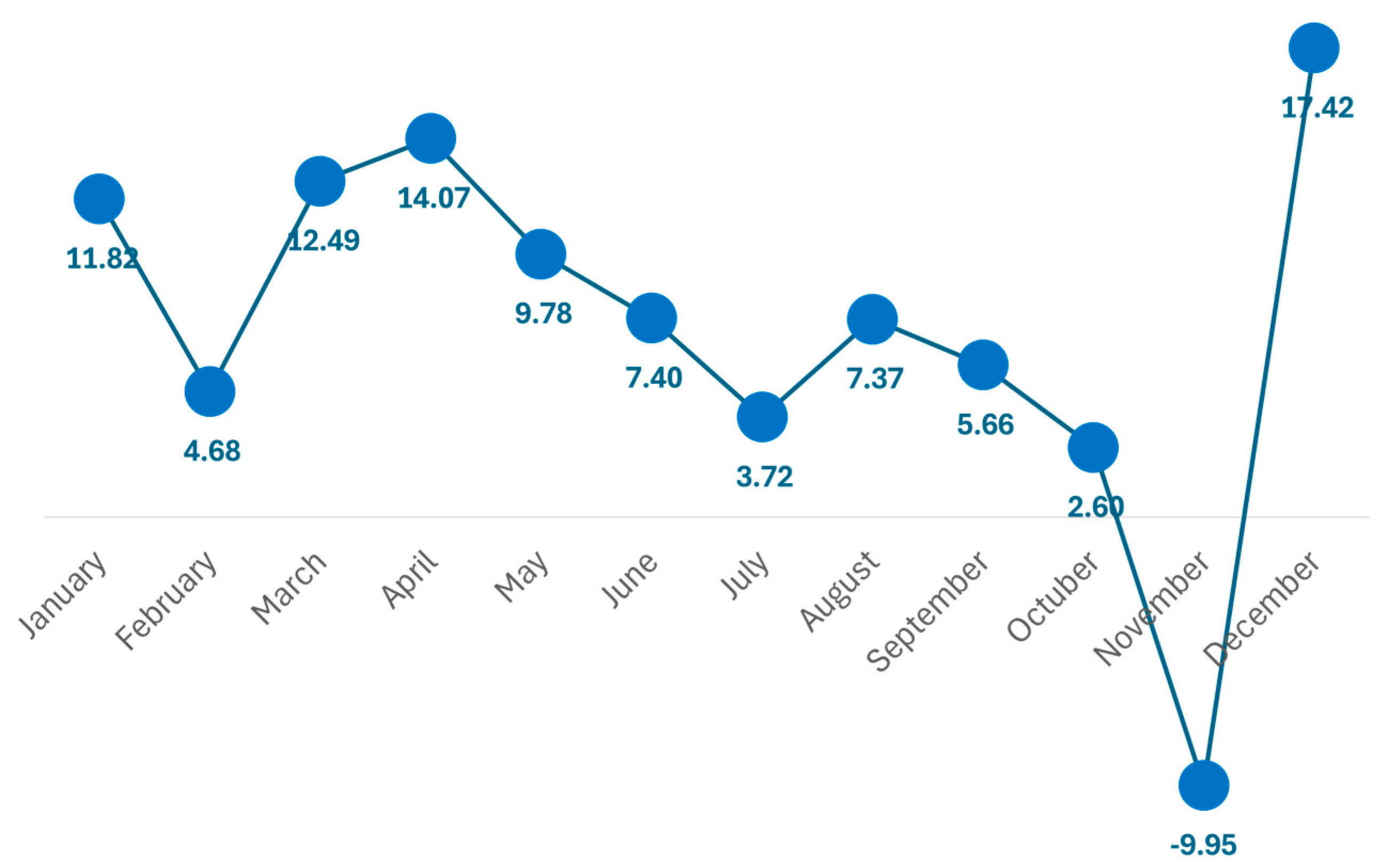
Figure 1 shows that the mean ICR, close to 7.27, indicates moderate slack; however, the standard deviation and the presence of extreme values (November and December) indicate significant volatility. Overall, the liquidity gap is the determinant of capacity consumption, accounting for between 83% and 96% of aggregate exposure in all months analyzed. The expected loss comprises variable and secondary shares, while the market VaR is practically irrelevant (<0.2%). The evolution of the ICR is shown in
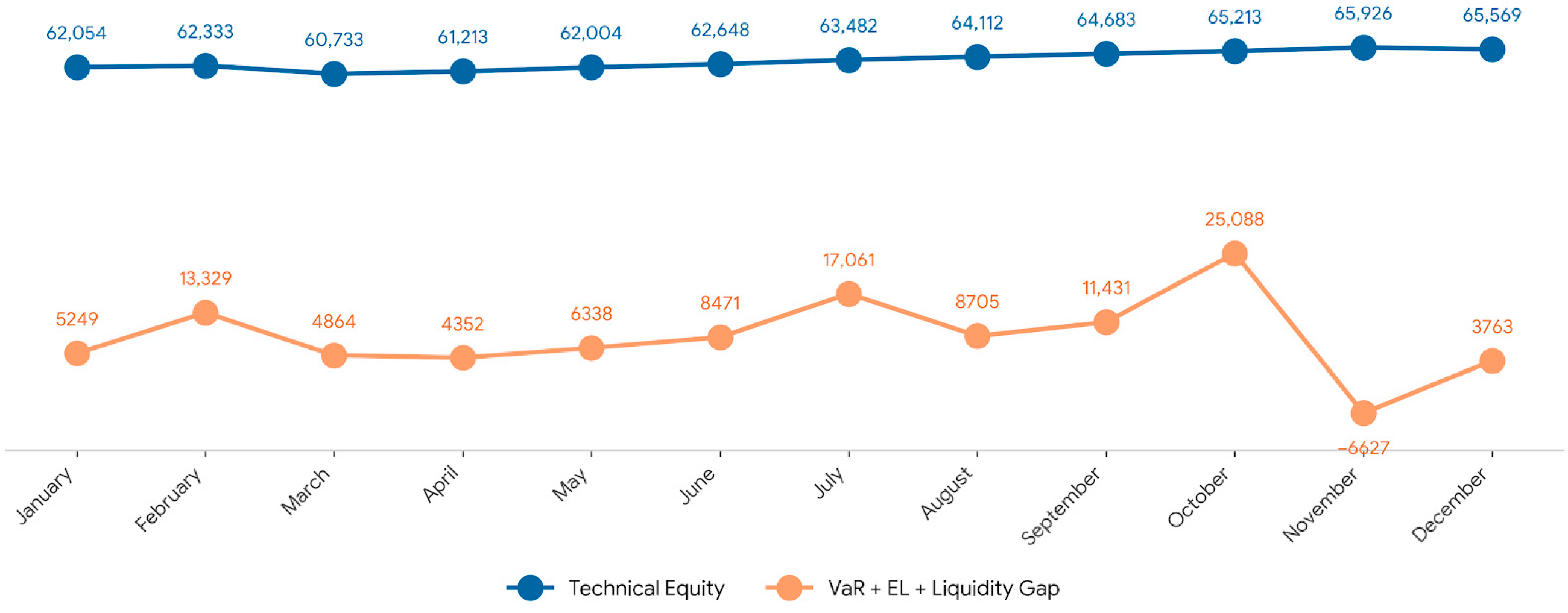
Figure 1. The indicator starts in January at 11.8, reflecting significant slack: equity of COP 62,054 million covers more than 11 times the aggregate exposure (approximately COP 5249 million). Subsequently, the indicator fluctuates throughout the year, reaching its lowest level in November (−9.9), associated with a negative liquidity gap, and its highest level in December (17.4), which shows a significant recovery in coverage capacity. The entity under study presents low short-term liquidity risk; however, between October and November 2025, the gap decreased significantly, from
$20,324 million to
$938 million, representing a 95.4% decrease. The abrupt fall in the Risk Capacity Index (ICR) to −9.95 in November is explained by an extreme liquidity shock stemming from a strategic decision by Financial Management. To prepare for the massive outflow of contractual savings scheduled for December, the entity decided to transfer resources from its investments into cash and equivalents. Given that the regulations require different maturation dynamics—investments mature in proportion to their maturities, while cash is calculated based on historical decreases—this accounting treatment severely altered the distribution of flows across time bands. As a result, the liquidity gap collapsed to negative values, generating what the document calls a “structural breakdown” of the balance sheet, an extreme imbalance that temporarily nullifies the entity’s ability to absorb risks.
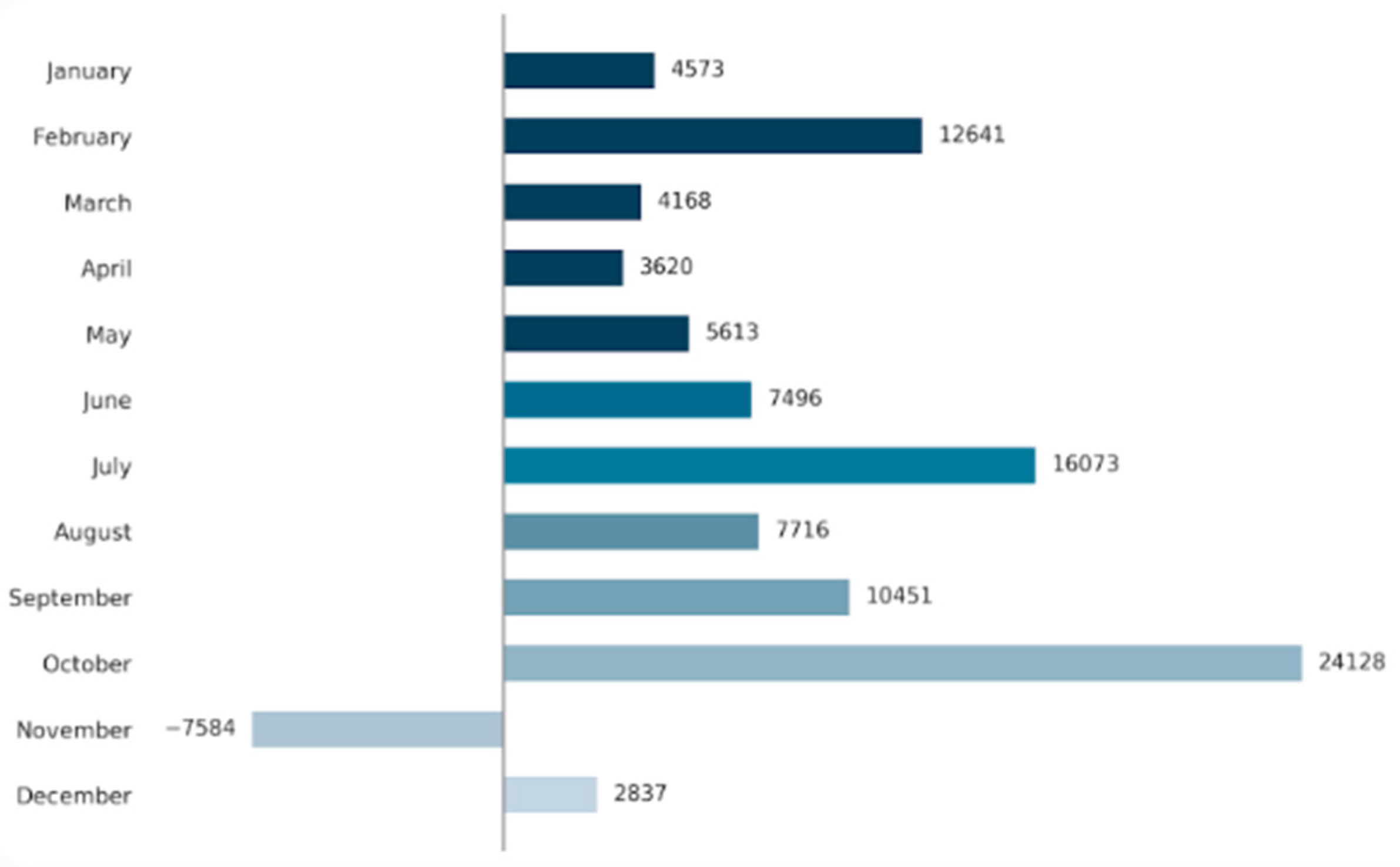
October is a critical month, with an ICR of 2.6. This drop is not due to significant changes in equity, which remains at COP 65,213 million, but to an abrupt increase in the liquidity gap to COP 24,128 million, representing approximately 96% of the total exposure for the month.
Figure 2 shows this behavior: the liquidity gap shoots up in October, far exceeding the levels recorded in the previous and subsequent months.
The months of March and April show a significant recovery. With the gap normalized to 4167 and 3620 million, the ICR rises to 12.49 and 14.07, respectively. However, in June, the PE rose to 965 million, raising its relative share to 11.4% of total exposure and suggesting a worsening in lending conditions.
In September and October, the trend is downward again. The ICR falls to 5.7 and 2.6, driven by the simultaneous growth of the gap (from 10,451 to 24,128 million) and the PE (from 970 to 975 million). This dynamic reveals a scenario in which liquidity and credit pressures combine to sustainably reduce the capacity to absorb risk.
Figure 3 compares the stability of equity with changes in total exposure, showing that risk components, not capital, determine fluctuations in the ICR.
Statistical analysis confirms the indicator’s volatility. The mean ICR was 7.27, the median 7.40, and the standard deviation 6.94. The range extends from a low of −9.9 in November to a high of 17.4 in December. This dispersion shows that risk capacity is sensitive to idiosyncratic shocks, particularly liquidity shocks.
Sensitivity exercises allow the effectiveness of different management measures to be assessed. In September, a 20% reduction in the gap would have raised the ICR from 5.7 to 7.1, and a 50% reduction would have brought it to 11.0. In contrast, in June, even if the PE was reduced by 50%, the ICR would have barely gone from 7.40 to 7.84. These results confirm that liquidity management is the most efficient lever to improve the ICR in the short term, while reducing the EL has a more gradual impact.
The critical episode in October, when the ICR fell to 2.6, underscores how a sudden increase in the liquidity gap can drastically erode the capacity to absorb risks, even in the absence of equity impairment. This behavior is similar to that described in the literature on liquidity spirals (
Brunnermeier & Pedersen, 2009), in which temporary financing tensions are amplified and, in a non-linear way, reduce institutions’ capacity to sustain their positions. In the solidarity sector, where liability structures often depend heavily on members’ deposits, such episodes can be more frequent and potentially more damaging than in traditional commercial banks.
The results show that EL represents a constant and significant fraction of exposure (≈8–13%), with an upward trend in the last months analyzed. This finding aligns with regulatory concerns expressed after the pandemic, when the Superintendence of the Solidarity Economy emphasized the need to adopt expected-loss models to anticipate portfolio deterioration. Indeed, the increase in the PE in June, which coincided with a fall in the ICR to 7.40, shows that the progressive materialization of credit risk can be combined with liquidity pressures to generate fragile scenarios. In contrast, market risk, as measured by VaR, was marginal across all periods, accounting for less than 0.2% of exposure. This result does not invalidate its methodological relevance, but it does indicate that, in practice, solidarity entities concentrate their vulnerability on liquidity and credit management.
The empirical application presented in this study is designed as an illustrative implementation of the proposed supervisory framework and as an initial empirical demonstration of the Risk Capacity Index. Given that the primary contribution of the study is methodological, the purpose of the empirical exercise is to assess whether the proposed index can be operationally constructed, consistently applied, and meaningfully interpreted within the prudential risk-management architecture of a cooperative financial institution. The analysis therefore focuses on the internal coherence, operational feasibility, and supervisory interpretability of the ICR rather than on estimating sector-wide statistical relationships.
This scope is also consistent with the recent development of the prudential risk-management architecture in the Colombian solidarity sector. The progressive implementation of the relevant risk-management systems, including the mandatory implementation of the regulatory Expected Loss model in January 2025, has only recently created the conditions for the systematic integration of the prudential variables required by the ICR. Consequently, the availability of sufficiently long and homogeneous multi-institutional datasets remains in the process of consolidation. The empirical application should therefore be understood as a proof of concept that demonstrates how the ICR can integrate Technical Equity, Expected Loss, Value at Risk, and the Liquidity Gap into a common institution-level assessment of risk-bearing capacity.
Accordingly, the results obtained from the selected cooperative are interpreted within its specific institutional and temporal context and are not intended to represent the financial condition or risk-bearing capacity of the Colombian solidarity sector as a whole. The methodological framework, however, is designed to be transferable and replicable across supervised institutions that generate the corresponding prudential information within the common regulatory architecture. The empirical exercise thus provides an initial implementation of the ICR while establishing a methodological foundation for future multi-institutional and longitudinal validation as longer and more homogeneous datasets become available.
4. Discussion
The proposed Risk Capacity Index (ICR) was developed to quantify a dimension of financial soundness not explicitly measured by conventional prudential indicators: the institution’s structural risk-bearing capacity, defined as the ability of available equity to absorb the aggregate effects of multiple financial risks. Unlike traditional regulatory measures, which evaluate credit, market, and liquidity risks separately, the ICR integrates these exposures into a single metric that reflects the institution’s effective capacity to withstand adverse financial conditions. This distinction is particularly relevant for cooperative financial institutions, whose business model, capital structure, and funding sources differ substantially from those of commercial banks.
4.1. From Risk Measurement to Risk-Bearing Capacity Assessment
The principal contribution of this study is to shift prudential measurement from assessing isolated risk exposures to evaluating an institution’s aggregate structural risk-bearing capacity. While current Basel III frameworks quantify credit (EL), market (VaR), and liquidity risks separately, this fragmented approach may be insufficient to capture the interaction among multiple sources of vulnerability in cooperative institutions. Due to their limited access to wholesale capital markets and strict reliance on member deposits and retained surpluses (
Esther et al., 2023;
Superintendencia de la Economía Solidaria de Colombia, 2025), cooperatives are highly vulnerable to localized liquidity spirals, where credit deterioration rapidly constrains cash inflows (
Brunnermeier & Pedersen, 2009). The proposed ICR explicitly addresses this by integrating these risks into a unified measure.
Furthermore, this unified approach fills a critical gap in Latin American cooperative finance literature. Although recent studies have significantly advanced the understanding of idiosyncratic solvency, credit, and liquidity challenges within the region’s solidarity sector (
Avila et al., 2025;
Sarsoza & Pallasco, 2025;
Bermeo-Cisneros & Moreno-Narváez, 2024;
Jarama-Jarama & Jaramillo-Calle, 2024), these contributions primarily evaluate financial performance dimensions in isolation. By integrating these parameters into a single metric, the ICR captures the complexities of liquidity spirals and successfully bridges the gap between Basel-adapted micro-prudential supervision and the operational reality of Latin American solidarity institutions.
4.2. Nonlinear Deterioration and Liquidity Risk as the Primary Driver of Financial Fragility
The stress-testing results reveal that the deterioration of the ICR follows a markedly nonlinear pattern. As adverse shocks simultaneously affect credit losses, market risk, and liquidity conditions, the reduction in risk-bearing capacity accelerates rather than evolving proportionally. This behavior originates from the rational structure of the proposed indicator, in which aggregate exposure appears in the denominator, causing successive increases in financial risk to reduce the marginal contribution of available capital at an increasing rate. Traditional supervisory approaches frequently assume that the effects of individual risks can be evaluated independently and subsequently aggregated. However, this nonlinear behavior indicates that interactions among financial risks generate amplification mechanisms that cannot be inferred from isolated analyses.
Among these interacting factors, empirical findings highlight the dominant role of liquidity risk in driving this accelerated deterioration. Throughout the sample period, liquidity exposure consistently represents the largest component of aggregate financial risk:
indicating that funding shortages constitute the primary source of reductions in structural risk-bearing capacity. This result contributes to an ongoing debate within the literature on cooperative finance. While several empirical studies conducted in Latin America identify liquidity management as a principal determinant of financial sustainability, they generally analyze it as an independent dimension. The present findings suggest a broader interpretation: liquidity does not merely represent another source of financial risk; rather, it functions as the principal transmission channel through which financial disturbances propagate across the balance sheet.
This interpretation aligns seamlessly with the macro-financial literature on financial amplification and liquidity spirals.
Brunnermeier and Pedersen (
2009) demonstrate how deteriorating funding conditions trigger self-reinforcing interactions between market liquidity and funding liquidity, forcing constrained institutions to liquidate assets or restrict lending. Similarly,
Bigio and d’Avernas (
2021) show that reductions in financial capacity tighten borrowing constraints, amplifying aggregate fluctuations, while
Borio (
2003) argue that banking crises emerge through the cumulative interaction of multiple vulnerabilities rather than from isolated shocks. Within cooperative institutions, this amplification mechanism is likely to be even more pronounced because their liabilities are largely composed of withdrawable member deposits while access to external funding remains strictly limited. Consequently, the dominant contribution of liquidity observed in the ICR should not be interpreted simply as evidence that liquidity risk is quantitatively larger than other risks. Rather, it acts as the central mechanism through which credit deterioration, market volatility, and funding constraints become mutually reinforcing, accelerating the nonlinear exhaustion of the institution’s capital constraint. These results reinforce the forward-looking philosophy underlying the Basel Committee’s Principles for Stress Testing (
Basel Committee on Banking Supervision, 2018) and the Internal Capital Adequacy Assessment Process (ICAAP), providing empirical support for integrated supervisory approaches that prioritize liquidity management as a central, interactive component of prudential oversight rather than an isolated regulatory requirement.
4.3. Financial Viability Boundaries and Implications for Prudential Supervision
Beyond quantifying financial capacity, the proposed ICR naturally defines a quantitative boundary separating financially sustainable institutions from structurally fragile states. Under progressively adverse stress scenarios, the indicator decreases until reaching the following critical condition:
at which available equity exactly equals aggregate stressed exposure. Beyond the following threshold:
the institution no longer possesses sufficient financial capacity to absorb additional losses, implying that any further deterioration would compromise its financial viability.
This interpretation substantially extends the informational content of conventional solvency indicators. Capital adequacy ratios primarily evaluate regulatory compliance with minimum capital requirements. In contrast, the ICR measures the remaining distance between the institution’s current financial position and the point at which aggregate risks exceed its structural loss-absorbing capacity. Consequently, the indicator provides information not only about solvency but also about the institution’s vulnerability to future macro-financial deterioration.
This interpretation is closely aligned with the Reverse Stress Testing philosophy proposed by the
Prudential Regulation Authority (
2026), which recommends identifying the minimum combination of adverse conditions that can render an institution non-viable, rather than merely estimating losses under predefined scenarios. By defining the viability frontier through the condition
, the proposed methodology provides an operational criterion linking financial sustainability to aggregate risk exposure.
From a supervisory perspective, these findings have important implications for the Colombian solidarity sector. Current supervisory practices remain largely organized around specialized indicators for individual risk categories. Although this approach has substantially strengthened prudential oversight, it may underestimate the systemic effects arising from the interaction among credit, market, and liquidity risks. The ICR complements—not replaces—existing supervisory indicators by incorporating this interaction into a single forward-looking measure of structural financial capacity. Such an integrated perspective is particularly valuable for cooperative institutions, whose limited access to external capital markets makes it essential to preserve internal loss-absorbing capacity for long-term financial sustainability.
4.4. Structural Comparison Between the ICR and the Regulatory Solvency Ratio
As established in
Section 2.3, the Regulatory Solvency Ratio provides the closest prudential benchmark for the proposed Risk Capacity Index (ICR), as both indicators relate an institution’s available capital to a measure of financial exposure. The comparison developed in this section therefore seeks to clarify the complementary information provided by both measures and to identify the additional analytical perspective offered by the ICR.
Under the prudential framework applicable to Colombian solidarity-sector institutions, the Solvency Ratio is defined as the relationship between technical equity and risk-weighted assets:
where
denotes technical equity and
represents risk-weighted assets. The ratio provides a standardized assessment of whether the institution maintains an adequate capital buffer relative to the regulatory risk exposure associated with its assets. Through the application of regulatory risk weights, the framework transforms different asset exposures into a common measure of risk-weighted exposure, thereby supporting the assessment of capital adequacy and institutional solvency (
Superintendencia de la Economía Solidaria de Colombia, 2025;
Basel Committee on Banking Supervision, 2017).
The ICR, whose construction is described in
Section 2, adopts a complementary perspective by relating available loss-absorbing capacity to the aggregate quantified exposure arising from expected credit losses, market risk, and liquidity risk. Consequently, the two indicators share a capital-based analytical structure but provide different representations of institutional exposure. The Solvency Ratio evaluates capital adequacy relative to regulatory risk-weighted assets, whereas the ICR evaluates the extent to which available capital can cover the simultaneous financial exposures incorporated into the proposed framework.
This distinction provides an opportunity to enrich the assessment of institutional resilience. The Solvency Ratio offers a standardized and comparable prudential measure of regulatory capital adequacy, while the ICR adds an integrated balance-sheet perspective that brings together credit, market, and liquidity exposures within a common capital-absorption framework. The two indicators can therefore be interpreted as providing complementary layers of information: the former focuses on regulatory capital adequacy, while the latter emphasizes the institution’s capacity to absorb multiple quantified financial exposures simultaneously.
The complementary nature of the ICR becomes particularly relevant when financial risks evolve jointly. An institution may maintain a satisfactory regulatory capital position while experiencing an increase in its aggregate exposure due to rising expected credit losses, market volatility, or liquidity pressures. By explicitly incorporating these dimensions into a common analytical framework, the ICR can provide additional information regarding the potential consumption of available loss-absorbing capacity. This perspective is consistent with the broader literature emphasizing the interaction between funding conditions, market liquidity, and financial vulnerability (
Brunnermeier & Pedersen, 2009).
The comparison also reflects a broader distinction between regulatory capital adequacy and integrated financial risk-bearing capacity. The Solvency Ratio evaluates whether the institution maintains sufficient technical equity relative to risk-weighted regulatory exposures. The ICR, in contrast, evaluates the relationship between available loss-absorbing capital and the aggregate quantified exposures included in the proposed framework. This latter perspective is consistent with the concept of financial risk-bearing capacity, according to which available capital constrains the amount of financial exposure that an institution can absorb (
Bigio & d’Avernas, 2021).
Accordingly, the ICR is proposed as a complementary analytical layer rather than as an alternative to the Regulatory Solvency Ratio. The Solvency Ratio remains essential for assessing compliance with regulatory capital requirements and for ensuring comparability within the prudential framework. The ICR may complement this assessment by providing additional information on how available capital relates to the simultaneous exposure generated by credit, market, and liquidity risks. This combination can support a more comprehensive analytical perspective for internal risk monitoring, sensitivity analysis, stress testing, capital planning, liquidity planning, and recovery planning.
The empirical comparison presented in this study should therefore be understood as an illustration of the complementary information provided by both indicators. The Solvency Ratio offers the established regulatory benchmark, whereas the ICR provides an additional measure of integrated risk-bearing capacity. Its potential value lies in contributing an additional perspective to the existing prudential architecture, particularly for institutions in which credit, market, and liquidity risks may interact and jointly affect the consumption of available loss-absorbing capacity.
The potential use of the ICR in formal supervisory monitoring or early-warning frameworks should be approached progressively and supported by further empirical validation. Future research based on multiple institutions, longer time horizons, out-of-sample backtesting, and observed episodes of financial distress will be necessary to assess its predictive performance and incremental supervisory value. Within the scope of the present study, the ICR is therefore presented as a proposed complementary measure of institutional financial risk-bearing capacity whose potential contribution can be evaluated alongside established prudential indicators.
4.5. Prudential and Regulatory Implications for the Solidarity Sector
An important advantage of the proposed Risk Capacity Index (ICR) is that it relies exclusively on prudential variables already required under the Colombian regulatory framework, including Technical Equity, Expected Loss (EL), Value at Risk (VaR), and the Liquidity Gap (LG). Consequently, the ICR integrates existing supervisory information into a single measure of institutions’ risk-bearing capacity, without imposing additional regulatory requirements or increasing implementation costs.
Beyond its methodological contribution, the Risk Capacity Index (ICR) provides a practical framework for strengthening prudential supervision by complementing existing risk management systems with an integrated assessment of institutions’ aggregate risk-bearing capacity. Because it is constructed exclusively from standardized regulatory information already required under the Colombian prudential framework, the indicator can be readily incorporated into risk-based supervision, capital planning, stress testing, recovery planning, and other forward-looking supervisory assessments.
To facilitate its potential operational implementation, this study proposes a supervisory framework in which the ICR is incorporated into a traffic-light monitoring scheme, enabling supervisory authorities to associate predefined threshold values with proportionate supervisory actions based on institutions’ risk-bearing capacity. The framework is intended to support supervisory decision-making by providing a structured interpretation of integrated prudential information. Although the proposed framework may provide a basis for potential early-warning applications, its incorporation into formal early-warning systems should be regarded as a future research direction requiring additional validation through out-of-sample backtesting, multi-institutional analyses, and the examination of observed episodes of financial distress:
Green Zone (
): Represents robust financial slack. The setting of this threshold is based on the multiplier factors applied in the Internal Capital Adequacy Assessment Process (ICAAP) recommended by the Basel Committee (
Basel Committee on Banking Supervision, 2017), which suggests that equity should cover between 3- and 5-times short-term risk estimates to adequately absorb Unexpected Losses and systemic tail events (
Crouhy et al., 2000). Institutions in this tier would be subject to standard risk-based supervision and authorized to proceed with ordinary surplus distributions.
Yellow Zone (1 < ICR ≤ 5): Functions as a proposed integrated supervisory monitoring threshold for identifying institutions whose aggregate risk-bearing capacity may be deteriorating. Entry into this zone indicates a lower level of loss-absorbing capacity relative to aggregate quantified financial exposures and may signal increasing financial vulnerability. This interpretation is consistent with the forward-looking orientation of Basel III and the analytical perspective underlying early-warning indicators discussed by
Drehmann and Juselius (
2014). At this stage, supervisory authorities could consider requiring a Capital and Liquidity Restoration Plan, encouraging more conservative surplus allocation policies, and strengthening supervisory monitoring until adequate loss-absorbing capacity is restored. However, the proposed threshold should be interpreted as a supervisory monitoring criterion rather than as a validated early-warning threshold. Its potential use within formal early-warning systems requires further validation through out-of-sample backtesting, multi-institutional analyses, and the examination of observed episodes of financial distress.
Red Zone (
): Indicates that the structural viability threshold has been breached. This exact mathematical condition is supported by the Reverse Stress Testing philosophy, in which liabilities and risks absorb the full capacity (
Prudential Regulation Authority, 2026). It would serve as an objective and quantitative trigger for immediate regulatory intervention or guided resolution mechanisms before actual cash insolvency materializes.
Furthermore, the ICR opens opportunities for the practical execution of proportional regulation. Because the ICR is dimensionless and independent of institutional size, authorities could classify entities by their actual capacity to assume aggregate risks, rather than segmenting them solely by asset volume.
Operational Tools for Cooperative Management: For cooperative managers and boards of directors, the ICR could serve as a dynamic Key Risk Indicator (KRI) that encourages the use of differentiated operational tools, beyond generic cash management. The decomposition of the denominator:
allows for targeted and proactive managerial responses:
Advanced Liquidity Management: If the liquidity component () drives the ICR downward, cooperatives could explore the implementation of structural funding tools, such as the proactive negotiation of contingent liquidity lines with second-tier cooperative banks to smooth seasonal outflows, as well as the establishment of prudential concentration limits to prevent sudden spikes in non-contractual withdrawals.
Dynamic Credit Underwriting: Sustained increases in Expected Loss () could trigger automated adjustments in origination policies. Management would have the possibility to implement pricing schemes adjusted to ICR consumption, in which riskier credit lines compensate, through staggered rates or collateral requirements, for the accelerated reduction in the entity’s absorption capacity.
Market Risk Hedging: Unusual variations in Value at Risk () would suggest the application of dynamic portfolio rebalancing rules, favoring the transfer of excess liquidity from volatile sovereign bonds toward short-duration, high-credit-quality instruments.




 ,
,