1. Introduction
Financial flexibility is a central concern in corporate finance because firms must preserve borrowing capacity and liquidity if they are to respond effectively to shocks and investment opportunities. In corporate finance, financial flexibility refers to a firm’s ability to obtain and deploy funds at relatively low cost and on short notice, thereby preserving borrowing capacity and sustaining investment under uncertainty (
Denis, 2011;
Byoun, 2016;
Myers, 1984;
Teng et al., 2021). Prior studies show that financially flexible firms are better positioned to maintain investment and avoid financial distress during downturns and financial crises (
Marchica & Mura, 2010;
Ferrando et al., 2017). Consequently, understanding the determinants of financial flexibility has become an important issue in corporate finance, particularly in settings characterized by uncertainty, information asymmetry, and agency conflicts.
Firms may preserve financial flexibility by maintaining lower leverage, retaining earnings, and limiting financing commitments that constrain future borrowing capacity. Although debt may offer tax-shield advantages, excessive leverage reduces future borrowing capacity and raises financial risk, implying an inverse relationship between leverage and financial flexibility (
Modigliani & Miller, 1963). However, traditional capital structure theory does not fully explain how firms dynamically build and sustain financial flexibility over time (
Myers, 1977). Survey evidence further suggests that managers place substantial value on financial flexibility when making financing decisions (
Bancel & Mittoo, 2011), highlighting its practical importance beyond static theoretical models. Financial flexibility also interacts with payout policy. Dividends reduce retained earnings available for reinvestment (
Kotze et al., 2024). While higher payouts may mitigate agency costs of overinvestment (
Jensen, 1986;
Grullon et al., 2002), they may simultaneously constrain internal financing capacity and reduce borrowing reserves. Empirical evidence also shows that financially flexible firms exhibit higher investment efficiency, particularly during financial crises (
Cherkasova & Kuzmin, 2018).
Despite extensive empirical evidence from developed economies such as the United States, China, and Europe (
De Jong et al., 2012;
Arslan-Ayaydin et al., 2014;
Ferrando et al., 2017;
Teng et al., 2021), firm-level evidence on the determinants of financial flexibility in African capital markets remains limited. South Africa provides a particularly relevant setting because its listed firms operate in an emerging-market environment characterized by relatively sophisticated financial markets, broader access to capital markets than many other emerging economies, and significant exposure to global financing conditions through overseas and dual listings (
de Wet & Gossel, 2016). At the same time, the JSE operates within a context marked by macro-financial volatility, political and economic uncertainty, and elevated sensitivity to country-risk dynamics, all of which may shape corporate financing behavior differently from developed-market benchmarks (
Vengesai & Muzindutsi, 2019;
Vengesai et al., 2021). Prior survey evidence further suggests that South African listed firms do not align uniformly with a single canonical capital structure theory: smaller firms are more likely to behave in line with the Pecking Order theory, whereas larger firms more often resemble Static Trade-Off behavior (
de Wet & Gossel, 2016). These features imply that leverage, payout policy, internal funds, and growth opportunities may not influence financial flexibility in exactly the same way as reported in the developed-market literature. The joint examination of leverage, payout policy, internal funds, liquidity, and growth opportunities is particularly important in the JSE context because financial flexibility is shaped not by a single balance-sheet characteristic, but by the interaction of financing, retention, and investment choices under emerging-market constraints. Whereas
Kotze et al. (
2024) focus primarily on the prevalence of financial flexibility in South Africa, the objective of the present study is to examine the firm-level determinants associated with financial flexibility among JSE-listed non-financial firms. In this sense, the study shifts attention from how widespread financial flexibility is to which firm characteristics are associated with preserving it. Against this background, the present study contributes in four ways. First, it examines the firm-level determinants of financial flexibility in a major African emerging market rather than revisiting prevalence alone. Second, it contextualizes standard pecking order and trade-off predictions within the JSE environment. Third, it considers whether payout policy forms part of the financial characteristics associated with preserving financial flexibility. Fourth, it evaluates whether the estimated determinants are sensitive to the operationalization of financial flexibility by comparing the baseline specification with an alternative low-leverage/high-cash robustness model.
2. Literature Review
2.1. Theoretical Foundations
The analysis of financial flexibility is primarily grounded in capital structure theory, agency theory, and the pecking order framework, which jointly explain how firms manage financing decisions under conditions of uncertainty and information asymmetry. Agency theory posits that conflicts between managers and shareholders influence financing and investment decisions (
Myers, 1977;
Jensen, 1986). Managers may overinvest in negative-NPV projects when excess free cash flow is available, thereby reducing firm value (
Richardson, 2006). In this context, financial flexibility can either enhance value by enabling optimal investment or reduce value if it facilitates managerial discretion. The pecking order theory (
Myers, 1984) suggests that firms prefer internal financing due to asymmetric information costs. Usually, large and profitable firms accumulate retained earnings, thereby increasing internal equity and preserving debt capacity.
Elsas and Florysiak (
2011) argue that firms with high internal funds and unused borrowing capacity exhibit greater flexibility.
Modigliani and Miller (
1963) and
Denis (
2011) conceptualize financial flexibility as spare debt capacity.
Marchica and Mura (
2010) empirically demonstrate that firms with unused debt capacity invest more in new projects, particularly during constrained periods. However,
Jensen (
1987) warns that excessive flexibility may generate agency costs of overinvestment if managers are insufficiently disciplined by debt obligations.
2.2. Leverage and Financial Flexibility
Capital structure theory predicts a strong relationship between leverage and financial flexibility because borrowing decisions directly influence a firm’s unused debt capacity and future financing options. The pecking order theory (
Myers & Majluf, 1984;
Myers, 1984) suggests that firms prefer internal financing to external financing in order to preserve financial slack. Maintaining lower leverage allows firms to retain unused borrowing capacity, which enhances their ability to respond to future investment opportunities (
Teng et al., 2021). Similarly, the trade-off theory implies that although debt provides tax advantages, excessive leverage increases financial distress costs and constrains future financing options. Lower leverage increases a firm’s future borrowing capacity by reducing financial risk and preserving access to external capital markets (
Kotze et al., 2024). Firms that actively reduce debt during profitable periods accumulate retained earnings, decrease financial risk, and strengthen their balance sheets (
Denis & McKeon, 2012). This behavior enhances unused debt capacity and improves the firm’s ability to raise funds at short notice and lower cost. Empirical evidence supports this theoretical prediction.
Fliers (
2025) document a negative relationship between leverage and financial flexibility among US firms.
Ferrando et al. (
2017), show that European firms achieve financial flexibility through conservative leverage policies, particularly in environments with limited credit access. Similarly,
Bancel and Mittoo (
2011) report that firms with lower leverage and higher earned equity were better able to withstand the 2008 financial crisis. These findings consistently suggest that leverage reduces future borrowing capacity and therefore constrains financial flexibility. Accordingly, leverage is expected to be negatively associated with financial flexibility.
H1. Leverage has a significant negative relationship with financial flexibility.
2.3. Profitability, Cash Holdings, Retained Earnings and Financial Flexibility
Prior literature suggests that firms seek to build and preserve financial slack in order to maintain financial flexibility (
Myers & Majluf, 1984). Profitability plays an important role in this process because more profitable firms generate stronger internal cash flows and accumulate retained earnings, thereby increasing earned equity and reducing reliance on external finance. In turn, the availability of internal funds may preserve borrowing capacity and strengthen financial flexibility. From this perspective, profitability, cash holdings, and retained earnings are closely related dimensions of internal financial strength.
Jensen (
1986) argues that free cash flow represents cash in excess of that required to finance positive net present value projects. While excess cash may generate agency costs, it can also enhance financial flexibility by increasing liquidity reserves and reducing the need for costly external finance. Similarly, the pecking order theory predicts that firms prefer to finance investments using internally generated funds before issuing debt or equity, implying a negative relationship between profitability and leverage (
Denis, 2011;
Fliers, 2025). Under this view, higher profitability contributes to greater retained earnings, stronger liquidity, lower leverage, and ultimately greater financial flexibility.
However, higher profitability does not always imply that firms preserve financial slack, because internally generated funds may be actively deployed to finance investment opportunities, working capital needs, or operating expansion. Likewise, retained earnings may either strengthen financial flexibility by increasing internal funding capacity or reduce observable slack if they are quickly absorbed into firm operations. Cash holdings also involve competing considerations. While precautionary liquidity can support financial flexibility, excess cash may reflect agency problems or short-term cash management rather than a deliberate strategy to preserve borrowing capacity. Accordingly, although theory generally points to a positive relationship between internal financial strength and financial flexibility, the effects of profitability, cash holdings, and retained earnings may vary across firms and institutional settings. On balance, profitability, retained earnings, and liquidity reserves remain plausible drivers of financial flexibility, but their effects should not be assumed to be one-directional. Accordingly, the hypotheses are stated in associative form:
H2a. Profitability is significantly associated with financial flexibility.
H2b. Cash holdings are significantly associated with financial flexibility.
H2c. Retained earnings are significantly associated with financial flexibility.
2.4. Asset Tangibility and Financial Flexibility
Asset tangibility is commonly viewed as a factor that enhances financing capacity because tangible assets can be pledged as collateral, thereby reducing lender risk and improving access to debt markets (
Almeida et al., 2004;
Teng et al., 2021).
Rajan and Zingales (
1995) further argue that tangible assets reduce agency costs of debt by limiting risk-shifting incentives and by providing lenders with greater security. Empirical evidence generally supports this channel.
Charalambakis and Psychoyios (
2012) find that tangibility is positively associated with leverage, while
Zou and Adams (
2008) show that larger and more mature firms tend to hold more tangible assets that strengthen collateral value and borrowing ability. Likewise,
Hall (
2012) and
Habib and Ranasinghe (
2022) suggest that when creditors can enforce claims on physical assets, collateral quality improves borrowing terms and financing access. At the same time, this relationship does not imply that higher tangibility necessarily increases financial flexibility.
The same collateral base that expands financing access may also encourage firms to make greater use of debt, thereby reducing spare borrowing capacity. In this sense, tangibility may support actual leverage utilization rather than the preservation of financing capacity (
Rajan & Zingales, 1995;
Charalambakis & Psychoyios, 2012;
Hall, 2012). The effect of tangibility on financial flexibility may therefore depend on whether collateral is used primarily to preserve future financing options or to support greater current borrowing. Accordingly, the relationship is better treated as theoretically open rather than mechanically one-directional.
H3. Asset tangibility is significantly associated with financial flexibility.
2.5. Investment Opportunities (Tobin’s Q), Finance Cost and Firm Financial Flexibility
Investment opportunities reflect the firm’s growth prospects and the availability of positive-net-present-value projects. Their relationship with financial flexibility, however, is theoretically ambiguous. On the one hand, firms with strong growth opportunities may have greater incentive to preserve financial flexibility so that future investments can be financed without costly external constraints. Dynamic capital structure models suggest that firms build financial flexibility in anticipation of future investment needs, while
Marchica and Mura (
2010) show that financially flexible firms are better positioned to undertake new investments and exploit growth opportunities.
Butt et al. (
2023) likewise argue that firms expecting substantial investment opportunities may preserve unused debt capacity and accumulate cash reserves in order to avoid financing constraints. Under this view, growth opportunities increase the value of maintaining financial slack.
On the other hand, growth opportunities may also reduce observed financial flexibility if firms actively draw down available borrowing capacity and internal liquidity to finance expansion. In such cases, firms do not preserve financial slack; rather, they utilize it. This possibility is also consistent with pecking order reasoning, since firms facing investment opportunities may first exhaust retained earnings and then rely on external finance as funding needs increase (
Myers & Majluf, 1984). Accordingly, the relationship between investment opportunities and financial flexibility need not be mechanically one-directional and may depend on whether firms are primarily preserving future financing capacity or actively deploying it.
Financing costs may similarly affect financial flexibility through competing channels. Higher borrowing costs, reflected in interest rates or risk premia, increase the cost of external capital and may discourage firms from issuing debt (
Barclay & Smith, 2020;
Zhu & Liu, 2025). In such circumstances, firms may rely more heavily on internal equity and retained earnings in order to preserve financial slack. Survey evidence from European firms indicates that managers attach particular value to financial flexibility when external financing is costly or uncertain (
Bancel & Mittoo, 2011). However, higher financing costs may also weaken financial flexibility by making it more difficult for firms to access or preserve borrowing capacity in the first place. In this sense, costly external finance may either encourage precautionary retention of slack or reflect financing frictions that constrain flexibility directly. Taken together, investment opportunities and financing conditions are important determinants of financial flexibility, but their effects are theoretically open rather than uniformly directional. Accordingly, the hypotheses are stated in associative form:
H4a. Investment opportunities are significantly associated with financial flexibility.
H4b. Financing costs are significantly associated with financial flexibility.
2.6. Payout Policy and Firm Financial Flexibility
Payout policy presents one of the clearest tensions in the financial flexibility literature. On the one hand, distributing cash to shareholders through dividends or share repurchases can mitigate agency conflicts by reducing free cash flow available for managerial discretion (
Jensen, 1986). In this sense, payout may improve discipline and limit overinvestment. On the other hand, payouts also reduce internally generated funds and retained earnings, both of which are important sources of financial flexibility. From a pecking order perspective, firms seeking to preserve financial slack are expected to retain earnings and rely less on costly external finance (
Myers & Majluf, 1984). Under this view, high payout ratios may weaken financial flexibility by reducing internal equity, increasing dependence on external funding, and potentially limiting unused borrowing capacity (
Oded, 2019). The relationship is therefore shaped by a trade-off between agency-cost reduction and precautionary retention. Firms with limited growth opportunities and excess cash flows may distribute earnings to reduce overinvestment concerns (
Jensen, 1987). By contrast, firms facing stronger growth opportunities, financing frictions or uncertainty may prefer to conserve internal funds in order to preserve financial flexibility and avoid underinvestment. In addition, payout policy may be relatively sticky, meaning that firms do not always adjust distributions immediately in response to short-term financing pressures. As a result, the relationship between payout and financial flexibility may be negative on average but not necessarily uniform across firms or institutional settings.
Empirical evidence generally points to an inverse relationship.
Rahimi and Mosavi (
2016) and
Vo et al. (
2025) document a negative association between dividend payments and financial flexibility among Asian firms. Similarly,
Kingwara (
2015), using African firm-level data, finds that both the likelihood and magnitude of dividend payments decrease as financial flexibility increases.
Abdulkadir et al. (
2017) further show that Nigerian firms adjust dividend decisions in response to the need to preserve cash reserves. Taken together, the literature suggests that payout policy is closely linked to the preservation of internal liquidity and borrowing capacity, even though the strength of this relationship may vary across firms. Accordingly, the hypothesis is stated in associative form:
H5. Payout ratios are significantly associated with financial flexibility.
3. Materials and Methods
This study adopts a quantitative empirical approach using panel data econometric techniques to examine the determinants of financial flexibility (
Saunders et al., 2019).
3.1. Sample and Data
The population consists of non-financial firms listed on the JSE Limited (
JSE, n.d.). Financial firms are excluded due to regulatory capital requirements. After applying purposive sampling criteria, 106 firms with sufficient data coverage from 2000–2019 were selected. The sample comprised 43 large non-financial firms, 36 medium non-financial firms and 27 small non-financial firms, whose size was determined in terms of market capitalization, with complete data and those firms with 3 years of missing data for the study period. Financial data were obtained from the IRESS Research Domain database. Foreign currency items were translated into ZAR in accordance with IAS 21, The Effects of Changes in Foreign Exchange Rates, guidelines. Data were organized into an unbalanced panel dataset with 2100 firm-year observations.
3.2. Econometric Estimation
The empirical analysis was conducted in two stages. In the first stage, expected leverage is estimated using a panel-data framework based on firm-specific characteristics and industry conditions, following the leverage prediction approach used in
Frank and Goyal (
2009) and
Marchica and Mura (
2010). The difference between actual and predicted leverage is then used to identify firms with persistent spare debt capacity. Firms exhibiting negative deviations between actual and predicted leverage for at least two consecutive years are classified as financially flexible, consistent with the financial flexibility identification approach in (
Marchica & Mura, 2010).
In the second stage, the determinants of financial flexibility are estimated using a random-effects linear probability model. The choice of the random-effects specification is informed by the
Nwakuya and Ijomah (
2017) specification test, which fails to reject the null hypothesis that the random-effects estimator is appropriate. Because the dependent variable is binary, the coefficients are interpreted as approximate changes in the probability that a firm is financially flexible. To address heteroscedasticity, robust standard errors are used for statistical inference.
3.3. Measurement of Variables
To estimate firms’ expected leverage, the study follows the methodology of
Frank and Goyal (
2009) and
Marchica and Mura (
2010), where leverage is modelled as a function of firm-specific characteristics and industry conditions. Expected leverage is estimated as a function of industry leverage, size, profitability, asset tangibility, Tobin’s Q, and inflation using the following econometric equation.
where
is defined as the ratio of the sum of interest-bearing long-term and short-term debt to the sum of interest-bearing long-term and short-term debt and market value of equity.
is defined as the lagged value of the ratio of the sum of interest-bearing long-term and short-term debt to the sum of interest-bearing long-term and short-term debt and market value of equity.
is defined as the year-end average leverage ratios of firms in a particular industry.
is defined as the ratio of the market value of equity plus book value of debt to total assets.
is the natural logarithm of the firm’s total asset.
is defined as the ratio of earnings before interest and tax to total assets.
is defined as the ratio of the sum of property, plant and equipment to total assets.
is defined as the year-end inflation rate as determined by the South African Reserve Bank.
Financial flexibility is identified by comparing actual leverage with predicted leverage. Firms exhibiting negative deviations between actual and predicted leverage for at least two consecutive years are classified as financially flexible, consistent with the notion that such firms preserve spare debt capacity over time. Accordingly, is defined as a binary indicator equal to 1 for financially flexible firms and 0 otherwise.
As an additional robustness check, financial flexibility was alternatively proxied using a low-leverage/high-cash classification based on yearly sample medians. This alternative proxy was introduced to assess whether the estimated determinants of financial flexibility remain sensitive to the way financial flexibility is operationalized.
where
denotes the yearly sample median leverage ratio and
denotes the yearly sample median cash holdings ratio. Under this alternative proxy, a firm-year observation is classified as financially flexible if it simultaneously exhibits below-median leverage and above-median cash holdings in a given year. This approach captures both spare borrowing capacity and internal liquidity buffers and is used as a supplementary robustness measure rather than as a replacement for the baseline leverage-based classification.
3.4. Model Specification
The study tested the hypotheses developed in
Section 2 using the following model.
where
is defined as the ratio of the sum of interest-bearing long-term and short-term debt to the sum of interest-bearing long-term and short-term debt and market value of equity.
is defined as the ratio of earnings before interest and tax to total assets.
is defined as the ratio of the market value of equity plus book value of debt to total assets.
is defined as the ratio of the cash and cash equivalents to total assets.
is defined as the ratio of the sum of property, plant and equipment to total assets.
is defined as the ratio of retained earnings to total assets. This specification captures firm-specific characteristics and payout policy determinants of financial flexibility. Robustness checks are implemented to ensure consistent and unbiased estimators.
To complement the baseline specification, an alternative robustness model was estimated using the low-leverage/high-cash proxy for financial flexibility:
where Λ(•) denotes the logistic cumulative distribution function. Leverage and cash holdings were excluded from the right-hand side because they are embedded in the construction of the alternative dependent variable. Firm size and age were retained as basic controls for firm heterogeneity, while the specification was kept parsimonious to preserve model stability and goodness-of-fit. In addition to the baseline random-effects linear probability specification, the alternative binary logistic model was estimated to assess whether the main findings remain sensitive to an alternative operationalization of financial flexibility.
3.5. Data Analysis
The data were analyzed using STATA 15. The dataset comprised JSE-listed non-financial firms over the period 2000–2019 and was obtained from the IRESS research domain database. In the first stage, expected leverage was estimated to construct the financial flexibility indicator by identifying firms with persistent negative deviations between actual and predicted leverage. Firms meeting this criterion were coded as 1, and 0 otherwise, so the dependent variable in the second stage is binary. In the second stage, the determinants of financial flexibility were estimated using a random-effects linear probability model. This approach was retained for ease of interpretation, while a binary logistic model was used as a robustness check. Heteroscedasticity-robust standard errors were used for statistical inference. The full sample included 106 firms, but the final estimation sample was reduced to 74 firms after applying the financial flexibility classification criterion. As an additional robustness check, financial flexibility was alternatively proxied using a low-leverage and high-cash classification and estimated using a binary logistic model. This supplementary specification was introduced to assess whether the estimated determinants remained sensitive to an alternative operationalization of financial flexibility that does not rely on the original predicted-leverage classification rule. The robustness model was intentionally kept parsimonious because more heavily parameterized versions generated instability or poorer fit.
4. Results and Discussion
The panel dataset was constructed from 106 JSE-listed non-financial firms observed over 2000–2019, comprising 43 large, 36 medium, and 27 small firms. This sample was used to estimate the leverage model and identify firms with persistent spare debt capacity.
4.1. Descriptive Statistics
The final panel consists of 2100 firm-year observations drawn from 106 non-financial firms listed on the JSE Limited over the period 2000–2019.
The descriptive statistics also indicate substantial dispersion and non-normality for several variables, as reflected in the skewness and kurtosis values reported in
Table 1. This suggests the presence of outliers and asymmetric distributions in parts of the sample. To reduce the influence of heteroscedasticity and distributional irregularities on statistical inference, the regression analysis relies on heteroscedasticity-robust standard errors.
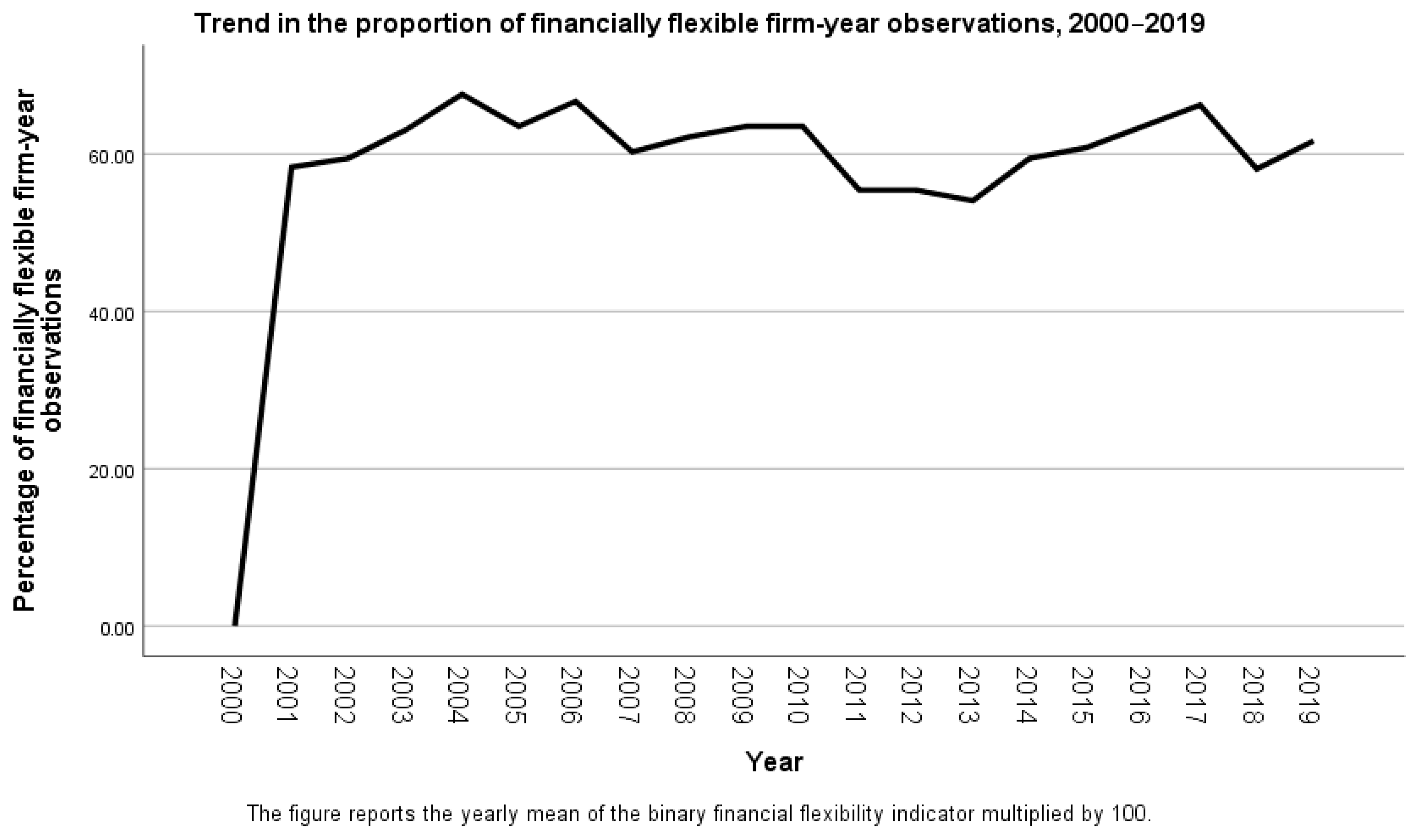
Figure 1 illustrates the evolution of financial flexibility over the sample period. The proportion of financially flexible firm-year observations is zero in 2000, rises sharply in 2001, and thereafter remains broadly stable.
The descriptive statistics indicate substantial cross-firm heterogeneity in the sample. The mean leverage ratio of 0.217 suggests moderate debt usage on average within the sample, although this should not be interpreted as definitive evidence of conservative financing behavior across all firms (
Rajan & Zingales, 1995;
Graham & Harvey, 2001). The average Tobin’s Q of 1.172 indicates the presence of positive, though not extreme, growth opportunities. Mean cash holdings of 12.8% of total assets suggest that many firms maintained meaningful liquidity positions during the study period, consistent with the precautionary role of cash under financing frictions (
Almeida et al., 2004). The average dividend payout ratio of 3.56% points to relatively modest cash distributions on average (
Fama & French, 2001). Financing costs averaging 1.9% of total assets indicate that debt-servicing obligations were present but varied across firms (
Titman & Wessels, 1988). Overall, these statistics reflect variation in capital structure, liquidity, payout, and growth characteristics within the sample, supporting the use of multivariate analysis to examine the determinants of financial flexibility. These patterns are also consistent with evidence that financing decisions among JSE-listed firms are shaped by a combination of trade-off and pecking order considerations within a market-specific South African context.
4.2. Determinants of Financial Flexibility
The determinants of financial flexibility were estimated using a random-effects linear probability model with heteroscedasticity-robust standard errors. The choice of the random-effects specification was informed by the Hausman test reported in
Appendix A, which failed to reject the null hypothesis that the random-effects estimator is appropriate (
(8) = 11.62, Prob >
= 0.1690). Because the dependent variable is binary, the estimated coefficients are interpreted as approximate changes in the probability that a firm is classified as financially flexible. The regression results are presented in
Table 2.
4.2.1. Leverage
The regression results indicate a strong and statistically significant negative relationship between leverage and financial flexibility (
β = −0.85138,
p < 0.001). This implies that, within the random-effects linear probability specification, higher leverage is associated with a lower probability of a firm being classified as financially flexible.
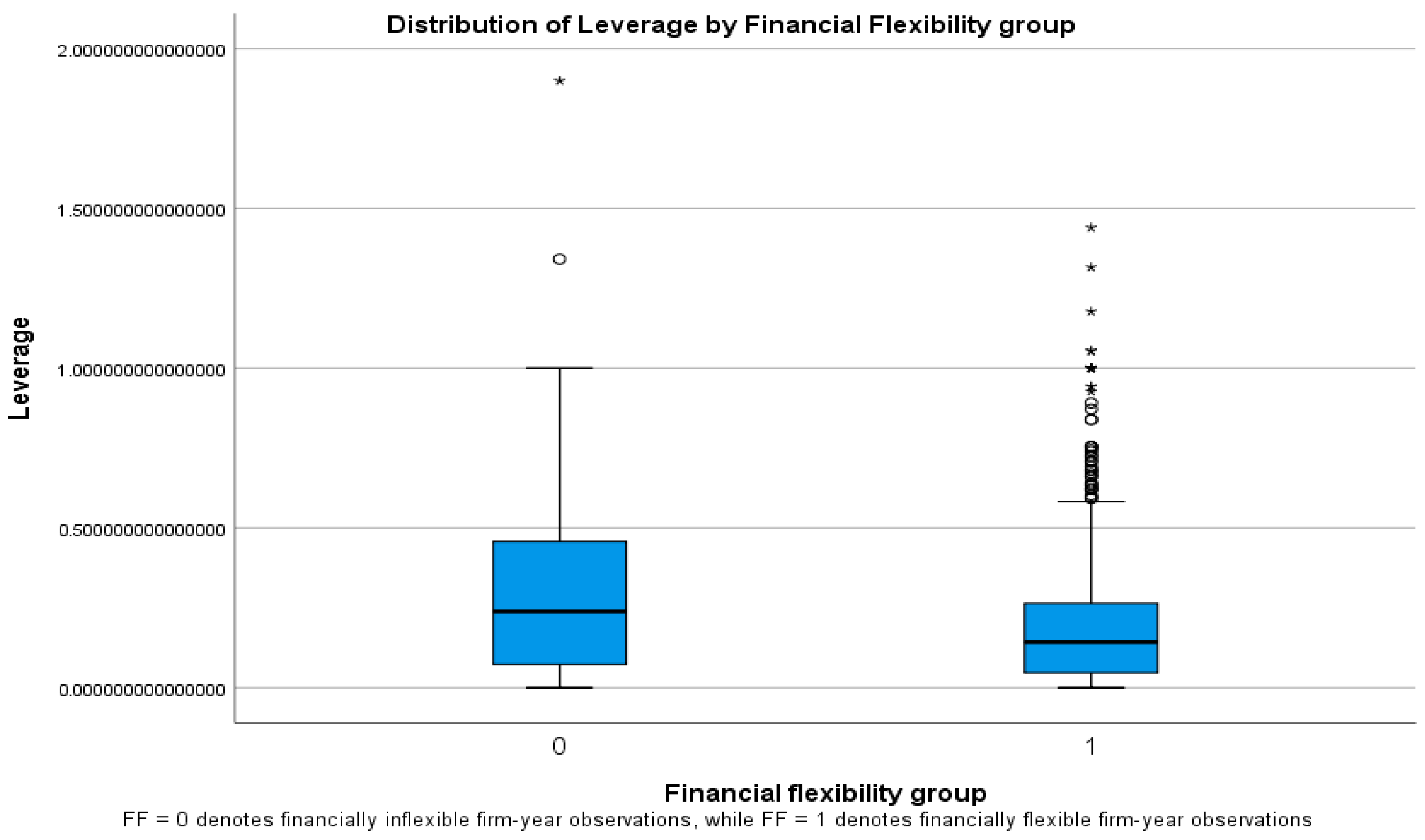
Figure 2 visually reinforces the regression evidence by showing that financially flexible firm-year observations are associated with lower leverage levels than financially inflexible observations.
The finding is consistent with the view that financial flexibility depends on the preservation of spare debt capacity through a conservative leverage policy (
Modigliani & Miller, 1963;
Myers & Majluf, 1984;
Ferrando et al., 2017). Firms that rely less heavily on debt financing are better positioned to retain untapped borrowing capacity that can later be used to fund investment opportunities or absorb adverse shocks. This interpretation can be understood through both trade-off and pecking-order lenses. From a trade-off perspective, excessive leverage reduces future borrowing capacity by increasing expected financial distress costs. From a pecking order perspective, firms seeking to preserve financial flexibility may limit debt usage and rely more on internal funds when possible (
Myers, 1984). Empirically, the result accords with earlier evidence reported by
Bancel and Mittoo (
2011),
Denis and McKeon (
2012) and
Rahimi and Mosavi (
2016), as well as more recent evidence such as (
Zhu & Liu, 2025). The finding is also consistent with South African evidence showing that JSE-listed firms follow a combination of trade-off and pecking order behavior in their capital structure decisions (
de Wet & Gossel, 2016), and that financing behavior becomes more cautious under crisis conditions, with firms adjusting leverage in response to changing economic shocks (
Mouton & Pelcher, 2023;
Thabethe & Toerien, 2025). In addition, country risk and market volatility have been shown to influence investment and financing conditions among JSE-listed firms, increasing the importance of preserving debt capacity under uncertain conditions (
Vengesai & Muzindutsi, 2019;
Vengesai et al., 2021). The result therefore provides statistically significant support for Hypothesis H1.
4.2.2. Dividend Payout
Dividend payout does not emerge as a statistically significant determinant of financial flexibility, despite carrying the expected negative coefficient (β = −0.39534, p = 0.196). This indicates that, although lower payout may theoretically support internal funding and reduce reliance on external finance, the relationship is not sufficiently strong or stable across the sample to be empirically confirmed.
From a theoretical standpoint, this finding can be interpreted through both pecking-order and agency lenses. Lower payout may preserve internal funds and enhance flexibility (
Myers & Majluf, 1984), but it may also increase managerial discretion over free cash flow (
Jensen, 1986). The absence of statistical significance suggests that these competing effects may offset each other in practice.
This outcome is also consistent with the South African context, where dividend policy is influenced by investor expectations, regulatory frameworks, and firm-specific considerations. South African evidence shows that payout decisions do not follow a single universal model and that firms often prioritize dividend stability due to negative market reactions to dividend cuts (
Nyere & Wesson, 2019). As a result, payout policy may reflect signaling and institutional pressures rather than financial flexibility management alone. Accordingly, no statistically significant evidence is found to support Hypothesis H5.
4.2.3. Tobin’s Q
A different pattern emerges for growth opportunities. The coefficient on Tobin’s Q is negative and highly significant (
β = −0.11541,
p < 0.001), indicating that firms with stronger growth opportunities are less likely to remain financially flexible. This suggests that, in the JSE context, available borrowing capacity may be actively deployed to finance investment opportunities rather than preserved as precautionary financial slack. In other words, financial flexibility appears to be consumed when firms face attractive expansion prospects. This result can be interpreted through both pecking order and dynamic trade-off perspectives. From a pecking order standpoint, firms with rising investment demands are expected to exhaust internal funds and then rely on external finance as funding needs increase (
Myers & Majluf, 1984). From a dynamic trade-off perspective, firms may rationally draw down existing slack when the expected benefits of investment outweigh the value of preserving borrowing capacity. Under either interpretation, strong growth opportunities may reduce observed financial flexibility even where the associated investments are value enhancing. This contrasts with the static trade-off view that growth firms may maintain lower leverage because of limited collateral and higher agency costs. The finding accords with
Marchica and Mura (
2010) and more recent evidence such as
Do and Huang (
2025), both of which suggest that the realization of investment opportunities can absorb financial slack. In the South African context, this result is also plausible because investment behavior among JSE-listed firms is sensitive to country-risk conditions, including economic, financial, and political risk, which can affect the timing and financing of investment decisions (
Vengesai & Muzindutsi, 2019). Evidence on JSE volatility further suggests that market uncertainty and country-risk shocks shape financing conditions across sectors, which may intensify the trade-off between preserving slack and funding growth (
Vengesai et al., 2021). Accordingly, the result provides statistically significant support for Hypothesis H4a.
4.2.4. Profitability
At a theoretical level, profitability should support financial flexibility because firms with stronger earnings can rely more on internal funds and less on external borrowing (
Myers, 1984;
Myers & Majluf, 1984;
Denis, 2011). The present findings, however, suggest that this relationship is not robust in the JSE sample. Although the coefficient is positive (
β = 0.04067), it is not statistically significant (
p = 0.592), which indicates that profitability does not systematically increase the probability of financial flexibility among JSE-listed non-financial firms. One plausible reason is that profits are not necessarily retained as slack; they may instead be distributed, reinvested, or used to support working capital and leverage adjustment, thereby diluting any direct flexibility effect. This reading is consistent with the South African context, where financing behavior is shaped by country-, company-, and market-specific conditions (
Nyere & Wesson, 2019;
de Wet & Gossel, 2016), and where crisis evidence shows that liquidity pressures and financing constraints can alter normal capital structure responses (
Mouton & Pelcher, 2023;
Thabethe & Toerien, 2025). Accordingly, despite its expected sign and consistency with evidence such as
Denis and McKeon (
2012), profitability does not receive statistically significant support as a determinant of financial flexibility in the present study.
4.2.5. Cash and Cash Equivalents
Liquidity, on its own, does not appear to be a decisive source of financial flexibility in the present sample. The coefficient on cash holdings is positive, but extremely small and statistically insignificant (
β = 0.02106,
p = 0.876), suggesting that firms with larger cash balances are not systematically more likely to be classified as financially flexible. This is somewhat surprising because both pecking order theory and the precautionary motive for cash imply that firms facing financing frictions should accumulate internal liquidity in order to reduce reliance on costly external finance (
Myers, 1984;
Almeida et al., 2004). Earlier empirical work also points in that direction, with studies such as
Arslan-Ayaydin et al. (
2014) and
Rapp et al. (
2014) showing that financially flexible firms often maintain higher cash reserves. In the JSE setting, however, cash may serve a broader set of purposes than the preservation of financial slack alone. Firms may hold liquidity for transaction needs, working-capital support, or short-term precautionary reasons without this translating into a stable balance-sheet flexibility effect. This interpretation is consistent with South African evidence showing that the role of liquidity becomes more pronounced during periods of market stress and financing disruption, but that such behavior is not necessarily uniform across sectors or economic conditions (
Mouton & Pelcher, 2023;
Thabethe & Toerien, 2025). The result therefore suggests that cash holdings may matter operationally at the firm level, but the estimate is too imprecise to provide statistically significant support for Hypothesis H2b.
4.2.6. Retained Earnings
The results reveal a negative relationship between retained earnings and financial flexibility, with weak statistical significance at the 10% level (
β = −0.06962,
p = 0.057). This suggests tentative evidence that internally generated funds may be used more as an active financing source than as a reserve of precautionary slack. Under the standard pecking order view, the accumulation of retained earnings should enhance financial flexibility by increasing internal equity and reducing dependence on external finance (
Myers & Majluf, 1984). Empirical evidence has often supported this expectation, with studies such as (
De Jong et al., 2012;
Arslan-Ayaydin et al., 2014) reporting a positive association between retained earnings and financial flexibility, although insignificant effects have also been documented (
Yung et al., 2015). In the JSE context, however, the negative sign may indicate that retained earnings are not necessarily preserved as borrowing slack, but may instead be drawn upon to finance investment, liquidity needs, or operating commitments in an environment where financing decisions remain sensitive to internal cash flow and external financing conditions. This interpretation is consistent with survey evidence suggesting that South African listed firms attach importance to internally generated funds and financial flexibility in financing decisions (
de Wet & Gossel, 2016). It is also compatible with South African evidence that payout and retention decisions are shaped by firm- and market-specific considerations rather than a single universal rule (
Nyere & Wesson, 2019). Because the coefficient is only marginally significant, the result should be interpreted with caution. Overall, the result provides only weak statistical support for Hypothesis H2c.
4.2.7. Tangibility
The results indicate a positive but statistically insignificant relationship between asset tangibility and financial flexibility (
β = 0.03639,
p = 0.650). While the positive sign suggests that firms with greater tangible assets may possess stronger collateral capacity and, therefore, better access to external finance, the absence of statistical significance indicates that tangibility does not exert a systematic effect on the probability of financial flexibility among JSE-listed non-financial firms. This finding is directionally consistent with
Almeida et al. (
2004) and
Do and Huang (
2025), who argue that tangible assets enhance borrowing capacity by providing collateral value. From a trade-off perspective, higher tangibility may support leverage capacity by reducing expected creditor risk, but from a financial flexibility perspective this does not necessarily imply that firms will preserve unused debt capacity. In the South African context, this interpretation is also plausible because JSE evidence suggests that tangibility can matter for capital structure under tighter financing conditions, particularly in stressed periods when collateral becomes more valuable to lenders. At the same time, South African evidence also indicates that tangibility is not always a statistically significant determinant of capital structure across sectors and periods. For example,
Mouton and Pelcher (
2023) report that, in the South African retail context, tangibility was not a significant determinant of capital structure during the COVID-19 period, suggesting that collateral value may improve financing access in some circumstances without translating into a strong or uniform effect across listed firms. More broadly,
Thabethe and Toerien (
2025) show that the importance of tangibility varies across crisis conditions and financing environments. Accordingly, although the coefficient sign is consistent with the expected collateral channel, no statistically significant evidence is found to support Hypothesis H3.
4.2.8. Finance Cost
The results reported in
Table 2 show a negative relationship between financing cost and financial flexibility, with weak statistical significance at the 10% level (
β = −2.20545,
p = 0.059), suggesting limited evidence that higher financing costs may reduce firms’ ability or willingness to preserve financial flexibility. This negative sign is consistent with pecking order reasoning and financing-frictions logic, both of which suggest that firms become more cautious in their use of external capital when outside finance is costly (
Myers & Majluf, 1984;
Barclay & Smith, 2020;
Zhu & Liu, 2025). It may also be interpreted through a trade-off lens, insofar as rising borrowing costs reduce the attractiveness of operating close to debt capacity. In the JSE context, this weak result is plausible because firms operate in an environment shaped by country-risk exposure, shifting capital costs, and uneven access to debt markets. Evidence from JSE-listed firms shows that country-risk components affect firm-level investment behavior (
Vengesai & Muzindutsi, 2019), while stock-market volatility across JSE sectors is also influenced by economic and political risk shocks (
Vengesai et al., 2021). South African crisis evidence further suggests that financing behavior changes materially when funding conditions tighten, with firms adjusting leverage and liquidity management in response to shocks (
Thabethe & Toerien, 2025). Under such conditions, financing cost may influence financial flexibility through multiple channels rather than as a single uniform determinant. Accordingly, while the negative coefficient is directionally consistent with theoretical expectations, Hypothesis H4b receives only weak statistical support.
Taken together, the baseline results suggest that financial flexibility among JSE-listed non-financial firms is driven most clearly by leverage discipline and growth-related financing pressures. In the preferred specification, leverage and Tobin’s Q are the only strongly significant determinants, while retained earnings and financing cost show only weak significance at the 10% level. By contrast, dividend payout, profitability, asset tangibility, and cash holdings do not exhibit statistically significant effects. These findings indicate that financial flexibility in the JSE context is more systematically associated with balance-sheet discipline and the financing demands created by growth opportunities than with internal liquidity, payout behavior, or collateral structure alone. More broadly, the results suggest that standard corporate finance theory does not fully capture firm behavior in an emerging-market setting, where financing decisions reflect a hybrid of trade-off and pecking-order behavior shaped by market structure, investor expectations, country risk, and crisis conditions. The findings therefore reflect not only firm-level characteristics but also the wider institutional and economic environment in which these firms operate. However, because several determinants do not display strong or consistent effects in the baseline model, it is necessary to assess whether the results are sensitive to how financial flexibility is operationalised. The next section therefore presents a robustness analysis using an alternative low-leverage/high-cash specification.
4.2.9. Robustness Tests
Diagnostic tests were conducted to assess the reliability of the estimated model. The Breusch–Pagan test indicated the presence of heteroscedasticity; accordingly, heteroscedasticity-robust standard errors were used in the preferred specification. Variance Inflation Factors remained below conventional thresholds, suggesting that multicollinearity was not a major concern. The Hausman test supported the use of the random-effects specification. These procedures improve confidence in the reported estimates and support the reliability of statistical inference. Notwithstanding these checks, the results should be interpreted with caution because the dependent variable is binary and estimated using a linear probability-type specification. The coefficients should therefore be read as approximate probability effects rather than exact nonlinear marginal effects.
As a robustness check, an alternative binary proxy for financial flexibility based on low leverage and high cash holdings was estimated using a binary logistic model. Under the preferred alternative specification, tangibility, retained earnings, profitability, age, lagged Tobin’s Q, and lagged dividend payout were positively associated with financial flexibility, while firm size was negatively associated. Lagged stock returns were only weakly significant at the 10% level. The alternative model converged satisfactorily, and the Hosmer–Lemeshow test did not indicate significant lack of fit (
x2(8) = 9.80,
p = 0.28). These alternative results differ materially from those obtained under the baseline leverage-based classification, indicating that inferences about the secondary determinants of financial flexibility are sensitive to measurement choice. This sensitivity does not overturn the baseline findings, but it does suggest caution in drawing strong conclusions beyond the more stable effects identified in the main model. The alternative specification is therefore best interpreted as supplementary robustness evidence rather than as a replacement for the baseline results. The full coefficient estimates are reported in
Appendix A Table A2.
5. Conclusions and Policy Implications
This study provides empirical evidence on the determinants of financial flexibility among non-financial firms listed on the Johannesburg Stock Exchange over the period 2000–2019. The results from the random-effects linear probability model with robust standard errors indicate that leverage remains a major constraint on financial flexibility. Firms with higher leverage are less likely to preserve spare debt capacity and are therefore less likely to be classified as financially flexible. The findings also show a statistically significant negative relationship between Tobin’s Q and financial flexibility, suggesting that firms with stronger growth opportunities tend to utilize available borrowing capacity to finance investment rather than preserve it as precautionary financial slack.
The results further indicate weak negative associations for retained earnings and financing cost at the 10% significance level, while dividend payout, profitability, cash holdings, and asset tangibility are statistically insignificant in the preferred specification. Overall, the evidence suggests that financial flexibility in the South African context is shaped primarily by leverage discipline and growth-related financing demands, while the effects of internal liquidity, payout behavior, and asset structure are weaker and less consistent.
For corporate managers, the findings highlight the importance of maintaining prudent leverage positions if future borrowing capacity is to be preserved. The results also suggest that firms should carefully balance the financing of growth opportunities against the need to retain financial slack for future uncertainty. For policymakers, the findings underscore the relevance of broader financing conditions in shaping corporate flexibility, particularly in an emerging-market environment where borrowing costs and access to capital may materially influence firms’ financing choices and investment capacity.
This study contributes to the corporate finance literature in four important ways. First, it provides new empirical evidence on the determinants of financial flexibility in an African emerging-market context, where firm-level evidence remains relatively limited. Second, it incorporates payout policy into the financial flexibility framework, thereby extending discussion of how internal distribution decisions relate to the preservation of borrowing capacity in emerging markets. Third, it applies a panel-data approach, including the first-stage estimation of expected leverage, to examine how firm-specific characteristics shape financial flexibility. Fourth, it shows that the estimated determinants are sensitive to the operationalization of financial flexibility by comparing the baseline specification with an alternative low-leverage/high-cash robustness model. In doing so, the findings extend capital structure theory by showing how growth opportunities, financing conditions, and measurement choices shape financial flexibility in an emerging-market setting.
However, the study is subject to several limitations. First, the sample period ends in 2019 and therefore does not capture the COVID-19 period or subsequent shocks. Second, the baseline model relies on a linear probability specification for a binary dependent variable. Third, the estimated determinants of financial flexibility are sensitive to the way financial flexibility is operationalized, as shown by the alternative low-leverage/high-cash robustness specification. Accordingly, the reported relationships should be interpreted as conditional associations rather than definitive causal effects. Future research may extend the analysis using more recent data, alternative measures of financial flexibility, and nonlinear panel estimators.
Author Contributions
Conceptualization, V.M. and J.K.; methodology, J.K.; software, J.K.; validation, F.M., V.M. and J.K.; formal analysis, J.K.; investigation, J.K.; resources, J.K.; data curation, V.M.; writing—original draft preparation, J.K.; writing—review and editing, F.M.; visualization, V.M.; supervision, V.M.; project administration, V.M. All authors have read and agreed to the published version of the manuscript.
Funding
This research received no external funding.
Institutional Review Board Statement
Not applicable.
Informed Consent Statement
Not applicable.
Data Availability Statement
The raw data supporting the conclusions of this article will be made available by the authors on request.
Acknowledgments
During the preparation of this manuscript/study, the author(s) used ChatGPT 5.2 to improve language clarity, grammar, and readability. The authors have reviewed and edited the output and take full responsibility for the content of this publication.
Conflicts of Interest
The authors declare no conflicts of interest.
Abbreviations
The following abbreviations are used in this manuscript:
| JSE | Johannesburg Stock Exchange |
| FF | Financial Flexibility |
| RE | Random Effects |
| SARB | South African Reserve Bank |
Appendix A
Appendix A reports the Hausman specification test used to determine the appropriate panel estimator. Since the test failed to reject the null hypothesis (
(8) = 11.62, Prob >
= 0.1690), the random-effects specification was retained for the main model.
Table A1.
Hausman test statistics.
Table A1.
Hausman test statistics.
| Variable | Fixed Effects (b) | Random Effects (B) | Difference (b − B) | S.E. of Difference |
|---|
| −0.8991 | −0.8514 | −0.0480 | 0.0145 |
| −0.3576 | −0.3953 | 0.0378 | 0.0318 |
| −0.1140 | −0.1154 | 0.0014 | 0.0036 |
| 0.0457 | 0.0407 | 0.0051 | 0.0033 |
| −0.0011 | 0.0211 | −0.0222 | 0.0314 |
| −0.0514 | −0.0696 | 0.0182 | 0.0104 |
| 0.0255 | 0.0364 | −0.0109 | 0.0179 |
| −4.0273 | −2.2054 | −1.8219 | 1.1123 |
Table A2.
Binary logistic regression results for the alternative low-leverage/high-cash financial flexibility proxy.
Table A2.
Binary logistic regression results for the alternative low-leverage/high-cash financial flexibility proxy.
| Variable | B | S.E. | Wald | p-Value | Exp(B) | 95% CI for Exp(B) |
|---|
| 0.687 | 0.345 | 3.973 | 0.046 | 1.988 | 1.012–3.908 |
| 0.669 | 0.135 | 24.502 | 0.000 *** | 1.952 | 1.498–2.545 |
| 1.647 | 0.405 | 16.529 | 0.000 *** | 5.194 | 2.347–11.492 |
| −0.272 | 0.025 | 116.194 | 0.000 *** | 0.762 | 0.725–0.801 |
| 0.008 | 0.002 | 10.987 | 0.001 *** | 1.008 | 1.003–1.012 |
| 0.225 | 0.078 | 8.304 | 0.004 *** | 1.252 | 1.075–1.460 |
| 3.533 | 1.296 | 7.431 | 0.006 *** | 34.217 | 2.699–433.864 |
| 0.167 | 0.093 | 3.235 | 0.072 † | 1.182 | 0.985–1.417 |
| Constant | 1.605 | 0.457 | 12.322 | 0.000 *** | 4.977 | — |
References
- Abdulkadir, R. I., Abdurraheem, A. A., & Siyanbola, A. A. (2017). Financial flexibility and dividend payout: Evidence from the Nigerian financial sector. Osogbo Journal of Management, 2(3), 9–17. [Google Scholar]
- Almeida, H., Campello, M., & Weisbach, M. S. (2004). The cash flow sensitivity of cash. The Journal of Finance, 59(4), 1777–1804. [Google Scholar] [CrossRef]
- Arslan-Ayaydin, Ö., Florackis, C., & Ozkan, A. (2014). Financial flexibility, corporate investment and performance: Evidence from financial crises. Review of Quantitative Finance and Accounting, 42(2), 211–250. [Google Scholar] [CrossRef]
- Bancel, F., & Mittoo, U. R. (2011). Financial flexibility and the impact of the global financial crisis: Evidence from France. International Journal of Managerial Finance, 7(2), 179–216. [Google Scholar] [CrossRef]
- Barclay, M. J., & Smith, C. (2020). The capital structure puzzle: Another look at the evidence. Journal of Applied Corporate Finance, 32(1), 80–91. [Google Scholar] [CrossRef]
- Butt, A. A., Shahzad, A., Ghaffar, B., & Bilal, S. (2023). Financial flexibility and firm behavior: Evidence from emerging market. Research Journal for Societal Issues, 5(1), 382–394. [Google Scholar] [CrossRef]
- Byoun, S. (2016). The effects of financial flexibility demand on corporate financial decisions. SSRN. Available online: https://ssrn.com/abstract=2817972 (accessed on 22 February 2020).
- Charalambakis, E. C., & Psychoyios, D. (2012). What do we know about capital structure? Revisiting the impact of debt ratios on some firm-specific factors. Applied Financial Economics, 22(20), 1727–1742. [Google Scholar] [CrossRef]
- Chen, Z., Harford, J., & Kamara, A. (2019). Operating leverage, profitability, and capital structure. Journal of Financial and Quantitative Analysis, 54(1), 369–392. [Google Scholar] [CrossRef]
- Cherkasova, V., & Kuzmin, E. (2018). Financial flexibility as an investment efficiency factor in Asian companies. Gadjah Mada International Journal of Business, 20(2), 137–164. [Google Scholar] [CrossRef]
- Dalci, I., & Ozyapici, H. (2018). Working capital management policy in health care: The effect of leverage. Health Policy, 122(11), 1266–1272. [Google Scholar] [CrossRef] [PubMed]
- De Jong, A., Verbeek, M., & Verwijmeren, P. (2012). Does financial flexibility reduce investment distortions? Journal of Financial Research, 35(2), 243–259. [Google Scholar] [CrossRef]
- Denis, D. J. (2011). Financial flexibility and corporate liquidity. Journal of Corporate Finance, 17(3), 667–674. [Google Scholar] [CrossRef]
- Denis, D. J., & McKeon, S. B. (2012). Debt financing and financial flexibility evidence from proactive leverage increases. Review of Financial Studies, 25(6), 1897–1929. [Google Scholar] [CrossRef]
- de Wet, L. H., & Gossel, S. J. (2016). South African capital structure decisions: A survey of listed companies. Journal of African Business, 17(2), 167–187. [Google Scholar] [CrossRef]
- Do, T. K., & Huang, H. H. (2025). Assets on the move, leverage in flux: How asset redeployability shapes leverage adjustments. Journal of Business Finance and Accounting, 53, 525–547. [Google Scholar] [CrossRef]
- Elsas, R., & Florysiak, D. (2011). Heterogeneity in the speed of adjustment toward target leverage. International Review of Finance, 11(2), 181–211. [Google Scholar] [CrossRef]
- Fama, E. F., & French, K. R. (2001). Disappearing dividends: Changing firm characteristics or lower propensity to pay? Journal of Financial Economics, 60(1), 3–43. [Google Scholar] [CrossRef]
- Ferrando, A., Marchica, M. T., & Mura, R. (2017). Financial flexibility and investment ability across the euro area and the UK. European Financial Management, 23(1), 87–126. [Google Scholar] [CrossRef]
- Fliers, P. T. (2025). The impact of market power and financial flexibility on corporate investment policy. Applied Economics, 57(52), 8710–8725. [Google Scholar] [CrossRef]
- Frank, M. Z., & Goyal, V. K. (2009). Capital structure decisions around the world: Which factors are reliably important? Financial Management, 50(3), 1–37. [Google Scholar] [CrossRef]
- Frank, M. Z., & Goyal, V. K. (2015). The profits-leverage puzzle revisited. Review of Finance, 19(4), 1415–1453. [Google Scholar] [CrossRef]
- Graham, J. R., & Harvey, C. R. (2001). The theory and practice of corporate finance: Evidence from the field. Journal of Financial Economics, 60(2–3), 187–243. [Google Scholar] [CrossRef]
- Grullon, G., Michaely, R., & Swaminathan, B. (2002). Are dividend changes a sign of firm maturity? Journal of Business, 75(3), 387–424. [Google Scholar] [CrossRef]
- Habib, A., & Ranasinghe, D. (2022). Asset redeployability and credit ratings. Finance Research Letters, 50, 103295. [Google Scholar] [CrossRef]
- Hall, T. W. (2012). The collateral channel: Evidence on leverage and asset tangibility. Journal of Corporate Finance, 18(3), 570–583. [Google Scholar] [CrossRef]
- Jensen, M. C. (1986). Agency costs of free cash flow, corporate finance and takeovers. American Economic Review, 76(2), 323–329. [Google Scholar]
- Jensen, M. C. (1987). The free cash flow theory of takeovers: A financial perspective on mergers and acquisitions and the economy. In Conference series proceeding (Vol. 31, pp. 104–148). Federal Reserve Bank of Boston. [Google Scholar]
- Johannesburg Stock Exchange (JSE). (n.d.). Raise capital. Available online: https://jse.co.za/raise-capital (accessed on 22 October 2020).
- Kingwara, R. (2015). The relationship between financial flexibility and dividend payouts: A case of listed firms in Kenya. European Journal of Business and Management, 7(3), 51–59. [Google Scholar]
- Kotze, P., Tsaurai, K., & Marozva, G. (2024). Financial flexibility prevalence revisited with evidence from South Africa. Journal of Risk and Financial Management, 17(10), 450. [Google Scholar] [CrossRef]
- Marchica, M. T., & Mura, R. (2010). Financial flexibility, investment ability, and firm value: Evidence from firms with spare debt capacity. Financial Management, 39(4), 1339–1365. [Google Scholar] [CrossRef]
- Modigliani, F., & Miller, M. H. M. (1963). American economic association corporate income taxes and the cost of capital: A correction. American Economic Review, 53(3), 433–443. [Google Scholar] [CrossRef]
- Mouton, M., & Pelcher, L. (2023). Capital structure and COVID-19: Lessons learned from an emerging market. Acta Commercii, 23(1), a1125. [Google Scholar] [CrossRef]
- Myers, S. C. (1977). Determinants of corporate Stewart C. MYERS. Journal of Financial Economics, 5, 147–175. [Google Scholar] [CrossRef]
- Myers, S. C. (1984). The capital structure puzzle. The Journal of Finance, 39(3), 574–592. [Google Scholar] [CrossRef]
- Myers, S. C., & Majluf, N. S. (1984). Corporate financing and investment decisions when firms have information that investors do not have. Journal of Financial Economics, 13(2), 187–221. [Google Scholar] [CrossRef]
- Nwakuya, M. T., & Ijomah, M. A. (2017). Fixed Effect versus random effects modeling in a panel data analysis; a consideration of economic and political indicators in six African countries. International Journal of Statistics and Applications, 7(6), 275–279. [Google Scholar] [CrossRef]
- Nyere, L., & Wesson, N. (2019). Factors influencing dividend payout decisions: Evidence from South Africa. South African Journal of Business Management, 50(1), a1302. [Google Scholar] [CrossRef]
- Oded, J. (2019). Payout policy, financial flexibility, and agency costs of free cash flow. Journal of Business Finance & Accounting, 47(1–2), 218–252. [Google Scholar] [CrossRef]
- Rahimi, K., & Mosavi, A. (2016). Value of financial flexibility and firm’s financial policies: Empirical evidence from the firms listed in Tehran stock exchange. International Journal of Economics and Finance, 8(4), 207. [Google Scholar] [CrossRef]
- Rajan, R. G., & Zingales, L. (1995). American finance association what do we know about capital structure? Some evidence from international data. The Journal of Finance, 50(5), 1421–1460. [Google Scholar] [CrossRef]
- Rapp, M. S., Schmid, T., & Urban, D. (2014). The value of financial flexibility and corporate financial policy. Journal of Corporate Finance, 29, 288–302. [Google Scholar] [CrossRef]
- Richardson, S. (2006). Over-investment of free cash flow. Review of Accounting Studies, 11(2–3), 159–189. [Google Scholar] [CrossRef]
- Saunders, M., Lewis, P., & Thornhill, A. (2019). Chapter 4: Understanding the research philosophy and approaches to theory development. In Research methods for business students (8th ed., pp. 2–30). Pearson Education, Inc. [Google Scholar]
- Stoiljković, A., Tomić, S., Leković, B., & Matić, M. (2023). Determinants of capital structure: Empirical evidence of manufacturing companies in the Republic of Serbia. Sustainability, 15(1), 778. [Google Scholar] [CrossRef]
- Teng, X., Chang, B. G., & Wu, K. S. (2021). The role of financial flexibility on enterprise sustainable development during the COVID-19 crisis-A consideration of tangible assets. Sustainability, 13(3), 1245. [Google Scholar] [CrossRef]
- Thabethe, M. F., & Toerien, F. E. (2025). The effects of economic crises on capital structure: Evidence from an emerging economy. South African Journal of Economic and Management Sciences, 28(1), a6134. [Google Scholar] [CrossRef]
- Titman, S., & Wessels, R. (1988). The determinants of capital structure choice. The Journal of Finance, 43(1), 1–19. [Google Scholar] [CrossRef]
- Vengesai, E., & Muzindutsi, P.-F. (2019). Country risk components and firm investment behaviour of JSE listed firms. Journal of Accounting and Management, 9, 35–44. [Google Scholar]
- Vengesai, E., Obalade, A. A., & Muzindutsi, P.-F. (2021). Country risk dynamics and stock market volatility: Evidence from the JSE cross-sector analysis. Journal of Economics and Financial Analysis, JEFA, 5(2), 63–84. [Google Scholar] [CrossRef]
- Vo, H., Haddad, C., & Trinh, Q. D. (2025). Economic policy uncertainty and dividends: New evidence on moderating effects from Japan. International Review of Economics and Finance, 104, 104640. [Google Scholar] [CrossRef]
- Yung, K., Li, D. D., & Jian, Y. (2015). The value of corporate financial flexibility in emerging countries. Journal of Multinational Financial Management, 32–33, 25–41. [Google Scholar] [CrossRef]
- Zhu, P., & Liu, J. (2025). How esg rating divergence undermines financial flexibility and sustainable resilience. Sustainability, 17(21), 9607. [Google Scholar] [CrossRef]
- Zou, H., & Adams, M. B. (2008). Debt capacity, cost of debt, and corporate insurance. Journal of Financial and Quantitative Analysis, 43(2), 433–466. [Google Scholar] [CrossRef]
| Disclaimer/Publisher’s Note: The statements, opinions and data contained in all publications are solely those of the individual author(s) and contributor(s) and not of MDPI and/or the editor(s). MDPI and/or the editor(s) disclaim responsibility for any injury to people or property resulting from any ideas, methods, instructions or products referred to in the content. |