1. Introduction
Climate-related risks have emerged as a primary concern for the financial sector, as they may impact asset values, credit quality, capital allocation, and the stability of financial institutions. Climate change is no longer viewed only as an environmental concern; it is increasingly understood as a source of financial risk that may influence banks, investors, firms, regulators, and central banks (
Campiglio et al., 2023;
Chenet et al., 2021;
Monasterolo, 2020). As these risks become more financially material, financial actors are expected to integrate them into lending, investment, disclosure, risk management, and financial stability frameworks (
Daumas, 2024;
Dikau & Volz, 2021;
D’Orazio, 2025).
Climate-related financial risks generally refer to the financial consequences of climate change for firms, financial institutions, markets, and the wider financial system. They are commonly divided into physical risks and transition risks. Physical risks arise from acute climate events and chronic environmental changes, such as floods, droughts, storms, heatwaves, rising temperatures, and sea-level rise, which may damage assets, disrupt economic activity, reduce collateral values, and weaken borrowers’ repayment capacity (
TCFD, 2017;
NGFS, 2019;
BCBS, 2022). Transition risks result from the adjustment toward a low-carbon economy and include carbon pricing, climate regulation, technological change, changing investor or consumer preferences, and the risk of stranded assets in carbon-intensive sectors (
TCFD, 2017;
NGFS, 2019;
Bolton et al., 2020). Financial decision-making refers here to the way financial actors integrate information, risk, and expected returns into decisions related to lending, loan pricing, credit and portfolio allocation, asset pricing, disclosure, stress testing, and financial stability supervision.
The relationship between climate-related risks and financial decision-making can be interpreted through complementary risk management, information asymmetry, institutional, and systemic-risk perspectives. Together, these perspectives explain how climate exposures are measured and disclosed, how regulatory and supervisory pressures shape financial responses, and how firm- or bank-level exposures may transmit to the wider financial system. These theoretical lenses are developed in detail in
Section 2.2.
These impacts are observed across financial sectors. In banking, climate risk may affect loan pricing, credit allocation, borrower monitoring, non-performing loans, and bank risk-taking (
Bruno & Lombini, 2023;
Khemiri & Nouaili, 2025;
Takahashi & Shino, 2025;
Zhang & Ming, 2025). In financial markets, climate-related information may influence stock returns, bond spreads, credit default swap (CDS) spreads, portfolio allocation, and the pricing of physical and transition risks (
Alessi et al., 2021;
Bouri et al., 2023;
Bua et al., 2024;
Costola & Vozian, 2025). Climate stress testing and scenario analysis have also become important tools for assessing the resilience of banks, portfolios, and financial systems under climate-related shocks (
Acharya et al., 2023;
D’Orazio et al., 2024;
Zanin et al., 2024).
Despite this growing body of research, the literature remains fragmented. Some studies focus on central banking, sustainable finance, and financial stability, while others examine asset pricing, transition-risk premia, market reactions, banking, credit risk, ESG disclosure, greenwashing, or climate-risk reporting (
Agustin et al., 2025;
Alessi et al., 2024;
Bouteska et al., 2026;
Kraus, 2024). This fragmentation requires a systematic organization of the literature and a clearer understanding of the main research streams through which climate-related risks are linked to financial decision-making.
This paper seeks to address these gaps by conducting a systematic review of the literature on the links between climate-related risks and financial decision-making. The review was conducted following the PRISMA 2020 guidelines, and a total of 80 articles retrieved from Scopus and Web of Science using predefined database filters for 2015–2025 were included. The review focuses, in particular, on publication trends, thematic research streams, the interplay between physical and transition risks and financial decision-making, methodological trends, and future research directions, specifically with regard to financial institutions and emerging economies.
This review adds to the body of literature by organizing a fragmented and growing field of study into coherent research streams. It combines quality appraisal, descriptive analysis, keyword co-occurrence mapping, and cluster-based thematic synthesis to explain how climate-related risks are conceptualized, measured, and connected to financial decision-making. The review also identifies gaps with respect to data quality, the joint modeling of physical and transition risks, internal decision-making processes in financial institutions, and the underrepresentation of emerging economies.
2. Conceptual and Theoretical Background
This section briefly defines the main concepts used in the review and presents the theoretical lenses that guide the analysis of climate-related risks and financial decision-making.
2.1. Climate-Related Financial Risks and Financial Decision-Making
In this review, climate-related financial risks are understood as the financial consequences of climate change for firms, financial institutions, markets, and the wider financial system. Rather than treating climate change only as an environmental issue, the review approaches it as a source of financial risk that may affect how capital is allocated, priced, monitored, and governed.
Physical and transition risks represent the two main channels through which climate change becomes financially relevant. Physical risks are linked to the financial effects of acute and chronic climate-related events, while transition risks are linked to the adjustment toward a low-carbon economy. These two forms of risk may affect financial actors in different ways. Physical risks may influence asset values, collateral quality, insurance losses, business continuity, and borrowers’ repayment capacity. Transition risks, in contrast, may arise through carbon pricing, climate regulation, technological change, taxonomy alignment, changing market expectations, and stranded assets in carbon-intensive sectors (
TCFD, 2017;
NGFS, 2019;
BCBS, 2022;
Bolton et al., 2020).
Financial decision-making refers here to the way financial actors integrate information, risk, expected returns, regulatory signals, and institutional constraints into decisions related to lending, loan pricing, credit allocation, portfolio allocation, asset pricing, disclosure, stress testing, and financial stability supervision. Therefore, climate-related risks are treated in this review as financially material risks that may shape both individual financial decisions and broader financial-system outcomes.
2.2. Theoretical Lenses Explaining Climate-Finance Decision-Making
The relationship between climate-related risks and financial decision-making can be interpreted through several complementary theoretical lenses. Although frameworks such as TCFD, NGFS, BCBS, and ISSB are important for translating climate-related risks into disclosure, supervision, and risk-management practices, they should not be treated as theories in themselves. Rather, they operationalize broader theoretical concerns related to risk measurement, information quality, institutional pressure, and financial stability.
This review therefore draws on four theoretical lenses. First, the risk management perspective views climate-related risks as financial risk drivers that need to be identified, measured, priced, monitored, and managed. This lens sheds light on the growing connection of physical and transition risks to lending, credit-risk assessment, asset pricing, portfolio allocation, stress testing, and capital planning. Second, the information asymmetry and disclosure perspective highlights the importance of the availability, credibility, and comparability of information in financial decisions. This lens helps to better understand the role of ESG disclosure, climate-risk reporting, greenwashing, rating divergence, and sustainability-related financial information. Third, institutional theory explains how financial actors respond to regulatory, supervisory, normative, and market pressures. It helps explain cross-country differences in climate-risk integration across banking systems and regulatory environments. Fourth, the systemic risk and financial stability perspective emphasizes that climate-related shocks can have consequences that extend beyond individual firms, banks, or portfolios and affect the stability of the wider financial system.
These lenses are complementary rather than competing. The risk management perspective explains why climate-related risks are relevant to financial decisions, whereas the information asymmetry and disclosure perspective explains how these risks become visible and decision-useful. Institutional theory explains why financial actors respond differently depending on their regulatory and market environments. The systemic risk and financial stability perspective explains how individual exposures can become broader financial vulnerabilities. The four theoretical lenses, their core ideas, and key references are summarized in
Table 1.
These lenses also clarify the variable logic of the review. Climate-related financial risk can be understood as an explanatory construct observed through physical risk and transition risk exposure, carbon emissions, climate-policy uncertainty, climate-related events, or climate vulnerability. Financial decision-making can be understood as an outcome construct observed through lending, loan pricing, credit supply, asset pricing, portfolio allocation, credit spreads, non-performing loans, bank risk-taking, and financial stability indicators. However, the theoretical lenses suggest that this relationship is rarely direct or uniform. Disclosure quality, ESG information, institutional pressure, regulatory development, bank characteristics, sectoral exposure, and country vulnerability may mediate or moderate the link between climate-related risks and financial outcomes. The results section examines how these dimensions appear in the reviewed literature, while the discussion highlights the gap between this theoretical logic and the way climate-related risks are operationalized in practice.
3. Materials and Methods
This section describes the methodological procedure followed to identify, select, appraise, and synthesize the literature on climate-related risks and financial decision-making. The review was conducted using Scopus and Web of Science and followed a PRISMA-based process (
Page et al., 2021), complemented by quality appraisal inspired by the Mixed Methods Appraisal Tool (
Hong et al., 2018), descriptive analysis, keyword co-occurrence mapping using VOSviewer (
van Eck & Waltman, 2010), and cluster-based thematic synthesis.
3.1. Research Design
This study adopts a systematic literature review (SLR) approach to examine how climate-related risks influence financial decision-making. The SLR design was selected because it allows a transparent, structured, and reproducible identification, screening, appraisal, and synthesis of the existing literature. The review process was guided by the PRISMA 2020 framework (
Page et al., 2021), which provides a structured approach for reporting systematic reviews, particularly regarding study identification, screening, eligibility assessment, and final inclusion. The completed PRISMA 2020 checklist is provided as
Supplementary File S1. The review was retrospectively registered with OSF Registries after the review process had commenced (DOI: 10.17605/OSF.IO/V3M28). No post-registration amendments are reported.
The purpose of the review is not only to summarize previous studies but also to organize the literature into coherent research streams linking climate-related risks with financial decision-making. Therefore, the review is based on descriptive analysis, quality appraisal, keyword co-occurrence mapping, and cluster-based thematic synthesis.
3.2. Data Sources and Search Strategy
Two major academic databases, namely Web of Science (WoS) and Scopus, were used for the literature search. They were selected because of their broad coverage of peer-reviewed literature in finance, economics, management, sustainability, and environmental studies. The search strategy was formulated to focus on research that explored the relationship between climate-related risks and financial decision-making.
The database searches were conducted on 2 March 2026, and the retrieved records were screened and processed immediately after extraction.
The search was based on two main conceptual blocks. The first block captured climate-related risk terminology, such as climate risk, physical risk, transition risk, and climate-related financial risk. The second block focused on financial decision-making dimensions, such as banking, credit risk, investment, portfolio allocation, asset pricing, disclosure, stress testing, and financial stability.
The search queries were applied to titles, abstracts, and keywords in Scopus, and to the topic field in Web of Science. Filters were then applied to refine the results according to the scope of the review, including publication period, document type, language, and relevant subject areas.
The filters applied were publication period 2015–2025, English language, journal articles, and relevant subject areas related to economics, finance, business, management, and sustainability. The complete database search queries are presented in
Table 2.
The initial search produced 1416 records in Web of Science and 1503 records in Scopus. After applying database filters, the final extraction retained 705 records from Web of Science and 632 records from Scopus, giving a combined total of 1337 records before duplicate removal. The database-specific search results are summarized in
Table 3.
3.3. Inclusion and Exclusion Criteria
The selection of studies was based on predefined inclusion and exclusion criteria. These criteria were used to ensure that the final sample was directly aligned with the objective of the review, namely to analyze the relationship between climate-related risks and financial decision-making. The inclusion and exclusion criteria are presented in
Table 4.
3.4. Screening and Study Selection Process
The study selection process followed the PRISMA 2020 guidelines (
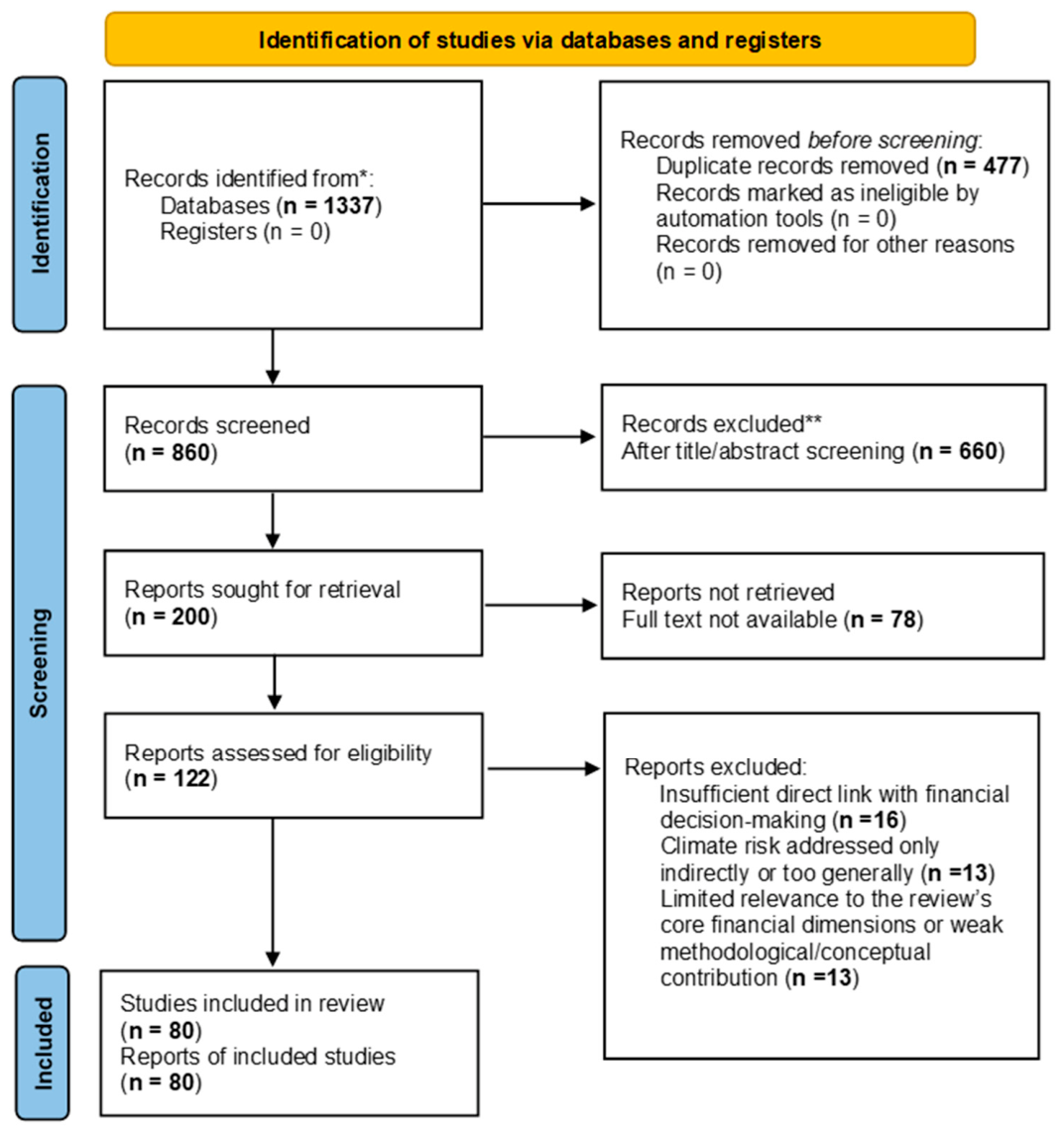
Page et al., 2021). After the database search, 1337 records were identified from Scopus and Web of Science. Before screening, 477 duplicate records were removed, leaving 860 records for title and abstract screening. At this stage, 660 records were excluded because they did not sufficiently match the review objective.
A total of 200 reports were then sought for retrieval. Among these, 78 reports could not be retrieved because the full text was not available. The remaining 122 full-text reports were assessed for eligibility. Following the eligibility assessment, 42 reports were excluded because they did not sufficiently meet the inclusion criteria. Consequently, 80 studies were retained for final inclusion in the systematic literature review and were subsequently subjected to quality appraisal and synthesis.
The full selection process is presented in
Figure 1.
After the identification, screening, and eligibility stages, the final set of included studies required further assessment to ensure that the synthesis was based on articles that were not only thematically relevant, but also methodologically robust and useful for addressing the review objective. Therefore, a quality appraisal step was added after the PRISMA-based selection process and before data extraction and synthesis.
The screening and eligibility assessment were conducted by the first author using the predefined inclusion and exclusion criteria. Titles and abstracts were first screened to exclude records that did not address both climate-related risks and financial decision-making. Full-text eligibility was then assessed for the retrieved reports. Cases that were initially unclear were reassessed by returning to the full text and applying the inclusion and exclusion criteria consistently. Since the screening and eligibility assessment were not conducted independently by two parallel reviewers, no inter-rater agreement coefficient was calculated.
3.5. Quality Appraisal of Included Studies
Following the final selection of studies, a quality appraisal was conducted to assess the methodological adequacy, thematic relevance, and usefulness of the included articles for the synthesis. Given the multidisciplinary nature of the final sample, the QAM was developed in line with the logic of quality appraisal approaches used for heterogeneous review designs, particularly the Mixed Methods Appraisal Tool (MMAT) (
Hong et al., 2018).
The QAM was designed to assess methodological adequacy, thematic relevance, and usefulness for synthesis. Each included article was evaluated using eight appraisal questions. Each question was scored from 0 to 2, where 2 indicates that the criterion was strongly satisfied, 1 indicates partial satisfaction, and 0 indicates weak or unclear satisfaction. The maximum score was therefore 16 points.
Once the quality appraisal was completed, the final set of studies was considered sufficiently relevant and robust for synthesis. The next step consisted of extracting comparable information from each article in order to organize the evidence consistently across methodological, thematic, and financial decision-making dimensions.
The QAM was applied after the PRISMA-based eligibility screening and was therefore used to appraise the methodological adequacy, thematic relevance, and usefulness of studies that had already met the review’s inclusion criteria. It was not designed as a formal risk-of-bias tool for meta-analysis, nor was it used to calculate effect-size certainty. Rather, it served as a transparent appraisal tool adapted to a heterogeneous body of empirical, conceptual, methodological, and policy-oriented studies. The quality appraisal was conducted by the first author using the eight predefined criteria. To improve transparency, the article-level QAM scores are reported in the
Supplementary Materials. The eight appraisal questions are presented in
Table 5 and the QAM total score classification is presented in
Table 6.
3.6. Data Extraction and Synthesis
After the screening, eligibility assessment, and quality appraisal stages, data were systematically extracted from the final sample of 80 included studies. A structured extraction grid was used to ensure consistency across the reviewed articles. The data extraction and synthesis process is summarized in
Table 7.
Data extraction was conducted by the first author using a structured extraction grid. The grid was designed to ensure consistency across the 80 included studies and covered bibliographic information, affiliations, citation count, research objectives, climate-risk type, financial decision-making area, methodology, data or conceptual material, geographical context, main findings, contribution to the review, and QAM score.
No meta-analysis or statistical effect-size synthesis was conducted because the included studies were heterogeneous in terms of research design, data, climate-risk measures, financial outcomes, geographical scope, and methodological approach. Consequently, no formal publication bias test, subgroup analysis, meta-regression, or statistical sensitivity analysis was performed. Heterogeneity was instead addressed narratively through descriptive analysis, QAM results, keyword co-occurrence mapping, and cluster-based thematic synthesis.
4. Results
This section presents the main results of the systematic review. It first describes the profile of the final sample, then reports the quality appraisal results, keyword analysis, cluster-based thematic synthesis, and the main variables and analytical dimensions identified in the reviewed studies.
4.1. Descriptive Overview of the Final Sample
4.1.1. Publication Trends over Time
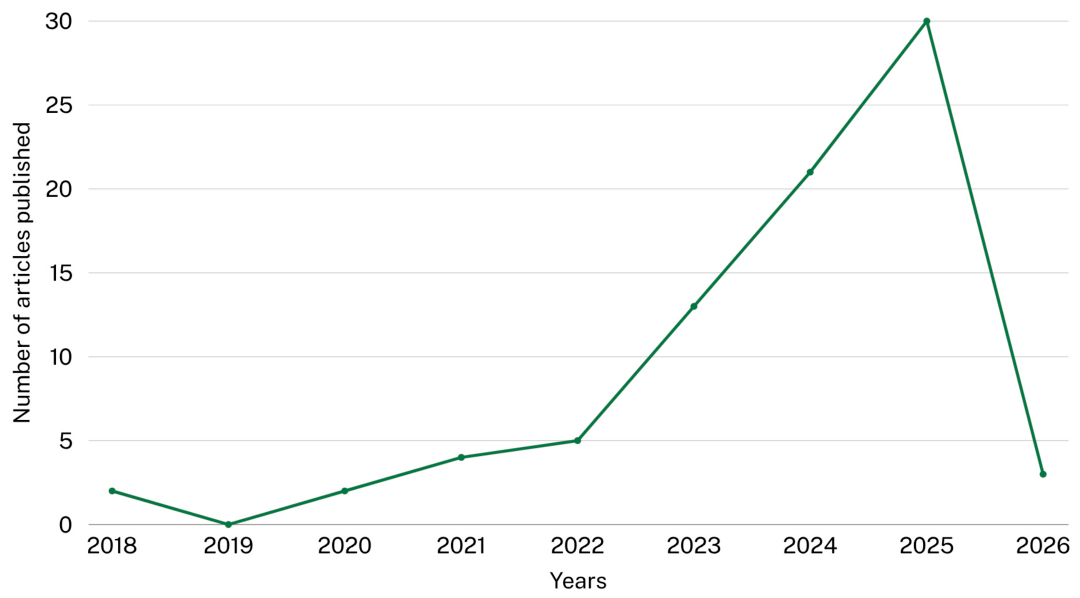
Figure 2 presents the annual publication trend of the final sample of 80 included articles. This analysis shows the evolution of academic interest in climate risk and financial decision-making over time.
Research output clearly increased after 2022, as indicated by the publication trend. Until 2021, the number of studies was relatively small, but grew substantially in 2023, 2024, and particularly 2025. This growth partly reflects the increased academic and policy focus on climate risks in finance, with physical risk, transition risk, credit risk, climate stress testing, and financial stability increasingly becoming part of financial decision-making frameworks.
The increase observed from 2023 onward may also be interpreted in light of the growing international standardization of sustainability and climate-related financial disclosure. In June 2023, the International Sustainability Standards Board issued IFRS S1, which addresses general sustainability-related financial disclosures, and IFRS S2, which focuses on climate-related disclosures (
IFRS Foundation, 2023a,
2023b). Although the publication trend cannot be attributed to one regulatory development alone, the emergence of these standards reflects the broader institutional momentum that has increased academic attention to climate-related financial risks, disclosure comparability, and decision-useful sustainability information.
Note: There are three records that appear as 2026 in the exported metadata because of online-first or issue-assignment differences; the search was restricted to 2015–2025. These records were retained because they were retrieved using the predefined filters.
4.1.2. Country Contribution
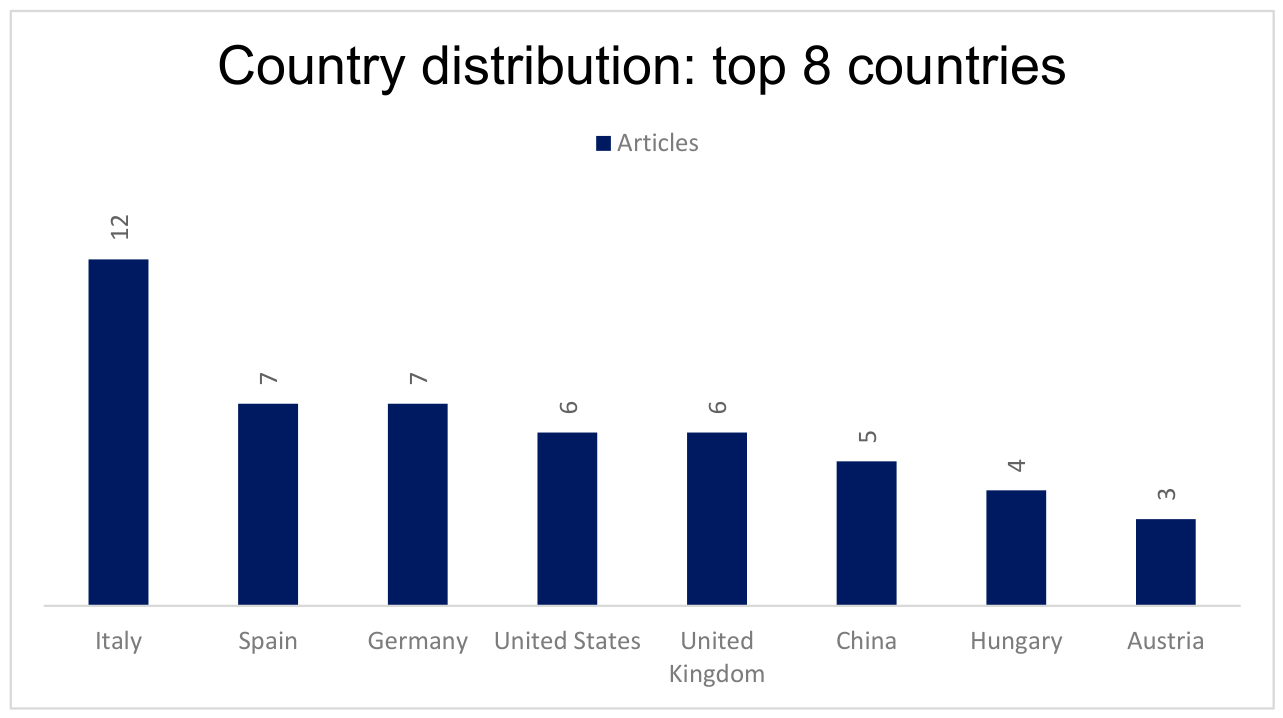
Figure 3 presents the eight most represented countries in the final sample, based on the first author’s first listed institutional affiliation. Articles were not double-counted, as some may have more than one international author. This method provides a perspective on key national settings in which research on climate-related risks and financial decision-making has developed.
Although the figure highlights the leading countries for readability, it does not imply that the remaining studies are geographically insignificant. The other 30 articles are dispersed across 24 additional countries, each contributing between one and two studies. These include, for example, South Africa, Tunisia, Brazil, India, Malaysia, Thailand, Indonesia, Jordan, Uruguay, Poland, South Korea, New Zealand, France, Australia, Japan, and Switzerland. The concentration of first-author affiliations in European and other advanced-economy institutions points to an uneven geography of research production and confirms an important research gap: emerging and developing economies remain underrepresented, despite their high exposure to climate-related financial risks and their growing need for climate-risk integration in financial decision-making.
4.1.3. Leading Authors
Table 8 shows the most productive authors in the final sample of 80 included studies. The analysis helps identify the scholars who have contributed most frequently to the literature on climate risk, financial decision-making, banking, financial stability, and sustainable finance.
The results show recurring contributors working mainly on climate finance, transition risk, asset pricing, and climate stress testing. However, authorship remains broadly distributed across the final sample. Irene Monasterolo appears as the most recurrent author in the final sample.
4.1.4. Most Cited Articles
The most cited articles in the final sample are listed in
Table 9, based on the citation counts in the final dataset. Citation counts were obtained from the Scopus and Web of Science metadata exported on 2 March 2026. This analysis helps identify the papers with the strongest influence on the literature on climate risk, financial decision-making, financial stability, central banking, and asset pricing. The most-cited studies are predominantly conceptual, policy-oriented, or empirical contributions that influenced the discussion on climate-related financial risks and the role of financial institutions.
4.1.5. Leading Journals and Sources
Table 10 reports the top 10 journals and publication sources represented in the final sample. This analysis identifies the main academic outlets through which research on climate risk and financial decision-making is disseminated.
The final sample is concentrated in journals focused on finance, economics, sustainability, and financial stability. This highlights the interdisciplinary aspect of the topic: climate risk, financial decision-making, banking, and sustainable finance.
4.1.6. Leading Affiliations
The leading institutional affiliations (top 10) contributing to the final sample are shown in
Table 11. This analysis reveals the most active universities and research institutes contributing to the growing body of knowledge on climate-related financial risks. Affiliation analysis included all institutional affiliations reported by the authors of the articles included, while the country analysis was based on the first author’s first institutional affiliation. Each institution was counted only once per article. Obvious spelling variants of the same affiliation were standardized, while distinct institutional or organizational units were retained as reported.
The leading affiliations show a strong European concentration, especially Italian, Austrian, Swiss, and EU research institutions. This is consistent with the dominance of European studies on climate stress testing, transition risk, financial stability, and prudential regulation.
4.2. Quality Appraisal Results
The quality appraisal results are summarized in
Table 12, while the detailed article-level assessment is provided in
Supplementary Table S3. The
Supplementary Table reports the Q1–Q8 scores, total score, and final quality rating for each of the 80 included studies.
The QAM results show the distribution of study quality and relevance within the final sample. Among the 80 included studies, 57 studies were classified as High/Core, representing 71.25% of the final sample. A further 20 studies were classified as High-medium/Core-supporting, representing 25.00%, while 3 studies were classified as Medium/Supporting, representing 3.75%. No study was classified as Medium-low or Low. This distribution indicates that the final sample remains methodologically adequate and highly relevant to the review objective, while avoiding an overly uniform classification of all studies as full core evidence.
The concentration of high QAM scores should be interpreted in light of the strict eligibility process that preceded appraisal. The QAM was applied only after 1337 records had been reduced to 80 studies that directly addressed the relationship between climate-related risks and financial decision-making. Therefore, the final sample was already strongly aligned with the review objective before quality appraisal. The high number of studies scoring 15 or 16 does not mean that all studies contributed equally to the synthesis. Rather, it indicates that many included studies clearly satisfied the review-specific criteria of relevance, methodological clarity, and usefulness. Studies with lower scores were retained as supporting or contextual evidence, particularly when they were conceptual, methodological, policy-oriented, or less directly connected to concrete financial decision-making. Accordingly, the QAM should be interpreted as a transparency and relevance appraisal tool for a heterogeneous systematic review, rather than as a formal risk-of-bias instrument designed to exclude studies or produce effect-size certainty.
Overall, the QAM results support the methodological adequacy and relevance of the final sample and justify the inclusion of all 80 studies in the descriptive analysis, keyword co-occurrence mapping, and cluster-based thematic synthesis. The full article-level scoring is presented in
Supplementary Table S3.
4.3. Keyword Analysis
4.3.1. Keyword Frequency
Table 13 reports the most frequent author keywords in the final sample of 80 included articles. Similar keywords were harmonized where appropriate, including singular and plural forms such as “transition risk” and “transition risks,” “physical risk” and “physical risks,” and related expressions such as “climate stress-test” and “climate stress testing.” This analysis identifies the dominant concepts used by scholars to frame the relationship between climate risk and financial decision-making.
Finally, the frequency of the terms “climate change,” “climate risk,” “transition risk,” “credit risk,” and “financial stability” in the final sample further underscores the importance of these issues. The updated results also highlight the significance of physical risk, climate transition risk, and climate stress testing, which indicates the growing emphasis on scenario analysis, banking resilience, and the incorporation of climate-related risks into financial risk management. Overall, the keyword structure indicates that the literature is focused on the financial consequences of physical and transition risks, especially their implications for credit risk, financial stability, sustainable finance, and climate stress-testing frameworks.
4.3.2. Keyword Co-Occurrence Analysis
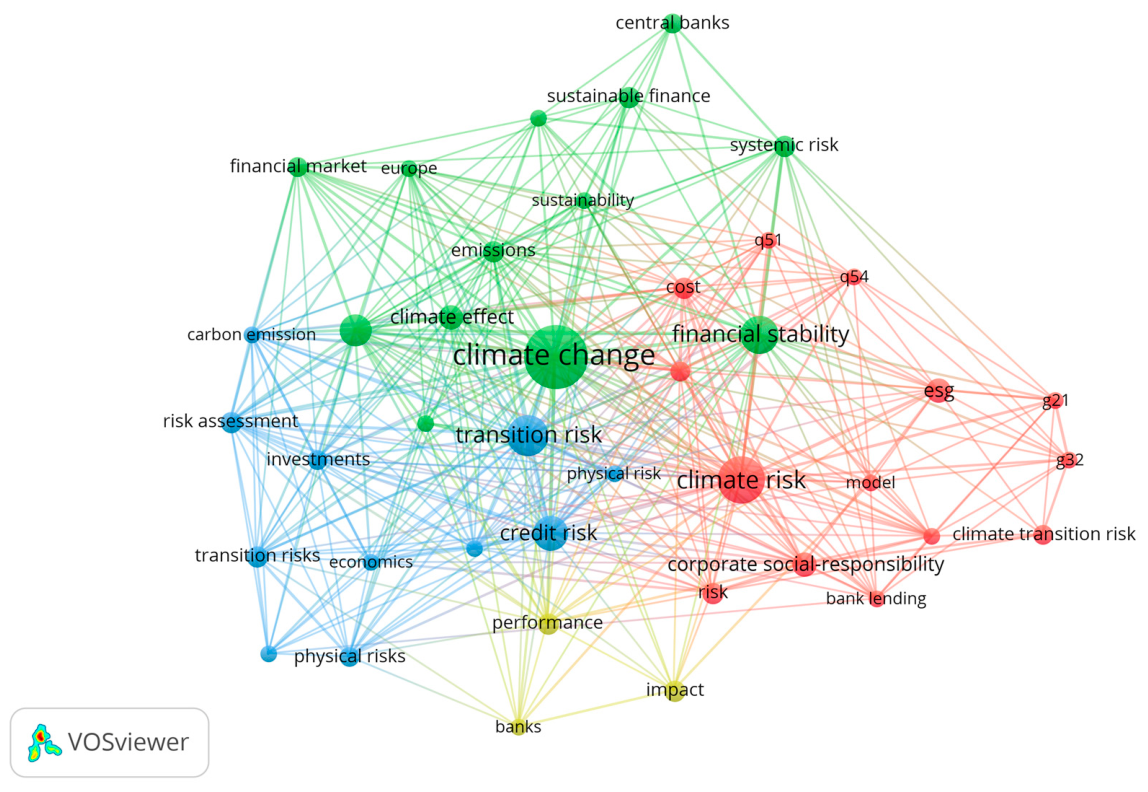
To complement the keyword frequency analysis, a keyword co-occurrence network was created with VOSviewer. This analysis reveals the conceptual structure of the final sample by showing how often keywords co-occur across the included studies. In the network, larger nodes represent more frequently used keywords, while links between nodes indicate keyword co-occurrence. Themes are represented by colors.
The keyword co-occurrence analysis was performed with VOSviewer version 1.6.20. A map was generated from bibliographic information imported from reference manager files. Co-occurrence analysis was used as the type of analysis, keywords were used as the unit of analysis, and the counting method was full counting. The minimum number of occurrences of a keyword was set at 4. The initial set of 499 keywords was reduced to 41 keywords that met the threshold and were included in the final network. The association strength method was used to normalize the network. The clustering parameters were set as follows: resolution = 1.00; minimum cluster size = 1; “merge small clusters” = enabled. The final network contained 41 items, 4 clusters, 386 links, and a total link strength of 603. For the descriptive frequency analysis in
Table 13, closely related terms were harmonized. In the VOSviewer network, variants retained as separate keywords by the software were reported as generated and considered during interpretation. The default layout values were used, with attraction set to 2 and repulsion set to 0. The resulting keyword network was interpreted through VOSviewer clustering and manual reading of the titles, abstracts, full texts, and extraction notes of the included studies. Alternative minimum-occurrence thresholds were not tested. Therefore, the stability of the four-cluster solution across different threshold settings was not formally assessed. The resulting cluster structure should accordingly be interpreted as an exploratory representation of the keyword network under the reported parameters. The resulting keyword co-occurrence network is shown in
Figure 4.
The VOSviewer output identified four main thematic clusters. These clusters provide the basis for the cluster-based thematic synthesis developed in the following subsection. Unlike keyword frequency, which shows the most repeated terms, keyword co-occurrence analysis reveals how concepts are connected across the literature and how the field is structured around related research streams. Cluster 4 is smaller than the other clusters, as it contains only three keywords: “banks,” “performance,” and “impact.” For this reason, it is interpreted cautiously and not as an equally broad thematic stream compared with the other clusters. It was retained because the three keywords form a coherent banking-performance dimension and because manual reading of the included studies confirmed that banking outcomes, lending behavior, and financial performance constitute an important part of the climate-finance decision-making literature.
The keyword co-occurrence map identifies 41 keywords grouped into four clusters, reflecting the main conceptual connections within the final sample. While node size indicates the relative prominence of each keyword and links show co-occurrence relationships, the cluster colors reveal how the literature is organized around distinct but interconnected research streams. To clarify the structure of the map,
Table 14 summarizes the four clusters generated by VOSviewer and lists their main keywords. The analytical interpretation of these clusters is developed in the following section through a cluster-based thematic synthesis.
4.4. Cluster-Based Thematic Synthesis
Each cluster is examined comparatively by connecting studies that address similar or contrasting aspects of climate-related risks and financial decision-making. Rather than presenting articles separately, the analysis compares findings across studies, interprets their contribution, and explains how each cluster advances understanding of disclosure, risk modeling, investment, banking, credit risk, and financial stability.
4.4.1. Climate Risk, ESG, and Financial Modeling
The red cluster highlights the growing role of ESG information, disclosure, and financial modeling in translating climate-related risks into financial decisions. This literature shows that climate-related information can improve risk assessment, but also that its usefulness depends on credibility, comparability, and measurement quality.
Alessi et al. (
2021) show that greenhouse gas emissions and environmental disclosure influence stock market valuation, suggesting that investors incorporate environmental information into pricing decisions. However,
Agustin et al. (
2025) show that greenwashing may increase stock price crash risk, while
Bouteska et al. (
2026) indicate that ESG rating divergence can complicate sustainable portfolio allocation and transition-risk assessment. Taken together, these studies suggest that ESG and climate-related data support financial decision-making only when they reduce, rather than amplify, information asymmetry.
4.4.2. Climate Change, Sustainable Finance, and Systemic Stability
The green cluster pushes climate risk onto the macro-financial and systemic agenda. This stream centers on the impacts of climate change on financial stability, central bank mandates, and sustainable finance policy, as well as on climate change as a firm-level environmental problem.
Monasterolo (
2020) shows that the financial system is vulnerable to climate risk through physical and transition channels, while
Chenet et al. (
2021) point out the uncertainty that climate change poses to conventional financial risk models.
Dikau and Volz (
2021) continue this line of research by exploring the central bank’s role in green finance, and
D’Orazio (
2025) considers the potential for climate-related financial policies to reduce risks to financial stability. The studies show that climate-related risks affect financial decision-making not only in markets and firms, but also in regulation, supervision, and macroprudential policy.
4.4.3. Transition Risk, Investment, and Risk Assessment
In the blue cluster, the effects of transition risk on investment decision-making, portfolio allocation, and financial risk assessment are discussed. Carbon exposure, climate-policy signals, and indicators of climate transition risk are becoming more prominent in this stream, but they are not always priced consistently in financial markets.
Alessi et al. (
2021) show that environmental performance and disclosure can be reflected in stock market valuation, while
Alessi et al. (
2024) provide evidence of how investors reacted to major climate-policy events, such as the Paris Agreement and the U.S. withdrawal from it.
Bua et al. (
2024) demonstrate that financial markets price transition and physical climate risks differently, and
Costola and Vozian (
2025) provide evidence that transition risk is reflected in corporate CDS spreads. The results show that transition risk is becoming a financially material risk but is not consistently included in the investment decision-making process across asset classes, policy events, and market conditions.
4.4.4. Banks, Performance, and Financial Impact
The yellow cluster represents a smaller but relevant dimension of climate-related financial decision-making focused on banking performance. Its primary keywords include “banks,” “performance,” and “impact,” indicating that it is concerned with the effects of climate-related risks on banking outcomes and financial performance. Since the keyword “credit risk” appears in the blue cluster rather than in the yellow cluster, the interpretation of this stream should be considered related to, but distinct from, the broader credit-risk and risk-assessment cluster. Research on this topic reveals that climate-related risks can affect banks through borrower credit quality, lending practices, profitability, risk-taking, and financial resilience.
Bruno and Lombini (
2023) demonstrate that transition risk affects bank lending through changes in loan pricing and credit supply after the Paris Agreement, while
Takahashi and Shino (
2025) find that banks reduce lending to firms with higher greenhouse gas emissions.
Khemiri and Nouaili (
2025) relate climate risk and green growth to non-performing loans in MENA banks, while
Zhang and Ming (
2025) demonstrate that physical and transition risks affect bank risk-taking and insolvency risk in China. Overall, the findings of these studies indicate that banks play an important role as a transmission mechanism through which climate-related risks influence credit allocation, financial performance, and resilience.
4.5. Main Variables and Analytical Dimensions
This classification shows that the reviewed literature generally treats climate-related risks as explanatory variables and financial outcomes as dependent variables. Mediating and moderating variables appear less systematically, suggesting that many studies still focus on direct effects rather than on the mechanisms and contextual conditions shaping climate-related financial decisions. The main variables and analytical dimensions identified in the reviewed studies are summarized in
Table 15.
4.6. Theoretical Reading of the Review Findings
The findings reveal that, based on the literature reviewed, four complementary theoretical lenses can be used to interpret the literature. In studies dealing with the risk management perspective, physical risk, transition risk, carbon emissions, climate-policy uncertainty, and climate-related events are regarded as financial risk factors that influence credit risk, asset pricing, portfolio allocation, lending activities, and financial stability. The information asymmetry and disclosure perspective also appears in studies on ESG disclosure, environmental performance, climate-risk reporting, greenwashing, ESG rating divergence, and financed emissions, where financial decisions depend on the availability and credibility of information. Institutional theory is reflected in studies on the significance of regulation, disclosure requirements, central bank expectations, taxonomies, sustainable finance policies, and supervisory pressures as factors influencing the responses of financial actors to climate-related risks. Finally, the systemic risk and financial stability perspective is reflected in research showing how climate-related shocks can affect not only individual firms, banks, or portfolios, but also the financial system as a whole through correlated exposures, asset repricing, credit channels, and stress-testing scenarios.
The present theoretical reading indicates that no single logic is found in the literature to explain this relationship. Instead, it appears that the financial decision-making process is influenced by climate exposure, information, institutional context, and systemic transmission. The financial relevance of climate risks is explained by exposure; the process through which these risks become visible and usable by financial actors is explained by information; differences in how financial actors respond to climate risks across jurisdictions are explained by institutional context; and the way localized or sectoral risk can become a broader financial vulnerability is explained by systemic transmission. The discussion section examines the convergence and divergence between the theoretical lenses and the evidence found in the review.
5. Discussion
5.1. Interpreting Climate-Related Financial Risks Beyond Frameworks
This review illustrates that climate-related risks have become financially material risks that affect credit risk, financial stability, disclosure, lending, portfolio allocation, stress testing, and asset pricing. This finding is in line with the rising importance of frameworks such as the TCFD, NGFS, BCBS, and ISSB. The role of these frameworks is largely practical, however: they establish categories, reporting requirements, supervisory principles, and risk-management practices. They do not fully explain the link between climate-related risks and financial decisions or the varying responses of financial actors across different contexts. Hence, the results should be interpreted using broader theoretical lenses.
From a risk management perspective, the review confirms that physical and transition risks are now understood as financial risk drivers. Physical risks are related to borrower vulnerability, collateral values, business disruption, insurance losses, and default probability, while transition risks are related to carbon exposure, policy uncertainty, stranded assets, credit spreads, portfolio performance, and market repricing. The literature therefore supports the view that climate-related risks should be identified, measured, priced, monitored, and managed. However, most studies focus on quantifying exposure or estimating financial impacts rather than understanding how climate-risk information is incorporated into internal financial decision-making, such as loan approval, loan pricing, credit limits, collateral valuation, portfolio rebalancing, or capital allocation. This shows that there is a gap between climate-risk measurement and climate-risk decision-making.
A second explanation is based on the information asymmetry and disclosure perspective. The studies reviewed reveal a range of ESG disclosure and reporting elements, such as climate-risk reporting, environmental performance, greenwashing, ESG rating divergence, and financed emissions, as key components of climate-related financial decision-making. This reinforces the idea that investors, lenders, and regulators consider climate risks only once they become visible, credible, and comparable. The results also show that disclosure is not necessarily decision-useful. Inconsistent ESG ratings, heterogeneous reporting practices, and greenwashing can create and worsen information asymmetry. The volume of climate-related information is not the only concern, however; its credibility, comparability, and connection to financial materiality are the primary concerns raised by the review.
Another explanation for the variation in climate-risk integration across contexts comes from institutional theory. The reviewed literature is strongly influenced by regulatory and supervisory developments, especially within advanced economies and in Europe. This implies that financial actors are not only reacting to exposure to climate risk, but also to institutional factors like central bank expectations, disclosure standards, taxonomies, prudential guidance, market norms, and reputational considerations. Institutional theory can therefore be helpful in explaining how the decision-making process for climate finance unfolds unevenly across countries, banking systems, and financial markets. It also draws attention to an important issue: emerging economies are underrepresented, although they may be more physically climate-vulnerable and have less developed climate-data infrastructure.
The systemic risk and financial stability perspective provides an additional explanation by showing that climate risk can extend beyond a single firm, bank, or portfolio. Broader vulnerabilities can spread through financial institutions and markets when physical shocks, transition-policy changes, unexpected repricing of carbon-intensive assets, or correlated exposures occur. This systemic interpretation is supported by the reviewed studies on central banking, climate stress testing, stranded assets, and macroprudential supervision. However, the literature often studies micro-level financial decisions separately from macro-level financial stability issues. A greater understanding of the interaction between borrower-level exposure, bank lending behavior, portfolio allocation, market repricing, and financial stability is needed.
5.2. The Main Analytical Insight: Exposure, Information, Institutions, and Transmission
The main analytical finding of the review is that there are four interrelated dimensions of climate-related financial decision-making: exposure, information, institutional context, and systemic transmission. Exposure explains why climate risk can affect financial outcomes. Information makes these risks visible and usable. The institutional context helps explain differences in how actors respond across jurisdictions and financial systems. Individual exposures can lead to broader financial vulnerabilities through systemic transmission.
The dimensions are related to one another. It is difficult to assess climate exposure without reliable information. Without institutional pressure or market incentives, climate-related information may not be used. Institutional pressure may lead only to formal compliance if exposure measurement and disclosure quality remain weak. Lastly, the systemic effects of individual financial decisions can emerge when similar exposures accumulate across firms, banks, sectors, and portfolios. This integrated interpretation moves the literature beyond a technical understanding of climate-finance frameworks and toward a more theory-based understanding of climate-related financial decision-making.
5.3. Theoretical and Empirical Gaps
Based on the review, there are five key gaps. First, climate-risk measurement is still more advanced in the literature than the study of real-world financial decision-making. Future studies should analyze the use of climate-risk data for credit scoring, loan pricing, borrower monitoring, portfolio construction, capital planning, and stress testing by banks and investors. Second, the information channel is still underdeveloped. Previous research indicates that disclosure and ESG data are important; however, problems of credibility, comparability, greenwashing, and rating divergence also exist. Future research should therefore examine when climate-related information becomes genuinely decision-useful. Third, institutional differences need to be studied in more detail. Few studies focus on emerging economies, so results are not easily applicable to these contexts. Regulatory capacity, data availability, financial-system structure, and climate vulnerability are important factors to consider for the integration of climate risk in contexts where this has not been explored extensively, such as Morocco, North Africa, and the broader MENA region. Fourth, there is an inadequate understanding of the relationship between micro-level decision-making processes and systemic risk. Further research is required to connect borrower exposures to bank lending, asset repricing, portfolio adjustment, and financial stability outcomes. Fifth, physical and transition risks are still considered separately. Future research should develop integrated methods that take into account the simultaneous impact of both types of risk on credit risk, investment decisions, bank performance, and financial stability.
5.4. Limitations and Future Research Directions
This review has several limitations. First, it is based on studies retrieved from Scopus and Web of Science, which may exclude relevant work indexed elsewhere or published as policy reports, working papers, or regional studies. Second, it focuses on English-language journal articles retrieved under database filters covering 2015–2025. Third, screening, eligibility assessment, data extraction, and QAM scoring were conducted by one reviewer rather than by two independent reviewers in parallel. Although predefined inclusion and exclusion criteria, a structured extraction grid, and article-level QAM reporting were used to improve transparency, some interpretive judgment remains involved in study selection and thematic synthesis. Fourth, the QAM was designed as a review-specific tool for assessing methodological adequacy, thematic relevance, and usefulness for synthesis. It should not be interpreted as a formal risk-of-bias instrument equivalent to those used in meta-analytical reviews. Fifth, the VOSviewer clusters depend on keyword selection, harmonization, and threshold settings. In particular, the fourth cluster contains only three keywords and is therefore interpreted cautiously, with support from manual reading of the included studies. In addition, no sensitivity analysis using alternative keyword-occurrence thresholds was conducted; therefore, the stability of the four-cluster solution across different threshold settings was not formally assessed. Finally, because no meta-analysis or statistical effect-size synthesis was conducted, the review does not provide pooled estimates, publication bias tests, subgroup analysis, meta-regression, or statistical sensitivity analysis. Its contribution lies instead in systematically organizing, appraising, mapping, and interpreting a heterogeneous body of literature on climate-related risks and financial decision-making.
These limitations suggest several directions for future research. First, future reviews may draw on information from sources beyond the major academic databases, which may provide broader coverage and greater contextual diversity. Second, future reviews could employ multi-reviewer screening and coding methods to enhance reliability and minimize subjective bias. Third, when feasible, methodological advances such as meta-analysis or mixed-method synthesis may provide stronger quantitative insights into the financial effects of climate-related risks. Fourth, future studies should also investigate the use of climate-risk information in financial institutions, especially in credit allocation, pricing, and portfolio management. Fifth, greater attention should be given to emerging and developing economies, where climate vulnerability is high and empirical evidence remains limited. Sixth, there is a need to improve the quality, comparability, and standardization of climate-related data, including ESG metrics and financed emissions. Finally, future research could explore the connection between micro-level financial decision-making and macro-financial stability and investigate how individual exposures contribute to systemic risk. Developing interdisciplinary approaches that integrate finance, economics, climate science, and data analytics will be important for improving understanding of climate-related financial risks and their consequences for financial systems.
6. Conclusions
A total of 80 studies were selected from Scopus and Web of Science to analyze the relationship between climate-related risks and financial decision-making as part of a systematic literature review. The results reveal that climate-related risks are increasingly perceived as financially material risks affecting banks, investors, firms, regulators, and central banks. Four research streams are identified in the literature under the headings climate risk, ESG, and financial modeling; climate change, sustainable finance, and systemic stability; transition risk, investment, and risk assessment; and banks, performance, and financial impact.
The review identifies multiple mechanisms through which physical and transition risks affect financial decision-making, such as asset pricing, portfolio allocation, lending, credit-risk assessment, disclosure, climate stress testing, and financial stability supervision. The literature is still fragmented, however, especially regarding the joint modeling of physical and transition risks, the actual incorporation of climate risk into internal financial decision-making, the quality and comparability of climate-related data, and the scarcity of evidence from emerging economies.
Overall, this review contributes by organizing a rapidly expanding field and clarifying how climate-related risks are conceptualized, measured, and connected to financial decision-making. Future research should move beyond documenting climate-risk exposure and examine how financial actors operationalize these risks in concrete decisions, especially in banking systems and underexplored contexts such as Morocco, North Africa, and emerging economies.