1. Introduction
Environmental Management Accounting (EMA) has emerged as an important response to the limitations of Traditional Management Accounting, which often fails to identify environmental costs accurately. In conventional accounting systems, environmental expenditures are frequently aggregated into general overhead accounts, causing “hidden” environmental costs to remain invisible in managerial decision-making and leading to distorted product costing and weak environmental performance (
Jamil et al., 2015). In Vietnam, this limitation is even more evident because under Circular 99/2025/TT-BTC, the current accounting system does not provide separate accounts specifically for environmental costs. In practice, most environmental expenditures are often embedded in Account 627 (manufacturing overhead costs) or Account 642 (general and administrative expenses), making environmental expenditures difficult to trace and manage strategically. EMA has been proposed to address this limitation by integrating both physical information, such as material and energy flows, and monetary information related to environmental costs and benefits, thereby supporting better decisions and long-term sustainability (
IFAC, 2005). Recent studies in emerging economies further suggest that EMA has become increasingly relevant in the context of ESG reporting, carbon accounting, sustainability disclosure, and climate-related accountability. Moreover, firms at these economies face growing pressure to improve both internal environmental cost management and external sustainability transparency (
Khamisu et al., 2024;
Nyakuwanika & Panicker, 2025).
The steel industry provides a particularly important context for examining EMA adoption intention. Steel production is highly resource-intensive, characterized by significant energy consumption, high CO
2 emissions, and substantial solid waste generation. In Vietnam, according to the Vietnam Steel Association (VSA), as reported by
Asemconnect Vietnam (
2025), crude steel output reached 5.81 million tons in the first quarter of 2025, reflecting rapid industrial expansion and increasing environmental pressure. In addition, the industry is increasingly exposed to sector-specific environmental pressures, including carbon border adjustment policies, stricter emissions requirements, and international sustainability standards. Therefore, steel is not selected simply because it is a polluting industry. As one of the strategic industries supporting Vietnam’s industrialization and international competitiveness, the sector faces increasing pressure to balance economic growth with environmental sustainability. Understanding the factors that are associated with EMA adoption in this context therefore has implications not only for environmental management but also for the sustainable transformation of an industry in a transition economy.
However, recent theoretical and systematic reviews suggest that although TOE effectively categorizes technological, organizational, and environmental determinants, it remains limited in explaining how these conditions are reflected into actual organizational adoption outcomes (
Prakash, 2025;
Mpanza, 2025). Existing TOE-based and related EMA adoption models have provided valuable insights into the factors associated with adoption intention, such as technological readiness, organizational resources, management support, regulatory pressure, and stakeholder expectations. However, these models tend to explain what factors are associated with adoption rather than how managers interpret, compare, and evaluate these factors before forming adoption intentions. This limitation is important because EMA adoption cannot be fully explained as an automatic outcome of favorable technological, organizational, or environmental conditions. In practice, firms may face similar regulatory or stakeholder pressures but adopt EMA to different degrees; firms may possess adequate resources and capabilities but still hesitate to adopt; and firms may operate under favorable technological conditions. These situations suggest that contextual conditions alone are insufficient to explain EMA adoption intention because managers may first weigh expected benefits against implementation costs, operating burdens, organizational risks, and required organizational effort.
To address this limitation, this study draws on RCT and positions PNB as a contextually relevant evaluative construct reflecting managerial assessment. From this perspective, existing models identify the conditions associated with EMA adoption intention, whereas RCT explains the interpretive perspective for understanding how managers assess these conditions when forming adoption intention.
While prior research on EMA adoption intention has mainly examined organizational behavior from legitimacy-oriented perspectives, drawing on Institutional Theory, Legitimacy Theory, Stakeholder Theory, and Agency Theory, this study adopts a different explanatory lens by conceptualizing adoption as a rational utility evaluation process through the application of Rational Choice Theory.
Among the theoretical perspectives employed in this study, TOE serves as the anchor theory because EMA adoption is primarily an organizational innovation decision shaped by technological, organizational, and environmental contexts. Within this architecture, a two-level theoretical hierarchy is proposed. Level 1 (anchor): TOE defines the macro-level innovation context and its three dimensions. Level 2 (evaluative process): RCT explains the managerial interpretation process through which contextual conditions are considered in forming adoption intention.
From a research philosophy perspective, this study adopts a post-positivist stance, acknowledging that organizational decisions are influenced by contextual conditions but are not determined by them in a purely deterministic manner. Instead, managerial decision-making is understood as involving probabilistic and context-dependent evaluation. Consistent with this philosophical position, the study employs a cross-sectional survey and PLS-SEM to examine theoretically grounded associations among constructs rather than to establish definitive causal relationships. Within the proposed theoretical architecture, the TOE framework specifies the technological, organizational, and environmental contexts surrounding EMA adoption, whereas Rational Choice Theory explains the managerial evaluative process through which these contextual conditions are interpreted in terms of expected net benefits before shaping adoption intention. This distinction provides a coherent analytical separation between contextual antecedents and managerial evaluation while remaining consistent with the study’s post-positivist orientation. This philosophical positioning ensures coherent integration between the contextual determinism of TOE and the rational evaluation logic of RCT within a unified analytical framework.
Therefore, this study investigates the determinants of EMA adoption intention in Vietnam’s steel industry, with particular emphasis on the mediating role of PNB. It contributes by: (1) providing an alternative explanatory perspective alongside the legitimacy-oriented approaches commonly adopted in prior EMA studies; (2) extending research to the underexplored steel sector, and positioning PNB as an RCT-based mediating process that explains how managers translate TOE contextual factors into EMA adoption intention through net benefit–cost evaluation.
2. Theoretical Background
The TOE framework developed by
Tornatzky and Fleischer (
1990) provides a useful theoretical foundation for explaining behavioral intentions toward EMA adoption at the organizational level. The TOE framework suggests that innovation adoption is shaped by three dimensions: (1) the technological context refers to the characteristics of innovation, such as perceived usefulness and perceived ease of use, which influence how firms evaluate EMA; (2) the organizational context includes internal factors such as financial resources and top management support, which determine a firm’s capacity to implement EMA; (3) the environmental context reflects external pressures such as government regulations and stakeholder expectations, which often influence firms to adopt environmental accounting practices. Moreover, ΤΟE framework has been used successfully across various studies in the IT adoption literature in general; for example, the adoption of the open system (
Chau & Tam, 1997), EDI adoption (
Kuan & Chau, 2001), KM systems adoption (
Alatawi et al., 2012), and e-commerce adoption (
Seyal & Rahman, 2003). In this study, EMA is viewed as an organizational innovation and an information-based managerial practice rather than merely an accounting technique. Therefore, we consider that the TOE framework is suitable because it provides a multidimensional explanation of how firms adopt and implement EMA under the interaction of technological, organizational, and environmental conditions.
However, although TOE identifies the technological, organizational, and environmental conditions associated with EMA adoption, it provides limited insight into how managers evaluate these conditions when forming adoption intention. Specifically, TOE explains what contextual factors matter but not how managers interpret them in deciding whether EMA adoption is worthwhile.
Rational Choice Theory is therefore incorporated to provide this missing decision logic. According to this theory, decision makers evaluate expected benefits relative to anticipated costs before selecting a course of action (
Becker, 1976;
Coleman, 1990). From an RCT perspective, favorable conditions alone do not trigger adoption. Managers first evaluate whether expected benefits outweigh costs, risks, and required effort (
Coleman, 1990). From this perspective, PNB differs conceptually from related constructs such as perceived usefulness (PU), perceived benefits (PB), perceived value (PV), and perceived ease of use (PEOU). PU primarily captures functional utility, PB emphasizes expected positive outcomes, PV reflects overall value assessment, and PEOU concerns implementation simplicity. In contrast, PNB is grounded in Rational Choice Theory and captures managers’ integrated evaluation of whether expected organizational benefits outweigh implementation costs, resource commitments, and operational risks. This construct operationalizes the cost–benefit evaluation central to RCT. Unlike PU, PB, or PV, PNB simultaneously incorporates four evaluative dimensions: (1) expected organizational benefits, (2) implementation costs, (3) resource commitments, and (4) operational risks. Managers form adoption intention only after weighing these dimensions as an integrated judgment. Although perceived value also reflects a trade-off between benefits and sacrifices, it is primarily developed within consumer and information-system research to explain users’ subjective value perceptions. In contrast, PNB is specifically conceptualized at the organizational decision-making level, where managers evaluate whether EMA represents a worthwhile strategic investment after considering organizational costs, implementation burdens, resource commitments, and operational risks. Therefore, PNB is not intended to substitute for perceived value, but rather to operationalize the managerial expected-utility mechanism proposed by Rational Choice Theory.
3. Literature Review and Hypothesis Development
Perceived ease of use (PEOU), as conceptualized by
Davis (
1989), captures the degree to which managers expect EMA technological systems adoption to demand minimal effort. Systems perceived as straightforward lower implementation resistance and increase organizational readiness, both of which make adoption more likely (
Chen et al., 2020). In developing economies, however, EMA tools are often seen as complex and unwieldy, largely because standardized implementation guidelines remain scarce (
Jamil et al., 2015;
Setthasakko, 2010). When managers perceive EMA implementation as requiring relatively little effort, the anticipated implementation burden decreases. This reduced effort consideration becomes one input into managers’ subsequent cost–benefit assessment, which is captured exclusively by PNB. Accordingly, PEOU is conceptualized as a technological attribute, whereas PNB represents the managerial evaluative outcome derived after broader consideration of expected benefits, implementation costs, resource commitments, and operational risks (
Wang et al., 2019;
Alnaim & Metwally, 2024). Therefore, rather than directly shaping adoption intention, PEOU is not itself an evaluative construct. Instead, it represents a technological characteristic that influences the implementation effort considered during managerial cost–benefit evaluation. The evaluative judgment itself is captured exclusively by PNB.
Therefore, the following hypotheses are proposed:
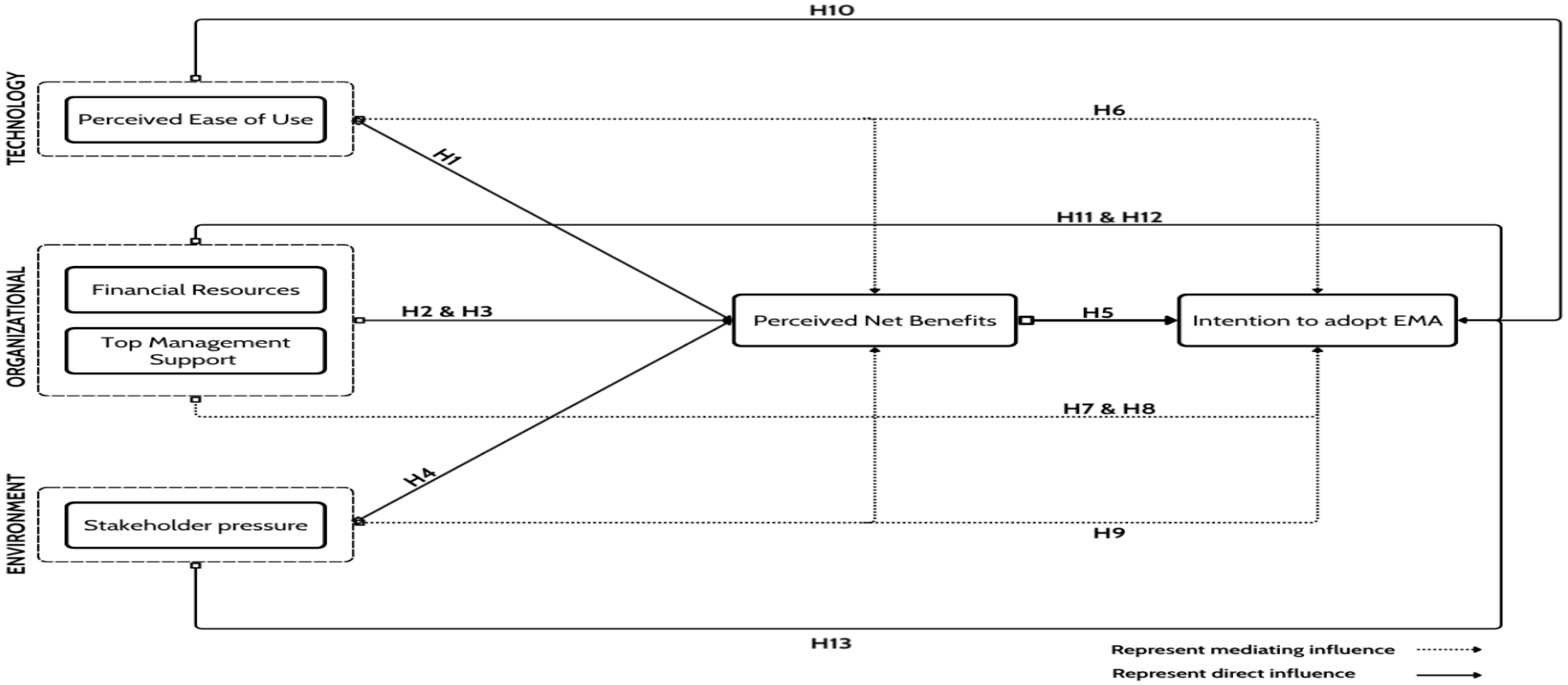
H1. Perceived ease of use is positively correlated with perceived net benefits.
H6. Perceived net benefits mediate the relationship between perceived ease of use and intention to adopt EMA.
H10. Perceived ease of use is positively correlated with intention to adopt EMA.
Financial resources (FR) refers to the availability of internal capital sufficient to cover EMA implementation costs, including training, infrastructure, system development, and ongoing environmental monitoring (
Jamil et al., 2015;
Le et al., 2019). Many firms in developing economies lack this capital, making EMA feel financially burdensome rather than strategically attractive (
Elhossade et al., 2022). Prior studies suggest that firms with stronger financial capacity are better able to absorb implementation costs and pursue long-term eco-efficiency benefits (
Wang et al., 2019;
Lutfi et al., 2023). However, the literature also indicates that financial resources may function more as an enabling condition than as a direct determinant of adoption. Firms may possess sufficient resources but still avoid EMA adoption if managers do not perceive EMA’s expected net benefits.
Therefore, the following hypotheses are proposed:
H2. Financial resources are positively correlated with perceived net benefits.
H7. Perceived net benefits mediate the relationship between financial resources and intention to adopt EMA.
H11. Financial resources are positively correlated with Intention to adopt EMA.
Top management support (TMS) refers to the level of active engagement, commitment, and direct participation of senior executives in planning and using new management systems. Previous studies emphasize that leadership support is critical because environmental accounting initiatives often require strategic direction, resource allocation, and coordination across accounting, production, and environmental management units (
Setthasakko, 2010;
Asiaei & Rahim, 2019;
T. H. Nguyen, 2022). In the context of Vietnamese steel firms, TMS may be more than an internal resource; it may signal that EMA is an organizational priority. Therefore, TMS be positively associated with adoption intention and be associated with stronger PNB evaluations by strengthening managers’ perception of EMA’s strategic and operational value.
Therefore, the following hypotheses are proposed:
H3. Top management support is positively correlated with perceived net benefits.
H8. Perceived net benefits mediate the relationship between top management support and intention to adopt EMA.
H12. Top management support is positively correlated with intention to adopt EMA.
Stakeholder pressure (SP): within the TOE framework, stakeholder pressure represents an environmental-context factor reflecting the external conditions surrounding organizational innovation adoption rather than an independent theoretical perspective. In the context of EMA adoption, stakeholder expectations may encourage firms to improve environmental transparency, environmental cost management, and sustainability performance. However, consistent with Rational Choice Theory, such external pressure is not assumed to lead directly to adoption. Instead, managers evaluate whether responding to these pressures through EMA is expected to generate sufficient organizational benefits relative to implementation costs, resource commitments, and operational risks. In the environmental context, this pressure arises when non-regulatory stakeholders increasingly expect firms to reduce environmental harm, operate responsibly, and demonstrate commitment to sustainability rather than focusing only on short-term financial performance. Prior studies suggest that stakeholder demands increase the need for cleaner production, credible sustainability reporting, and environmental accountability (
Setthasakko, 2010;
Mohd Khalid et al., 2012;
Le et al., 2019). EMA can help firms respond to these expectations by generating relevant environmental cost information and supporting better decision-making (
Chen et al., 2020;
Lutfi et al., 2023). However, stakeholder pressure may not automatically result in adoption unless managers perceive EMA as valuable for reputation, competitiveness, compliance, and long-term strategic positioning.
Therefore, the following hypotheses are proposed:
H4. Stakeholder pressure is positively correlated with perceived net benefits.
H9. Perceived net benefits mediate the relationship between stakeholder pressure and intention to adopt EMA.
H13. Stakeholder pressure is positively correlated with intention to adopt EMA.
Perceived net benefits (PNB), as defined in
Section 2, has been applied as a cost–benefit evaluative mechanism in non-EMA contexts, including vaccination willingness and management accounting (
J. Li et al., 2023;
S. X. Li et al., 2023). EMA adoption may generate organizational benefits such as improved environmental cost visibility, resource efficiency, and sustainability reporting (
Burritt & Schaltegger, 2010;
Christ & Burritt, 2013). However, implementation requires investments in training, infrastructure, and organizational resources (
Qian et al., 2018;
Lutfi et al., 2023). Managers perceiving that expected benefits outweigh these commitments are expected to report stronger adoption intentions. EMA adoption may generate important organizational benefits, including improved environmental cost visibility, resource efficiency, managerial decision-making, sustainability reporting, and environmental accountability (
Burritt & Schaltegger, 2010;
Christ & Burritt, 2013;
Schaltegger & Burritt, 2010). At the same time, implementation requires investments in training, technological infrastructure, system integration, and organizational resources, particularly in resource-constrained firms (
Qian et al., 2018;
Lutfi et al., 2023). Therefore, managers perceiving that the expected organizational benefits outweigh these implementations commitments are expected to report stronger intention to adopt EMA.
Therefore, the following hypothesis is proposed:
H5. Perceived net benefits are positively correlated with intention to adopt EMA.
Based on the preceding discussion and the proposed hypotheses, the study develops the conceptual model presented in
Figure 1.
Figure 1 represents the proposed relationships under the boundary condition that EMA adoption is voluntary, and organizations retain discretion in adoption decisions. The mediating role of PNB is therefore theorized for voluntary adoption contexts rather than mandatory regulatory settings.
4. Research Method
4.1. Data Collection
We conducted three stages in the research data collection process. In the first step, the author uses the systematic approach, synthesizes documents, analyzes to determine the factors affecting intention to implement EMA, then compares the differences in EMA implementation in Vietnam and internationally. From there, the author selects relevant factors that can affect the intention of implementation EMA in steel companies.
Then, a focus group discussion (FGD) was conducted with 12 participants. The participants included managers, chief accountants, and accountants in Vietnamese steel enterprises. The purpose of this stage was to assess the relevance, clarity, and contextual appropriateness of the proposed constructs and observed variables. Feedback from the FGD was used to revise and improve the survey instrument before pilot testing.
Third, a pilot survey was conducted by sending 50 emails to steel companies that are members of the Vietnam Steel Association to evaluate the clarity, comprehensibility, and practical relevance of the questionnaire. Based on the pilot results, necessary adjustments were made to refine the wording, sequence, and overall structure of the survey instrument.
Following this preliminary validation, the official survey was conducted from 10 August to 10 December 2025. The sampling frame consisted of steel companies that were members of the Vietnam Steel Association. Respondents were purposively selected because they were expected to have knowledge of accounting, environmental management, or managerial decision-making related to EMA implementation. Within each firm, the questionnaire was sent to multiple potential respondents, including managers, accountants and environmental officers involved in environmental or cost management activities. This approach was adopted to reduce reliance on a single informant and to capture different organizational perspectives on EMA adoption.
The survey was distributed via email to 678 target respondents across 62 steel companies. Multiple responses from the same organization were allowed, as the unit of analysis was the individual respondent’s perception of EMA implementation intention, while the firm-level coverage was used to improve sectoral representation. A total of 443 responses were received, representing a response rate of 65.34%. Questionnaires with substantial missing data or inconsistent response patterns were excluded from the dataset. After data screening, 420 valid responses were retained for final analysis. A complete list of the participating steel companies is presented in
Appendix A.
4.2. Common Method Bias and Non-Response Bias
To assess potential non-response bias, early and late responses were compared based on key demographic and firm-level characteristics using the extrapolation approach commonly applied in survey research. No substantial differences were identified, suggesting that non-response bias was unlikely to represent a critical concern.
In addition, because this study used self-reported cross-sectional survey data, common method bias (CMB) was assessed using Harman’s single-factor test. The results showed that the first factor accounted for 21.412% of the total variance, which is well below the commonly used threshold of 50%. This suggests that no single factor dominated the variance structure of the data and that common method bias was unlikely to substantially affect the study findings. The final sample was therefore considered adequate for subsequent statistical analyses, including measurement model assessment and structural model testing.
4.3. Instrument Development and Data Analysis
In this study, each determinant of the intention to adopt EMA was measured using multiple observed items adapted from previously validated scales and refined to suit the context of Vietnamese steel industry.
The questionnaire included closed questions about observed variables for each potential impact factor. In total, 24 items were used to measure the study constructs, and all items were assessed on a five-point Likert scale, consistent with prior research. Respondents were asked to indicate their level of agreement with each statement, ranging from 1 (“strongly disagree”) to 5 (“strongly agree”) (
Appendix B).
5. Results
5.1. Sample Characteristics
In the 420 valid questionnaires, 82.6% of respondents were male and 17.4% were female, reflecting the male-dominated nature of the steel industry. Regarding age, the sample was largely composed of older respondents, with 30.7% aged 41–45 years, 28.8% aged 46–50 years, and 27.6% over 50 years, while younger groups were underrepresented. Similarly, most respondents had substantial work experience, with 49.8% reporting more than 20 years and 36.4% having 16–20 years of experience. Regarding job positions, 38.8% of respondents were managers, 33.6% were accountants, and 27.6% were environmental officers. These roles are directly involved in decision-making and the implementation of Environmental Management Accounting practices, suggesting that respondents possess relevant knowledge and experience related to EMA adoption.
Overall, the sample is characterized by experienced individuals in organizational roles, which may enhance the reliability of responses. However, the dominance of senior and male respondents may limit the representation of younger employees and should be considered when interpreting the findings (
Table 1).
5.2. Construct Reliability and Validity
The reliability and convergent validity of the measurement model were assessed using outer loadings, composite reliability (CR), average variance extracted (AVE), and Cronbach’s alpha. The reliability of the measurement scale was assessed using Cronbach’s Alpha analysis based on the quantitative aspects in the questionnaires. The results show that Cronbach’s alpha values for all factor groups ranged from 0.776 to 0.84, exceeding the recommended threshold of 0.70 for reliable scales (
Hair et al., 2006;
Nunnally, 1978). This reflects that all constructs in this study meet the required criteria for internal consistency reliability and are suitable for subsequent analysis. The reliability statistics of all factor groups are in
Table 2.
Convergent validity was assessed through an examination of the outer loadings, CR and AVE.
Hair et al. (
2006) suggested that convergent validity is acceptable when item loadings are at least 0.50, while
Field (
2005) and
Ertz et al. (
2016) argued that loadings above 0.40 may still be acceptable in certain cases. Nevertheless, stricter methodological guidelines recommend that outer loadings above 0.70 indicate good indicator reliability, whereas values between 0.60 and 0.70 may still be retained if other measures of construct validity remain satisfactory (
Hair et al., 2006,
2019).
The results in
Table 2 show that almost all items have outer loading values greater than 0.7, indicating strong correlations between observed variables and their respective constructs. Specifically, the outer loadings ranged from 0.709 to 0.867 for most items, with the lowest loading observed for PEOU4 and the highest for SP2. The composite reliability values ranged from 0.856 to 0.893, further confirming the reliability of the constructs. Moreover, the AVE values ranged from 0.597 to 0.675, all above the minimum threshold of 0.5 (
Fornell & Larcker, 1981). Therefore, all constructs demonstrate adequate indicator reliability, internal consistency reliability, and convergent validity.
5.3. Discriminant Validity
Discriminant validity was assessed using the heterotrait–monotrait ratio of correlations (HTMT), which is considered a more sensitive criterion for detecting discriminant validity problems than traditional approaches such as cross-loadings and the Fornell–Larcker criterion. According to
Henseler et al. (
2015), a conservative threshold of 0.85 was adopted to ensure a rigorous assessment of discriminant validity.
The results in
Table 3 show that all HTMT values range from 0.06 to 0.730, which are well below the conservative threshold of 0.85. The highest HTMT value is observed between PNB and IEMA (HTMT = 0.730). Although this value is relatively higher compared to other construct pairs, it remains within the acceptable range, suggesting that these constructs, while conceptually related, are empirically distinct.
Furthermore, the majority of HTMT values are relatively low (majority below 0.30), indicating an elevated level of conceptual separation among the constructs. This implies that each latent variable captures a distinct dimension of the model without substantial overlap. The relatively higher association between PNB and IEMA is theoretically justifiable, as both constructs are linked within a net benefit–cost decision-making process; however, the HTMT result confirms that they do not exhibit problematic redundancy.
Overall, these findings provide convincing evidence of discriminant validity and support the adequacy of the measurement model for subsequent structural analysis.
5.4. Structural Model Assessment
Table 4 presents the structural model results. Collinearity diagnostics indicate that all VIF values are well below the recommended threshold, suggesting that multicollinearity is not a concern in the model (
Hair et al., 2022). Based on the bootstrap confidence intervals, nine of the thirteen hypothesized relationships are statistically significant, providing partial empirical support for the proposed theoretical framework.
The model explained 38.9% of the variance in IEMA, indicating moderate explanatory power. In addition, Q2 values for PNB (0.098) and IEMA (0.248) exceeded zero, confirming predictive relevance. The SRMR value of 0.053 further indicated acceptable model fit.
Regarding the technological context, PEOU does not significantly influence either PNB or intention to adopt EMA, as the corresponding confidence intervals include zero. This result suggests that PEOU alone may not be sufficient to shape firms’ perceived net benefits or directly stimulate EMA adoption intention in this context. In other words, although PEOU remains a relevant technological consideration, its role appears limited when managers evaluate the adoption of EMA.
From the organizational and environmental perspectives, FR, TMS, and SP all have significant positive effects on PNB, indicating that both internal capabilities and external pressures enhance firms’ perception of the value of EMA. In terms of direct effects on IEMA, TMS, and SP have considerable influence on IEMA, whereas FR does not have a significant effect. These findings suggest that managerial commitment and external pressures are more strongly associated with adoption intention. In contrast, financial resources may function mainly as an enabling condition rather than a direct determinant.
Most importantly, PNB exerts the strongest direct effect on adoption intention (β = 0.560), confirming its significant role in the proposed model. Firms reporting higher perceived benefits also tend to report stronger intentions to adopt EMA. This relationship appears stronger than the influence of technological or external pressure alone.
Overall, the results suggest that intention to adopt EMA among Vietnamese steel companies is associated with perceived value, with perceived net benefits serving as the theorized pathway through which various antecedent factors are considered in forming adoption intention.
Table 5 confirms that PNB functions as an important theorized mediating variable in the model. Mediation was assessed based on the bootstrapped indirect effect and its 95% confidence interval. An indirect effect was considered statistically significant when the confidence interval did not include zero. Indirect-only mediation occurs when the indirect effect is significant while the direct effect is not significant, whereas complementary mediation occurs when both direct and indirect effects are significant and point in the same direction (
Nitzl et al., 2016).
From the technological perspective, PEOU does not demonstrate a robust mediation effect because the bootstrap confidence interval of the indirect effect includes zero (β = 0.040, LL = −0.002, UL = 0.076). This finding suggests that PEOU alone may be insufficient to influence EMA adoption intention, either directly or indirectly through PNB. Therefore, in this context, technological ease appears to play a limited role in shaping firms’ adoption decisions.
From the organizational and environmental perspectives, the findings further reinforce the role of PNB. FR also shows indirect-only mediation, indicating that resource availability alone is not directly associated with EMA adoption unless it enhances firms’ perceived benefits. This suggests that financial capacity functions as an enabling condition rather than a factor that directly determines EMA adoption. In contrast, TMS and SP demonstrate complementary mediation because both their direct and indirect effects are significant and positive. This indicates that TMS and SP can influence EMA adoption intention directly through leadership commitment, resource allocation, reputational concerns, and external expectations, while their indirect effects operate through managers’ perceived net benefit evaluation. In particular, the relatively strong indirect mediation of TMS highlights the role of leadership in allocating resources and reinforcing managers’ perception of EMA’s organizational value.
Overall, the mediation results suggest that EMA adoption intention in Vietnamese steel firms is fundamentally value-mediated, with PNB serving as the principal evaluative mechanism through which organizational and environmental conditions are translated into adoption intention. This interpretation should, however, be understood within the boundary condition that EMA adoption in Vietnam remains largely voluntary. Because firms retain discretion over whether to adopt EMA, managers are able to evaluate expected organizational gains against implementation costs before forming adoption intention. In contexts where EMA adoption is mandatory, this mediating mechanism may become weaker because adoption decisions are driven primarily by regulatory compliance rather than managerial evaluation of net benefits.
6. Discussion
The findings of this study are best explained through the integration of multiple theoretical perspectives rather than any single framework alone. The TOE framework identifies the technological, organizational, and environmental conditions surrounding EMA adoption. However, it does not fully explain how these conditions are evaluated by managers before adoption intention is formed.
Compared with studies in other countries and industries, the present findings provide a more specific explanation of the pre-adoption decision process.
Qian et al. (
2018) showed that EMA in Australian local government was shaped by waste-management needs, community expectations, and functional demands. In Malaysian manufacturing SMEs,
Jamil et al. (
2015) examined EMA practices and found that their implementation was influenced by coercive pressure, financial constraints, and difficulties in identifying and allocating environmental costs. While these studies mainly emphasize the conditions, pressures, and operational needs associated with EMA practice during implementation, the present study extends, showing that, in Vietnam’s steel industry, managers’ perceived net benefits are decisive before adoption intention is formed.
The results confirm that PNB is the strongest predictor of adoption intention, consistent with RCT’s premise that organizational decisions are guided by cost–benefit evaluation (
Coleman, 1990;
Scott, 2000). In Vietnam’s steel industry, high production costs, environmental pressure, and resource constraints make EMA adoption unlikely unless managers perceive clear organizational value. This interpretation is consistent with prior EMA research, which shows that firms are more likely to adopt environmental accounting practices when these practices are linked to tangible managerial and strategic benefits (
Burritt & Schaltegger, 2010;
Christ & Burritt, 2013;
Ferreira et al., 2010;
Qian et al., 2018). An important boundary condition applies: PNB’s explanatory role is strongest when EMA adoption remains voluntary and managers retain decision discretion. In mandatory settings, compliance requirements may override cost–benefit evaluation. However, in settings where EMA adoption is mandated by government regulation, adoption decisions are externally imposed rather than driven by firms’ internal evaluation of expected benefits. In such cases, the explanatory relevance of PNB may be substantially reduced or no longer hold.
Additionally, the mediation results suggest that antecedents influence EMA adoption through different pathways. Stakeholder pressure and top management support retain significant direct effects on EMA adoption. Stakeholder pressure may motivate adoption through reputational concerns and external expectations, while top management support can directly influence adoption through leadership commitment, resource allocation, and strategic prioritization. As a result, these factors affect adoption both directly and indirectly through PNB, producing complementary mediation. By comparison, financial resources exhibit indirect-only mediation. Its direct effects on EMA adoption are not significant, suggesting that resource availability alone is insufficient to stimulate adoption unless managers perceive that EMA can generate clear organizational value. This pattern is consistent with the central premise of Rational Choice Theory, which posits that contextual conditions influence organizational decisions primarily through actors’ evaluation of expected costs and benefits. In addition, the insignificant role of PEOU provides a theoretically meaningful finding. PEOU does not significantly affect either PNB or EMA adoption intention (
Davis, 1989;
Venkatesh & Davis, 2000), suggesting that in organizational and heavy-industry settings, managers are more concerned with the value generated by EMA than with its ease of use. Because EMA implementation involves organizational changes beyond simple technology usage, adoption appears to depend primarily on perceived net benefits rather than technical simplicity. This finding is consistent with prior organizational technology adoption research (
Oliveira & Martins, 2011;
Gangwar et al., 2015).
Overall, the findings extend the TOE framework by demonstrating that contextual conditions influence EMA adoption through managerial evaluation represented by PNB rather than solely through direct effects. By integrating Rational Choice Theory, the study provides a process-oriented explanation of organizational adoption decisions in resource-constrained settings (
Tornatzky & Fleischer, 1990;
Baker, 2012). Furthermore, the findings support the relevance of Rational Choice Theory in explaining innovation adoption in transition economies, where firms often face resource constraints (
Coleman, 1990).
The mediating role of perceived net benefits (PNB) should be interpreted within the boundary conditions of the proposed theoretical model. Specifically, the mediation mechanism is expected to operate most strongly when EMA adoption is largely discretionary, and managers possess sufficient autonomy to evaluate expected organizational benefits, implementation costs, resource commitments, and operational risks. Under these circumstances, contextual conditions specified by the TOE framework are translated into adoption intention through managerial evaluation, consistent with Rational Choice Theory.
By contrast, when EMA adoption is legally mandated, contractually required, or imposed by dominant parent organizations or regulatory authorities, managerial discretion becomes substantially constrained. In such situations, firms may adopt EMA regardless of managers’ evaluation of its net benefits, thereby reducing the explanatory role of PNB and weakening the interpretation of mediation effects. Accordingly, the mediation results reported in this study should be interpreted primarily within voluntary or semi-voluntary organizational adoption contexts rather than as universally applicable across all regulatory environments.
Accordingly, the findings should not be generalized to all EMA settings. The proposed mediation mechanism is expected to be most applicable where firms retain managerial discretion over EMA adoption. In highly regulated settings where adoption is compulsory, external compliance requirements may dominate managerial cost–benefit evaluation, reducing the explanatory role of PNB.
Boundary conditions and scope of applicability: The proposed mediation mechanism operates under specific boundary conditions. First, the mediating role of PNB is theorized for contexts where EMA adoption remains voluntary and managers retain discretion over adoption decisions. Second, the findings may be more applicable to resource-intensive industries facing similar sustainability pressures. Third, in highly regulated environments where EMA is mandated, adoption decisions are likely compliance-driven rather than evaluation-driven, potentially weakening the explanatory role of PNB.
7. Conclusions
This study examined the determinants of EMA adoption intention in the Vietnamese steel industry using an integrated framework combining TOE and Rational Choice Theory. Based on 420 valid observations and PLS-SEM analysis, the findings show that PNB contributes a mediating role in shaping EMA adoption intention. PNB serves as the evaluative mechanism through which TOE factors are translated into adoption intention.
The results reveal that EMA adoption intention is more strongly associated with value-based evaluation than with technological ease alone. PEOU does not significantly influence either PNB or EMA adoption intention, suggesting that ease of use by itself may be insufficient to motivate EMA adoption in this context. While FR, TMS, and SP significantly influence PNB, their direct effects on adoption intention are either weaker or insignificant in several cases. These findings indicate that PNB is the principal mechanism through which technological, organizational, and environmental conditions are translated into EMA adoption intention.
From a theoretical perspective, this study makes several contributions. First, this study refines prior TOE-based EMA adoption research by incorporating PNB as a theoretically grounded evaluative construct. Rather than assuming that contextual factors directly influence adoption intention, the proposed model introduces an explicit managerial evaluation mechanism through which these contextual conditions are translated into adoption intention. Second, by integrating Rational Choice Theory, the study complements existing TOE-based explanations with a managerial cost–benefit perspective, providing an additional theoretical lens for understanding EMA adoption decisions. Third, instead of relying exclusively on legitimacy-oriented perspectives adopted in much of the previous EMA literature, this study demonstrates that Rational Choice Theory can serve as a complementary explanatory perspective for understanding voluntary EMA adoption decisions in resource-constrained contexts.
From a practical perspective, the findings generate three steel-sector-specific recommendations: (a) Managers should strengthen TMS by allocating dedicated resources, assigning responsible personnel, and integrating EMA into internal cost management and sustainability control systems. Since TMS has both direct and indirect effects on EMA adoption intention, managerial commitment is essential for transforming EMA from a general sustainability concept into an operational accounting practice. (b) Managers should link EMA to the specific cost structures of steel production. In Vietnam, environmental costs are often embedded in production overheads’ expense (Account 627), including raw material consumption, energy use, water use, waste treatment, emissions control, slag and dust management, and compliance costs. Therefore, firms should classify and monitor these costs across key production stages such as furnace operations, rolling mills, surface treatment, and finishing processes. (c) EMA implementation should consider the operational constraints of steel plants, including energy-intensive processes, continuous production requirements, high fixed costs, and complex material flows. Rather than treating EMA as an additional reporting burden, managers should embed EMA indicators into existing production, maintenance, quality control, and cost accounting routines. By linking EMA to measurable outcomes such as material waste reduction, energy savings, compliance improvement, and ESG performance, managers can make its PNB more visible and actionable.
This study is subject to several limitations: the use of cross-sectional data limits the ability to capture changes in adoption behavior over time, as well as potential feedback effects, and to establish definitive causal relationships among the constructs. Although the proposed model is grounded in the TOE framework and Rational Choice Theory, the PLS-SEM results should be interpreted as evidence of theoretically grounded associations rather than conclusive causal effects. Therefore, future research should use longitudinal designs, multi-wave surveys, or competing model comparisons to examine causal ordering more rigorously. Second, the focus on the steel industry may restrict the generalizability of the findings to other sectors and the reliance on self-reported data may introduce potential response bias. Furthermore, the generalizability of the findings should also be interpreted in light of the proposed theoretical boundary conditions. The mediating role of perceived net benefits (PNB) is expected to be most applicable in organizational settings where managers retain discretion over EMA adoption decisions. In highly regulated industries or jurisdictions where EMA adoption is legally mandated or contractually required, adoption decisions may be driven primarily by compliance requirements rather than managerial cost–benefit evaluation. Consequently, the explanatory role of PNB may be weaker in such contexts. Future research should therefore examine whether the proposed mediation mechanism differs across industries with varying levels of regulatory pressure and managerial discretion. Third, symbolic compliance was not directly measured in this study. Although the concept may be relevant for understanding how firms respond to external sustainability expectations, it was not included as a construct in the empirical model. Future research could incorporate direct or proxy measures of symbolic compliance to distinguish between substantive EMA adoption and adoption motivated mainly by external visibility, reputational concerns, or formal compliance. Furthermore, future study should employ longitudinal designs to examine adoption dynamics over time, compare transition and developed economies, investigate actual EMA implementation rather than intention, and integrate EMA research with broader ESG and carbon accounting frameworks. Although this study focuses specifically on the Vietnamese steel industry, its findings may have broader relevance for other resource-intensive and environmentally sensitive industries, such as cement, chemicals, mining, energy, textiles, and manufacturing sectors in developing economies. These industries often face similar conditions, including increasing sustainability expectations, rising environmental cost concerns, stakeholder pressure, and resource constraints. However, the generalizability of the findings should be interpreted cautiously. The results may be less applicable to service industries, low-emission sectors, or firms in developed economies where environmental accounting practices, sustainability reporting systems, and managerial capabilities are more mature.