Article

Macroeconomic Barriers to Green Bond Markets in the Majority World: A Cross-Country Panel Analysis


Department of Management Information Systems, Faculty of Economics and Administrative Sciences, İstinye University, Istanbul 34396, Türkiye
J. Risk Financ. Manag. 2026, 19(7), 531; https://doi.org/10.3390/jrfm19070531
Submission received: 17 June 2026 / Revised: 7 July 2026 / Accepted: 8 July 2026 / Published: 16 July 2026
(This article belongs to the Section Economics and Finance)

Abstract

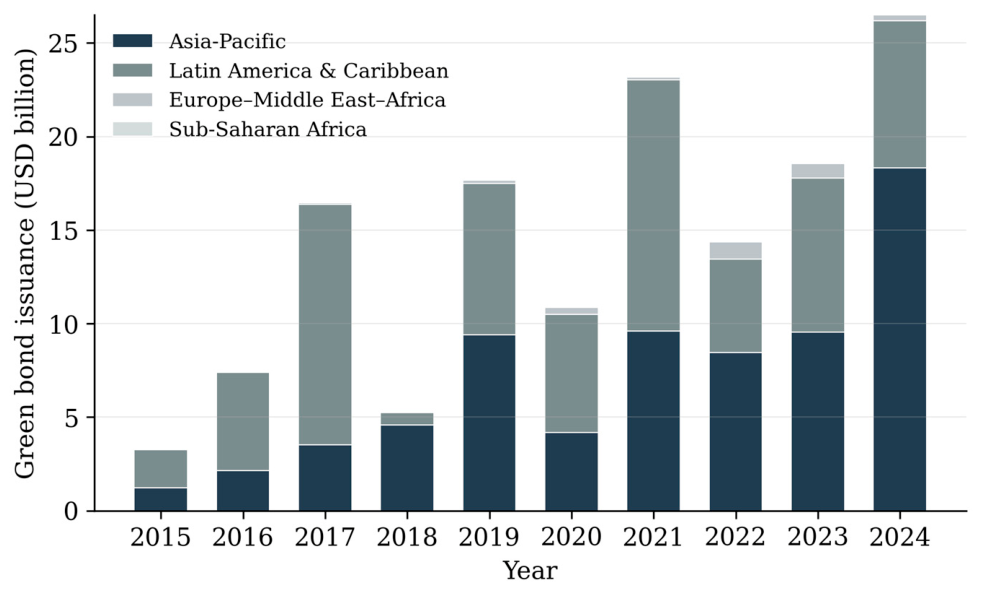
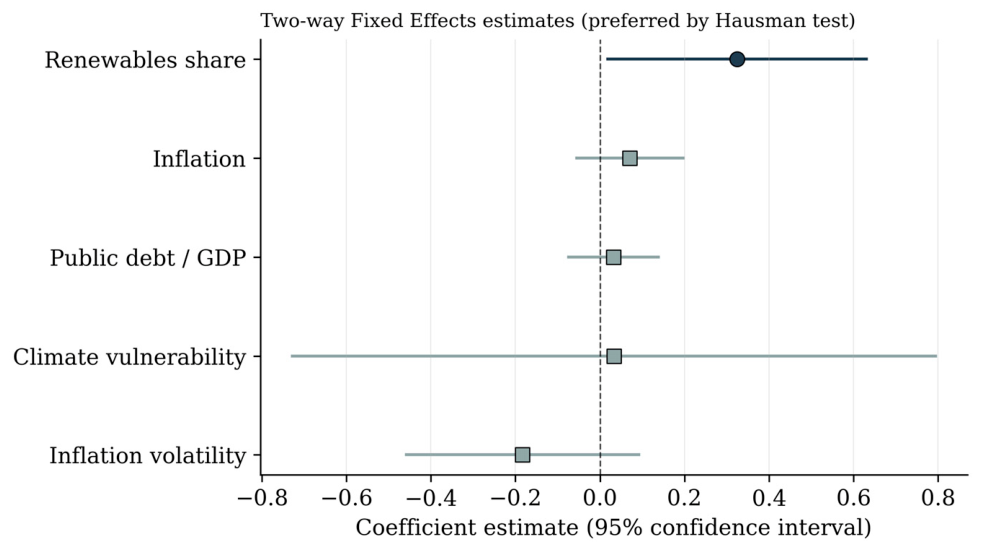
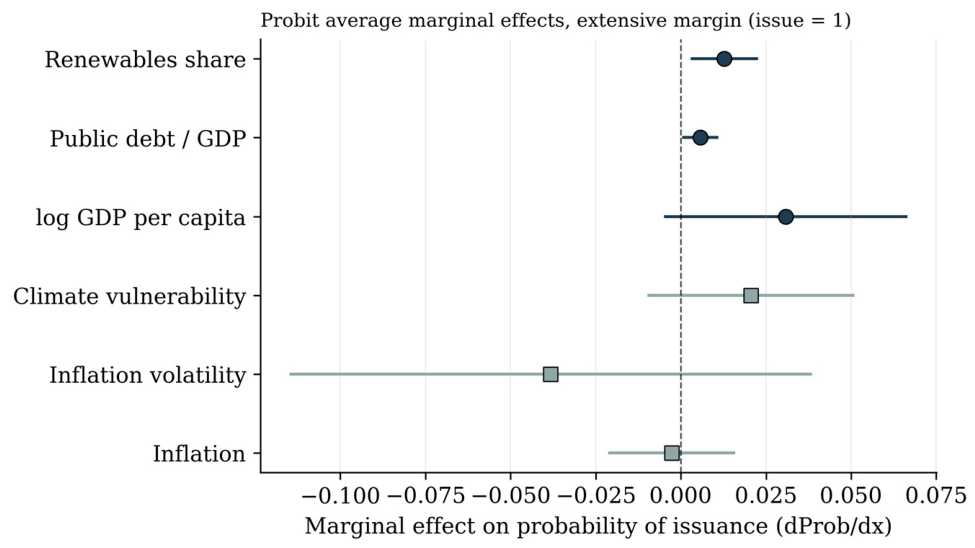
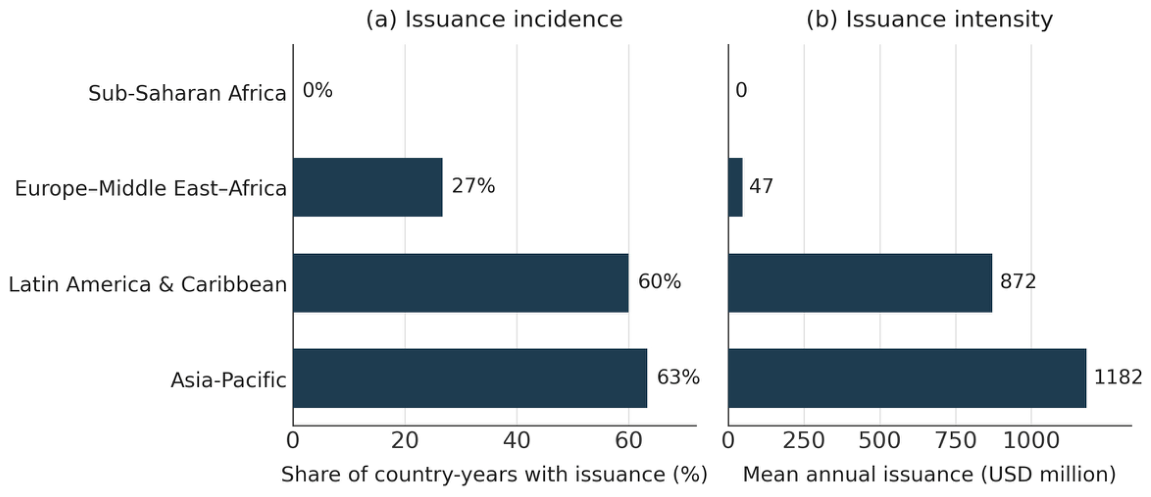
Cities in the Majority World face a widening climate investment gap that is often attributed to the absence of suitable financing instruments. Green bonds promise to mobilise private capital for low-carbon urban infrastructure, yet they have diffused unevenly, leaving the economies with the greatest needs at the market’s margins. This study asks whether macroeconomic constraints—the cost of finance, monetary instability, and public indebtedness—systematically shape green bond issuance across emerging and developing economies. We assemble an original panel of 24 such economies over 2015–2024 (240 country-year observations) and estimate pooled ordinary least squares (OLS), random-effects, two-way fixed-effects, Tobit, and probit models with robust standard errors. The public debt-to-GDP ratio is positively associated with issuance in most specifications, though the strength of this relationship varies across estimators and it is not statistically significant in the preferred two-way fixed-effects model; the renewable energy share is consistently positive, while consumer price inflation shows no significant suppressive effect. A probit model of the extensive margin shows that public debt, the renewable energy share, and income per capita raise the probability of issuing among the economies for which the data permit estimation. The four lower-income Sub-Saharan economies in the sample fall outside this estimation owing to missing data, yet record no issuance whatsoever over the decade—a descriptive pattern consistent with the structural barriers the model identifies. The findings challenge the assumption that monetary stabilisation is a precondition for climate finance, pointing instead to capital-market depth and subnational fiscal capacity as the more binding constraints.
Keywords: green bonds; climate finance; Majority World; macroeconomic determinants; subnational fiscal autonomy; panel data; Tobit model; climate investment trap green bonds; climate finance; Majority World; macroeconomic determinants; subnational fiscal autonomy; panel data; Tobit model; climate investment trap