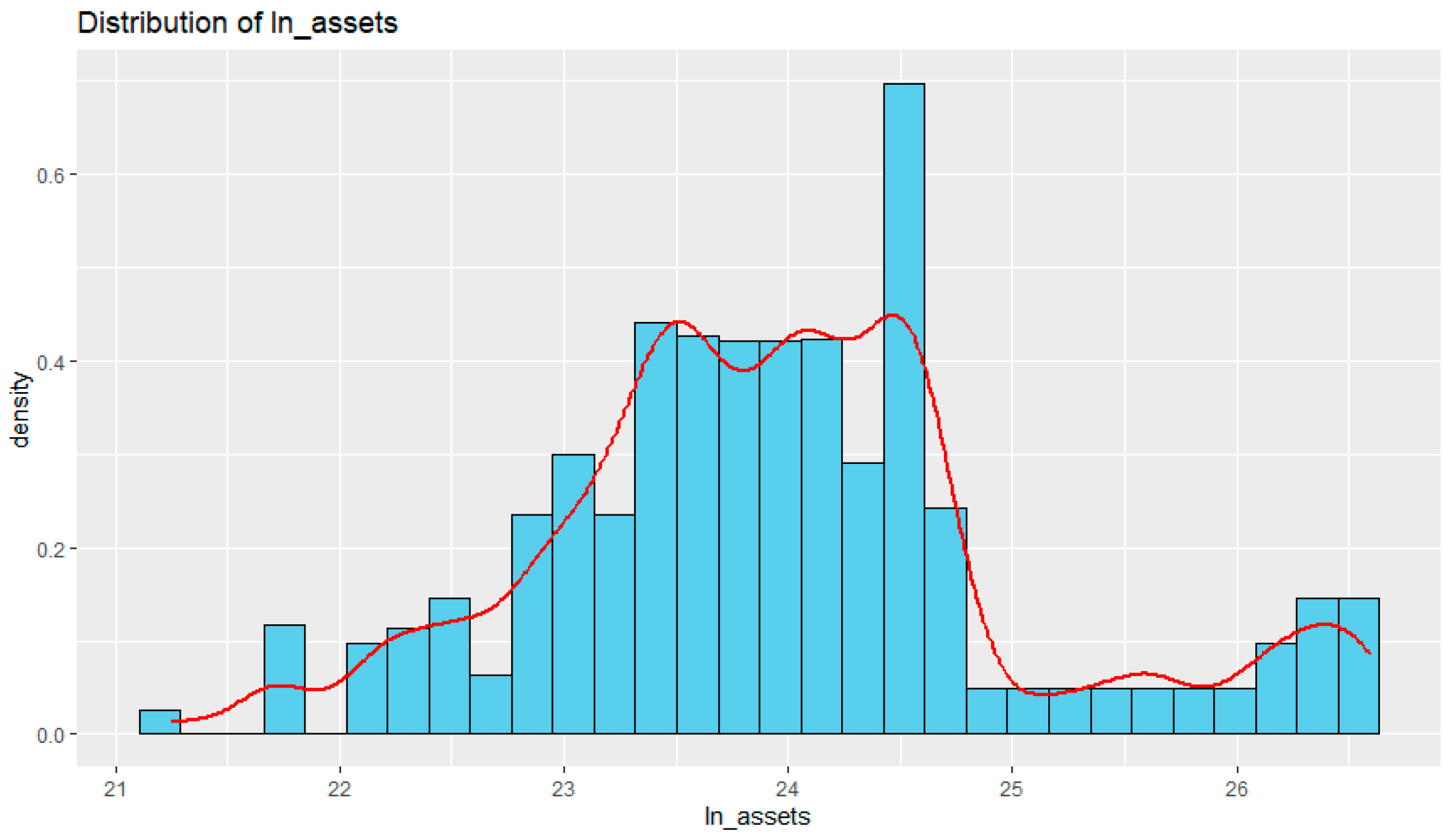

Assessing the Association Between FinTech-Related Policy Reforms and the Profitability of Banks in Qatar: A Preliminary Two-Decade Panel Analysis (2005–2024)


Abstract
1. Introduction
2. Literature Review and Hypothesis Development
2.1. Theoretical Foundations
2.2. FinTech and Bank Performance: Global and Regional Evidence
2.3. FinTech in Qatar and the Research Gap
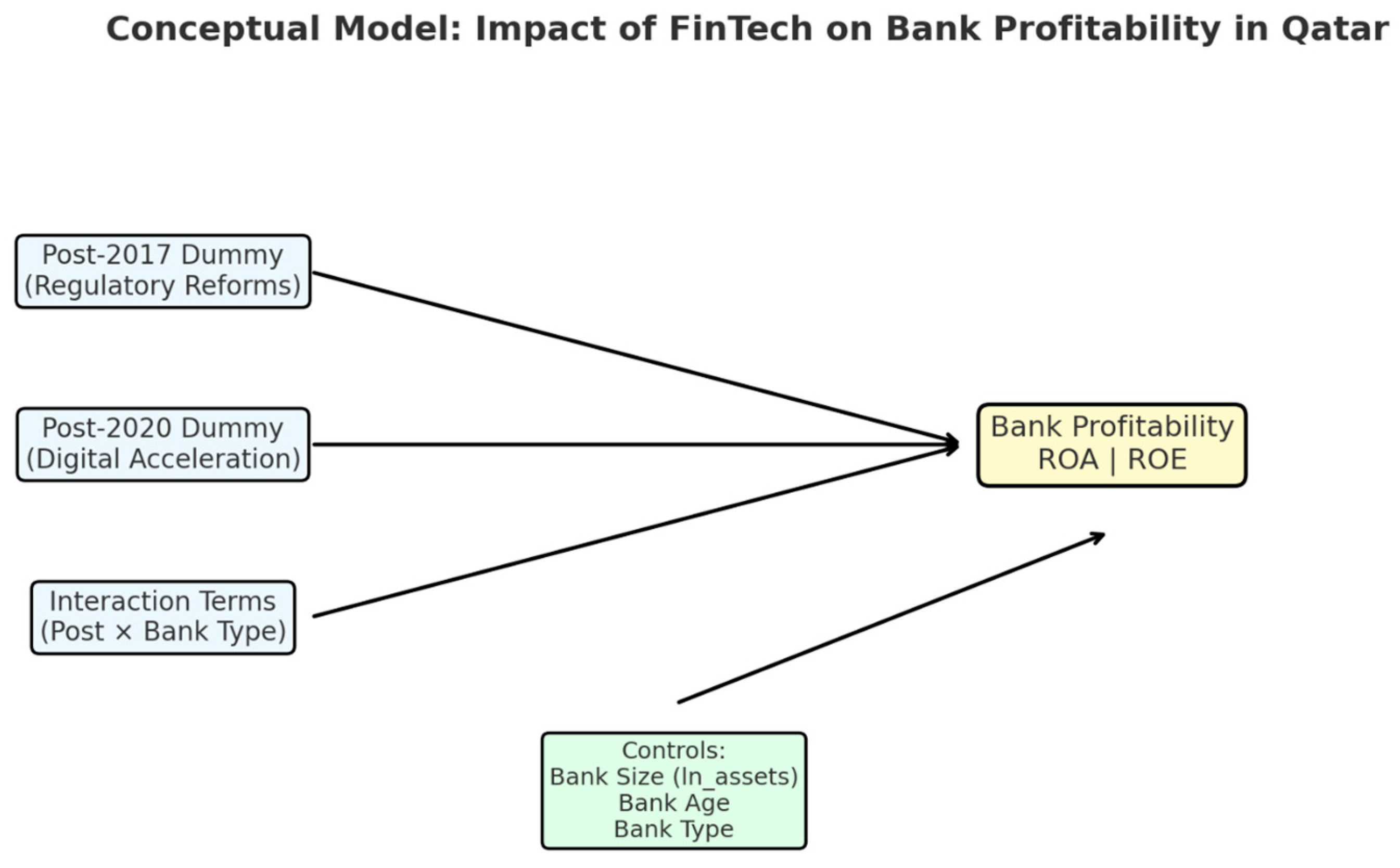
2.4. Hypotheses and Conceptual Model
3. Data and Methodology
3.1. Sample, Period and Data Source
3.2. Variables
3.3. Estimation Strategy
4. Empirical Results
4.1. Descriptive Statistics and Diagnostics
4.2. The Post-2017 Regulatory Phase
4.3. The Post-2020 Digital-Acceleration Phase
4.4. Hypothesis Testing Summary
5. Discussion
5.1. Interpreting the Post-2017 Effects
5.2. Why Post-2020 Effects Are Muted
5.3. Theoretical and Practical Implications
5.4. Limitations
6. Conclusions
Author Contributions
Funding
Institutional Review Board Statement
Informed Consent Statement
Data Availability Statement
Acknowledgments
Conflicts of Interest
Abbreviations
| AI | Artificial Intelligence | MENA | Middle East and North Africa |
| CBQ | Commercial Bank of Qatar | QCB | Qatar Central Bank |
| FE | Fixed Effects | QFC | Qatar Financial Centre |
| FinTech | Financial Technology | QNB | Qatar National Bank |
| GCC | Gulf Cooperation Council | RBV | Resource-Based View |
| ICT | Information and Communication Technology | RE | Random Effects |
| KYC | Know Your Customer | ROA | Return on Assets |
| LM | Lagrange Multiplier | ROE | Return on Equity |
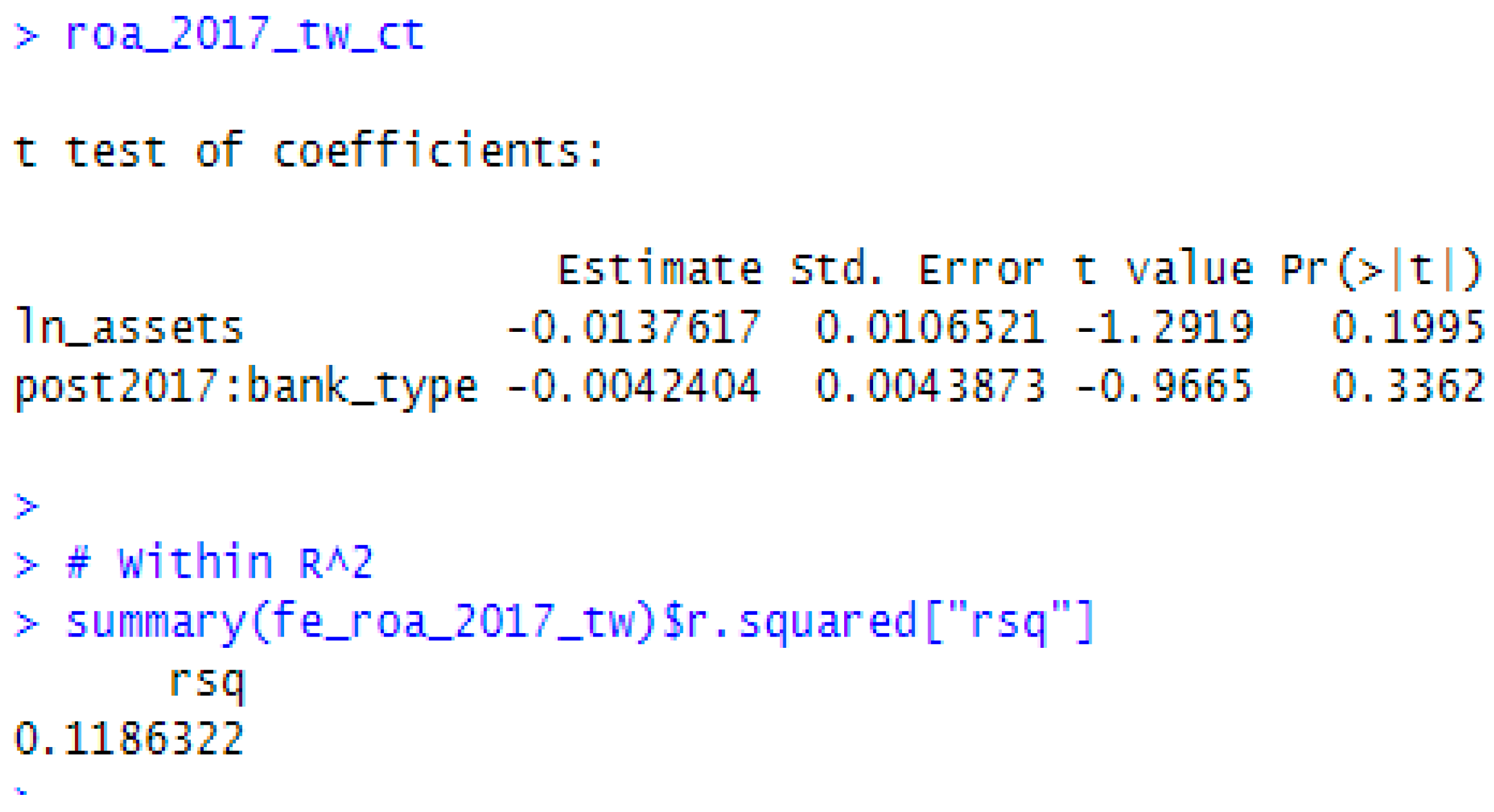
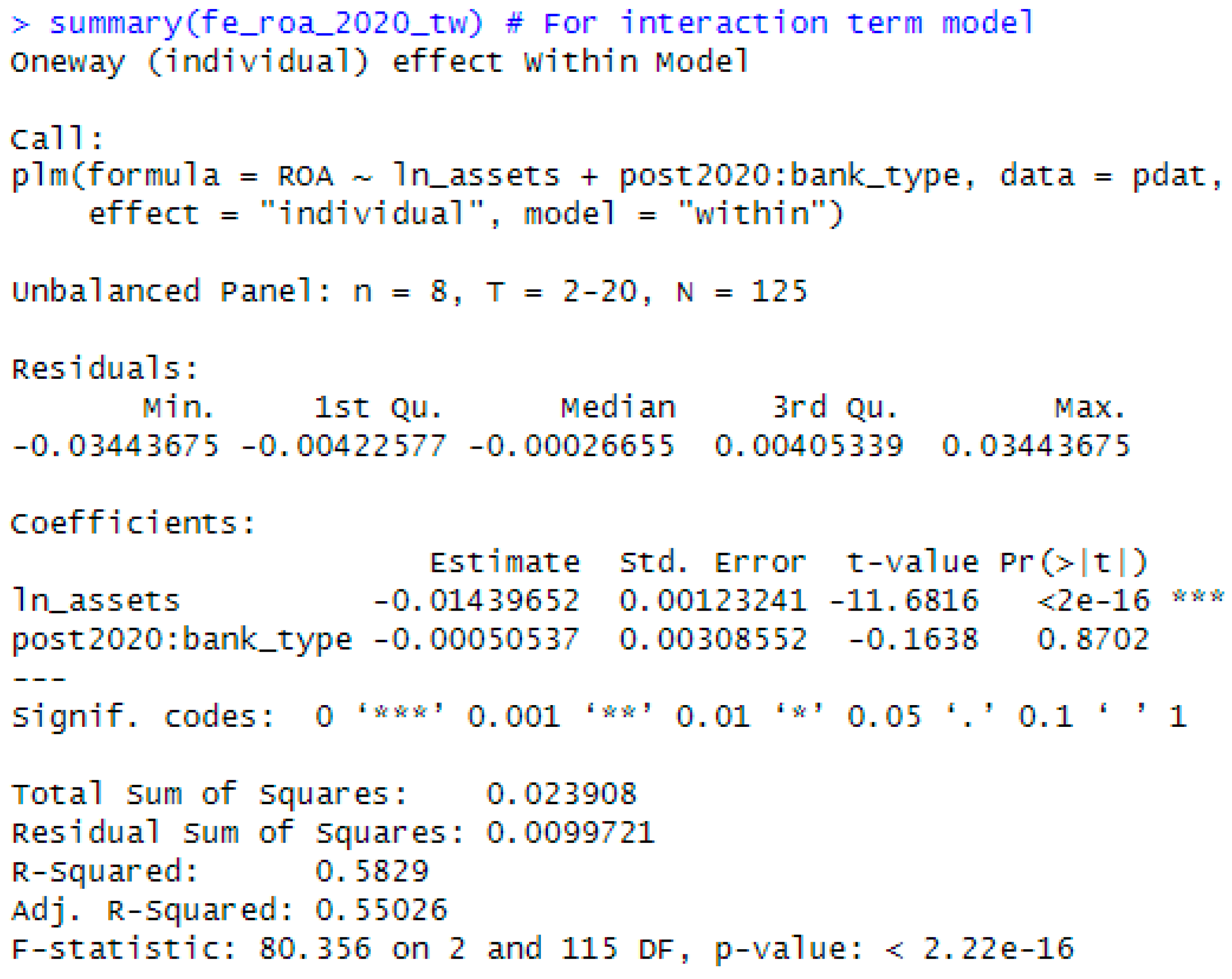
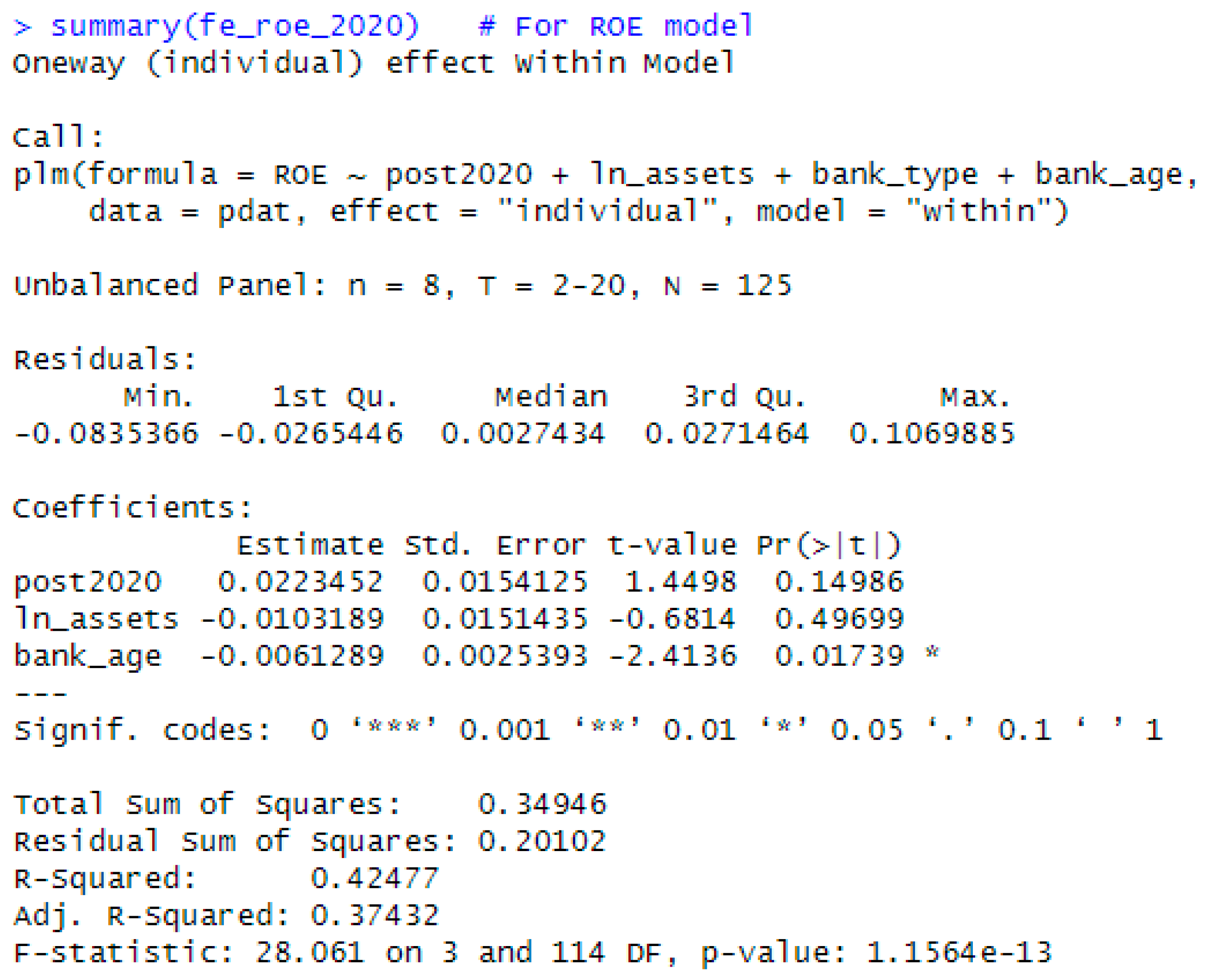
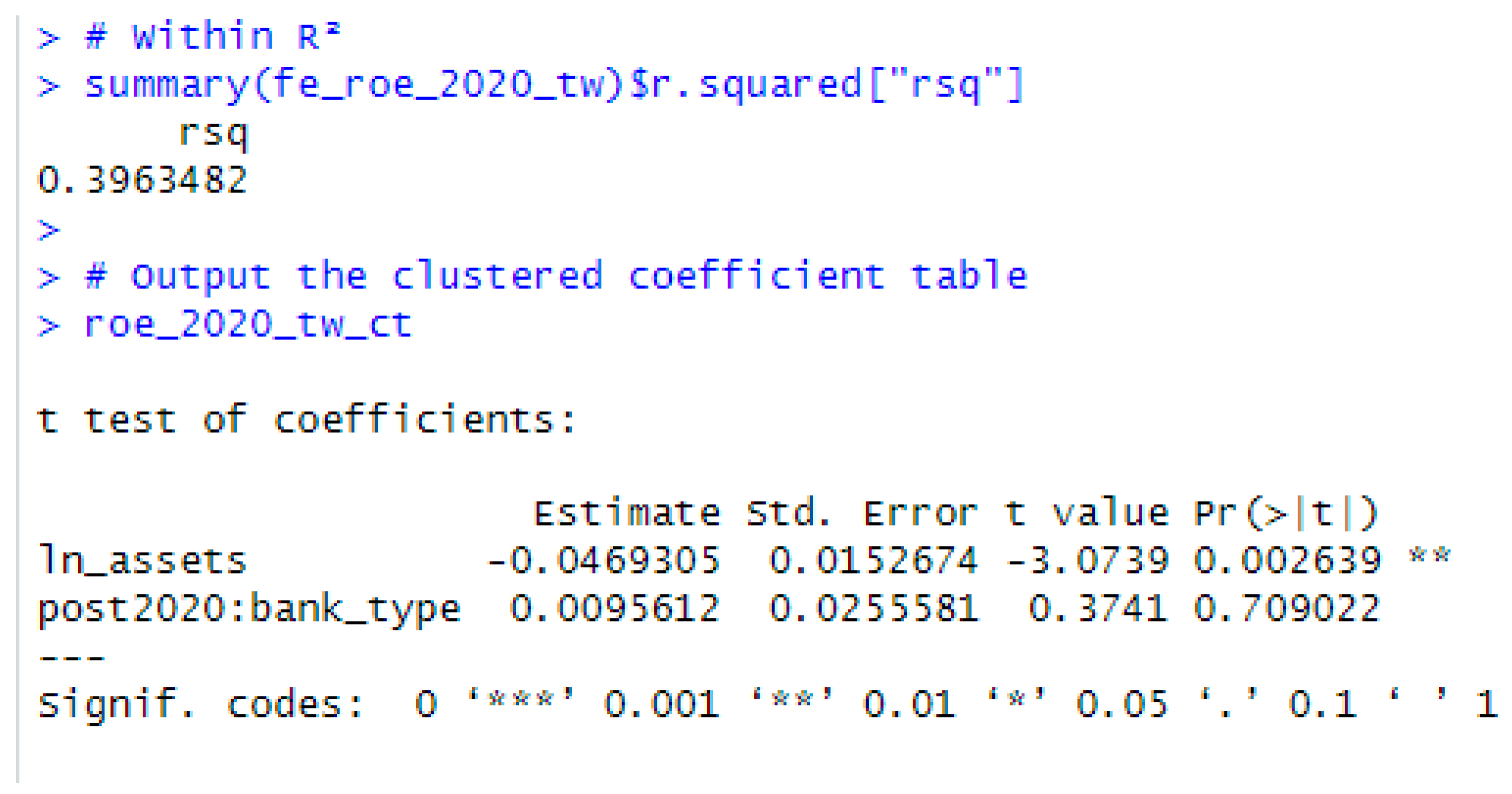
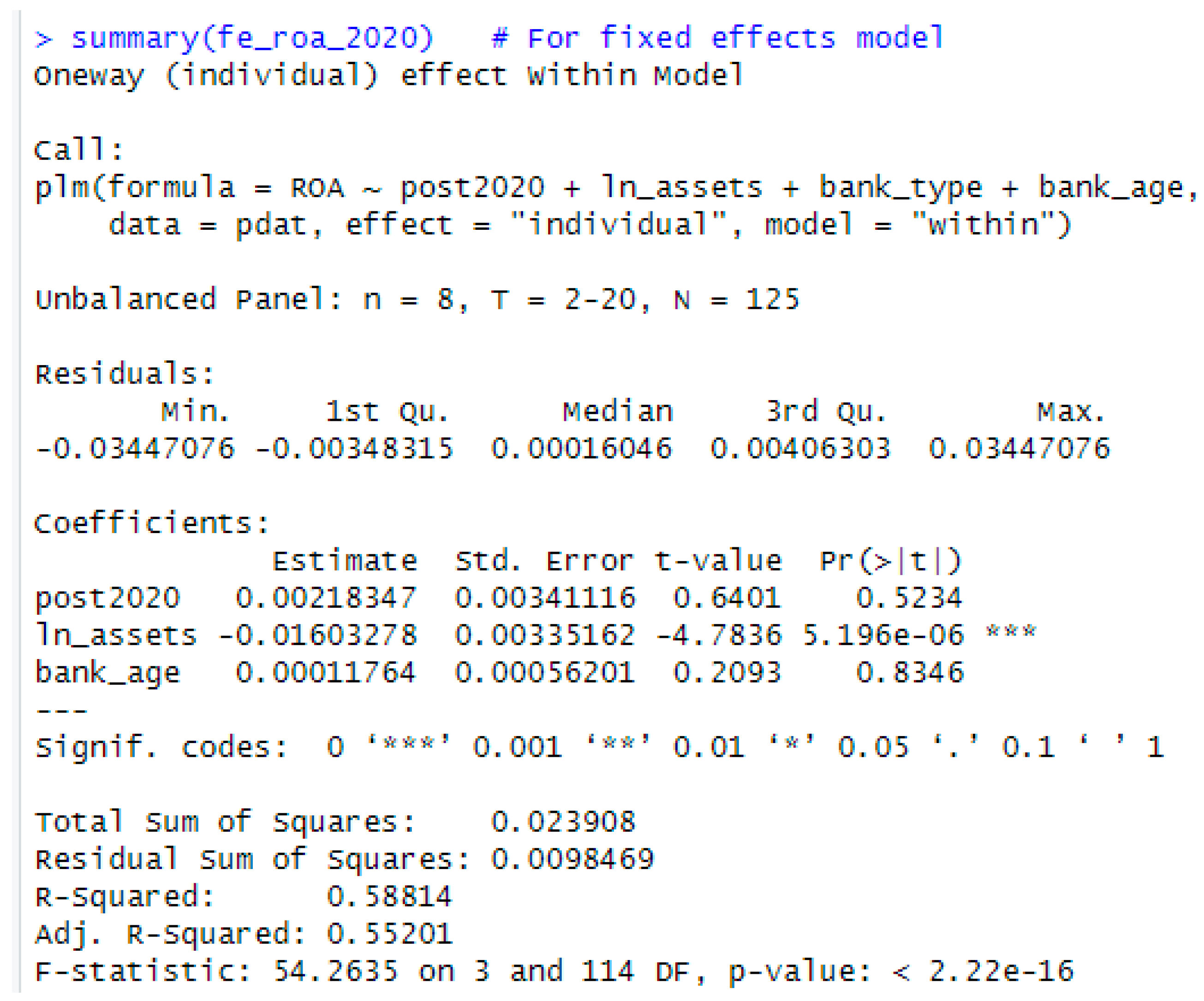
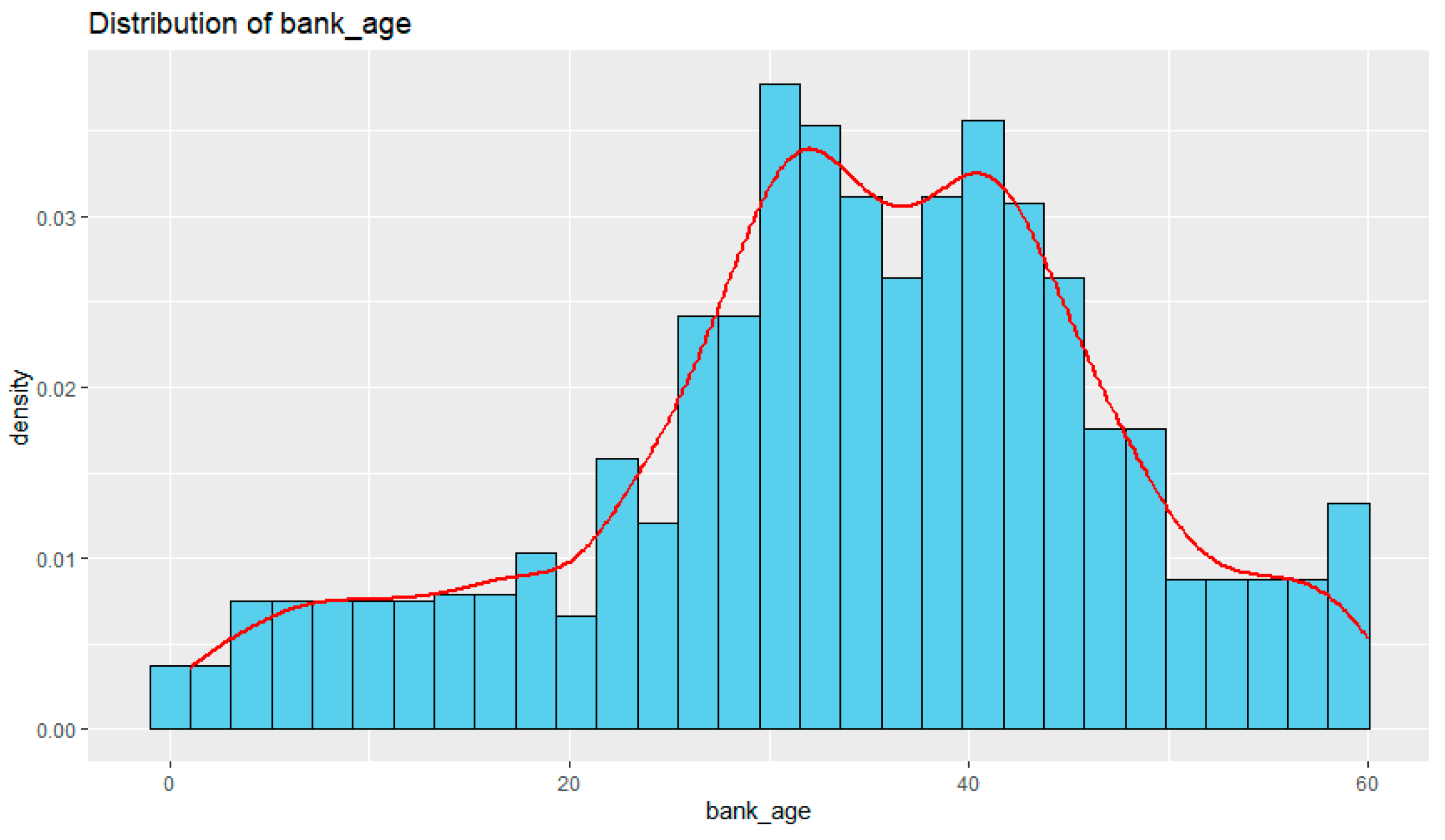
Appendix A. Statistical Output Evidence (R Plm and Sandwich)




Appendix B. Response to Reviewer Comments
| Source | Comment | Where Addressed | How Addressed |
| R2 #1 | No actual bank-level FinTech adoption measures (digital transactions, IT capex, mobile-banking usage, etc.). | §3 (3.2); §5.4 | Section 3.2 now explicitly characterises the policy dummies as an intent-to-treat identification and acknowledges the absence of granular bank-level proxies. Section 5.4 “Low statistical power” and “Intent-to-treat design” paragraphs discuss the trade-off and flag bank-level FinTech-intensity proxies as a priority for future work once disclosure improves. |
| R2 #2 | No year FE, no untreated control, no event-study structure; pandemic acknowledged as not a clean treatment but interpretation proceeds. | §3 (3.3); §5.4 | A new paragraph in 3.3 explains why year FE would absorb the policy dummies in a single-country, lock-step regulatory setting, and that no domestic untreated control exists. A dedicated paragraph in 5.4 confirms the limitation and flags a cross-GCC difference-in-differences extension as the natural relaxation. |
| R2 #3 | TAM, DOI and RBV not integrated into the model. | §2 (2.1) | A new paragraph maps the three frameworks to specific empirical-model variables: TAM → Postt (policy windows); DOI → Postt × BankTypei (interaction); RBV → ln(Assets)it and Ageit. |
| R2 #4 | Need more bank-time-varying controls (capitalisation, cost/income, NPL, liquidity, income diversification). | §3 (3.3); §5.4 | 3.3 now acknowledges the data constraint and that the bank-size coefficient absorbs part of these omitted controls. 5.4 “Limited bank–time-varying controls” specifies the missing controls and tags re-estimation with richer covariates as priority future work. |
| R2 #5 | Sample inconsistency: bank age = 1 in descriptives; 9 banks listed but 8 in regression. | §3 (3.1); footnote to Table 1 | Section 3.1 now explains that Lesha Bank was QFC-licenced from 2008 and publicly listed in 2016, and Dukhan Bank (formerly Barwa Bank) commenced full operations around 2009 with further restructuring in 2020—which produces the age = 1 entry. It also clarifies that one bank is dropped by plm under the FE within-transformation due to a singleton time-series, yielding 8 banks in the regression. |
| R2 #6 | Discussion is stronger than the marginally significant (10%) results warrant. | §5; §6 | The tone of 5.1, 5.2 and the Conclusion has been moderated throughout (“broadly consistent”, “tentative”, “preliminary”, “marginal”), and the abstract now explicitly states that findings are preliminary and indicative. |
| R2 #7 | Title promises competitiveness but no market-share measurement. | Title | “and Competitiveness” has been removed from the title; the revised title focuses on profitability, which the data and design can credibly support. |
| R2 #8 | Need a replication package: variable construction, data processing and workflow. | Data Availability Statement; §5.4 | The Data Availability Statement now offers an informal replication package (variable construction, R workflow using plm/lmtest/sandwich, and disaggregated extracts) available from the corresponding author on reasonable request. Appendix A continues to reproduce the R console output. |
| R2 #9a | “Interaction term disapprove” is incorrect statistical English. | §4 (4.3) | Replaced with “Interaction effects are again not statistically significant” and the equivalent phrasing throughout. |
| R2 #9b | “Accepted”/“Rejected” hypothesis language. | §4 (4.4); Table 5 | Replaced with “Supported”/“Not supported”/“Partially supported” throughout. |
| R2 #9c | “Christian banks and Islamic banks” is incorrect in context. | §5 (5.3) | Replaced with “conventional and Islamic banks”. |
| R2 #10 | Reference consistency check (at least one mismatch with the claim). | §2 (2.2); references | The MENA cross-country claim in 2.2 has been re-attributed explicitly to Abu Khalaf et al. (2025) (consistent with their reported positive ROA/ROE finding). References have been audited end-to-end. |
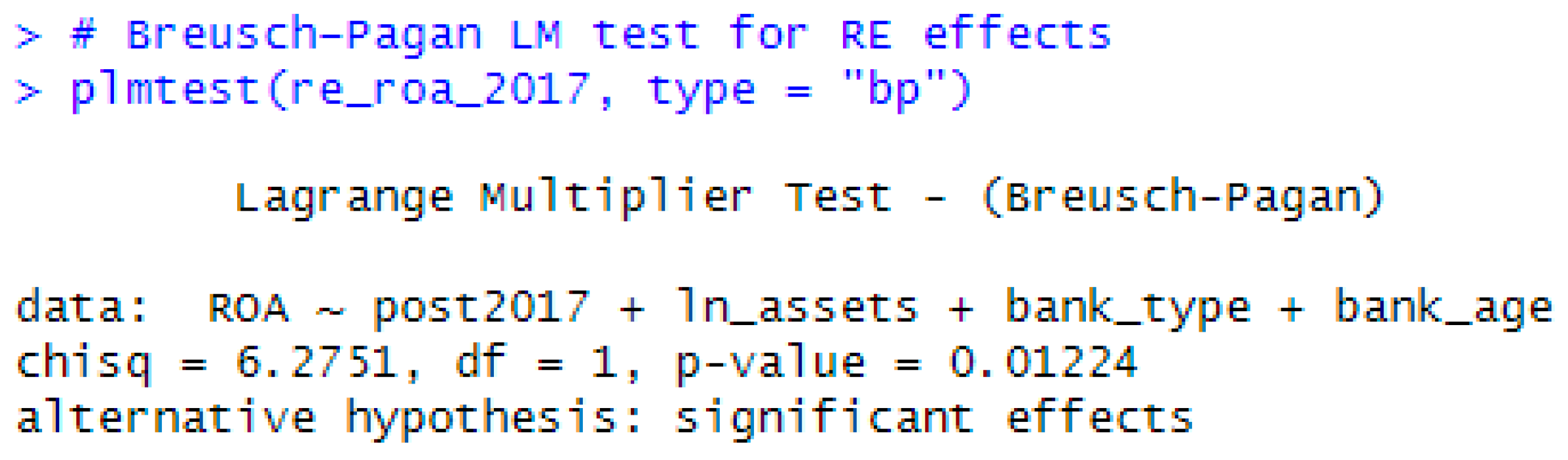
| R2 #11 | Shapiro–Wilk normality not justified for panel FE; normality is not consequential for FE. | §3 (3.3); §4 (4.1) | 3.3 and 4.1 now explicitly state that FE consistency does not require normality (Wooldridge, 2010); the Shapiro–Wilk results are retained only as a descriptive note. |
| R2 #12 | Add suggested studies (DOI 10.17549/gbfr.2024.29.10.94 and DOI 10.21511/bbs.20(2).2025.12). | §2 (2.2); §5 (5.1, 5.2); references | Added Alslaibi (2024) GBFR and Alslaibi et al. (2025) BBS to Section 2.2 (regional context), Section 5.1 (transmission of efficiency to profitability) and Section 5.2 (pandemic-period bank performance). |
| R1 | Low statistical power not sufficiently discussed. | §5.4 | A dedicated “Low statistical power” paragraph now states that under 9 banks and 125 observations, the minimum detectable effect at conventional 80% power and 5% level is bounded below at β ≈ 0.025–0.035 on the ROA/ROE scales. The marginally significant 2017 ROE result sits very close to that floor; Type II error on the other policy windows cannot be ruled out; the findings are framed as preliminary and indicative. |
| Editor—refs | FinTech Times (2024) hard to verify. | §1; §3 (3.1); references | Replaced with International Monetary Fund (2025)—IMF 2024 Article IV Consultation, Staff Country Report 2025/047 (with DOI 10.5089/9798229001069.002)—which independently documents the QCB Third Financial Sector Strategy and digital-finance agenda. |
| Editor—refs | Frost (2020) BIS Quarterly Review March 2023, 45–62 not traceable. | §2 (2.2); §5 (5.1); references | Replaced with the verifiable original: Frost (2020), BIS Working Papers No. 838 (URL: bis.org/publ/work838.pdf). |
| Editor—refs | Qatar Central Bank (2024). Third Financial Sector Strategy 2024–2030—hard to verify as a direct source. | §1; references | Replaced with the IMF 2024 Article IV Consultation (DOI 10.5089/9798229001069.002), which describes FSS3 from an independent multilateral source. |
| Editor—refs | SDK Finance (2024). The complete list of FinTech regulations in the Middle East—not a verifiable academic source. | §1; §3 (3.1); references | Replaced with International Monetary Fund (2025) and S. Khan et al. (2022) (already in the bibliography) for the regulatory context. |
| Editor—refs | References to JRFM must not exceed three citations. | References; §2 (2.2) | The current revision cites JRFM exactly three times: Alshouha et al. (2025), Butt and Chamberlain (2025), Thakur et al. (2023). The previously cited fourth JRFM paper (Lamey et al., 2024) has been removed from the reference list and the corresponding text in 2.2 has been adjusted. |
| Editor—English | English should be improved. | Throughout | The manuscript has been copy-edited throughout for grammar, sentence flow and clarity; awkward phrasing has been replaced and tense/voice consistency improved. |
| Editor—tables | Table formatting. | Table 1, Table 2, Table 3, Table 4 and Table 5 | Tables retain a clean booktabs style (single top/middle/bottom rules, no vertical lines), with the hypothesis-outcome column updated to the “Supported/Not supported” convention. |
| R3 #1 | “FinTech” wording is problematic because the study does not use direct bank-level FinTech measures; only post-2017 and post-2020 policy dummies. | Title; Abstract; §6 | The title now reads “Assessing the Association between FinTech-related Policy Reforms and the Profitability of Banks in Qatar: A Preliminary Two-Decade Panel Analysis”. The abstract opening, framing sentence and conclusion lead now refer to “the association between two FinTech-related policy windows” and explicitly note that FinTech adoption is not measured directly at the bank level. |
| R3 #2 | Repeated language like “impact of fintech”, “fintech uptake”, “fintech onboarding”, “fintech adoption effects” remains stronger than the design supports. Reframe as a preliminary study using policy-window proxies. | Title; Abstract; §6; §5.3 | The manuscript is now framed throughout as a preliminary policy-window study. “Impact of FinTech”, “FinTech uptake” and “FinTech onboarding” have been replaced by “association between two FinTech-related policy windows”, “post-policy windows” and equivalent design-honest wording. The conclusion now opens with the policy-window framing rather than with the previous “estimate the effect of FinTech uptake” formulation. |
| R3 #3 | Report exact p-values where possible; avoid ambiguous phrasing such as “statistically weak”. Acknowledge that cluster-robust SEs with only eight bank clusters can be unstable. | Abstract; §3 (3.3); §4 (4.2); §5.4; §6 | The abstract and §4.2 now report exact cluster-robust p-values (e.g., p = 0.054, p = 0.868, p = 0.539, p = 0.150) and drop the “marginally significant” framing in favour of “at the conventional 10% threshold; should be treated as suggestive”. §3.3 adds an explicit caveat citing Cameron and Miller (2015) on small-cluster cluster-robust inference, and §5.4 includes a new “Small cluster count” limitations paragraph reiterating the eight-cluster caveat and pointing to wild-cluster bootstrap as a future-work robustness check. |
| R3 #4 | Practical implications related to AI analytics, cybersecurity, blockchain, Islamic digital wallets, ecosystem regulation, and specific digital transformation areas go beyond the empirical evidence—these areas are not directly tested. | §5 (5.3); §6 | §5.3 and §6 (bank managers and policymakers paragraphs) have been rewritten. The specific recommendations on cybersecurity, AI analytics, blockchain, Islamic digital wallets and ecosystem regulation are now explicitly flagged as “beyond what this study can support empirically, since none of these activities is measured at the bank level”. The retained implications are restricted to what the design actually shows: limited marginal returns to additional FinTech-related reforms in a concentrated, uniformly regulated market, and the dominance of bank size in the within-bank variation. |
| R3 #5 | Theoretical frameworks (TAM, DOI, RBV) should be presented as interpretive lenses rather than fully tested mechanisms. | §2 (2.1) | A new closing paragraph in §2.1 now states that “these three frameworks should be understood as interpretive lenses rather than as fully tested mechanisms”. It explains that the empirical specification operationalises selected channels through observable proxies (policy dummies, bank size, bank age, bank type), while the underlying constructs (perceived usefulness and ease of use, adopter category, VRIN characteristics) are not directly measured—so the framework-to-variable map is an interpretive choice motivated by theory, not a direct empirical test of TAM, DOI or RBV. |
| R3 #6 | The negative and significant coefficient on bank size may be absorbing omitted bank characteristics—either add available controls or declare a limitation. | §5.4 | The “Limited bank–time-varying controls” paragraph in §5.4 is extended with an explicit closing sentence: “the negative coefficient on bank size should not be interpreted as direct causal evidence of a size disadvantage but rather as a composite signal that may absorb the explanatory power of these omitted bank characteristics” (capitalisation, asset quality, cost-to-income, income diversification, etc.). |
| R3 #7 | The model cannot isolate the effect of FinTech-related reforms from concurrent macroeconomic, sectorial or pandemic-related developments. Strengthen this acknowledgement. | §3 (3.3); §5.4 | §3.3 (“Two design choices” paragraph) now closes with: “Taken together, the absence of year fixed effects, an untreated control group and an event-study structure means that the model cannot isolate the effect of the FinTech-related reforms from concurrent macroeconomic, sectorial or pandemic-related developments”, and explicitly labels the post-2017 and post-2020 coefficients as “upper-bound estimates of an association around the policy windows, not as causal estimates of FinTech adoption effects”. §5.4 mirrors this language in the “No year fixed effects” limitations paragraph. |
References
- Abdul Rahman, A. A., Ur Rahiman, H., Meero, A., Amin, A. R., & Hamdan, H. (2023). FinTech innovations and Islamic banking performance: Post-pandemic challenges and opportunities. Banks and Bank Systems, 18(4), 281–292. [Google Scholar] [CrossRef]
- Abu Khalaf, B., Al-Sharkas, A., & Sarea, A. (2025). Realizing opportunities: The influence of FinTech on the success of MENA banks. Discover Sustainability, 6(1), 501. [Google Scholar] [CrossRef]
- Afzal, A. M., Abu Khalaf, B., Al-Naimi, M. S., & Samara, E. (2025). The impact of FinTech on the stability of Middle Eastern and North African (MENA) banks. Risks, 13(6), 106. [Google Scholar] [CrossRef]
- Alafeef, M. A., Kalyebara, B., Kalbouneh, N. Y., Abuoliem, N., & Bani Yousef, A. N. (2024). The impact of FinTech on banking performance: Evidence from Middle Eastern countries. International Journal of Data and Network Science, 8(4), 2219–2230. [Google Scholar] [CrossRef]
- AlHares, A., Dahkan, A., & Abu-Asi, T. (2022). The effect of financial technology on the sustainability of banks in the gulf cooperation council countries. Corporate Governance and Organizational Behavior Review, 6(4), 395. [Google Scholar] [CrossRef]
- Al-Kubaisi, M. K., & Abu Khalaf, B. (2023). Does green banking affect banks’ profitability? Journal of Governance and Regulation, 12(4), 157–164. [Google Scholar] [CrossRef]
- Alnsour, I. R. (2023). The effect of financial technology on Islamic banks’ performance in Jordan: Panel data analysis. International Journal of Data and Network Science, 7(4), 1515–1524. [Google Scholar] [CrossRef]
- Al-Shari, H. A., & Lokhande, M. A. (2023). The relationship between the risks of adopting FinTech in banks and their impact on the performance. Cogent Business & Management, 10(1), 2174242. [Google Scholar] [CrossRef]
- Alshouha, L., Khasawneh, O., Alshannag, F., & Al Tanbour, K. (2025). Nexus between FinTech innovations and liquidity risk in GCC banks: The moderating role of bank size. Journal of Risk and Financial Management, 18(5), 226. [Google Scholar] [CrossRef]
- AlShouha, L., Khasawneh, O., El-qawaqneh, S., Al-Naimi, A. A., Saram, M., & Ismail, W. N. S. W. (2024). The impact of financial technology on bank performance in Arabian countries. Banks and Bank Systems, 19(2), 234–247. [Google Scholar] [CrossRef]
- Alslaibi, N. A. (2024). Testing sustainable solutions: Analyzing the impact of FinTech on profitability before and during COVID in Palestine banking sector. Global Business & Finance Review, 29(10), 94. [Google Scholar] [CrossRef]
- Alslaibi, N. A., Qawasmeh, R., Samara, H., & Abualrob, R. M. (2025). Key drivers of bank financial performance: Insights from the Arab Levant region. Banks and Bank Systems, 20(2), 143–155. [Google Scholar] [CrossRef]
- Arner, D. W., Barberis, J., & Buckley, R. P. (2016). The evolution of FinTech: A new post-crisis paradigm? Georgetown Journal of International Law, 47, 1271–1319. [Google Scholar]
- Aysan, A. F., Belatik, A., Unal, I. M., & Ettaai, R. (2022). FinTech strategies of Islamic banks: A global empirical analysis. FinTech, 1(2), 206–215. [Google Scholar] [CrossRef]
- Barney, J. (1991). Firm resources and sustained competitive advantage. Journal of Management, 17(1), 99–120. [Google Scholar] [CrossRef]
- Boot, A., Hoffmann, P., Laeven, L., & Ratnovski, L. (2021). FinTech: What’s old, what’s new? Journal of Financial Stability, 53, 100837. [Google Scholar] [CrossRef]
- Butt, U., & Chamberlain, T. (2025). Performance of Islamic banks during the COVID-19 pandemic: An empirical analysis and comparison with conventional banking. Journal of Risk and Financial Management, 18(6), 308. [Google Scholar] [CrossRef]
- Cameron, A. C., & Miller, D. L. (2015). A practitioner’s guide to cluster-robust inference. The Journal of Human Resources, 50(2), 317–372. [Google Scholar] [CrossRef]
- Davis, F. D. (1989). Perceived usefulness, perceived ease of use, and user acceptance of information technology. MIS Quarterly, 13(3), 319–340. [Google Scholar] [CrossRef]
- Demirgüç-Kunt, A., & Huizinga, H. (2010). Bank activity and funding strategies: The impact on risk and returns. Journal of Financial Economics, 98(3), 626–650. [Google Scholar] [CrossRef]
- Frost, J. (2020). The economic forces driving FinTech adoption across countries (BIS working papers No. 838). Bank for International Settlements. Available online: https://www.bis.org/publ/work838.pdf (accessed on 1 May 2025).
- Gujarati, D. N., & Porter, D. C. (2009). Basic econometrics (5th ed.). McGraw-Hill Irwin. [Google Scholar]
- Hair, J. F., Black, W. C., Babin, B. J., & Anderson, R. E. (2019). Multivariate data analysis (8th ed.). Cengage Learning. [Google Scholar]
- International Monetary Fund. (2025). Qatar: 2024 article IV consultation—Press release; Staff report; and statement by the executive director for Qatar (IMF Staff Country Reports No. 2025/047). International Monetary Fund. [Google Scholar] [CrossRef]
- Kalai, L., & Toukabri, M. (2024). Risks, regulations, and impacts of FinTech adoption on commercial banks in the United States and Canada: A comparative analysis. Thunderbird International Business Review, 66(5), 554–569. [Google Scholar] [CrossRef]
- Khan, J., Dahdal, A., & Ibrahim, I. A. (2022). Sandboxes in the desert: Is a cross-border ‘Gulf Box’ feasible? Law, Innovation and Technology, 14(2), 203–229. [Google Scholar]
- Khan, S., & Al-Harby, A. S. A. (2022). The use of FinTech and its impact on financial intermediation: A comparison of Saudi Arabia with other GCC economies. Intellectual Economics, 16(2), 26–43. [Google Scholar] [CrossRef]
- Khan, S., Khan, H. H., & Ghafoor, A. (2022). FinTech adoption, the regulatory environment and bank stability: An empirical investigation from GCC economies. Borsa Istanbul Review, 23(6), 1263–1281. [Google Scholar]
- Morshed, A. (2025). Navigating tradition and modernity: Digital accounting and financial integration in family-owned enterprises in the Arab Gulf. Sustainable Futures, 7(1), 100345. [Google Scholar]
- Philippon, T. (2020). On FinTech and financial inclusion. Annual Review of Financial Economics, 12, 141–158. [Google Scholar]
- Rogers, E. M. (2003). Diffusion of innovations (5th ed.). Free Press. [Google Scholar]
- Thakur, S., Rastogi, S., Parashar, N., Tejasmayee, P., & Kappal, J. M. (2023). The impact of ICT on the profitability of Indian banks: The moderating role of NPA. Journal of Risk and Financial Management, 16(4), 211. [Google Scholar] [CrossRef]
- Vives, X. (2019). Digital disruption in banking. Annual Review of Financial Economics, 11, 243–272. [Google Scholar] [CrossRef]
- Wooldridge, J. M. (2010). Econometric analysis of cross section and panel data (2nd ed.). MIT Press. [Google Scholar]


| No. | Bank Name |
|---|---|
| 1 | Qatar National Bank QPSC |
| 2 | Qatar International Islamic Bank QPSC |
| 3 | Qatar Islamic Bank QPSC |
| 4 | Ahli Bank QPSC |
| 5 | Doha Bank QPSC |
| 6 | Commercial Bank PSQC |
| 7 | Masraf Al Rayan QPSC |
| 8 | Lesha Bank LLC (Public) |
| 9 | Dukhan Bank QPSC |
| Variable | Mean | SD | Median | Skew | Kurtosis | Min | Max |
|---|---|---|---|---|---|---|---|
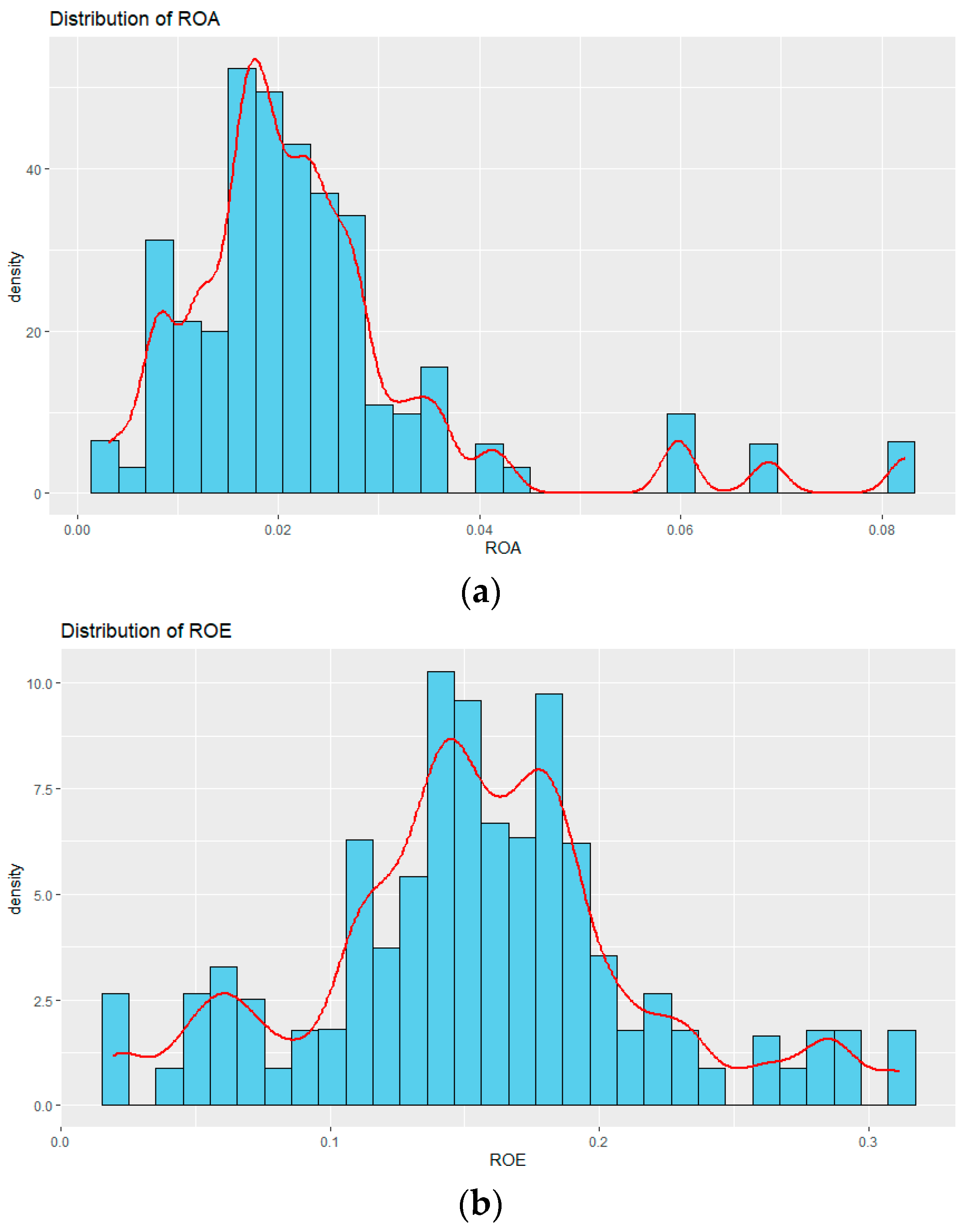
| ROA | 0.0200 | 0.0100 | 0.0200 | 2.07 | 5.29 | 0.000 | 0.080 |
| ROE | 0.1600 | 0.0600 | 0.1500 | 0.18 | 0.28 | 0.020 | 0.310 |
| Assets (QAR bn) | 48.88 | 73.85 | 25.67 | 2.80 | 7.05 | 1.69 | 356.13 |
| ln_assets | 23.97 | 1.07 | 23.97 | 0.41 | 0.40 | 21.25 | 26.60 |
| Bank age (yr) | 33.89 | 13.01 | 35.00 | −0.42 | −0.10 | 1 | 60 |
| (1) ROA | (2) ROE | (3) ROA—Interaction | |
|---|---|---|---|
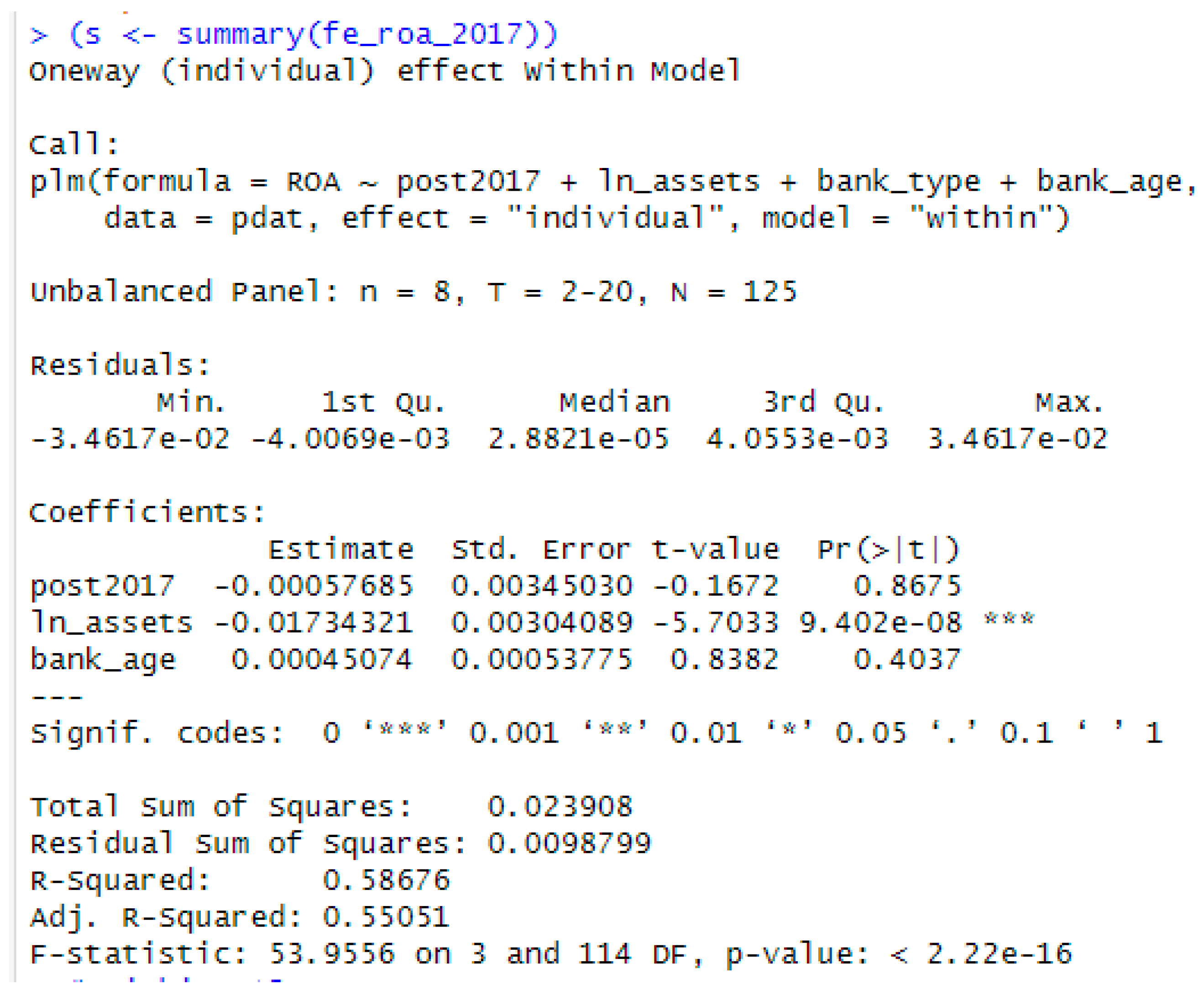
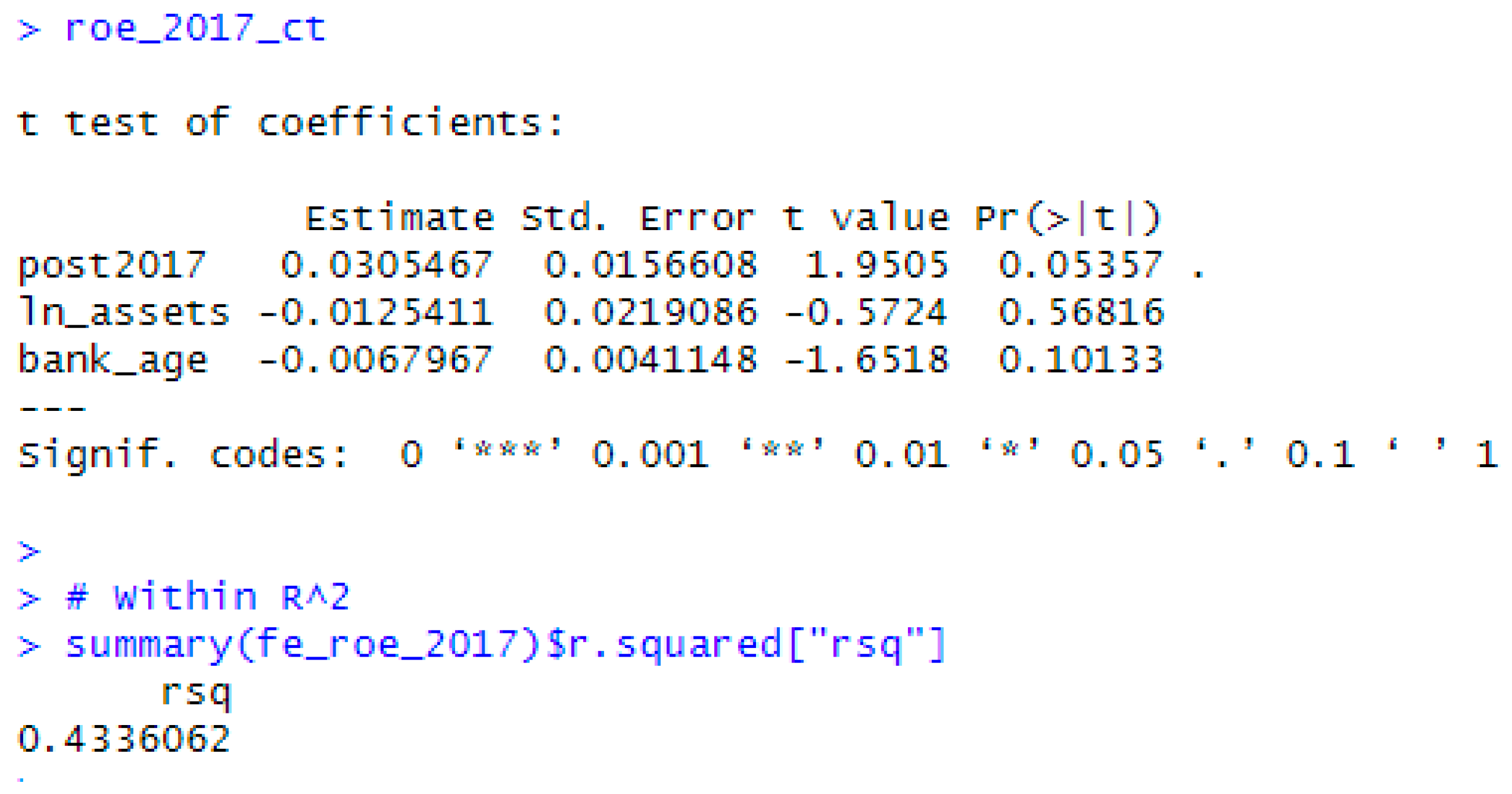
| post2017 | −0.00058 | 0.0306 † | – |
| (0.00345) | (0.0157) | – | |
| ln_assets | −0.0173 *** | −0.0125 | −0.0138 |
| (0.00304) | (0.0219) | (0.0107) | |
| bank_age | 0.00045 | −0.00680 | – |
| (0.00054) | (0.00411) | – | |
| post2017 × bank_type | – | – | −0.00424 |
| (0.00439) | |||
| Bank fixed effects | Yes | Yes | Yes |
| Cluster-robust SE | Yes | Yes | Yes |
| Within R2 | 0.587 | 0.434 | 0.119 |
| Observations (N) | 125 | 125 | 125 |
| Banks (n) | 8 | 8 | 8 |
| (1) ROA | (2) ROA—Inter. | (3) ROE | (4) ROE—Inter. | |
|---|---|---|---|---|
| post2020 | 0.00218 | – | 0.0224 | – |
| (0.00354) | – | (0.0154) | – | |
| ln_assets | −0.0160 * | −0.0144 *** | −0.0103 | −0.0469 *** |
| (0.00812) | (0.00386) | (0.0151) | (0.0153) | |
| bank_age | 0.00012 | – | −0.00613 ** | – |
| (0.00096) | – | (0.00254) | – | |
| post2020 × bank_type | – | −0.00051 | – | 0.00956 |
| (0.00467) | (0.0256) | |||
| Bank fixed effects | Yes | Yes | Yes | Yes |
| Cluster-robust SE | Yes | Yes | Yes | Yes |
| Within R2 | 0.588 | 0.583 | 0.425 | 0.396 |
| Observations (N) | 125 | 125 | 125 | 125 |
| Banks (n) | 8 | 8 | 8 | 8 |
| Hypothesis | Empirical Finding | Decision |
|---|---|---|
| H1a: Post-2017 → ↑ ROA | β = −0.00058, p = 0.868 | Not supported |
| H1b: Post-2017 → ↑ ROE | β = 0.0306, p ≈ 0.054 | Partially supported |
| H2a: Post-2020 → ↑ ROA | β = 0.00218, p = 0.539 | Not supported |
| H2b: Post-2020 → ↑ ROE | β = 0.0224, p = 0.150 | Not supported |
| H3: Islamic ≠ Conventional response | All interaction terms insignificant | Not supported |
Disclaimer/Publisher’s Note: The statements, opinions and data contained in all publications are solely those of the individual author(s) and contributor(s) and not of MDPI and/or the editor(s). MDPI and/or the editor(s) disclaim responsibility for any injury to people or property resulting from any ideas, methods, instructions or products referred to in the content. |
© 2026 by the authors. Licensee MDPI, Basel, Switzerland. This article is an open access article distributed under the terms and conditions of the Creative Commons Attribution (CC BY) license.
Share and Cite
Almohannadi, A.M.A.; Malik, A. Assessing the Association Between FinTech-Related Policy Reforms and the Profitability of Banks in Qatar: A Preliminary Two-Decade Panel Analysis (2005–2024). J. Risk Financial Manag. 2026, 19, 511. https://doi.org/10.3390/jrfm19070511
Almohannadi AMA, Malik A. Assessing the Association Between FinTech-Related Policy Reforms and the Profitability of Banks in Qatar: A Preliminary Two-Decade Panel Analysis (2005–2024). Journal of Risk and Financial Management. 2026; 19(7):511. https://doi.org/10.3390/jrfm19070511
Chicago/Turabian StyleAlmohannadi, Abdulaziz Mohammed A., and Ali Malik. 2026. "Assessing the Association Between FinTech-Related Policy Reforms and the Profitability of Banks in Qatar: A Preliminary Two-Decade Panel Analysis (2005–2024)" Journal of Risk and Financial Management 19, no. 7: 511. https://doi.org/10.3390/jrfm19070511
APA StyleAlmohannadi, A. M. A., & Malik, A. (2026). Assessing the Association Between FinTech-Related Policy Reforms and the Profitability of Banks in Qatar: A Preliminary Two-Decade Panel Analysis (2005–2024). Journal of Risk and Financial Management, 19(7), 511. https://doi.org/10.3390/jrfm19070511