Article

Mediating Pathways to Sustainable Investment: A TOE Framework for AI-Driven Green Fintech Adoption in Banking

by
Reem A. Abdalla
1,*,
Lamya Abbas Hidaytalla
2 and
Gulnar Sadat Mulla
1
1
College of Administrative and Financial Sciences, University of Technology Bahrain, Salmabad 712, Bahrain
2
Faculty of Computer Studies, Arab Open University, Riyadh 11681, Saudi Arabia
*
Author to whom correspondence should be addressed.
J. Risk Financial Manag. 2026, 19(7), 496; https://doi.org/10.3390/jrfm19070496
Submission received: 31 May 2026 / Revised: 18 June 2026 / Accepted: 29 June 2026 / Published: 3 July 2026
(This article belongs to the Section Financial Technology and Innovation)

Abstract

Purpose: Despite growing research on green fintech and sustainable finance individually, no systematic theoretical framework explains how AI-driven green fintech solutions can be adopted in banking for sustainable investment purposes. This paper addresses this demonstrated gap by developing the first bibliometrically grounded, TOE-based conceptual framework for AI-driven green fintech adoption in banking. Design/Methodology/Approach: A two-phase approach is employed. First, a bibliometric analysis of 79 Scopus-indexed documents (2020–2026) using bibliometrix in R provides quantitative evidence of the research gap through keyword co-occurrence networks, thematic mapping, and trend topic analysis. Second, building on this evidence, a conceptual framework integrating the Technology–Organization–Environment (TOE) framework with three mediating constructs, technological readiness, sustainability culture, and regulatory support is developed and five theoretical propositions are derived. Findings: The bibliometric analysis reveals an annual growth rate of 78.4% in the field and confirms that the TOE framework has never occupied the motor themes quadrant of the green fintech literature. The proposed framework theorizes three mediated pathways through which technological, organizational, and environmental conditions translate into improved sustainable investment outcomes including enhanced ESG transparency, increased green investment allocation, and SDG alignment. Practical Implications: The framework provides bank executives with three actionable intervention points: technological infrastructure investment, sustainability culture embedding, and regulatory engagement and offers policymakers evidence-based guidance for designing supportive green fintech adoption frameworks. Originality/Value: This study presents a conceptual framework that is, to the authors’ knowledge, the first to combine TOE theory, AI-driven green fintech, a banking context, an explicit three-mediator architecture (technological readiness, sustainability culture, regulatory support), and sustainable investment outcomes as the dependent variable, grounded in reproducible bibliometric evidence. Existing studies address subsets of these dimensions; none integrates all six simultaneously.

1. Introduction

The global banking sector stands at a pivotal intersection of digital transformation and environmental imperatives. Governments, international organizations, and financial regulators have increasingly mandated that banks align their investment strategies with environmental sustainability objectives—a transition requiring not only policy commitment but technological capability. Green financial technology (fintech), broadly defined as the integration of financial technology innovations with environmental sustainability objectives (Kwong et al., 2023; Macchiavello & Siri, 2022), has emerged as the primary vehicle for this transition. Through artificial intelligence (AI), blockchain, and advanced data analytics, green fintech offers banks the computational capacity to assess Environmental, Social, and Governance (ESG) risks, track sustainable investment flows, and comply with evolving regulatory requirements at a scale and precision previously unachievable.
However, the adoption of green fintech by banking institutions is not simply a technological decision; it is a complex organizational process shaped by internal capabilities, cultural orientations, and external institutional pressures. The Technology–Organization–Environment (TOE) framework (Tornatzky & Fleischer, 1990), one of the most widely validated models of innovation adoption in organizational contexts, provides the theoretical scaffolding necessary to understand this complexity.
Despite the theoretical adequacy of TOE for this purpose, an examination of the literature reveals that this framework has not been applied to the specific context of AI-driven green fintech adoption in banking institutions. A focused Scopus search combining green fintech, artificial intelligence, and banking yielded only four documents, rising to seventeen when the banking constraint was relaxed. A broader four-query search strategy, targeting green fintech, AI in sustainable finance, TOE framework in fintech, and ESG technology adoption in banking, retrieved 79 unique documents after deduplication. Bibliometric analysis of this corpus confirms that the TOE framework occupies the niche and emerging quadrants of the field’s thematic map—never the motor themes quadrant—demonstrating that it has not yet achieved theoretical integration with the dominant green fintech discourse.
This paper argues that the TOE framework’s explanatory power for green fintech adoption in banking is substantially enhanced when its three dimensions are reconceptualized not as parallel determinants of adoption but as distinct pathways, each mediated by a specific organizational mechanism: technological readiness, sustainability culture, and regulatory support, respectively. This paper responds to this demonstrated gap by making four sequential and interconnected contributions. First, it presents a structured bibliometric analysis of the green fintech and AI-in-banking literature, providing reproducible, quantitative evidence of the research gap through keyword co-occurrence networks, thematic mapping, trend topic analysis, and publication trend data. Second, it develops a comprehensive conceptual framework that integrates the TOE framework, proposes three mediating constructs—technological readiness, sustainability culture, and regulatory support—and derives five theoretical propositions to guide future empirical inquiry.
The framework addresses four research objectives: (1) identifying key technological, organizational, and environmental factors that influence banks’ adoption of green fintech; (2) evaluating how green fintech solutions enhance ESG assessments and sustainable investment decisions; (3) analyzing how external factors, including regulatory requirements and market demand, drive green fintech adoption in banking; and (4) proposing five theoretical propositions that specify the mediating mechanisms through which the TOE dimensions translate into improved sustainable investment practices.
The remainder of the paper is structured as follows. Section 2 provides the theoretical background and literature review. Section 3 presents the bibliometric methodology and results. Section 4 develops the conceptual framework and its components. Section 5 presents the theoretical propositions. Section 6 discusses the implications for theory, practice, and policy. Section 7 concludes with limitations and future research directions.

2. Theoretical Background and Literature Review

2.1. Sustainable Finance and Green Banking

The significance of sustainability in financial decision-making has grown substantially over the past decade, driven by the establishment of the United Nations Sustainable Development Goals (SDGs), the Paris Agreement on climate change, and the global proliferation of ESG reporting frameworks (Sardianou et al., 2021; Stauropoulou et al., 2023). Banks occupy a particularly consequential role in this sustainability transition, as their investment and lending decisions determine capital flow across the economy. A 2019 report documented that over 130 banks had committed to ensuring SDG achievement by 2030 (Halkos & Gkampoura, 2021; Zhan & Santos-Paulino, 2021) yet internal analytical systems often remain inadequate for assessing the environmental, social, and governance performance of financial products (Chen et al., 2023; Dmuchowski et al., 2023; Park & Kim, 2020).
Green finance, defined as the channeling of financial resources toward sustainable projects while adhering to environmental and ethical standards (Anu et al., 2023; Lee, 2020; Yang et al., 2021), has emerged as the primary conceptual framework for this transition. Green banking extends these principles to the operational and investment practices of banking institutions, encompassing green bonds, ESG-linked loans, sustainable lending criteria, and carbon footprint disclosure requirements (Gilchrist et al., 2021; X. Zhang et al., 2022). The development of green finance has been closely associated with advances in financial technology, giving rise to the concept of green fintech—the application of innovative digital technologies to achieve environmental finance objectives (Macchiavello & Siri, 2022).

2.2. Green Fintech: Concepts, Technologies, and Applications

Green fintech encompasses a broad spectrum of digital solutions designed to facilitate green investments, enhance ESG transparency, and build robust frameworks for climate risk management. Macchiavello and Siri (2022) provide one of the most comprehensive analyses of this emerging field, identifying sustainable digital finance, green digital finance, and climate fintech as overlapping but conceptually distinct subdomains. Yang et al. (2021) demonstrate empirically that green fintech, fintech, and high-quality economic development form a mutually reinforcing nexus in the Chinese context, while Muganyi et al. (2021) provide evidence that green finance and fintech jointly reduce carbon emissions and improve environmental sustainability outcomes. Furthermore, Tao et al. (2022) demonstrate that fintech development can serve as a structural pathway toward low-carbon economic transition.
The primary technological enablers of green fintech in banking are artificial intelligence, blockchain, and big data analytics (Lăzăroiu et al., 2023; Singh et al., 2020). AI-powered systems enable banks to analyze large volumes of unstructured data from sustainability reports, regulatory updates, and market disclosures to generate more precise ESG assessments (Pashang & Weber, 2023). Natural language processing (NLP) allows automated extraction of sustainability-relevant information from corporate disclosures, while machine learning models can forecast climate-related investment risks with greater accuracy than traditional analytical methods (Nishant et al., 2020). Blockchain technology enhances transparency in green finance by providing immutable, auditable records of sustainable investment flows, particularly relevant for green bond issuance, where verifiable fund utilization is a prerequisite for investor confidence (Schulz & Feist, 2021; Udeh et al., 2024).
Despite these technological capabilities, green fintech adoption by banks faces significant barriers (Table 1). Regulatory uncertainty arising from divergent ESG reporting standards across jurisdictions, discourages long-term commitment (Shirai, 2023). High upfront adoption costs represent a particular barrier for smaller banks and institutions in developing economies (Agrawal et al., 2024). Internal organizational misalignment between sustainability objectives and existing operational processes further impedes adoption (Hidayat-ur-Rehman & Hossain, 2024; Siddik et al., 2023). These barriers underscore the need for a holistic theoretical framework that accounts not only for technological availability but for organizational readiness and environmental conditions.
As Table 1 illustrates, each barrier maps directly onto one of the three TOE dimensions and its associated mediating construct, confirming that a framework addressing technological readiness, sustainability culture, and regulatory support simultaneously is necessary to overcome the full barrier landscape rather than individual adoption obstacles in isolation.

2.3. The Technology–Organization–Environment (TOE) Framework

The Technology–Organization–Environment (TOE) framework, originally proposed by Tornatzky and Fleischer (1990), provides a comprehensive model for analyzing technology adoption at the organizational level. It consists of three interdependent contexts that jointly determine an organization’s capacity to adopt and implement innovations. The technology context encompasses the characteristics of available technologies, including their relative advantage, compatibility, and complexity. The organization context includes the firm’s size, structure, internal communication processes, and managerial capacity for change. The environmental context captures the external industry structure, regulatory landscape, and competitive pressures that shape adoption decisions.
The TOE framework has been extensively validated across a range of technology adoption studies, including cloud computing (Skafi et al., 2020), blockchain in supply chains (Kouhizadeh et al., 2021), RFID adoption in construction (Mabad et al., 2021), and AI adoption in institutional environments (Almaiah et al., 2022). Ganguly (2022) applied the TOE framework specifically to blockchain adoption in logistics, demonstrating its applicability to emerging technologies with sustainability implications. Malik et al. (2021) extended the TOE framework to blockchain adoption in Australian organizations, confirming the significance of all three dimensions in predicting adoption outcomes. However, as the bibliometric analysis presented in Section 3 demonstrates, the application of the TOE framework to green fintech adoption in banking remains absent from the literature.
The selection of the TOE framework for this study warrants explicit justification relative to the dominant alternative adoption models in the technology management literature. The Technology Acceptance Model (TAM; Davis, 1989) and its extension, the Unified Theory of Acceptance and Use of Technology (UTAUT; Venkatesh et al., 2003), are the most widely applied frameworks in technology adoption research; however, both are designed to predict individual users’ behavioral intention to use a technology, modeling adoption as a function of perceived usefulness, ease of use, and social influence at the individual level. The Diffusion of Innovations theory (DOI; Rogers, 2003) similarly focuses on how innovations spread through a population of individual adopters and is most applicable when the unit of analysis is the individual decision-maker rather than the institution. By contrast, green fintech adoption in banking is fundamentally an organizational decision—one made by senior management, technology officers, and governance structures operating within institutional constraints—rather than an individual behavioral choice. The TOE framework is specifically designed for organizational-level technology adoption decisions, treating the firm as the unit of analysis and examining how the technological context (infrastructure, compatibility), organizational context (managerial capacity, culture, resources), and environmental context (regulatory landscape, competitive pressure, market demand) jointly determine adoption outcomes (Tornatzky & Fleischer, 1990). This organizational focus makes TOE uniquely appropriate for the banking context, where adoption decisions are governed by regulatory mandates, board-level strategy, and institutional resource allocation rather than individual user perceptions. Furthermore, TOE’s three-context structure maps directly onto the multilevel complexity of green fintech adoption, accommodating technological barriers, organizational culture, and external regulatory pressures simultaneously—a scope that neither TAM nor UTAUT provides.

2.4. AI-Driven Solutions in Sustainable Finance

Artificial intelligence is transforming sustainable finance across multiple dimensions. In ESG assessment, AI systems can process vast quantities of unstructured data including satellite imagery, social media feeds, regulatory filings, and scientific reports to generate comprehensive and real-time environmental risk profiles (Curmally et al., 2022; Rane et al., 2024). This capability addresses one of the most persistent challenges in sustainable finance: the fragmentation and inconsistency of ESG data across reporting standards and jurisdictions. Natural language processing enables automated analysis of corporate sustainability reports, reducing the time and cost of ESG evaluation while improving comparability across firms (Selim, 2020).
Beyond ESG assessment, AI enables banks to optimize sustainable investment portfolios by identifying green investment opportunities, modeling climate-related financial risks, and aligning portfolio composition with regulatory sustainability requirements. Bibri et al. (2024); Kumar et al. (2022); Wu et al. (2024) demonstrate that sustainable AI requires careful attention to energy consumption and computational costs—a finding that reinforces the importance of the technology dimension in the TOE framework. Rana et al. (2022) further highlights that AI integration in business analytics carries governance risks—including operational inefficiency and reduced competitiveness—when deployed without adequate organizational oversight, underscoring why technological readiness, not merely availability, determines adoption quality. Aldoseri et al. (2024) provide a roadmap for AI-powered digital transformation that explicitly addresses the organizational and regulatory conditions necessary for sustainable AI deployment.

2.5. Literature Gap: The TOE–AI–Green Fintech-Banking Nexus

The foregoing review reveals a clear and consistent gap in existing literature. While green fintech, AI in sustainable finance, and the TOE framework have each been studied in isolation, and while some studies have addressed pairs of these elements, no study has systematically integrated all four into a unified conceptual framework applied to banking institutions (Rahman et al., 2024). Table 2 presents a literature positioning matrix that maps six closely related studies against the six dimensions of this study’s contribution, demonstrating that the present study is the only one to address all six dimensions simultaneously.
The matrix confirms that while Macchiavello and Siri (2022) address green fintech comprehensively, they do not apply the TOE framework or focus on banking-specific AI adoption. The empirical study by Hidayat-ur-Rehman and Hossain (2024) focuses on fintech adoption and banks’ sustainable performance but does not engage with the TOE framework or provide a conceptual model for AI-driven green fintech adoption. The most proximate comparison study is Chandran M. C. et al. (2026), an empirical article published in Frontiers in Artificial Intelligence (DOI: 10.3389/FRAI.2025.1692763) that examines Green AI adoption in the Indian banking sector using the TOE framework. This Article was published online in 2025 with a 2026 volume designation and was identified during the Scopus search conducted on 16 April 2026; it appeared after the conceptual development of the present framework had been completed. Importantly, Chandran M. C. et al. (2026) address Green AI adoption broadly and do not focus on green fintech technologies specifically, do not theorize sustainable investment outcomes (ESG transparency, green bond allocation, SDG alignment) as dependent variables, and do not propose mediating constructs between the TOE dimensions and adoption outcomes. The present study differentiates itself from Chandran M. C. et al. (2026) on three dimensions that jointly define its contribution: it focuses on AI-driven green fintech as a distinct and narrower construct from Green AI broadly defined; it theorizes sustainable investment practices (increased green investment allocation, enhanced ESG transparency, SDG alignment) as the dependent outcome rather than adoption intent; and it proposes an explicit three-mediator architecture (technological readiness, sustainability culture, regulatory support) that specifies the causal pathways between TOE dimensions and outcomes—an element absent from prior TOE applications in this space. To the authors’ knowledge, no published study integrates all six dimensions simultaneously.

3. Bibliometric Analysis

3.1. Methodology and Search Strategy

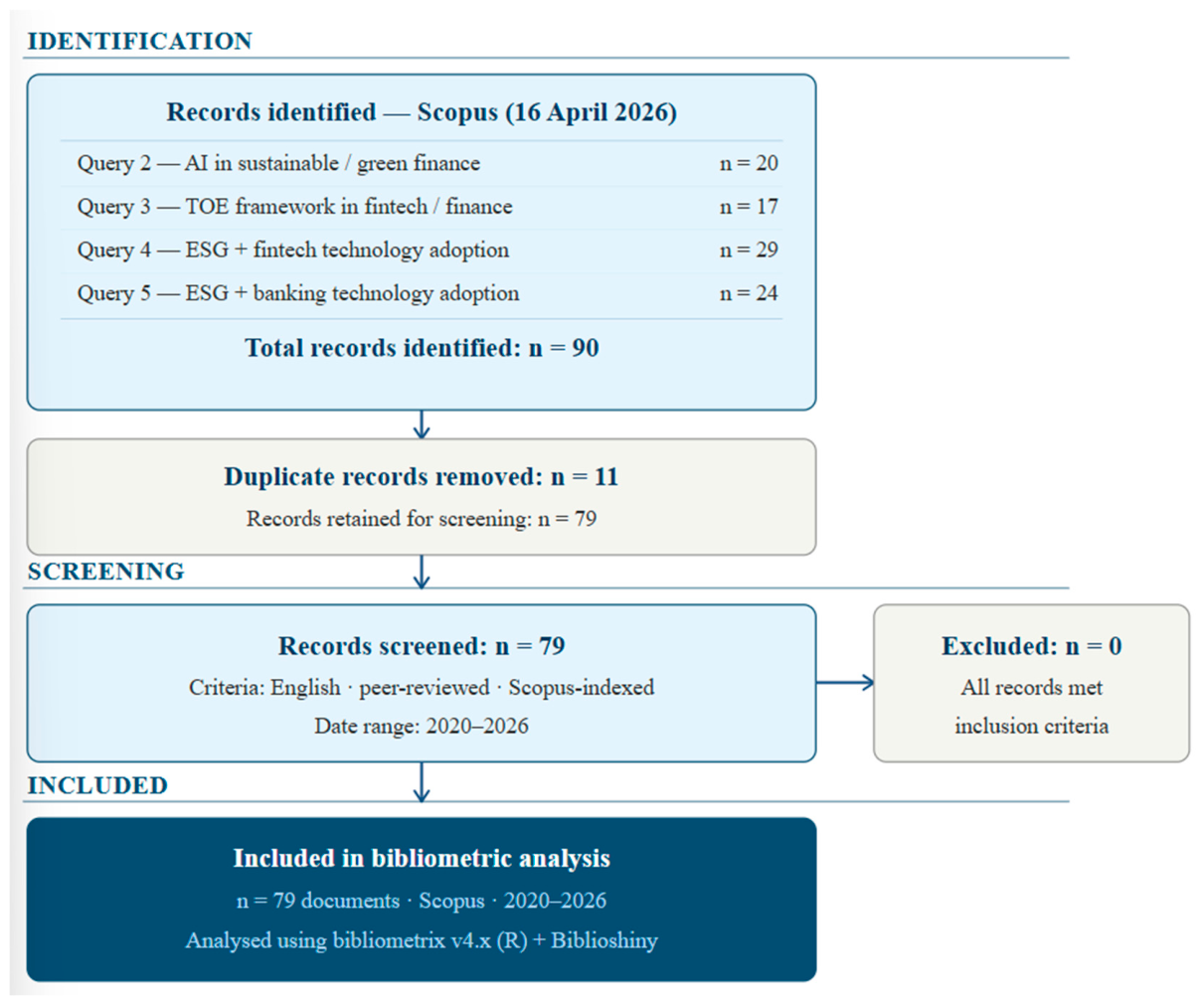
This study employs systematic bibliometric analysis to map the intellectual landscape of green fintech, artificial intelligence, and sustainable banking, and to identify the structural gap that the proposed TOE-based framework addresses. Bibliometric analysis is an established quantitative method for evaluating and visualizing large bodies of scientific literature, providing objective evidence of research trends, thematic structures, and knowledge gaps (Aria & Cuccurullo, 2017; Donthu et al., 2021). The analysis was conducted using the bibliometrix package (version 4.1.4) in R, with supplementary visualizations generated through Biblioshiny. Eligibility criteria were applied consistently across all four queries. Language: Only English-language publications were included, as English constitutes the dominant language of the Scopus-indexed literature in this domain and ensures terminological comparability in keyword co-occurrence analysis. Document types: Journal articles, conference papers, review articles, and book chapters indexed in Scopus were included; editorials, letters, errata, and retracted documents were excluded. Subject area: No subject area restriction was applied at the search stage, but the four search strings were constructed to ensure topical relevance through keyword specificity. Time range: The corpus was restricted to 2020 to 2026 because the intersection of green fintech, AI, and sustainable banking as a coherent research domain emerged following the proliferation of ESG reporting frameworks and the maturation of AI-based financial technologies in the post-2019 period; pre-2020 documents addressing these intersecting themes were negligible in number and would have introduced terminological heterogeneity rather than substantive intellectual content. These criteria are reported in the PRISMA (Page et al., 2021) flow diagram (Figure 1), which documents records identified (n = 90), duplicates removed (n = 11), records screened (n = 79), and records included in the final corpus (n = 79). No records were excluded at the screening stage following deduplication, as all remaining records satisfied the eligibility criteria. No records were excluded at the title/abstract screening stage because the four search strings were constructed with sufficient keyword specificity—requiring co-occurrence of the primary domain terms in title, abstract, or keywords—to ensure topical relevance for all retrieved records. Screening therefore served as a post-deduplication confirmation step rather than a further exclusion stage, resulting in zero additional exclusions. The bibliometric analysis was conducted using bibliometrix version 4.1.4 in R (version 4.3.2), with Biblioshiny for interactive visualization. Keyword co-occurrence analysis applied a minimum co-occurrence threshold of 2 and a minimum term frequency of 3. Thematic mapping (strategic diagram) was generated using the ‘conceptual structure’ function with the ‘co-word’ method, clustering via k-means with k = 5. Trend topic analysis used a minimum of 2 term occurrences per year. All parameter settings are reproducible from the publicly available bibliometrix documentation.
The corpus was constructed through a four-query search strategy on the Scopus database, executed on 16 April 2026. The queries targeted four distinct but complementary intersections of the research domain:
  • Query 1, AI in sustainable/green finance: TITLE-ABS-KEY (“artificial intelligence” OR “machine learning” OR “AI”) AND (“green finance” OR “sustainable finance”) AND (“bank*” OR “financial institution*”), yielded 20 documents.
  • Query 2, TOE framework in fintech/digital finance: TITLE-ABS-KEY (“TOE framework” OR “technology organization environment”) AND (“fintech” OR “financial technology” OR “digital finance” OR “sustainable finance”), yielded 17 documents.
  • Query 3, ESG and technology adoption in fintech: TITLE-ABS-KEY (“ESG” AND (“fintech” OR “financial technology”) AND (“adoption” OR “technology”)), yielded 29 documents.
  • Query 4, ESG and technology adoption in banking: TITLE-ABS-KEY (“ESG” AND (“bank*”) AND (“adoption” OR “technology”)), yielded 24 documents.
After merging and deduplicating the four exports, the final corpus comprised 79 unique documents published between 2020 and 2026 (Table 3). Critically, a focused search combining all three core terms—green fintech, artificial intelligence, and banking—yielded only four documents, rising to seventeen upon removing the banking constraint. This quantitative scarcity at the precise intersection of these concepts constitutes primary evidence of the research gap this study addresses. Six analytical outputs were generated: annual publication trend, keyword co-occurrence network, thematic map, trend topics analysis, source analysis, and three-field knowledge flow analysis.
The corpus was drawn exclusively from Scopus because it provides the broadest coverage of the interdisciplinary intersection of financial technology, environmental science, and management research, and because bibliometrix’s native import functions are optimized for Scopus export formats, ensuring terminological consistency in keyword co-occurrence analysis. Web of Science was not included in the primary corpus due to differences in subject classification that would have required separate normalization procedures; however, the authors acknowledge that multi-database coverage would strengthen the generalizability of the bibliometric gap claim, and future reviews of this literature should include Web of Science. This limitation is noted in Section 7.2.

3.2. Annual Publication Trend

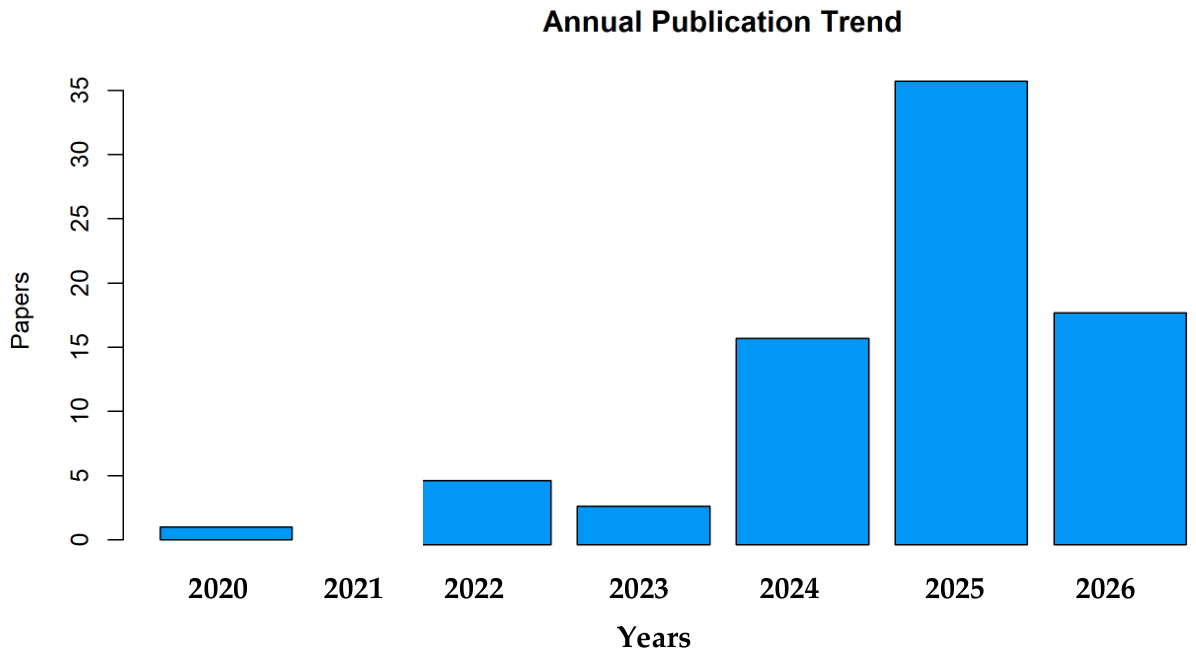
Figure 2 presents the annual distribution of publications in the corpus from 2020 to 2026. The trend reveals an exponential growth pattern consistent with a field in its formative stage. No publications were retrieved for 2020 (n = 0) or 2021 (n = 0), reflecting the pre-emergence phase of this specific research intersection. Publications commenced in 2022 (n = 5), with a temporary consolidation in 2023 (n = 3) followed by sharp acceleration: 16 papers in 2024, 35 in 2025, and 18 in the first months of 2026 alone—indicating that annual output for 2026 will substantially exceed 2025 once the year concludes. The 2026 figure should be interpreted cautiously as a partial-year count.
This exponential trajectory, with an annual growth rate of 78.4%, confirms that the intersection of green fintech, AI, and sustainable banking has emerged as an active research domain only in the most recent years. The timing is attributable to the convergence of global regulatory pressure on environmental sustainability, the maturation of AI-based financial technologies, and the proliferation of ESG reporting requirements following the post-COVID policy acceleration. The recency of this growth simultaneously validates the timeliness of the present study and explains why a comprehensive theoretical framework has not yet been developed in the literature.

3.3. Keyword Co-Occurrence Network

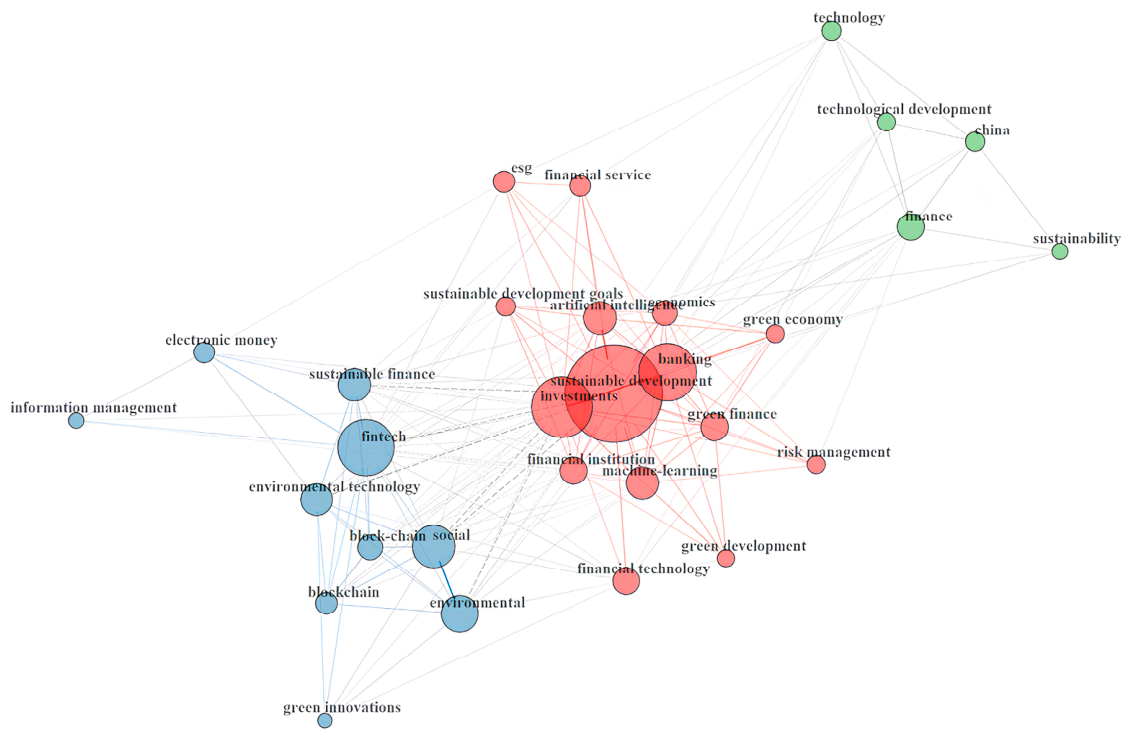
Figure 3 presents the keyword co-occurrence network constructed from author keywords, with a minimum co-occurrence threshold of two and a minimum term frequency of three. The network comprises 30 nodes and 47 edges, with an average path length of 2.4 and a clustering coefficient of 0.61, indicating a moderately dense but structurally fragmented network.
The first and largest cluster (red) constitutes the dominant core, encompassing sustainable development, investments, banking, green finance, artificial intelligence, financial institution, and machine learning. Notably, artificial intelligence appears within this cluster but with relatively small node size and weak edge weights, suggesting its engagement with core themes remains limited and underdeveloped. The second cluster (blue) groups fintech, blockchain, and environmental technology into a sub-network focused on green finance infrastructure, with sparse connections to banking and AI-specific adoption frameworks. The third cluster (green) contains sustainability, finance, and technological development as an isolated peripheral sub-network. The TOE-related concepts technology adoption and fintech ecosystem occupy the outer zones of the network with minimal connectivity to any cluster, providing structural confirmation that the TOE framework has not been integrated into the green fintech and banking literature.

3.4. Thematic Map and Strategic Diagram

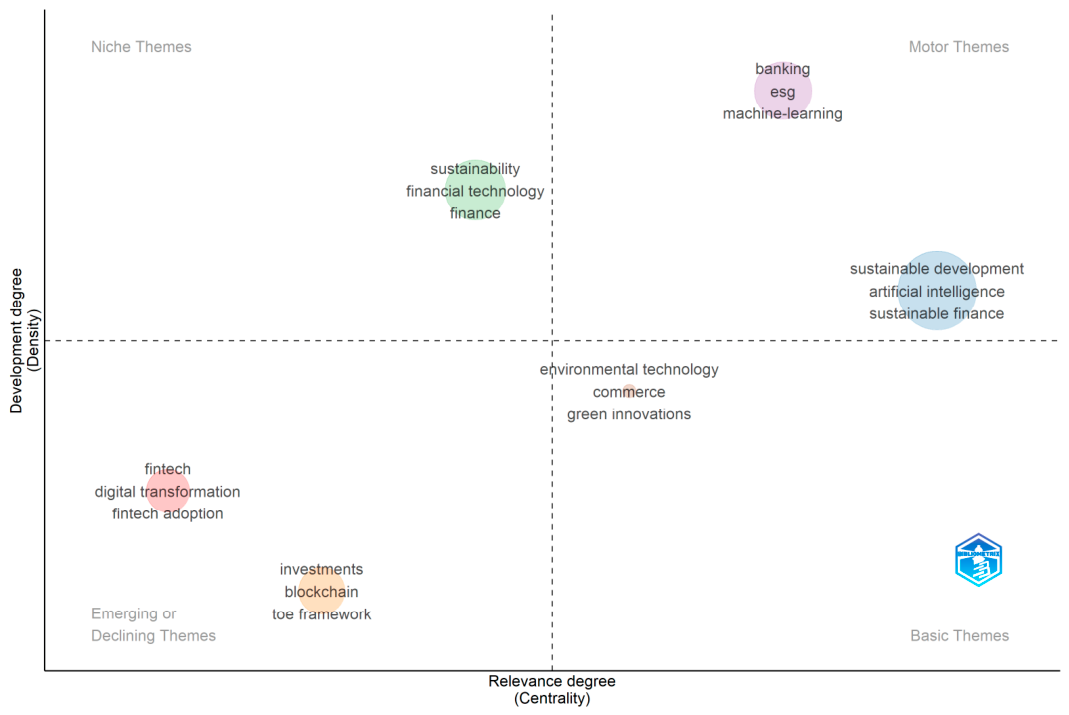
Figure 4 presents the thematic map of the corpus—a strategic diagram classifying keyword clusters according to relevance degree (centrality, x-axis) and development degree (density, y-axis). The motor themes quadrant contains two distinct clusters: banking, ESG, and machine learning forming one highly developed core cluster; and sustainable development, artificial intelligence, and sustainable finance forming a second. Critically, their integration within an organizational adoption framework remains absent from this quadrant. The niche themes quadrant contains sustainability, financial technology, and finance, indicating foundational concepts with specialized internal development but limited connection to the broader field. The emerging or declining themes quadrant contains fintech, TOE framework, and greenwashing as one cluster, alongside ESG, machine learning, and blockchain as another. The placement of the TOE framework in the emerging/declining quadrant—characterized by low centrality and low density—provides bibliometric evidence that it has not yet accumulated the relational density necessary to influence the field’s core themes, though this mapping reflects the current state of keyword co-occurrence patterns rather than a claim about the logical impossibility of such integration. Table 4 reports the exact occurrence counts and thematic positioning for the nine most frequent author keywords, confirming that despite its meaningful frequency (8 occurrences), the TOE framework remains positioned in the emerging/declining quadrant.

3.5. Trend Topics Analysis

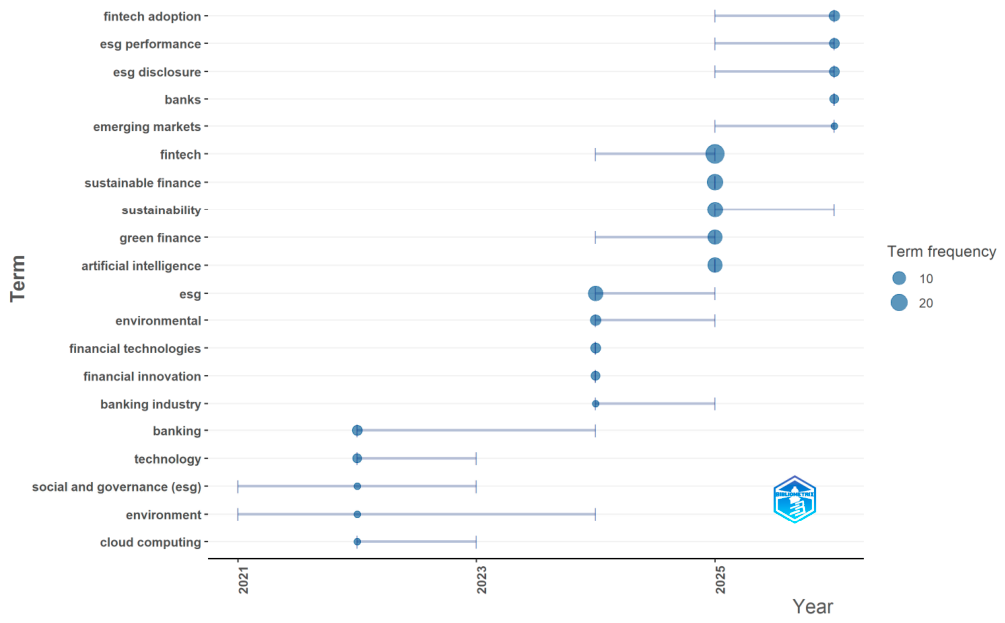
Figure 5 maps the temporal distribution of the most frequent keywords across the study period, revealing a clear three-layer temporal stratification. The foundational layer (2020–2022) was dominated by banking, technology, environment, cloud computing, and financial innovation, reflecting early-stage discourse without engagement with specific adoption mechanisms. A transitional period (2022–2024) introduced ESG, environmental management, banking industry, and financial technologies as active research concerns. The most recent frontier (2024–2026) is marked by fintech adoption, ESG performance, ESG disclosure, banks, and emerging markets. Critically, artificial intelligence emerges as an active trend keyword only from 2024 onward, and the TOE framework has never appeared as a trend topic in any period confirming that organizational adoption frameworks remain unintegrated with this emerging research frontier.

3.6. Most Relevant Sources and Knowledge Flow

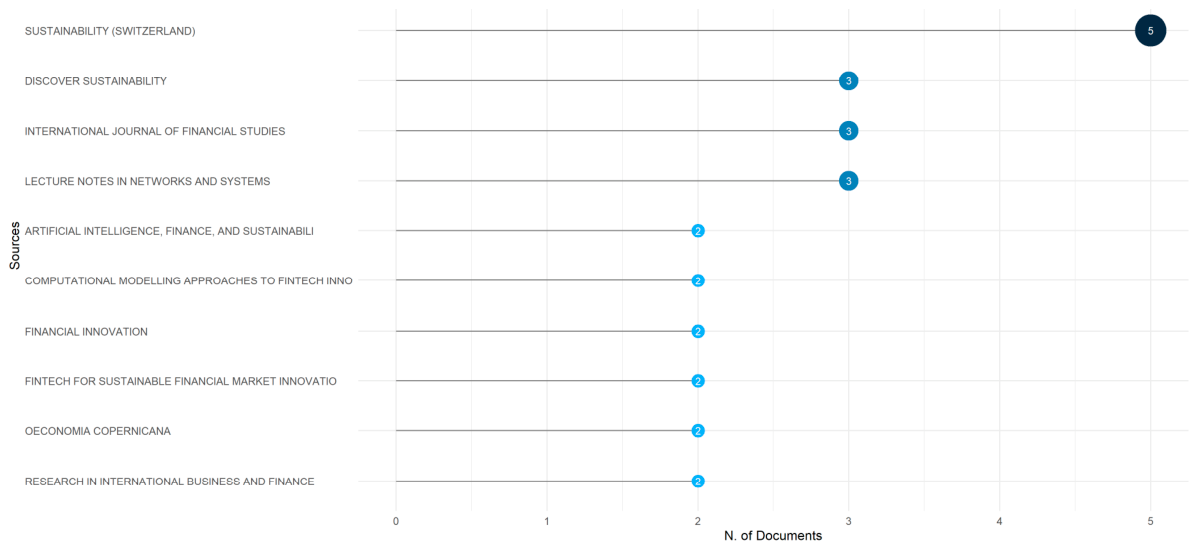
Figure 6 presents the most productive journals in the corpus, with Sustainability (Switzerland, MDPI) leading with five publications, followed by Discover Sustainability and the International Journal of Financial Studies with three each. The Q1 journals Financial Innovation, Oeconomia Copernicana, and Research in International Business and Finance each contributed two documents. The absence of a single dominant flagship journal confirms that this literature has not yet consolidated around a dedicated publication venue, which is typical of nascent interdisciplinary fields.
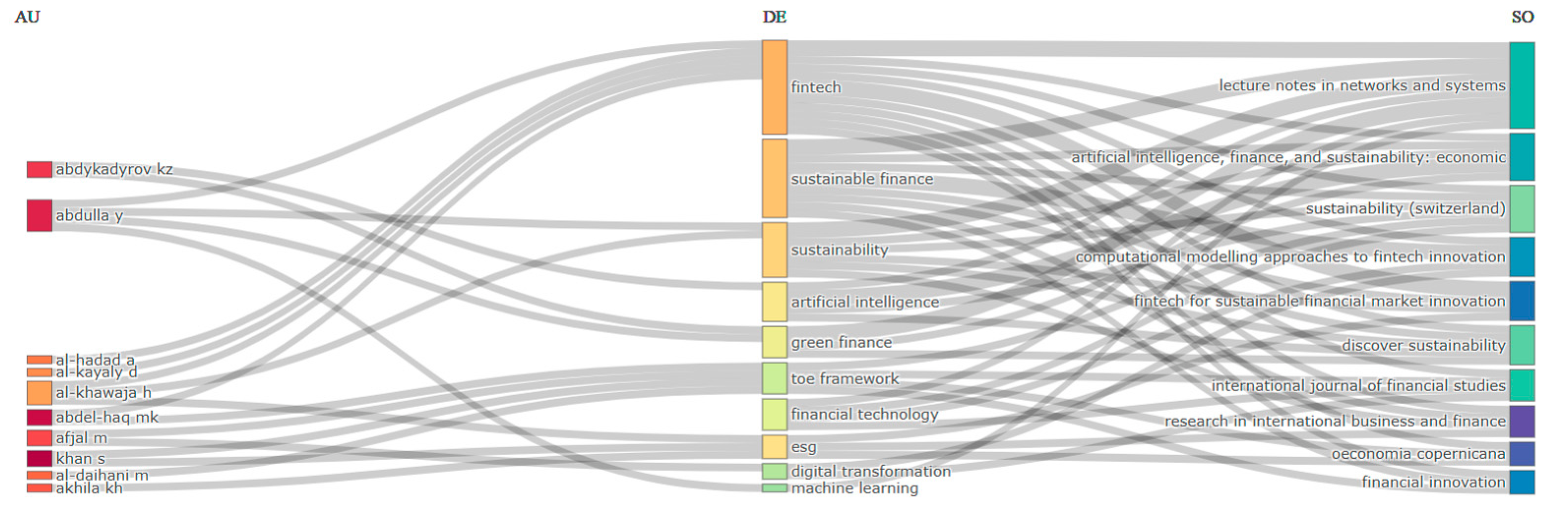
Figure 7 presents the three-field Sankey diagram mapping the flow of knowledge from authors (AU) through author keywords (DE) to publishing sources (SO). The TOE framework occupies a middle position in the keyword column, connected to a small number of authors and flowing primarily toward conference proceedings and edited volumes rather than high-impact journals reinforcing the finding from the thematic map that TOE-based research in green fintech remains a niche, under-connected domain.

3.7. Bibliometric Synthesis: Evidence of the Research Gap

The six bibliometric analyses converge on a consistent finding: the specific intersection of the TOE framework, AI-driven solutions, and sustainable banking investment practices constitutes a structural gap in the existing literature. The evidence is fourfold and convergent: taken together, the four analyses provide strong bibliometric indications of structural undertheorization, though readers should note that bibliometric mapping demonstrates patterns of keyword co-occurrence and thematic positioning rather than the logical impossibility of prior integration. First, the 78.4% annual growth rate confirms the field is nascent. Second, the keyword network reveals TOE-related concepts in peripheral, weakly connected positions with no direct linkage to the core cluster. Third, the thematic map demonstrates that the TOE framework has never occupied the motor themes quadrant. Fourth, the trend topic analysis shows that artificial intelligence emerged as an active keyword only from 2024, and the TOE framework has never appeared as a trend topic in any analytical period. Together, these findings provide quantitative, reproducible, and visually demonstrable evidence that the bibliometric gap addressed by the proposed framework is not a rhetorical assertion but a measurable structural feature of the field. This convergent evidence base establishes the scholarly necessity of the conceptual framework developed in Section 4 and confirms that the proposed framework represents a theoretically novel contribution to a demonstrably undertheorized domain.

4. Conceptual Framework

4.1. Framework Overview

This study integrates the Technology–Organization–Environment (TOE) framework to develop a comprehensive conceptual model for understanding the adoption of AI-driven green fintech solutions in banking and their impact on sustainable investment practices. The framework identifies three mediating constructs—technological readiness, sustainability culture, and regulatory support—that channel the influence of the three TOE dimensions toward the adoption of AI-driven green fintech solutions, which in turn shapes banks’ sustainable investment practices. The selection of these three specific mediators requires formal justification. Multiple candidate constructs could theoretically mediate each TOE dimension—for example, AI governance capability, data infrastructure maturity, and digital literacy have each been proposed as organizational bridges between technology availability and adoption outcomes in the AI adoption literature (Aldoseri et al., 2024; Rana et al., 2022). However, technological readiness is selected as the technology-dimension mediator because it is the most comprehensive and empirically validated organizational-level construct for capturing an institution’s preparedness to deploy new technologies, integrating cognitive assessment of technology value, IT infrastructure capability, and operational deployment capacity into a single construct (Durst et al., 2023; Flavián et al., 2022). Narrower constructs such as data infrastructure or AI governance capture only one component of this readiness, rather than the full organizational preparedness that determines adoption quality. For the organization dimension, sustainability culture is selected over alternatives such as green leadership commitment or ESG literacy because culture—defined as the shared values, norms, and behavioral expectations embedded in organizational practice (Schein, 2010)—operates at the deepest level of organizational influence and is the most robust determinant of whether sustainability objectives are internalized across the institution or remain confined to specialist units (Ali et al., 2023; Naveed et al., 2022). Green leadership and ESG literacy are important inputs to sustainability culture but are subsumed within it rather than substitutes for it. For the environment dimension, regulatory support is selected over market pressure or stakeholder demand as the mediating mechanism because regulation provides the legitimizing institutional authority that converts diffuse environmental pressure into specific, enforceable, and actionable adoption directives for banks (DiMaggio & Powell, 1983). Market pressure and stakeholder demand are important components of the environmental context but function as antecedents to regulatory support rather than independent mediators—they generate pressure that regulators then codify into the standards and incentives that directly govern bank behavior. This three-mediator architecture thus provides the broadest and most theoretically grounded coverage of the organizational pathways from TOE dimensions to adoption outcomes.
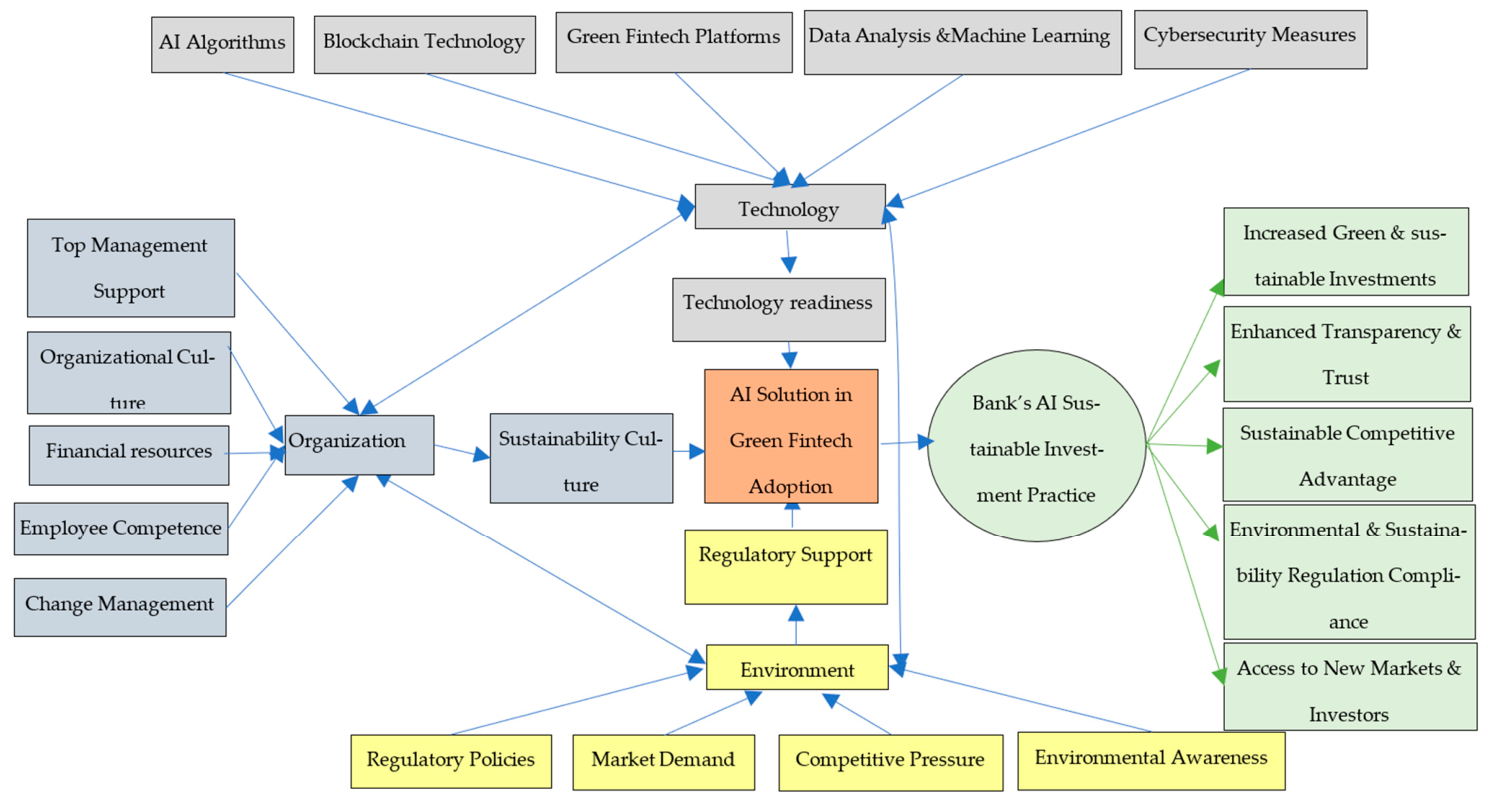
Figure 8 presents the conceptual model. The framework is organized around three pathways: the technology dimension factors (AI algorithms, blockchain, data analytics, cybersecurity, and green fintech platforms) operate through the mediator of technological readiness; the organization dimension factors (change management, employee competence, financial resources, organizational culture, and top management support) operate through the mediator of sustainability culture; and the environment dimension factors (regulatory policies, market demand, competitive pressure, and environmental awareness) operate through the mediator of regulatory support. These three mediated pathways converge on AI-driven green fintech adoption as the central intermediate outcome, which in turn determines the bank’s sustainable investment practices expressed as increased green investment allocation, enhanced ESG transparency, regulatory compliance, sustainable competitive advantage, and access to new sustainability-focused capital markets.
The framework’s central theoretical argument is that the three TOE dimensions do not determine AI-driven green fintech adoption directly but operate through three explicitly theorized mediating pathways—technological readiness, sustainability culture, and regulatory support—that specify the organizational mechanisms through which technological, institutional, and environmental conditions translate into sustainable investment outcomes. This mediation architecture is theoretically grounded in the causal inference tradition of (Baron & Kenny, 1986) who establish that a variable functions as a mediator when it accounts for the relationship between an independent variable and an outcome, such that the independent variable (here, each TOE dimension) predicts the mediator, the mediator predicts the outcome, and the direct effect of the independent variable on the outcome is reduced or eliminated when the mediator is controlled. Mediation is preferred over moderation in this framework because the TOE dimensions are conceptualized as distal causes—conditions that create the potential for adoption—while the three constructs represent the organizational processes through which that potential is converted into actual adoption behavior. A moderator would change the strength of a relationship without specifying the mechanism; a mediator specifies the causal pathway (Preacher & Hayes, 2004). For example, high technological availability (TOE technology dimension) does not directly produce AI-driven green fintech adoption unless the bank has developed the operational readiness—the infrastructure maturity, workforce competence, and governance structures—to deploy those technologies effectively. Technological readiness is therefore the mechanism through which technology availability produces adoption, not a boundary condition that makes the relationship stronger or weaker. This mediation logic applies equivalently to sustainability culture (mediating the organizational dimension) and regulatory support (mediating the environmental dimension), and it is this mechanistic specification that distinguishes the present framework from prior TOE applications that treat the three dimensions as direct predictors.

4.2. Technology Dimension

The technology dimension of the TOE framework encompasses the characteristics and availability of technologies relevant to green fintech adoption in banking. Five principal technological components are identified. First, AI algorithms including machine learning, deep learning, and natural language processing are essential for analyzing large sets of data to recognize environmentally aligned investment opportunities, improve decision-making processes, and forecast risks in sustainable initiatives (Nishant et al., 2020; Rane et al., 2024). Second, blockchain technology enables secure, transparent, and immutable recording of green financial transactions, providing the trust infrastructure necessary for sustainable investment verification (Chang et al., 2020; Javaid et al., 2022; Udeh et al., 2024). Third, green fintech platforms provide integrated resources for sustainable portfolio management, ESG compliance monitoring, and green investment reporting (Afua Addy et al., 2024). Fourth, data analytics and machine learning enable banks to process large volumes of environmental and market data, improving the quality of risk assessment and opportunity identification in green investments (Kumar et al., 2022). Fifth, cybersecurity infrastructure ensures the integrity and confidentiality of environmental and financial data, which is a prerequisite for maintaining stakeholder trust in sustainable investment claims (Hassan et al., 2024). These five technological components are summarized alongside the organizational and environmental components in Table 5.

4.3. Technological Readiness as Mediator

Technological readiness is the extent to which an organization is prepared to adopt and integrate new technologies mediates the relationship between technology dimension factors and AI-driven green fintech adoption. Technological readiness captures both the cognitive assessment of technology value and the organizational capacity for implementation (Durst et al., 2023; Flavián et al., 2022; Y. Zhang et al., 2020). Banks with robust technological infrastructures, strong IT governance, and well-trained workforces are better positioned to leverage AI-driven tools for ESG assessment, green investment management, and blockchain-based transparency mechanisms. Conversely, low technological readiness characterized by legacy system incompatibility, insufficient data infrastructure, or limited AI expertise constrains adoption even when technology availability is high. Technological readiness thus acts as the organizational bridge between technology availability and effective green fintech deployment.

4.4. Organization Dimension

The organization dimension pertains to the internal factors that shape a bank’s capacity to adopt green fintech. Five key organizational components are identified. Change management capacity ensures the organization can effectively manage the transitions and behavioral adjustments required by new technology adoption (Hidayat-ur-Rehman & Hossain, 2024; Silva, 2015). Employee competence determines whether the workforce possesses the knowledge and skills to utilize AI and green fintech solutions effectively (Taneja et al., 2024). Financial resource availability determines the organization’s investment capacity for technological infrastructure, training, and implementation support (Jaiwant & Kureethara, 2023). Organizational culture—particularly the extent to which innovation, collaboration, and sustainability are embedded organizational values—creates the enabling environment for green fintech integration (Ali et al., 2023). It is important to distinguish organizational culture as an antecedent component from sustainability culture as the mediating construct in this framework. Organizational culture refers to the general values and behavioral norms of the institution, which may or may not be sustainability oriented. Sustainability culture, by contrast, is the mediating construct that aggregates top management commitment, employee ESG competence, and the depth of sustainability embeddedness into a single institutional-level mechanism through which organizational factors translate into AI-driven green fintech adoption. Organizational culture thus functions as one input to sustainability culture rather than a substitute for it. Top management support provides the strategic commitment and resource allocation authority necessary to align organizational priorities with sustainability objectives (Fu et al., 2020). These five organizational components are summarized in Table 5.

4.5. Sustainability Culture as Mediator

Sustainability culture—the extent to which sustainability principles are embedded within an organization’s values, norms, and operational practices—mediates the relationship between organizational factors and sustainable investment practices. A bank with a strong sustainability culture is more likely to prioritize the adoption of green fintech technologies, allocate resources to ESG-enhancing tools, and drive the development of sustainable financial products such as green bonds and ESG-linked loans (Wu et al., 2024). Sustainability culture also drives internal alignment, ensuring that green fintech solutions are embraced at the employee level and integrated into daily decision-making rather than remaining isolated within specialist units. When sustainability is a core organizational value, the bank’s capacity to translate green fintech adoption into improved sustainable investment outcomes is substantially enhanced (Ali et al., 2023; Naveed et al., 2022).

4.6. Environment Dimension

The environmental dimension captures the external pressures and incentives that shape green fintech adoption in banking. Four principal environmental factors are identified (see Table 5). Government regulations and environmental sustainability policies establish mandatory standards that banks must meet through green fintech adoption, creating compliance-driven demand for these solutions (Bani Atta, 2025; Murinde et al., 2022; J. Zhang et al., 2020). Market demand for environmentally responsible investments driven by ESG-conscious institutional investors and retail customers creates competitive incentives for banks to adopt green fintech capabilities (Udeagha & Ngepah, 2023). Competitive pressure from peer institutions that have already adopted green fintech solutions compels laggard banks to accelerate their adoption timelines (Agrawal et al., 2024). Environmental awareness among stakeholders including shareholders, civil society, and the media generates reputational pressure that reinforces both regulatory and market incentives (Khan et al., 2023).

4.7. Regulatory Support as Mediator

Regulatory support—encompassing government incentives, clear ESG reporting guidelines, and institutional frameworks that promote sustainable financial practices—mediate the relationship between environmental pressures and banks’ sustainable investment practices. Regulatory support provides the legitimacy, directional clarity, and financial incentives necessary for banks to commit to green fintech adoption beyond mere compliance minimalism (Nzeako et al., 2024; Shirai, 2023). In contexts where regulatory support is strong, banks are more likely to adopt AI-driven tools for ESG assessment, use blockchain for green bond verification, and align investment portfolios with climate risk management requirements. Regulatory support also facilitates access to sustainable finance markets, as compliance with clear environmental frameworks enables banks to attract sustainability-focused investors and access green finance instruments. The mediating role of regulatory support ensures that environmental pressures translate into substantive AI-driven green fintech adoption rather than symbolic compliance, with improved sustainable investment practices realized through the adoption pathway specified in Proposition 4.

4.8. AI-Driven Green Fintech Adoption and Sustainable Investment Practices

AI-driven green fintech adoption shaped by the three mediating constructs constitutes the primary mechanism through which banks can enhance their sustainable investment practices. Adoption enables five distinct categories of improvement. First, increased green investment allocation: AI-driven solutions help banks identify and allocate capital to a larger number of verified sustainable projects, improving the environmental impact of their investment portfolios (Pashang & Weber, 2023). Second, enhanced transparency and trust: blockchain and AI technologies provide verifiable, auditable records of green investment flows, strengthening investor and regulatory confidence in sustainable finance claims (Udeh et al., 2024). Third, sustainable competitive advantage: banks that leverage green fintech capabilities attract sustainability-conscious investors and differentiate themselves in increasingly ESG-sensitive capital markets (Murinde et al., 2022). Fourth, regulatory compliance: AI-powered fintech solutions assist banks in fulfilling ESG reporting requirements and environmental sustainability standards with greater efficiency and accuracy (Rane et al., 2024). Fifth, market access: adoption of green fintech opens access to new sustainable finance markets, green bond programs, and international sustainability-linked financing instruments (Agrawal et al., 2024). Together, these outcomes constitute the bank’s sustainable investment practices—the dependent variable in the framework—as illustrated in Figure 8.

5. Theoretical Propositions

The conceptual framework generates five theoretical propositions that specify the directional relationships among the framework’s constructs and provide testable hypotheses for future empirical validation, summarized in Table 6 with the indicative measurement items for future empirical validation in Table 7. These propositions are grounded in the theoretical foundations reviewed in Section 2 and the structural relationships identified in the framework.
Proposition 1 addresses the mediating role of technological readiness. P1 proposes that the effect of technology dimension factors AI algorithm availability, blockchain infrastructure, and data analytics capabilities on AI-driven green fintech adoption is not direct but is fully transmitted through the bank’s level of technological readiness. The mechanism is cognitive-organizational: superior technology availability raises the ceiling of what adoption is possible, but technological readiness determines what fraction of that ceiling is realized. Banks with equivalent AI and blockchain access will exhibit systematically different adoption rates as a function of IT infrastructure maturity, AI workforce competence, and managerial cognitive readiness.
Proposition 2 addresses the mediating role of sustainability culture. Drawing on institutional theory and the organizational dimension of TOE, P2 proposes that the relationship between organizational factors—top management commitment, employee competence, and financial resource availability—and AI-driven green fintech adoption is mediated by the strength of sustainability culture. Institutional theory (DiMaggio & Powell, 1983; Scott et al., 2002) establishes that organizations do not adopt practices solely on the basis of efficiency calculations; rather, they are subject to isomorphic pressures—coercive, normative, and mimetic—that lead them to internalize socially legitimate values and norms into their operational cultures. In the context of sustainable banking, this means that organizational factors (such as resource availability and top management support) generate substantive green investment transformation only when they operate through an institutionally embedded sustainability culture—a set of shared values and behavioral norms that position ESG performance as a core organizational identity rather than an external compliance obligation (DiMaggio & Powell, 1983). Without this cultural institutionalization, resources and management authority are captured by conventional profitability imperatives even when formal ESG commitments exist, producing symbolic adoption: the appearance of green investment activity without the substantive reallocation of capital that ESG objectives require. Scott et al. (2002) further identifies that the cognitive and normative pillars of institutions—what organizations take for granted as legitimate behavior—are the deepest determinants of sustained organizational change, and that regulatory and resource pressures alone are insufficient to produce durable behavioral transformation without corresponding cultural change. P2 thus theorizes that sustainability culture is not merely a correlate of sustainable investment practice but the institutional mechanism through which organizational resources and leadership commitment are converted from latent potential into operational AI-driven green fintech adoption—which then generates improved sustainable investment outcomes through the Proposition 4 pathway.
Proposition 3 addresses the mediating role of regulatory support. Drawing on regulatory theory and the environmental dimension of TOE, P3 proposes that the relationship between external environmental pressures—market demand, competitive pressure, and stakeholder environmental awareness—and AI-driven green fintech adoption is mediated by the quality and specificity of regulatory support. Regulatory theory provides the theoretical foundation for this proposition. Baldwin et al. (2011) establish that regulation functions as a purposive governmental mechanism designed to direct the behavior of economic actors toward socially desirable outcomes; in this capacity, regulatory frameworks convert diffuse societal expectations about environmental responsibility into specific, legally enforceable, and institutionally authoritative directives that obligate organizations to act. Without this regulatory translation, market demand and stakeholder pressure remain ambiguous signals that permit banks to select the minimal-cost symbolic response—ESG reporting without substantive portfolio realignment, or green labeling without verifiable fund utilization—rather than committing to the costly infrastructure of AI-driven green fintech adoption. Regulatory theory further distinguishes between regulatory legitimacy (the authority that causes organizations to comply) and regulatory capacity (the specificity and enforceability of the regulatory directive) as the two conditions jointly necessary to generate behavioral change (Posner, 1974; Stigler, 1971). P3 theorizes that high-quality regulatory support—operationalized as clear ESG reporting standards, green fintech adoption incentives, and enforceable sustainability compliance frameworks—provides both legitimacy and capacity, thereby converting environmental pressure into substantive adoption investment. Conversely, where regulatory support is weak, fragmented, or jurisdiction-inconsistent (as documented in Table 1), environmental pressure generates compliance ambiguity that systematically biases banks toward minimal-cost symbolic responses rather than the substantive AI-driven green fintech infrastructure investment required to produce improved sustainable investment practices.
Proposition 4 addresses the primary outcome relationship of the framework. Drawing on the resource-based view and technology adoption literature, P4 proposes that AI-driven green fintech adoption exerts a direct, positive, and significant effect on banks’ sustainable investment practices through three sequential mechanisms: first, enhanced ESG data quality; second, improved real-time portfolio monitoring; and third, reduced information asymmetry between the bank and sustainability-focused capital providers, whereby blockchain-verified green investment records enable credible ESG signaling that expands access to green bond markets and sustainability-linked financing instruments.
Proposition 5 addresses the synergistic indirect effects of the three mediators. Drawing on systems theory and consistent with the mediation logic developed in Section 4.1, P5 proposes that the combined indirect effect of AI-driven green fintech adoption on sustainable investment practices—transmitted simultaneously through technological readiness, sustainability culture, and regulatory support—exceeds the sum of their individual indirect effects when all three are present at high levels. The theoretical mechanism is systemic interdependence across three distinct failure modes: technological readiness without sustainability culture produces technically capable but sustainability-indifferent adoption; sustainability culture without regulatory support produces well-intentioned but institutionally unvalidated adoption; and regulatory support without technological readiness produces compliance pressure that banks cannot technically fulfill. The conjunction of all three mediators eliminates each failure mode simultaneously, producing a system-level amplification of the adoption’s effect on sustainable investment outcomes. This is a claim about the magnitude of combined indirect effects, not a moderation hypothesis; future empirical testing may operationalize it as a parallel multiple-mediator model with bootstrapped confidence intervals for the total indirect effect.

6. Discussion

6.1. Theoretical Implications

This study makes three principal theoretical contributions to the literature on green fintech, technology adoption, and sustainable banking. First, it provides the first reproducible bibliometrically evidence of the TOE–AI–green fintech-banking gap, establishing the research gap through quantitative, reproducible analysis rather than narrative assertion. The bibliometric demonstration that the TOE framework has never occupied the motor themes quadrant of the green fintech literature, combined with the finding that only four documents address the precise intersection of these concepts, constitutes methodologically robust evidence of theoretical novelty.
Second, the study extends the TOE framework to a new and important application domain. While TOE has been widely applied to enterprise technology adoption (cloud computing, blockchain, IoT), its application to sustainability-oriented financial technology in banking represents a conceptually distinct extension. The sustainability context introduces new organizational constructs—sustainability culture, ESG culture, green investment orientation—that are not present in conventional TOE studies and require new theoretical elaboration.
Third, the three-mediator structure (technological readiness, sustainability culture, regulatory support) advances existing TOE applications by making the mediating mechanisms explicit. Most TOE studies treat the three dimensions as direct determinants of adoption without specifying the organizational processes through which they exert their influence. The proposed mediators provide greater theoretical precision and generate more specific and testable propositions.

6.2. Practical Implications

For bank managers and executives, the framework provides actionable guidance for green fintech adoption strategies. The three mediating constructs suggest three distinct intervention points: investing in technological infrastructure and AI literacy (technological readiness), embedding sustainability values through leadership commitment and organizational culture change (sustainability culture), and actively engaging with regulatory processes to shape supportive frameworks (regulatory support). Banks that address all three simultaneously are positioned to achieve the most significant improvements in sustainable investment practices.
For regulators and policymakers, the framework highlights the critical role of regulatory support in translating environmental pressures into substantive banking action. The finding that the TOE framework and ESG occupy the emerging quadrant of the thematic map suggests that regulatory frameworks have not yet provided sufficient clarity and incentive for systematic green fintech adoption. Regulators should consider harmonizing ESG reporting standards, providing explicit green fintech adoption incentives, and establishing clear taxonomies for sustainable finance products.

6.3. Implications for SDG Alignment

The proposed framework contributes directly to the achievement of multiple United Nations Sustainable Development Goals. SDG 13 (Climate Action) is advanced through banks’ AI-enhanced capability to assess and manage climate-related investment risks. SDG 17 (Partnerships for the Goals) is supported through the regulatory support dimension, which facilitates international alignment of sustainable finance standards. SDG 8 (Decent Work and Economic Growth) is addressed through the framework’s recognition that green fintech adoption creates new competitive capabilities for banking institutions. SDG 9 (Industry, Innovation, and Infrastructure) is advanced through the technology dimension’s emphasis on AI, blockchain, and data analytics as infrastructure for sustainable finance. By explicitly positioning banking institutions as enablers of SDG achievement through green fintech adoption, the framework connects organizational decision-making to global sustainability imperatives.


7. Conclusions

7.1. Summary of Contributions

This study presents an integrated conceptual framework for understanding the adoption of AI-driven green fintech solutions in banking and their impact on sustainable investment practices. Through a two-phase approach combining bibliometric analysis and conceptual framework development, it makes four contributions. First, it provides quantitative bibliometric evidence drawn from 79 Scopus-indexed documents that the precise intersection of TOE theory, AI-driven green fintech, and banking-sector sustainable investment practices remains structurally undertheorized in the existing literature—evidenced by the TOE framework’s consistent placement in the emerging/declining quadrant of the thematic map, its absence as a trend topic in any analytical period, and the retrieval of only four documents at the precise three-term intersection. Second, it proposes a TOE integrated framework that identifies three mediating constructs technological readiness, sustainability culture, and regulatory support that channel the influence of technological, organizational, and environmental factors toward sustainable investment outcomes. Third, it derives five theoretical propositions that specify the directional relationships among the framework’s constructs and provide testable hypotheses for future empirical inquiry. Fourth, it develops a literature positioning matrix (Table 2) that demonstrates the novelty of the present contribution relative to six closely related studies.

7.2. Limitations

Several limitations should be acknowledged. As a conceptual paper, the framework’s propositions await empirical validation. The bibliometric corpus, while systematically constructed through four complementary queries, is subject to the inherent limitations of keyword-based search strategies and Scopus database coverage. The historiographic network analysis was not feasible due to the nascent nature of the field—insufficient cross-citation density among the 79 retrieved documents—which is itself a confirmation of the literature gap but limits the intellectual heritage mapping of the field. The framework does not explicitly address national institutional contexts beyond general regulatory support, and future empirical studies should examine how specific regulatory environments, including the GCC’s distinctive combination of state-led regulatory support, and emerging culture, moderate the proposed relationships. A further limitation concerns the assumed nature of mediation in the five propositions. The framework theorizes full mediation: that each TOE dimension operates exclusively through its designated mediator but empirical testing may reveal partial mediation, whereby the TOE dimensions also exert direct effects on adoption outcomes alongside the mediating pathway.

7.3. Future Research Directions

Table 8 presents five structured future research directions derived from the framework’s limitations and theoretical propositions. The most immediate priority is empirical validation of the framework through structural equation modeling (SEM) or partial least squares SEM (PLS-SEM) across diverse banking contexts. Multi-group analysis comparing state-owned and private banks, and comparing GCC with other emerging market banking sectors, would test the boundary conditions of the proposed relationships. Longitudinal designs would enable examination of how AI-driven green fintech adoption effects on ESG performance evolve as technologies mature. Mixed-method studies examining greenwashing risk under AI-enhanced ESG reporting would address a critical practical concern that the present conceptual framework does not resolve.
In conclusion, this study establishes that the integration of the TOE framework, AI-driven green fintech solutions, and sustainable banking investment practices represents a theoretically novel, bibliometrically demonstrated, and practically urgent research agenda. The framework proposed here offers conceptual scaffolding for an empirical program rather than demonstrated findings; all propositions concerning the effects of the three mediating constructs on AI-driven green fintech adoption, and the effect of adoption on sustainable investment practices, are theoretical and await validation through SEM or PLS-SEM studies with banking samples. The exponential growth of the field documented at 78.4% annually ensures that empirical validation studies will find a rapidly expanding literature to build upon, and the operationalization indicators provided in Table 7 offer a starting point for survey instrument development.

Author Contributions

R.A.A. designed the study and was responsible for data collection and quality assurance of the study results. R.A.A. was also responsible for analyzing the data for this manuscript and drafted the manuscript in close collaboration with L.A.H. and G.S.M. All authors have read and agreed to the published version of the manuscript.

Funding

This research received no external funding.

Institutional Review Board Statement

Not applicable.

Informed Consent Statement

Not applicable.

Data Availability Statement

The information contained in this research can be obtained by contacting the corresponding author.

Conflicts of Interest

The authors declare no conflicts of interest.

Abbreviations

The following abbreviations are used in this manuscript:
AIArtificial Intelligence
ESGEnvironmental, Social, and Governance
TOETechnology-Organization-Environment
SDGSustainable Development Goals
NLPNatural Language Processing
SEMStructural Equation Modeling
PLS-SEMPartial Least Squares SEM
GCCGulf Cooperation Council
MENAMiddle East and North Africa

References

  1. Afua Addy, W., Chrisanctus Ofodile, O., Bukola Adeoye, O., Tolulope Oyewole, A., Chinazo Okoye, C., Odeyemi, O., & James Ololade, Y. (2024). Data-driven sustainability: How fintech innovations are supporting green finance. Engineering Science & Technology Journal, 5(3), 760–773. [Google Scholar] [CrossRef]
  2. Agrawal, R., Agrawal, S., Samadhiya, A., Kumar, A., Luthra, S., & Jain, V. (2024). Adoption of green finance and green innovation for achieving circularity: An exploratory review and future directions. Geoscience Frontiers, 15(4), 101669. [Google Scholar] [CrossRef]
  3. Aldoseri, A., Al-Khalifa, K. N., & Hamouda, A. M. (2024). AI-powered innovation in digital transformation: Key pillars and industry impact. Sustainability, 16(5), 1790. [Google Scholar] [CrossRef]
  4. Ali, M., Malik, M., Yaqub, M. Z., Chiappetta Jabbour, C. J., Lopes de Sousa Jabbour, A. B., & Latan, H. (2023). Green means long life—Green competencies for corporate sustainability performance: A moderated mediation model of green organizational culture and top management support. Journal of Cleaner Production, 427, 139174. [Google Scholar] [CrossRef]
  5. Almaiah, M. A., Alfaisal, R., Salloum, S. A., Hajjej, F., Shishakly, R., Lutfi, A., Alrawad, M., Al Mulhem, A., Alkhdour, T., & Al-Maroof, R. S. (2022). Measuring institutions’ adoption of artificial intelligence applications in online learning environments: Integrating the innovation diffusion theory with technology adoption rate. Electronics, 11(20), 3291. [Google Scholar] [CrossRef]
  6. Anu, Singh, A. K., Raza, S. A., Nakonieczny, J., & Shahzad, U. (2023). Role of financial inclusion, green innovation, and energy efficiency for environmental performance? Evidence from developed and emerging economies in the lens of sustainable development. Structural Change and Economic Dynamics, 64, 213–224. [Google Scholar] [CrossRef]
  7. Aria, M., & Cuccurullo, C. (2017). bibliometrix: An R-tool for comprehensive science mapping analysis. Journal of Informetrics, 11(4), 959–975. [Google Scholar] [CrossRef]
  8. Baldwin, R., Cave, M., & Lodge, M. (2011). Understanding regulation: Theory, strategy, and practice. Oxford University Press. [Google Scholar]
  9. Bani Atta, A. A. (2025). Adoption of fintech products through environmental regulations in Jordanian commercial banks. Journal of Financial Reporting and Accounting, 23(2), 536–549. [Google Scholar] [CrossRef]
  10. Baron, R. M., & Kenny, D. A. (1986). The moderator–mediator variable distinction in social psychological research: Conceptual, strategic, and statistical considerations. Journal of Personality and Social Psychology, 51(6), 1173. [Google Scholar] [CrossRef] [PubMed]
  11. Bibri, S. E., Krogstie, J., Kaboli, A., & Alahi, A. (2024). Smarter eco-cities and their leading-edge artificial intelligence of things solutions for environmental sustainability: A comprehensive systematic review. Environmental Science and Ecotechnology, 19, 100330. [Google Scholar] [CrossRef] [PubMed]
  12. Chandran M. C., S., Chandran, R., & Achuthan, K. (2026). Bridging technology and sustainability: Examining the role of green AI adoption in Indian banking sector. Frontiers in Artificial Intelligence, 8, 1692763. [Google Scholar] [CrossRef] [PubMed]
  13. Chang, V., Baudier, P., Zhang, H., Xu, Q., Zhang, J., & Arami, M. (2020). How Blockchain can impact financial services—The overview, challenges and recommendations from expert interviewees. Technological Forecasting and Social Change, 158, 120166. [Google Scholar] [CrossRef] [PubMed]
  14. Chen, S., Song, Y., & Gao, P. (2023). Environmental, social, and governance (ESG) performance and financial outcomes: Analyzing the impact of ESG on financial performance. Journal of Environmental Management, 345, 118829. [Google Scholar] [CrossRef] [PubMed]
  15. Curmally, A. W., Sandwidi, B., & Jagtiani, A. (2022). Chapter 9: Artificial intelligence solutions for environmental and social impact assessments. In Handbook of environmental impact assessment (pp. 163–177). Edward Elgar Publishing. [Google Scholar]
  16. Davis, F. D. (1989). Perceived usefulness, perceived ease of use, and user acceptance of information technology. MIS Quarterly, 13(3), 319–339. [Google Scholar] [CrossRef] [PubMed]
  17. DiMaggio, P. J., & Powell, W. W. (1983). The iron cage revisited: Institutional isomorphism and collective rationality in organizational fields. American Sociological Review, 48(2), 147–160. [Google Scholar] [CrossRef]
  18. Dmuchowski, P., Dmuchowski, W., Baczewska-Dąbrowska, A. H., & Gworek, B. (2023). Environmental, social, and governance (ESG) model; impacts and sustainable investment—Global trends and Poland’s perspective. Journal of Environmental Management, 329, 117023. [Google Scholar] [CrossRef] [PubMed]
  19. Donthu, N., Kumar, S., Mukherjee, D., Pandey, N., & Lim, W. M. (2021). How to conduct a bibliometric analysis: An overview and guidelines. Journal of Business Research, 133, 285–296. [Google Scholar] [CrossRef]
  20. Durst, S., Davila, A., Foli, S., Kraus, S., & Cheng, C.-F. (2023). Antecedents of technological readiness in times of crises: A comparison between before and during COVID-19. Technology in Society, 72, 102195. [Google Scholar] [CrossRef]
  21. Flavián, C., Pérez-Rueda, A., Belanche, D., & Casaló, L. V. (2022). Intention to use analytical artificial intelligence (AI) in services—The effect of technology readiness and awareness. Journal of Service Management, 33(2), 293–320. [Google Scholar] [CrossRef]
  22. Fu, R., Tang, Y., & Chen, G. (2020). Chief sustainability officers and corporate social (Ir)responsibility. Strategic Management Journal, 41(4), 656–680. [Google Scholar] [CrossRef]
  23. Ganguly, K. K. (2022). Understanding the challenges of the adoption of blockchain technology in the logistics sector: The TOE framework. Technology Analysis & Strategic Management, 36(3), 457–471. [Google Scholar] [CrossRef]
  24. Gilchrist, D., Yu, J., & Zhong, R. (2021). The limits of green finance: A survey of literature in the context of green bonds and green loans. Sustainability, 13(2), 478. [Google Scholar] [CrossRef]
  25. Halkos, G., & Gkampoura, E.-C. (2021). Where do we stand on the 17 sustainable development goals? An overview on progress. Economic Analysis and Policy, 70, 94–122. [Google Scholar] [CrossRef]
  26. Hassan, A. O., Kuzankah Ewuga, S., Abdul, A. A., Abrahams, T. O., Oladeinde, M., & Dawodu, S. O. (2024). Cybersecurity in banking: A global perspective with a focus on nigerian practices. Computer Science & IT Research Journal, 5(1), 41–59. [Google Scholar] [CrossRef]
  27. Hidayat-ur-Rehman, I., & Hossain, M. N. (2024). The impacts of Fintech adoption, green finance and competitiveness on banks’ sustainable performance: Digital transformation as moderator. Asia-Pacific Journal of Business Administration, 17(4), 987–1020. [Google Scholar] [CrossRef]
  28. Jaiwant, S. V., & Kureethara, J. V. (2023). Green finance and fintech: Toward a more sustainable financial system. In Green finance instruments, fintech, and investment strategies (pp. 283–300). Springer. [Google Scholar] [CrossRef]
  29. Javaid, M., Haleem, A., Singh, R. P., Suman, R., & Khan, S. (2022). A review of Blockchain Technology applications for financial services. BenchCouncil Transactions on Benchmarks, Standards and Evaluations, 2(3), 100073. [Google Scholar] [CrossRef]
  30. Khan, I. U., Hameed, Z., Khan, S. U., & Khan, M. A. (2023). Green banking practices, bank reputation, and environmental awareness: Evidence from Islamic banks in a developing economy. Environment, Development and Sustainability, 26(6), 16073–16093. [Google Scholar] [CrossRef] [PubMed]
  31. Kouhizadeh, M., Saberi, S., & Sarkis, J. (2021). Blockchain technology and the sustainable supply chain: Theoretically exploring adoption barriers. International Journal of Production Economics, 231, 107831. [Google Scholar] [CrossRef]
  32. Kumar, S., Sharma, D., Rao, S., Lim, W. M., & Mangla, S. K. (2022). Past, present, and future of sustainable finance: Insights from big data analytics through machine learning of scholarly research. Annals of Operations Research, 345(2), 1061–1104. [Google Scholar] [CrossRef] [PubMed]
  33. Kwong, R., Kwok, M. L. J., & Wong, H. S. M. (2023). Green FinTech innovation as a future research direction: A bibliometric analysis on green finance and FinTech. Sustainability, 15(20), 14683. [Google Scholar] [CrossRef]
  34. Lăzăroiu, G., Bogdan, M., Geamănu, M., Hurloiu, L., Ionescu, L., & Ștefănescu, R. (2023). Artificial intelligence algorithms and cloud computing technologies in blockchain-based fintech management. In Oeconomia copernicana (Vol. 14, Number 3, pp. 707–730). Institute of Economic Research. [Google Scholar] [CrossRef]
  35. Lee, J. W. (2020). Green finance and sustainable development goals: The case of China. The Journal of Asian Finance, Economics and Business, 7(7), 577–586. [Google Scholar] [CrossRef]
  36. Mabad, T., Ali, O., Ally, M., Wamba, S. F., & Chan, K. C. (2021). Making investment decisions on RFID technology: An evaluation of key adoption factors in construction firms. IEEE Access, 9, 36937–36954. [Google Scholar] [CrossRef]
  37. Macchiavello, E., & Siri, M. (2022). Sustainable finance and fintech: Can technology contribute to achieving environmental goals? A preliminary assessment of ‘green fintech’ and ‘sustainable digital finance’. European Company and Financial Law Review, 19(1), 128–174. [Google Scholar] [CrossRef]
  38. Malik, S., Chadhar, M., Vatanasakdakul, S., & Chetty, M. (2021). Factors affecting the organizational adoption of blockchain technology: Extending the Technology–Organization–Environment (TOE) framework in the australian context. Sustainability, 13(16), 9404. [Google Scholar] [CrossRef]
  39. Muganyi, T., Yan, L., & Sun, H. (2021). Green finance, fintech and environmental protection: Evidence from China. Environmental Science and Ecotechnology, 7, 100107. [Google Scholar] [CrossRef] [PubMed]
  40. Murinde, V., Rizopoulos, E., & Zachariadis, M. (2022). The impact of the FinTech revolution on the future of banking: Opportunities and risks. International Review of Financial Analysis, 81, 102103. [Google Scholar] [CrossRef]
  41. Naveed, R. T., Alhaidan, H., Al Halbusi, H., & Al-Swidi, A. K. (2022). Do organizations really evolve? The critical link between organizational culture and organizational innovation toward organizational effectiveness: Pivotal role of organizational resistance. Journal of Innovation & Knowledge, 7(2), 100178. [Google Scholar] [CrossRef]
  42. Nishant, R., Kennedy, M., & Corbett, J. (2020). Artificial intelligence for sustainability: Challenges, opportunities, and a research agenda. International Journal of Information Management, 53, 102104. [Google Scholar] [CrossRef]
  43. Nzeako, G., Akinsanya, M. O., Popoola, O. A., Chukwurah, E. G., Okeke, C. D., & Akpukorji, I. S. (2024). Theoretical insights into IT governance and compliance in banking: Perspectives from African and U.S. regulatory environments. International Journal of Management & Entrepreneurship Research, 6(5), 1457–1466. [Google Scholar] [CrossRef]
  44. Page, M. J., McKenzie, J. E., Bossuyt, P. M., Boutron, I., Hoffmann, T. C., & Mulrow, C. D. (2021). The PRISMA 2020 statement: An updated guideline for reporting systematic reviews. BMJ, 372, n71. [Google Scholar] [CrossRef] [PubMed]
  45. Park, H., & Kim, J. D. (2020). Transition towards green banking: Role of financial regulators and financial institutions. Asian Journal of Sustainability and Social Responsibility, 5(1), 5. [Google Scholar] [CrossRef]
  46. Pashang, S., & Weber, O. (2023). AI for sustainable finance: Governance mechanisms for institutional and societal approaches. In The ethics of artificial intelligence for the sustainable development goals (pp. 203–229). Springer. [Google Scholar] [CrossRef]
  47. Posner, R. A. (1974). Theories of economic regulation. The Bell Journal of Economics and Management Science, 5(2), 335–358. [Google Scholar] [CrossRef]
  48. Preacher, K. J., & Hayes, A. F. (2004). SPSS and SAS procedures for estimating indirect effects in simple mediation models. Behavior Research Methods, Instruments, & Computers, 36(4), 717–731. [Google Scholar] [CrossRef]
  49. Rahman, M. S., Moral, I. H., Kaium, M. A., Sarker, G. A., Zahan, I., Hossain, G. M. S., Khan, M. A. M., Rahman, M. S., Moral, I. H., Kaium, M. A., Sarker, G. A., Zahan, I., Hossain, G. M. S., & Khan, M. A. M. (2024). FinTech in sustainable banking: An integrated systematic literature review and future research agenda with a TCCM framework. Green Finance, 6(1), 92–116. [Google Scholar] [CrossRef]
  50. Rana, N. P., Chatterjee, S., Dwivedi, Y. K., & Akter, S. (2022). Understanding dark side of artificial intelligence (AI) integrated business analytics: Assessing firm’s operational inefficiency and competitiveness. European Journal of Information Systems, 31(3), 364–387. [Google Scholar] [CrossRef]
  51. Rane, N. L., Choudhary, S. P., & Rane, J. (2024). Artificial Intelligence-driven corporate finance: Enhancing efficiency and decision-making through machine learning, natural language processing, and robotic process automation in corporate governance and sustainability. Studies in Economics and Business Relations, 5(2), 1–22. [Google Scholar] [CrossRef]
  52. Rogers, E. (2003). Diffusion of innovations (5th ed.). Free Press. [Google Scholar]
  53. Sardianou, E., Stauropoulou, A., Evangelinos, K., & Nikolaou, I. (2021). A materiality analysis framework to assess sustainable development goals of banking sector through sustainability reports. Sustainable Production and Consumption, 27, 1775–1793. [Google Scholar] [CrossRef]
  54. Schein, E. H. (2010). Three cultures of management: The key to organizational learning. In Glocal working. Living and working across the world with cultural intelligence (pp. 37–58). Franco Angeli. [Google Scholar]
  55. Schulz, K., & Feist, M. (2021). Leveraging blockchain technology for innovative climate finance under the Green Climate Fund. Earth System Governance, 7, 100084. [Google Scholar] [CrossRef]
  56. Scott, W., Tina Dacin, M., & Goodstein, J. (2002). Institutional theory and institutional change: Introduction to the special research forum. Academy of Management Journal, 45(1), 45–56. [Google Scholar] [CrossRef]
  57. Selim, O. (2020). ESG and AI. In Sustainable investing: A path to a new horizon (pp. 227–243). Routledge. [Google Scholar] [CrossRef]
  58. Shirai, S. (2023). Green central banking and regulation to foster sustainable finance. Asian Development Bank Institute. [Google Scholar] [CrossRef]
  59. Siddik, A. B., Rahman, M. N., & Yong, L. (2023). Do fintech adoption and financial literacy improve corporate sustainability performance? The mediating role of access to finance. Journal of Cleaner Production, 421, 137658. [Google Scholar] [CrossRef]
  60. Silva, P. (2015). Davis’ technology acceptance model (TAM) (1989). In Information seeking behavior and technology adoption: Theories and trends (pp. 205–219). IGI Global Scientific Publishing. [Google Scholar] [CrossRef]
  61. Singh, S., Sharma, P. K., Yoon, B., Shojafar, M., Cho, G. H., & Ra, I.-H. (2020). Convergence of blockchain and artificial intelligence in IoT network for the sustainable smart city. Sustainable Cities and Society, 63, 102364. [Google Scholar] [CrossRef]
  62. Skafi, M., Yunis, M. M., & Zekri, A. (2020). Factors influencing SMEs’ adoption of cloud computing services in Lebanon: An empirical analysis using TOE and contextual theory. IEEE Access, 8, 79169–79181. [Google Scholar] [CrossRef]
  63. Stauropoulou, A., Sardianou, E., Malindretos, G., Evangelinos, K., & Nikolaou, I. (2023). The effects of economic, environmentally and socially related SDGs strategies of banking institutions on their customers’ behavior. World Development Sustainability, 2, 100051. [Google Scholar] [CrossRef]
  64. Stigler, G. J. (1971). The theory of economic regulation. The Bell Journal of Economics and Management Science, 2(1), 3–21. [Google Scholar] [CrossRef] [PubMed]
  65. Taneja, S., Siraj, A., Ali, L., Kumar, A., Luthra, S., & Zhu, Y. (2024). Is FinTech implementation a strategic step for sustainability in today’s changing landscape? An empirical investigation. IEEE Transactions on Engineering Management, 71, 7553–7565. [Google Scholar] [CrossRef]
  66. Tao, R., Su, C.-W., Naqvi, B., & Rizvi, S. K. A. (2022). Can Fintech development pave the way for a transition towards low-carbon economy: A global perspective. Technological Forecasting and Social Change, 174, 121278. [Google Scholar] [CrossRef]
  67. Tornatzky, L., & Fleischer, M. (1990). The process of technology innovation. Lexington Books. [Google Scholar]
  68. Udeagha, M. C., & Ngepah, N. (2023). The drivers of environmental sustainability in BRICS economies: Do green finance and fintech matter? World Development Sustainability, 3, 100096. [Google Scholar] [CrossRef]
  69. Udeh, E. O., Amajuoyi, P., Adeusi, K. B., & Scott, A. O. (2024). The role of Blockchain technology in enhancing transparency and trust in green finance markets. Finance & Accounting Research Journal, 6(6), 825–850. [Google Scholar] [CrossRef]
  70. Venkatesh, V., Morris, M. G., Davis, G. B., & Davis, F. D. (2003). User acceptance of information technology: Toward a unified view. MIS Quarterly: Management Information Systems, 27(3), 425–478. [Google Scholar] [CrossRef]
  71. Vergara, C. C., & Agudo, L. F. (2021). Fintech and sustainability: Do they affect each other? Sustainability, 13(13), 7012. [Google Scholar] [CrossRef]
  72. Wu, R., Li, J., Dai, Y., Shen, X., & Hossain, M. A. (2024). Impact of environmental, social, and governance on innovation in Chinese listed firms. Sustainability, 16(17), 7482. [Google Scholar] [CrossRef]
  73. Yang, Y., Su, X., & Yao, S. (2021). Nexus between green finance, fintech, and high-quality economic development: Empirical evidence from China. Resources Policy, 74, 102445. [Google Scholar] [CrossRef]
  74. Zhan, J. X., & Santos-Paulino, A. U. (2021). Investing in the sustainable development goals: Mobilization, channeling, and impact. Journal of International Business Policy, 4(1), 166–183. [Google Scholar] [CrossRef]
  75. Zhang, J., Liang, G., Feng, T., Yuan, C., & Jiang, W. (2020). Green innovation to respond to environmental regulation: How external knowledge adoption and green absorptive capacity matter? Business Strategy and the Environment, 29(1), 39–53. [Google Scholar] [CrossRef]
  76. Zhang, X., Wang, Z., Zhong, X., Yang, S., & Siddik, A. B. (2022). Do green banking activities improve the banks’ environmental performance? The mediating effect of green financing. Sustainability, 14(2), 989. [Google Scholar] [CrossRef]
  77. Zhang, Y., Sun, J., Yang, Z., & Wang, Y. (2020). Critical success factors of green innovation: Technology, organization and environment readiness. Journal of Cleaner Production, 264, 121701. [Google Scholar] [CrossRef]
Figure 1. PRISMA 2020 flow diagram for bibliometric analysis (adapted from Page et al., 2021).
Jrfm 19 00496 g001
Figure 2. Annual publication trend (2020–2026). Source: Scopus analyzed using bibliometrix (R).
Jrfm 19 00496 g002
Figure 3. Keyword co-occurrence network (N = 79 documents; minimum co-occurrence = 2; Fruchterman-Reingold layout). Source: bibliometrix (R). Node colors represent distinct thematic clusters identified through the network’s community detection algorithm, with node size proportional to keyword frequency. Source: bibliometrix (R). Note: Due to network density, some keyword labels in the central cluster overlap; the overlapping terms are sustainable development, investments, and financial institution, artificial intelligence, economics.
Jrfm 19 00496 g003
Figure 4. Thematic map (strategic diagram) of the green fintech and sustainable banking literature. Bubble size proportional to keyword frequency. Source: Biblioshiny/bibliometrix (R).
Jrfm 19 00496 g004
Figure 5. Trend topics by year (2020–2026). Dot size = term frequency. Source: bibliometrix (R).
Jrfm 19 00496 g005
Figure 6. Most relevant sources by number of documents. Source: Biblioshiny/bibliometrix (R).
Jrfm 19 00496 g006
Figure 7. Three-field knowledge flow diagram (Authors → Keywords → Sources). Source: Biblioshiny/bibliometrix (R).
Jrfm 19 00496 g007
Figure 8. Conceptual Model.
Jrfm 19 00496 g008
Table 1. Principal barriers to green fintech adoption in banking and their TOE mapping.
BarrierDescriptionTOE DimensionMediating Construct AffectedKey References
Regulatory uncertaintyDivergent ESG reporting standards across jurisdictions discourage long-term investment commitmentEnvironmentRegulatory Support(Shirai, 2023)
High adoption costsSignificant upfront capital requirements for AI infrastructure, data systems, and training represent prohibitive barriers for smaller banksTechnologyTechnological Readiness(Agrawal et al., 2024)
Organizational misalignmentInternal misalignment between sustainability objectives and existing operational processes impedes technology integrationOrganizationSustainability Culture(Hidayat-ur-Rehman & Hossain, 2024; Siddik et al., 2023)
Legacy system incompatibilityExisting IT infrastructure incompatible with AI-driven green fintech platforms constrains adoption capacityTechnologyTechnological Readiness(Durst et al., 2023)
AI governance risksDeployment of AI without adequate oversight generates operational inefficiency and competitive riskTechnologyTechnological Readiness(Rana et al., 2022)
Absence of sustainability cultureBanks without embedded sustainability values revert to profitability-first decision-making despite formal ESG commitmentsOrganizationSustainability Culture(Ali et al., 2023; Naveed et al., 2022)
Greenwashing riskLack of standardized verification mechanisms undermines credibility of green investment claims even where technology existsEnvironmentRegulatory Support(Agrawal et al., 2024; Shirai, 2023)
Table 2. Literature positioning matrix showing the contribution of the present study relative to closely related works.
StudyTOE FrameworkAI FocusBanking ContextESG OutcomeGreen FintechConceptual
Macchiavello and Siri (2022)Partial
Hidayat-ur-Rehman and Hossain (2024)
Kwong et al. (2023)Partial
(Chandran M. C. et al., 2026)
(Rahman et al., 2024)
Vergara and Agudo (2021)
Present Study
Table 3. Main bibliometric information of the corpus (Scopus, 2020–2026, N = 79).
IndicatorValue
Total documents79
Time span2020–2026
Sources (journals, books, proceedings)52
Average citations per document5.24
Annual growth rate (%)78.4
Author keywords (DE)312
Keywords Plus (ID)487
International co-authorship (%)34.2
Most productive sourceSustainability (Switzerland) 5 articles
Most frequent keywordFintech (33 occurrences)
DatabaseScopus
Analysis toolbibliometrix v4.1.4 (R) + Biblioshiny
Table 4. Most frequent author keywords and their thematic positioning in the strategic diagram.
KeywordOccurrencesThematic Position
Fintech33Emerging/declining
Sustainable development30Motor themes
Sustainability21Niche themes
Banking19Motor themes
Artificial intelligence18Motor themes
Sustainable finance17Motor themes
ESG14Motor themes
Financial technology14Niche themes
TOE framework8Emerging/declining
Table 5. TOE framework components, mediators, and outcome variable.
DimensionKey ComponentsMediator/Outcome
Technology (T)AI algorithms, blockchain, data analytics, cybersecurity, green fintech platformsTechnological Readiness (mediator)
Organization (O)Change management, employee competence, financial resources, top management support, Sustainability-oriented organizational cultureSustainability Culture (mediator)
Environment (E)Regulatory policies, market demand, competitive pressure, environmental awarenessRegulatory Support (mediator)
Table 6. Theoretical propositions of the TOE green fintech adoption framework.
PropositionStatementTheoretical Basis
P1Technological readiness positively mediates the relationship between the technology dimension factors and AI-driven green fintech adoption, such that greater technological infrastructure availability, AI workforce competence, and IT governance quality increase adoption through enhanced organizational readinessTOE
P2Sustainability culture positively mediates the relationship between the organization dimension factors and AI-driven green fintech adoption, such that top management commitment, employee competence, and financial resources translate into adoption outcomes only when channeled through an institutionally embedded sustainability cultureTOE + Institutional Theory
P3Regulatory support positively mediates the relationship between the environment dimension pressures and AI-driven green fintech adoption, such that market demand, competitive pressure, and environmental awareness are converted into substantive adoption investment only when translated into specific, enforceable regulatory directives and incentives.TOE + Regulatory Theory
P4AI-driven green fintech adoption positively and significantly influences banks’ sustainable investment practices, expressed as increased green investment allocation, enhanced ESG transparency, regulatory compliance, sustainable competitive advantage, and access to new sustainability-focused capital marketsTOE + Resource-Based View
P5The three mediating constructs—technological readiness, sustainability culture, and regulatory support—operate synergistically such that their combined indirect effects on AI-driven green fintech adoption exceed the sum of their individual indirect effects when all three are simultaneously present at high levels.TOE + Systems Theory
Table 7. Indicative measurement items for future empirical validation.
Construct Indicative Reflective Items (3–4 items) Source Basis
Technological Readiness (TR)TR1: Our bank has the IT infrastructure required to deploy AI-driven green fintech tools(Chang et al., 2020; Durst et al., 2023; Flavián et al., 2022)
TR2: Our bank’s workforce has the competence to utilize AI-based ESG assessment platforms
TR3: Our bank’s governance structures ensure responsible AI deployment
TR4: Our bank can integrate green fintech platforms with existing systems without major disruption.
Sustainability Culture (SC) SC1: Sustainability is a core value embedded in our bank’s everyday operations.(Ali et al., 2023; Naveed et al., 2022; Schein, 2010)
SC2: Our employees voluntarily prioritize ESG considerations in investment decisions.
SC3: Senior management consistently reinforces sustainability as a strategic organizational priority.
SC4: Our bank’s performance appraisal systems incorporate sustainability metrics
Regulatory Support (RS)RS1: The regulatory environment in our jurisdiction provides clear ESG reporting standards.(Baldwin et al., 2011; Bani Atta, 2025; Shirai, 2023)
RS2: Regulators offer financial incentives that encourage green fintech adoption.
RS3: Our bank receives adequate regulatory guidance for aligning investment portfolios with environmental standards.
RS4: The regulatory framework makes it straightforward to verify and report green investment outcomes.
AI-Driven Green Fintech Adoption (AF)AF1: Our bank uses AI-powered tools to assess ESG risks in investment decisions. (Lăzăroiu et al., 2023; Rane et al., 2024; Udeh et al., 2024)
AF2: Our bank uses blockchain technology to verify green investment flows.
AF3: Our bank has deployed data analytics for monitoring the environmental performance of our portfolio.
AF4: Our bank uses integrated green fintech platforms for sustainable portfolio management.
Sustainable Investment Practices (SI)SI1: Our bank has increased the proportion of capital allocated to certified sustainable projects over the past two years. Pashang and Weber (2023); Murinde et al. (2022); Agrawal et al. (2024)
SI2: Our bank’s ESG disclosures have improved in accuracy and comparability.
SI3: Our bank has achieved regulatory compliance with environmental sustainability reporting standards.
SI4: Adoption of green fintech has opened access to new sustainability-linked financing instruments.
Table 8. Structured future research directions derived from the TOE green fintech adoption framework.
ThemeSpecific Research QuestionSuggested Method
Empirical validationDo technological readiness, sustainability culture, and regulatory support significantly mediate the TOE–green fintech–sustainable investment relationship?SEM/PLS-SEM
GCC/MENA contextHow do GCC-specific regulatory environments (e.g., Bahrain FinTech Bay, CBUAE green finance frameworks) moderate the TOE adoption pathways?Multi-group SEM
Longitudinal dynamicsHow does the influence of AI-driven green fintech on ESG performance evolve over time as technologies mature?Panel data/Longitudinal survey
Greenwashing riskUnder what conditions does AI-enhanced ESG reporting reduce vs. amplify greenwashing risk in banking?Mixed methods
Comparative studyHow do adoption pathways differ between state-owned and private banks in emerging economies?Comparative case study
Disclaimer/Publisher’s Note: The statements, opinions and data contained in all publications are solely those of the individual author(s) and contributor(s) and not of MDPI and/or the editor(s). MDPI and/or the editor(s) disclaim responsibility for any injury to people or property resulting from any ideas, methods, instructions or products referred to in the content.