
FinTech Integration and Tax Compliance: A Systematic Literature Review of Risk, Criminal Justice Challenges, and Due Process Implications

 , , and
Abstract
1. Introduction
2. Theoretical and Mathematical Foundations
2.1. The Classical Model and Why It Is Insufficient
2.2. Algorithmic Detection: When p Depends on Who You Are
2.3. The Bomb-Crater Effect: A Formal Treatment
2.4. Zero-Knowledge Proofs: Compliance Without Disclosure
2.5. Blockchain Forensics: What Taint Scores Can and Cannot Prove
3. Materials and Methods
3.1. Research Design
3.2. Search Strategy
(“FinTech” OR “Financial Technology” OR “Digital Finance” OR “Mobile Money” OR “Digital Payments”) AND (“Tax compliance” OR “Tax evasion” OR “Tax avoidance” OR “Tax administration” OR “Taxpayer behavior”)
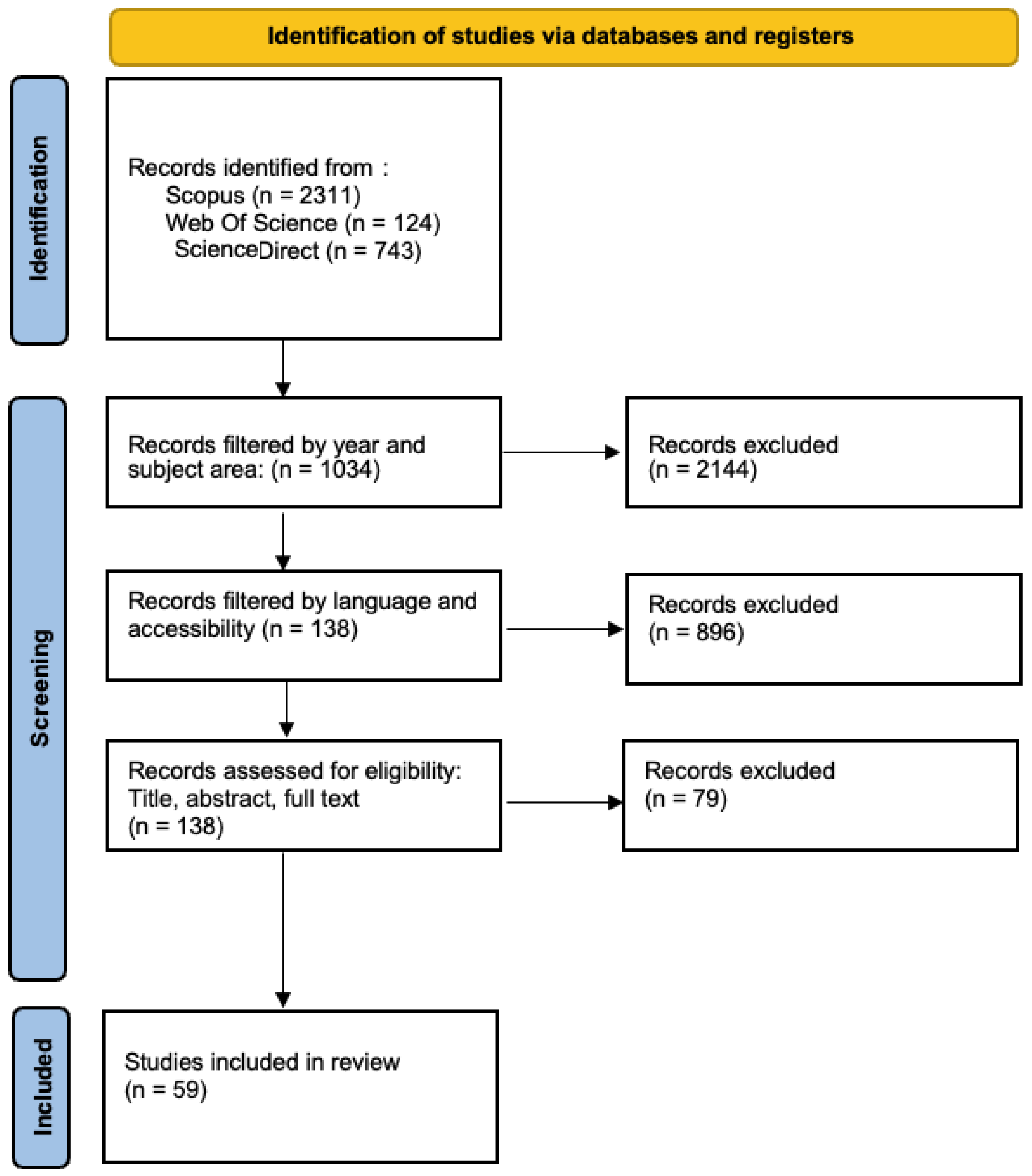
3.3. PRISMA 2020 Selection
3.4. IRAMUTEQ Lexicometric Procedure
4. Results
4.1. Bibliometric Analysis
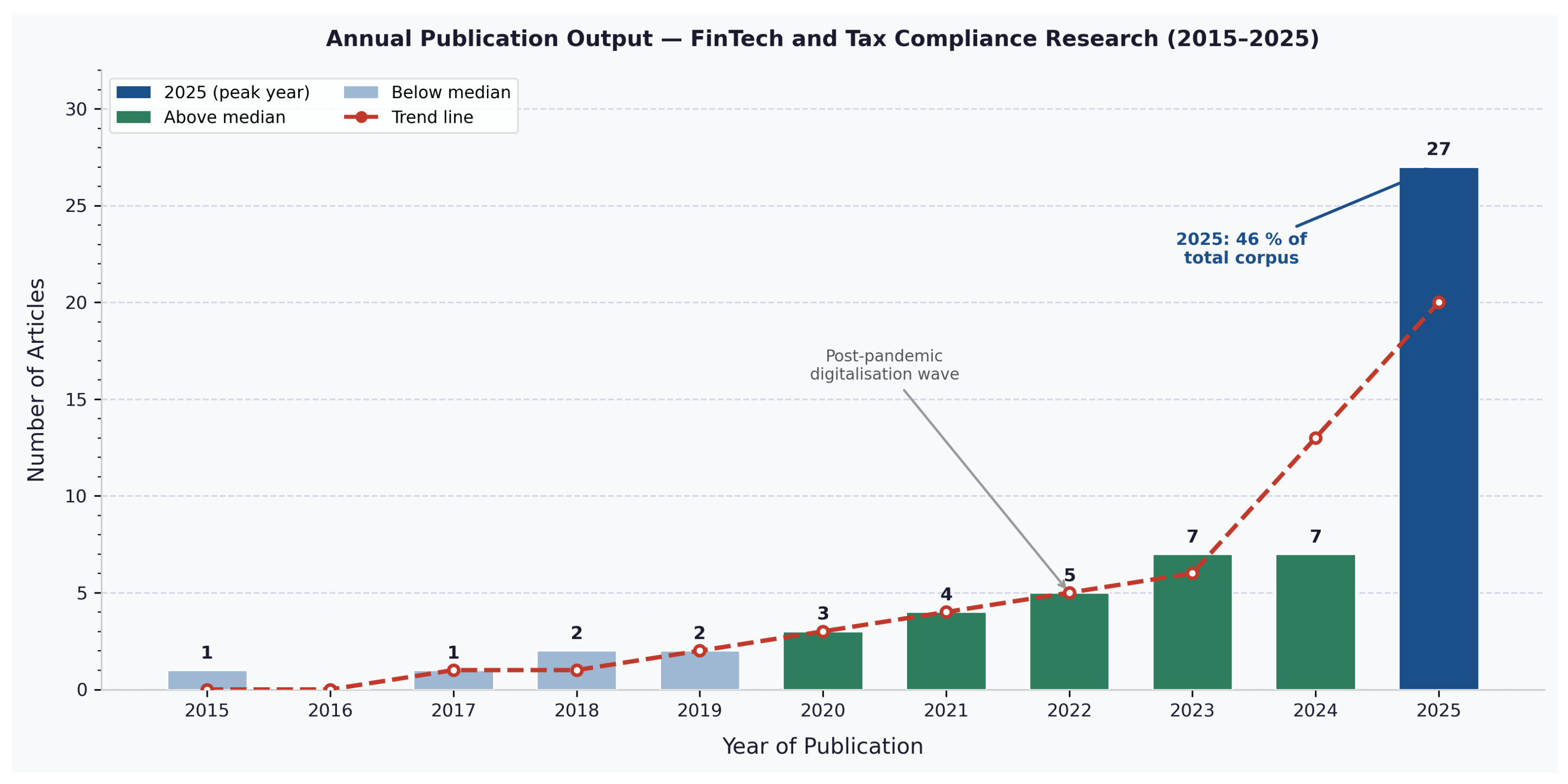
4.1.1. The Field Is New and Growing Fast
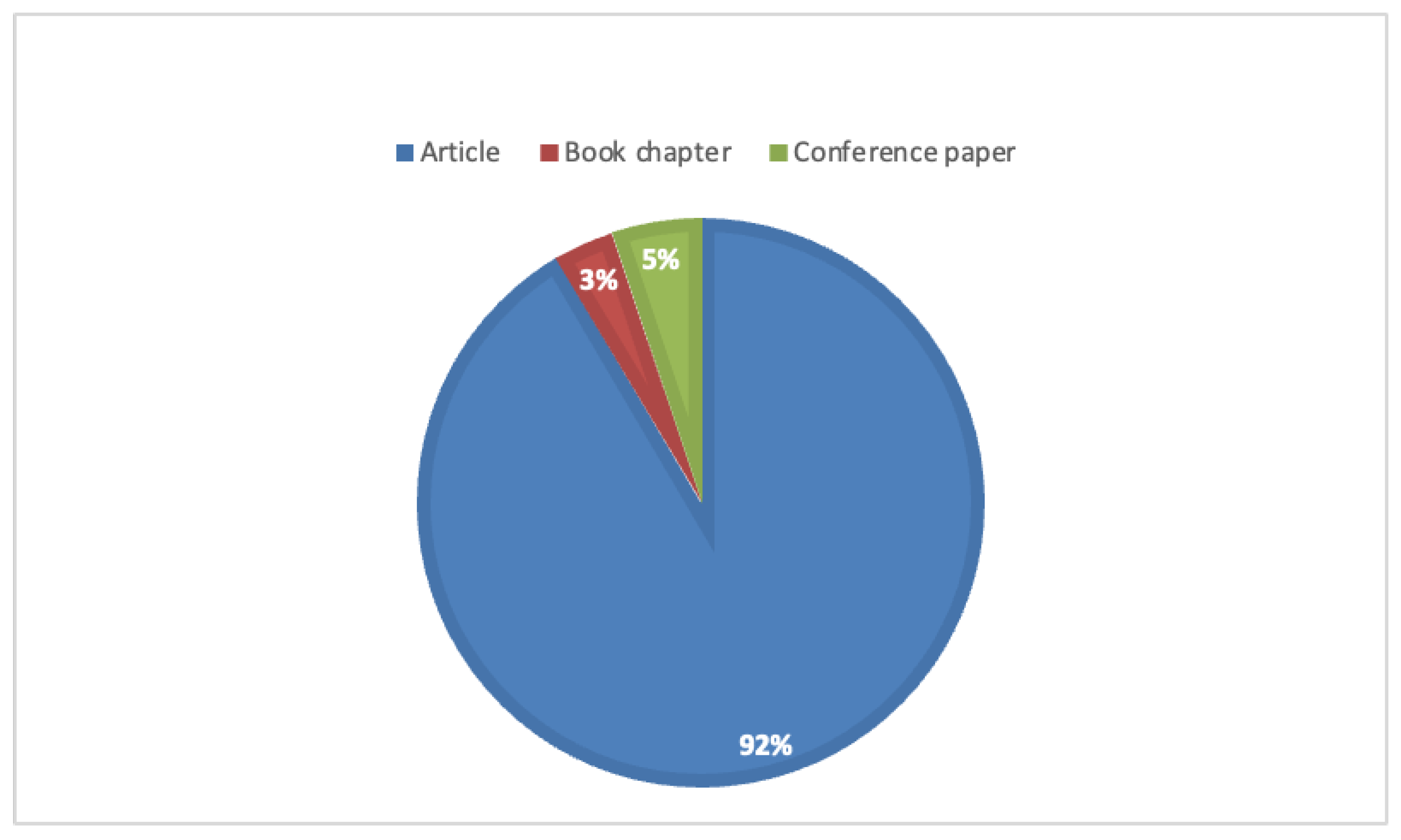
4.1.2. Who Publishes and How
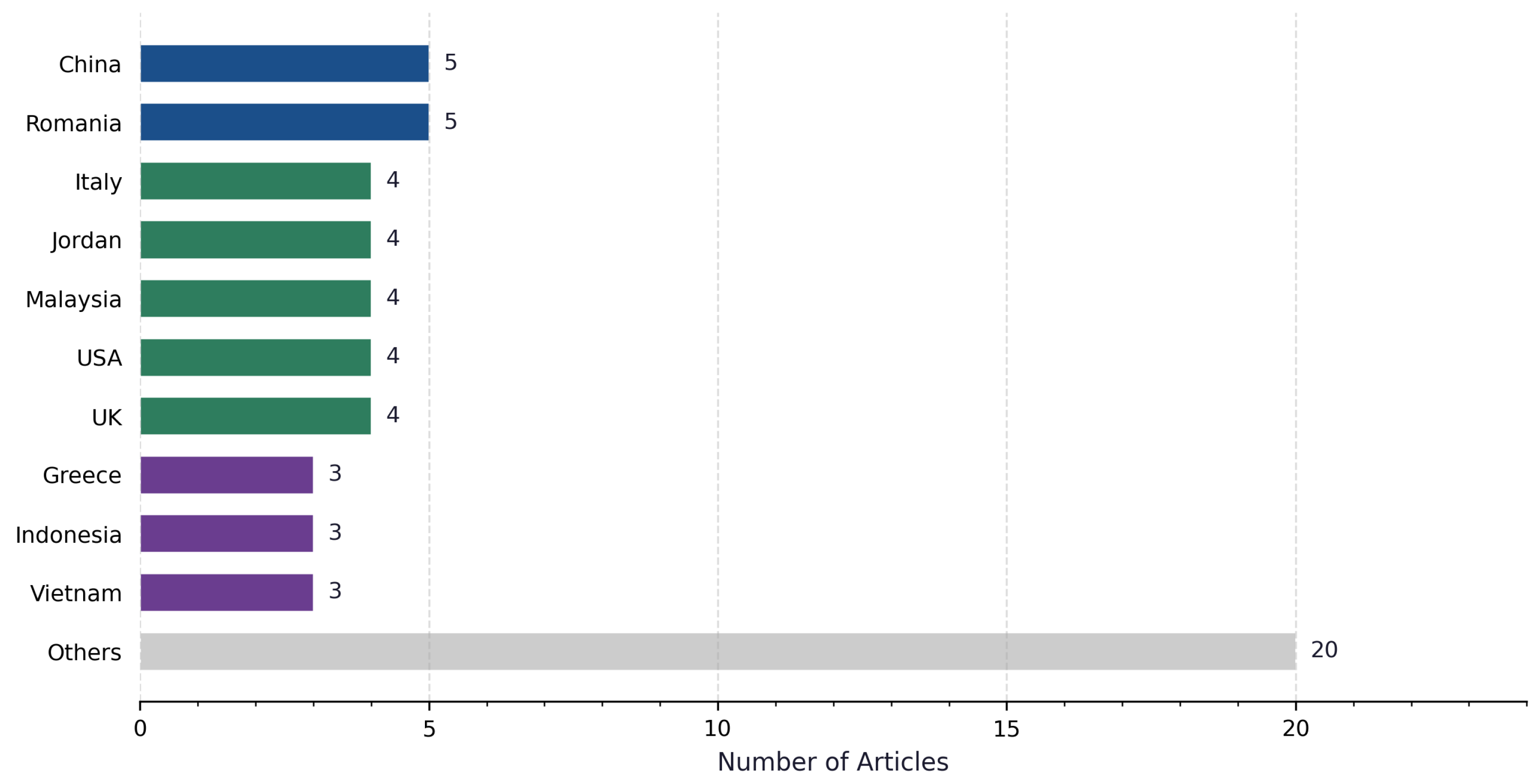
4.1.3. Geographic Distribution
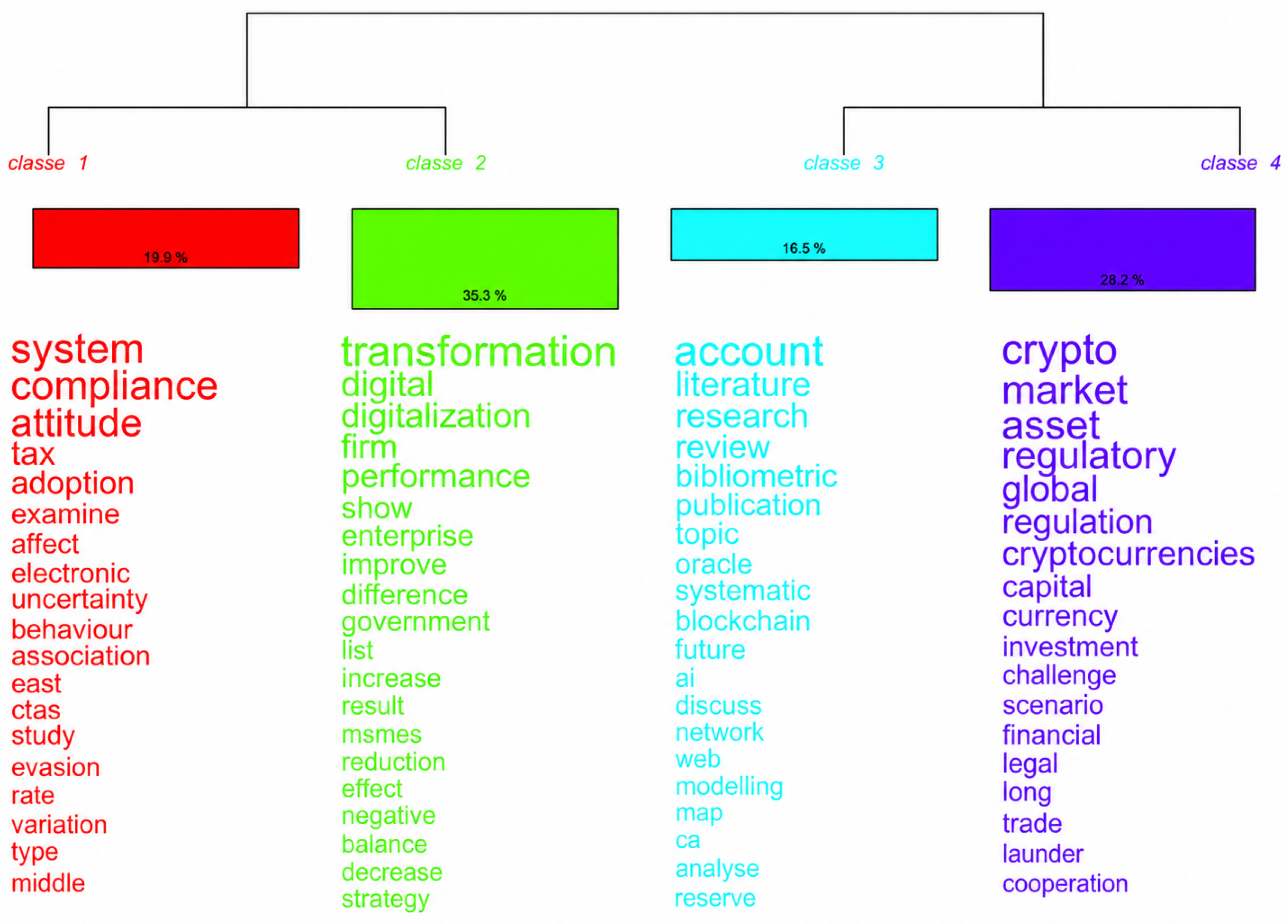
4.2. Textometry Analysis
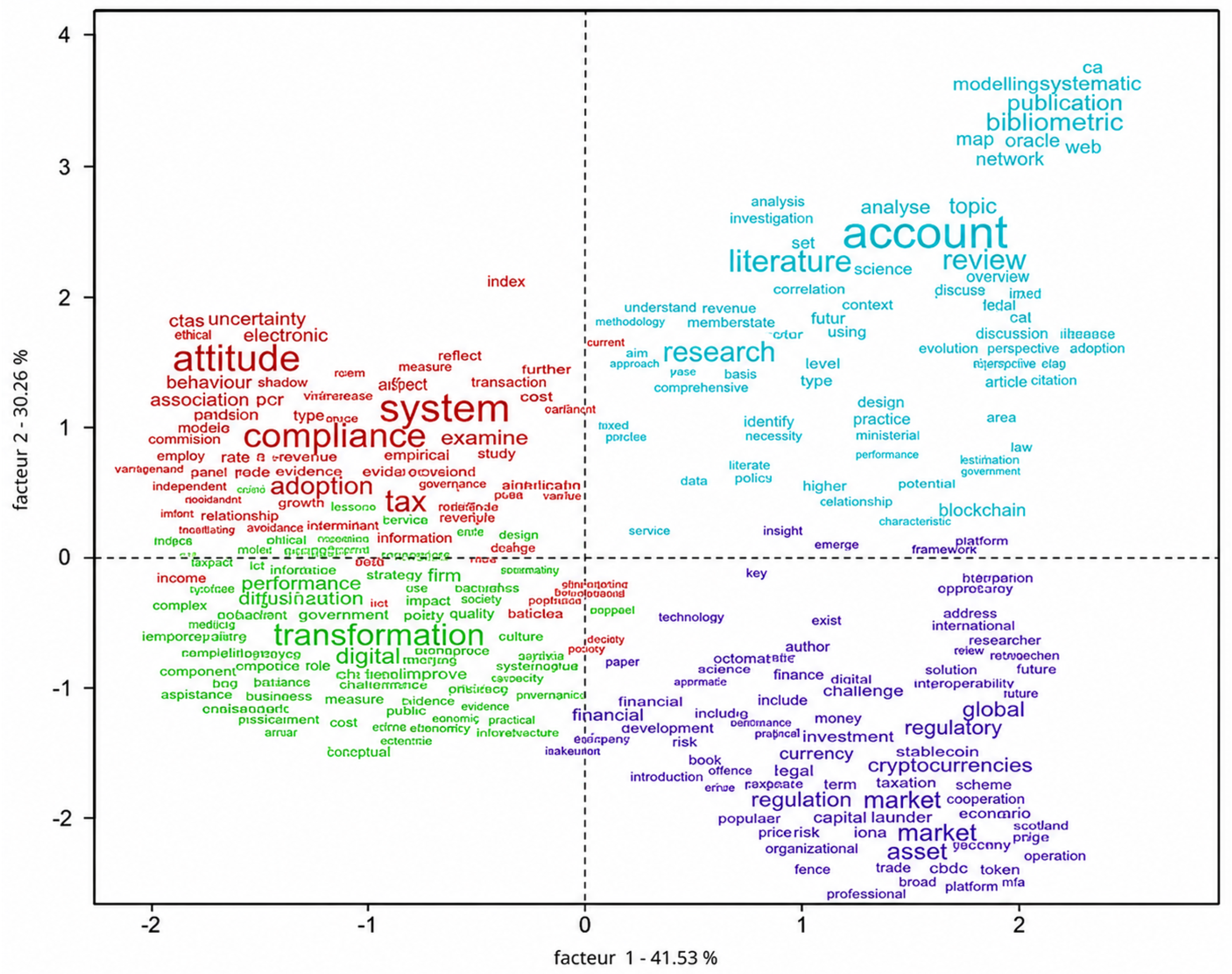
4.3. Correspondence Factorial Analysis
5. Discussion
5.1. Compliance by Design: The Limits of What Deterrence Can Explain
5.2. Decentralised Finance and the Collapse of Territorial Tax Jurisdiction
5.3. Digital Transformation, Firm Behaviour, and the Unequal Geography of FinTech’s Gains
5.4. The Machine in the Courtroom: Algorithmic Governance and the Rights of the Taxpayer
5.5. Costs, Failure Modes, and Resistance: A Counterweight to the Optimistic Reading
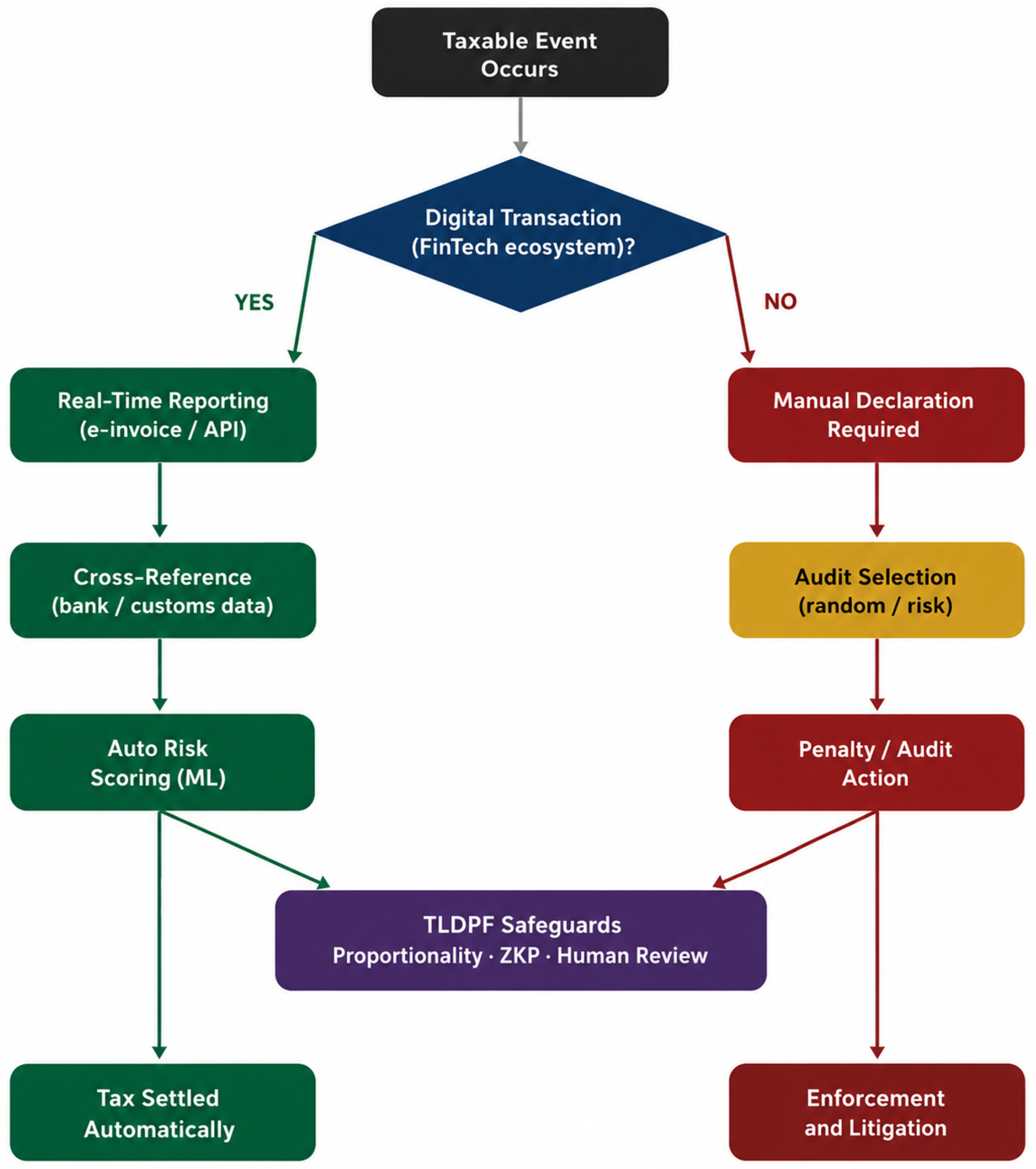
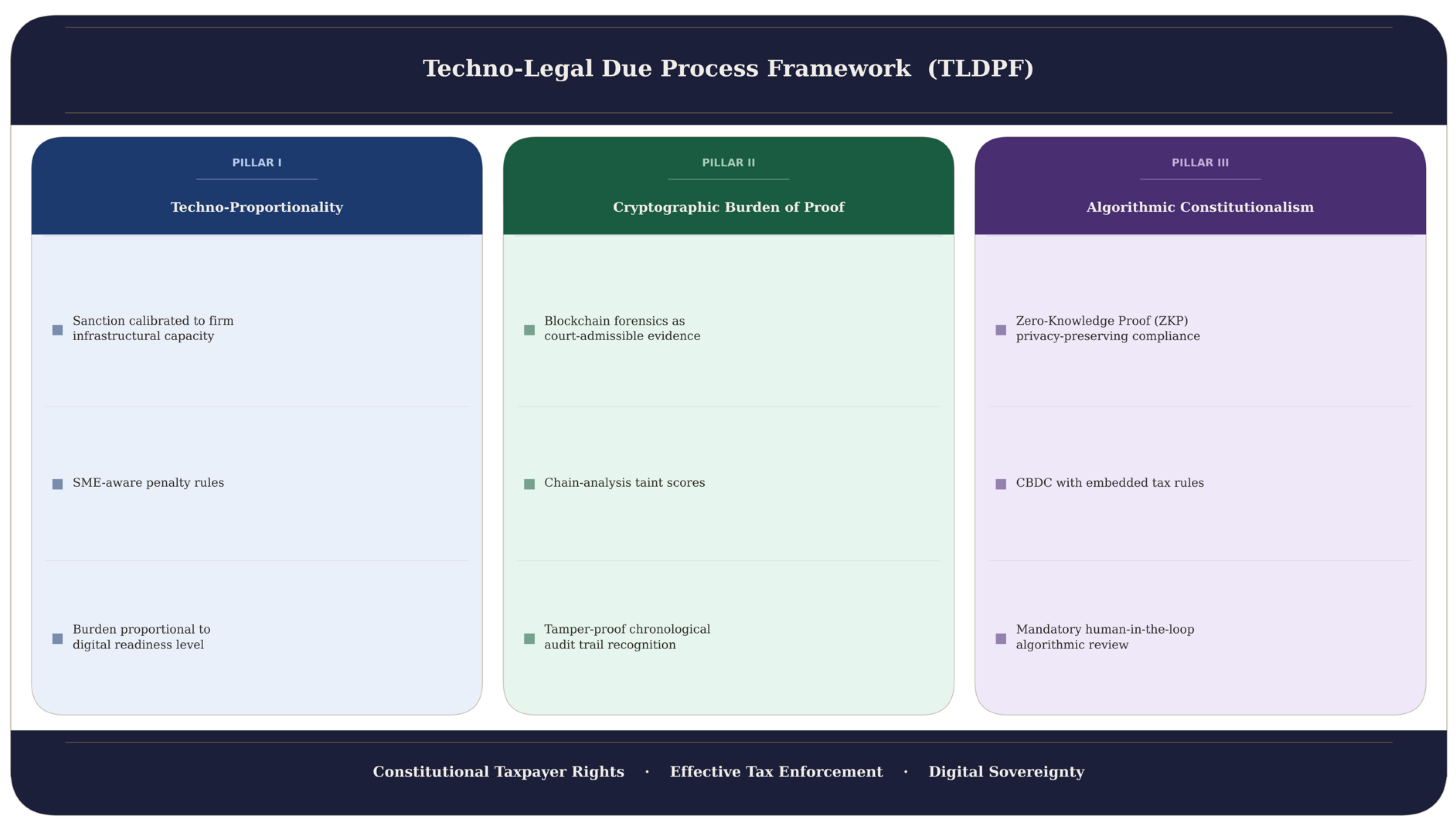
6. The Techno-Legal Due Process Framework
6.1. Pillar I-Techno-Proportionality
6.2. Pillar II-The Cryptographic Burden of Proof
6.3. Pillar III-Algorithmic Constitutionalism
7. Limitations and Future Research
8. Conclusions
Supplementary Materials
Author Contributions
Funding
Institutional Review Board Statement
Informed Consent Statement
Data Availability Statement
Conflicts of Interest
References
- Acemoglu, D., & Restrepo, P. (2022). Tasks, automation, and the rise in US wage inequality. Econometrica, 90(5), 1973–2016. [Google Scholar] [CrossRef]
- Adeoye, O. B., Addy, W. A., Odeyemi, O., Okoye, C. C., Ofodile, O. C., Oyewole, A. T., & Ololade, Y. J. (2024). FinTech, taxation, and regulatory compliance: Navigating the new financial landscape. Finance & Accounting Research Journal, 6(3), 320–330. [Google Scholar] [CrossRef]
- Advani, A., Elming, W., & Shaw, J. (2023). The dynamic effects of tax audits. Review of Economics and Statistics, 105(3), 545–561. [Google Scholar] [CrossRef]
- Al Ghunaimi, H., Almaqtari, F. A., Almamari, S., & Al-Hattami, H. M. (2025). The role of digital advancement and artificial intelligence in improving the efficiency of accounting software to facilitate optimal tax procedures and prevent legal appeals. In Digital transformation in customs and taxation (pp. 156–182). Auerbach Publications. [Google Scholar]
- Aljawarneh, N., Alqmool, T., Huson, Y. A., Jarbou, S., & Alqudah, M. (2025). Bibliometric analysis of accounting and sustainability research. ABAC Journal, 45, 22. [Google Scholar] [CrossRef]
- Allen, S., Čapkun, S., Eyal, I., Fanti, G., Ford, B. A., Grimmelmann, J., Juels, A., Kostiainen, K., Meiklejohn, S., Miller, A., Prasad, E., Wust, K., & Zhang, F. (2020). Design choices for central bank digital currency. NBER Working Paper No. 27634. NBER. [Google Scholar]
- Allingham, M., & Sandmo, A. (1972). Income tax evasion: A theoretical analysis. Journal of Public Economics, 1(3–4), 323–338. [Google Scholar] [CrossRef]
- Alm, J. (2019). What motivates tax compliance? Journal of Economic Surveys, 33(2), 353–388. [Google Scholar]
- Alm, J., & Torgler, B. (2011). Do ethics matter? Tax compliance and morality. Journal of Business Ethics, 101(4), 635–651. [Google Scholar] [CrossRef]
- Appendino, M., Blavy, R., Deb, P., Fuertes, A., Gornicka, L., & Yoon, H. (2023). Crypto assets and CBDCs in Latin America and the Caribbean. IMF. [Google Scholar]
- Azenzoul, A., Mahouat, N., & Mokhlis, K. (2026a). Artificial intelligence and corporate governance: Strengthening oversight mechanisms to mitigate tax avoidance. Corporate Governance: The International Journal of Business in Society, 1–27. [Google Scholar] [CrossRef]
- Azenzoul, A., Mahouat, N., Mokhlis, K., & Moussaid, A. (2025). Digital transformation and corporate tax avoidance: Moroccan listed firms. Journal of Risk and Financial Management, 18, 575. [Google Scholar] [CrossRef]
- Azenzoul, A., Mahouat, N., Vandapuye, S., Slimane, S. N., Jbene, M., & Mokhlis, K. (2026b). From predictive accuracy to algorithmic justice: Mapping the multidimensional impact of AI in tax auditing. Journal of Risk and Financial Management, 19(5), 354. [Google Scholar] [CrossRef]
- Barocas, S., & Selbst, A. D. (2016). Big data’s disparate impact. California Law Review, 104(3), 671–732. [Google Scholar]
- Beck, T., Pamuk, H., Ramrattan, R., & Uras, B. (2018). Payment instruments, finance and development. Journal of Development Economics, 133, 162–186. [Google Scholar] [CrossRef]
- Bellucci, M., Cesa Bianchi, D., & Manetti, G. (2022). Blockchain in accounting: Systematic literature review. Meditari Accountancy Research, 30(1), 121–146. [Google Scholar] [CrossRef]
- Ben Mekhlouf, H., Moussaid, A., & Ghanimi, F. (2025). Financial fraud detection using machine learning: A review. In Technology and the environment (pp. 49–54). Springer. [Google Scholar] [CrossRef]
- Ben Mekhlouf, H., Moussaid, A., & Ghanimi, F. (2026). Adaptive credit card fraud detection: Reinforcement learning vs. anomaly detection. FinTech, 5(1), 9. [Google Scholar] [CrossRef]
- Bespalova, O., De León, D., Kida, M., Kopp, E., & Tovar, C. (2025). Crypto assets and CBDCs in Latin America and the Caribbean. Latin American Journal of Central Banking, 6, 100157. [Google Scholar] [CrossRef]
- Bharadwaj, A., El Sawy, O. A., Pavlou, P. A., & Venkatraman, N. V. (2013). Digital business strategy. MIS Quarterly, 37(2), 471–482. [Google Scholar] [CrossRef]
- Bird, R. M., & Zolt, E. M. (2008). Technology and taxation in developing countries. National Tax Journal, 61(4), 791–821. [Google Scholar] [CrossRef]
- Caldarelli, G. (2025). Blockchain in accounting and ESG reporting. Journal of Risk and Financial Management, 18, 491. [Google Scholar] [CrossRef]
- Camargo, B. V., & Justo, A. M. (2013). IRAMUTEQ: Um software gratuito. Temas em Psicologia, 21(2), 513–518. [Google Scholar] [CrossRef]
- Cong, L. W., Landsman, W., Maydew, E., & Rabetti, D. (2023). Tax-loss harvesting with cryptocurrencies. Journal of Accounting and Economics, 76, 101607. [Google Scholar] [CrossRef]
- Dai, J., & Vasarhelyi, M. A. (2017). Toward blockchain-based accounting and assurance. Journal of Information Systems, 31(3), 5–21. [Google Scholar] [CrossRef]
- Demirguc-Kunt, A., Klapper, L., Singer, D., & Ansar, S. (2022). The global findex database 2021. World Bank. [Google Scholar]
- Diakopoulos, N. (2016). Accountability in algorithmic decision making. Communications of the ACM, 59(2), 56–62. [Google Scholar] [CrossRef]
- Do, H. T. H., Mac, Y. T. H., Van Tran, H. T., & Le Nguyen, T. T. (2022). Attitude towards an e-tax system and tax compliance of Vietnamese enterprises. Journal of Entrepreneurship, Management and Innovation, 18, 35–64. [Google Scholar] [CrossRef]
- Doshi-Velez, F., & Kim, B. (2017). Towards a rigorous science of interpretable machine learning. arXiv, arXiv:1702.08608. [Google Scholar]
- El Hatimi, R., Choukhan, C. F., Moussaid, A., & Esghir, M. (2024). Predicting global education quality: A comprehensive machine learning approach using world bank data. International Journal of Engineering Pedagogy, 14(4), 24–37. [Google Scholar] [CrossRef]
- Finck, M. (2018). Blockchain regulation and governance in Europe. Cambridge University Press. [Google Scholar]
- Gharrafi, M., Fellah, I. B., Loubna, A., Mahouat, N., & Abderrahim, B. (2024). Exploring the external factors affecting the effectiveness of internal audit in Moroccan public enterprises with commercial activities: A qualitative approach. Edelweiss Applied Science and Technology, 8(6), 7419–7429. [Google Scholar] [CrossRef]
- Goldwasser, S., Micali, S., & Rackoff, C. (1989). The knowledge complexity of interactive proof systems. SIAM Journal on Computing, 18(1), 186–208. [Google Scholar] [CrossRef]
- Gomber, P., Kauffman, R. J., Parker, C., & Weber, B. W. (2018). On the fintech revolution. Journal of Management Information Systems, 35(1), 220–265. [Google Scholar] [CrossRef]
- Goodhart, C. A. E. (1975). Problems of monetary management: The UK experience. Papers in Monetary Economics, 1, 1–20. [Google Scholar]
- Goodman, B., & Flaxman, S. (2017). European Union regulations on algorithmic decision-making and a right to explanation. AI Magazine, 38(3), 50–57. [Google Scholar] [CrossRef]
- Jrondi, Z., Moussaid, A., & Hadi, M. Y. (2025). Interpretable Citrus Fruit Quality Assessment Using Vision Transformers and Lightweight Large Language Models. AgriEngineering, 7, 286. [Google Scholar] [CrossRef]
- Kasper, M., & Rablen, M. D. (2023). Tax compliance after an audit. Journal of Economic Behavior & Organization, 207, 157–171. [Google Scholar] [CrossRef]
- Kleven, H. J., Knudsen, M. B., Kreiner, C. T., Pedersen, S., & Saez, E. (2011). Unwilling or unable to cheat? Evidence from a randomized tax audit experiment in Denmark. Econometrica, 79(3), 651–692. [Google Scholar]
- Koparan, A. (2025). Central bank digital currencies: Global trends. Journal of Central Banking Theory and Practice, 14(1), 5–32. [Google Scholar]
- Kotsogiannis, C., Salvadori, L., Karangwa, J., & Murasi, I. (2025). E-invoicing, tax audits and VAT compliance. Journal of Development Economics, 172, 103403. [Google Scholar] [CrossRef]
- Kristiana, D. R., Kristianti, I. P., & Setyaningsih, P. R. A. (2025). The role of digital transactions, tax policy, and CTAS in shaping taxpayer compliance: A case study of Indonesian SMEs. International Journal of Business and Society, 26(3), 825–841. [Google Scholar] [CrossRef]
- Lepri, B., Oliver, N., Letouzé, E., Pentland, A., & Vinck, P. (2018). Fair, transparent, and accountable algorithmic decision-making. Philosophy & Technology, 31(4), 611–627. [Google Scholar]
- Mahalle, A., Yong, J., & Tao, X. (2021). Regulatory challenges for FinTech account services. In Proceedings IEEE 25th CSCWD (pp. 280–287). IEEE. [Google Scholar]
- Mahouat, N., Azenzoul, A., Chaiboub, M., Daoudi, L., Lemsieh, H., Aftiss, A., & Mokhlis, K. (2025a). Exploratory study on the role of digitalization in improving the external audit quality in public institutions: Evidence from Morocco. Qubahan Academic Journal, 5(3), 176–194. [Google Scholar] [CrossRef]
- Mahouat, N., Azenzoul, A., Nait Slimane, S., Es-Sanoun, M., Mokhlis, K., & Jbene, M. (2025b). Corporate governance and tax aggressiveness: The moderating role of audit quality. Journal of Risk and Financial Management, 19(1), 10. [Google Scholar] [CrossRef]
- Mahouat, N., Gharrafi, M., Wissa, H., Rachida, B., Abdelaziz, B., & Zaim, M. (2024). Impact of cooperation between internal and external auditors on internal audit effectiveness in moroccan public companies: Analysis using the structural equation modeling (SEM). Pakistan Journal of Life and Social Sciences (PJLSS), 22(2), 7046–7059. [Google Scholar] [CrossRef]
- Marian, O. (2013). Are cryptocurrencies super tax havens? Michigan Law Review First Impressions, 112, 38–48. [Google Scholar]
- Marian, O. (2017). A conceptual framework for the regulation of cryptocurrencies. University of Chicago Law Review Dialogue, 82, 53–68. [Google Scholar]
- Mittone, L. (2006). Dynamic behaviour in tax evasion: An experimental approach. The Journal of Socio-Economics, 35(5), 813–835. [Google Scholar] [CrossRef]
- Moussaid, A., Gamoussi, Y., & Briak, H. (2025). Hybrid CNN-LSTM model for predicting nitrogen, phosphorus, and potassium (NPK) fertilization requirements: Integrating satellite spectral indices with field microclimate data. Internet of Things, 34, 101746. [Google Scholar] [CrossRef]
- Murphy, B., Feeney, O., Rosati, P., & Lynn, T. (2024). Exploring accounting and AI using topic modelling. International Journal of Accounting Information Systems, 55, 100709. [Google Scholar] [CrossRef]
- Nakamoto, S. (2008). Bitcoin: A peer-to-peer electronic cash system. Available online: https://bitcoin.org/bitcoin.pdf (accessed on 1 February 2026).
- Omarova, S. T. (2020). Technology v technocracy: FinTech as a regulatory challenge. Journal of Financial Regulation, 6(1), 75–124. [Google Scholar] [CrossRef]
- Organisation for Economic Co-operation and Development. (2022). Crypto-asset reporting framework and amendments to the common reporting standard. OECD Publishing. [Google Scholar]
- Organisation for Economic Co-operation and Development. (2023a). Corporate tax statistics (4th ed.). OECD Publishing. [Google Scholar]
- Organisation for Economic Co-operation and Development. (2023b). Crypto-asset reporting framework: Implementation guidance. OECD Publishing. [Google Scholar]
- Owens, E., O’Leary, D., Maybury, M., & Flanagan, P. (2022). Explainable AI in insurance. Risks, 10, 230. [Google Scholar] [CrossRef]
- Page, M. J., McKenzie, J. E., Bossuyt, P. M., Boutron, I., Hoffmann, T. C., Mulrow, C. D., Shamseer, L., Tetzlaff, J. M., Akl, E. A., Brennan, S. E., Chou, R., Glanville, J., Grimshaw, J. M., Hróbjartsson, A., Lalu, M. M., Li, T., Loder, E. W., Mayo-Wilson, E., McDonald, S., ... , Moher, D. (2021). The PRISMA 2020 statement: An updated guideline for reporting systematic reviews. BMJ, 372, n71. [Google Scholar] [CrossRef] [PubMed]
- Paleka, H., & Vitezić, V. (2023). Tax compliance challenge through taxpayers’ typology. Economies, 11(9), 219. [Google Scholar] [CrossRef]
- Pane, A. A., & Simanjuntak, F. A. (2024). Factors influencing taxpayers’ intention to use online tax filing systems. Journal of Tax Reform, 10(2), 228–239. [Google Scholar] [CrossRef]
- Prichard, W., Custers, A. L., Dom, R., Davenport, S. R., & Roscitt, M. A. (2019). Innovations in tax compliance: Conceptual framework. Policy Research Working Paper 9032. World Bank. [Google Scholar]
- Rixen, T. (2013). Why reregulation after the crisis is feeble. Regulation & Governance, 7(4), 435–459. [Google Scholar] [CrossRef]
- Skandalis, K. S., & Skandali, D. (2025a). Can FinTech close the VAT gap? FinTech, 4(1), 38. [Google Scholar] [CrossRef]
- Skandalis, K. S., & Skandali, D. (2025b). Unlocking entrepreneurship in the FinTech era. FinTech, 4(1), 12. [Google Scholar] [CrossRef]
- Slemrod, J. (2019). Tax compliance and enforcement. Journal of Economic Literature, 57(4), 904–954. [Google Scholar] [CrossRef]
- Souguir, Z., Lassoued, N., Khanchel, I., & Bejaoui, E. (2025). Behind the screens: Digital transformation and tax policy. Journal of Risk and Financial Management, 18, 390. [Google Scholar] [CrossRef]
- Spinelli, G., Gastaldi, L., Van Hove, L., & Van Droogenbroeck, E. (2024). Can tax evasion be reduced by fostering cashless payments? Journal of Financial Market Infrastructures, 11, 65–93. [Google Scholar] [CrossRef]
- Spyra, M., Klimontowicz, M., Piotrowska, A. I., Mitrega-Niestrój, K., & Spyra, Z. (2025). Cryptocurrencies as a tool for money laundering. Risks, 13(10), 189. [Google Scholar] [CrossRef]
- Srinivasan, T. N. (1973). Tax evasion: A model. Journal of Public Economics, 2(4), 339–346. [Google Scholar] [CrossRef]
- Srokosz, W., Lenio, P., & Sobiecki, G. (2025). Blockchain technology in project finance. Routledge. [Google Scholar]
- Su, L. (2025). Tax administration digitization and corporate tax avoidance: A quasi-natural experiment based on Golden Tax III. Baltic Journal of Economics, 25(2), 175–199. [Google Scholar] [CrossRef]
- Sugimoto, N., Morozova, A., & Cuervo, C. (2020). Regulation of crypto assets. International Monetary Fund. [Google Scholar]
- Sun, X., Han, J., & Işık, C. (2025). Can digital transformation curb corporate tax avoidance? International Review of Economics & Finance, 102, 104330. [Google Scholar] [CrossRef]
- Thakor, A. V. (2020). Fintech and banking: What do we know? Journal of Financial Intermediation, 41, 100833. [Google Scholar] [CrossRef]
- Tranfield, D., Denyer, D., & Smart, P. (2003). Towards a methodology for developing evidence-informed management knowledge. British Journal of Management, 14(3), 207–222. [Google Scholar] [CrossRef]
- Veale, M., & Brass, I. (2019). Administration by algorithm? In K. Yeung, & M. Lodge (Eds.), Algorithmic regulation (pp. 121–149). Oxford University Press. [Google Scholar]
- Werbach, K. (2018). The blockchain and the new architecture of trust. MIT Press. [Google Scholar]
- Wirtz, B., Weyerer, J., & Geyer, C. (2019). Artificial intelligence and the public sector. International Journal of Public Administration, 42(7), 596–615. [Google Scholar]
- Woldeamanuel, A. G., & Kebede, T. N. (2025). Mapping the landscape of tax revenue research. Journal of Tax Reform, 11(3), 512–531. [Google Scholar] [CrossRef]
- Ylönen, M., Raudla, R., & Babic, M. (2024). From tax havens to cryptocurrencies: Secrecy-seeking capital in the global economy. Review of International Political Economy, 31(2), 563–588. [Google Scholar] [CrossRef]
- Zarsky, T. (2016). The trouble with algorithmic decisions. Science, Technology, & Human Values, 41(1), 118–132. [Google Scholar]
- Zheng, B., Yuan, Y., Li, H., & Jiang, Y. (2023). Digital transformation and MSMEs: A spatial perspective. Journal of Economics and Management, 45, 319–343. [Google Scholar] [CrossRef]
- Zupic, I., & Čater, T. (2015). Bibliometric methods in management and organization. Organizational Research Methods, 18(3), 429–472. [Google Scholar]





| Cluster 1 (19.92%) | Cluster 2 (35.34%) | Cluster 3 (16.54%) | Cluster 4 (28.20%) | ||||||||
|---|---|---|---|---|---|---|---|---|---|---|---|
| Compliance and FinTech | Digital Transf. & Perf. | Bibliometric and Emerging | Crypto and Regulation | ||||||||
| Word | Word | Word | Word | ||||||||
| system | 58.50 | <0.0001 | transformation | 46.97 | <0.0001 | account | 74.94 | <0.0001 | crypto | 33.32 | <0.0001 |
| compliance | 58.50 | <0.0001 | digital | 31.11 | <0.0001 | literature | 41.50 | <0.0001 | market | 32.00 | <0.0001 |
| attitude | 54.93 | <0.0001 | digitalization | 23.34 | <0.0001 | research | 37.14 | <0.0001 | asset | 32.00 | <0.0001 |
| tax | 42.45 | <0.0001 | firm | 20.76 | <0.0001 | review | 36.10 | <0.0001 | regulatory | 24.15 | <0.0001 |
| adoption | 36.23 | <0.0001 | performance | 20.76 | <0.0001 | bibliometric | 30.97 | <0.0001 | global | 24.15 | <0.0001 |
| examine | 21.77 | <0.0001 | show | 16.65 | <0.0001 | publication | 25.71 | <0.0001 | regulation | 23.67 | <0.0001 |
| affect | 19.54 | <0.0001 | enterprise | 16.40 | <0.0001 | topic | 25.30 | <0.0001 | cryptocurrencies | 22.29 | <0.0001 |
| electronic | 16.32 | <0.0001 | improve | 15.22 | <0.0001 | oracle | 20.49 | <0.0001 | capital | 16.95 | <0.0001 |
| uncertainty | 16.32 | <0.0001 | difference | 15.09 | 0.0001 | systematic | 20.49 | <0.0001 | currency | 16.95 | <0.0001 |
| behaviour | 16.32 | <0.0001 | government | 13.88 | 0.0002 | blockchain | 16.95 | <0.0001 | investment | 16.30 | <0.0001 |
| association | 16.32 | <0.0001 | list | 13.16 | 0.0003 | future | 15.90 | <0.0001 | challenge | 16.00 | <0.0001 |
| evasion | 14.08 | 0.0002 | increase | 12.91 | 0.0003 | ai | 15.69 | <0.0001 | scenario | 15.63 | <0.0001 |
| study | 14.87 | 0.0001 | result | 12.88 | 0.0003 | discuss | 15.69 | <0.0001 | financial | 15.38 | <0.0001 |
| cost | 12.34 | 0.0004 | msmes | 11.69 | 0.0006 | network | 15.31 | <0.0001 | legal | 14.33 | 0.0002 |
| trust | 11.90 | 0.0006 | reduction | 11.23 | 0.0008 | web | 15.31 | <0.0001 | launder | 12.98 | 0.0003 |
| Cluster | Title | Description |
|---|---|---|
| 1 | Tax Compliance Behaviour and FinTech Adoption | Research examining how digital tools change what taxpayers actually do: e-filing adoption, compliance costs, deterrence dynamics, trust formation, and the unintended behavioural consequences of algorithmic audit targeting. |
| 2 | Digital Transformation and Corporate Performance | Studies of the organisational and macroeconomic effects of FinTech on firms: performance gains, reductions in tax avoidance, and the heterogeneous distribution of those gains across large corporations versus MSMEs in different infrastructure environments. |
| 3 | Bibliometric Research and Emerging Technologies | Literature mapping the field’s academic landscape alongside studies of next-generation instruments-blockchain accounting, AI auditing, oracle-based smart contracts-and their governance implications. |
| 4 | Cryptocurrency Markets and Regulatory Challenges | Analysis of the governance problems created by crypto-assets and DeFi protocols: money laundering, cross-border evasion, the contested evidentiary status of taint-score forensics, and the jurisdictional vacuum created by decentralised systems. |
| IRAMUTEQ Cluster | Governance Problem | TLDPF Pillar | Mechanism |
|---|---|---|---|
| C1-Compliance behaviour and FinTech adoption | Opacity and behavioural distortion (bomb-crater); regressive, infrastructure-based compliance burden | Pillar I (with Pillar III) | Capacity-adjusted penalty (Equtations (7) and (8)); explainability mandate |
| C2-Digital transformation and performance | Unequal distribution of gains; SME infrastructure inequity; cybersecurity exposure | Pillar I | Publicly disclosed capacity score and calibrated penalties (Equtations (7) and (8)) |
| C3-Bibliometric and emerging technologies | Immature governance of AI, oracle and blockchain instruments; explainability gap | Pillar III | Explainability mandate; human-in-the-loop review; impact assessments |
| C4-Cryptocurrency markets and regulation | Collapse of territorial jurisdiction; contested forensic evidence; CBDC surveillance risk | Pillar II (with Pillar III) | Three-tier admissibility standard (Equtation (9)); ZKP privacy-preserving design (Equtation (5)) |
Disclaimer/Publisher’s Note: The statements, opinions and data contained in all publications are solely those of the individual author(s) and contributor(s) and not of MDPI and/or the editor(s). MDPI and/or the editor(s) disclaim responsibility for any injury to people or property resulting from any ideas, methods, instructions or products referred to in the content. |
© 2026 by the authors. Licensee MDPI, Basel, Switzerland. This article is an open access article distributed under the terms and conditions of the Creative Commons Attribution (CC BY) license.
Share and Cite
Azenzoul, A.; Mahouat, N.; El Gharbaoui, O.; Tayazime, J.; Moussaid, A.; Mokhlis, K. FinTech Integration and Tax Compliance: A Systematic Literature Review of Risk, Criminal Justice Challenges, and Due Process Implications. J. Risk Financ. Manag. 2026, 19, 457. https://doi.org/10.3390/jrfm19070457
Azenzoul A, Mahouat N, El Gharbaoui O, Tayazime J, Moussaid A, Mokhlis K. FinTech Integration and Tax Compliance: A Systematic Literature Review of Risk, Criminal Justice Challenges, and Due Process Implications. Journal of Risk and Financial Management. 2026; 19(7):457. https://doi.org/10.3390/jrfm19070457
Chicago/Turabian StyleAzenzoul, Anas, Nacer Mahouat, Ouissale El Gharbaoui, Jihane Tayazime, Abdellatif Moussaid, and Khalil Mokhlis. 2026. "FinTech Integration and Tax Compliance: A Systematic Literature Review of Risk, Criminal Justice Challenges, and Due Process Implications" Journal of Risk and Financial Management 19, no. 7: 457. https://doi.org/10.3390/jrfm19070457
APA StyleAzenzoul, A., Mahouat, N., El Gharbaoui, O., Tayazime, J., Moussaid, A., & Mokhlis, K. (2026). FinTech Integration and Tax Compliance: A Systematic Literature Review of Risk, Criminal Justice Challenges, and Due Process Implications. Journal of Risk and Financial Management, 19(7), 457. https://doi.org/10.3390/jrfm19070457