Article

Artificial Intelligence Adoption in Accounting Systems and Organizational Performance: The Mediating Role of Financial Decision-Making Quality

by
Nouran Nabil Abdelsalam Mahmoud Ellelly
1,
Saleh Aly Saleh Aly
2,
Sherif El-Halaby
3,* and
Abdelmoneim Bahyeldin Mohamed Metwally
4
1
Department of Accounting, Faculty of Commerce, Port Said University, Port Said 42526, Egypt
2
Business Administration Department, University College of Tayma, University of Tabuk, Tabuk 47512, Saudi Arabia
3
Department of Accounting & Finance, College of Business Administration, Ajman University, University Street, Al-Jerf 1, Ajman 346, United Arab Emirates
4
Department of Accounting, Faculty of Commerce, Assiut University, Assiut 71515, Egypt
*
Author to whom correspondence should be addressed.
J. Risk Financial Manag. 2026, 19(6), 405; https://doi.org/10.3390/jrfm19060405
Submission received: 4 May 2026 / Revised: 30 May 2026 / Accepted: 31 May 2026 / Published: 2 June 2026
(This article belongs to the Special Issue Financial Decision Making in the Age of Artificial Intelligence)

Abstract

This study aims to explore the impact of artificial intelligence adoption in accounting systems (AIAS) on organizational performance (OP). Further, the study explores the mediating role of financial decision-making quality (FDMQ) on the AIAS-OP relationship. The sample comprises 583 accountants, finance managers, CFOs, and auditors in all firms listed on the Egyptian Stock Exchange (EGX), covering banking, IT, manufacturing, and service sectors. Data were analyzed using Smart-PLS 4 software. The results revealed a positive and significant impact of AIAS on both FDMQ and OP. Further, the results revealed a positive and significant impact of FDMQ on OP. Finally, FDMQ showed a significant mediating role between AIAS and OP. These results have significant implications for policymakers, investors, regulators, and corporate executives, emphasizing the crucial role played by AIAS and FDMQ in shaping OP, particularly within emerging markets such as Egypt. This study provides a valuable contribution to the accounting literature by highlighting the impactful consequences of AIAS and FDMQ on OP in a unique and unexplored context. Furthermore, this research underscores the vital role that FDMQ assumes in mediating the relationship between AIAS and OP, contrasting with earlier studies in the literature which primarily examined the direct impact of AIAS or FDMQ on OP.

1. Introduction

The ubiquitous presence of Artificial Intelligence (AI) has significantly influenced the way accounting information is processed and analyzed, which in turn has profound implications for decision-making and organizational performance (Han et al., 2023). In accounting, various AI-based applications, such as machine learning and natural language processing, are becoming integral parts of accounting information systems (AIS), which are otherwise automated (Abbas, 2026; Elnakeeb & Elawadly, 2025).
Past studies suggest that the integration of AI in accounting has a positive impact on the accuracy and relevance of financial information, quality of managerial decisions, and sustainable competitive performance (Monteiro et al., 2022). Thus, an under-explored area of research on the performance implications of AI in emerging economies such as Egypt is an interesting topic to explore (Ali et al., 2026; Nguyen et al., 2025; Thongprim et al., 2025).
The level of AI in accounting systems is measured in terms of support for financial accounting, management accounting, and risk management (Abikoye et al., 2024; Chukwuani & Egiyi, 2020; Mohammed Jumaah et al., 2026). Prior research on accounting and digital information systems indicates that such systems can improve accuracy and speed in information processing, allow accountants more time to analyze, and enhance fraud detection, continuous audit, and KPI tracking in sectors such as banking, manufacturing, and SMEs (Chen et al., 2018; Feng, 2024; Han et al., 2023; Metwally et al., 2026b; Mwachikoka, 2024).
However, recent work stresses that these benefits materialize only when AI is supported by effective information-systems infrastructures; otherwise, AI may amplify existing data-quality problems, implying that AI adoption in accounting should be examined primarily as an informational factor shaping financial decision quality and organizational outcomes (Al-Hashimy & Yao, 2025; Neiroukh et al., 2024).
Organizational performance is now widely conceptualized as multidimensional, encompassing short-term financial results and longer-term competitiveness, efficiency, and stakeholder value creation (Ahmad et al., 2023). Sustainable competitive performance and operational efficiency have been linked to stronger information-processing capabilities, adaptive risk management, and data-based strategic decision-making (Abdullah & Almaqtari, 2024; Buhaya & Metwally, 2024; Correia et al., 2024; Gadekar et al., 2022; Metwally et al., 2024, 2026a; Tran et al., 2025).
From a resource-based and dynamic-capabilities perspective, AI-enabled AIS act as strategic resources whose effective use enhances cost management, pricing, resource allocation, and risk management, thereby improving performance relative to industry peers (Climent et al., 2024; Hossain et al., 2022; Nguyen et al., 2025). Yet in developing economies, findings on whether technology adoption in accounting and analytics consistently yields favorable performance are limited and mixed, suggesting that the relationship between AI-based accounting systems and performance is likely mediated by intermediate decision-related mechanisms (Dey et al., 2024; Hossain et al., 2022; Mohammed Jumaah et al., 2026; Neiroukh et al., 2024).
In this context, the quality of financial decision-making has been identified as an important link connecting information system capabilities and organizational performance (Al-Hashimy & Yao, 2025; Neiroukh et al., 2024). According to the decision-usefulness theory, financial information should be relevant, reliable, comparable, and timely to support rational decision-making processes (Ohlson, 1995). Empirical studies on banking and business domains validate the premise that the quality of financial and cost information has a positive relationship with the accuracy of budgeting, pricing, and investment decisions, thereby influencing organizational performance in a positive manner (Dechow & Dichev, 2002).
Research into digital and AI-related accounting systems suggests that accounting technologies tend to affect organizational performance mainly through their impact on information and decision quality rather than directly (Al-Okaily, 2024; Al-Okaily et al., 2022; Thongprim et al., 2025). Consistent with the DeLone and McLean model of information systems success, data and information quality have been found to exert stronger influence on managerial decision-making processes than system quality itself (Gorla et al., 2010; Monteiro et al., 2021; A. Rahman & Shaon, 2026; Urbach & Müller, 2011; Wieder & Ossimitz, 2015).
Evidence from Jordan and Iraq indicates that digital and, in some cases, AI-enabled accounting systems are associated with higher data and information quality, which in turn relates to improved decision-making processes, financial reporting, transparency, and stakeholder confidence, while system quality itself often has no direct effect (Ajayi et al., 2024; Al-Okaily, 2024; Al-Okaily et al., 2022; Alslaibi et al., 2025; Mohammed Jumaah et al., 2026; A. Rahman & Shaon, 2026). Moreover, studies from Vietnam and Thai SMEs suggest that AI adoption in accounting is associated with better risk management, cost information quality, and decision efficiency, with these factors mediating the relationship between AI in accounting and competitive performance (Ali et al., 2026; Alsughayer, 2025; Kottara et al., 2026; Nguyen et al., 2025; Thongprim et al., 2025).
Despite these advances, the core research problem addressed in this study is that the performance implications of AI adoption in accounting systems remain insufficiently understood in emerging economies. In particular, it is still unclear how AI-enabled accounting systems shape the quality of financial decision-making and, in turn, organizational performance in the context of Egyptian firms operating under distinctive institutional, regulatory, and resource constraints. Addressing this problem is particularly important for Egyptian firms, which operate under significant institutional and regulatory pressures, data-quality constraints, and resource limitations, yet are increasingly expected to leverage AI-based accounting systems to improve financial decision-making and enhance organizational performance.
From a literature perspective, although prior research has grown considerably, important gaps remain, particularly for emerging economies and Egypt. Most empirical work on AI in accounting and digital systems is based on Vietnam, Jordan, Iraq, Thailand, and other MENA countries, while studies jointly examining AI adoption, financial decision-making quality, and organizational performance in Egypt are scarce (Al-Okaily et al., 2022; Mohammed Jumaah et al., 2026; Thongprim et al., 2025). Existing research also tends to analyse either technology–performance or information–decision relationships in isolation, rather than modelling financial decision-making quality explicitly as a mediator between AI-based accounting systems and performance (Dey et al., 2024; Hudin et al., 2025; Nguyen et al., 2025; Thongprim et al., 2025).
In addition, some recent studies have examined the implications of AI for transparency, fraud, and risk management, showing, for example, that AI can improve financial statement transparency when supported by reliable accounting information systems (Alslaibi et al., 2025). However, there is still limited evidence on how AI-enabled accounting systems affect financial decision quality and, ultimately, performance in emerging economies with unique institutional, legal, and governance environments, such as Egypt (Al-Okaily, 2024; Alslaibi et al., 2025). Egypt has contextual ramifications which affect its ownership structures and changing regulatory environment, impacting its accounting system and reporting. Hence, there are challenges for Egyptian firms in terms of improving their reporting, internal control, and decision-making processes to attract investors and increase their competitive advantage, despite their limited technology and human resources.
Considering the digitalization of the financial sector, the expansion of fintech, and the rising use of AI-based analytics in the MENA region, there is a proliferation of AI-based accounting and finance tools in organizations in Egypt. However, the organizational implications of these tools have not been adequately researched, thus making the impact of AI-based accounting on financial decisions a key determinant of technology adoption (Lashkevich & Zelenkov, 2026; Yaseen, 2025).
Accordingly, this study investigates the relationship between AI adoption in accounting systems and organizational performance in Egyptian firms, with particular emphasis on the mediating role of financial decision-making quality. More specifically, the study examines (i) the effect of AI adoption in accounting systems on financial decision-making quality, (ii) the effect of financial decision-making quality on organizational performance, and (iii) the mediating role of financial decision-making quality in the AIAS–OP relationship. Building on the resource-based view (RBV), decision-usefulness theory, and information-systems success models, AI-enabled accounting systems are conceptualized as strategic information resources that enhance data and information quality and thereby improve financial decision-making and performance (Ali et al., 2026; Baroma, 2025).
By focusing on Egypt, the study responds to calls for more evidence from developing economies and contributes to recent research on AI, digital accounting, and decision-making in MENA and Asian contexts (Al-Okaily, 2024; Al-Okaily et al., 2022; Alslaibi et al., 2025; Mohammed Jumaah et al., 2026; Nguyen et al., 2025; Thongprim et al., 2025), clarifying the mechanisms through which AI affects performance and providing context-specific insights for policymakers, regulators, and practitioners.
This study makes several contributions to the existing literature. Theoretically, it integrates the resource-based view, decision usefulness theory, stakeholder theory, and behavioral management theory to develop and test a comprehensive model linking AI adoption in accounting systems, financial decision-making quality, and organizational performance in an emerging-market setting. Empirically, it provides firm-level evidence from Egypt, an under-researched MENA economy, thereby extending prior findings beyond the more commonly studied Asian and regional contexts. Practically, the study offers insights for policymakers, regulators, and corporate decision-makers on how AI-enabled accounting systems and financial decision-making quality can be leveraged to enhance organizational performance.
The remainder of this paper is structured as follows. The next section develops the theoretical framework underpinning the relationships between AI adoption in accounting systems, financial decision-making quality, and organizational performance. The third section presents empirical literature and derives the study’s hypotheses. Subsequent sections describe the research design, report the empirical results, and discuss their implications for theory and practice in the Egyptian context.

2. Theoretical Framework

This study adopts an integrated theoretical framework to describe why firms in emerging economies such as Egypt use AI in accounting, how it impacts the quality of financial decisions, and when it contributes to organizational performance. RBV, stakeholder theory, decision usefulness theory, and behavioral management theory inform the perspective that AI-based accounting systems are strategic resources, information sources for decision-making, and behavioral environments through which managers interpret and use accounting information (Al-Okaily et al., 2022; Ali et al., 2026; Liu, 2025; Mutashar & Flayyih, 2024; Neiroukh et al., 2024; Thongprim et al., 2025). Within this integrated view, the resource-based view (RBV) and decision usefulness theory provide the core theoretical foundations for the proposed model, while stakeholder theory and behavioral management theory provide supporting contextual and behavioral insights. RBV highlights AI-based accounting capabilities—comprising data assets, technological infrastructure, human competencies, and integrative routines—as higher-order resources that can underpin sustainable competitive advantage when they are valuable, rare, and inimitable (Neiroukh et al., 2024; M. Rahman et al., 2026; Sandeep & Lavanya, 2025).
Moreover, AI in the form of AIS will improve data processing capabilities, detection of irregularities, forecasting, and risk analysis. This will propel accounting into a decision-support role that is highly analytical in nature and will improve the overall capabilities of the firm in the form of strategic information systems for planning and decision-making. Literature suggests that high levels of AI will improve decision-making capabilities and accelerate the overall performance of the firm by expediting financial analysis and value-creating opportunities (Mutashar & Flayyih, 2024; Neiroukh et al., 2024). From this perspective, RBV explains the direct performance implications of AI adoption in accounting systems, as well as its indirect role in enabling superior organizational outcomes through stronger information-processing and decision-support capabilities (Alslaibi et al., 2025).
Decision usefulness theory posits the requirement for the financial report to include relevant, reliable, timely, and comparable information to reduce uncertainty and provide decision-making information on investment, pricing, cost control, liquidity, and risk (Ohlson, 1995). Studies on the application of digital technology and AI technology in accounting practice show the importance of data quality, information quality, and system quality in the quality of decision-making, particularly in financial institutions (Pérez-Calderón et al., 2025). Moreover, the role of AI is seen to be useful in the decision usefulness theory in the validation of the information, the utilization of various sources of data, and the production of reports in real time with analytically rich information (Al-Okaily et al., 2022; Ali et al., 2026; Thongprim et al., 2025). Accordingly, decision usefulness theory provides the main explanation for how AI adoption in accounting systems can improve financial decision-making quality by enhancing the relevance, reliability, and timeliness of accounting information.
The stakeholder theory extends the scope of those who should be considered to include creditors, regulators, tax authorities, and society, for whom accounting information provides a basis for monitoring and contracting (Peng et al., 2026). AI-based accounting systems can enhance the breadth and depth of performance reporting, reduce information asymmetry, and improve legitimacy, which is particularly relevant in the Egyptian context, where external stakeholders rely heavily on financial reporting to evaluate risk and allocate capital (Liu, 2025). In this study, stakeholder theory plays a supporting role by clarifying why improvements in accounting information and financial decisions matter for broader stakeholder-oriented performance outcomes.
According to behavioral management, organizational decisions are influenced by bounded rationality, cognitive biases, and information processing, not rationality. Although AI-based accounting systems can deliver quality information, financial decision quality is contingent upon how managers perceive, accept, and utilize information generated by AI systems; studies on digital accounting in banking reveal that information quality is highly correlated with decision quality (Al-Okaily et al., 2022; A. Rahman & Shaon, 2026). Managers in AI-rich systems can utilize AI to overcome cognitive overload, detect anomalies, and perform complex analyses to support investment, finance, and cost decisions. However, over-reliance on AI, lack of understanding of AI systems, and reluctance to base decisions on data can undermine these benefits (Neiroukh et al., 2024; Thongprim et al., 2025).
In the Egyptian context, where many organizations are transitioning from traditional to computerized and AI-based accounting systems, managerial attitudes, learning, and openness to analytics are therefore likely to be central in determining how AI-generated information enters financial decision-making processes, so behavioral management theory complements the core framework by explaining why the performance consequences of AI adoption are contingent on actual decision behaviors (Szukits, 2022; Thongprim et al., 2025).
Moreover, evidence from emerging markets suggests that the effectiveness of implementing a digital or AI-based accounting system is not only dependent on the technical capabilities of such a system but also on other variables such as top management support, user competence, organizational capabilities, and regulatory influence (Al-Okaily, 2024; Al-Okaily et al., 2022; Maria & Halim, 2025; Mutashar & Flayyih, 2024). In the Egyptian context, it is reasonable to suggest that national strategies for digital transformation and financial inclusion, accompanied by significant teleworking since COVID-19, along with the diffusion of financial technologies in supply chain management, will likely influence the adoption of AI in accounting systems, especially in the banking sector and large non-financial enterprises. However, the size and governance of these enterprises are likely to influence the depth of such an influence (Abdullah & Almaqtari, 2024; Buhaya & Metwally, 2024; Metwally et al., 2024, 2026a, 2021).
Taken together, the core logic of the study is that AI adoption in accounting systems constitutes a strategic information capability from an RBV perspective, while decision usefulness theory explains how this capability improves the quality of accounting information and, consequently, financial decision-making quality. Stakeholder theory and behavioral management theory complement this logic by clarifying how such information is evaluated by external stakeholders and how it is interpreted and acted upon by managers within organizations.
Within this integrated framework, the quality of financial decision-making emerges as a key mediating variable through which AI-based accounting systems impact organizational performance. Through their potential to improve the relevance, accuracy, timeliness, and depth of financial and cost information, these systems are seen to enable superior financial decisions and, thus, superior organizational performance. This route resonates with the emphasis of the RBV on information capabilities and with the emphasis of stakeholder theory on fulfilling stakeholder expectations and maintaining legitimacy (Al-Okaily et al., 2022; Ma et al., 2026; Mutashar & Flayyih, 2024; Neiroukh et al., 2024; Thongprim et al., 2025).
In Egypt, where institutional barriers, data-quality issues, and skill gaps remain pronounced, the extent to which AI adoption in accounting systems improves organizational performance will depend on how effectively firms mobilize AI-related resources and capabilities, foster analytical and learning-oriented cultures, satisfy external information demands, and support the diffusion and integration of AI technologies. To make the theoretical logic of the study more transparent, Table 1 summarizes the correspondence between the study hypotheses and their core and supporting theoretical foundations.

3. Literature Review and Hypotheses Development

3.1. AI Adoption in Accounting Systems and Financial Decision-Making Quality

In recent studies, the role of AI-supported and digital accounting systems is conceptualized as being integral to the relevant information infrastructure in terms of the quality, relevance, and timeliness of the data employed in the context of managerial financial decision-making, especially in the banking industry (Al-Okaily et al., 2022; Hasan et al., 2025; Tran Thanh Thuy, 2025). Empirical findings support the argument that data quality in digital accounting systems and AIS directly impacts decision quality, with system quality being mediated through its effect on information quality to support the decision-usefulness perspective (Al-Okaily et al., 2022; Tran Thanh Thuy, 2025).
AI-based systems in accounting can add to conventional AIS by using automated systems, anomaly recognition, and predictions, thus improving cost information and decision efficiency in pricing, inventory, and production cost control, and strengthening informational support for strategic and risk-related decisions (Nguyen et al., 2025; Thongprim et al., 2025). However, these systems depend on certain organizational variables like analytical decision-making culture, behavioral assimilation of AIS information, and technology readiness; otherwise, high information quality is not necessarily associated with high decision quality, and AI systems do not contribute to high stakeholder trust except in financial reporting and decision-making by management in Iraqi banks (Al-Okaily et al., 2022; Mohammed Jumaah et al., 2026; Tran Thanh Thuy, 2025).
These issues are of particular concern to Egyptian firms in the initial stages of adopting AI in their accounting functions, which still heavily depend on legacy systems and face tremendous institutional pressure from banks, tax authorities, and government agencies that require firms to disclose their financial information. In an emerging economy like Egypt, the application of AI in accounting technologies can greatly expand the relevant information set used in budgeting, financing, and investment decisions. Using the RBV, decision-usefulness theory, behavioral management theories, and innovation diffusion theories, we propose:
H1. 
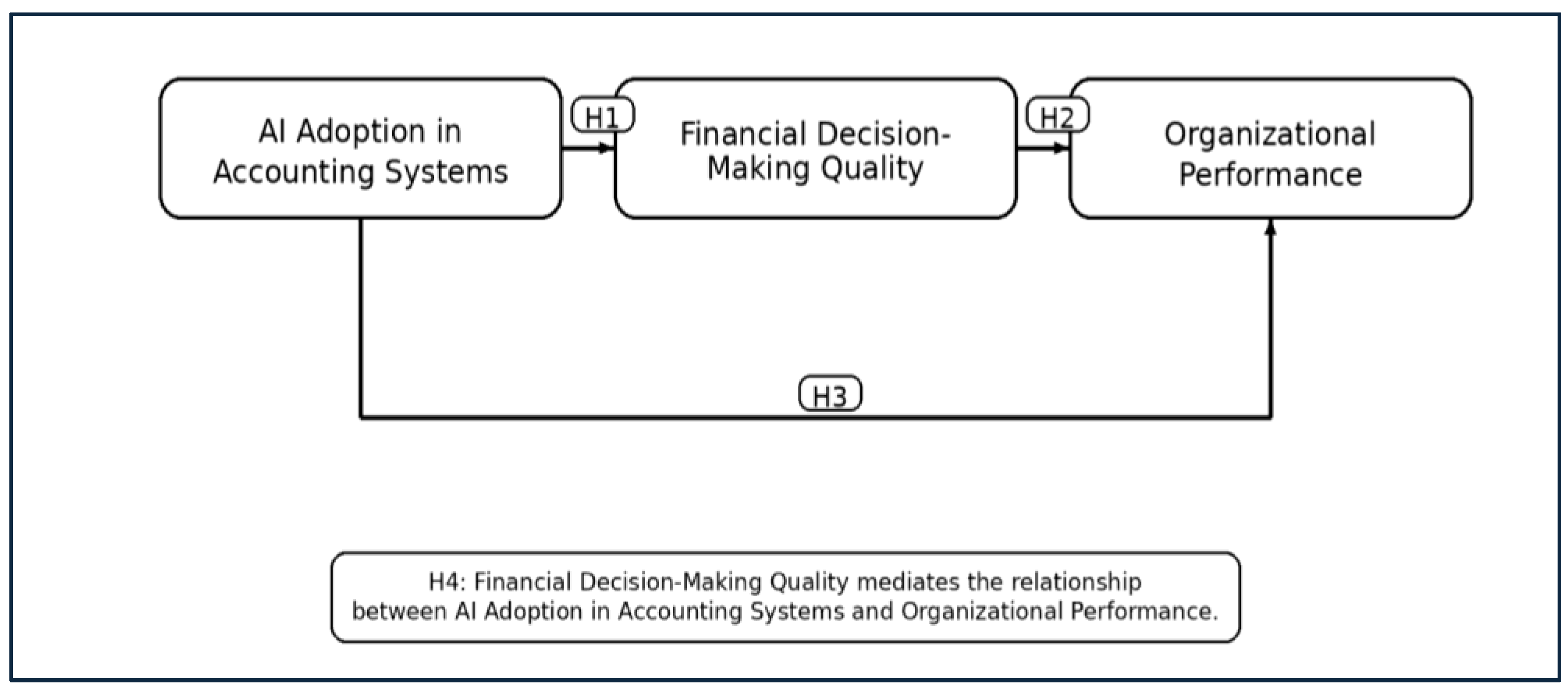
Artificial intelligence adoption in accounting systems positively affects financial decision-making quality.

3.2. Financial Decision-Making Quality and Organizational Performance

Substantial research supports the assertion that decision-making processes are key drivers of organizational performance, particularly in a changing environment. Performance differentials are a function of the effectiveness of managers in utilizing information to produce decisions that are timely, consistent, and goal-congruent (Neiroukh et al., 2024). In the context of AIS research, both AIS and information quality have a significant positive effect on decision success and non-financial performance, where decision success is a mediator of the information quality-performance relationship (Monteiro et al., 2022, 2021).
This is consistent with stakeholder theory, which suggests that better-informed decisions regarding products, customers, employees, and environmental concerns lead to better relationships and outcomes for stakeholders, such as customer satisfaction and process efficiencies (Tran Thanh Thuy, 2025). Within AI-enhanced systems, not only does decision speed and quality improve, but both factors correlate with organizational performance. Additionally, quality cost information within AI-based accounting systems has a positive impact on decision efficiency, competitiveness, and sustainable performance (Neiroukh et al., 2024; Thongprim et al., 2025).
Within an emerging economy like Egypt, in which access to finance, cost of borrowing, and tax and regulatory compliance are critical success factors for organizational survival, likely, the quality of management decisions in areas such as capital structure, working capital management, investment decisions, and cost management will have a direct and immediate impact on financial and organizational performance. Accordingly, and in line with the RBV, behavioral management, and stakeholder theories, we propose:
H2. 
Financial decision-making quality positively affects organizational performance.

3.3. Artificial Intelligence Adoption and Organizational Performance

RBV and the dynamic capabilities approach propose a conceptualization of AI capabilities and AI-enabled accounting systems as a strategic resource and a dynamic capability that can lead to a competitive advantage when properly developed and leveraged (Juman et al., 2025). Recent research has shown that AI capabilities significantly and positively impact organizational performance, both directly and indirectly, by improving decision-making processes in terms of speed and quality, thus highlighting AI as a crucial information-based resource (Neiroukh et al., 2024).
With respect to accounting-oriented studies, AI in accounting has been established as a major driver of sustainable competitive performance, which can have direct and indirect effects via enterprise risk management. This process can be related to the concept of long-term sustainable competitive performance and stakeholder theory, considering risk management, transparency, and reporting (Nguyen et al., 2025). In the context of the banking industry, AI-based service channels have been established to promote sustainable development, which in turn can enhance the performance of accounting in Iraqi banks (Hamdan, 2025; Mutashar & Flayyih, 2024).
Similarly, the research on digital accounting and AIS also suggests that the quality of the information system, data, and information is positively related to organizational performance (Monteiro et al., 2022). In this regard, the quality of the digital accounting system improves decision quality, while the quality of AIS improves non-financial performance through information quality and decision success, as suggested by the RBV perspective that information systems are performance-relevant resources (Al-Okaily et al., 2022; Tran Thanh Thuy, 2025). The inclusion of AI in management accounting also increases the accuracy, timeliness, and transparency of financial reporting, which enhances organizational performance through increased stakeholders’ confidence.
In the case of Egyptian organizations, the adoption of AI technologies in accounting systems is in line with the national strategy for digital transformation and financial inclusion, especially in the banking sector and large corporations that dominate the capital market. In this context, accounting technologies with AI capabilities can contribute to the financial as well as non-financial performance of the organization; however, there is limited evidence on the subject in the context of Egypt. Following the resources-based view, the stakeholder theory, and the diffusion of innovations theory, we propose the following hypotheses:
H3. 
Artificial intelligence adoption positively affects organizational performance.

3.4. Financial Decision-Making Quality as a Mediator Between AI Adoption and Organizational Performance

There is general agreement that AI and information systems improve organizational performance, although many contemporary studies focus on the indirect rather than direct effects. According to decision-usefulness and behavioral management approaches, information systems based on AI are seen to improve information and analysis quality, which in turn increases decision-making speed and quality to improve organizational performance (Neiroukh et al., 2024). Decision-making success is shown to have a mediation effect between information systems quality, non-financial information quality, and non-financial performance in studies of AIS, and in some cases, this is shown to be a serial process with information quality (Thongprim et al., 2025; Tran Thanh Thuy, 2025). The quality of cost information is also shown to have a mediation effect between AI-based accounting systems, financial reporting quality, and decision-making efficiency, which is close to organizational performance.
The studies conducted on banking have found support for mediated models, where the adoption of AI in management accounting would increase trust in banks solely through its impact on financial reporting, and sustainable development would mediate the relationship between AI adoption and accounting system performance in Iraqi banks (Mohammed Jumaah et al., 2026; Mutashar & Flayyih, 2024). All these studies suggest that the adoption of AI in accounting systems would most likely influence organizational performance through its relationship with information quality and decision-making in finance, without a direct, unmediated relationship.
Existing research has contributed significantly to the understanding of the potential of AI, the quality of AIS, the quality of digital accounting, the quality of information, and the decision process regarding organizational performance in various emerging economies. Despite the progress made, some gaps still exist. First, most of the research on the subject considered AI capability or AIS quality as an overarching construct, but did not consider the adoption of AI in accounting systems as an explicit construct. Second, while the role of decision speed and decision quality as mediators between AI capability and organizational performance was examined, the construction of financial decision-making quality, including budgeting, investment, financing, and cost decisions, was not examined as a mediator between the adoption of AI in accounting systems and organizational performance.
Third, the majority of the empirical data is derived from the Asian and regional environments, such as Vietnam, Thailand, and Iraq, while the empirical data in the MENA environment is scarce, and the evidence related to Egypt is nonexistent despite the rapid digital evolution in its financial/corporate sector and its unique institutional, regulatory, and financial environment. Fourth, most of the relevant studies apply only one theoretical model (e.g., RBV, success models related to AIS, TOE-IDT), while the current study utilizes the integrated theoretical model, including the above four theories in the context of the AI-accounting-performance relationship.
This research makes a theoretical contribution to the body of knowledge by explicitly addressing AI systems adoption in accounting systems, as well as its direct and indirect impact on organizational performance in an emerging economy. This research also identifies the quality of financial decision-making as a mediator variable connecting AI systems adoption to organizational performance, thus bridging decision usefulness and behavioral management theories with resource-based view and stakeholder theories. This research also makes a geographical and theoretical extension to the body of knowledge on AI systems adoption in accounting systems, as well as financial decision-making in developing economies.
In the context of the emerging economy of Egypt, which is characterized by information asymmetry, governance issues, government interventions, and resource constraints, with financial decisions being under intense scrutiny by banks, tax authorities, and regulators, the quality of financial decision-making is expected to function as a critical link between AI-based accounting systems and performance. The study’s methodological framework, which incorporates the research variables and proposed linkages in a logical structure, is shown in Figure 1. Consistent with the RBV, stakeholder theory, decision usefulness, behavioral management, and innovation diffusion theories, the following hypotheses can be posited:
H4. 
Financial decision-making quality mediates the relationship between AI adoption and organizational performance.

4. Research Design and Methods

4.1. Sample and Data Collection

This research adopts a quantitative, cross-sectional survey design to examine the impact of AI adoption in accounting systems (AIAS) on financial decision-making quality (FDMQ) and subsequent organizational performance (OP) in firms listed on the Egyptian Stock Exchange (EGX), covering banking, IT, manufacturing, and service sectors. The target population comprises accounting and finance professionals, including accountants, finance managers, CFOs, and auditors with hands-on experience in AI tools. Where the questionnaire included a screening question verifying participants’ experience with AI-based applications in accounting and financial activities to ensure respondent suitability. The analysis did not include responses from those who had never used AI.
The questionnaire items were modified using previously validated English-language measures related to organizational performance, financial decision-making quality, and use of artificial intelligence. A sample of academic specialists in accounting and management information systems evaluated the instrument to guarantee content validity and contextual applicability for the Egyptian setting, and changes were made in response to their input. In order to guarantee language coherence and conceptual equivalence between the original and translated versions, the questionnaire was also translated into Arabic and then back-translated into English by independent bilingual experts. The satisfactory results of factor loadings, composite reliability (CR), and average variance extracted (AVE) further support the measurement equivalence and validity of the adapted scales.
A purposive sampling technique was utilized to ensure that participants possessed relevant knowledge and experience to provide meaningful insights on AI adoption, financial decision-making, and performance outcomes. Therefore, the responses lend greater credibility to our findings and provide significant value to the study (Estep et al., 2024; Nguyen et al., 2025). Even though purposive sampling was used to select respondents with relevant expertise and experience in AI applications, several procedural remedies were implemented to reduce potential common method bias; the study included firms of various sizes, industries, and levels of AI adoption to ensure sample heterogeneity; participation was voluntary and anonymous to minimize social desirability bias; the questionnaire items were carefully designed using neutral wording; the measurement constructs were separated within the survey instrument to reduce the likelihood of response pattern bias and consistency effects; and screening criteria were used to ensure data quality (López, 2023; Podsakoff et al., 2024).
To ensure the sample size was sufficient, the minimum sample size was determined using G*Power software (Version 3.1.9.7). The recommended minimum sample size required to evaluate the research model produced is 119, based on a priori power analysis using a medium effect size with a significance level of 0.05 and the power of 0.95 (with 3 latent variables and 18 observable items). However, in order to reduce sample size error and account for participant nonresponse, we raised the size of our study. So, we distributed 850 surveys since multiple qualified respondents can be drawn from each firm, and more than one questionnaire was distributed per company.
To justify aggregating individual responses to the firm level and address data non-independence, aggregation analyses were conducted following established guidelines in multilevel research. Specifically, within-group agreement (rwg(j)) and intraclass correlations [ICC(1) and ICC(2)] were calculated for all constructs, in line with recommendations by Bliese (2000) and LeBreton and Senter (2008). The results indicated satisfactory levels of within-group agreement, with mean rwg(j) values exceeding the 0.70 threshold, acceptable ICC(1) values indicating meaningful between-group variability, and ICC(2) values supporting the reliability of group-level aggregation.
Both online and manual methods were used to administer the survey. Data collection for the study began in December 2025 and lasted for four months. A response rate of 68.6% was obtained (A total of 583 questionnaires were collected). The sample characteristics are displayed in Table 2.

4.2. Instrument Measurement

The questionnaire made use of measures and metrics that have been verified in earlier research. In order to guarantee validity and reliability, the measures were chosen based on relevant literature. For instance, six elements were taken from Abu Afifa et al. (2024) and Nguyen et al. (2025) to assess the adoption of AI in the accounting system and in the firm. The concept shows how much AI-enabled apps are used and functionally integrated into accounting procedures. To improve construct clarity and guarantee greater conformity with the conceptual description, a small amount of language modification was added to the items. Important accounting tasks, including responsibility accounting, budget planning, performance evaluation, and decision support systems, are covered. Additionally, six metrics from earlier research were used to measure FDMQ (Ghasemaghaei, 2019; Neiroukh et al., 2024) that evaluated how well a decision accomplishes its goals and enhances organizational performance. For evaluating organizational performance, six items were derived from Garg et al. (2003), Al-Okaily et al. (2022), and Neiroukh et al. (2024). We used a multi-dimensional perceptual scale that captured sales growth, profitability, market share, customer satisfaction, staff satisfaction, and innovation performance to gauge organizational performance (OP). Prior research indicates that subjective performance measures given by informed respondents are strongly correlated with objective indicators and are frequently used in organizational studies when firm-level financial data are unavailable, despite the preference for objective financial indicators. The reliability and comparability of the responses were enhanced by asking respondents to assess performance in relation to rivals rather than in absolute terms in order to lessen bias.
A 5-point Likert scale was used to measure each scale, ranging from 1 = “strongly disagree” to 5 = “strongly agree.” AIAS, FDMQ, and OP are first-order, reflective constructs. To ensure the accuracy and cultural relevance of the scales, the survey was tested with 10 CFOs from Egyptian firms to evaluate its scalability and usability. Based on the feedback, the survey’s clarity and applicability were enhanced by a few minor modifications. The final version demonstrates high reliability, as it was developed with input from both experts and practitioners (see Table 3). To ensure the quality of the study, we conducted a pilot survey of 40 CFOs, and the findings indicated that Cronbach’s alpha of the constructs (AIAS, FDMQ, and OP) were all higher than 0.7. As a result, the questionnaire met the quality standards for formal research.

4.3. The Common Method Bias (CMB)

The possibility of common method bias (CMB) was taken into consideration because the data were gathered using a self-reported survey that was given at a particular moment in time. During the research design phase, several procedural solutions were put in place to allay this worry, such as guaranteeing respondent anonymity, employing neutral language in questionnaire items, and conceptually separating measurement constructs within the survey instrument to lessen social desirability bias and consistency effects. Furthermore, statistical analyses were performed to assess the extent of common method bias. We utilized Harman’s single-factor method and variance inflation factors (VIFs). The results indicate that the overall variance accounted for by a single factor is 24.479% of the total variance, below the threshold of 50% (Podsakoff et al., 2003). Additionally, analysis of the data indicates that all indicators possessed a VIF value lower than 5.0. This suggests the absence of multicollinearity among the indicators. Overall, CMB does not pose a significant risk to the validity of the results, according to the results from both procedural and statistical approaches.

4.4. Data Analysis Methods

The Smart-PLS tool is used to perform PLS regression, testing the hypotheses of the research model, because it has many outstanding advantages. First, Smart-PLS is particularly useful when studying a new field where theory is weak or evolving. Smart-PLS allows for exploring relationships and identifying important factors, which are of interest in the new concepts of AIAS, FDMQ, and OP, this method works especially well for models with intricate structural linkages, such as mediation effects (Abu Afifa et al., 2024; Neiroukh et al., 2024). Second, Smart-PLS is suitable for small sample sizes and provides comprehensive tools focused on explaining variance in dependent variables. Furthermore, PLS-SEM is robust to possible non-normality in survey data because it can handle models with multiple constructs and indirect effects without requiring strict distributional assumptions. Although the sample size (n = 583) is relatively large and could support covariance-based SEM (CB-SEM), PLS-SEM was chosen because of its emphasis on prediction-oriented modeling and its suitability for theory development in emerging research areas like AI adoption in accounting systems.
This is useful when the primary goal is to predict and understand the factors that influence a particular variable. In addition, Smart-PLS also supports the assessment of the goodness of fit of measurement models and structural models through fit indices. The analytical method employed in this investigation is Partial Least Squares Structural Equation Modeling (PLS-SEM). The model incorporates complex relationships, including direct and indirect effects, which PLS-SEM is well-suited to handle. With PLS-SEM, the analyses are performed with 5000 subsamples, which improves the accuracy and reliability of the results (Hair et al., 2021a, 2021b, 2019).

5. Research Results

5.1. Assessment of Measurement Model

The fundamental step in evaluating the validity and dependability of the measurement model for PLS-SEM is the measurement model analysis. Regarding the assessment of the measurement model, we used factor loading (FL) of 0.70 to evaluate the reliability of the questionnaire items; Cronbach’s alpha (α) and composite reliability (CR) of 0.70 and higher are used to evaluate internal consistency reliability; and average variance extracted (AVE) of 0.50 and higher is used to evaluate convergent validity (Hair et al., 2021a, 2021b). Table 3 shows that every item FL fell within the recommended range. Additionally, all research factors’ CR and AVE are higher than the cut-off values of 0.70 and 0.50, respectively. As a result, all of these values fell inside the approved range, confirming that the measurement model’s reliability has been proven and allowing the study to move forward safely.
In this study, we used three methods to evaluate discriminant validity: the heterotrait-monotrait (HTMT) ratio method (Henseler et al., 2015), the Fornell and Larcker correlation method, and the cross-loading method (Hair et al., 2019, 2014). According to Henseler et al. (2015), the first method is a different approach to evaluating discriminant validity in PLS-SEM. Where the multitrait and multimethod matrix, or HTMT of correlations, can be used to assess discriminant validity. A lack of discriminant validity is shown by HTMT scores close to 0.90. As a result, Table 4 shows the HTMT criterion values that fall within the recommended range and satisfy the lowest HTMT value.
The second method is to use the Fornell–Larcker correlation matrix to assess discriminant validity. Accordingly, Fornell and Larcker (1981) suggest that when a single factor’s AVE is higher than its squared multiple correlations with other factors, discriminant validity is well-established (Hair et al., 2014). Accordingly, if the diagonal items in the rows and columns are larger than other off-diagonal items, then the Fornell and Larcker principle has discriminant validity. The square root of the AVE of all factors is presented by the values in bold type in Table 4. In this sense, it is discovered that each of the three latent components’ square root of the AVE is greater than its correlation with any other path model factor.
The third method of assessing discriminant validity is called cross-loadings, and it focuses on the cross-loadings of the items, where an item is predicted to load higher on its proposed factor than on the other factors (Hair et al., 2014). All factors load greater on their respective factors than on other factors in the route model, as shown in Table 5. As a result, the research shows that the majority of the track model’s variables and signals exhibit satisfactory discriminant validity. Consequently, the suggested path model has a sufficient degree of validity and dependability.

5.2. Structural Model: Hypotheses Testing

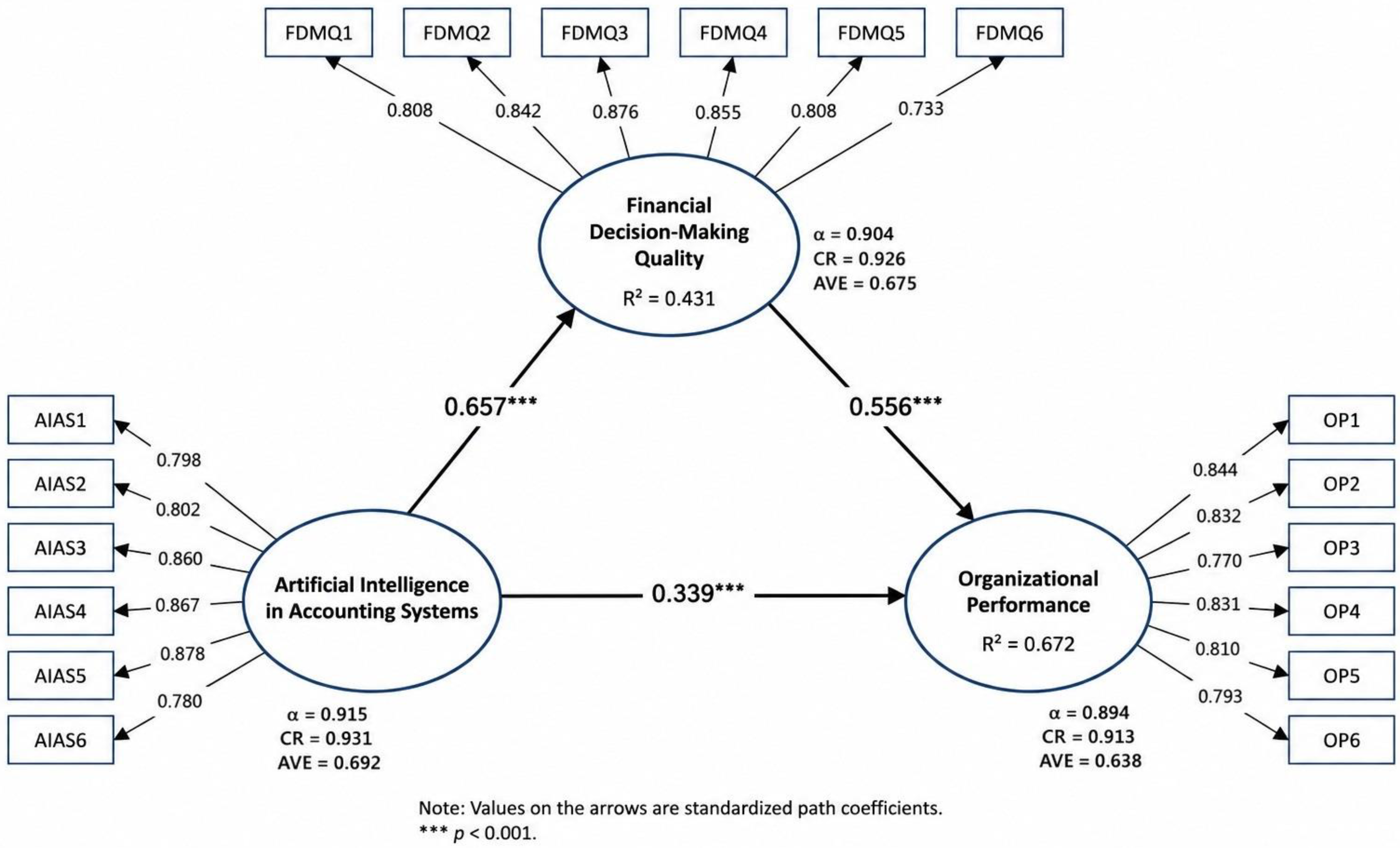
The next step in the PLS analysis is to evaluate the structural model and test hypotheses after the measurement model has been verified. We employed standardized path coefficients (β), explained variance (R2) of endogenous variables, and the significance levels of proposed linkages to evaluate the relevance of path coefficients in the structural model, as shown in Figure 2. We employed a bootstrapping approach with 5000 resamples in Smart-PLS 4.0 to evaluate significance levels using t-statistics in order to guarantee statistical robustness.
Table 6 presents the results of the study relationships. The three direct hypotheses show statistically significant and positive associations, according to our analysis, highlighting the significance of AIAS in its relationship with FDMQ and OP. In particular, adoption of AI in accounting systems had a powerful and statistically significant favorable association with financial decision-making quality (β = 0.657, t = 16.058, p < 0.01) and with organizational performance (β = 0.339, t = 6.877, p < 0.01), supporting hypotheses H1 and H3. Additionally, FDMQ demonstrated a statistically significant positive association with OP (β = 0.556, t = 10.896, p < 0.01), supporting hypothesis H2.
The mediation’s outcomes are also shown in Table 6. Partial mediation was found in the analysis within the financial decision-making quality, demonstrating that adoption of AI in accounting systems is associated with the firm’s organizational performance through financial decision-making quality (AIAS → FDMQ → OP) (β = 0.365, t = 8.815, p < 0.01). Thus, we accepted H4.
The results of the explanatory power test show how well the model explains correlations between variables. The determination coefficients (R2) showed significant explanatory power, surpassing the suggested cutoff of 0.10 (Falk & Miller, 1992). Notably, the model explained 67.2% of the variance in organizational performance (R2 = 0.672) and 43.1% of the variance in financial decision-making quality (R2 = 0.431). Furthermore, the effect sizes F2 (AIAS → FDMQ) is 0.558, F2 (FDMQ → OP) is 0.202, and F2 (AIAS → OP) is 0.337. The predictive relevance Q2(FDMQ) and Q2(OP) are 0.19 and 0.42, respectively. And SRMR is 0.061. When taken as a whole, these indices show that the model has acceptable levels of predictive and explanatory relevance.

6. Discussion

The study shows that AIAS notably enhances FDMQ, aligning with previous research suggesting that AIAS is crucial for enabling relevant infrastructure in terms of quality, relevance, and timeliness, which in return enhance FDMQ (Al-Okaily et al., 2022; Hasan et al., 2025; Tran Thanh Thuy, 2025). Moreover, the study findings are consistent with early studies that claimed that data quality in digital accounting systems and AIS directly impacts decision quality, with system quality being mediated through its effect on information quality to support the decision-usefulness perspective (Al-Okaily et al., 2022; Tran Thanh Thuy, 2025).
Further, the study findings show that FDMQ notably enhances organizational performance. This finding is consistent with the findings of several studies in the literature (Monteiro et al., 2022, 2021; Neiroukh et al., 2024; Thongprim et al., 2025; Tran Thanh Thuy, 2025). This result assures that performance differentials are a function of the effectiveness of managers in utilizing information to produce decisions that are timely, consistent, and goal-congruent (Neiroukh et al., 2024). This result is in line with stakeholders’ theory claims, which suggest that better-informed decisions regarding products, customers, employees, and environmental concerns lead to better relationships and outcomes for stakeholders, such as customer satisfaction and process efficiencies (Tran Thanh Thuy, 2025). Within AI-enhanced systems, not only does decision speed and quality improve, but both factors also correlate with organizational performance (Neiroukh et al., 2024; Thongprim et al., 2025).
Moreover, the study’s findings indicate that AIAS has a positive and significant impact on organizational performance. This result is consistent with many studies that reported that AIAS enhances OP (Al-Okaily et al., 2022; Hamdan, 2025; Mutashar & Flayyih, 2024; Neiroukh et al., 2024; Nguyen et al., 2025; Tran Thanh Thuy, 2025). This confirms early claims that the quality of the information system, data, and information is positively related to organizational performance (Monteiro et al., 2022), and that the quality of the digital accounting system improves decision quality, while the quality of AIS improves non-financial performance through information quality and decision success, as suggested by the RBV perspective that information systems are performance-relevant resources (Al-Okaily et al., 2022; Tran Thanh Thuy, 2025). The inclusion of AI in management accounting also increases the accuracy, timeliness, and transparency of financial reporting, thereby enhancing OP by increasing stakeholders’ confidence.
Finally, the study findings indicated that FDMQ partially mediates the relationship between AIAS and OP. This result confirms early claims by some studies that AI and information systems improve organizational performance in an indirect rather than a direct effect. These early studies, along with the current study, are supported by decision-usefulness and behavioral management approaches, which state that information systems based on AI are seen to improve information and analysis quality, which in turn increases decision-making speed and quality to improve organizational performance (Neiroukh et al., 2024). Unlike some early studies that claimed that the adoption of AI in accounting systems would most likely influence organizational performance through its relationship with information quality and decision-making in finance, without a direct, unmediated relationship, the current study confirmed both direct and indirect relationships (Mohammed Jumaah et al., 2026; Mutashar & Flayyih, 2024).

7. Conclusions, Limitations, and Future Research

Using a sample of 583 accountants, finance managers, CFOs, and auditors in all firms listed on the Egyptian Stock Exchange (EGX), covering banking, IT, manufacturing, and service sectors, this research explored the impact of AIAS on OP. Further, it investigated the impact of AIAS on FDMQ and the impact of FDMQ on OP. Moreover, the study explored the mediating role of financial decision-making quality (FDMQ) on the AIAS-OP relationship. The results revealed a positive and significant impact of AIAS on both FDMQ and OP. Further, the results revealed a positive and significant impact of FDMQ on OP. Finally, FDMQ showed a significant mediating role between AIAS and OP. All hypotheses, whether direct or indirect, are supported by empirical evidence.
Theoretically, this study contributes to the literature on AI in accounting and accounting systems and their relation with performance by providing firm-level evidence from an under-researched emerging economy, thereby extending prior findings that have predominantly focused on developed markets and specific industries (Abdullah & Almaqtari, 2024; Buhaya & Metwally, 2024; Metwally et al., 2024, 2021; Quynh Trang & Nguyen, 2025). It also enriches the body of knowledge by explicitly addressing AI systems adoption in accounting systems, as well as its direct and indirect impact on organizational performance in an emerging economy. This research also identifies the quality of financial decision-making as a mediator variable connecting AI systems adoption to organizational performance, thus bridging decision usefulness and behavioral management theories with resource-based view and stakeholder theories. In the context of the emerging economy of Egypt, which is characterized by information asymmetry, governance issues, government interventions, and resource constraints, with financial decisions being under intense scrutiny by banks, tax authorities, and regulators, the quality of financial decision-making is expected to function as a critical link between AI-based accounting systems and performance.
Building on these theoretical insights, the study recommends that policymakers improve OP practices and promote employee participation in AIAS to enhance FDMQ. These findings support earlier research, which also showed that AIAS positively affects both OP and FDMQ (Al-Okaily et al., 2022; Hamdan, 2025; Hasan et al., 2025; Mutashar & Flayyih, 2024; Neiroukh et al., 2024; Nguyen et al., 2025; Tran Thanh Thuy, 2025). The study recommends that policymakers strategically prioritize investments in AIAS, viewing it as a way for firms to improve their reputation among stakeholders. AI-based accounting systems can enhance the breadth and depth of performance reporting, reduce information asymmetry, and improve legitimacy (Liu, 2025). This is particularly relevant to the Egyptian context, where the business model means external stakeholders rely on financial reporting and internal reporting to evaluate risk and invest capital (Mutashar & Flayyih, 2024). Overall, the concepts of decision usefulness and Stakeholder Theory suggest that AI-based accounting systems have the potential to improve performance because they can improve the usefulness and legitimacy of information for both external and internal decision-makers.
This study presents several important implications for managers within Egyptian firms. Firstly, the evidence indicating that AIAS enhances both OP and FDMQ suggests that operations and plant managers should prioritize the implementation of pilot AIAS in areas of high impact to optimize firm performance and improve decision-making quality. Secondly, our findings that FDMQ not only improves OP but also mediates the relationship between AIAS and OP imply that management, accountants, and governance officers need to redesign their decision support systems to incorporate AIAS-generated data and translate these into decision-relevant cost and performance indicators, thereby supporting firm performance and activities. Lastly, these results collectively suggest that senior executives should regard AIAS and FDMQ as complementary strategic capabilities and integrate them into broader firm strategies and digitalization initiatives. Investing in AIAS without concurrent enhancement of FDMQ practices, or vice versa, is unlikely to yield the full benefits observed in this study.
Although this research offers valuable practical and theoretical insights, it also encounters certain limitations that pave the way for future scholarly inquiries. The dependence on survey data collected from Egyptian firms constrains the ability to generalize findings across other sectors. Subsequent investigations could explore diverse industries and regions, thereby facilitating comparative analyses and extending research to other nations within the MENA region. A notable limitation pertains to the study’s cross-sectional design, with data collected at a single time point. Given that technological projects typically undergo long-term evolution, longitudinal studies could more effectively monitor these developments. Moreover, reliance solely on quantitative data may neglect critical qualitative insights. The integration of both methodologies would foster a more comprehensive understanding of participants’ motivations. Additionally, considering the pivotal role of strategic management accounting (SMA) practices in influencing employee behavior and enhancing OP, future research might evaluate both the direct and indirect impacts of SMA on OP.
Furthermore, the theoretical model employed in this study is deliberately simplified, as it exclusively encompasses AIAS, FDMQ, and OP, and does not explicitly consider other significant factors influencing organizational performance, such as institutional pressures, corporate governance, machine learning, or broader digital transformation capabilities (Metwally et al., 2024, 2026a, 2026b). This parsimonious approach presents an additional limitation and indicates that future research should focus on developing and testing more comprehensive models that incorporate these constructs. It is also advisable to investigate more intricate mediated and moderated relationships, as well as potential reciprocal links among AIAS, FDMQ, and various dimensions of OP. The inclusion of control variables such as gender, age, and education within the model could further illuminate additional factors influencing OP. Overall, these limitations and recommended research directions pave the way for more thorough and diverse future investigations.
Control factors that may affect organizational performance, such as company size, firm age, or leverage, are not included in this study; future research is recommended to include these variables to strengthen the findings’ robustness. The cross-sectional nature of the data makes it impossible to draw firm conclusions about causation, and there may be reverse causality between factors. It is recommended that longitudinal or panel data be used in future research to overcome endogeneity issues.

Author Contributions

Conceptualization, N.N.A.M.E., S.A.S.A., S.E.-H., and A.B.M.M.; methodology, N.N.A.M.E., S.A.S.A., S.E.-H., and A.B.M.M.; software, N.N.A.M.E., S.A.S.A., S.E.-H., and A.B.M.M.; validation N.N.A.M.E., S.A.S.A., S.E.-H., and A.B.M.M.; analysis and interpretation of the data N.N.A.M.E., S.A.S.A., S.E.-H., and A.B.M.M.; the drafting of the paper N.N.A.M.E., S.A.S.A., S.E.-H., and A.B.M.M.; revising it critically for intellectual content N.N.A.M.E., S.A.S.A., S.E.-H., and A.B.M.M.; funding acquisition, N.N.A.M.E., S.A.S.A., S.E.-H., and A.B.M.M.; All authors have read and agreed to the published version of the manuscript.

Funding

This research received no external funding.

Institutional Review Board Statement

The study was conducted in accordance with the Declaration of Helsinki and approved by the deanship of the scientific research ethical committee of King Faisal University (protocol code KFU250028 and 1 July 2025).

Informed Consent Statement

Informed consent was obtained from all subjects involved in the study.

Data Availability Statement

Data are available upon request from researchers who meet the eligibility criteria. Kindly contact the corresponding author privately through email.

Acknowledgments

I acknowledge the support provided by Ajman University for covering the publication fee and any other relevant charges.

Conflicts of Interest

The authors declare no conflicts of interest.

References

  1. Abbas, K. (2026). Management accounting and artificial intelligence: A comprehensive literature review and recommendations for future research. The British Accounting Review, 58(2), 101551. [Google Scholar] [CrossRef]
  2. Abdullah, A. A. H., & Almaqtari, F. A. (2024). The impact of artificial intelligence and Industry 4.0 on transforming accounting and auditing practices. Journal of Open Innovation: Technology, Market, and Complexity, 10(1), 100218. [Google Scholar] [CrossRef]
  3. Abikoye, B. E., Umeorah, S. C., Adelaja, A. O., Ayodele, O., & Ogunsuji, Y. M. (2024). Regulatory compliance and efficiency in financial technologies: Challenges and innovations. World Journal of Advanced Research and Reviews, 23(1), 1830–1844. [Google Scholar] [CrossRef]
  4. Abu Afifa, M. M., Nguyen, T. H., Le, M. T. T., Nguyen, L., & Tran, T. T. H. (2024). Accounting going digital: A Vietnamese experimental study on artificial intelligence in accounting. VINE Journal of Information and Knowledge Management Systems, 55(4), 1031–1050. [Google Scholar] [CrossRef]
  5. Ahmad, M., Wu, Q., & Ahmed, S. (2023). Does CSR digitalization improve the sustainable competitive performance of SMEs? Evidence from an emerging economy. Sustainability Accounting, Management and Policy Journal, 15(1), 119–147. [Google Scholar] [CrossRef]
  6. Ajayi, A. M., Omokanye, A. O., Olowu, O., Adeleye, A. O., Omole, O. M., & Wada, I. U. (2024). Detecting insider threats in banking using AI-driven anomaly detection with a data science approach to cybersecurity. World Journal of Advanced Research and Reviews, 24, 123–132. [Google Scholar] [CrossRef]
  7. Al-Hashimy, H. N. H., & Yao, J. (2025). Mediating effect of cybernetic feedback loops on the performance of computerised accounting information systems in China’s information and control systems. Journal of Enterprise Information Management, 38(6), 1831–1859. [Google Scholar] [CrossRef]
  8. Ali, M., Ahmad, S., Ahmed, S., & Gul, A. (2026). Artificial intelligence adoption in public policy processes and its effects on governance effectiveness and public sector management performance: Roles of decision-making quality and institutional accountability. Center for Management Science Research, 4, 135–150. [Google Scholar]
  9. Al-Okaily, M. (2024). Artificial intelligence and its applications in the context of accounting and disclosure. Journal of Financial Reporting and Accounting, 23(4), 1387–1401. [Google Scholar] [CrossRef]
  10. Al-Okaily, M., Alghazzawi, R., Alkhwaldi, A. F., & Al-Okaily, A. (2022). The effect of digital accounting systems on the decision-making quality in the banking industry sector: A mediated-moderated model. Global Knowledge, Memory and Communication, 72(8–9), 882–901. [Google Scholar] [CrossRef]
  11. Alslaibi, N. A., Mowafaq Alshdaifat, S., Yousef Bani Hani, L., Kamal Khaled Abu Farha, E., & Yousif Alhasnawi, M. (2025). Artificial intelligence and financial statement transparency: The moderating role of accounting information systems’ reliability. EDPACS, 71(5), 17–29. [Google Scholar] [CrossRef]
  12. Alsughayer, S. (2025). Assessing the integration and impact of artificial intelligence on accounting practices in Saudi Arabia. WSEAS Transactions on Business and Economics, 22, 1721–1740. [Google Scholar] [CrossRef]
  13. Baroma, B. S. (2025). The effect of artificial intelligence on the accounting information systems in Egyptian commercial banks. Journal of Accounting Research, 12(1), 112–142. [Google Scholar] [CrossRef]
  14. Bliese, P. D. (2000). Within-group agreement, non-independence, and reliability: Implications for data aggregation and analysis. In K. J. Klein, & S. W. Kozlowski (Eds.), Multilevel theory, research, and methods in organizations: Foundations, extensions, and new directions (pp. 349–381). Jossey-Bass. [Google Scholar]
  15. Buhaya, M. I., & Metwally, A. B. M. (2024). The interplay between digital technologies and sustainable performance: Does lean manufacturing matter? Sustainability, 16(22), 10002. [Google Scholar] [CrossRef]
  16. Chen, Z., Van Khoa, L. D., Na Teoh, E., Nazir, A., Karuppiah, E. K., & Lam, K. S. (2018). Machine learning techniques for anti-money laundering (AML) solutions in suspicious transaction detection: A review. Knowledge and Information Systems, 57(2), 245–285. [Google Scholar] [CrossRef]
  17. Chukwuani, V. N., & Egiyi, M. A. (2020). Automation of accounting processes: Impact of artificial intelligence. International Journal of Research and Innovation in Social Science, 4(8), 444–449. [Google Scholar]
  18. Climent, R. C., Haftor, D. M., & Staniewski, M. W. (2024). AI-enabled business models for competitive advantage. Journal of Innovation & Knowledge, 9(3), 100532. [Google Scholar] [CrossRef]
  19. Correia, A. B., Farrukh Shahzad, M., Moleiro Martins, J., & Baheer, R. (2024). Impact of green human resource management towards sustainable performance in the healthcare sector: Role of green innovation and risk management. Cogent Business & Management, 11(1), 2374625. [Google Scholar] [CrossRef]
  20. Dechow, P. M., & Dichev, I. D. (2002). The quality of accruals and earnings: The role of accrual estimation errors. The Accounting Review, 77(s-1), 35–59. [Google Scholar] [CrossRef]
  21. Dey, P. K., Chowdhury, S., Abadie, A., Vann Yaroson, E., & Sarkar, S. (2024). Artificial intelligence-driven supply chain resilience in Vietnamese manufacturing small- and medium-sized enterprises. International Journal of Production Research, 62(15), 5417–5456. [Google Scholar] [CrossRef]
  22. Elnakeeb, S., & Elawadly, H. S. H. (2025). Automation and artificial intelligence in accounting: A comprehensive bibliometric analysis and future trends. Journal of Financial Reporting and Accounting. [Google Scholar] [CrossRef]
  23. Estep, C., Griffith, E. E., & MacKenzie, N. L. (2024). How do financial executives respond to the use of artificial intelligence in financial reporting and auditing? Review of Accounting Studies, 29(3), 2798–2831. [Google Scholar] [CrossRef]
  24. Falk, R. F., & Miller, N. B. (1992). A primer for soft modeling. University of Akron Press. [Google Scholar]
  25. Feng, S. (2024). Integrating artificial intelligence in financial services: Enhancements, applications, and future directions. Applied and Computational Engineering, 69(1), 19–24. [Google Scholar] [CrossRef]
  26. Fornell, C., & Larcker, D. F. (1981). Evaluating structural equation models with unobservable variables and measurement error. Journal of Marketing Research, 18(1), 39–50. [Google Scholar] [CrossRef]
  27. Gadekar, R., Sarkar, B., & Gadekar, A. (2022). Investigating the relationship among Industry 4.0 drivers, adoption, risks reduction, and sustainable organizational performance in manufacturing industries: An empirical study. Sustainable Production and Consumption, 31, 670–692. [Google Scholar] [CrossRef]
  28. Garg, V. K., Walters, B. A., & Priem, R. L. (2003). Chief executive scanning emphases, environmental dynamism, and manufacturing firm performance. Strategic Management Journal, 24(8), 725–744. [Google Scholar] [CrossRef]
  29. Ghasemaghaei, M. (2019). Does data analytics use improve firm decision making quality? The role of knowledge sharing and data analytics competency. Decision Support Systems, 120, 14–24. [Google Scholar] [CrossRef]
  30. Gorla, N., Somers, T. M., & Wong, B. (2010). Organizational impact of system quality, information quality, and service quality. The Journal of Strategic Information Systems, 19(3), 207–228. [Google Scholar] [CrossRef]
  31. Hair, J. F., Risher, J. J., Sarstedt, M., & Ringle, C. M. (2019). When to use and how to report the results of PLS-SEM. European Business Review, 31(1), 2–24. [Google Scholar] [CrossRef]
  32. Hair, J. F., Jr., Hult, G. T. M., Ringle, C. M., Sarstedt, M., Danks, N. P., & Ray, S. (Eds.). (2021a). An introduction to structural equation modeling. In Partial least squares structural equation modeling (PLS-SEM) using R: A workbook (pp. 1–29). Springer International Publishing. [Google Scholar]
  33. Hair, J. F., Jr., Hult, G. T. M., Ringle, C. M., Sarstedt, M., Danks, N. P., & Ray, S. (2021b). Partial least squares structural equation modeling (PLS-SEM) using R: A workbook. Springer. [Google Scholar]
  34. Hair, J. F., Jr., Sarstedt, M., Hopkins, L., & G. Kuppelwieser, V. (2014). Partial least squares structural equation modeling (PLS-SEM): An emerging tool in business research. European Business Review, 26(2), 106–121. [Google Scholar] [CrossRef]
  35. Hamdan, A. (2025). Integrating artificial intelligence, security for environmental and business sustainability: Volume 1 (Vol. 1). Springer Nature. [Google Scholar]
  36. Han, H., Shiwakoti, R. K., Jarvis, R., Mordi, C., & Botchie, D. (2023). Accounting and auditing with blockchain technology and artificial Intelligence: A literature review. International Journal of Accounting Information Systems, 48, 100598. [Google Scholar] [CrossRef]
  37. Hasan, E. F., Alzuod, M. A., Al Jasimee, K. H., Alshdaifat, S. M., Hijazin, A. F., & Khrais, L. T. (2025). The role of organizational culture in digital transformation and modern accounting practices among Jordanian SMEs. Journal of Risk and Financial Management, 18(3), 147. [Google Scholar] [CrossRef]
  38. Henseler, J., Ringle, C. M., & Sarstedt, M. (2015). A new criterion for assessing discriminant validity in variance-based structural equation modeling. Journal of the Academy of Marketing Science, 43(1), 115–135. [Google Scholar] [CrossRef]
  39. Hossain, A., Agnihotri, R., Rushan, R. I., Rahman, M. S., & Sumi, S. F. (2022). Marketing analytics capability, artificial intelligence adoption, and firms’ competitive advantage: Evidence from the manufacturing industry. Industrial Marketing Management, 106, 240–255. [Google Scholar] [CrossRef]
  40. Hudin, N. S., Ramdan, M. R., Hadi, F. S. A., Bunsit, T., Ahmad, N. S., & Sun, J. (2025). The effect of technological, organizational and environmental factors on artificial intelligence adoption among Malaysia MSMEs: A preliminary analysis. Journal of Islamic, Social, Economics and Development, 10(78), 364–376. [Google Scholar]
  41. Juman, M. K. I., Hyder, M. N. A., Rahaman, M., & Yeasmin, K. (2025). Artificial intelligence in business decision making: Legal, ethical, & strategic implications. International Journal of Academic Reserach in Economics Management Sciences, 14(4), 301–322. [Google Scholar]
  42. Kottara, C., Kavalieraki-Foka, D., & Asonitou, S. (2026). Artificial intelligence and the redefinition of the accounting profession. Journal of Accounting, Business and Finance Research, 22(1), 40–47. [Google Scholar] [CrossRef]
  43. Lashkevich, E., & Zelenkov, Y. (2026). Designing an AI-based financial advisor for distressed firms: A decision support framework for actionable and accounting-consistent algorithmic recourse. IEEE Access, 14, 20084–20099. [Google Scholar] [CrossRef]
  44. LeBreton, J. M., & Senter, J. L. (2008). Answers to 20 questions about interrater reliability and interrater agreement. Organizational Research Methods, 11(4), 815–852. [Google Scholar] [CrossRef]
  45. Liu, H. (2025). Research on financial sharing and accounting information quality under the background of big data information. International Journal of e-Collaboration, 21(1), 1–19. [Google Scholar] [CrossRef]
  46. López, M. (2023). The effect of sampling mode on response rate and bias in elite surveys. Quality & Quantity, 57(2), 1303–1319. [Google Scholar] [CrossRef]
  47. Ma, D., Wu, W., Liang, Y., & He, R. (2026). How do artificial intelligence applications influence firm digital innovation performance? Based on a strategic change perspective. Technology in Society, 86, 103306. [Google Scholar] [CrossRef]
  48. Maria, E., & Halim, A. (2025). Institutional readiness and resistance to AI-based accounting platforms: Evidence from Indonesian local governments. Transforming Government: People, Process and Policy, 20(2), 248–266. [Google Scholar] [CrossRef]
  49. Metwally, A. B. M., Ali, H. A. A., Aly, S. A. S., & Ali, M. A. S. (2024). The interplay between digital technologies, supply chain resilience, robustness and sustainable environmental performance: Does supply chain complexity matter? Sustainability, 16(14), 6175. [Google Scholar] [CrossRef]
  50. Metwally, A. B. M., Ali, M. A. S., & Ellelly, N. N. A. M. (2026a). The impact of blockchain technology on sustainable environmental performance: The moderating role of environmental management accounting. Sustainability, 18(8), 3974. [Google Scholar] [CrossRef]
  51. Metwally, A. B. M., Al-Maghzom, A., Shabeeb Ali, M. A., & El-Halaby, S. (2026b). Human familiarity meets machine intelligence: Evidence from experimental studies of generative AI and financial performance in U.K. retail. Journal of Retailing and Consumer Services, 91, 104726. [Google Scholar] [CrossRef]
  52. Metwally, A. B. M., Diab, A., & Mohamed, M. K. (2021). Telework operationalization through internal CSR, governmentality and accountability during the COVID-19: Evidence from a developing country. International Journal of Organizational Analysis, 30(6), 1441–1464. [Google Scholar] [CrossRef]
  53. Mohammed Jumaah, T., Ahmed Abdul Ridha, D., Ahmed Abdulridha, I., & Al-Jumaili, H. N. (2026). Integrating AI and management accounting to improve the quality of financial reporting and enhance trust in Iraqi banks [version 1; peer review: Awaiting peer review]. F1000Research, 15, 105. [Google Scholar] [CrossRef]
  54. Monteiro, A. P., Vale, J., Leite, E., Lis, M., & Kurowska-Pysz, J. (2022). The impact of information systems and non-financial information on company success. International Journal of Accounting Information Systems, 45, 100557. [Google Scholar] [CrossRef]
  55. Monteiro, A. P., Vale, J., Silva, A., & Pereira, C. (2021). Impact of the internal control and accounting systems on the financial information usefulness: The role of the financial information quality. Academy of Strategic Management Journal, 20(3), 1–13. [Google Scholar]
  56. Mutashar, S. S., & Flayyih, H. H. (2024). The impact of artificial intelligence on accounting performance: Sustainable development as a mediating variable. International Journal of Economics and Finance Studies, 16(2), 36–54. [Google Scholar]
  57. Mwachikoka, C. F. (2024). Effects of artificial intelligence on financial reporting accuracy. World Journal of Advanced Research and Reviews, 23(3), 1751–1767. [Google Scholar] [CrossRef]
  58. Neiroukh, S., Emeagwali, O. L., & Aljuhmani, H. Y. (2024). Artificial intelligence capability and organizational performance: Unraveling the mediating mechanisms of decision-making processes. Management Decision, 63(10), 3501–3532. [Google Scholar] [CrossRef]
  59. Nguyen, T. H., Abu Afifa, M., Van, H. V., & Bui, D. V. (2025). Artificial intelligence in accounting, risk management, sustainable competitiveness and managerial IT infrastructure: A moderation-mediation model. Asia-Pacific Journal of Business Administration. [Google Scholar] [CrossRef]
  60. Ohlson, J. A. (1995). Earnings, book values, and dividends in equity valuation. Contemporary Accounting Research, 11(2), 661–687. [Google Scholar] [CrossRef]
  61. Peng, N., Chen, J., Fang, C., Yu, H., & Yuan, B. (2026). Mechanisms and multidimensional heterogeneity of artificial intelligence technology in enhancing corporate ESG performance: Evidence from China. Environment, Development and Sustainability. [Google Scholar] [CrossRef]
  62. Pérez-Calderón, E., Alrahamneh, S. A., & Milanés Montero, P. (2025). Impact of artificial intelligence on auditing: An evaluation from the profession in Jordan. Discover Sustainability, 6(1), 251. [Google Scholar] [CrossRef]
  63. Podsakoff, P. M., MacKenzie, S. B., Lee, J. Y., & Podsakoff, N. P. (2003). Common method biases in behavioral research: A critical review of the literature and recommended remedies. Journal of Applied Psychology, 88(5), 879–903. [Google Scholar] [CrossRef] [PubMed]
  64. Podsakoff, P. M., Podsakoff, N. P., Williams, L. J., Huang, C., & Yang, J. (2024). Common method bias: It’s bad, it’s complex, it’s widespread, and it’s not easy to fix. Annual Review of Organizational Psychology and Organizational Behavior, 11, 17–61. [Google Scholar] [CrossRef]
  65. Quynh Trang, N., & Nguyen, T. H. (2025). Artificial intelligence in accounting: Key factors shaping adoption intention in Vietnamese enterprises. Organizational Cultures: An International Journal, 25(2), 157–178. [Google Scholar] [CrossRef]
  66. Rahman, A., & Shaon, S. H. (2026). The decision matrix: A mediated-moderated model of analytical orientation on digital accounting and decision quality. Accounting Research Journal, 39(3), 443–465. [Google Scholar] [CrossRef]
  67. Rahman, M., Islam, J., Happy, K., Hossain, B., & Debnath, A. (2026). Unveiling the nexus of AI driven business strategies for organizational resilience: Testing resource based view theory using SEM-NCA approach. Strategic Business Research, 2(1), 100109. [Google Scholar] [CrossRef]
  68. Sandeep, M., & Lavanya, V. (2025). Artificial intelligence redefines the source of competitive advantage in recruitment and selection: A resource-based view and dynamic managerial capabilities approach. Journal of Management Development, 45(2), 308–331. [Google Scholar] [CrossRef]
  69. Szukits, Á. (2022). The illusion of data-driven decision making—The mediating effect of digital orientation and controllers’ added value in explaining organizational implications of advanced analytics. Journal of Management Control, 33(3), 403–446. [Google Scholar] [CrossRef]
  70. Thongprim, P., Sincharoonsak, T., & Tulacharatkul, P. (2025). AI-based accounting systems, financial reporting quality, and decision-making efficiency in Thai SMEs. Journal of Cultural Analysis and Social Change, 10(4), 3326–3334. [Google Scholar] [CrossRef]
  71. Tran, Y. T., Tran Thi Hong, D., & Hoang, T. C. (2025). Accounting service quality and firm performance: The full mediating role of accounting information quality in small and medium enterprises. Pacific Accounting Review, 38(2), 405–425. [Google Scholar] [CrossRef]
  72. Tran Thanh Thuy, N. (2025). Effect of accounting information system quality on decision-making success and non-financial performance: Does non-financial information quality matter? Cogent Business & Management, 12(1), 2447913. [Google Scholar] [CrossRef]
  73. Urbach, N., & Müller, B. (2011). The updated DeLone and McLean model of information systems success. In Information systems theory: Explaining and predicting our digital society (Vol. 1, pp. 1–18). Springer. [Google Scholar]
  74. Wieder, B., & Ossimitz, M. (2015). The impact of business intelligence on the quality of decision making—A mediation model. Procedia Computer Science, 64, 1163–1171. [Google Scholar] [CrossRef]
  75. Yaseen, S. G. (2025). Applied artificial intelligence in business. Springer. [Google Scholar]
Figure 1. Study framework model.
Jrfm 19 00405 g001
Figure 2. Final Research Model.
Jrfm 19 00405 g002
Table 1. Theory–path mapping.
HypothesisThe Core Theory Explaining the PathSupporting Perspectives
H1.
Artificial intelligence adoption in accounting systems positively affects financial decision-making quality.
Decision usefulness theory (AIAS enhances the relevance, reliability, and timeliness of accounting information, which improves financial decision-making quality).Behavioral management theory (the extent to which managers use AI-generated information effectively depends on their cognitive limits, attitudes, and decision culture).
H2.
Financial decision-making quality positively affects organizational performance.
Decision usefulness theory; Resource-based view (high-quality financial decisions help transform superior information into better resource allocation and performance outcomes).Stakeholder theory (better financial decisions improve value creation and relationships with key stakeholders such as investors, creditors, regulators, and employees).
H3.
Artificial intelligence adoption positively affects organizational performance.
Resource-based view (AI adoption in accounting systems represents a strategic capability that can directly enhance competitive advantage and organizational performance).Stakeholder theory (AI-based accounting systems can strengthen transparency and legitimacy for external stakeholders, and their performance impact depends on how widely and deeply they are adopted in the organizational and institutional context).
H4.
Financial decision-making quality mediates the relationship between AI adoption and organizational performance.
Integrated Resource-based view and decision usefulness logic (AI adoption improves information quality, which enhances financial decision-making quality and thereby converts AI-related capabilities into superior performance).Behavioral management theory; Stakeholder theory (financial decision-making quality is the behavioral mechanism through which AI-based information is used, and its outcomes are ultimately reflected in stakeholder-relevant performance dimensions).
Table 2. The sample characteristics.
Freq.%
GenderMale39868.3
Female18531.7
Total583100
Experience (years)1–5 years6411
6–10 years14224.4
11–15 years16828.8
More than 15 years20935.8
Total583100
Educational LevelBachelor18631.9
Masters29250.1
PhD10518
Total583100
IndustryBanking11820.3
IT9315.9
Manufacturing25944.4
Services11319.4
Total583100
Table 3. Convergent validity.
Variables and ItemsOuter LoadingAlphaCRAVE
1. AI Adoption in Accounting Systems (AIAS) 0.9150.9310.692
Our firm recognizes the use of AI within accounting systems and related accounting processes.0.798
Our firm recognizes the use of AI in budget planning and performance evaluation techniques.0.802
Our firm recognizes the use of AI in support systems.0.860
Our firm recognizes the use of AI in planning and control processes.0.867
Our firm recognizes the use of AI in responsibility accounting.0.878
Our firm recognizes the use of AI in financial reporting and accounting information processes.0.780
2. Financial Decision-Making Quality (FDMQ) 0.9040.9260.675
In our organization, financial decisions are based on reliable information.0.808
In our organization, financial decisions are made with a high level of accuracy.0.842
In our organization, financial decisions are precise and well-informed.0.876
In our organization, financial decisions are generally free from significant errors.0.855
In our organization, financial decisions are consistent with financial objectives and policies.0.808
In our organization, financial decisions are dependable for supporting financial planning and control.0.733
3. Organizational Performance (OP) 0.8940.9130.638
Our organization has achieved growth in sales in recent years.0.844
Our profitability has improved compared to competitors.0.832
Our organization has increased its market share.0.770
Customer satisfaction with our products or services has improved.0.831
Employee satisfaction within the organization has improved.0.810
The organization has successfully introduced new products or services.0.793
Table 4. Fornell–Larcker and the HTMT ratio.
Fornell–LarckerHTMT
ConstructAIASFDMQOPAIASFDMQOP
1. AIAS0.832
2. FDMQ0.6570.822 0.719
3. OP0.7040.7790.7990.7800.824
Note: The square root of AVE is shown by the bolded Fornell–Larcker criteria values on the diagonal, whereas inter-construct correlations are indicated by off-diagonal values. In order to evaluate discriminant validity, HTMT values are also given; values less than 0.85 signify adequate validity.
Table 5. Cross-loadings Indicators and VIF.
AIASFDMQOPVIF
AIAS-10.7980.4950.5162.128
AIAS-20.8020.6170.5992.049
AIAS-30.8600.5350.6162.805
AIAS-40.8670.5510.6062.905
AIAS-50.8780.6030.6293.036
AIAS-60.7800.4530.5361.985
FDMQ-10.5280.8080.6052.192
FDMQ-20.5130.8420.5872.715
FDMQ-30.5510.8760.6013.096
FDMQ-40.5640.8550.6172.754
FDMQ-50.5760.8080.6012.169
FDMQ-60.4970.7330.6191.779
OP-10.6080.6120.8442.634
OP-20.5820.6080.8322.524
OP-30.5170.4580.7701.479
OP-40.5480.5720.8312.334
OP-50.5080.5880.8102.217
OP-60.5090.6010.7932.063
Table 6. Results of hypothesis testing.
HypothesesBeta (β)t-Statisticsp-ValuesConfidence
Interval
Results
2.5%97.5%
Direct effects
H-1AIAS → FDMQ0.657 ***16.0580.0000.5740.733Accepted
H-2FDMQ → OP0.556 ***10.8960.0000.4530.651Accepted
H-3AIAS → OP0.339 ***6.8770.0000.2430.435Accepted
Indirect effects
H-4AIAS → FDMQ → OP0.365 ***8.8150.0000.2860.446Accepted
Total effect
AIAS → OP0.704 ***22.4630.0000.6400.762
Variance Accounted For (VAF):
Indirect Effect = 0.365
Total Effect = 0.704
VAF = 0.365/0.704 = 51.8% → Partial Mediation
Note: *** p < 0.01.
Disclaimer/Publisher’s Note: The statements, opinions and data contained in all publications are solely those of the individual author(s) and contributor(s) and not of MDPI and/or the editor(s). MDPI and/or the editor(s) disclaim responsibility for any injury to people or property resulting from any ideas, methods, instructions or products referred to in the content.