1. Introduction
Over the past two decades, the global financial system has experienced steady shocks and increasing uncertainty, which has affected regulatory and policy environments in a manner that has had a drastic impact on bank stability and lending outcomes. The measurement of loan performance in terms of non-performing loan (NPL) ratios is usually used as an indicator of financial institution stability and macroeconomic stability on the global front. The failure of loans can bring down whole economies, with the contraction of credit, the absence of bank capital and the inability to grow the economy all trickling across financial sectors and into the real economy. Evidence offered by international organizations suggests that there are no such things as effective lending practices that exist in a vacuum, but that they are, in fact, intertwined with a three-fold effect: resilient credit growth, financial inclusion, and sustainable development (
World Bank Group, 2022;
International Monetary Fund, 2024a).
In recent years, the importance of financial sector efficiency for sustainable economic development has been given a new emphasis in global policy discourse, especially in fragile and emerging economies. Poor loan performance—manifested in high non-performing loan (NPL) ratios—stifles financial intermediation and reduces private sector investment, and exacerbates macroeconomic vulnerabilities (
International Monetary Fund, 2024b;
World Bank Group, 2022). The efficiency of the credit allocation is fundamental for the economic resilience and growth outcomes in Sub Saharan Africa (SSA) where banking systems are the dominant mediums of financial intermediation. Therefore, the relationship between regulatory quality and economic policy uncertainty with the performance of loans is not only academically interesting, but also has policy relevance.
The salient characteristic of the global financial structure is the structural bifurcation of the advanced and the emerging economies, in that it is manifested in the systemic differences in their exposure to financial shocks as well as their capacity to establish sound macroprudential regulation. The developed nations, which are endowed with well-built strong institutional structures, possess impressive levels of risk-absorbing capacities which cushion the effects of uncertain policies and financial shocks. Such environments enjoy the advantage of careful banking regulation, effective enforcement of the law and the existence of institutionalized crisis-response frameworks that shield their banking industry against both local and global shocks. Another contrast is that the financial systems of the developing world, including SSA, are in dire need (
Iezzi, 2023). Chronic regulatory, institutional vulnerabilities, unstable macroeconomic conditions, and continuous fluctuations in economic policies contribute to the erosion of loan quality, resulting in high and persistent NPL ratios, as well as periodically driving banking systems to the edge (
Sarpong et al., 2025;
Tehulu, 2022).
The African continent, especially the SSA, is characterized by a convergence of poor formal institutions, shallow financial markets, and a policy environment which is highly volatile in all aspects-monetary, fiscal, and political. In this systemic environment, loan performance is not merely a technical measure of creditworthiness, but rather an indicator of a symptomatic sign of institutional, regulatory, and macroeconomic vulnerabilities. The banking industries in the region face external financial instability, including commodity price fluctuations and global interest rates on the one hand and local issues including a lack of governance and currency insecurity, on the other hand (
Kuznetsov, 2025). In the meantime, empirical evidence indicates that, when compared to advanced economies, SSA has a weak crisis-management network that enhances the spread of shocks and worsening of loan quality (
Onyenwe et al., 2025;
Ngwu et al., 2019).
Regulatory quality and economic policy uncertainty are rapidly becoming the two decisive factors of loan performance in weak financial systems in the scholarly literature. This is sometimes seen as a social responsibility (
Ogbu, 2024). An improvement in the quality of regulations such as high standards of banking supervision, uniformity of property and credit rights enforcement, and reliable legal systems has a direct positive effect on credit rating and risk management, limiting the growth of bad loans (
Nurkhin et al., 2024). Simultaneously, EPU surges, which are recorded through news-based indices, direct macroeconomic indicators, or policy changes, present another element of uncertainty that can undermine the quality of portfolios and disrupt lending (
Aledeimat & Bein, 2025;
Bouri et al., 2023). The confluence of the poor oversight and high policy volatility in SSA, where regulatory capacity and macro-institutional resilience are both lower, has resulted in outcomes that are significantly worse than those of the developed world. Policy swings, erratic fiscal policies, and the changing political landscape are more prone to making the non-performing loans increase because of poor credit culture and undercapitalization of banks.
Although evidence of these mechanisms is building up, there are significant gaps in the empirical literature on SSA. To begin with, in recent years, there has always been a shortage of region-wide, cross-country studies that employ current data to deconstruct the dynamic interaction between regulatory quality, multidimensional EPU (monetary, fiscal and political), and heterogeneous loan performance patterns (
Marín-Rodríguez et al., 2025). Theoretically, regulatory quality and macroeconomic risk are compartmentalized in most studies, instead of institutional and macro-financial considerations being incorporated into an analytical system. In practice, the policymakers, along with banking regulators in SSA, seldom access strong and evidence-based advice that fits in the high-uncertainty setting in which the region operates. The lack of recent and granular evidence stands in the way of both scholarly knowledge and the development of proactive, multi-pronged reforms that would stabilize lending and promote a greater degree of financial sector sustainability.
The article addresses these key gaps and offers three basic contributions to knowledge and practice. To accomplish this aim, the paper takes a two-pronged econometric approach, i.e., the panel autoregressive distributed lag (PARDL) model and the quantile autoregressive distributed lag (QARDL) model are used to strictly test the dynamic interaction between regulatory quality and economic policy uncertainty and loan performance. The QARDL estimation is based on the
Cho et al. (
2015) approach, which enables simultaneous estimation of the short- and long-run associations among the varying conditional quantiles of the loan performance to capture distributional heterogeneity alongside asymmetric adjustment dynamics that are not identified by standard mean-based estimators. To the knowledge of the authors, this quantile-based dynamic model has not been used in the past to explore the relationships between regulatory quality policy and uncertainty of loan performance in the context of SSA economies. Second, high-frequency data are used, based on quarterly data covering 2008Q1–2024Q4, as compared to previous research that relied mainly on annual data. The higher-frequency data increases the capacity to identify short-term variations, structural changes, and cross-sectional dispersion in loan performance, especially at times when economic uncertainty is greater and regulatory changes are being made, and produces more robust and policy-relevant empirical data. Third, SSA offers an exceptionally good setting within which to study the connection between regulatory quality, economic policy uncertainty, and loan performance because of the structural weakness of its largely bank-based financial systems, institutional weaknesses and repeated policy-induced shocks. Banking sectors in SSA are very sensitive to the effectiveness of regulation and credibility of the policies where the limited supervisory capacity and ineffective enforcement systems and information asymmetry all contribute to the credit risk and non-performing loans during the periods of increased uncertainty. In addition, the region has undergone several systemic stress periods such as the global financial crisis, commodity price crashes, and the COVID-19 pandemic that have produced non-homogeneous loan performance across countries and over the years. Such characteristics provide SSA with a perfect empirical environment in which to examine both average and distributional impacts of policy uncertainty and the quality of regulatory frameworks on the performance of loans, as well as providing policy-relevant information on how to enhance the fragile financial system and regulatory structures to promote financial stability. The article fills the gaps in the literature by incorporating the regulatory quality into the discourse of macro-finance through the up-to-date panel time-series models, which directly guides regulatory and macro-prudential reforms amidst the incessant uncertainty.
Objectively, this study investigates the nexus of regulatory-quality, monetary-policy, fiscal-policy, and political-policy uncertainties on loan performance in a fragile financial system using the SSA contexts covering the period 2008Q1–2024Q4; the choice of the period is based on the availability of data. Also, the selected temporal scope aims to provide a comprehensive landscape to analyse financial system resilience under policy uncertainties in the SSA climes. The SSA financial systems, though differing country by country, have common structural features that leave them exceptionally susceptible to policy changes. Their capital markets are inadequately developed and not liquid, and they are mostly bank-based. This level of concentration in the banking industry provides a standard means of transmission, whereby the uncertainty in the policy directly affects the availability of credit, non-performing loans, and financial stability. These systemic, instead of idiosyncratic, vulnerabilities can be identified by studying the region.
Subsequent to this introduction, the paper proceeds in four parts.
Section 2 presents a synthesis of the literature that exists. In
Section 3, the empirical methodology and data utilized in the analysis are outlined.
Section 4 gives the presentation and discussion of the results. The concluding part wraps up the research, highlights the findings, and explains the resultant policy implications.
2. Literature Review
A substantial body of empirical literature has investigated the nexus between regulatory quality, economic policy uncertainty, and loan performance, employing varied methodologies across different periods and countries. Despite this wealth of research, the results are characterized by a lack of consistency, yielding conflicting conclusions. This divergence has prevented the emergence of a scholarly consensus on the fundamental nature, directional influence, and strength of these relationships. The initial review was the work of
Haile et al. (
2025), which investigated whether regulatory convergence shaped banking resilience in African countries spanning the period 2011 to 2022. The method of data analysis used was the system GMM estimator. The result of the study confirms that Basel III compliance enhances stability across the region. Also, institutional quality, particularly governance and property rights protections, amplifies regulatory impact, supporting transparency and resilience within the banking system.
Recent insight was established by
Angela (
2025) on economic policy uncertainty and non-performing loans in the Bangladeshi context. The study looked at key variables such as crisis episodes, financial depth, sovereign debt, remittance inflows, and institutional quality as the study focus. Analysis of data spanned from 2000 to 2021 and was estimated using Newey–West corrected OLS models. Findings establish a counterintuitive pattern: higher global economic policy uncertainty (GEPU) is associated with lower reported growth in non-performing loans (NPLs). This negative coefficient indicates a masking mechanism, where banks restrict credit supply and regulators delay recognising losses, concealing actual NPLs as risks accumulate unseen. Interaction effects suggest that domestic structures influence this relationship: more developed private credit markets and increasing public debt amplify exposure to shocks, while institutional quality reduces long-term defaults but may encourage short-term moral hazard during crises.
Another line of research was carried out by
Ahiase et al. (
2024), who studied the influence of macroeconomic cyclical indicators and country governance on bank non-performing loans in African countries between 2005 and 2021 for a total of 53 African countries. The study used the random effects models and the General Method of Moments to establish the association. The findings of the study revealed that the debt-to-GDP ratio, unemployment, regulatory quality, government effectiveness, and inflation have significant relationships with NPLs. Similarly,
Abaidoo and Agyapong (
2023) examined regulatory policy uncertainty, banking industry innovations, and financial development among 25 emerging markets using a timeframe spanning 2010 to 2020. Their research adopted the two-step system generalized method of moment’s estimation technique. Empirical feedback reveals that regulatory policy uncertainty and macroeconomic risk adversely influence financial sector development among the observed nations. Also, banking industry innovations were found to have established a direct influence on the financial sector development.
In addition,
Ozili (
2022) examined economic policy uncertainty, bank non-performing loans and loan loss provisioning among 22 developed countries over the period 2008 to 2017. The analysis was conducted through the Pearson correlation methodology. The findings reveal that EPU is negatively correlated with nonperforming loans and loan loss provisions in the banking sector of EU countries, but not in non-EU countries. Also, EPU is negatively correlated with nonperforming loans in the banking sector of the most advanced economies-the G7 countries while loan loss provisions are more responsive to changes in EPU than NPLs in EU countries. Further nuances were provided by
Karadima and Louri (
2021) in their research on the nexus between economic policy uncertainty and non-performing loans: the moderating role of bank concentration. By employing a panel dataset of 507 banks from four major euro area countries (France, Germany, Italy and Spain) during the period 2005–2017, their research established that EPU has a positive impact on NPLs, but this impact is significantly moderated by higher bank concentration.
Eleje et al. (
2025) study found that non-performing loans have a positive impact on commercial bank assets.
The extant literature provides robust evidence of a correlation between regulatory quality, economic policy uncertainty and non-performing loans. However, the underlying transmission mechanisms remain inadequately specified. This study addresses this critical gap by positing and empirically testing specifically regulatory quality, monetary policy, fiscal policy and political policy uncertainties on the non-performing loans in the SSA context.
2.1. Theoretical Underpinnings
This research is anchored in the synergistic integration of Institutional Theory, Real option, the Financial Instability hypothesis and the Asymmetric information framework to dissect its complex interplay on loan performance in a fragile SSA economies.
2.2. Institutional Theory
Institutional Theory, developed by
Meyer and Rowan (
1977), posits that the structures, norms, and regulations established by institutions shape organizational behaviour and outcomes. In the context of regulatory quality, this theory suggests that higher regulatory quality such as clear, stable, and enforceable rules, creates an environment where organizations, including financial institutions, behave more prudently. Effective regulation enhances transparency, reduces information asymmetry, strengthens contract enforcement, and minimizes the risk of moral hazard or opportunistic behaviour. In fragile Sub-Saharan African economies, where weak institutions and poor regulatory frameworks often prevail, banks become vulnerable to non-performing loans due to inadequate oversight and enforcement. Institutional Theory justifies the fact that improving regulatory quality realigns incentives, reduces loan default risks, and boosts overall loan performance by fostering accountability and trust in the lending process.
2.3. Real Option Theory
Real Option Theory was notably advanced by
Myers (
1977). This theory treats firm investment decisions in an uncertain environment as “options”, i.e., opportunities that can be exercised when conditions are favourable. When economic policy uncertainty is high, lenders and borrowers face increased risk regarding future returns, policy shifts, or macroeconomic instability. This uncertainty makes banks more cautious, often delaying lending or tightening loan standards. Within the context of Sub-Saharan African economies, economic policy uncertainty (like fluctuating regulations, unpredictable fiscal policy, or political instability) heightens perceived risk for banks and borrowers. According to Real Option Theory, this leads to deferred or altered lending and borrowing decisions, thus directly impacting loan performance, often resulting in higher default rates or reduced credit disbursement as players “wait and see” before committing to irreversible choices.
2.4. Financial Instability Hypothesis
In addition to Institutional Theory and Real Options Theory, this study also relies on the Financial Instability Hypothesis by Hyman Minsky, which states that the financial system is inherently unstable because endogenous risk accumulation occurs during times of economic growth (
Minsky, 1986). This transition is compounded in fragile financial settings like those in SSA, where regulatory standards are weak and allow excessive risk-taking, weak credit monitoring, and inadequate provisioning practices.
2.5. Asymmetric Information Framework
Further, the asymmetric information framework (
Stiglitz & Weiss, 1981) offers an alternate perspective that can help clarify the connection between regulatory quality, uncertainty, and loan performance. In times of high economic-policy uncertainty, lender–borrower information asymmetries increase, which in turn increases adverse selection and moral hazard. These distortions have a negative impact on the efficiency of credit allocation and on the risk of default.
3. Data and Methodology
3.1. Model Specification
This research is based on the institutional economics and uncertainty–risk transmission model that states that the quality of institutions and the level of uncertainty in economic policies play a vital role in financial intermediation and risk-taking behaviour, as well as loan performance in the banking systems. The information asymmetry is increased by weak regulatory quality and enhanced policy uncertainty in fragile financial systems, and less capacity for enforcement diminishes the quality of loans, worsening loan quality (
North, 1990;
Ashraf & Shen, 2019;
Zeqiraj et al., 2024). The timeframe of the sample is 2008Q1 to 2024Q4, covering 15 economies in SSA. The scope of the study is justified by the pre/post global crisis monetary/fiscal policy changes, the 2014–2016 commodity price decline induced by the SSA economies, and the COVID-19 pandemic, which has caused spikes in the policy uncertainty. The paper also integrates several high-quality external databases including (i) World Bank Development Indicators (WDIs) obtained through (
https://data.worldbank.org/indicator/ accessed on 29 March 2026) (ii) World Bank Worldwide Governance Indicators (WGIs) obtained through (
www.govindicators.org accessed on 29 March 2026) and (iii) Economic Policy Uncertainty obtained through the Federal Reserve Bank of St. Louis (
https://fred.stlouisfed.org accessed on 29 March 2026).
Based on this theoretical context and extending the empirical strategy used in the literature on financial fragility and credit risk (e.g.,
Bordo et al., 2016), this study estimates non-performing loans as dependent on the elements of regulatory quality and uncertainty in economic policies. In this way, the functional relationship can be defined as follows:
where i = 1, 2, ……. 15 denotes fragile Sub-Saharan African countries and t = 2008Q1, …… 2024Q4.
The mathematical form of the model is stated in Equation (2):
The model in econometric form is stated in Equation (3);
where
NPLR = Non-Performing Loans ratio,
REQ = Regulatory Quality,
MPU = Monetary Policy Uncertainty,
FPU = Fiscal Policy Uncertainty,
EPU = Composite Economic Policy Uncertainty,
= Intercept term,
– = Coefficients of independent variables,
= Error term.
The definitions, measurements, and data sources for all operational variables used in the model are detailed in
Table 1.
3.2. Estimation Method
Considering the quarterly nature of the data (2008Q1–2024Q4) and the possibility of having a heterogeneous, fragile financial system, and the possibility of having regressors of mixed orders being integrated, the empirical analysis uses both a Panel Autoregressive Distributed Lag (PARDL) model and a Panel Quantile Autoregressive Distributed Lag (QARDL) model. This two-fold approach allows for estimation of both the average dynamic effects and distribution-specific responses in each regime of loan performance.
One of the main methodological issues in this study is the existence of possible endogeneity between regulatory quality and non-performing loans. Specifically, loan performance could be related to regulatory quality, and at the same time, regulatory interventions could be associated with deteriorating loan portfolios, and so lead to reverse causality. To address this concern, the empirical specification includes the lagged values of the explanatory variables in the ARDL framework, which reduces simultaneity bias and allows for the identification of the dynamic changes over time (
Pesaran et al., 2001).
3.3. Panel ADRL Model
To test both the long-run equilibrium relationship and short-run dynamics between regulatory quality, policy uncertainty, and loan performance, the Panel ARDL method that was developed by
Pesaran et al. (
2001) is used. The approach is appropriate when regressors are of order I(0) and I(1) but not I(2), and a short-run heterogeneity in the dynamics of multiple countries with long-run homogeneity is taken as the Pooled Mean Group (PMG) estimator.
Equation (4) is the ARDL model showing both the long-run and short-run relationship among the variables.
where
is the difference operator indicating short-run,
is the constant term, γ represents the trend, ρ is the coefficient of the lag values of the dependent variable,
represents the short-run coefficient of the explanatory variables,
represents long-run coefficients of the explanatory variables, and
represents the error term.
Equation (5) Is the Short-Run Error Correction Model (ECM):
where all parameters are as previously defined in Equation (4). In addition, ECT is the error correction term. The error correction term’s coefficient
indicates how quickly short-term disequilibrium is adjusted to long-term equilibrium.
3.4. Quantile ARDL Model
The use of the Quantile Autoregressive Distributed Lag (QARDL) model is justified by the fact that fragile financial systems are characterized by the presence of state-dependent and nonlinear dynamics. Regulatory-quality and economic-policy uncertainty in such settings are not likely to affect all levels of financial stress equally. In other words, financial institutions can process policy shocks with little impact on their loan performance during periods of low credit risk but can have a much larger impact during periods of high stress.
Traditional mean-based estimators like the standard ARDL models can mask such distributional differences by only reporting average effects. The QARDL framework, on the other hand, enables estimation of heterogeneous relationships for different quantiles of the NPL distribution while accounting for the regime-specific dynamics and tail-risk behaviour (
Cho et al., 2015). This is especially true in the context of SSA economies with weak institutions and financial fragilities, which can cause considerable dissymmetry in reaction to credit risks in the economy.
The Qardl Specification Is Expressed as
The QARDL-ECM form of the model above can be stated as follows:
where
(*) denotes the conditional quantile
(0.25, 0.50 and 0.75).
The total short-run effect of the preceding non-performing loans on the contemporary NPLR is calculated using the delta method, i.e., b*, and the cumulative short-run impact of the past and present values of REQ, MPU, FPU and EPU are calculated by c* = , d* = , * = , and g* = , respectively.
The long-run parameters for REQ, MPU, FPU, and EPU are calculated as βREG* = −, βMPU* = −, βFPU* = −, and βEPU* = −, respectively. The ECM parameter is expected to be negative and significant.
3.5. Empirical Results
Table 2 below shows the pooled summary statistics of all the series being investigated in the period 2008Q1–2024Q4. The data distributional characteristics are defined in terms of the mean, standard deviation, and relative standard deviation (RSD). The descriptive statistics give an initial indication on the frailty of the financial systems, institutional vulnerabilities and high policy uncertainty among the Sub-Saharan African economies.
The results indicate that the mean non-performing loan ratio (NPLR) ratio of about 9.8 and the lower median indicates that the loan performance in SSA banking systems is typified by episodic stresses, with periods of extreme deterioration usually related to macroeconomic or policy shocks that increase the mean. This aligns with weak financial structures where credit risk is not realized progressively, but, rather, suddenly. The SSA banking sectors are sensitive to institutional and policy disturbances, as the standard deviation (4.60) and the RSD of 47 percent are relatively high, and reflect high volatility in the loan performance. Regulatory quality (REQ) has a negative mean, which is due to institutional and regulatory vulnerabilities that have remained within the region. The relative standard deviation (65.28 percent) was relatively high, which indicates a high degree of cross-country heterogeneity in regulatory effectiveness, hence the application of panel methods that permit heterogeneous short-run dynamics. The negative skewness suggests that extremely weak regulatory results are more prevalent than strong regulatory ones, which supports the importance of regulatory fragility in regulating loan performance.
Conversely, the policy uncertainty indicators like monetary policy uncertainty (MPU), fiscal policy uncertainty (FPU), and economic policy uncertainty (EPU) have significantly higher means and wide dispersion. Their high standard deviations and relatively large RSD values that imply high policy-uncertainty shocks are indicative of common and large policy-uncertainty shocks, which is consistent with policy reversals, fiscal dominance and credibility issues in SSA economies. The observed positive skewness in the NPLRs and policy uncertainty indicators show that the extreme stress episodes are infrequent, but have disproportionally large impacts characteristic of crisis-driven processes. Moreover, the kurtosis values that are far beyond the normal threshold (which is three) indicate fat-tailed distributions, meaning a more likely occurrence of extreme outcomes. This distributional behaviour creates the rationale of using Quantile ARDL, since the effects of tail risk can be masked by the mean-based estimators, especially in situations where NPL is high. Altogether, the descriptive data supports the presence of institutional weakness, high policy uncertainty, and unstable loan performance in SSA, which is a good reason to utilize the combination of the Panel ARDL and Quantile ARDL to estimate both the average dynamics and the stress-dependent effects.
3.6. Correlational Matrix
The correlation matrix (
Table 3) demonstrates heterogeneous linear relationships among the variables, and both the positive and negative relationships are being considered. Importantly, the size of the pairwise coefficients of correlation is much smaller than standard levels of concern, thus eliminating the possibility of the presence of an extreme multicollinearity between the explanatory variables and validating the accuracy of the further econometric estimation.
3.7. Pre-Estimation Test
This part discusses the unit root tests that are performed to determine the stationarity property of the variables, and the process of identifying the optimal lag structure. It also discusses the presence of a long-run relationship of equilibrium between the variables using the ARDL bounds cointegration testing method.
The
Table 4 results of the ADF, DF-GLS, and structural-break unit root tests all demonstrate a mixed order of integration, with variables I(0) and I(1) integrated order of zero and one respectively. This type of integration is most appropriate to the ARDL methodology, and in this respect, bounds testing methodology is used to make a formal evaluation of the existence of a stable long-run cointegrating relationship between the variables.
In
Table 5. The computed F-statistic value of 6.21 is greater than the upper-bound critical value at 5% level of significance, which causes the null hypothesis of no cointegration to be rejected. This finding supports the presence of a long-run equilibrium relationship among non-performing loans, regulatory quality, and economic policy uncertainty across the 15 Sub-Saharan Africa economies between 2008Q1 and 2024Q4.
3.8. Model Estimation
The PARDL model’s short-run, long-run and error-correction coefficients are shown in
Table 6 below:
3.9. Pre-Qardl Estimation
The reported PARDL in
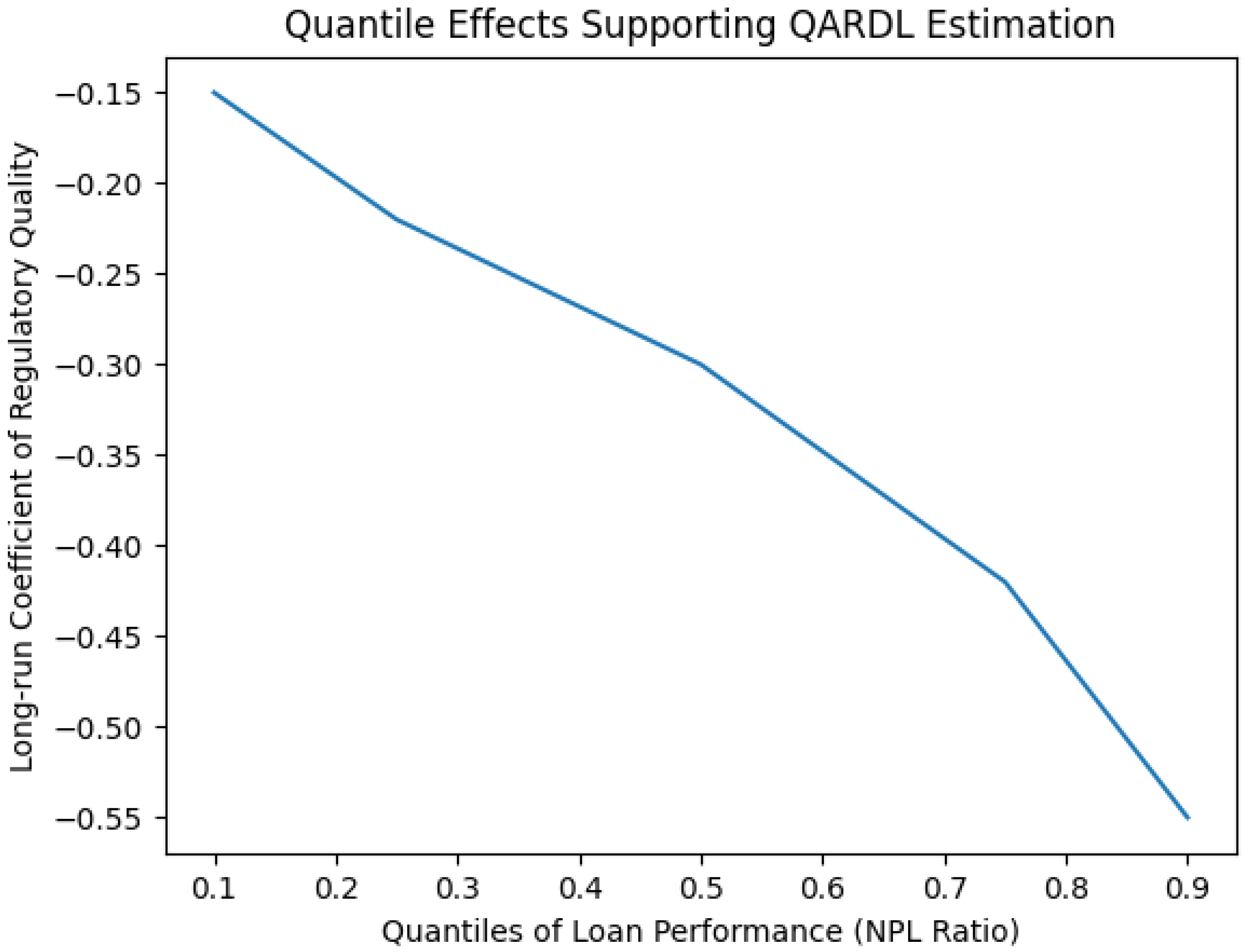
Table 6 above determined the average short-run and long-run impact of regulatory quality and economic policy uncertainty on the loan performance across the 15 Sub-Saharan African nations during the time frame 2008Q1 2024Q4. Nevertheless, the mean-based ARDL model implies that the parameters are constant throughout the conditional distribution of non-performing loans (NPLs). Since financial systems in the region are fragile, and regime-dependent dynamics of credit risk could occur, such average estimates can obscure important distributional heterogeneity. To begin with, the quantile effect graph is used to visually evaluate the difference in the magnitude of the coefficients at the chosen quantiles (0.25, 0.50 and 0.75) of loan performance. This method is based on the quantile regression model proposed by
Koenker and Bassett (
1978), which makes it possible to estimate the conditional relationships at various levels of the distribution of the dependent variable. Second, Wald tests of equality of the slopes across quantiles in line with the methodology developed by
Koenker and Machado (
1999) are conducted to formally test whether the estimated coefficients are significantly different across the conditional distribution of NPLs.
3.10. Quantile Effect Graph
Figure 1 shows the quantile effect graph apparent distributional heterogeneity in the correlation between regulatory quality, economic policy uncertainty and loan performance. In particular, the coefficients are significantly large throughout the conditional distribution of non-performing loans (NPLs) and the coefficients are large at the upper quantiles (0.75–0.90), which are associated with the high credit-risk regimes. This trend implies that the influence of the institutional quality and policy uncertainty is more severe in times of financial distress, which implies regime-dependent tendencies that can be inadequately explained by the mean-based estimation.
Table 7 shows that the Wald statistics reject the null hypothesis at the 1 percent level of significance, showing that the impact of regulatory quality and uncertainty of economic policy varies significantly throughout the distribution of loan performance. This empirical finding shows that the mean-based PARDL findings conceal significant distributional and regime-specific differences. In this respect, the Quantile Autoregressive Distributed Lag (QARDL) model, as shown in
Table 8, is relevant, since it helps estimate quantile-specific short-run and long-run dynamics to gain a more comprehensive insight into credit risk behaviour in the context of fragile Sub-Saharan African financial systems.
The short-run and long-run elasticity are shown in
Table 8, which not only shows the impact on the outcome variable but also acts as a robustness check on the earlier adopted estimation techniques.
4. Discussions and Policy Implications of Findings
4.1. Standard ARDL Result
Empirical results show robust and statistically significant links between regulatory quality, economic policy uncertainty, and loan performance. In addition to being statistically significant, the economic significance of these effects is large. This negative coefficient of the regulatory quality suggests that credit risk decreases substantially when institutions get better, emphasizing the importance of effective regulatory oversight in financial stability. For instance, the long-run coefficient of −1.27 indicates that institutional improvement has a strong effect on the credit risk exposure. These reductions also translate to improvements in banking stability, especially when compared to the average NPL ratio of about 9.8% in SSA. The positive signs of policy uncertainty variables, on the other hand, indicate that there is a material impact on loan portfolios when uncertainty persists, highlighting the need for credible and predictable policy frameworks.
The short-run coefficients show that the contemporaneous effects of changes in regulatory quality and policy uncertainty are also statistically significant and have smaller magnitudes when compared with the long-run effects. Better regulatory quality also minimizes NPLs in the short-term, indicating both short-term supervisory and enforcement impacts. Therefore, combining the findings of the Panel ARDL, there is strong evidence that regulatory quality and economic policy uncertainty are the main long-run drivers of loan performance in SSA. Regulatory enhancements can play a role in long-run declines in non-performing loans, but long-term uncertainty, especially in relation to monetary and fiscal factors, also has long-term negative impacts on credit quality.
4.2. Quantile ARDL Result
The quantile analysis also shows that such effects are not necessarily homogeneous along the loan performance distribution. Regulatory quality has a greater effect on countries with higher risk levels, implying that it is especially important in times of financial crisis. The negative impacts of policy uncertainty are also stronger at higher quantiles, suggesting that policy uncertainty is a systemic risk amplifier in weak financial systems. The results reveal that an analysis of credit risk dynamics needs to be nonlinear and state-dependent, because mean-based models can mask important financial system behaviour heterogeneity.
We considered the error correction representations of both PARDL and QARDL models. This is significant in assessing how promptly the loan performance has adjusted to the shocks and dynamics of regulatory quality and uncertainty of the economic policies. After this, we observe a shift of short-run deviation to long-run equilibrium in all the models estimated, with different speeds of adjustment. The error correction term takes the right sign in such cases. They are all negatively significant, as reported, and confirm that there is convergence in the long run with the disequilibrium in the short run as a result of shocks and deviations. According to the PARDL, the approximated coefficient of adjustment is −0.34, which suggests that about 34 percent of short-run disequilibrium in the non-performing loans would be remedied within one quarter, which implies a medium rate of convergence to long-run equilibrium following a policy or institutional shock. This rate of adjustment indicates the low shock-absorbing ability of vulnerable SSA banking systems, whereby credit risk does not adjust immediately. The outcome of the QARDL also demonstrates that the rate of adjustment is greater in higher NPL levels: about 19 percent of disequilibrium is being corrected in one quarter at Q0.25 and 48 percent at Q0.75. This implies that banking systems in extreme stress tend to readjust quicker and more frequently by credit contraction, loan restructuring or regulatory intervention, compared to stable times.
4.3. Financial Risk Implications
The findings of this study give important insights into financial risk management in SSA banking systems. Economic policy uncertainty becomes a major systemic risk factor, especially in times of financial stress, when its impact on loan performance is magnified.
The quality of regulation is poor, which raises the risk of risk accumulation by decreasing the ability to effectively supervise and enforce. This creates an environment in which credit risks can build up unchecked, eventually leading to financial instability. Moreover, new uncertainties related to the financial digitalization, geopolitical risks and cyber risks emerge, which can intensify the risk of impaired loan performance. These developments require a forward-looking regulatory approach which combines prudential regulation with new risk.
4.4. Model Validation
The diagnostic results as reported in
Table 9 below confirm the robustness and reliability of the estimated model. The explanatory power of the model is high, which shows that the selected variables together explain a significant variation in non-performing loans. A further confirmation of the overall significance of the model is provided by the F-statistic (
p = 0.0000). The Breusch–Pagan–Godfrey test (
p = 0.6945) suggests that the variance of the residuals is not heteroscedastic. The Breusch–Godfrey LM test (
p = 0.1248) suggests that there is no serial correlation of the residuals. The Ramsey RESET test (
p = 0.7374) shows that there are no significant functional form misspecifications involved in the model. In addition, the Jarque–Bera test (
p = 0.8896) suggests that the residuals are normally distributed. Overall, these diagnostic results suggest that the model meets the necessary econometric assumptions, leading to stable, efficient, and appropriate estimates of its coefficients for robust statistical inference.
5. Conclusions and Recommendations
This paper explores the dynamic impacts of regulatory quality and economic policy uncertainty on loan performance in weak financial systems in 15 economies in Sub-Saharan Africa, based on quarterly data between 2008Q1 and 2024Q4. Using a Panel ARDL (PMG) model complemented by the Quantile ARDL (QARDL) model, a strong long-run cointegrating relationship has been developed between non-performing loans, regulatory quality, and policy uncertainty.
The results reveal that the quality of regulation consistently decreases non-performing loans, and its stabilizing impact increases with the increasing strength of credit risk. Conversely, the uncertainty in the monetary, fiscal and general economic policy leads to a considerable rise in the non-performing loans, especially in high-stress regimes. According to the QARDL results, the NPL distribution exhibits a high level of heterogeneity, and in times of financial vulnerability, policy uncertainty is a systemic risk enhancer. The large and adverse error-correction components among models affirm that there is a significant and noteworthy adjustment in the long run, but convergence speed differs with the degree of financial strain. In general, the evidence reveals that institutional capability and the credibility of policies are the key factors for maintaining the quality of loans and financial stability in the weak banking systems in the SSA.
This study yields several policy suggestions. Increasing the quality of the regulatory system should be a key objective of financial sector reforms in SSA. This involves strengthening the independence of supervisors, as well as the capacity for enforcement and transparency of the rules. Political interference in the regulatory process is especially important and should be curbed through institutional reforms. Second, a macroprudential approach, including countercyclical capital buffers, dynamic loan-loss provisioning, and stress testing, should be emphasized, to reduce systemic risk and improve the banking sector’s resilience.
Third, providing credibility and predictability to policy regimes in both money and finance is essential to lower economic-policy uncertainty. Clear policy communication and forward guidance can be significant in shaping expectations and bolstering borrower confidence. Fourth, regulations should include measures for digital risk management to mitigate new risks arising from financial innovation, such as cyber risks and fintech risks. Lastly, there is a need for regional coordination, such as regulatory harmonization and policy signalling, between countries in SSA, to reduce cross-border spillover effects and increase financial stability in a more interdependent financial system.
Limitations and Future Research
The research provides some valuable insights which are in line with, and complementary to, the prevailing literature in this area, but are conducted within certain boundaries and limitations. One of the critical constraints of the study was its reliance on aggregated country-level data that may mask bank-level heterogeneity in loan performance. Second, although the endogeneity has been minimized, there may also be reverse causality between regulatory quality and NPLs. Third, the indicator of economic policy uncertainty is based on proxy indexes which might not sufficiently reflect country-specific dynamics.
Despite these constraints, the contributions of the study to the tant literature cannot be overemphasized. It provides a solid foundation for future investigations, offering a clearer direction for scholars and practitioners interested in the interplay of regulatory quality, economic policy uncertainty and loan performance. Bank-level data, sophisticated econometric methods like System-GMM, and newly identified risks like digital finance and climate risks, could be used in future research.
Future studies could also compare Sub-Saharan Africa to emerging regions like Latin America, South Asia, Southeast Asia, the Middle East and North Africa. A cross-regional comparative study would be useful for determining the region-specific or generalizable nature of the conclusions drawn from the results of SSA. This would increase the external validity of the framework and its relevance to the broader emerging-market banking systems.




 ,
,