1. Introduction
‘Foreign Direct Investment plays a critical role in the economic development of emerging economies by facilitating technology transfer, enhancing productivity, and fostering innovation and managerial capacity’ (
Ali et al., 2023;
Benzaim et al., 2021;
Moralles & Moreno, 2020). It also contributes to workforce training, integrates domestic industries into global supply chains, and stimulates competition, thereby improving technical efficiency and resource allocation (
Fu et al., 2021;
Huan & Qamruzzaman, 2022;
Orji et al., 2021). ‘Given these benefits, understanding the factors that influence FDI flows remains a priority for policymakers in developing countries’ (
Ali et al., 2023;
Desbordes & Franssen, 2019;
Huan & Qamruzzaman, 2022). A key factor affecting FDI is exchange rate volatility, which can significantly shape the investment decisions of multinational corporations (
Firoozi, 1997;
MacDermott, 2008;
Taylor et al., 2021). Currency fluctuations introduce uncertainty about future returns, potentially discouraging long-term commitments in host countries (
Dai et al., 2023). The motivation for this research is rooted in the increasing significance of exchange rate stability as a determinant of India’s macroeconomic resilience. While FDI is a primary driver of technology transfer and industrial growth in India, the persistent fluctuations of the rupee introduce substantial uncertainty into the risk–return calculus of foreign investors. This study is specifically justified by the ‘uncertainty channel,’ which posits that exchange rate volatility can discourage long-term capital commitments by reducing expected returns and increasing the value of waiting to invest. Despite India’s growing integration into global capital markets, there remains a notable lack of consensus in the literature regarding how these currency dynamics influence investment under varying economic conditions. By moving beyond traditional mean-based analysis, this study provides a more robust justification for how Indian monetary and exchange rate policies should be tailored to different phases of the FDI cycle—specifically distinguishing between periods of weak and strong capital inflows to better support domestic industrial performance.
‘Existing studies have explored the effect of exchange rate movements on FDI across various contexts, but results remain mixed, with some highlighting deterrent effects while others suggest limited or conditional impacts based on sector or region’ (
Cushman & Vita, 2017;
Firoozi, 1997). Despite this growing body of research, there is limited consensus on the causal relationship between exchange rate volatility and FDI in the Indian context, particularly using modern econometric frameworks.
This study addresses this gap by examining the impact of exchange rate volatility on FDI inflows to India over the period 1990–2023. The research aims to assess how fluctuations in currency values influence the risk–return calculus of foreign investors, ultimately affecting investment volumes. It also seeks to evaluate whether macroeconomic uncertainty, as reflected in exchange rate volatility, serves as a barrier or stimulus to foreign investment inflows. This study contributes to the existing literature by addressing the limited consensus on the relationship between exchange rate volatility and FDI in the Indian context through the application of the Quantile Autoregressive Distributed Lag (QARDL) framework. A significant novelty of this research lies in its departure from conventional mean-based estimators, such as the standard ARDL model, which often fail to capture the heterogeneous and asymmetric responses of FDI under varying economic conditions. By utilizing the QARDL approach, this study provides a more nuanced justification for how currency fluctuations impact investment differently across the entire FDI distribution—specifically during periods of low, moderate, and high inflows. This methodological choice reveals that exchange rate depreciation stimulates investment primarily during moderate and high investment phases, whereas it remains an insufficient driver when inflows are weak—a distinction that mean-based models overlook. Consequently, this research offers substantial theoretical and empirical contributions by uncovering regime-dependent dynamics that are vital for external sector policymakers in India.
By exploring these channels, this paper seeks to deepen understanding of the complex interplay between exchange rate volatility and FDI. The findings could offer valuable insights for policymakers aiming to enhance FDI inflows and address the challenges posed by currency fluctuations. The remainder of this paper is organized as follows:
Section 2 establishes the theoretical framework, outlining the core hypotheses that link exchange rate dynamics to investment decisions.
Section 3 provides a comprehensive review of the literature, highlighting the mixed findings in previous research.
Section 4 details the research methodology, specifically justifying and specifying the QARDL model.
Section 5 presents the empirical results and discussion, including diagnostic tests and cross-validation with other studies. Finally,
Section 6 offers the conclusion, summarizing the key findings and providing clear-cut policy recommendations for the Indian economy.
3. Review of Literature
The relationship between exchange rate fluctuations and Foreign Direct Investment has been a subject of extensive research, yielding diverse and often contradictory findings across various economies and time periods. This divergence highlights the complex interplay of macroeconomic factors, country-specific characteristics, and methodological approaches.
Some research indicates a ‘positive or limited effect of exchange rate movements on FDI’. Okonkwo et al. found that ‘both real exchange rate and nominal exchange rate are positively related with foreign direct investment’ in Nigeria, recommending ‘a sustained/stable exchange rate level which will serve as attraction of foreign investors for increased inflow of foreign direct investment’ (
Okonkwo & Ukoh, 2021). Udomkerdmongkol et al. suggest ‘a cheaper local currency (a higher value implies a cheaper currency and attracts FDI)’ for US FDI into emerging market countries (
Udomkerdmongkol et al., 2009). Additionally, McCloud et al. noted ‘the most prevalent type of symbiosis between FDI and the exchange rate is a positive effect of FDI on the exchange rate, but no effect of the exchange rate on FDI’ across developed and developing economies (
McCloud et al., 2023). Furthermore, a study on Vietnam observed ‘a positive causal relationship between FDI and Vietnam’s real effective exchange rate’ (
Huong et al., 2020).
Conversely, a significant body of literature points to a negative relationship, where exchange rate volatility deters FDI.
Ramirez (
2010) provided evidence from Latin America showing that lagged changes in real exchange rate volatility exert a negative effect on foreign direct investment. Specifically for India, Durairaj and Nirmala concluded that ‘exchange rate volatility deters FDI in India, suggesting that flexible but stable exchange rate system may be needed to successfully attract FDI inflows in India’ (
Durairaj & Nirmala, 2012). Dhasmana’s work indicated that ‘exchange rate uncertainty is found to affect firm-level employment growth adversely on average’ in India (
Dhasmana, 2021). Mustafa et al. reported ‘a strong negative connection between short and long-term fluctuations in currency rates and FDI inflows’ in Pakistan, using an ARDL model (
Mustafa et al., 2024). Sultana et al., in their PMG-ARDL panel data analysis across emerging markets, stated that to attract FDI a nation should ‘stabilize exchange rates, and minimize economic indebtedness’ (
Sultana et al., 2024). Agarwal generally affirms that ‘currency fluctuations significantly influence the investment decisions of individuals’ in India (
Agarwal, 2023). MacDermott’s study, applying a fixed-effects gravity model to panel data, found that ‘weak host currencies and greater exchange rate volatility are found to discourage FDI flows’ (
MacDermott, 2008). Similarly, Gidey and Nuru indicated that ‘high exchange rate uncertainty affects domestic investment negatively’ in South Africa (
Gidey & Nuru, 2021). Bénassy-Quéré et al. also concluded that ‘exchange-rate volatility is detrimental to foreign direct investment’ (
Bénassy-Quéré et al., 2001). Using data from Japan,
Kiyota and Urata (
2004) found a negative relationship between exchange rate volatility and FDI inflows, implying that higher volatility discourages foreign investment.
The mixed findings underscore the importance of context-specific analyses and robust econometric methodologies.
Latief and Lefen (
2018) found ‘no consensus on the nature of this impact’ of exchange rate volatility on FDI. However, other ARDL studies, such as Kanodia et al. on India, highlighted that ‘domestic investment, inflation rate, level of infrastructure and trade openness influence inward FDI flows,’ with market size being insignificant (
Kanodia et al., 2023). These factors ‘have both long and short-term relationship with FDI inflows’ (
Kanodia et al., 2023). Firoozi notes that ‘existing investigations have indicated mixed results regarding multinationals’ FDI response to changes in return uncertainty’ (
Firoozi, 1997). Cushman and De Vita found that ‘empirical analyses with a variety of countries have found effects from volatility in both directions, or neither’ (
Cushman & Vita, 2017). Theoretical explanations for this complexity include the ‘uncertainty channel,’ where ‘exchange rate volatility creates uncertainty, reducing expected returns and discouraging FDI’ (
Dai et al., 2023). Another is the ‘financing channel,’ where ‘volatility can lead to a decrease in financial support from multinational parent enterprises’ (
Dai et al., 2023;
Wuri et al., 2025). Real options theory also posits that ‘higher exchange rate uncertainty increases the value of waiting, thereby tending to depress current FDI inflows’ (
Taylor et al., 2021). A significant limitation in prior research concerning FDI in relation to exchange rates, inflation, and industrial output is the frequent reliance on linear, mean-based frameworks that overlook the potential for distributional heterogeneity. Many existing studies—such as those by
Durairaj and Nirmala (
2012) or
Mustafa et al. (
2024)—examine these macroeconomic determinants through aggregated models that may fail to capture how their influence shifts during different phases of the FDI cycle. Furthermore, there is a notable scarcity of research that treats industrial productivity and price stability as integrated components of the exchange rate–FDI nexus, often resulting in mixed or conflicting findings regarding their collective impact. By failing to account for these nonlinearities and the regime-dependent nature of investment, previous methodologies often mask the complex ways in which domestic structural fundamentals and external currency movements interact. This gap underscores the necessity of an integrated methodology like the QARDL framework, which can simultaneously evaluate these determinants across the entire distribution of FDI inflows.
5. Empirical Analysis
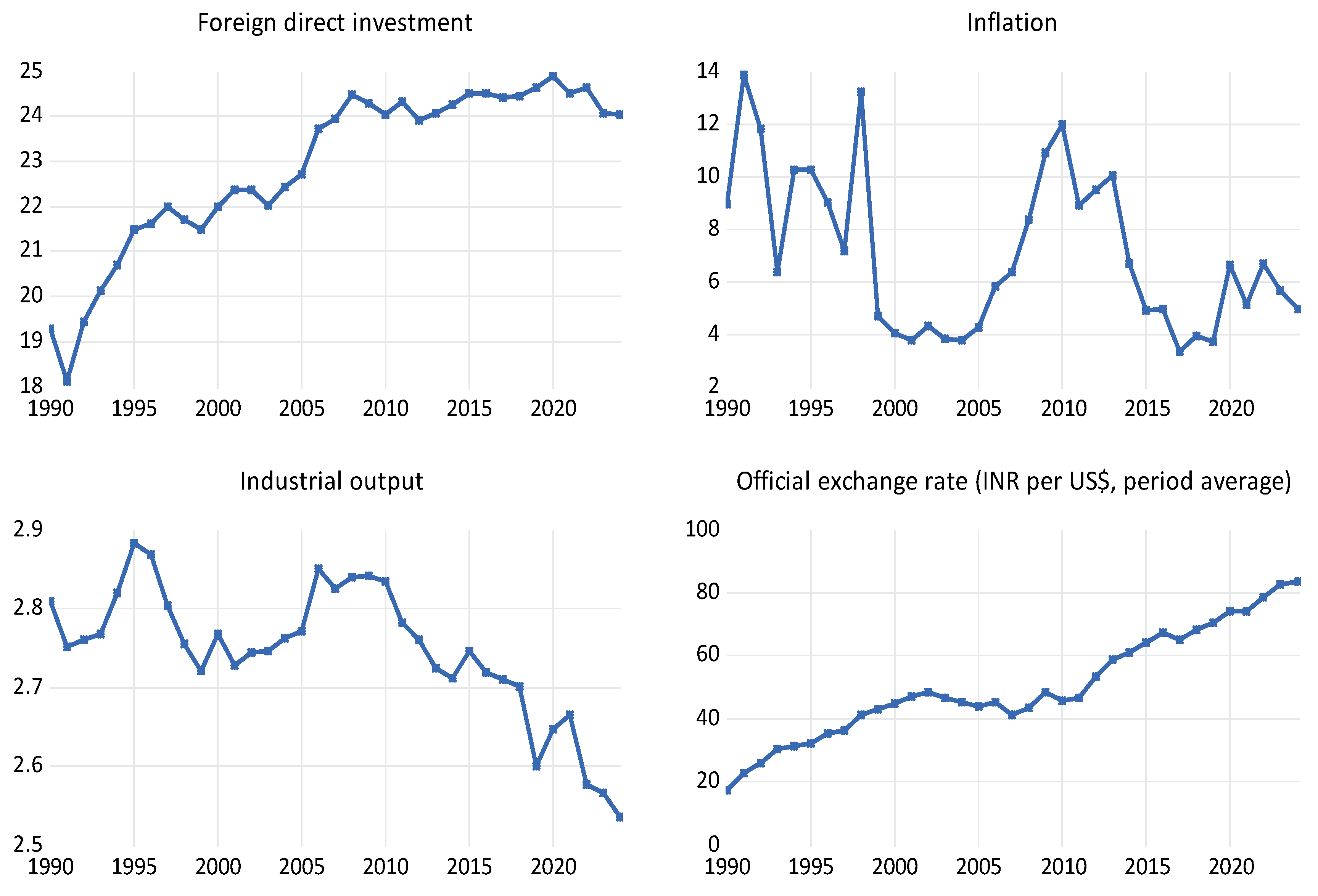
Figure 1 presents a long-term overview of India’s macroeconomic performance, illustrating the evolution of the exchange rate, foreign direct investment inflows, inflation, and manufacturing value added over time. Foreign direct investment (FDI) inflows remained modest during the 1990s but increased significantly from the mid-2000s, reflecting the impact of economic liberalization and growing investor confidence, before peaking around 2018–2019 and declining thereafter, likely due to global uncertainty and pandemic-related disruptions. Inflation was relatively high and volatile in the early 1990s but declined and stabilized from the 2000s onward, indicating improved monetary policy management, although occasional spikes suggest continued exposure to supply-side and external shocks. In contrast, manufacturing value added as a share of GDP shows a gradual downward trend, particularly after 2010, pointing to signs of relative deindustrialization and structural shifts within the economy. Meanwhile, the official exchange rate exhibits a persistent upward movement, indicating a steady depreciation of the Indian rupee against the US dollar. While this depreciation may have enhanced export competitiveness, it also likely contributed to imported inflationary pressures. Overall, these trends suggest that India has experienced improved macroeconomic stability and increased integration into global capital markets, but continues to face structural challenges, particularly in sustaining industrial growth and managing external vulnerabilities.
Table 2 presents the descriptive statistics of the variables used in the analysis. The average value of FDI is 9.57, with a median of 9.56, indicating a relatively balanced distribution around the mean. The standard deviation of 0.81 suggests moderate variability in FDI inflows during the sample period. The exchange rate has a mean value of 68.04 rupees per US dollar, reflecting gradual currency depreciation over time, with noticeable volatility as indicated by a standard deviation of 8.34. Industrial output shows the highest variability among the variables, with a standard deviation of 7.96 and extreme values ranging from −57.30 to 27.60, indicating periods of significant contraction and expansion in industrial activity. Inflation averages 5.91, suggesting moderate price growth, while broad money supply (M3) has a mean of 10.36, reflecting steady monetary expansion. The skewness and kurtosis statistics indicate that most variables deviate slightly from normality, particularly industrial output, which exhibits strong negative skewness and high kurtosis, suggesting the presence of extreme observations. The Jarque–Bera test confirms non-normality for some variables, supporting the use of distribution-sensitive approaches such as quantile-based estimation methods.
Table 3 shows the unit root test results, which evaluate the stationarity of the dataset, which is a crucial step in ensuring the reliability of the econometric model. At their level form, variables such as FDI, Industrial Output, and inflation are found to be stationary, particularly when a constant or trend is included, as indicated by probability values of 0.0000. However, the Exchange Rate and Inflation demonstrate non-stationarity at their levels, failing to reject the null hypothesis of a unit root in most specifications. This inconsistency is resolved when examining the variables at their first difference, where every indicator—including FDI, Exchange Rate, Industrial Output, and Inflation—reaches stationarity at a 1% significance level across all test types. This combination of I(0) and I(1) variables provides the statistical justification for employing the QARDL methodology used in the study.
Table 4 presents the empirical results of the Quantile Autoregressive Distributed Lag (QARDL) model examining the relationship between the exchange rate and foreign direct investment (FDI) in India. Unlike conventional mean-based estimators, the QARDL framework allows the impact of explanatory variables to vary across different points of the conditional distribution of FDI. This approach is particularly useful for capturing potential asymmetries and heterogeneous dynamics in investment behavior, as the determinants of FDI may differ when inflows are relatively low, moderate, or high.
The analysis focuses on three key quantiles of the FDI distribution (τ = 0.333, τ = 0.5, and τ = 0.667), representing lower, median, and upper investment regimes. The results provide insights into both the long-run equilibrium relationship and short-run dynamics between exchange rate movements and FDI inflows, while controlling for domestic macroeconomic conditions including industrial output and inflation. In addition, the significance and sign of the error correction term are examined to determine whether a stable long-run equilibrium relationship exists across the different quantiles. To enhance the clarity of the empirical findings and resolve potential ambiguity, the results in
Table 3 are presented with a clear illustrative differentiation between the long-run and short-run dynamics. Variables presented in their level form—specifically Exchange Rate, Industrial Output, and Inflation—represent the long-run coefficients, capturing the equilibrium relationship between these determinants and FDI across the distribution. In contrast, variables preceded by the difference operator ‘D’ (e.g., D(Exchange Rate)) specifically denote the short-run impacts. This structural distinction is critical for the QARDL framework, as it allows for a precise interpretation of how macroeconomic factors exert different effects on foreign investment depending on the time horizon and the specific investment regime being analyzed.
The long-run estimates show that the exchange rate coefficient is positive and becomes statistically significant at the 50th and 66.7th quantiles. Specifically, at the median quantile (τ = 0.5), the coefficient (0.0354) is positive and significant at the 1% level, while at τ = 0.667, the coefficient (0.0352) remains positive and highly significant. However, at the lower quantile (τ = 0.333), the effect is positive but statistically insignificant. This pattern indicates that exchange rate depreciation (higher rupee per USD) stimulates FDI inflows particularly when FDI is at moderate and higher levels, but not when FDI is relatively low. The result implies asymmetric exchange rate effects across the distribution of FDI. When FDI inflows are already strong, currency depreciation may enhance cost competitiveness and asset acquisition incentives for foreign investors. However, when FDI inflows are weak, exchange rate movements do not significantly influence investment decisions, possibly due to underlying structural or macroeconomic constraints. The ECM coefficient is negative and statistically significant across all quantiles. This confirms the presence of a stable long-run equilibrium relationship. The magnitude is largest (in absolute terms) at the median quantile, suggesting faster adjustment toward equilibrium when FDI is at moderate levels. The negative and significant coefficient validates the existence of mean-reverting dynamics and supports the robustness of the long-run specification.
Industrial output is positive and statistically significant only at the lower quantile (τ = 0.333). This suggests that when FDI inflows are relatively low, domestic industrial performance plays an important role in attracting foreign investment. However, at median and upper quantiles, industrial output becomes statistically insignificant, implying that once FDI inflows reach moderate or high levels, other factors—such as exchange rate competitiveness—become more influential. The estimated coefficient of inflation remains statistically insignificant across all quantiles. Although coefficients are positive, their lack of significance suggests that inflation does not play a decisive long-run role in determining FDI inflows in India within this model specification. This may indicate that investors view inflation as manageable or that macroeconomic stabilization policies mitigate its adverse effects.
The differenced exchange rate variable is statistically insignificant across all quantiles. Although the coefficient is positive at the lower and median quantiles and negative at the upper quantile, none are significant. This suggests that short-run exchange rate volatility does not immediately influence FDI inflows. Investors appear to respond more to long-run exchange rate trends rather than short-term fluctuations. The QARDL findings provide critical insights that align with the Reserve Bank of India’s (RBI) evolving policy framework. The statistically significant positive impact of long-run exchange rate depreciation at the median and upper quantiles suggests that the RBI’s strategy of allowing a gradual, market-determined depreciation helps maintain India’s export competitiveness, which in turn attracts foreign capital looking for cost-efficient production hubs. Conversely, the insignificance of short-run exchange rate volatility across all quantiles reflects the success of the RBI’s ‘managed float’ regime, which aims to curb excessive daily fluctuations while allowing the rupee to find its long-term equilibrium. This suggests that foreign investors have gained confidence in the RBI’s ability to prevent disorderly market conditions, choosing to base their decisions on long-term structural trends rather than temporary currency shocks. Furthermore, the insignificance of inflation in our model indicates that the RBI’s inflation-targeting framework (formally adopted in 2016) has successfully stabilized investor expectations, ensuring that price movements remain within manageable bounds and do not act as a deterrent to long-term capital commitments. Differenced industrial output is highly significant and positive at the lower quantile (τ = 0.333) but insignificant elsewhere. This indicates that improvements in domestic economic activity matter most when FDI is relatively weak. In stronger FDI regimes, short-run domestic output changes do not significantly alter investment flows. The findings of this study, which highlight a regime-dependent relationship between exchange rate depreciation and FDI, align with and extend existing cross-country literature. Specifically, the positive impact of depreciation observed at the median and upper quantiles (τ = 0.5 and 0.667) is consistent with the ‘cost competitiveness’ findings of
Udomkerdmongkol et al. (
2009) in emerging markets and
Huong et al. (
2020) in Vietnam. However, our results provide a necessary nuance that contrasts with mean-based studies, such as
Mustafa et al. (
2024) in Pakistan and
Sultana et al. (
2024) in emerging markets, which reported a uniform negative link between currency fluctuations and FDI. While previous Indian studies using traditional ARDL methods, such as
Durairaj and Nirmala (
2012), suggested that volatility universally deters investment, our QARDL results demonstrate that this effect is not uniform across all investment levels. By moving beyond the mean-based estimators used in prior research, this study validates that currency dynamics are primary drivers only during moderate-to-strong investment phases, whereas domestic industrial performance—consistent with the findings of
Kanodia et al. (
2023)—is the more critical determinant during weak investment periods. This cross-methodological validation underscores the superiority of the QARDL framework in resolving the ‘mixed results’ often reported in the literature. In the specific context of the Indian economy, these findings underscore the evolving nature of India’s external sector since the 1991 market reforms. The positive long-run impact of rupee depreciation observed at the median and upper quantiles suggests that for the mature, export-oriented segments of Indian industry that attract the bulk of FDI, a competitive exchange rate effectively enhances cost efficiency and encourages asset acquisition. Conversely, the insignificance of the exchange rate during periods of weak investment (lower quantiles) reflects the structural bottlenecks within India’s industrial landscape, particularly the gradual decline in manufacturing value added as a share of GDP seen since 2010. This indicates that during ‘laggard’ investment phases, currency adjustments cannot compensate for underlying issues such as infrastructure gaps or signs of relative deindustrialization. Furthermore, the lack of short-run significance suggests that foreign investors in India have become increasingly resilient to temporary rupee volatility, choosing instead to focus on the long-term macroeconomic stability and growth potential fostered by the country’s integration into global capital markets.
6. Conclusions
This study examined the relationship between exchange rate movements and foreign direct investment (FDI) inflows in India using the Quantile Autoregressive Distributed Lag (QARDL) framework. By allowing the effects of macroeconomic variables to vary across different points of the FDI distribution, the analysis provides deeper insights into the heterogeneous dynamics underlying foreign investment behavior. The results reveal significant asymmetries in how exchange rate movements influence FDI across investment regimes.
The empirical findings indicate that exchange rate depreciation exerts a positive and statistically significant effect on FDI inflows in the long run, particularly at the median and upper quantiles of the FDI distribution. This suggests that currency competitiveness becomes increasingly important when FDI inflows are already moderate or high. In contrast, the exchange rate effect is insignificant when FDI inflows are relatively low, implying that exchange rate adjustments alone are insufficient to attract investment in weaker investment environments. These findings highlight the presence of regime-dependent effects and underscore the importance of macroeconomic conditions in shaping investor responses.
The error correction term is negative and statistically significant across all quantiles, confirming the existence of a stable long-run equilibrium relationship between FDI and its determinants. The magnitude of the adjustment coefficient suggests that deviations from the long-run equilibrium are corrected relatively quickly, particularly at the median quantile. This indicates that the FDI system in India exhibits strong mean-reverting dynamics.
The results also reveal that domestic economic activity, measured by industrial output, plays a more important role in attracting FDI when investment inflows are relatively weak. However, its influence diminishes as FDI inflows increase, suggesting that once investment levels become sufficiently strong, other factors—such as exchange rate competitiveness—become more influential. Inflation, on the other hand, does not appear to significantly influence FDI inflows within the model specification, indicating that investors may perceive inflationary pressures as manageable within the broader macroeconomic environment.
Short-run dynamics further indicate that exchange rate volatility does not significantly influence FDI inflows. This suggests that foreign investors are more responsive to long-term macroeconomic trends rather than temporary currency fluctuations. The findings therefore emphasize the importance of sustained macroeconomic stability and competitiveness in attracting and maintaining foreign investment.
Overall, the results highlight the importance of considering distributional heterogeneity when analyzing the determinants of FDI. The asymmetric effects uncovered by the QARDL model demonstrate that policy interventions may have different impacts depending on the prevailing investment regime. For policymakers, this implies that exchange rate management alone may not be sufficient to stimulate FDI during periods of weak investment. Instead, strengthening domestic economic fundamentals and improving industrial performance may be more effective in attracting foreign capital during such periods. The empirical evidence from this study provides several clear-cut policy implications for Indian macroeconomic management. First, the regime-dependent nature of the FDI–exchange rate nexus suggests that a ‘one-size-fits-all’ exchange rate policy is insufficient. During periods of weak FDI inflows, policymakers should prioritize strengthening domestic industrial performance and improving structural economic fundamentals, as currency depreciation alone fails to act as a significant driver in this regime. Second, as FDI inflows transition into moderate or high phases, the Reserve Bank of India should maintain a focus on exchange rate competitiveness, as depreciation becomes a statistically significant stimulus for investment at these higher quantiles. Finally, the insignificance of short-run volatility suggests that investors are more concerned with long-term currency trends rather than temporary fluctuations. Therefore, policy interventions should be geared toward ensuring sustained long-term macroeconomic stability and industrial productivity, rather than merely managing short-term currency market interventions, to foster a resilient environment for foreign capital. Conversely, maintaining exchange rate competitiveness can play a critical role in sustaining higher levels of foreign investment once the economy enters a stronger investment phase.
Future research could extend this analysis by incorporating additional structural variables such as institutional quality, trade openness, and financial development to further explore the mechanisms through which macroeconomic conditions influence foreign investment dynamics in emerging economies.