


From Financial Practices to Sustainable Outcomes: A Resilience-Based Perspective


Abstract
1. Introduction
2. Literature Review and Hypothesis Development
Hypotheses Development
3. Materials and Methods
3.1. Purpose of the Paper
3.2. Data Collection and Sample
3.3. Data Analysis
3.4. Measures and Instrument Development
4. Results
5. Discussion
6. Conclusions
Author Contributions
Funding
Institutional Review Board Statement
Informed Consent Statement
Data Availability Statement
Conflicts of Interest
References
- Akgün, A. E., & Keskin, H. (2014). Organisational resilience capacity and firm product innovativeness and performance. International Journal of Production Research, 52(23), 6918–6937. [Google Scholar] [CrossRef]
- Ameer, R., & Othman, R. (2012). Sustainability practices and corporate financial performance: A study based on the top global corporations. Journal of Business Ethics, 108(1), 61–79. [Google Scholar] [CrossRef]
- Attridge, S., & Novak, C. (2022). Governance. In An exploration of bilateral development finance institutions’ business models (pp. 59–61). ODI. Available online: http://www.jstor.org/stable/resrep51285.14 (accessed on 8 April 2026).
- Avdimetaj, E., Lulaj, E., & Alcoriza, G. B. (2025). Bridging theory to practice: Empowering indigenous businesses through innovative analysis of audited financial statements. In I. Ghosal, S. Gupta, S. Rana, & D. Saha (Eds.), Indigenous empowerment through human-machine interactions: The challenges and strategies from business lenses. Emerald Publishing. [Google Scholar] [CrossRef]
- Ayalew, M. M., & Zhang, J. H. (2024). Financial structure and innovation: Firm-level evidence from Africa. Asian Review of Accounting, 33(2), 189–222. [Google Scholar] [CrossRef]
- Bani Mfarrej, M. F., Belyamani, I., Ahmad, S. Z., & Abu Bakar, A. R. (2025). Exploring the path to sustainable firm performance: The role of leadership, learning, and procurement in SMEs. Sustainable Futures, 10, 101454. [Google Scholar] [CrossRef]
- Bansal, P., & DesJardine, M. R. (2014). Business sustainability: It is about time. Strategic Organization, 12, 70–78. [Google Scholar] [CrossRef]
- Barney, J. (1991). Firm resources and sustained competitive advantage. Journal of Management, 17, 99–120. [Google Scholar] [CrossRef]
- Baron, R. M., & Kenny, D. A. (1986). The moderator–mediator variable distinction in social psychological research: Conceptual, strategic, and statistical considerations. Journal of Personality and Social Psychology, 51(6), 1173–1182. [Google Scholar] [CrossRef] [PubMed]
- Bates, T. W., Kahle, K. M., & Stulz, R. M. (2009). Why do U.S. firms hold so much more cash than they used to? The Journal of Finance, 64(5), 1985–2021. [Google Scholar] [CrossRef]
- Bazyari, A. (2025). Optimal risk management strategies in a diffusion risk process: A simultaneous problem. Scandinavian Actuarial Journal, 2025(7), 718–740. [Google Scholar] [CrossRef]
- Bercovitz, J., & Mitchell, W. (2007). When is more better? The impact of business scale and scope on long-term business survival, while controlling for profitability. Strategic Management Journal, 28(1), 61–79. [Google Scholar] [CrossRef]
- Bianchi, M., & Bobba, M. (2013). Liquidity, risk, and occupational choices. The Review of Economic Studies, 80(2), 491–511. [Google Scholar] [CrossRef]
- Birou, L. M., Green, K. W., & Inman, R. A. (2019). Sustainability knowledge and training: Outcomes and firm performance. Journal of Manufacturing Technology Management, 30(2), 294–311. [Google Scholar] [CrossRef]
- Bolton, P., Chen, H., & Wang, N. (2011). A unified theory of Tobin’s q, corporate investment, financing, and risk management. The Journal of Finance, 66(5), 1545–1578. [Google Scholar] [CrossRef]
- Boubaker, S., Cellier, A., Manita, R., & Saeed, A. (2020). Does corporate social responsibility reduce financial distress risk? Economic Modelling, 91, 835–851. [Google Scholar] [CrossRef]
- Bourgeois, L. J. (1981). On the measurement of organizational slack. The Academy of Management Review, 6(1), 29–39. [Google Scholar] [CrossRef]
- Bourgeois, L. J. (1985). Strategic goals, perceived uncertainty, and economic performance in volatile environments. The Academy of Management Journal, 28(3), 548–573. [Google Scholar] [CrossRef]
- Branicki, L. J., Sullivan-Taylor, B., & Livschitz, S. R. (2018). How entrepreneurial resilience generates resilient SMEs. International Journal of Entrepreneurial Behavior & Research, 24(7), 1244–1263. [Google Scholar] [CrossRef]
- Brown, T. A. (2015). Confirmatory factor analysis for applied research (2nd ed.). Guilford Press. [Google Scholar]
- Bryman, A. (2016). Social research methods (5th ed.). Oxford University Press. [Google Scholar]
- Burch, S. (2018). Small businesses and sustainability innovation: Confronting the gap between motivation and capacity. Centre for International Governance Innovation. Available online: http://www.jstor.org/stable/resrep17322 (accessed on 10 April 2026).
- Calder, B. J., Phillips, L. W., & Tybout, A. M. (1982). The concept of external validity. Journal of Consumer Research, 9(3), 240–244. [Google Scholar] [CrossRef]
- Campello, M., Graham, J. R., & Harvey, C. R. (2010). The real effects of financial constraints: Evidence from a financial crisis. Journal of Financial Economics, 97(3), 470–487. [Google Scholar] [CrossRef]
- Chung, A. M., Chung, R. K., & Pounder, J. S. (2026). Financial behavior toward suppliers by ethical conscientious companies: Evidence from Hong Kong-listed companies. The Chinese Economy, 59(1), 17–36. [Google Scholar] [CrossRef]
- Conz, E., & Magnani, G. (2020). A dynamic perspective on the resilience of firms: A systematic literature review and a framework for future research. European Management Journal, 38(3), 400–412. [Google Scholar] [CrossRef]
- Corbett, R. B. (2004). A view of the future of risk management. Risk Management, 6(3), 51–56. [Google Scholar] [CrossRef]
- Crum, L. R. (1953). The role of cost accounting in cost control. The Accounting Review, 28(3), 363–372. [Google Scholar] [CrossRef]
- Cruz, R., Nobre, F., & dos Santos, J. P. (2025). The economic footprint of short-term rentals on local businesses: Evidence from Portugal. IZA—Institute of Labor Economics. Available online: http://www.jstor.org/stable/resrep73782 (accessed on 10 April 2026).
- Cyert, R. M., & March, J. G. (1963). A behavioral theory of the firm. Prentice Hall/Pearson Education. [Google Scholar]
- Dang, V. A., Kim, M., & Shin, Y. (2012). Asymmetric capital structure adjustments: New evidence from dynamic panel threshold models. Journal of Empirical Finance, 19(4), 465–482. [Google Scholar] [CrossRef]
- DeAngelo, H., & DeAngelo, L. (2007). Capital structure, payout policy, and financial flexibility (Marshall School of Business Working Paper No. FBE 02-06). SSRN. [Google Scholar] [CrossRef]
- DeAngelo, H., DeAngelo, L., & Whited, T. M. (2011). Capital structure dynamics and transitory debt. Journal of Financial Economics, 99, 235–261. [Google Scholar] [CrossRef]
- DeVellis, R. F. (2016). Scale development: Theory and applications (Vol. 26). Sage. [Google Scholar]
- Ding, W., Levine, R., Lin, C., & Xie, W. (2021). Corporate immunity to the COVID-19 pandemic. Journal of Financial Economics, 141(2), 802–830. [Google Scholar] [CrossRef] [PubMed]
- Dinh, H. T. T., Nguyen, Q. L. H. T. T., & Thanh Nguyen, P. (2024). Constructing a resilience measurement model for small and medium-sized enterprises in Vietnam: A PLS-SEM approach. Journal of Eastern European and Central Asian Research (JEECAR), 11(3), 526–536. [Google Scholar] [CrossRef]
- Duchek, S. (2020). Organizational resilience: A capability-based conceptualization. Business Research, 13, 215–246. [Google Scholar] [CrossRef]
- Eccles, R. G., Ioannou, I., & Serafeim, G. (2014). The impact of corporate sustainability on organizational processes and performance. Management Science, 60(11), 2835–2857. [Google Scholar] [CrossRef]
- Eckles, D. L., Hoyt, R. E., & Miller, S. M. (2014). The impact of enterprise risk management on the marginal cost of reducing risk: Evidence from the insurance industry. Journal of Banking & Finance, 43, 247–261. [Google Scholar] [CrossRef]
- ElAlfy, A., & Weber, O. (2019). The financial sector and sustainability. In Corporate sustainability reporting: The case of the banking industry (pp. 8–9). Centre for International Governance Innovation. Available online: http://www.jstor.org/stable/resrep24967.11 (accessed on 9 April 2026).
- Epstein, M. J., & Roy, M.-J. (2003). Making the business case for sustainability: Linking social and environmental actions to financial performance. The Journal of Corporate Citizenship, 9, 79–96. [Google Scholar] [CrossRef]
- Etikan, I., Musa, S. A., & Alkassim, R. S. (2016). Comparison of convenience sampling and purposive sampling. American Journal of Theoretical and Applied Statistics, 5, 1–4. [Google Scholar] [CrossRef]
- Fabrigar, L. R., Wegener, D. T., MacCallum, R. C., & Strahan, E. J. (1999). Evaluating the use of exploratory factor analysis in psychological research. Psychological Methods, 4(3), 272–299. [Google Scholar] [CrossRef]
- Faff, R., Kwok, W. C., Podolski, E. J., & Wong, G. (2016). Do corporate policies follow a life-cycle? Journal of Banking & Finance, 69, 95–107. [Google Scholar] [CrossRef]
- Farrell, M., & Gallagher, R. (2019). Moderating influences on the ERM maturity–performance relationship. Research in International Business and Finance, 47, 616–628. [Google Scholar] [CrossRef]
- Fatemi, A., Glaum, M., & Kaiser, S. (2018). ESG performance and firm value: The moderating role of disclosure. Global Finance Journal, 38, 45–64. [Google Scholar] [CrossRef]
- Fatemi, A. M., & Fooladi, I. J. (2013). Sustainable finance: A new paradigm. Global Finance Journal, 24(2), 101–113. [Google Scholar] [CrossRef]
- Florio, C., & Leoni, G. (2017). Enterprise risk management and firm performance: The Italian case. The British Accounting Review, 49, 56–74. [Google Scholar] [CrossRef]
- Folke, C., Carpenter, S. R., Walker, B., Scheffer, M., Chapin, T., & Rockström, J. (2010). Resilience thinking: Integrating resilience, adaptability and transformability. Ecology and Society, 15(4), 20. [Google Scholar] [CrossRef]
- Fornell, C., & Larcker, D. F. (1981). Evaluating structural equation models with unobservable variables and measurement error. Journal of Marketing Research, 18(1), 39–50. [Google Scholar] [CrossRef]
- Freedman, J. (2000). Limited liability: Large company theory and small firms. The Modern Law Review, 63(3), 317–354. [Google Scholar] [CrossRef]
- Gabriel, S. C., & Baker, C. B. (1980). Concepts of business and financial risk. American Journal of Agricultural Economics, 62(3), 560–564. [Google Scholar] [CrossRef]
- Gaspar, J., & Massa, M. (2006). Idiosyncratic volatility and product market competition. The Journal of Business, 79(6), 3125–3152. [Google Scholar] [CrossRef]
- Gennaioli, N., & Shleifer, A. (2018). A crisis of beliefs: Investor psychology and financial fragility. Princeton University Press. [Google Scholar] [CrossRef]
- Graham, J. R., & Harvey, C. R. (2001). The theory and practice of corporate finance: Evidence from the field. Journal of Financial Economics, 60, 187–243. [Google Scholar] [CrossRef]
- Graham, J. R., Leary, M. T., & Roberts, M. R. (2015). A century of capital structure: The leveraging of corporate America. Journal of Financial Economics, 118(3), 658–683. [Google Scholar] [CrossRef]
- Guo, J., He, J., Pu, J., & Yang, Y. (2025). Impact of emergencies and supply chain resilience on corporate financial decision-making: An empirical analysis of Chinese manufacturing firms. Asia Pacific Business Review, 1–32. [Google Scholar] [CrossRef]
- Hair, J. F., Black, W. C., Babin, B. J., & Anderson, R. E. (2019). Multivariate data analysis (8th ed.). Cengage Learning. [Google Scholar]
- Hair, J. F., Jr., Hult, G. T. M., Ringle, C. M., & Sarstedt, M. (2022). A primer on partial least squares structural equation modeling (PLS-SEM) (3rd ed.). SAGE Publications. [Google Scholar]
- Hayes, A. F. (2018a). Introduction to mediation, moderation, and conditional process analysis: A regression-based approach (methodology in the social sciences) (2nd ed.). The Guilford Press. [Google Scholar]
- Hayes, A. F. (2018b). Partial, conditional, and moderated moderated mediation: Quantification, inference, and interpretation. Communication Monographs, 85(1), 4–40. [Google Scholar] [CrossRef]
- Helfat, C. E., Finkelstein, S., Mitchell, W., Peteraf, M. A., Singh, H., Teece, D. J., & Winter, S. G. (2007). Dynamic capabilities: Understanding strategic change in organizations. Blackwell Publishing. [Google Scholar]
- Hillmann, J., & Guenther, E. (2021). Organizational resilience: A valuable construct for management research? International Journal of Management Reviews, 23, 7–44. [Google Scholar] [CrossRef]
- Hoyt, R. E., & Liebenberg, A. P. (2011). The value of enterprise risk management. The Journal of Risk and Insurance, 78(4), 795–822. [Google Scholar] [CrossRef]
- Hörisch, J., Freeman, R. E., & Schaltegger, S. (2014). Applying stakeholder theory in sustainability management: Links, similarities, dissimilarities, and a conceptual framework: Links, similarities, dissimilarities, and a conceptual framework. Organization & Environment, 27(4), 328–346. [Google Scholar] [CrossRef]
- Hu, L.-t., & Bentler, P. M. (1999). Cutoff criteria for fit indexes in covariance structure analysis: Conventional criteria versus new alternatives. Structural Equation Modeling, 6(1), 1–55. [Google Scholar] [CrossRef]
- IBM Corp. (2017a). IBM SPSS Amos for Windows, Version 25.0. IBM Corp. Available online: https://www.ibm.com/products/spss-amos (accessed on 11 January 2026).
- IBM Corp. (2017b). IBM SPSS Statistics for Windows, Version 25.0. IBM Corp. Available online: https://www.ibm.com/products/spss-statistics (accessed on 10 January 2026).
- International Accounting Standards Board (IASB). (2018). Conceptual framework for financial reporting. IFRS Foundation. [Google Scholar]
- Jarvis, C. B., MacKenzie, S. B., & Podsakoff, P. M. (2003). A critical review of construct indicators and measurement model misspecification in marketing and consumer research. Journal of Consumer Research, 30(2), 199–218. [Google Scholar] [CrossRef]
- Jensen, C., & Meckling, H. (1976). Theory of the firm: Managerial behavior, agency costs and ownership structure. Journal of Financial Economics, 3, 305–360. [Google Scholar] [CrossRef]
- Jensen, M. C. (1986). Agency costs of free cash flow, corporate finance, and takeovers. The American Economic Review, 76(2), 323–329. [Google Scholar]
- Jiang, W., & Liu, B. (2025). Registration reform: A game-changer for corporate financial discipline? Finance Research Letters, 85(Pt E), 108254. [Google Scholar] [CrossRef]
- Kahn, W. A., Barton, M. A., & Fellows, S. (2013). Organizational crises and the disturbance of relational systems. The Academy of Management Review, 38(3), 377–396. [Google Scholar] [CrossRef]
- Kantur, D., & İşeri-Say, A. (2012). Organizational resilience: A conceptual integrative framework. Journal of Management & Organization, 18(6), 762–773. [Google Scholar] [CrossRef]
- Kaplan, S. N., & Minton, B. A. (2012). How has CEO turnover changed? Review of Financial Studies, 25(1), 1–46. [Google Scholar] [CrossRef]
- Kline, R. B. (2016). Principles and practice of structural equation modeling (4th ed.). The Guilford Press. [Google Scholar]
- Kose, M. A., Kurlat, S., Ohnsorge, F., & Sugawara, N. (2022). A cross-country database of fiscal space. Journal of International Money and Finance, 128, 102682. [Google Scholar] [CrossRef]
- Kukalaj, R., Lulaj, E., & Dragusha, B. (2025). Evaluating business performance through audited financial statements: Considerations for future trends in indigenous finance. In I. Ghosal, S. Gupta, S. Rana, & D. Saha (Eds.), Indigenous empowerment through human-machine interactions: The challenges and strategies from business lenses. Emerald Publishing. [Google Scholar] [CrossRef]
- Kukalaj, R., Lulaj, E., Shabani, H., & Mazreku, I. (2026). Control, sustainability, and risk: A structural perspective within financial decision systems. EDPACS, 1–16. [Google Scholar] [CrossRef]
- Langeland, K. S., Manheim, D., McLeod, G., & Nacouzi, G. (2016). Adapt and respond: Supply-chain risk management. In How civil institutions build resilience: Organizational practices derived from academic literature and case studies (pp. 19–26). RAND Corporation. Available online: http://www.jstor.org/stable/10.7249/j.ctt1btc0m7.10 (accessed on 11 April 2026).
- Lengnick-Hall, C. A., Beck, T. E., & Lengnick-Hall, M. L. (2011). Developing a capacity for organizational resilience through strategic human resource management. Human Resource Management Review, 21, 243–255. [Google Scholar] [CrossRef]
- Likert, R. (1932). A technique for the measurement of attitudes. Archives of Psychology, 140, 1–55. [Google Scholar]
- Lozano, R. (2015). A holistic perspective on corporate sustainability drivers. Corporate Social Responsibility and Environmental Management, 22(1), 32–44. [Google Scholar] [CrossRef]
- Lulaj, E. (2023). A sustainable business profit through customers and its impacts on three key business domains: Technology, innovation, and service (TIS). Business, Management and Economics Engineering, 21(1), 19–47. [Google Scholar] [CrossRef]
- Lulaj, E. (2024). Thriving amidst uncertainty: A financial blueprint for the public budget. Public Sector Economics, 48(4), 493–528. [Google Scholar] [CrossRef]
- Lulaj, E. (2025a). Decoding the financial zeitgeist: A scientific exploration of the calculus of capital for cost-efficient and sustainable growth in investments and operations. BAR-Brazilian Administration Review, 22(2), e230171. [Google Scholar] [CrossRef]
- Lulaj, E. (2025b). Digitalization as catalysts of change in finance, accounting, and reporting: Uncovering symbiotic relationships among financial factors. Studies in Business and Economics, 20(1), 97–124. [Google Scholar] [CrossRef]
- Lulaj, E. (2025c). Discerning financial and investment epiphanies: Challenges, inhibitions, and global perspectives—What secrets does research reveal? Studia Universitatis “Vasile Goldis” Arad—Economics Series, 35(3), 1–38. [Google Scholar] [CrossRef]
- Lulaj, E. (2025d). Penny-wise acumen in costonomics: Transforming costs into entrepreneurial gold through smart financial management. Journal of Risk and Financial Management, 18(1), 9. [Google Scholar] [CrossRef]
- Lulaj, E. (2025e). Unearthing the depths of revenue precision: A cutting-edge research agenda for empowering agile finance. Croatian Economic Survey, 27(1), 29–70. [Google Scholar] [CrossRef]
- Lulaj, E. (2026). Spotlight on sustainable finance and managerial accounting: The analytical triad for a profitable and sustainable future. Thailand and The World Economy, 44(1), 26–61. [Google Scholar]
- Lulaj, E., & Brajković, M. (2025). The moderating role of finance, accounting, and digital disruption in ESG, financial reporting, and auditing: A triple-helix perspective. Journal of Risk and Financial Management, 18(5), 245. [Google Scholar] [CrossRef]
- Lulaj, E., Dragusha, B., & Hysa, E. (2023). Investigating accounting factors through audited financial statements in businesses toward a circular economy: Why a sustainable profit through qualified staff and investment in technology? Administrative Sciences, 13(3), 72. [Google Scholar] [CrossRef]
- Lulaj, E., Dragusha, B., & Lulaj, D. (2024). Market mavericks in emerging economies: Redefining sales velocity and profit surge in today’s dynamic business environment. Journal of Risk and Financial Management, 17(9), 395. [Google Scholar] [CrossRef]
- Lulaj, E., Hysa, E., & Panait, M. (2026). Does digitalization drive sustainable transformation in finance and accounting? Kybernetes, 55(1), 631–657. [Google Scholar] [CrossRef]
- Lulaj, E., & Lulaj, D. (2025). Expenses mastery: Thriving on thrift for sustainable budgeting and elevating Finnov. Ekonomika, 104(4), 27–42. [Google Scholar] [CrossRef]
- Lulaj, E., & Minguez-Vera, A. (2024). Cash flow dynamics: Amplifying swing models in a volatile economic climate for financial resilience and outcomes. Scientific Annals of Economics and Business, 71(3), 315–336. [Google Scholar] [CrossRef]
- Lulaj, E., & Thakore, R. (2026). Sustainability tactics in consumer finance: Exploring moderation of behavior, desire and service. EDPACS, 1–20. [Google Scholar] [CrossRef]
- Lynch, J. G. (1983). The role of external validity in theoretical research. Journal of Consumer Research, 10(1), 109–111. [Google Scholar] [CrossRef]
- Makadok, R. (2001). Toward a synthesis of the resource-based and dynamic-capability views of rent creation. Strategic Management Journal, 22, 387–401. [Google Scholar] [CrossRef]
- Markowitz, H. (1952). Portfolio selection. The Journal of Finance, 7(1), 77–91. [Google Scholar] [CrossRef]
- Markowitz, H. (1959). Portfolio selection: Efficient diversification of investment. John Wiley & Sons. [Google Scholar]
- McGrath, J. E., & Brinberg, D. (1983). External validity and the research process: A comment on the Calder/Lynch dialogue. Journal of Consumer Research, 10(1), 115–124. [Google Scholar] [CrossRef]
- McShane, M. K., Nair, A., & Rustambekov, E. (2011). Does enterprise risk management increase firm value? Journal of Accounting, Auditing & Finance, 26(4), 641–658. [Google Scholar] [CrossRef]
- Medcalfe, S., & Miralles Miro, E. (2021). Sustainable practices and financial performance in fashion firms. Journal of Fashion Marketing and Management: An International Journal, 26(1), 141–158. [Google Scholar] [CrossRef]
- Merchant, K. A. (1981). The design of the corporate budgeting system: Influences on managerial behavior and performance. The Accounting Review, 56(4), 813–829. [Google Scholar] [CrossRef]
- Mikes, A., & Kaplan, R. R. (2014). Towards a contingency theory of enterprise risk management (pp. 1–45). Working Paper 13-063. Harvard Business School. [Google Scholar]
- Miller, K. D. (1992). A framework for integrated risk management in international business. Journal of International Business Studies, 23(2), 311–331. [Google Scholar] [CrossRef]
- Miroudot, S. (2020). Resilience versus robustness in global value chains: Some policy implications. VoxEU CEPR. [Google Scholar]
- Modigliani, F., & Miller, M. H. (1958). The cost of capital, corporation finance and the theory of investment. The American Economic Review, 48(3), 261–297. [Google Scholar]
- Mura, R., Vicentini, F., Botti, L. M., & Chiriacò, M. V. (2023). Economic and environmental outcomes of a sustainable and circular approach: Case study of an Italian wine-producing firm. Journal of Business Research, 154, 113300. [Google Scholar] [CrossRef]
- Myers, S. C. (1977). Determinants of corporate borrowing. Journal of Financial Economics, 5, 147–175. [Google Scholar] [CrossRef]
- Ngilisho, M., Mori, N., & Kitindi, E. (2025). The effect of company goals on the relationship between foreign ownership and financial performance of listed companies in Kenya and Tanzania. Journal of African Business, 1–30. [Google Scholar] [CrossRef]
- Nguyen, T. H. (2024). The impact of capital structure on the performance of state-invested enterprises in Vietnam. Cogent Economics & Finance, 12(1), 2399955. [Google Scholar] [CrossRef]
- Nocco, B., & Stulz, R. (2006). Enterprise risk management: Theory and practice. Journal of Applied Corporate Finance, 18, 8–20. [Google Scholar] [CrossRef]
- Nunnally, J. C., & Bernstein, I. H. (1994). Psychometric theory (3rd ed.). McGraw-Hill. [Google Scholar]
- Ortiz-de-Mandojana, N., & Antolín-López, R. (2023). How do companies measure and report corporate sustainability? A comparison among the most innovative European companies (JRC Publication No. 132579). Publications Office of the European Union. [Google Scholar] [CrossRef]
- Ortiz-de-Mandojana, N., & Bansal, P. (2016). The long-term benefits of organizational resilience through sustainable business practices. Strategic Management Journal, 37(8), 1615–1631. [Google Scholar] [CrossRef]
- Pabico, C. (2015). Creating supportive environments and thriving in a volatile, uncertain, complex, and ambiguous world. The Journal of Nursing Administration, 45(10), 471–473. [Google Scholar] [CrossRef]
- Pal, R., Torstensson, H., & Mattila, H. (2014). Antecedents of organizational resilience in economic crises—An empirical study of swedish textile and clothing SMEs. International Journal of Production Economics, 147, 410–428. [Google Scholar] [CrossRef]
- Palinkas, L. A., Horwitz, S. M., Green, C. A., Wisdom, J. P., & Duan, N. (2015). Purposeful sampling for qualitative data collection and analysis in mixed method implementation research. Administration and Policy in Mental Health and Mental Health Services Research, 42, 533–544. [Google Scholar] [CrossRef]
- Penrose, E. (1995). The theory of the growth of the firm (3rd ed.). Oxford University Press. [Google Scholar] [CrossRef]
- Podsakoff, P. M., MacKenzie, S. B., Lee, J.-Y., & Podsakoff, N. P. (2003). Common method biases in behavioral research: A critical review of the literature and recommended remedies. Journal of Applied Psychology, 88(5), 879–903. [Google Scholar] [CrossRef] [PubMed]
- Preacher, K. J., & Hayes, A. F. (2008). Asymptotic and resampling strategies for assessing and comparing indirect effects in multiple mediator models. Behavior Research Methods, 40(3), 879–891. [Google Scholar] [CrossRef] [PubMed]
- Rappaport, A. (2005). The economics of short-term performance obsession. Financial Analysts Journal, 61(3), 65–79. [Google Scholar] [CrossRef]
- Raykov, T. (1997). Estimation of composite reliability for congeneric measures. Applied Psychological Measurement, 21(2), 173–184. [Google Scholar] [CrossRef]
- Schilke, O., Hu, S., & Helfat, C. E. (2018). Quo vadis, dynamic capabilities? A content-analytic review of the current state of knowledge and recommendations for future research. Academy of Management Annals, 12(1), 390–439. [Google Scholar] [CrossRef]
- Sizeland, E. (2025). Front Matter. In Resilience first: Strengthening individuals, securing the United States, and protecting the free world (pp. 1–6). Atlantic Council. Available online: http://www.jstor.org/stable/resrep71436.1 (accessed on 12 April 2026).
- Slater, S. F., & Zwirlein, T. J. (1996). The structure of financial strategy: Patterns in financial decision making. Managerial and Decision Economics, 17(3), 253–266. [Google Scholar] [CrossRef]
- Tabachnick, B. G., & Fidell, L. S. (2019). Using multivariate statistics (7th ed.). Pearson. [Google Scholar]
- Teece, D. J., Pisano, G., & Shuen, A. (1997). Dynamic capabilities and strategic management. Strategic Management Journal, 18(7), 509–533. [Google Scholar] [CrossRef]
- van der Vegt, G. S., Essens, P., Wahlström, M., & George, G. (2015). From the editors—Managing risk and resilience [Editorial]. Academy of Management Journal, 58(4), 971–980. [Google Scholar] [CrossRef]
- Volonino, L., & Watson, H. J. (1990). The strategic business objectives method for guiding executive information systems development. Journal of Management Information Systems, 7(3), 27–39. [Google Scholar] [CrossRef]
- Walker, B., Holling, C. S., Carpenter, S. R., & Kinzig, A. (2004). Resilience, adaptability and transformability in social–ecological systems. Ecology and Society, 9(2), 5. [Google Scholar] [CrossRef]
- Wang, Z., Huang, J., Tang, S., Luo, R., & Huang, H. (2025). Can restrictive green financial policies enhance enterprise value? The mediating role of ESG performance. Applied Economics Letters, 1–5. [Google Scholar] [CrossRef]
- Wu, W., Zhang, S., Fan, Y., & Shi, Y. (2024). Financial flexibility, firm performance, and financial distress: A comparative study of China and the U.S. during pandemics. International Review of Financial Analysis, 96(Pt B), 103706. [Google Scholar] [CrossRef]
- Zhu, C., Liang, X., & Yao, J. (2025). The role of market value management and liquidity management in the shareholder equity management-firm performance relationship. Cogent Business & Management, 12(1), 2464950. [Google Scholar] [CrossRef]



| Factor | Code | Measurement Items | Source |
|---|---|---|---|
| Financial Discipline (FD) | FD1 | Cost and profitability targets are clearly defined | Akgün and Keskin (2014) Lulaj et al. (2024) Bani Mfarrej et al. (2025) Lulaj and Brajković (2025) Kukalaj et al. (2025) Bazyari (2025) Birou et al. (2019) Branicki et al. (2018) Duchek (2020) Jiang and Liu (2025) McShane et al. (2011) Freedman (2000) Lulaj (2025c) Avdimetaj et al. (2025) |
| FD2 | Credit and liability policies are regularly reviewed | ||
| FD3 | Cost accounting techniques are systematically applied | ||
| FD4 | High-cost debt is prioritized for repayment | ||
| FD5 | Internal financing is preferred over external debt | ||
| Financial Risk Management (FRM) | FRM1 | Long-term savings and investment strategies aim to ensure financial stability | |
| FRM2 | Financial resources are diversified as part of long-term strategy | ||
| FRM3 | Investment decisions align with strategic development objectives | ||
| FRM4 | Investment portfolios are periodically reviewed and rebalanced | ||
| FRM5 | Financial risks are systematically identified and addressed | ||
| Financial Resilience Capacity (FRC) | FRC1 | Financial resources are structured to absorb unexpected shocks | |
| FRC2 | Financial reserves support continuity during adverse conditions | ||
| FRC3 | Financial planning prioritizes long-term resilience over short-term gains | ||
| FRC4 | Financial capacity enables stable operations under uncertainty | ||
| FRC5 | Expert input is used to strengthen financial resilience | ||
| Financial Sustainability (FSS) | FSS1 | Financial performance remains stable over time | |
| FSS2 | Long-term financial obligations can be consistently met | ||
| FSS3 | Financial viability is maintained under economic uncertainty | ||
| FSS4 | Operations can be sustained without financial distress |
| Variable | Category | No. | % |
|---|---|---|---|
| EXP | Less than 5 years | 36 | 16.6 |
| 5–10 years | 93 | 42.9 | |
| 11–15 years | 54 | 24.9 | |
| More than 15 years | 34 | 15.7 | |
| GEN | Male | 148 | 68.2 |
| Female | 69 | 31.8 | |
| AGE | Under 30 years | 60 | 27.6 |
| 30–39 years | 75 | 34.6 | |
| 40–49 years | 57 | 26.3 | |
| 50 years and above | 25 | 11.5 | |
| EDU | Bachelor’s degree | 74 | 34.1 |
| Master’s degree or higher | 104 | 47.9 | |
| Other | 39 | 18.0 | |
| POS | Senior management/Executive | 78 | 35.9 |
| Financial manager/Controller | 88 | 40.6 | |
| Middle management | 16 | 7.4 | |
| Other professional position | 35 | 16.1 |
| Variable | Mean | SD | GEN | AGE | EDU | POS | EXP | FD | FRM | FRC | FSS |
|---|---|---|---|---|---|---|---|---|---|---|---|
| GEN | 1.32 | 0.47 | 1 | ||||||||
| AGE | 2.22 | 0.98 | 0.40 ** | 1 | |||||||
| EDU | 1.84 | 0.70 | −0.08 | 0.31 ** | 1 | ||||||
| POS | 2.04 | 1.04 | 0.31 ** | 0.22 ** | 0.08 | 1 | |||||
| EXP | 2.40 | 0.94 | 0.71 ** | 0.50 ** | 0.04 | 0.69 ** | 1 | ||||
| FD | 3.36 | 1.18 | 0.60 ** | 0.61 ** | 0.31 ** | 0.71 ** | 0.85 ** | 1 | |||
| FRM | 3.22 | 1.28 | 0.63 ** | 0.63 ** | 0.32 ** | 0.71 ** | 0.87 ** | 0.97 ** | 1 | ||
| FRC | 3.27 | 1.17 | 0.60 ** | 0.61 ** | 0.34 ** | 0.68 ** | 0.82 ** | 0.93 ** | 0.94 ** | 1 | |
| FSS | 3.31 | 0.84 | 0.59 ** | 0.62 ** | 0.31 ** | 0.57 ** | 0.75 ** | 0.86 ** | 0.89 ** | 0.83 ** | 1 |
| Factor | Items | FD | FRM | FRC | FSS | KMO | TVE (%) | α |
|---|---|---|---|---|---|---|---|---|
| FD | FD1 | 0.909 | ||||||
| FD2 | 0.699 | |||||||
| FD3 | 0.947 | |||||||
| FD4 | 0.938 | |||||||
| FD5 | 0.968 | 0.85 | 80.6 | 0.94 | ||||
| FRM | FRM1 | 0.932 | ||||||
| FRM2 | 0.982 | |||||||
| FRM3 | 0.981 | |||||||
| FRM4 | 0.979 | |||||||
| FRM5 | 0.981 | 0.90 | 94.3 | 0.98 | ||||
| FRC | FRC1 | 0.905 | ||||||
| FRC2 | 0.748 | |||||||
| FRC3 | 0.952 | |||||||
| FRC4 | 0.827 | |||||||
| FRC5 | 0.781 | 0.84 | 71.6 | 0.89 | ||||
| FSS | FSS1 | 0.867 | ||||||
| FSS2 | 0.899 | |||||||
| FSS3 | 0.895 | |||||||
| FSS4 | 0.840 | 0.62 | 61.6 | 0.72 |
| Construct | Item | SL | CR | AVE | MaxR(H) |
|---|---|---|---|---|---|
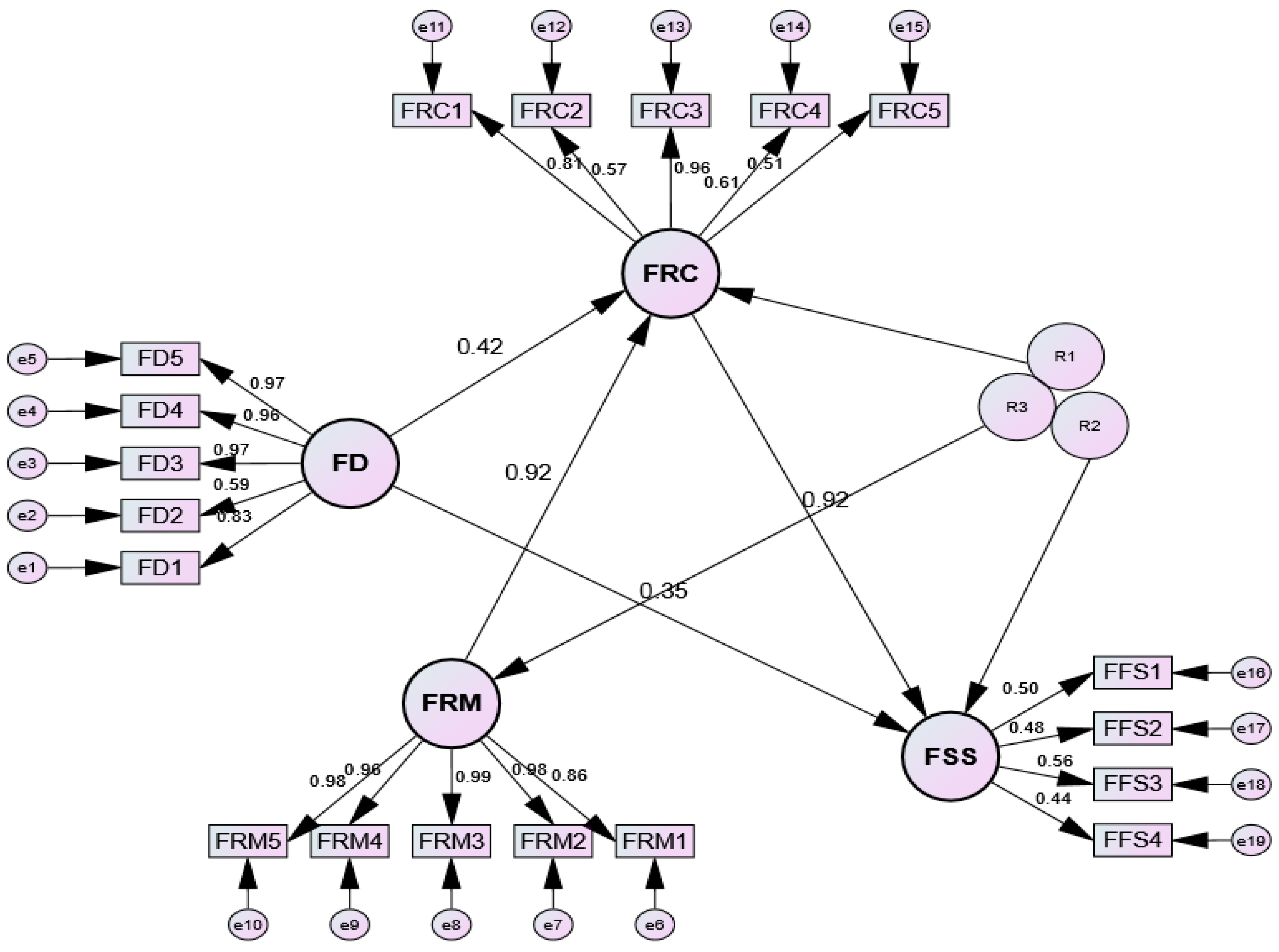
| Financial Discipline (FD) | FD1 | 0.88 | 0.94 | 0.77 | 0.99 |
| FD2 | 0.59 | ||||
| FD3 | 0.93 | ||||
| FD4 | 0.92 | ||||
| FD5 | 0.96 | ||||
| Financial Risk Management (FRM) | FRM1 | 0.89 | 0.98 | 0.93 | 0.99 |
| FRM2 | 0.98 | ||||
| FRM3 | 0.96 | ||||
| FRM4 | 0.97 | ||||
| FRM5 | 0.99 | ||||
| Financial Resilience Capacity (FRC) | FRC1 | 0.90 | 0.90 | 0.65 | 0.97 |
| FRC2 | 0.68 | ||||
| FRC3 | 0.98 | ||||
| FRC4 | 0.75 | ||||
| FRC5 | 0.68 | ||||
| Financial Sustainability (FSS) | FSS1 | 0.54 | 0.71 | 0.45 | 0.73 |
| FSS2 | 0.69 | ||||
| FSS3 | 0.75 | ||||
| FSS4 | 0.54 |
| Fit Index | Recommended Criterion | Model Value | Evaluation |
|---|---|---|---|
| χ2 (CMIN) | — | 170.44 | — |
| Degrees of Freedom (df) | — | 102 | — |
| χ2/df (CMIN/DF) | <2.00 | 1.67 | Excellent |
| RMR | <0.05 | 0.03 | Excellent |
| GFI | ≥0.90 | 0.93 | Excellent |
| AGFI | ≥0.85 | 0.86 | Excellent |
| NFI | ≥0.95 | 0.98 | Excellent |
| IFI | ≥0.95 | 0.99 | Excellent |
| TLI | ≥0.95 | 0.98 | Excellent |
| CFI | ≥0.95 | 0.99 | Excellent |
| RMSEA | ≤0.06 | 0.06 | Excellent (close fit) |
| RMSEA PCLOSE | >0.05 | 0.25 | Excellent (close fit supported) |
| PNFI | ≥0.50 | 0.58 | Excellent |
| PCFI | ≥0.50 | 0.59 | Excellent |
| Hoelter (0.05) | ≥150 | 161 | Excellent |
| Hoelter (0.01) | ≥150 | 176 | Excellent |
| Hypothesis | Path | B | SE | C.R. | p Value | β | CIlow | CIhigh | Supported |
|---|---|---|---|---|---|---|---|---|---|
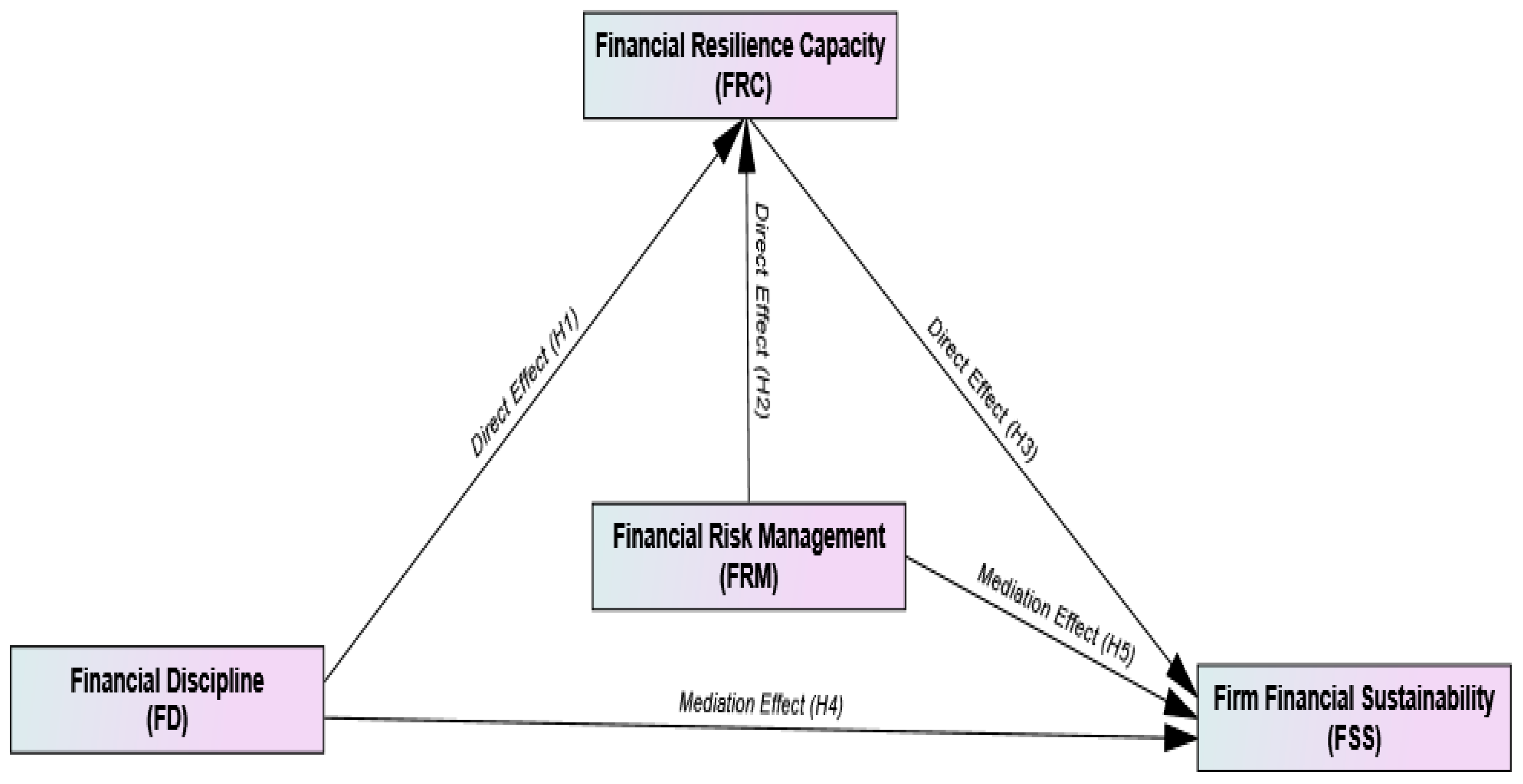
| H1 | FD → FRC | 0.366 | 0.029 | 12.529 | <0.001 (***) | 0.418 | 0.130 | 0.783 | Yes |
| H2 | FRM → FRC | 0.801 | 0.053 | 15.142 | <0.001 (***) | 0.919 | 0.631 | 0.997 | Yes |
| H3 | FRC → FSS | 0.461 | 0.058 | 7.989 | <0.001 (***) | 0.919 | 0.205 | 1.312 | Yes |
| Hypothesis | Indirect Path | Indirect β | p Value | Direct β | CIlow | CIhigh | Total β | Supported |
|---|---|---|---|---|---|---|---|---|
| H4 | FD → FRC → FSS | 0.384 | 0.039 (**) | 0.345 | 0.054 | 0.986 | 0.729 | Supported (Partial mediation) |
| H5 | FRM → FRC → FSS | 0.845 | 0.027 (**) | — | 0.189 | 1.058 | 0.845 | Supported (Full mediation) |
Disclaimer/Publisher’s Note: The statements, opinions and data contained in all publications are solely those of the individual author(s) and contributor(s) and not of MDPI and/or the editor(s). MDPI and/or the editor(s) disclaim responsibility for any injury to people or property resulting from any ideas, methods, instructions or products referred to in the content. |
© 2026 by the authors. Licensee MDPI, Basel, Switzerland. This article is an open access article distributed under the terms and conditions of the Creative Commons Attribution (CC BY) license.
Share and Cite
Lulaj, E.; Dragusha, B. From Financial Practices to Sustainable Outcomes: A Resilience-Based Perspective. J. Risk Financial Manag. 2026, 19, 318. https://doi.org/10.3390/jrfm19050318
Lulaj E, Dragusha B. From Financial Practices to Sustainable Outcomes: A Resilience-Based Perspective. Journal of Risk and Financial Management. 2026; 19(5):318. https://doi.org/10.3390/jrfm19050318
Chicago/Turabian StyleLulaj, Enkeleda, and Blerta Dragusha. 2026. "From Financial Practices to Sustainable Outcomes: A Resilience-Based Perspective" Journal of Risk and Financial Management 19, no. 5: 318. https://doi.org/10.3390/jrfm19050318
APA StyleLulaj, E., & Dragusha, B. (2026). From Financial Practices to Sustainable Outcomes: A Resilience-Based Perspective. Journal of Risk and Financial Management, 19(5), 318. https://doi.org/10.3390/jrfm19050318